Celebrate National Trivia Day With The Actors Who Could Have Been James Bond!


Today is National Trivia Day so I thought why not share some trivia?  I love film trivia.  I especially love trivia about who was considered for certain films.  Hell, one of my most popular posts on the Shattered Lens dealt with all of the actors who were considered for the Godfather!

(I even came up with an alternative cast for The Godfather, even though I consider the actual film to be the best cast film in history.)

I also happen to love the James Bond films.  (Well, not so much the recent Bond films.  I’ve made my feelings on SPECTRE clear.)  As a franchise, I absolutely love them.  So, with all that in mind, here is a look at the actors who could have been Bond.  I’ve compiled this article from many sources.  And yes, you could probably just find a lot of the information on Wikipedia but then you’d miss out on my editorial commentary.

Hoagy Carmichael

Ian Fleming himself always said that his pick for Bond would have been the musician, Hoagy Carmichael.  He even made a point, in Casino Royale, of having Vesper Lynd exclaim that Bond looked like Hoagy Carmichael.  Of course, the first actor to actually play Bond was Barry Nelson in a 1954 television adaptation of Casino Royale.  Nelson is probably best remembered for playing Mr. Ullman in Stanley Kubrick’s The Shining.

Barry Nelson, the first James Bond

When Dr. No went into production in 1961, many actors were considered for the role before Sean Connery was eventually cast.  Many of them were very well-known actors and, had they been cast, Dr. No would not have been remembered as a Bond movie.  Instead, it would be remembered as a star vehicle for … well, let’s take a look at some of the better-known possibilities:

Among the famous actors who were mentioned for Bond in 1961: Cary Grant, Richard Burton, James Mason, Trevor Howard, Stanley Baker, George Baker, Jimmy Stewart, Rex Harrison, and David Niven.  (Of that list, I think Burton would have made for an interesting Bond.  If the Bond films had been made in the 1940s, Grant would have been my first choice.  Trying to imagine Jimmy Stewart as a British secret agent is … interesting.)

Once it became obvious that a star was not going to play Bond, the role was offered to Patrick McGoohan and Rod Taylor.  McGoohan had moral objections to the character.  Rod Taylor reportedly felt that the film would flop.  Steve Reeves, the American body builder who became famous for playing Hercules in Italy, was reportedly strongly considered.  At one point, director Terrence Young wanted to offer the role to Richard Johnson, who later played Dr. Menard in Lucio Fulci’s Zombi 2.

Of course, the role went to Sean Connery and made Connery a huge star.  In 1967, after Connery announced that he would no longer play the world’s most famous secret agent, there was a huge and widely publicized search for his replacement.  Some of the names that were considered are intriguing.  Others are just bizarre.

Oliver Reed

To me, perhaps the most intriguing name mentioned was that of Oliver Reed.  Reed definitely would have brought a rougher edge of the role than some of the other actors considered.  However, that’s one reason why Reed wasn’t picked.  Apparently, it was felt that he did not have the right public image to play the suave Mr. Bond.

Somewhat inevitably, Michael Caine was sought out for the role.  Caine, however, refused to consider it because he had already starred in three back-to-back spy thrillers and didn’t want to get typecast.  Caine’s former roommate, Terrence Stamp, was another possibility but wanted too much control over the future direction of the Bond films.  Future Bond Timothy Dalton was considered to be too young.  Another future Bond, Roger Moore, didn’t want to give up his television career.  Eric Braeden has the right look for Bond but was German.  Rumor has it that producer Cubby Broccoli even considered Dick Van Dyke for the role, though I find that hard to believe.  An even more surprising possibility was the nobleman Lord Lucan, who was offered a screen test in 1967 and who, ten years later, would vanish after being accused of murdering his children’s nanny.

Lord Lucan

Among the actors who auditioned before George Lazenby was cast in On Her Majesty’s Secret Service: Michael Billington, Jeremy Brett, Peter Purves, Robert Campbell, Patrick Mower, Daniel Pilon, John Richardson, Anthony Rogers, Hans De Vries, and Peter Snow.

After the mixed reception of both Lazenby’s performance and On Her Majesty’s Secret Service, Lazenby was soon out as James Bond.  Even today, there’s a lot of controversy about what led to Lazenby being dismissed from the role.  Some say Lazenby demanded too much money.  Some say that Lazenby was merely used a pawn to try to get Sean Connery to return to the role.  Regardless, Lazenby only made one film as Bond.  (Of course, On Her Majesty’s Secret Service has retroactively been recognized as being one of the best of the series.)

With Connery still claiming that he would never return to the role, the film’s producers went through the motions of looking for a new Bond.  Once again, Roger Moore and Timothy Dalton were considered.  Connery suggested that a talk show host named Simon Dee should play the role.  An actor named Roger Green auditioned.  So did Michael Gambon, though he later said he was turned down because, in his own words, he “had tits like a woman.”  Interestingly, several Americans were mentioned.  Clint Eastwood as James Bond?  Burt Reynolds?  Adam “Batman” West? The mind boggles but their names were mentioned.

John Gavin

And interestingly enough, an American was cast.  John Gavin is best known for playing Sam Loomis in Psycho but he was also, briefly, James Bond.  After Gavin accepted he role and signed a contract, Sean Connery announced that he would be willing to return to the role.  Gavin was paid off and Connery went on to star in Diamonds are Forever.

After Diamonds, Connery left the role for a second time and, once again, Bond was recast.  This time, Roger Moore would finally accept the role.  However, before Moore was cast, several other actors were considered.  Some of the regular possibilities were mentioned again: John Gavin, Simon Oates, Timothy Dalton, and Michael Billington.  Others considered included Jon Finch, Ranulph Fiennes, Peter Laughton, and Guy Peters.  Some of those names are probably as unknown to you as they are to me but it’s intriguing to think that Guy Peters may not be a well-known name but, at one time, there was a possibility that he could suddenly become one of the biggest stars in the world.

Looking over the history of the Bond franchise, it’s interesting to see the number of times that Moore tried to leave the role, just to be talked into returning.  Every time that Moore considered quitting, a new group of actors would be considered for the role of Bond.  In 1979, when Moore said he might not return after Moonraker, Timothy Dalton, Michael Jayston, Patrick Mower (who was also considered for On Her Majesty’s Secret Service), and Michael Billington were all considered as replacements.  So was Julian Glover.  Ironically, when Moore did agree to return to the role, Glover was cast as the villain in For Your Eyes Only.

David Warbeck

To me, the most intriguing actor mentioned as a replacement for Roger Moore was David Warbeck.  Warbeck was a television actor and model who subsequently had a nearly legendary film career in Italy.  Not only did he play a key role in Sergio Leone’s Duck You Sucker!, but he also starred in Lucio Fulci’s The Black Cat and The Beyond.  He also appeared in the best of Italian Apocalypse Now rip-offs, The Last Hunter.  In interviews, Warbeck claimed that he was under contract to Cubby Broccoli to step into the role in case Roger Moore ever walked off the set.  The likable and rugged Warbeck would have been an interesting Bond.

In 1983, when Moore again said he might not return to the role, Michael Billington (who actually did appear in a Bond film when he played a KGB agent killed at the start of The Spy Who Loved Me) would be once more considered as a replacement.  British TV actors Lewis Collins and Ian Ogilvy were also considered for the role.  In a repeat of what happened with John Gavin in Diamonds are Forever, American actor James Brolin was actually put under contract until Moore agreed to play the role in Octopussy.

James Brolin, in a screen test for Octopussy

After A View To A Kill, Moore left the role for the final time.  Famously, future Bond Pierce Brosnan was actually cast as his replacement until the surge of interest created by his casting led to the renewal of Remington Steele, the American television show in which Brosnan was starring.  Once the show was renewed, Brosnan could no longer work the Bond films into his schedule.

Among the other names mentioned: Sean Bean, Simon MacCorkindale, Andrew Clarke, Finlay Light, Mark Greenstreet, Neil Dickson, Christopher Lambert, Mel Gibson, and Antony Hamilton.  Sam Neill was another possibility and reportedly came very close to getting the role.  Watch any of the films that Neill made when he was younger and you can definitely see hints of Bond.

Sam Neill

In the end, Timothy Dalton finally accepted the role.  Ironically, for an actor who spent 20 years being courted for the role, Dalton turned out to be a bit of a flop as Bond.  He made two movies (both of which were considered to be disappointing when compared to the previous Bond films) and then left the role.

Looking over the contemporary reviews of Dalton as Bond, one thing that comes through clearly is that a lot of people resented him for taking a role that they felt should have gone to Pierce Brosnan.  When the Bond films resumed production with Goldeneye in 1994, Brosnan finally stepped into the role.  Reportedly, if Brosnan had turned down the role, the second choice was Sean Bean.  Much like Julian Glover, Bean may have lost out on 007 but he did end up playing the villain.

Sean Bean

Among the other actors who were reportedly considered before Brosnan accepted the role: Mark Frankel, Paul McGann, Liam Neeson, Russell Crowe, and Lambert Wilson.  Ralph Fiennes, who has been M since Skyfall, was also considered.

As opposed to his predecessors, Brosnan seemed to be very comfortable with the idea of playing Bond and never threatened to leave the role.  Looking over the Bond-related articles that were published from 1995 to 2004, I found the occasional speculation about whether Rupert Everett would be the first gay James Bond or if Sharon Stone would be the first female James Bond but I found very little speculation about Brosnan actually leaving the role.  Indeed, when Brosnan officially retired as Bond in 2004, it was less his decision and more at the prodding of the franchise’s producers, who felt that the series needed to be rejuvenated with a new (and younger) actor.  After Brosnan left, the series was rebooted and Daniel Craig played the role in Casino Royale.

In the past, I’ve made it clear that Daniel Craig is hardly my favorite Bond.  I loved Skyfall (and I consider it to the 2nd best Bond film, after From Russia With Love) but, even in that case, I felt that the film succeeded despite Craig instead of because of him.  With Casino Royale, we were supposed to be seeing a young and inexperienced Bond.  That’s never come through to me, probably because Craig looked like he was nearly 50 years old when he made Casino Royale.

Among the actors who were mentioned for the role before Craig received the role: Ralph Fiennes (again), Colin Salmon, Ewan McGregor, Henry Cavill, Rupert Friend, Julian McMahon, Alex O’Laughlin, Clive Owen, Dougray Scott, and Goran Visjnic.  Dominic West, who I think would have been great in the role, reportedly ruled himself out because he heard a rumor that Brosnan would be returning to the role.

Dominic West

Daniel Craig, of course, has been talking about leaving the role ever since he was first cast.  I think Skyfall would have been a perfect movie for him to leave on.  (It would have saved the world from SPECTRE.)  However, Craig has apparently agreed to do at least one more Bond film.  Maybe two.

When Craig does leave, who will replace him?  Idris Elba, of course, is probably the most widely discussed possibility.  James Norton has also been named as a possibility.  Others that I’ve seen mentioned: Tom Hardy, Jack Huston, Aidan Turner, Tom Hiddleston, Michael Fassbender, Jamie Bell, and Henry Cavill (again).

My personal choice?  Dominic Cooper.  He’d be an off-center Bond but I think it would still be an intriguing pick.

Dominic Cooper

Who knows what the future may hold for 007?  All I know is that I look forward to the speculation.

Happy National Trivia Day, everyone!

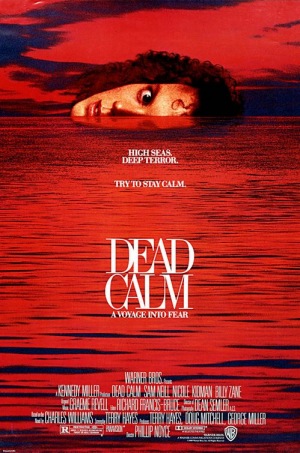
Horror Film Review: Dead Calm (dir by Philip Noyce)


As I was watching the 1989 thriller-horror hybrid Dead Calm, I found myself wondering what I would do if I found myself in the same situation as Rae (Nicole Kidman)?

You’re stuck on a yacht that’s floating out in the middle of the ocean, trying to mentally recover from the death of your child in a horrific car accident.  Your only company on the boat is your husband, an experienced sailor named John (Sam Neill), and a dog who always barks at the worst possible time.  One night, you see another boat in the distance.  The boat is obviously just drifting and appears as if it might be sinking.  Suddenly, a frantic man in a row boat approaches your yachet.  He says his name is Hughie (Billy Zane) and that he’s just escaped from the other boat.  He says he’s a photographer.  He says that everyone on the other boat is dead and he suggests that it was due to botulism.  (In real life, I had to look that up to figure out what Hughie and John were talking about.  However, in this scenario, you are Rae and you understand immediately.)

John has his doubts about Hughie’s story.  John says that he is going to go over to the boat on his own and check things out.  You nod and then watch as John rows away.  Of course, Hughie was supposed to remain locked up below deck but that doesn’t last long.  Soon, Hughie is free, he’s taken control of the yacht, and you are sailing away from both the other boat and John.

“Oh my God,” I thought as I watched, “what would I do if that happened to me!?  I have no idea!”

However, I then thought about it some more and I realized that would never happen to me.  I mean, let’s ignore the obvious fact that I’m terrified of drowning and would never be out in the middle of the ocean in the first place.  I would like to think that my husband would be smart enough to say, “There’s no way I’m leaving my wife, who is still emotionally recovering from the death of our son, alone on a boat with a total stranger who might be totally insane!”  And, if for some reason, my husband wasn’t that smart, I’d like to think that I would say, “Are you fucking kidding me?  You’re not leaving me alone on a boat with a total stranger who might be totally insane!”

In the past, I’ve always defended horror movies where people do stupid things by arguing that people do stupid things in real life all the time.  But Dead Calm really takes it a bit too far.  Maybe I could buy it if John and Rae were the type of teenagers who inevitably end up working as a camp counselor at Camp Crystal Lake.  But John is an officer in the Australian navy!  And Rae is Nicole Kidman!

That said, if you can accept the stupidity of the film’s premise, Dead Calm is an effective and often scary thriller.  There’s really only three characters in the entire film but Kidman, Neill, and Zane all give excellent performances, though their work is often undercut by the stupid things that the movie requires them to do.  Once Rae is trapped on that boat with the Hughie, Rae has to both play up to Hughie’s delusions while also looking for a way to get him out of the way so she can turn the yacht around and go back to rescue John and most of these scenes only work because of Kidman’s fierce performance (though, again, that same fierceness makes it hard to believe that Rae would ever have acquiesced to John’s decision to leave the yacht in the first place).  As for Zane, he is a bundle of nonstop, psychotic energy.  When he loses control, he is genuinely frightening.  This is probably the best Billy Zane performance that I’ve ever seen.  Certainly, he’s far better here than he was in Titanic.

Still, you have to wonder why Rae didn’t just shoot Hughie with a harpoon or a flare gun whenever he turned her back to him.  There’s even an extended sequence where Hughie dances on the deck, with no idea that Rae is watching him.  Considering that, by this point, there was no doubt that Hughie was a crazy murderer, it seems like Rae could have just giving him a little push overboard.  It seems like that could have saved everyone a lot of trouble…

Lisa Cleans Out Her DVR: Wimbledon (dir by Richard Loncraine)


(Lisa is currently in the process of cleaning out her DVR!  It is probably going to take her forever.  She recorded the 2004 romantic comedy, Wimbledon, off of Cinemax on February 15th.)

I wish I could play tennis.

Actually, I guess it would be more correct for me to say that I wish I could play tennis well.  I mean, I can hold the racket and I can run around the court and I can hit the ball and sometimes, it goes over the net.  I can do all the yelling and the grunting and the jumping.  I’m pretty good at slamming my racket down on the court whenever I miss a shot.  I can play the game but I just can’t win.  I’m way too easily distracted and that’s a shame because I’ve been told that I look cute in a tennis skirt.

It’s not for lack of trying either!  There’s a tennis court a few blocks away from my house and I’ve challenged both my sister and my BFF to several matches.  And, every time, they have totally kicked my ass.  In fact, now that I think about it, the only time I’ve ever won a set was because my opponent was feeling sorry for me and they had such confidence in their own abilities that they didn’t mind throwing a game or two.

(For the record, I’ve been told that, if not for my boobs getting in the way, I would have a pretty good golf swing.  But I don’t play golf so there you go…)

Anyway, I may not be able to play tennis but that doesn’t mean that I can’t enjoy a movie about people I can.  I really like Wimbledon.  I mean — yes, it’s a totally predictable sports movie.  You know, as soon as you see the opening credits, that Kirsten Dunst and Paul Bettany are going to fall in love.  They’re the prettiest people in the movie so, of course they’re meant to be together!  And, as soon as you see Sam Neill’s name, you know that he’s going to be playing the well-intentioned but clueless authority figure who tries to keep them apart.  When James McAvoy’s name appears, you yell, “He’ll be Paul Bettany’s best mate!”  (Actually, he plays Paul’s eccentric younger brother.)  And as soon as Jon Favreau’s name appears, you’re like, “Comic relief!”

Of course, since the movie is called Wimbledon, you know that the movie is going to be about tennis and you know that Paul Bettany and Kirsten Dunst are going to be competing at Wimbledon while falling in love.  You know that one of them will make it to the finals while the other sits in the stands and provides emotional support.  It’s just a question of which one.

As I said, it’s all totally predictable and yet, that’s actually a part of the film’s appeal.  With the plot being so obvious, you’re freed up to just appreciate the film as a vehicle of movie star charisma.  Paul Bettany and Kirsten Dunst are two of my favorite actors and I think they’re both criminally underrated.  In Wimbledon, Bettany is playing the older, veteran tennis player, the one who is playing at his final Wimbledon before retiring.  When he falls in love with Kirsten, it gives him a renewed sense of focus and, for the first time, he finds that he actually has a chance to win it all.  Kirsten, meanwhile, is the up-and-coming star.  Her father (Sam Neill) worries that Kirsten’s relationship with Paul will distract her and keep her from playing her best and it turns out that he’s absolutely right.

Even if you haven’t seen the film, you know everything that is going to happen but that’s okay.  Kirsten Dunst and Paul Bettany have got a really likable chemistry.  You want things to work out for them.  You want both of them to win championships and eventually get married and have a pretty family.  Bettany, in particular, proves that he can make even the most clichéd of lines sound fresh and spontaneous.  Add to that, both Paul and Kirsten look adorable in tennis white and that’s really all that most people ask for when it comes to a film like this.

Wimbledon is an enjoyable and predictable movie, one that won’t leave you feeling depressed or questioning the meaning of existence.  It may not be perfect but it’s certainly likable and sometimes, that’s all you need.

Here Are The North Carolina Film Critics Association Nominations!


For Christmas, there was a temporary pause in the flood of precursor awards.  Now that Christmas has passed, Oscar season is back in full swing.

Today, the North Carolina Film Critics Association announced their nominations for the best of 2016!

And here they are:

BEST NARRATIVE FILM
Arrival
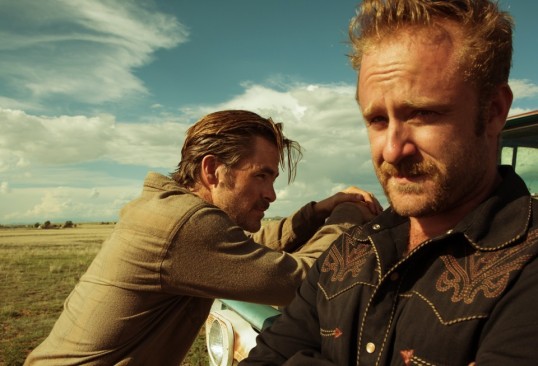
Hell or High Water
La La Land
Manchester by the Sea
Moonlight

BEST DOCUMENTARY FILM
13th
I Am Not Your Negro
Life, Animated
O.J.: Made in America
Weiner

BEST ANIMATED FILM
Finding Dory
Kubo and the Two Strings
Moana
Sausage Party
Zootopia

BEST FOREIGN LANGUAGE FILM
Elle
The Handmaiden
A Man Called Ove
Toni Erdmann
Things to Come

BEST DIRECTOR
Damien Chazelle — La La Land
Barry Jenkins — Moonlight
Kenneth Lonergan — Manchester by the Sea
David Mackenzie — Hell or High Water
Chan-woo Park — The Handmaiden

BEST CINEMATOGRAPHY
Chung-hoo Chung — The Handmaiden
James Laxton — Moonlight
Giles Nuttgens — Hell or High Water
Linus Sandgren — La La Land
Bradford Young — Arrival

BEST SPECIAL EFFECTS
Arrival
Captain America: Civil War
Doctor Strange
Jungle Book
Rogue One: A Star Wars Story

BEST ACTOR
Casey Affleck — Manchester by the Sea
Joel Edgerton — Loving
Ryan Gosling — La La Land
Viggo Mortensen — Captain Fantastic
Denzel Washington — Fences

BEST SUPPORTING ACTOR
Mahershala Ali — Moonlight
Jeff Bridges — Hell or High Water
Ben Foster — Hell or High Water
Lucas Hedges — Manchester by the Sea
Sam Neill — Hunt for the Wilderpeople

BEST ACTRESS
Annette Bening — 20th Century Women
Kate Beckinsale — Love & Friendship
Ruth Negga — Loving
Natalie Portman — Jackie
Emma Stone — La La Land

BEST SUPPORTING ACTRESS
Viola Davis — Fences
Greta Gerwig — 20th Century Women
Naomie Harris — Moonlight
Nicole Kidman — Lion
Michelle Williams — Manchester by the Sea

BEST ORIGINAL SCREENPLAY
Damien Chazelle — La La Land
Barry Jenkins — Moonlight
Kenneth Lonergan — Manchester by the Sea
Mike Mills — 20th Century Women
Taylor Sheridan — Hell or High Water

BEST ADAPTED SCREENPLAY
Tom Ford — Nocturnal Animals
Eric Heisserer — Arrival
Seo-kyeong Jeong and Chan-wook Park — The Handmaiden
Whit Stillman — Love & Friendship
Taika Waititi — Hunt for the Wilderpeople

KEN HANKE MEMORIAL TAR HEEL AWARD
(To an artist or film with a special connection to North Carolina.)
Anthony Mackie
Jeff Nichols
Starving the Beast

Horror Scenes I Love: In the Mouth of Madness


sutter-canes-agent

John Carpenter’s contribution and influence in horror and genre filmmaking could never be disputed. This man’s films, especially his work from the 70’s and early 80’s have made him one of the undisputed masters of horror (joined by such contemporaries as Wes Craven and George A. Romero). While his worked had become so-so at the tail-end of the 1990’s and quite sparse during the 2000’s his name still evokes excitement whenever something new comes out where he’s intimately involved in it’s creation (these days a series of synth-electronic albums).

It was during the mid-1990’s that we saw a John Carpenter already tiring of constantly fighting the Hollywood system, yet still game enough to come up with some very underrated and underappreciated horror and genre films. One such film was 1995’s In the Mouth of Madness. This was a film that didn’t so well in the box office yet has become a cult horror classic since. Part of his unofficial Apocalypse Trilogy (The Thing and Prince of Darkness the other two), In the Mouth of Madness combined Lovecraftian eldritch horror with the horror of the mundane that made Stephen King so popular with the masses.

This scene early in the film just showcases not just Carpenter’s masterful camera and editing work, but was ahead of its time in exploring the toxic nature of fandoms and groupthink. In 1995 such a concept might have been relegated to B-movie horror, but in 2016 it’s become synonymous with such everyday occurrences and topics as Gamergate, Tea Party and Trump supporters to SJW crusaders, Marvel vs. DC and Democrats and Republicans. Everyone believes their group to be the only righteous in whatever argument they happen to be part of and everyone else must be silenced (and in the scene below silenced equates to death).

John Carpenter might have turned into that old and cantankerous, albeit cool, dude who couldn’t care less what you thought of him, but it seems that he saw what was happening today as far back as the 1990’s.

Horror Film Review: Event Horizon (dir by Paul W. S. Anderson)


event_horizon_ver1

Event Horizon, a sci-fi/horror hybrid from 1997, is one of those films that starts out with a series of title cards:

“2015 First permanent colony established on moon.”

Wait … 2015?  How did I miss that?

” 2032 Commercial mining begins on Mars.”

Yay!  Only 16 more years to wait until we’re finally on Mars!

“2040 Deep space research vessel ‘Event Horizon’ launched to explore boundaries of Solar System. She disappears without trace beyond the eighth planet, Neptune. It is the worst space disaster on record.”

Wow, that sucks.  But things happen…

“2047 Now…”

Alright, let’s get this story going!

Seven years after it disappeared, the Event Horizon suddenly sends out a distress signal.  It turns out that it didn’t blow up like everyone assumed.  Instead, it’s still out in space.  The surly crew of the Lewis & Clark is called off of leave and sent on a rescue mission.  (And when I say surly, I do mean sur-ly!  Seriously, nobody on the Lewis & Clark is in a good mood … ever!)  Accompanying the crew is Dr. Weir (Sam Neill), the scientist who designed the Event Horizon.  Captain Miller (Laurence Fishburne) may not be happy about having Dr. Weir on his ship but, then again, Captain Miller always seems to be annoyed about something.

The Event Horizon appears to be deserted.  The walls are covered with blood.  The captain — at least it appears to be the captain — has been crucified and left on display.  Dr. Weir explains that the Event Horizon was designed to create an artificial black hole and it’s possible that the ship went into another dimension and that it may have brought something back with it.  Other crew members speculate that the Event Horizon may have accidentally been transported to Hell.  Either way, it’s not a good thing but, after the Lewis & Clark suffers some damage, the crew find themselves stranded on the Event Horizon.

Soon, the crew members are having hallucinations.  The ship’s doctor (Kathleen Quinlan) sees her son running through the ship.  Captain Miller sees the burning corpse of a friend that he had to abandon during a previous mission.  Another crewman appears to be possessed and attempts to commit suicide by opening up the airlock.  Dr. Weir has visions of his dead wife.  Things get darker and darker.  People die.  Eyes are ripped out of sockets.  A video of the original crew is found and it’s like something out of a painting by Hieronymus Bosch.  Miller wants to blow up the Event Horizon.  Dr. Weir replies, “We are home!”

Agck!

Seriously, Event Horizon is a curious film.  I’ve seen it a few times and I have to admit that it’s never quite as good as I remembered.  If you want to get really technical about it, Event Horizon is a poorly paced film that is overly derivative of the Alien franchise and it features perhaps the worst performance of Laurence Fishburne’s career.

(Yes, even worse than his performance in Contagion…)

But, at the same time, even if I’m always somewhat disappointed with the film, Event Horizon is also a movie that stays with you.  Whatever flaws the film may have, it is genuinely scary and disturbing.  Director Paul W.S. Anderson does a good job of turning that spaceship into the ultimate floating haunted house and, even more importantly, he keeps you off-balance.  This is one of the few horror films where literally anyone can die, regardless of whether they’re top-billed or have an Oscar nomination to their name.  Whatever the evil is that has possessed the Event Horizon, it is ruthlessly and sadistically efficient.

Plus, there’s that video.  If you’ve seen the movie, you know what I’m talking about.  Anderson has complained that the studio made him cut a lot of footage out of the video but what remains is disturbing enough.  Seriously, you’ll never want to hear another Latin phrase after watching Event Horizon.

Horror Film Review: Omen III: The Final Conflict (dir by Graham Baker)


Omen_III_the_final_conflict

Originally, it had been planned that the Omen franchise would be made up of six or seven films and that each movie would check in on another year in the life of Damien Thorn, a bit like an apocalyptic version of Boyhood.  However, after Damien: Omen II failed to perform up to expectations, plans were changed.

Instead of continuing the story of Damien’s adolescence, the 1981 film Omen III: The Final Conflict jumps straight into Damien’s adulthood.  Now 32 years old and played by a very young (and handsome) Sam Neill, Damien Thorn is now the CEO of Thorn Enterprises.  With the help of his loyal assistant Harvey Dean (Don Gordon), Damien has become one of the most popular and powerful men on the planet.  Thorn Enterprises, having followed Paul Buhler’s scheme from the second film, is now responsible for feeding a good deal of the world.  Damien is seen as being a humanitarian and a future President.  When the U.S. Ambassador to the United Kingdom reacts to spotting a black dog in the park by committing suicide, Damien is appointed to the position.

(Needless to say, everyone in London is happy to see Damien.  Nobody says, “I just hope you don’t end up going crazy and dying a violent death, like everyone else in your family and immediate circle of acquaintances.”  But they’re probably thinking it…)

Now in London (and also appointed to be head of the United Nations Youth Organization, which just goes to show that your crazy uncle is right and the United Nations is a conspiracy), Damien pursues a rather creepy romance with journalist Kate Reynolds (Lisa Harrow) and makes plans to prevent the Second Coming by killing every single baby born on the morning of March 24th.  (But Harvey’s son was born on March 24th — wow, could this lead to some sort of conflict?)

Meanwhile, a group of priests (led by an embarrassed-looking Rossanno Brazzi) have recovered these damn daggers of Megiddo and are now all attempting to assassinate Damien.  Unfortunately, none of them are very good at their job.  (“You had one job, Father!  One job!”)

Bleh.

The Final Conflict is not that good.  It’s boring.  The plot is full of holes.  For instance — and yes, these are SPOILERS — why have we sat through two movies listening to characters insist that Damien has to be stabbed by all seven of the daggers when apparently, just one dagger will do the job?  Why, after being told that Jesus is going to be reborn as a child, does he then appear as an adult at the end of the film?  And finally, why does nobody ever seem to find it strange that everyone that Damien knows end up suffering a freak accident?

I will say that there are two good things about The Final Conflict.

First off, Sam Neill gives a good performance as Damien Thorn.  He’s handsome, he’s charismatic, and he’s not afraid to be evil.  But, unfortunately, Damien’s just not that interesting of a character anymore.  In the first Omen, he was interesting because he was an evil five year old.  In the second Omen, he was at least occasionally conflicted about his role.  In the third Omen, Damien is just evil and evil without nuance is boring.

Secondly, there’s that sequence where Damien’s followers go after the babies born on March 24th.  Oh my God, that was so disturbing and it was one of the few moments when The Final Conflict actually became horrific.

Otherwise, The Final Conflict is a thoroughly forgettable sequel to a memorable film.

Embracing the Melodrama #43: The Piano (dir by Jane Campion)


I recently watched the 1993 best picture nominee The Piano and all I can say is that it is going to be a struggle to put into words just how much I loved this film.

Taking place in the 19th century, The Piano tells the story of Ada (Holly Hunter), a Scottish woman who hasn’t spoken since she was 6 years old.  Like many things in this enigmatic film, the reason why Ada stopped speaking is never clearly stated.  What is known is that she communicates through sign language and by playing her piano.  While Ada is usually a black-clad and somber figure, she comes to life when she plays the piano.  Ada also has a daughter named Flora, the result of a brief affair that Ada had with one of her teachers.  Unlike her mother, Flora (played by 10 year-old Anna Paquin, long before True Blood) is rarely silent and delights in telling elaborate lies about how her father died.

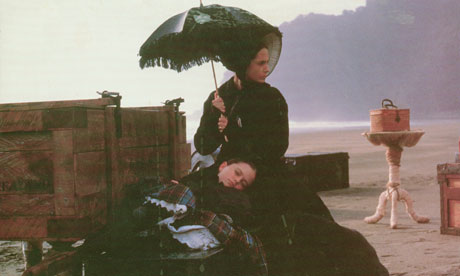
the-piano-01

Ada’s father sells her into marriage to a New Zealand frontiersman named Alisdair (Sam Neill), a man who Ada has never even met.   When Ada and Flora first arrive in New Zealand, they are dropped off on the beach and forced to wait a night until Alsdair can meet them.  In the film’s most hauntingly beautiful scenes, Ada plays her piano on that beach while Ada dances in the surf.  It’s during those scenes that The Piano reveals three of its greatest strengths: the lush cinematography of Stuart Dryburgh, the haunting score composed from Michael Nyman, and the fact that Hunter and Paquin are totally believable as mother and daughter.  Not only is it easy to imagine Paquin growing up to look like Holly Hunter, but the two actresses even manage to perfectly imitate each other’s gestures and facial expressions.  Most of the reviews that I’ve read of  The Piano tend to emphasize the film’s focus on the conflict between the sensual and repressed but to me, the film works just as well as an exploration of the strong bonds that naturally exist between mothers and daughters.  I’m not ashamed to admit that when I look at the picture above, I reminded of how, when I was Flora’s age, I also used to hide behind my mom whenever I saw anyone that I didn’t know coming our way.

When Alisdair does finally show up to take them to their new home, he proves to be a rather cold and distant figure.  It would have been very easy for the film to portray Alisdair as being a completely heartless villain but, as played by Sam Neill, Alisdair is potrtayed as being less a traditional villain and more as just being a painfully unimaginative man who is incapable of understanding why Ada’s piano is so important to her.  To Ada, the piano and its music equals the life and freedom that she’s not allowed to experience.  To Alisdair, the piano is simply a bulky object that will not fit into his small house.  Over Ada’s objections (luckily, Flora is on hand to translate her sign language), Alisdair first leaves the piano on the beach and then agrees to sell it to Baines (Harvey Keitel), another white settler who — unlike Alisdair — is comfortable with the natives and their customs.

Baines, however, allows Ada to come over to his hut and play the piano.  He offers to give the piano back to her — key by key — if she agrees to continue to come to his hut and play while he watches and “pleasures” himself.  Reluctantly, Ada agrees but soon, she and Baines are falling in love.

Needless to say, when Alisdair finds out what has been going on at Baines’s hut, he is not happy.  As he largely considers to be his property, bought and paid for, he also feels that he has the right to decide whether or not she’s capable of playing her piano…

The Piano: Holly Hunter and Anna Paquin

The Piano is a simply an amazing and visually sensual film that is blessed with excellent lead performances from Hunter, Keitel, Neill, and Paquin.  As directed by Jane Campion, The Piano plays out as both a delirious homage to gothic romanticism and a feminist parable about the way that even women who aren’t mute are still punished for expressing their honest desires.

And, of course, there’s that amazing score:

6 Late Reviews: Atlas Shrugged: Part II, Project X, This Means War, A Thousand Words, Trouble With The Curve, The Vow


2012 is quickly drawing to an end and seriously, where has the time gone?  I’m seriously running behind in reviewing all of the films that I’ve seen in 2012 so, in the interest of getting caught up, here are six quick (and late) reviews of some of the film that I saw earlier this year.

(Fortunately, seeing as how we live in a world of Netflix, DVD, Blu-ray, and On Demand service, it’s never too late to review any film.)

1) Atlas Shrugged: Part II (dir by John Putch)

Picking up where the first Atlas Shrugged ended, Atlas Shrugged: Part II continues to tell the story of how America was ruined by elitist do-gooders and how the smartest people in the world responded by uttering the phrase, “Who Is John Galt?” and then vanishing.

There’s a lot of bad stuff that I could say about Atlas, Shrugged Part II.  I could point out how close to nothing actually happens in the film.  I understand that this is the second part of a proposed film trilogy but, seriously, that’s all that Atlas Shrugged Part II has in common with The Two Towers.  With the exception of the great Patrick Fabian (who has a lot of fun playing a weasel), the cast isn’t memorable and the film is full of slow spots.

Part II was made by a different director and with a far more professional cast than Part I but that proves to be a mistake.  Part of the odd charm of Atlas Shrugged, Part I was that it was such a low-budget, pulpy affair.  Atlas Shrugged, Part II is a lot more slick and, as a result, it feels a lot less sincere.

That said, I couldn’t help but enjoy Atlas Shrugged, Part II because, much like For Greater Glory, the film flew so completely in the face of conventional cinematic political statements.  Atlas Shrugged Part II might not be a great (or even a good) film but it annoyed all of the professional film critics and it’s always amusing to watch the same critical establishment that embraced Avatar whine about how any other film is too heavy-handed.

Am I, therefore, recommending Atlas Shrugged, Part II?  Not really.  I tend to learn towards the Libertarian point of view when it comes to politics and even I found the film to be tedious.  That said, if you ever really want to annoy your wannabe hipster friend (the same one who leaves a hundred comments a day over at the A.V. Club), Atlas Shrugged, Part II might make the perfect holiday present.

2) Project X (dir by Nima Nourizadeh)

In California, two loathsome high school students — Costa (Oliver Cooper) and J.B.(Johnathan Daniel Brown) — throw a birthday party for their friend Thomas (Thomas Mann).  Thomas is a stereotypical nice guy but he’s also friends with Costa and J.B. and that makes him loathsome by association.  The party quickly gets out of control and eventually, houses are destroyed and a SWAT team is called in to restore order.

Oh!  And the entire film is presented as being a bunch of “found footage.”  What that means is that we have to sit through all the usual stuff of people acting awkward in an attempt to convince us that we’re not watching a movie, despite the fact that we clearly are.

Project X fails on so many levels that it’s hard to even know where to begin.

It’s impossible to sympathize with the film’s three main characters and let’s just say that Oliver Cooper is no Jonah Hill.

There’s no real build-up to the party getting out of control and hence, most of the film’s comedy falls flat.  This is the type of film where a midget happens to show up at the party just so he can then be tossed into an oven.  Uwe Boll would probably call that genius but, for the rest of us, it just feels like desperation on the part of the filmgoers.  (You can just here them going, “Midgets are always funny!”)

Finally, worst of all, Project X is the latest film to use the whole found footage gimmick as a way to try to explain away the fact that it’s just not a very good movie.  Seriously, mediocre filmmakers of America — it’s time to move on to a new gimmick!

3) This Means War (dir. by McG)

Two CIA Agents (Chris Pine and Tom Hardy) set aside their friendship and go to war when they realize that they’re both attempting to win the heart of the same woman (played by Reese Witherspoon).   Fortunately for them, they’ve both managed to fall in love with the one woman in the world too stupid to realize that there’s anything strange going on.  Chelsea Handler is also in this film.  She plays Witherspoon’s best friend and delivers all of her lines in this kind of depressed monotone that seems to suggest that she’d rather be co-starring with Whitney Cummings.  Eventually, a lot of things explode and well, anyway … bleh.

Seriously, This Means War has absolutely no right to be as boring as it is.  Outside of this film, Chris Pine and Tom Hardy are both hot, Reese Witherspoon is likable, and even Chelsea Handler still makes me laugh on occasion.  And yet, when all four of these people are put together in the same film, the end result is a mess that just gets more and more annoying with each passing second.

Most of the blame has to be put on the director.  McG never finds a consistent tone for his film and never seems to be sure whether he’s parodying or celebrating the conventions of both action films and romantic comedies.

Myself, I just find it funny that people actually address him as “McG.”

4) A Thousand Words (dir by Brian Robbins)

Jack (Eddie Murphy) is a literary agent who talks too much.  So, one night, a tree with a thousand leaves magically appears in his back yard.  Every time that Jack says a word, a leaf falls off of the tree.  Luckily, Jack happens to know a new age guru (Cliff Curtis) who explains that once every leaf has fallen, Jack will die.  As a result, the formerly glib Jack learns the importance of saying just the right thing and he becomes a better husband, father, and son as a result.

A Thousand Words is just as bad as the above plot synopsis suggests and that’s all that really needs to be said about it.  Wasting a thousand words talking about A Thousand Words would be a mistake indeed.

5)  Trouble With The Curve (dir by Robert Lorenz)

Widower Gus (Clint Eastwood) is an aging baseball scout who is slowly losing his eyesight.  Mickey (Amy Adams) is Gus’s daughter, a driven lawyer who has a strained relationship with her father.

And together … they solve crimes!

No, not really.  Instead, Gus is given one last assignment and Mickey, who is both concerned for her father’s well-being and wants to try to repair their fractured relationship, accompanies him.  At first, Gus doesn’t want Mickey around but she eventually proves her worth to him and gets to flirt with a young scout played by Justin Timberlake as well.  So, it’s a win-win.

 I don’t know much about baseball (beyond the fact that my sister Erin yells at the TV a lot whenever the Rangers are playing) but Trouble With The Curve is such a predictable movie that you really don’t have to know much about the game to be able to follow the plot.  That said, Trouble With The Curve might be predictable but it’s also a genuinely sweet and likable film.  Timberlake and Adams make for a really cute couple and it’s always fun to watch Eastwood growl at a world that never fails to disappoint him.

6) The Vow (dir by Michael Sucsy)

Paige (Rachel McAdams) and her husband Leo (Channing Tatum) are in a horrific car accident.  Paige is sent flying through the windshield and when she recovers consciousness, she no longer remembers being married or anything else about her life after she first met Leo.  While Leo attempts to get Paige to fall in love with him for a second time, Paige’s parents (Sam Neill and Jessica Lange) attempt to convince her to divorce him and return to her previous life as a pampered law student with a rich fiancée (played by Scott Speedman).

The Vow is a lot like Trouble With The Curve in that it’s totally predictable but, at the same time, it’s so sweet and likable that anyone who complains about the film being too predictable probably doesn’t have a heart.  Rachel McAdams and Channing Tatum have a lot of chemistry and anyone who complains that this film is too much like a Lifetime movie has obviously never experienced a really great Lifetime movie.

Quick Review: In the Mouth of Madness (dir. by John Carpenter, 1995)


In the Mouth of Madness is one of those films that in essence seems like a good idea, but later becomes strange and unwieldily to the point that you have to ask yourself “What am I watching, and why did I do so?”

Jumping right of of Memoirs of an Invisible Man, In the Mouth of Madness reunites Sam Neill (Jurassic Park) with Carpenter. Neill plays John Trent, an Insurance Investigator whose latest case deals with a horror writer named Sutter Cane (Jurgen Prochnow). Cane’s novels have the strange ability to affect anyone who reads them. After Cane’s own agent/publicist falls his influence and is abruptly killed, Trent is sent to find Cane (who is missing) and help bring back his latest story , “In the Mouth of Madness” to the agency. When he sets off on his mission, he slowly finds his sense of reality unraveling.

If Neill’s character is the Scully, Julie Carmen (Fright Night Part II) plays the Mulder in this equation. Sent along with Trent, her character witnesses more of the horror than he does. She’s the audience witness for a while and proves Trent wrong when he’s ready to disbelieve what’s occurring. She good here, but her reactions, mixed with Trent’s had me slapping my forehead. I’ll get to that in a moment.

I’m told that the film is something of a homage to H.P. Lovecraft’s stories. While I’ve never read Lovecraft, I’m somewhat familiar with the Cthulhu myths and there does seem to be some tentacled beasts near the last third of the film.  Overall, some of those references escape me. The movie’s fun in a Donnie Darko mind bending way and it’s that strangeness that actually helps the film a little.

I hate the fact that Sam Neill’s character simply  won’t accept that what’s happening is real. I’m not a big fan of stuffing square pegs into round holes. If it doesn’t fit – you’re being told “This is how it goes”, and you’re seeing that’s how it’s happening – then why in the world are you still holding on to the same train of thought that isn’t working / fitting the situation? I found that extremely annoying. It’s almost the opposite of Slither, where it didn’t take long for the characters to recognize that:

1.) People were becoming zombies.

-And-

2.) It just wasn’t normal for the situation. Accept and adjust. Cover your mouth.

Overall, it was okay, but it really needed something. I’m just not sure what.