Embracing the Melodrama #42: Indecent Proposal (dir by Adrian Lyne)


This one is just dumb.

First released in 1993 and something of a perennial on AMC, Indecent Proposal tells the story of David (Woody Harrelson) and Diane (Demi Moore), two kids who meet in high school, get married, and end up living what, in Hollywood, passes for an average, middle class lifestyle — which is to say, Diane is a successful real estate broker, David is an architect, and they’re in the process of building their dream house on the beach.  (Just like everyone else you know, right?)  However, the economy goes bad, David loses his job, and they find themselves deep in debt.

Desperately, they decide to take a gamble.  Literally.  They go to Las Vegas and, at first, it seems like everything’s going to be alright.  David has a run of luck and makes a lot of money.  They make so much money that David and Diane end up having sex on top of it.  Now, I have to admit, if I ever won $25,000 dollars in Vegas, I would probably spread it on a bed and roll around naked on it as well.  But only if it was paper money.  Coins would probably be uncomfortable and I’d hate to end up with a hundred little impressions of George Washington’s profile running up and down my body.

But anyway, David and Diane make the mistake of sticking around in Vegas for a second day and they end up losing all of the money that they previously won and you better believe that when the chips are pulled away, Diane is shown trying grab them in slow motion while going, “Noooooo!”  Soon, David and Diane are sitting in an all-night diner and trying to figure out what to do next.  A waitress overhears them and sadly shakes her head.  Obviously, she’s seen a lot of movies about Las Vegas.

Anyway, this movie is too dumb to waste this many words on its plot so let’s just get to the point.  David and Diane meets John Gage (Robert Redford), a millionaire who offers to give David a million dollars in exchange for having one (and only one) commitment-free night with Diane.  David and Diane agree and then spend the rest of the movie agonizing over their decision.  Eventually, this leads to Diane and David splitting up, John Gage reentering the picture and proving himself to be not such a bad guy, and David eventually buying a hippo.

It’s all really dumb.

Anyway, I was planning on making quite a few points about this set-up but, quite frankly, this film is so dumb that I’m getting annoyed just writing this review.  So, instead of breaking this all down scene-by-scene, I’m just going to point out a few things and then move on to better melodramas.

1) Every character in the movie has a scene where they eventually ask what we (the viewing audience) would do if we were in a similar situation.  “Would you have sex for a million dollars?”  Well, let’s see.  Basically, the deal seems to be that you have safe, non-kinky, missionary position sex with a millionaire who you will never have to see again after you get paid.  And you’re getting a million dollars in return.  Would I do it?  OF COURSE, I’D DO IT!  It’s a million dollars, it’s just one night, and it’s not like you’re being asked to fuck Vladimer Putin or something.  If the film wanted to create a true moral dilemma, they should have cast someone other than Robert Redford as John Gage and they should have had Gage propose something more than just one night.  If Gage had been played by an unappealing actor (or perhaps if the film were made today with Redford looking as craggly as he did in Capt. America or All Is Lost) or if it had been a million dollars for Diane to serve as a member of Gage’s harem for a year, the film would have been far different and perhaps not any better but at least all of the subsequent angst would have made sense.

2) What really annoyed me is that, after Diane returns from her night with Gage, neither she nor her husband ever cash that million dollar check.  If you’re going to agree to the stupid deal, at least take advantage of it.

3) Finally, why would you accept a check for something like that?  Did Gage write, “For letting me fuck your wife” in the memo line?  Why not get paid in cash so, at the very least, you don’t have to deal with IRS?

Seriously, this movie is just dumb.

Original Cinema Quad Poster - Movie Film Posters


Embracing the Melodrama #32: Ordinary People (dir by Robert Redford)


ordinary_people_oc87rd_1

For the past seven days, I’ve been reviewing — in chronological order — fifty of the most memorable melodramas ever filmed.  We started with a silent film from 1916 and now, we have reached the 80s.  What better way to kick off the decade than by taking a look at the 1980 Best Picture winner, Ordinary People?

Directed by Robert Redford, Ordinary People tells the story of the upper middle class Jarrett family.  On the surface, the Jarretts appear to be the perfect family.  Calvin Jarrett (Donald Sutherland) has a successful career.  Beth (Mary Tyler Moore) keeps a perfect home and appears to be the ideal suburban matriarch.  However, one summer, their oldest son drowns in a sailing accident and their youngest son, sensitive Conrad (Timothy Hutton), attempts to commit suicide.  After spending four months in a psychiatric hospital, Conrad come back home and the family struggles to put their lives back together.  Even though he starts to see a therapist (Judd Hirsch) and starts dating his classmate Jeannine (Elizabeth McGovern), Conrad still struggles with his feelings of guilt over having survived.  Beth’s struggle to maintain a facade of normalcy leads to several fights between her and Conrad with Calvin trapped in the middle.

Among my fellow film bloggers, there’s always going to be a very vocal group that is going to hate Ordinary People because it won the Oscar for best picture over challenging black-and-white films directed by Martin Scorsese (Raging Bull) and David Lynch (The Elephant Man).  They always tend to complain that Ordinary People is a conventional film that tells a conventional story and that it was directed by a very conventional director.  More than once, I’ve seen an online film critic refer to Ordinary People as being a “big budget Lifetime movie.”

Well, you know what?

I love Lifetime.  Lifetime is the best network on television and to me, a big budget Lifetime movie would be the best Lifetime movie of all.  And, at the risk of alienating all of my film-loving friends, if I had to choose between watching Raging Bull and Ordinary People, I’m going to pick Ordinary People every time.  Raging Bull is visually stunning and features great performances but it’s also two hours spent watching an incredibly unlikable human being beating the crap out of anyone who is foolish enough to love him.  Ordinary People may essentially look like a TV show but it’s also about characters that you can understand and that, as the film progresses, you grow to truly care about.

Yes, I do wish that the character of Beth had been given more of a chance to talk about her feelings and it’s hard not to feel that Ordinary People places too much blame on the mother.  But, even so, the film still ends with vague — if unlikely — hope that Beth will eventually be able to move past her anger and reconnect with her family.  The film may be hard on Beth but it never gives up on her.  That’s what distinguishes Ordinary People for me.  In many ways, it’s a very sad film.  It’s a film that was specifically designed to make you cry and I certainly shed a few tears while I watched it.  But, even with its somewhat ambiguous ending, Ordinary People is also a very optimistic movie.  It’s a movie that says that, as much pain as we may have in our life,we can recover and life can go on and it’s okay to be sad and its also okay to be happy.

And that’s an important lesson to learn.

(That said, if I had been alive and an Academy voter in 1981, I would have voted for The Elephant Man.)

And, for all you Oscar lovers out there, here are clips of Timothy Hutton and Robert Redford winning Oscars for their work on Ordinary People.

Trash Film Guru Vs. The Summer (?) Blockbusters : “Captain America : The Winter Soldier”


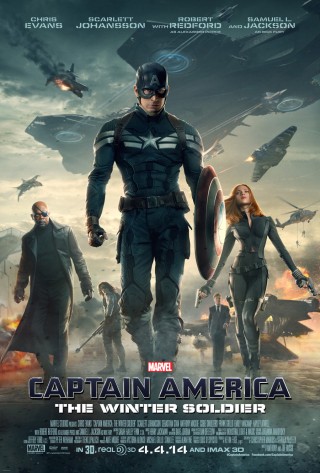
Capt2-Payoff-1-Sht-v8-Lg-c563d

I’m firmly of the belief that nobody my age has any business whatsoever using the phrase “WTF,” but nevertheless — WTF? Captain America : The Winter Soldier has been playing for two weeks now, there are, what, either or ten people who write regularly (or semi-regularly) for this website, pretty much all of ’em are bigger fans of Marvel’s cinematic product than I am — and I’m the first person to review this flick here, even though more or less  the entire country saw the thing before I did yesterday? Well, okay, but somebody had better get busy on writing a rebuttal to this, because what I’ve got to say is going to piss a lot of people off.

It’s not that DisMar’s latest blockbuster is “bad,” per se — it’s just that it’s exactly what you expect it to be, that’s all these things ever are, and sorry, but it’s not “the greatest super-hero flick ever made.” And that statement, in and of itself, is going to be enough to upset the die-hards out there because, to them, every Marvel movie is “the greatest super-hero flick ever made” — until the next one. Which is probably just as well because these things are entirely disposable and don’t hold up particularly well to multiple viewings. Be honest — once the initial “high” wore off, was The Avengers really all that great? Or Iron Man 3? Or Thor : The Dark World?

Of course they weren’t. Which doesn’t mean they weren’t fun, or that they didn’t hit all the right bullet points on whatever unofficial geek check-list you keep. It’s just that they do their job, get it over with, and move on — as you do, dear reader. Think about it : after watching your average Marvel movie (and if there’s one thing all of these films are, it’s aggressively average), you’re not necessarily pumped to see it again so much as you are pumped for the next one. And that’s kinda the point, isn’t it? The Marvel cinematic “universe” is a self-perpetuating organism at this point, whose primary function is to whet your appetite for the supposed “greatness” to come rather than give you time to reflect on the mediocrity of what’s already been/is going on. The hype surrounding the product is woven into the fabric of the product itself — in fact, it’s the largest part of it.

_1395260042

Don’t get me wrong — I had a reasonably fun time kicking back and watching Captain America : The Winter Soldier. Chris Evans does a reasonably good job portraying Cap/Steve Rogers as a guy who’s fundamentally decent, but not so holier than thou that you want to knock his teeth in. Robert Redford’s choice to play the treacherous Alexander Pierce as a believably nonchalant master manipulator is solid, and everything about him oozes “old movie vet” professionalism. Sebastian Stan cuts a strikingly mysterious pose as the (sub-) titular Winter Soldier. Anthony Mackie is likable in the extreme as sidekick Sam Wilson/The Falcon. And it’s cool to see Toby Jones “back” — after a fashion, at any rate — as Arnim Zola, this time in an iteration somewhat closer to how Jack Kirby originally envisioned him. The main thrust of the story is pretty engaging, too, revolving as it does around a massive web of Hydra “fifth columnists” within S.H.I.E.L.D. itself. It’s reasonably — though far from overwhelmingly — interesting, and keeps you guessing just enough.

But there are some pretty glaring flaws here, as well. Samuel L. Jackson seems tired and played-out as Nick Fury, and while it doesn’t help that his entire “character arc” in this film is lifted note-for-note from that of Jim Gordon in The Dark Knight, the fact of the matter is that Sam doesn’t seem to be putting any more effort into this gig than he does in his credit card commercials. Scarlett Johansson remains horribly miscast as Natasha Romanov/The Black Widow, and while that’s not such a huge problem in movies where she’s peripheral (at best) to the action, it stands out like a sore thumb here, where she’s called upon to be much more central to the proceedings. And for a supposed future love interest, Emily VanCamp is entirely forgettable in her brief time on screen.

Still, those are minor quibbles compared to the main problem here, which is how hopelessly generic, and indeed formulaic, this whole thing feels from start to finish. Joe Johnston’s Captain America : The First Avenger remains my personal favorite Marvel Studios film, but as with Kenneth Branagh and the Thor franchise, DisMar has opted here to show a veteran director with his own ideas and authorial stamp the door when it came time for a sequel and bring in “talent” from the world of television (in this case brothers Joe and Anthony Russo) to hammer things into the dry, predictable “house style” best exemplified by Joss Whedon’s Avengers and Jon Favreau’s first two Iron Man flicks. The end result is a multi-million-dollar, CGI-heavy, clinically-paced, personality-free zone.

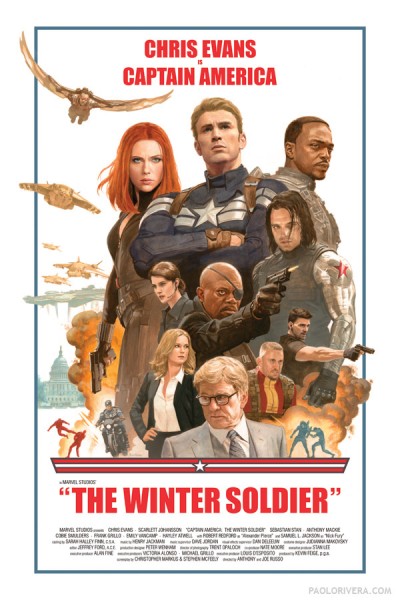
captain-america-winter-soldier-retro-poster-400x600

About a half hour into things here, you start to get the distinct feeling that you’ve seen all this before, and there’s good reason for that — you have. The action sequences are progressively bigger, louder, and more destructive, but not much else. They don’t become progressively more thrilling or suspenseful, and while the stakes are nominally raised every time, their execution remains largely the same. You could probably run ’em all in reverse order with no real difference to the story.  And while there does, in fact, seem to be a kind of major shake-up Marvel’s “universe” at the end of this film, the fact that the Agents Of S.H.I.E.L.D. TV series remains a going concern week in and week out is all you need to know to figure out that any “ramifications” from this story are apparently very short-lived indeed. In other words, Marvel’s doing on celluloid what they’ve always done in print — providing, in the words of Stan Lee (who it pains me to even quote, but in this case I must) “the illusion of change” — but no actual change at all.

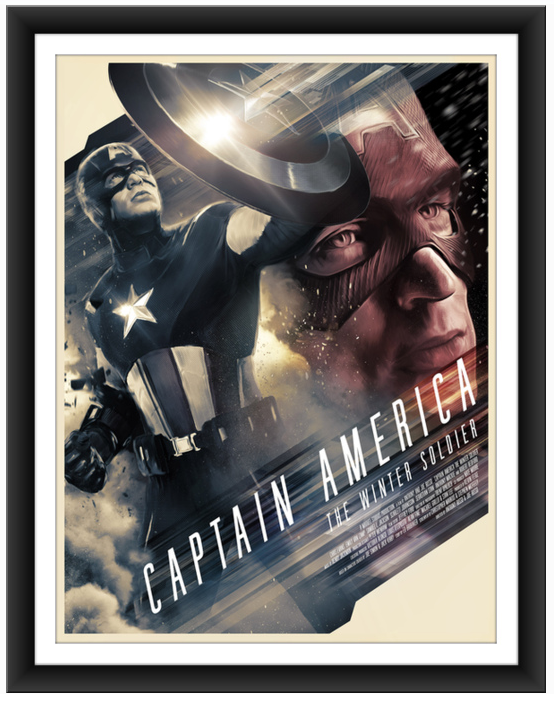
blurppy-poster-posse-captain-america-3

In the end, in the eyes of this armchair critic at any rate, that’s what Marvel’s movies are all about at this point  : the status quo. If you’re happy with that, then you’ll enjoy the heck out of Captain America : The Winter Soldier. But if you’d like to actually see something that takes a few risks, dares to break the mold a bit, and maybe even matters — well, you’ll have to look elsewhere. That’s not the point here. The point here is to get you all hot and bothered for Captain America 3, or The Avengers 2 — or whatever the hell else is in the pipeline — before this one’s even over. Viewed from that angle — the one that shows the goal of every Marvel movie is nothing more than ensuring that there will be a next Marvel movie — then yeah, this one’s gotta be viewed as an unqualified success. So what?

Captain America: The Winter Soldier (4 Minute Extended Clip & Trailer)


d001

It’s just less than a month away from one of 2014’s most-anticipated films. It’s the sequel to Captain America: The First Avenger and Marvel Studios has been kind enough to treat it’s fans to a 4-minute clip/trailer of the film.

This clip from Captain America: The Winter Soldier comes early in the film and helps in setting the tone of the film. This is not the gung-ho and patriotic first film. This follow-up shows the after-effects of the events from The Avengers and how it’s created a sense of paranoia and conspiracy surrounding the very group Captain America has now become a part of.

Where the first film had the nostalgic feel similar to Joe Johnston’s The Rocketeer, this sequel looks to tap the 70’s conspiracy and 80’s technothriller genres. It’s anyone’s guess whether the Russo Brothers succeeded, but just going by this extended scene and the previous teasers and trailers they may have just done that.

Captain America: The Winter Soldier arrives in North America on April 4, 2014.

Super Bowl Trailer: Captain America: The Winter Soldier


d001

It’s becoming a sort of yearly occurrence to have a Marvel Studios film premiere a special trailer during the live-broadcast of the NFL’s latest Super Bowl event. Last year, it was a special Super Bowl trailer of Iron Man 3 (an extended version soon coming out after). This year it will be Captain America: The Winter Soldier that will get the special Super Bowl treatment.

Captain America: The Winter Soldier has been gaining some major buzz since the release of its first teaser trailer from a couple months back. Where Thor: Dark World used fantasy as an overall theme for its look and story, with the sequel to Captain America: The First Avenger the filmmakers have taken on the look and feel of a techno/conspiracy-thriller. The Winter Soldier looks to be like something that wouldn’t seem out of place if made during the cynical and distrustful era of the 1970’s when conspiracies and distrust of those in power dominated the headlines.

Captain America: The Winter Soldier is set for an April 4, 2014 release date.

Also, we have the UK and Ireland version of the trailer which show a brief glimpse of Sharon Carter (Emily VanCamp) who is the descendant of Peggy Carter from the first film.

6 Reviews of 6 More Films That Were Released in 2013: The Company You Keep, Dracula 3D, Getaway, Identity Thief, Pawn, Welcome to the Punch


In part of my continuing effort to get caught up on my 2013 film reviews, here are 6 more reviews of 6 more films.

The Company You Keep (dir by Robert Redford)

Shia LeBeouf is a journalist who discovers that attorney Bill Grant (Robert Redford) is actually a former 60s radical who is still wanted by the FBI for taking part in a bank robbery in which a security guard was killed.  In one of those coincidences that can be filed directly under “Because it was convenient for the plot,” LeBeouf’s girlfriend (Anna Kendrick) works for the FBI.  Anyway, all of this leads to Grant going on the run and meeting up with a lot of his former radical colleagues (all of whom are played by familiar character actors like Susan Sarandon, Nick Nolte, Richard Jenkins, and Julie Christie).  Ben pursues him and discovers that Grant could very well be innocent and … oh, who cares?  The Company You Keep is a big smug mess of a film.   It’s full of talented actors — like Stanley Tucci, Brendan Gleeson, and Brit Marling (who, talented as she may be, is actually kinda terrible in this film) — but so what?  I lost interest in the film after the first 20 minutes, which was a problem since I still had 101 more minutes left to go.

Has there ever been a movie that’s actually been improved by the presence of Shia LeBeouf?

Dracula 3D (dir by Dario Argento)

Dario Argento’s version of the classic Dracula tale got terrible reviews when it was briefly released here in the States but I happen to think that it was rather underrated.  No, the film can not compares to classic Argento films like Deep Red, Suspiria, and Tenebre.  However, the film itself is so shamelessly excessive that it’s impossible not to enjoy on some level.  The film’s moody sets harken back to the classic gothic villages of the old Hammer films, Thomas Kretschman turns Dracula into the type of decadent European aristocrat who you would expect to find doing cocaine in 1970s New York, and Rutger Hauer is wonderfully over-the-top as Van Helsing.  Yes, Dracula does turn into a giant preying mantis at one point but if you can’t enjoy that then you’re obviously taking life (and movies) too seriously.

Getaway (dir by Courtney Solomon)

I saw Getaway during my summer vacation and the main thing I remember about the experience is that I saw it in Charleston, West Virginia.  Have I mentioned how in love I am with Charleston?  Seriously, I love that city!

As for the movie, it was 90 minutes of nonstop car chases and crashes and yet it somehow still managed to be one of the dullest films that I’ve ever seen.  Ethan Hawke’s wife is kidnapped by Jon Voight and Hawke is forced to steal a car and drive around the city, doing random things.  Along the way, he picks up a sidekick played by Selena Gomez.  Hawke and Voight are two of my favorite actors and, on the basis of Spring Breakers, I think that Gomez is a lot more talented than she’s given credit for.  But all of that talent didn’t stop Getaway from being forgettable.  It’s often asked how much action is too much action and it appears that Getaway was specifically made to answer that question.

Identity Thief (dir by Seth Gordon)

My best friend Evelyn and I attempted to watch this “comedy” on Saturday night and we could only get through the first hour before we turned it off.  Jason Bateman’s a great actor but, between Identity Thief and Disconnect, this just wasn’t his year.  In this film, Bateman is a guy named Sandy (Are you laughing yet?  Because the movie really thinks this is hilarious) whose identity is stolen by Melissa McCarthy.  In order to restore both his credit and his good name, Bateman goes down to Florida and attempts to convince McCarthy to return to Colorado with him.  The film’s “humor” comes from the fact that McCarthy is sociopath while Bateman is … not.

It’s just as funny as it sounds.

Pawn (dir by David Armstrong)

An all-night diner is robbed by three thieves led by Michael Chiklis and, perhaps not surprisingly, things do not go as expected.  It turns out that not only does Chilklis have a secret agenda of his own but so does nearly everyone else in the diner.  Pawn is a gritty little action thriller that’s full of twists and turns.  Chiklis gives a great performance and Ray Liotta has a surprisingly effective cameo.

Welcome to the Punch (dir by Eran Creevy)

In this British crime drama, gangster Jacob (Mark Strong) comes out of hiding and returns to London in order to get his son out of prison.  Waiting for Jacob is an obsessive police detective (James McAvoy) who is determined to finally capture Jacob.

In many ways, Welcome To The Punch reminded me a lot of Trance and n0t just because both films feature James McAvoy playing a morally ambiguous hero.  Like Trance, Welcome to the Punch is something of a shallow film but Eran Creevy’s direction is so stylish and Mark Strong and James McAvoy both give such effective performances that you find yourself entertained even if the film itself leaves you feeling somewhat detached.

Film Review: All Is Lost (dir by JC Chandor)


I have to admit that when I first heard the plot of All Is Lost, I was skeptical.

Essentially, the film is 100 minutes of Robert Redford (playing a nameless sailor) floating out in the middle of the ocean and trying not to die.  Beyond delivering some deliberately ambiguous narration at the beginning of the film and then shouting at some profanity about halfway through the film, Redford’s performance is almost entirely silent.  We’re never really sure why Redford was out in the ocean in the first place, though there are hints to be found by those who are willing to take the time to track down the small details.  Myself, I know nothing about sailing and, considering how utterly terrified I am of drowning, I doubt that I ever will.  As such, I spent most of the film not having the slightest idea what Redford was doing or why he was doing it.

(To just give one example of my lack of nautical knowledge, I was stunned to discover, while watching All Is Lost, that a boat can be flooded with water without automatically sinking to the bottom of the ocean.)

So, I really should have hated All Is Lost.

But I didn’t.

I have to admit that it took me a while to get into the film.  There were a few times when I thought the movie was going to lose me.  But every time that I thought I was going to zone out on the film, Robert Redford snapped me back.  Redford brings such a sense of immediacy to his role that you can’t help but watch him even if, like me, you’re not always sure what he’s doing.

If not for the all of the Oscar talk being generated by Redford’s performance, I probably would not have seen All Is Lost.

But I’m glad that I did.

The NYFCC Honors American Hustle


Oscar season has begun!  This afternoon, The New York Films Critics Circle announced their picks for the best of 2013.  Fortunately, I had the office to myself so I was able to follow along online.  Here are the winners and a few random thoughts:

BEST PICTURE
“American Hustle”

(This is something of a surprise, no?  Most award watchers were expecting 12 Years a Slave to pretty much sweep all of the critics’ awards.  It will be interesting to see if American Hustle does with the other critic groups but, for now, it seems like American Hustle has taken a major step forward to scoring a best picture nomination.)

BEST DIRECTOR
Steve McQueen, “12 Years a Slave”

(This was much more expected.)

BEST ACTOR
Robert Redford, “All Is Lost”

(Ditto.  I recently saw All Is Lost.  It’s interesting to note that Redford has only a few more lines than Jean Dujardin in The Artist.)

BEST ACTRESS
Cate Blanchett, “Blue Jasmine”

(Deserved and expected.)

BEST SUPPORTING ACTOR
Jared Leto, “Dallas Buyers’ Club”

(I haven’t seen this one yet but I hope to soon.)

BEST SUPPORTING ACTRESS
Jennifer Lawrence, “American Hustle”

(I was kind of surprised how angry some people on twitter got over Lawrence’s victory.  However, from my own personal experience, being intelligent, talented, and pretty really brings out the haters..)

BEST SCREENPLAY
“American Hustle”

(A lot of people on twitter were upset over this.  I haven’t seen American Hustle yet so I can’t judge.)

BEST CINEMATOGRAPHY
Bruno Delbonnel, “Inside Llewyn Davis”

(This was the award that managed to tick off thousands of Gravity fans.  Don’t get me wrong — I liked Gravity.  But some of the pro-Gravity people actually make the pro-Avatar people look calm and collected.)

BEST ANIMATED FILM
“The Wind Rises”

BEST FOREIGN LANGUAGE FILM
“Blue is the Warmest Color”

(I agree.)

BEST NON-FICTION FEATURE
“Stories We Tell”

(I agree.)

BEST FIRST FEATURE
“Fruitvale Station”

(And, for a third time, I agree.)

One final note — unlike the Academy, in which a simple majority determines the winner, the NYFCC awards were determined by consensus and, as a result, several of the categories apparently required multiple ballots before a winner was agreed upon.  As such, some of the winners listed above are definitely compromise picks.

Myself, I still have to see a lot of the potential Oscar nominees — including 12 Years A Slave, American Hustle, and Dallas Buyers Club.  However, for now, my favorite film of 2013 remains Upstream Color.

44 Days of Paranoia #13: Quiz Show (dir by Robert Redford)


For today’s entry in the 44 Days of Paranoia, I want to take a look at a film that I recently caught on cable — 1994’s Quiz Show.

Directed by Robert Redford and based on a true story, Quiz Show was nominated for the Academy Award for best picture but lost to Forrest Gump.  Among those of us who obsess over Oscar history, Quiz Show is often overshadowed by not only Forrest Gump but two of the other nominees as well, Pulp Fiction and The Shawshank Redemption.  When compared to Pulp Fiction, Quiz Show certainly feels old-fashioned.  At the same time, it’s not quite as much of a sentimental crowd-pleaser as Gump or Shawshank.  Perhaps for those reasons, Quiz Show never gets quite as much attention as some other films that have been nominated for best picture.  However, taking all of that into consideration, Quiz Show is still one of the best films of the 90s.

Quiz Show takes us back to the 1950s.  The most popular show on television is 21, a game show in which two contestants answer questions, win money, and try to be the first to score 21 points.  The American public believes that all of the questions asked on 21 are locked away in a bank vault until it’s time for the show.  What they don’t know is that the show’s producers have instead been rigging the show, giving the answers to contestants who they feel will be good for ratings.

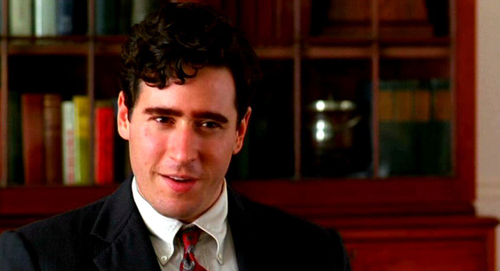
When Quiz Show begins, nerdy Herbie Stempel (John Turturro) has been the champion for several weeks.  However, both the show’s producers and sponsors feel that the untelegenic Herbie has peaked.  Hence, the handsome and charismatic Charles Van Doren (Ralph Fiennes) is brought on the show and Herbie is ordered to lose to him.  Reluctantly, Herbie does so.

john_turturro_quiz_show

Charles is initially reluctant to cheat but, as he continues to win, he finds himself becoming addicted to the fame.  Charles is the son of the prominent academic Mark Van Doren (Paul Scofield) and his success on television finally gives him a chance to escape from his father’s shadow.  Indeed, the film’s subtle and nuanced portrait of Charles and Mark’s loving but competetive relationship is one of the film’s greatest strengths.

ralph_fiennes_quiz_show

Herbie, however, is bitter over having to lose and has subsequently gambled away all of his winnings.  When 21′s producer (David Paymer) refuses to help Herbie get on another TV show, Herbie reacts by going to the New York County district attorney and publicly charging 21 as being fixed.  Though the grand jury dismisses Herbie as being obviously mentally unbalanced, his charges come to the attention of a congressional investigator, Richard Goodwin (Rob Morrow).

rob_morrow_quiz_show1

Goodwin launches his own investigation into 21 and discovers that the show is fixed.  (As the ambitious Goodwin puts it, he wants to “put television on trial.”)  Along the way, he also meets and befriends Charles Van Doren and finds himself torn between his desire to expose the show and to protect Charles from the bad publicity.  Again, the film is to be applauded for the subtle way that it uses Goodwin’s investigation of both Charles and Herbie as a way to explore issues of both class resentment and class envy.  Goodwin may have come from the same ethnic background of Herbie but it quickly becomes obvious that Goodwin has more sympathy for the genteel (and very WASPy) world that produced Charles Van Doren.  When Goodwin tries to justify protecting Charles, his wife (played by Mira Sorvino) responds by calling him “the Uncle Tom of the Jews” and it’s hard not to feel that she has a point.

1quiz3

While I greatly enjoyed Quiz Show, I do have to say that, on one major point, the film fails.  Try as he might, director Redford never convinces us that a rigged game show is really as big of a crime as he seems to be believe it to be.  Perhaps in the 1950s, people were still innocent enough to be shocked at the idea of television reality being fake but for cynical contemporary viewers, it’s hard not to feel that the “scandal” was more about Richard Goodwin’s ambition and less about any sort of ethical or legal issue.  Towards the end of the film, one character suggests that television will never be truly honest unless the government steps in to regulate it.  “What?” I yelled back at the TV.

Seriously, it seemed like a bit of an overreaction.

As I watched Quiz Show, I found it hard not to think about the reality shows that I love.  For instance, I know that The Bachelor and The Bachelorette are largely staged.  I know that the previous season of Big Brother was largely set up so that Amanda could win.  (And, believe me, if Amanda hadn’t sabotaged her chances by turning out to be a mentally unstable racist bully, she would have won and she would probably would have been invited back for the next all-stars season.)  I know that shows like Storage Wars and Dance Moms are “unscripted” in name only.  I know that reality shows aren’t real but my attitude can basically be summed up in two words: “who cares?”  Perhaps I would be more outraged if I lived in the 50s which, to judge from both Quiz Show and a host of other movies, was apparently a much more innocent time.

quiz-show-morrow-scorsese

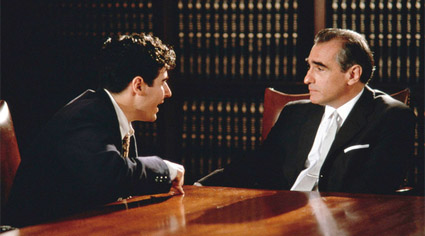
That said, I really enjoyed Quiz Show.  A lot of that is because I’m a history nerd and, therefore, I have a weakness for obsessively detailed period pieces.  But even beyond that, Quiz Show is a well-made, entertaining film that features three excellent lead performances and several strong supporting turns.  If you love to watch great actors playing great roles then Quiz Show is the film for you.  Rob Morrow lays his Boston accent on a bit thick but otherwise, he does a good job of suggesting both Goodwin’s ambition and the insecurities that lead him to desire Charles’s friendship even as he tries to expose him as a fraud.  John Turturro brings an odd — if manic — dignity to Herbie Stempel while Johann Carlo is well-cast as his wife.  Best of all, Ralph Fiennes makes Charles Van Doren into a sad, frustrating, and ultimately sympathetic character while Paul Scofield is the epitome of both paternal disappointment and love as his father.  The film is full of great supporting turns as well, with David Paymer and Hank Azaria perfectly cast as the show’s producers and Christopher McDonald playing the show’s host with the same smarmy charm that he brought to a similar role in the far different Requiem For A Dream.  Perhaps best of all, Martin Scorsese shows up as the owner of Geritol and gets to bark, “Queens is not New York!”

Even if Robert Redford doesn’t quite convince us that the quiz show scandal was as big a deal as he obviously believes it to be, Quiz Show is still an uncommonly intelligent film and one that deserves to rediscovered.

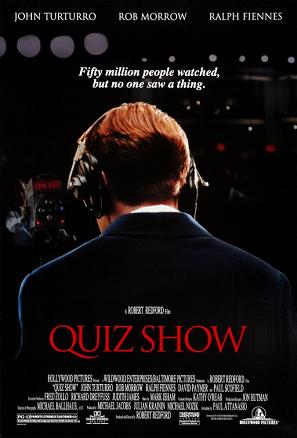
QuizShowPoster

Other entries in the 44 Days Of Paranoia:

  1. Clonus
  2. Executive Action
  3. Winter Kills
  4. Interview With The Assassin
  5. The Trial of Lee Harvey Oswald
  6. JFK
  7. Beyond The Doors
  8. Three Days of the Condor
  9. They Saved Hitler’s Brain
  10. The Intruder
  11. Police, Adjective
  12. Burn After Reading

It’s The 2014 Independent Spirit Nominations!


46-frances-ha

The nominees for the 2014 Independent Spirit Awards were announced earlier today.  While the Spirit noms aren’t exactly the most accurate of Oscar precursors (and the rules of Indie Spirit Awards are pretty much specifically designed to honor the type of low-budget films that are often ignored by the Academy), more than a few of the Spirit nominees are usually remembered when the Oscar nominations are announced.

The winners will be announced, by Patton Oswalt, on March 1st.

Myself, I’m just happy to see Frances Ha and Upstream Color’s Shane Carruth nominated.

Best Feature:
“12 Years a Slave”
“All Is Lost”
“Frances Ha”
“Inside Llewyn Davis”
“Nebraska”

Best Director:
Shane Carruth, “Upstream Color”
J.C. Chandor, “All is Lost”
Steve McQueen, “12 Years a Slave”
Jeff Nichols, “Mud”
Alexander Payne, “Nebraska”

Best Screenplay:
Woody Allen, “Blue Jasmine”
Julie Delpy, Ethan Hawke and Richard Linklater, “Before Midnight”
Nicole Holofcener, “Enough Said”
Scott Neustadter & Michael H. Weber, “The Spectacular Now”
John Ridley, “12 Years a Slave”

Best Female Lead:
Cate Blanchett, “Blue Jasmine”
Julie Delpy, “Before Midnight”
Gaby Hoffman, “Crystal Fairy”
Brie Larson, “Short Term 12″
Shailene Woodley, “The Spectacular Now”

Best Male Lead:
Bruce Dern, “Nebraska”
Chiwetel Ejiofor, “12 Years a Slave”
Oscar Isaac, “Inside Llewyn Davis”
Michael B. Jordan, “Fruitvale Station”
Matthew McConaughey, “Dallas Buyers Club”
Robert Redford, “All Is Lost”

Best Supporting Female:
Melonie Diaz, “Fruitvale Station”
Sally Hawkins, “Blue Jasmine”
Lupita Nyong’o, “12 Years a Slave”
Yolonda Ross, “Go for Sisters”
June Squibb, “Nebraska”

Best Supporting Male:
Michael Fassbender, “12 Years a Slave”
Will Forte, “Nebraska”
James Gandolfini, “Enough Said”
Jared Leto, “Dallas Buyers Club”
Keith Stanfield, “Short Term 12”

Best First Feature:
“Blue Caprice”
“Concussion”
“Fruitvale Station”
“Una Noche”
“Wadjda”

Best First Screenplay:
“In a World,” Lake Bell
“Don Jon,” Joseph Gordon-Levitt
“Nebraska,” Bob Nelson
“Afternoon Delight,” Jill Soloway
“The Inevitable Defeat of Mister and Pete,” Michael Starrbury

John Cassavetes Award:
“Computer Chess”
“Crystal Fairy”
“Museum Hours”
“Pit Stop”
“This Is Martin Bonner”

Best Cinematography:
Sean Bobbit, “12 Years a Slave”
Benoit Debie, “Spring Breakers”
Bruno Delbonnel, “Inside Llewyn Davis”
Frank G. DeMarco, “All Is Lost”
Matthias Grunsky, “Computer Chess”

Best Editing:
Shane Carruth & David Lowery, “Upstream Color”
Jem Cohen & Marc Vives, “Museum Hours”
Jennifer Lame, “Frances Ha”
Cindy Lee, “Una Noche”
Nat Sanders, “Short Term 12”

Best Documentary:
“20 Feet From Stardom”
“After Tiller”
“Gideon’s Army”
“The Act of Killing”
“The Square”

Best International Film:
“A Touch of Sin”
“Blue Is the Warmest Color”
“Gloria”
“The Great Beauty”
“The Hunt”

Robert Altman Award (given to a film’s director, casting director and ensemble cast)
“Mud”

Piaget Producers Award:
Toby Halbrooks & James M. Johnston
Jacob Jaffke
Andrea Roa
Frederick Thornton

Someone to Watch Award:
“My Sister’s Quinceanera,” Aaron Douglas Johnston
“Newlyweeds,” Shake King
“The Foxy Merkins,” Madeline Olnek

Truer Than Fiction Award:
“A River Changes Course,” Kalvanee Mam
“Let the Fire Burn,” Jason Osder
“Manakamana,” Stephanie Spray & Pacho Velez