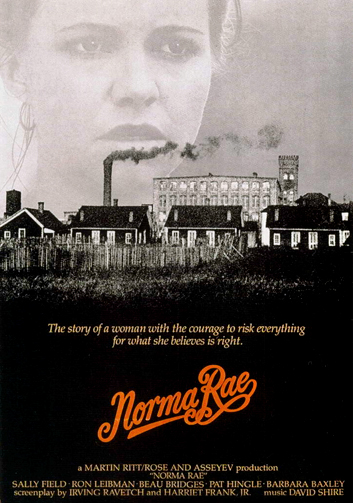
Lisa Reviews An Oscar Nominee For Labor Day: Norma Rae (directed by Martin Ritt)


Earlier, in honor of Labor Day, I reviewed one of the most anti-labor union films ever made, the 1954 Oscar winner On The Waterfront.  In the interest of fairness, it only seems right to now take a look at one of the most pro-union films ever made, the 1979 best picture nominee Norma Rae.

Norma Rae takes place in one of those small Southern towns that is defined by just one industry.  In this case, almost everyone in town works for minimum wage at the local textile mill.  Conditions are terrible, with the employees working long and brutal shifts in a hot and poorly ventilated factory.  The overwhelming roar of the machines have left the majority of the workers deaf to reality, both figuratively and literally.  The mill is run by the usual collection of slow-talking, tie-wearing rednecks who always seem to show up in movies like this.

One day, a union organizer from New York shows up in town.  Brash and cocky, Ruben Warshowsky (Ron Leibman) is determined to unionize the mill but, at first, he struggles.  Nobody wants to risk their job by being seen with him and his Yankee manners rub many of the townspeople the wrong way.

Eventually, Ruben does find one ally.  Norma Rae (Sally Field) has worked at the mill her entire life.  She’s tough and determined but she’s also regularly shunned because of her past.  A widow who has three children (“She’s had a child out of wedlock!” a judgmental union organizer tells Ruben in a near panic), Norma channels her frustration into drinking too much and having an affair with a married (and abusive) salesman.

Two things happen that give Norma Rae a new purpose in life.  First off, she meets and marries the well-meaning but chauvinistic Sonny (Beau Bridges).  Secondly, she helps Ruben in his efforts to unionize the plant, even at the risk of going to jail and losing her job.   With the mill’s management spreading untrue rumors about Norma’s relationship with Ruben, her dedication to the union soon starts to threaten her marriage to Sonny.

I have to admit that I have mixed feelings about Norma Rae.  In many ways, Ruben is an annoying character.  He’s so brash and so smugly out-of-place that I actually found it difficult to consider any of the points that he was making.  I suppose that was partly intentional.  Ruben can’t accomplish anything until he gets Norma Rae on his side.  But, at the same time, there was something very condescending about Ruben as a character.  Much like the villainous rednecks in charge of the mill, Ruben felt like a stock character.  He was Super Yankee, bravely venturing below the Mason-Dixon Line to bring the truth to all of us stupid Southerners.  Whenever Ruben smirked and started to complain about how dumb everyone else was, I was reminded of why I never wanted much to do with the whole Occupy Movement.

As well, Norma Rae is one of those films that technically takes place in the South but it’s the South of the Northern imagination.  The accents were inconsistent and the dialogue often tried way too hard to sound “authentic.”  Ultimately, Norma Rae lacked the artistry necessary to disguise its more heavy-handed moments.

And yet, I still liked Norma Rae.  It had nothing to do with the film’s political message and everything to do with the character of Norma Rae.  Sally Field gives such a good performance as Norma, making her both strong and vulnerable.  The film’s best moments are the ones where Norma stands up for herself and does what she feels is right, despite the opposition from the mill’s management, Sonny, and her father (Pat Hingle).  Towards the end of the film, there’s a simply incredible scene where Norma finally tells her children about her past and, at that moment, Norma Rae reveals itself to be a great and heartfelt tribute to the strength and resilience of women everywhere.  At that moment, Norma’s strength reminded me of the greatest woman that I’ve ever known, my mom.  It made me appreciate the struggles that my mom went through as she raised four strong-willed daughters on her own, while working crappy jobs and dealing with a society that is always threatened by and cruelly judges a woman who refuses to settle.  Personally, I think Norma could have done better than Sonny and that Ruben should have been called out for constantly talking to down to her but what’s important, in the end, is that Norma never stopped standing up for what she believed.  By the end of the film, Norma is standing in for every woman who has ever been underestimated or judged or told that her opinions didn’t matter.  Norma is standing up for all of us.

Sally Field won an Oscar for her role in Norma Rae.  Off the top of my head, I have no idea who she defeated for the award.  (Yes, I know that I could just look it up on wikipedia but that’s not the point.)  But, regardless of her competition, it’s an honor that she definitely deserved.
Norma Rae

Lisa Marie Reviews An Oscar Winner For Labor Day: On The Waterfront (dir by Elia Kazan)


On-the-Waterfront

I like On The Waterfront.

Nowadays, that can be a dangerous thing to admit.  On The Waterfront won the Oscar for Best Picture of 1954 and Marlon Brando’s lead performance as boxer-turned-dockworker Terry Malloy is still regularly cited as one of the best of all time.  The scene where he tells his brother (played by Rod Steiger) that he “could have been a contender” is so iconic that other films still continue to either parody or pay homage to it.  On The Waterfront is one of those films that regularly shows up on TCM and on lists of the greatest films ever made.

And yet, despite all that, it’s become fashionable to criticize On The Waterfront or to cite it as an unworthy Oscar winner.  Certain film bloggers wear their disdain for On The Waterfront like a badge of honor.  Ask them and they’ll spend hours telling you exactly why they dislike On The Waterfront and, not surprisingly, it all gets tedious pretty quickly.

Like all tedious things, the answer ultimately comes down to politics.  In the early 50s, as the House UnAmerican Affairs Committee conducted its search for communists in Hollywood, hundreds of actors, writers, and directors were called before the committee.  They were asked if they were currently or ever had been a member of the Communist Party.  It was demanded that they name names.  Refusing to take part was career suicide and yet, many witnesses did just that.  They refused to testify, apologize, or name names.

And then there was the case of Elia Kazan.  When he was called in front of HUAC, he not only testified about his communist past but he named names as well.  Many of his past associates felt that Kazan had betrayed them in order to protect his own career.  On The Waterfront was Kazan’s answer to his critics.

In On The Waterfront, Terry Malloy’s dilemma is whether or not to voluntarily testify before a commission that is investigating union corruption on the waterfront.  Encouraging him to testify is the crusading priest, Father Barry (Karl Malden), and Edie (Eva Marie Saint), the saintly girl who Terry loves.  Discouraging Terry from testifying is literally every one else on the waterfront, including Terry’s brother, Charlie (Rod Steiger).  Charlie is the right-hand man of gangster Johnny Friendly (a crudely intimidating Lee J. Cobb), who is the same man who earlier ordered Terry to throw a big fight.

At first, Terry is content to follow the waterfront of code of playing “D and D” (deaf and dumb) when it comes to union corruption.  However, when Johnny uses Terry to lure Edie’s brother into an ambush, Terry is forced to reconsider his previous apathy.  As Terry gets closer and closer to deciding to testify, Johnny order Charlie to kill his brother…

The issue that many contemporary critics have with On The Waterfront is that they view it as being essentially a “pro-snitch” film.  It’s easy to see that Elia Kazan viewed himself as being the damaged but noble Terry Malloy while Johnny Friendly was meant to be a stand-in for Hollywood communism.  They see the film as being both anti-union and Kazan’s attempt to defend naming names.

And maybe they’re right.

But, ultimately, that doesn’t make the film any less effective.  Judging On The Waterfront solely by its backstory ignores just how well-made, well-acted, well-photographed, well-directed, and well-written this film truly is.  Elia Kazan may (or may not) have been a lousy human being but, watching this film, you can’t deny his skill as a director.  There’s a thrilling grittiness to the film’s style that allows it to feel authentic even when it’s being totally heavy-handed.

And the performances hold up amazingly well.  Marlon Brando’s performance as Terry Malloy gets so much attention that it’s easy to forget that the entire cast is just as great.  Rod Steiger makes Charlie’s regret and guilt poignantly real.  Karl Malden, who gets stuck with the film’s more pedantic dialogue, is the perfect crusader.  Eva Marie Saint is beautiful and saintly.  And then you’ve got Lee J. Cobb, playing one of the great screen villains.

The motives behind On The Waterfront may not be the best.  But, occasionally, a great film does emerge from less than pure motives.  (Just as often, truly good intentions lead to truly bad cinema.)  Regardless of what one thinks of Elia Kazan, On The Waterfront is a great work of cinema and it’s on that basis that it should be judged.

On_the_Waterfront_poster

A Blast From The Past: Red Nightmare (directed by George Waggner)


Hi there!  Happy Labor Day!

Now, I have to be honest.  I’m not really sure what the point of Labor Day is.  I have no idea what we’re supposed to be celebrating today.  I’ve got the day off, which seems kind of unfair when you consider that people who have far worse jobs than me — i.e., the actual laborers — are having to work.

Like many Americans, I spent this weekend hanging out with my extended family.  On Sunday, I did a poll of every cousin, aunt, uncle, sister, niece, and nephew that I could find and almost every single one of them agreed with me that Labor Day sounded like something tedious that Jesse Myerson would come up with and then demand that everyone celebrate.  In short, it sounded communistic.

So, with that in mind, I think the best way to start out Labor Day would be by watching this educational film from 1962.  In Red Nightmare, Jerry Donavon (Jack Kelly) takes his freedom for granted.  So, Jack Webb shows up and casts a magic spell, which causes Jerry to have a dream about what it would be like to live in a communist society.  In fact, you could even say that Jack Webb gives Jerry a red nightmare!

So, there’s two ways to review a film like Red Nightmare.  We can either debate the film’s politics and get into a big discussion about economics and policy and all that crap and OH MY GOD, doesn’t that just sound perfectly tedious?  Or, we can simply enjoy Red Nightmare for what it is, a histrionic but sincere time capsule of what was going on in the psyche of 1962 America.

Red Nightmare!  Watch it before getting brainwashed by Labor Day!

What Lisa Watched Last Night #136: Fatal Flip (dir by Maureen Bharoocha)


Last night, I watched the latest Lifetime film, Fatal Flip!

fatal-flip

Why Was I Watching It?

With a name like Fatal Flip, I was thinking that this film might be another Lifetime cheerleader film.  And, as I’m sure I’ve mentioned before, one of my favorite Lifetime films of all time is Fab Five: The Texas Cheerleader Scandal.  I figured I could watch the movie and then ask Dazzling Erin whether or not Fatal Flip was an accurate portrayal of the dangerous world of cheerleading.

What Was It About?

Well, it quickly became obvious that Fatal Flip had absolutely nothing to do with cheerleading.  Instead, it turned out that Fatal Flip was about the dark side of house flipping.

Alex (Dominique Swain) and her boyfriend Jeff (Michael Steger) max out their credit cards so that they can buy a colonial house that they plan to fix up and then sell for a profit.  At first, Alex and Jeff are convinced that they can fix up the entire house on their own but then it turns out that Jeff is kind of a whiny little wimp.

Fortunately, while at the hardware store, Jeff meets Nate (Mike Faiola).  Nate knows everything about home improvement.  He also wears a lot of plaid.  Anyway, Nate agrees to help Jeff and Alex fix up the house.  And, because this is a Lifetime movie, neither Jeff nor Alex have any problem with Nate moving in with them.

However, Nate has secrets of his own.  For instance, there’s the woman who he previously sealed up in a wall.  Plus, he has a beard which, in the world of Lifetime, is always a huge red flag.

And, of course, he wears a lot of plaid…

What Worked?

The whole film was about redecorating a house so I definitely enjoyed that.  One of the fun things about watching a movie on Lifetime is that a lot of attention is always paid to the interior of everyone’s house.  Fatal Flip took that tendency to its logical extreme.

What Did Not Work?

Obviously, a movie like this always requires a certain suspension of disbelief.  But seriously, Fatal Flip took it just a little too far.  Nate was so obviously unhinged that it was impossible to believe that anyone could be stupid enough to not realize it.

Add to that, a better title for the film would have been The Plaid Killer.  Because, seriously, when it came to Nate, it was nonstop plaid.

“Oh my God!  Just like me!” Moments

Much like Alex, I also enjoy making houses look nice and salable.  (Though I do have to say that I’m kind of surprised that she never changed the wallpaper in the living room.  Seriously, that was bothering me through the entire film.)

Lessons Learned

House flipping is not as glamorous as HGTV would have you believe.

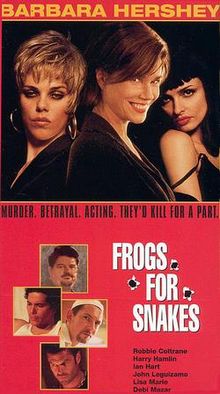
Insomnia File No. 6: Frogs For Snakes (dir by Amos Poe)


What’s an Insomnia File? You know how some times you just can’t get any sleep and, at about three in the morning, you’ll find yourself watching whatever you can find on cable? This feature is all about those insomnia-inspired discoveries!

220px-Frogs_for_Snakes

If you were suffering from insomnia last night, at around two a.m., you could have turned over to Flix and watched the 1998 film Frogs For Snakes.

And if you were suffering from insomnia, watching Frogs For Snakes would probably have been a good idea because this film is amazingly dull.  In fact, I am not sure that I have the words to express to you just how tedious Frogs For Snakes truly was.  It may be necessary for me to go back to school and learn how to speak in a dead language in order for me to express the boredom that I felt while watching Frogs For Snakes.

And yes, I realize that I’m talking about an obscure film that was released nearly 20 years ago and it might seem kind of petty to, at this late date, make a big deal about how terrible this film was.

But seriously, Frogs For Snakes was really, really bad.  In fact, it was disturbing to think that a film this bad could have actually been made.  It was even more disturbing to consider that this film was apparently given a theatrical release and, all these years later, still pops up on cable so that it can proudly display its overwhelming mediocrity.

Now, I’m going to tell you what Frogs For Snakes is about and you’re going to think, “That actually sounds like it might be kind of interesting.”  Don’t be fooled!  The film may sound interesting but it’s not.

Frogs for Snakes takes place in a stylized, neo-noir version of New York City.  Eva Santana (Barbara Hershey) is an aging actress who claims to have quit the business, though it’s clear that it’s more a case of the business quitting her.  She talks about leaving New York and raising her son in a better environment.  However, until she gets around to leaving, she’s making ends meet by working as a waitress at a diner owned by the kind-hearted Quint (Ian Hart).  And, of course, when she’s not waitressing, she’s working as a debt collector for her ex-husband, a loan shark named Al Santana (Robbie Coltrane).

That’s right, this actress has a gun and she uses it frequently.  However, because Eva is good at heart, she rarely kills anyone.  Instead, she just shoots them in the foot and tells them to pay back their loans while they lay on the floor and scream in agony.  (All that agonized screaming got pretty old after a while.)

As for Al, he’s not just a loan shark.  He’s a theatrical impressario.  He’s planning on putting on a production of David Mamet’s American Buffalo.  He promises his driver a role in American Buffalo on the condition that the driver assassinate Eva’s new boyfriend (John Leguizamo, of course).

Soon, actors all over New York are literally killing to get a role in Al’s play.  Meanwhile, Eva just wants to retire and get out of New York but first, she has to do one last job for Al…

In between all the killing, the characters frequently launch into monologues that have been lifted from other films.  John Leguizamo does a Brando imitation.  Lisa Marie (Tim Burton’s ex, not yours truly) delivers the cuckoo clock speech from The Third Man.  A suggestion for aspiring filmmakers: if you’re going to make a bad film, don’t remind your audience that they could be watching The Third Man instead.

Anyway, the plot sounds interesting but none of the potentially intriguing ideas are explored.  I imagine that the film was meant to be a satire of Off-Broadway ruthlessness but ultimately, the film is just another tediously violent indie film from the 90s.  This is one of those movies where nobody can do anything without spending an excessive amount of time talking about it beforehand and, when things do turn violent, it’s the worst type of quirky, sadistic, drawn-out, “look how crazy we are” violence.

There’s a scene towards the end of the film where Al shoots a group of people in a bar.  This is intercut with clips from the Odessa Steps sequence from Battleship Potemkin.  As Al leave, he shoots the TV showing Battleship Potemkin and, I have to say, that really annoyed me.  Seriously, just as a bad filmmaker should not remind people that they could be watching The Third Man, he shouldn’t invite them to compare his film to Battleship Potemkin unless he’s willing to back up the comparison.  When Al shot the TV, I found myself hoping that Sergei Eisenstein would pop up and shoot him.

Frogs for Snakes is one of the worst films that I’ve ever seen.  It may, in fact, be the worst but I would need to rewatch Ted 2 before I said that for sure.  But, if you have insomnia, Frogs For Snakes will at least put you to sleep.

Previous Insomnia Files:

  1. Story of Mankind
  2. Stag
  3. Love Is A Gun
  4. Nina Takes A Lover
  5. Black Ice


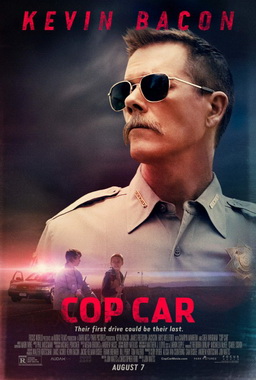
Film Review: Cop Car (dir by Jon Watts)


Cop_Car_poster

Cop Car opens with two young boys, Travis (James Freedson-Jackson) and Harrison (Hays Wellford) walking through a field.  Over the course of the film, we really don’t learn that much about either Travis or Harrison.  They speak in the tones and accent of childhood and the trailer park.  They’re just two ordinary kids, who appear to be bored out of their mind and who can blame them because it appears that they live out in the middle of nowhere.

And then, suddenly, their boredom ends.

They comes across a deserted cop car sitting in the middle of the wilderness.  After a successive number of dares, they end up inside of the car.  And then, they discover that the keys are still in the car as well.  Soon, Harrison and Travis are taking turns driving the car, roaring down the highway, nearly running an irate motorist (Camryn Manheim) off the road and basically having a great time.

What the kids don’t know is that the cop car belonged to Sheriff Kretzer (Kevin Bacon), a grim-faced lawman who isn’t going to allow two little kids to make a fool out of him.  Even while Harrison and Travis are playing around in the car, Kretzer is pursuing them.  Along the way, Kretzer is reduced to stealing a truck, gets stopped for speeding, and basically sacrifices any ounce of personal dignity that he may have.  Along the way, cars crash and cows are nearly run over.

And it all sounds like the making of a comedy, doesn’t it?  Just from reading the plot description, you might be justified in thinking that Cop Car is a white trash version of Ferris Bueller’s Day Off.  Well, make no mistake.  Cop Car has its funny moments but it is definitely not a comedy.  Sheriff Kretzer may occasionally be a bit of a bumbling adversary but he is no Principal Rooney.  Instead, Kretzer is a vicious and effective killer.

The reason Kretzer was away from his car is that he was busy burying a body in the woods.  And what the kids don’t realize, at first, is that there’s another body in the trunk of the car.  Kretzer is determined to get back his cop car and he’s willing to kill the boys to do it.  Even worse, Kretzer’s badge and uniform give him both the ability and the authority to do so.

There’s one particularly effective scene where Harrison and Travis playing with the weapons that Kretzer left in the car is juxtaposed with Kretzer pouring a baggie of cocaine into a toilet.  But, at the same time, I almost wish that the whole drug dealing subplot had been left out of the film.  When we first meet Kretzer, he’s scary precisely because his motives are unknowable.  He’s an authoritarian with a badge, and a bad mustache.  The more specific the film gets about Kretzer’s motivations, the less interesting he becomes.  Imagine if Kretzer has simply been an unstoppable force of wounded machismo, motivated by nothing more than his belief that his law is the only law that matters.  By making Kretzer a criminal as well as a cop, Cop Car dilutes its otherwise strong critique of the pro-authoritarian strain that currently runs through American culture.

As a thriller and chase film, Cop Car works pretty well, though the first half is significantly better than the second.  (The second half gets a little bogged down with the man in the trunk.)  Director Jon Watts keeps the film moving at a good pace and he shows that he knows how to generate suspense.  There’s a lengthy and narratively risky scene where Kretzer repeatedly tries and fails to pick a lock but the scene pays off in the end and Watts deserves some credit for having faith in the patience of his audience.

But really, Cop Car works largely because Kevin Bacon has become a national treasure.  It’s always fun to watch him throw himself into playing off-center roles like Sheriff Kretzer.  Bacon is smart enough to play up Kretzer’s stupidity without ever downplaying his dangerous and cunning nature.  It’s a great performance in a pretty good film.

A Quickie With Lisa Marie: We Are Your Friends (dir by Max Joseph)


We_Are_Your_Friends

So, this morning, I read some of the harsh reviews that mainstream critics have given the new film We Are Your Friends and I have to admit that I’m starting to get a little ticked off.

That’s not to say that We Are Your Friends is a very good movie.  I saw it last night with my BFF Evelyn and we enjoyed it but mostly, that was because we talked through almost the entire movie.  And yes, I know that it’s rude to talk through a movie but seriously, the theater was nearly deserted.  When we bought our tickets, there was a huge crowd of people gathered outside the theater but it turns out that they were all buying tickets for War Room.

Anyway, We Are Your Friends tells the story of Cole (Zac Efron), a DJ who lives with three idiot friends (who are so identical to the group from Entourage that one of them is even named Squirrel).  He spends his days working at a mortgage company and his nights DJing.  Then he meets James (Wes Bentley), a formerly great DJ who is on his way down.  James takes Cole under his wing and mentors him and teaches him how to get a room dancing.  But, Cole ends up falling in love with James’s abused girlfriend, Sophie (Emily Ratajkowski), which leads to… well, it leads to exactly what you think it’s going to lead to.  Storywise, We Are Your Friends is not going to win any points for originality.

While we were watching the movie, Evelyn and I agreed that Zac Efron is a strange actor.  I mean, yes, he’s hot and yes, he’s talented enough that he can walk while delivering his lines but, at the same time, his dramatic performances always feel oddly empty.  You watch him and you get the feeling that he’s still trying way too hard to prove that there’s more to him than just High School Musical.  He’s like the guy who you have crush on until you actually get to know him and discover that, beyond his looks, he’s really not that interesting.  Efron always seems to be putting in a lot of effort but, whenever you watch one of his performances, you get the feeling that there’s not much going on underneath the beautiful surface.  For all intents and purposes, Zac Efron is the anti-Gosling.

And some movies have made good use of Efron’s limits.  He was perfectly cast in Me and Orson Welles, for instance.  And he’s good in comedies, where he can play against his good looks.  But in a film like We Are Your Friends, where you’re actually supposed to have some sort of emotional stake in his hopes and dreams, Efron just feels miscast.

That said, I still enjoyed We Are Your Friends and I think that a lot of the reviews have been a bit too harsh.  Why did I enjoy the movie?  It all comes down to the music and the dancing.  If you love EDM, you’ll find a lot to enjoy in We Are Your Friends.  And if you’re not into EDM — well, then fuck off.  I could sit here and write another 500 words about how clichéd the storyline is but, ultimately, that’s not what the film is about.  The film is about the music.  The film is about the ecstasy of dancing all night and then waking up with the beats still playing in your head.  At its best, that’s what this film captures.  It’s not a great film.  A month from now, I have a feeling that it’ll be a struggle to remember much about We Are Your Friends.  But I’ll probably still be listening to the soundtrack.

That’s what a lot of the harsh reviews are missing but then again, most mainstream film reviews are written by people who are too old to appreciate EDM in the first place.  EDM is music for people who are young and who are still capable of enjoying the present and dreaming about the future.  Boring old mainstream critics will never get it and that’s why the reviews of We Are Your Friends feel so condescending.  The critical consensus on Rotten Tomatoes reads: “We Are Your Friends boasts magnetic stars and glimmers of insight, but they’re lost in a clichéd coming-of-age story as programmed as the soundtrack’s beats.”  Now I know how those Christians who went to see War Room feel whenever a reviewer thinks he’s being clever when he says that one of their films “doesn’t have a prayer.”  It’s all so condescending and cutesy.

Listen, We Are Your Friends is not a particularly good film.  But it’s not as bad as you might think.  The plot is bad but the music is good and really, isn’t that the point?

Film Review: Shaun The Sheep (dir by Richard Starzak and Mark Burton)


Shaun_the_Sheep_MoviePosterIf you want to see a film that will truly make you happy and actually give you a reason to feel optimistic about the future of civilization, then you simply must see Shaun The Sheep, the new stop-motion animated film from Aardman Animations, the same people behind Wallace and Gromit.

The film tells the story of Shaun, a sheep who lives on Mossy Bottom Farm.  Though Shaun and the other sheep have a good relationship with both the farmer and the farmer’s dog, Bitzer, Shaun still finds himself growing bored with the monotonous routine of life on the farm.  He wants to take a day off and go down to the Big City.  (It’s even identified as being the “Big City” on a nearby road sign.)  Shaun comes up with a plan.  He and his fellow sheep trick the farmer into watching as they jump over a fence.  The farmer falls asleep.  They put the farmer in a trailer, the inside of which they’ve disguised to look like the farmer’s bedroom.  The farmer will sleep through the day and, by the time he awakens, Shaun will have returned from the Big City.

And it’s actually a pretty good plan but we all know what they say about the best laid plans of sheep and men.  The trailer ends up rolling away, eventually reaching the city.  Once the farmer wakes up, he gets a blow to head that causes him to develop amnesia.  However, despite not knowing who he is, the farmer has enough vague memories of shearing the sheep that he quickly finds work as a hair stylist.  Working under the name “Mr. X,” the farmer is soon a minor celebrity himself.

Discovering what the sheep have done, Bitzer goes to the city to search for the farmer.  When he doesn’t return, Shaun and the other sheep come to realize how much they actually did like life with the farmer.  They go to the city themselves, searching for both the farmer and Bitzer.  However, once they arrive, they find themselves being stalked by A. Trumper, a fanatical animal control worker.

(Shaun the Sheep is a remarkably good-natured film, with almost every human and animal being kind at heart.  Trumper is the only exception.)

Can Shaun protect the other sheep from Trumper?  Can they track down Bitzer and the farmer?  Will the farmer ever remember the simple joys of country life or will he live the rest of his life as Mr. X, hair stylist to the stars?  You’ll have to watch Shaun the Sheep to find out!

And you really should watch it!  Shaun the Sheep is one of the most delightful films that I’ve seen in a long time.  It’s the perfect movie for kids but, at the same time, it’s smart enough that adults will be able to enjoy it as well.  Yes, a huge part of the film’s appeal is that Shaun is just so cute!  But, at the same time, this cheerful animated film also manages to work in homages to everything from The Great Escape to Silence of the Lambs.  My personal favorite of the film’s many in-jokes was a nod to The Night of the Hunter and no, I’m not going to spoil it for you here.  Why?  Because I want you to see this movie and I want you to have the same joy of discover that I did!

This is a movie that will make you laugh and yes, it will make you cry.  Most of all, Shaun the Sheep is a delightful film!  See it!

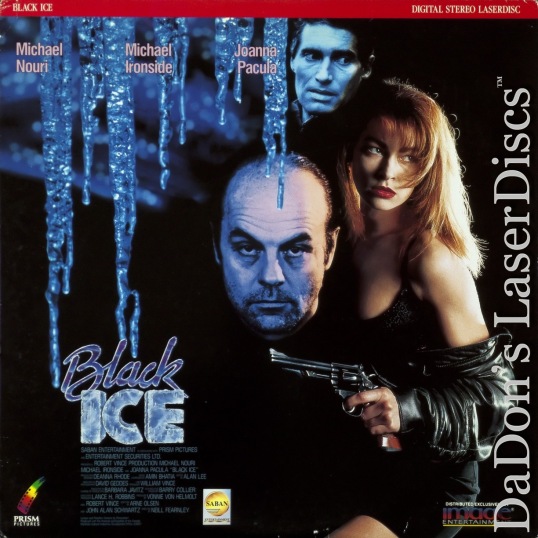
Insomnia File No. 5: Black Ice (dir by Neill Fearnley)


What’s an Insomnia File? You know how some times you just can’t get any sleep and, at about three in the morning, you’ll find yourself watching whatever you can find on cable? This feature is all about those insomnia-inspired discoveries!

Black Ice 2

If you were having trouble getting to sleep last night at 2 a.m., you could have turned over to Indieplex and watched Black Ice, a Canadian thriller from 1992.

Why is the film called Black Ice?  Well, that’s a good question.  There’s a lot of snow and ice to be seen in the film but absolutely none of it is black.  According to the imdb, this film was also released under the title A Passion for Murder.  I have to admit that I kind of like A Passion For Murder as a title, simply because it’s so generic and empty that it becomes oddly brilliant.  If you were making a parody of the type of movies that Netflix usually lists in the “steamy thriller” category,  A Passion For Murder is probably the title that you would come up with.

But, as for this film, it opens as all thrillers from the early 90s must, with a man in a suit meeting his clad-in-black-lingerie mistress in a hotel room.  The man in the suit is an up-and-coming senator.  His mistress is the mysterious Vanessa (Joanna Pacula).  When Vanessa pressures him to leave his wife, the senator gets mad and leaves.  Vanessa goes back to her apartment, where she is soon visited by the senator.  She and the senator get into a fight.  She shoves the senator into a window, which shatters and promptly kills the senator.

Meanwhile, Ben Shorr (Michael Nouri) is barely making a living as a taxi driver.  He’s an aspiring writer and, just in case we had any doubts about his intellectual bona fides, he has a pony tail and talks almost nonstop.  (Ben also owns a goldfish that he’s named Travis, as in Taxi Driver‘s Travis Bickle.)  Ben is pretty annoying and when he picks up Vanessa, you’re kind of hoping that she’ll end up killing him like she killed the senator.

But no, it turns out that Ben is supposed to be our hero.  Vanessa asks Ben to drive her from Detroit to Seattle.  And, of course, Ben agrees because … well, there wouldn’t be a movie otherwise.

It turns out that Vanessa is actually a secret agent.  She was supposed to seduce and eventually marry the senator.  Now that she’s accidentally killed him, her supervisor, Quinn, is determined to kill her.  Because this movie was made in Canada, the villainous Quinn is played by Michael Ironside.

The rest of the film is basically Quinn chasing Ben and Vanessa across the northwest.  Along the way, Vanessa and Ben fall in love.  One huge problem with Black Ice is that the audience knows everything about Vanessa before Ben does.  There are a lot of scenes of Ben trying to figure out why Quinn is pursuing Vanessa but, since we already know why, those scenes mostly feel like filler.  If  Vanessa had been as much of a mystery to the audience as she was to Ben for most of the film’s running time, Black Ice probably would have been a bit more intriguing.

As it is, Black Ice is pretty much a standard, low-budget chase film.  Michael Nouri is pretty annoying but Joanna Pacula and Michael Ironside both give good performances.  It snows throughout the entire film and there’s a few genuinely impressive shots of the three main characters running across the icy landscape.  Otherwise, Black Ice is pretty forgettable but it also doesn’t require much thought, which might make it an appropriate film to watch if you’ve got insomnia.

Black Ice

Previous Insomnia Files:

  1. Story of Mankind
  2. Stag
  3. Love Is A Gun
  4. Nina Takes A Lover

So that was the Unauthorized Full House Story…


0

So, last night, after months of nonstop promotion, Lifetime finally aired The Unauthorized Full House Story and…

Meh.

I have a confession to make.  I am 99.9% sure that I have never seen a complete episode of Full House.  I’ve seen bits and pieces, of course.  But I don’t think I have ever watched a single episode from beginning to end.  And yet, despite this, I still feel like I know everything about the show.  I know that John Stamos was obsessed with his hair.  I know that the Olsen Twins played Michelle.  I know about “Oh mylanta!” or “Cut it out” and “you got it, dude,” and all the rest.  I know that Dave Coulier may have inspired Alanis Morissette.

And, though I’ve never seen an entire episode of Full House, I have seen The Aristocrats, a documentary that features Bob Saget telling an incredibly long dirty joke.  And, of course, I’ve also seen Half Baked, which featured Saget asking if Dave Chapelle had ever “sucked dick for coke.”

So, naturally, I figured that The Unauthorized Full House Story would feature a lot of cocaine being snorted backstage while an actress meant to Alanis went down on Coulier in a theater.  I mean, it had to be unauthorized for a reason, right!?

But no — much like last year’s Unauthorized Saved By The Bell, the Full House movie was notable largely for how little drama it featured.  Apparently, there were no scandals.  There was little to no conflict behind the scenes.  John Stamos was apparently a little stand-offish at first.  Bob Saget occasionally forgot there were children around and made an off-color comment.  Dave Coulier apparently was just happy to be there.

In other words, it was all pretty boring.  But, I still had fun live tweeting the film and apparently, a lot of people enjoyed reading my tweets.  So, in honor of what the Full House movie was truly all about, here’s a collection of my best tweets from last night.

Hell yeah!  But, before they get to Unauthorized Degrassi, Lifetime will be showing Unauthorized 90210 and Unauthorized Melrose Place in October!  Now, those shows will be worthy of being unauthorized!