What would you do for love? How far would you go for the man or woman or thing that you love? That’s a question that has rested at the heart of many — perhaps almost all — stories. That’s because love is our most essential need. It’s something that we spend our entire lives either searching for or trying to hold onto. And really, is there any greater fear than being alone? That need to be in love and to be loved is the one thing that everyone has in common.
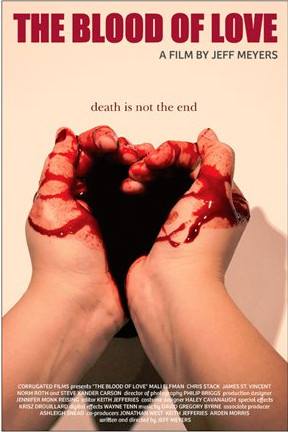
It’s also the subject matter of The Blood of Love, a short horror film that I was recently lucky enough to view. Directed by Jeff Meyers and clocking in at a brisk 18 minutes, The Blood of Love opens with Kate (played by a wonderful actress named Mali Elfman) saying goodbye to her husband, Josh (Chris Stack). Josh is in bed and obviously ill. He’s also worried about the little black dress that his wife is wearing. She assures him that it’s just for work and then goes out.
Though Kate does end up picking up a guy once she goes out, she’s not looking for a good time. Instead, she brings the guy home with her and promptly proceeds to slit his throat. Meanwhile, Josh is still in bed but now he’s dead.
However, it turns out that Kate has a special machine that will bring Josh back to life. The machine runs on blood and, unfortunately, Josh is only alive for a day or two before he dies again. Hence, Kate has to keep finding victims in order to bring her husband back to life over and over again.
However, with each resurrection, Josh is alive for a shorter amount of time. Finally, Kate makes one final attempt to bring Josh back to life permanently but it leads to a series of twists that neither she nor Josh sees coming.
With its mix of graphic gore and delirious romance, The Blood of Love can be favorably compared to the work of the great French filmmaker, Jean Rollin. (I am, in particular, thinking of the classic The Living Dead Girl but Josh’s short term amnesia also reminds one of Rollin’s Night of the Hunted.) The short film plays out with a Rollinesque dream-like intensity and Mali Elfman’s gives a remarkably brave performance as Kate, making her both sympathetic and scary at the same time. Special mention should also be made of Norman Roth, who plays a mysterious character named Mr. Ashling and gives the type of enigmatic performance that brings to mind the type of mad scientists and magicians who would have been embodied by Lionel Atwill or Vincent Price in the past.
I have never actually seen the 1996 film The Island of Dr. Moreau but I certainly have read a lot about it.
It’s one of those films that seems to get mentioned whenever film critics start talking about the worst films of all time and, as a result, the story of the film’s production has become legendary. The film’s shoot was difficult, for reasons of both nature and human nature. The film was shot in the inhospitable Australian rain forest and shooting was briefly shut down due to a sudden hurricane. Richard Stanley, the original director, was unceremoniously fired by New Line Cinema and apparently proceeded to go native in the Australian wilderness, smoking a huge amount of weed while the studio executives feared that he would return and burn down the set. Veteran director John Frankenheimer was brought in to finish the film and clashed immediately with the film’s notoriously eccentric and difficult stars, Val Kilmer and Marlon Brando.
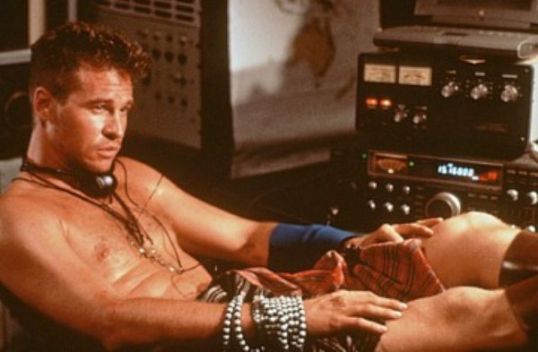
And I have to admit that, every time I read about The Island of Dr. Moreau, there’s a part of me that wants to track down and watch this film and see how bad it could possibly be. But, every time I find myself too tempted, I think about a shirtless Val Kilmer lounging around in a kilt and I quickly change my mind.
Bleh!
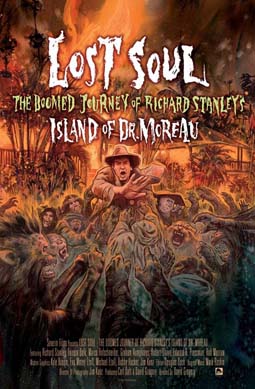
Fortunately, if I want to get a feel for the insanity behind the film’s production, I no longer have to actually watch The Island of Dr. Moreau. Instead, I can just get on Netflix and watch an entertaining documentary called Lost Soul: The Doomed Journey of Richard Stanley’s The Island of Dr. Moreau.
Lost Soul could have just as easily been called Everybody Hates Val Kilmer. Val himself declined to be interviewed for the documentary and I have to say that I think that was a huge mistake on his part because literally everyone who did agree to be interviewed appears to absolutely despise Val Kilmer. It’s not so much that everyone tells a story about Val’s bad behavior as much as the fact that, decades later, everyone still seems to be so traumatized by the experience of having been anywhere near him. (German actor Marco Hofschnieder especially seems to take a lot of delight in doing a devastating yet hilarious imitation of Val Kilmer smoking a cigarette and complaining about every line of dialogue, regardless of whether it was his dialogue or not.)
The documentary also includes plenty of crazy Marlon Brando stories but there’s a noticeable difference between the Brando stories and the Kilmer stories. Brando is portrayed as being an almost tragic figure, a great actor who hated his talent and, as a result, went out of his way to give performances that mocked the very idea of even trying to be good. As annoyed as everyone seems to have gotten with Brando, there’s still an undercurrent of affection to the Brando stories. That’s something that is definitely lacking from the Kilmer stories.
(According to the documentary, Brando was not a Val Kilmer fan. When Kilmer asked Brando if he had visited the Australian reef, Brando replied, “I own a reef,” and reportedly didn’t speak to Kilmer for the rest of the shoot.)
As interesting as the stories about Brando and Kilmer may be, the heart of the film rests with Richard Stanley, the promising young South African director whose brief “mainstream” film career was pretty much derailed by the drama surrounding The Island of Dr. Moreau. Interviewed at his home in France and captivating the audience with both his intense stare and his mordant sense of humor, Richard Stanley describes both his vision for The Island of Dr. Moreau and the pain of having that vision snatched away from him. Not only does he confirm that, as has long been rumored, he did sneak back onto the set as an extra but he also explains that the production’s problems were largely due to a mishap involving a warlock named Skip.
Lost Soul makes for an interesting cautionary tale about what happens when an artist has to deal with the establishment. Watch it with Jodorowsky’s Dune and have yourself a double feature of “what could have been” cinema.
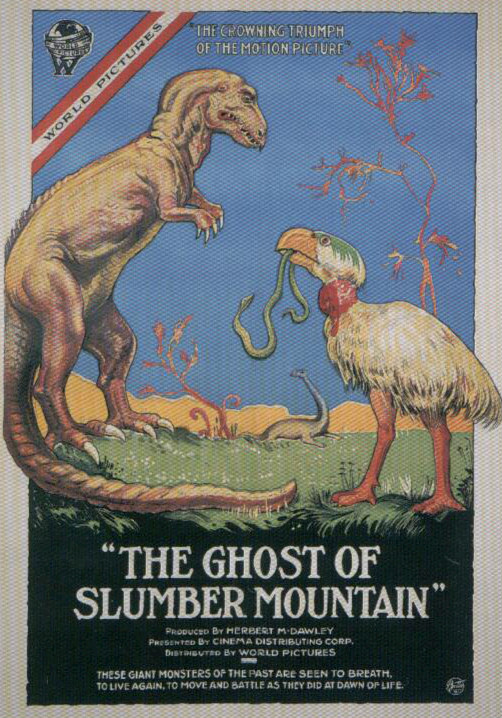
Directed by special effects pioneer Willis O’Brien (who would later do the special effects for the original King Kong), The Ghost of Slumber Mountain tells the story of an explorer and writer named Holmes (Herbert M. Dawley). When his nephews ask him to tell them a story, Holmes tells them about the time that he explored Slumber Mountain and met the ghost a prospector named Mad Dick (played by O’Brien himself). The ghost instructs Holmes to look through a telescope. Upon doing so, Holmes finds himself starting into prehistoric times. He not only sees a fight between a Tyrannosaurus and a Triceratops but then apparently gets sent though time himself as he soon finds himself being chased by the surviving dinosaur.
Now, there are a few things that I should make clear about The Ghost of Slumber Mountain. It’s a silent film, which means that watching it requires modern audiences to adapt to a far different narrative experience than they may be used to. As well, the film originally ran 30 minute but the current print clocks in at 19 minutes. As a result, most of the film’s non-dinosaur plot is unknown.
With all that in mind, The Ghost of Slumber Mountain is still a fascinating and fun slice of cinematic history. This was the first film to show live actors and stop-motion creatures together on the screen. And while the special effects are primitive when compared to today’s CGI monsters, there’s also an undeniable charm to them.
Today, of course, we tend to take special effects for granted. One of the great things about watching a movie like The Ghost of Slumber Mountain is that it gives you a chance to travel back to a time when special effects truly were special and unexpected. There was once a time when film magic truly did seem to be like magic and sometimes, it’s fun to hop into a cinematic time machine and try to imagine being in that 1918 audience and being truly amazed by what we are seeing.
So, why not hop into that time machine and watch The Ghost of Slumber Mountain?
In the past, I have occasionally shared old educational films here on the Shattered Lens. As everyone should know by now, I love history and these short films all serve as interesting time capsule of the era in which they were made. Seeing as how August is traditionally the time when students go back to school, I figured now would be as good a time as any to share some wisdom from the past.
The film below is from 1952. It’s called Cheating. It’s about what happens when John Taylor forces his friend Mary to help him cheat. When he gets caught, it not only harms Mary’s reputation but John soon finds his own position on the student council threatened! Oh, the horror!
Now, I have to admit that I enjoyed this short film because, as I’ve mentioned before on this site, I occasionally cheated on a few tests while I was in high school. But, beyond that, this film is interesting because it’s shot like a living nightmare, complete with crooked camera angles, expressionistic lighting, an atmosphere of existential dread, and an extremely judgmental narrator. Director Herk Harvey goes all out in his direction for this one. (Harvey is probably best known for later directing Carnival of Souls, his only feature film.)
Plus, there’s always the fun of listening to all those country accents. It may be tempting to make fun of the “actors,” all of whom seem to have picked out of a local high school drama class. But, there’s an authenticity to them that will make most viewers reconsider the importance of cinematic authenticity.
Anyway, the ultimate message here seems to be that you should only cheat if you know you can get away with it and that is a message that I happily endorse. It’s something that all students should keep in mind as they return to school this month.
What’s an Insomnia File? You know how some times you just can’t get any sleep and, at about three in the morning, you’ll find yourself watching whatever you can find on cable? This feature is all about those insomnia-inspired discoveries!
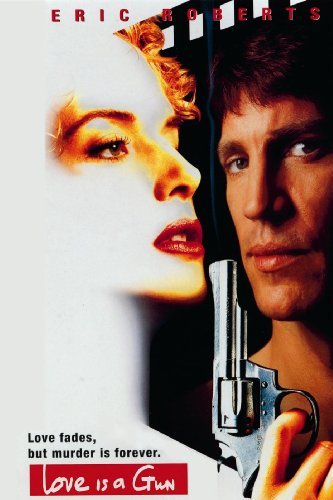
If you were suffering from insomnia last night, at around 2 in the morning, you could have turned on Showtime and watched Love is a Gun, an odd little thriller from 1994.
How odd is Love Is a Gun? It’s so odd that it stars Eric Roberts. Roberts plays Jack, a photographer with problems. His longtime girlfriend, Isabelle (Eliza Roberts), refuses to forgive him for cheating on her in the past and demands that he put a ring on her finger. (Jack, for his part, has bought a ring but he keeps losing it.) Jack is haunted by a reoccurring dream, in which he sees himself with a gun pointed at his head. Isabelle says that the dream means that Jack needs to give her a ring. Jack says it’s all about deja vu.
Jack gets a job working as a crime scene investigator. He meets a detective who is so crazy that he’s played by R. Lee Ermey. Jack takes pictures of dead bodies. His colleagues make macabre jokes. A local reporter offers to pay Jack for insider information. Ermey asks Jacks to help cover up a crime. Jack has visions of a line of well-dressed detectives shooting at him, firing squad style. Eventually, Jack ends up sitting in a living room, an anonymous body at his feet, and watching a soap opera. The actors on TV repeat dialogue that we’ve heard Jack and Isabelle say earlier in the film. Jack starts to giggle and is soon laughing like a maniac. A detective steps into the living room and asks Jack if he remembered to take a picture of the body in the bathroom. “Oh yeah,” Jack says, “I forgot about that…”
Jack meets a model named Jean (Kelly Preston). He takes pictures of her wearing a bridal gown and occasionally playing dead. He realizes that he’s already seen the exact same pictures that he’s just taken. Somebody left them in his locker at work but the images of Jean faded to black as soon as he looked at them. He asks Jean if this is all an elaborate joke. “Take the shot, Jack,” Jean replies.
Soon, Jean and Jack are having an affair. Jean tells Jack that she has a strange rash. Jack imagines that there’s a hole in Jean’s forehead. A man claiming to be Jean’s husband shows up and wishes Jack luck because his wife is crazy.
Jack goes back to Isabelle. Isabelle demands the ring. Jack freaks out and returns to Jean. Jean says she’s pregnant but then says she isn’t. Jack giggles and then cries. He goes back and forth between the two women, constantly begging for forgiveness as beads of sweat collect on his forehead.
Jack’s watch stops. He tries to get it repaired. An old man yells at him that his watch is cursed and cannot be repaired because it might infect all of the other watches in the man’s shop.
And, after all of that, the movie starts to get really weird…
Love Is A Gun does eventually offer up an explanation as to what’s going on. It doesn’t make a bit of sense but somehow, the total incoherence of it all adds to this low-budget film’s charm. Full of surreal images and intentionally odd dialogue, Love Is A Gun is compulsively watchable.
It also features a genuinely strange performance from Eric Roberts. Roberts goes through the film with this goofy smile on his face, except for the scenes when Jack gets upset. When Jack is upset, Roberts stomps his feet, jumps up and down, yells out every other line of dialogue, and contorts his body in some truly weird ways. When he gets really angry, he grabs can after can of beer and furiously shakes them before opening, causing the beer to drench his face. Eric Roberts’s lead performance is literally one of the oddest things that I have ever seen and it’s worth watching Love Is A Gun just to experience it.
Last night, I watched the Lifetime original film, Sorority Murder!
Why Was I Watching It?
Well, the obvious answer is that I was watching because it was on Lifetime. However, beyond that, I had high hopes for this film because Lifetime has a pretty good track record when it comes to over-the-top melodrama about sororities. Remember The Haunting Of Sorority Row?
What Was It About?
Jen (Scarlett Byrne) has a lot to deal with. She has just started her first semester at college and she already has a huge design project due. Her alcoholic mother (Sarah-Jane Redmond) keeps getting arrested and needs her daughter to bail her out. And, on top of all that, Jen is being harassed by the apparently crazy president of her sorority.
When the president turns up dead, everyone assumes that Jen must have killed her! However, Jen was alone in her bedroom, working on that design project, when the crime was committed! Can Jen track down the real murderer before the semester ends? Will Jen’s mother ever get her drinking under control? And will Jen ever manage to finish that project!?
You’ll have to watch the movie to find out.
What Worked?
The film’s title promised both a sorority and a murder and it totally delivered both of those things. You have to appreciate a film that actually keeps its promises. The murder mystery was enjoyable, if a little predictable. I especially enjoyed the way the film portrayed the sorority as almost being a Scientology-style cult. I was half-expecting someone to start talking about evil Lord Xenu.
Also, I liked the relationship between Jen and her mother. It was sweet and touching, in the best Lifetime tradition.
What Did Not Work?
Sadly, the film never quite reached the heights of the greatest of all Lifetime sorority films, The Haunting of Sorority Row.But, when taken on its own terms, the entire film worked. It was a good Lifetime movie.
“Oh my God! Just like me!” Moments
I have never been a member of a formal sorority (though I am a member of the unofficial sisterhood of red-headed film bloggers) and I have never killed anyone, though I have been tempted. So, unfortunately, this was the rare Lifetime film to which I could not directly relate.
Then again, when the film is about murder, that’s not necessarily a bad thing.
(Actually, I did relate to Jen’s desperate attempts to get her design project completed while dealing with all the death, lies, and cover-ups. What’s sad is that the project itself — which showed that Jen was heavily influenced by the Bauhaus School of Design — did not look like it was that impressive. I would have given her a C at the most.)
What’s an Insomnia File? You know how some times you just can’t get any sleep and, at about three in the morning, you’ll find yourself watching whatever you can find on cable? This feature is all about those insomnia-inspired discoveries!
Last night, if you were suffering from insomnia around 2:30 in the morning, you could have turned over to Flix and watched Stag, a dreary film from 1997!
And I know what you’re saying. “Really, Lisa? I could have watched a dreary film! WHY DIDN’T SOMEBODY TELL ME!?” Well, sorry. Your loss. Maybe next time you won’t be so quick to resist the call of insomnia…
Anyway, Stag eventually turns out to be pretty bad but it actually has a pretty good opening. A bunch of rich guys get together in a big house and throw a bachelor party. Whenever one of them first appears on screen, they get a freeze frame that tells us their name and gives us a few biographical facts.
For instance, one coke-snorting character is introduced as “Jon DiCapri: Soap opera star, spokesman for “Stars Against Drugs.” A drunk guy begging for money is identified as “Timan Bernard: Accountant, Author of ‘Ethics in Business.'” The pensive fellow standing by the window and a smoking a cigarette is “Daniel Kane: Gulf war veteran, post traumatic stress disorder,” while the guy running around in a wig and lingerie is “Ed Labenski: Contractor, church treasurer.” My personal favorite of the introductions belonged to the guy with the neck tattoo and the terrible teeth. We’re told that he’s “Pete Weber: Drug dealer, extortionist. Self employed.”
Of course, Pete Weber is also Andrew McCarthy, playing a character who is far removed from the world of Pretty In Pink and St. Elmo’s Fire. And Daniel Kane is actually Kevin Dillon, taking part in the type of misogynistic hi-jinks that would later be celebrated in Entourage. Jon DiCapri is actually William McNamara, who will always be remembered for his memorable death scene in Dario Argento’s Opera. As for Timan Bernard, he’s played by John Henson, who was the host of that terrible Wipeout show that was on the air forever despite the fact that nobody in the world would admit to watching it.
And they’re not the only ones at this bachelor party! The bachelor himself is played by John Stockwell, the director of movies like Cheaters, Crazy/Beautiful and In The Blood. His best friend is played by Mario Van Peebles. Even distinguished character actor Ben Gazzarra is at this bachelor party!
As I said, the film starts out well enough, with the men all acting like idiots and pretty much confirming everything that I’ve always suspected about bachelor parties. But then the strippers show up and there’s a highly improbable accident and soon there are two dead bodies bleeding out on the linoleum floor of John Stockwell’s house. The rest of the movie is pretty much the men yelling at each other and arguing about what they should do. Some fear going to jail. Some want to frame someone else. Some want to cover up the accident. A few suggest calling the police but then Andrew McCarthy rips the landline phone out of the wall and, since this movie was made in the 90s, that is literally all he has to do to keep everyone from contacting the outside world.
Despite some decent performances, the film turned out to be pretty tedious. That said, as I watched it, I found myself wondering how my girlfriends and I would have handled a similar situation. What if we were throwing a bachelorette party and suddenly Magic Mike ended up lying in the middle of the floor with a broken neck? To be honest, I get the feeling we’d probably handle it in roughly the same way as the characters in Stag. We would just be a lot more passive aggressive about it.
“Oh my God, is that guy dead!?”
“I don’t know but that’s what I think Heather said. But it’s all Amy’s fault and … Bitch, everyone says it’s your fault so unless everyone in the entire world is wrong … whatever, Amy.”
“Oh my God, what are we going to do with him?”
“I don’t know but Vanessa said that maybe we should say that he like never showed up at the party and then she said that Jen said that … oh my God, are those new earrings!?”
“Yeah, do you like them!?”
“They’re so pretty! Anyway, Jen said that maybe you should like go bury him somewhere…”
“Oh my God, Jen said I should go bury him!?”
“Well, I didn’t hear for sure but Tina said that she heard Vanessa say that Jen said that you should go bury him…”
“That bitch! I am so going to kick her ass! Oh my God!”
But anyway, the body would eventually get buried. Just not by me.
Last night, I watched the latest Lifetime original film, Sugarbabies!
Why Was I Watching It?
The main reason, of course, is that it was on Lifetime. But beyond that, I was watching the film because I was genuinely curious to see how Sugarbabies could possibly be any different from Sugar Daddiesand Babysitter’s Black Book.
What Was It About?
It’s pretty much exactly what you would expect. Katie (Alyson Stoner) wants to go to an expensive university and study art history but her bald father is kind of a jerk and her family is supposed to be so poor, despite the fact that they live in a huge house. Once Katie enrolls in school, she discovers how expensive an education can be.
Fortunately, her friend (Tira Skovbye) has a suggestion. All Katie has to do is join a website called Sugarbabies. (It’s always the internet’s fault.) Wealthy businessmen pay her for her companionship. Soon, Katie is spending all of her time with the wealthy James (Giles Paton) while ignoring Sean (Keenan Tracy), another student who has a crush on her. (Sean doesn’t help himself, however, when he gets drunk and throws up on her shoes. Seriously — ewwwww!) However, when Katie starts to get too serious about their “realtionship,” James stops paying Katie and Katie is forced to look for a new sugar daddy.
Meanwhile, Katie’s other friend, Rochelle (Sarah Dugdale) has a similar arrangement with a much older (but surprisingly nice) businessman (Ken Camroux-Taylor). Will Rochelle be able to secure her financial future before her sugar daddy dies of the heart attack that everyone will see coming from a mile away?
And, while all of this is going on, how is Katie going to explain to her parents where all of her new money is coming from?
And will all of the characters in the film ever realize how silly they all sound every time they use the term “sugar baby” in a sentence?
What Worked?
This was a fairly good example of a “Let’s see what everyone’s wearing and where they live!” type of Lifetime movie. The clothes, the offices, and the apartments were all to die for.
(Plus, seeing what everyone was wearing provided a nice distraction from the rather predictable storyline.)
Among the supporting cast, Ken Camroux-Taylor gave a good and sympathetic performance as a lonely businessman. He wasn’t in many scenes but he took full advantage of every minute of screen time that he got.
What Did Not Work?
Ultimately, Sugarbabies just could not escape the twin shadows of Sugar Daddies and Baby Sitter’s Black Book. Sugarbabies was alright but it was just never as much fun as Sugar Daddies, nor did it have the subtle hints of existential crisis that distinguished Baby Sitter’s Black Book.
Add to that, Katie was not exactly the most sympathetic of protagonists. She came across as being rather bland and judgmental. If you’re going to embrace the Lifetime version of what it is to be bad, at least have fun while you’re doing so. What you should not do is be like Katie and spend the entire movie wandering around with the same glum expression on your face, angry that you’re actually going to be able to get an education.
“Oh my God! Just like me!” Moments
Rochelle had red hair and liked to wear black lingerie. OH MY GOD, JUST LIKE ME!
One thing that definitely did NOT make me go, “Oh my God! Just like me!” was the film’s depiction of what it was like to an art history major. We only saw Katie attend one art class and it was taught in a lecture hall that was always half-empty. Whenever the film wanted to remind us that Katie was supposed to be a design genius, it would have her either say that she needed to go work on her term paper or else have her look at a nondescript piece of furniture, get excited, and say, “Oh, I love pieces from that period!”
(That’s the equivalent of having a character look at a painting and say, “Look what the artist does with color here.” It may sound good to people who don’t know any better but for those of us who actually studied art, comments like that are the sure sign of someone with no idea what he or she is actually trying to say.)
Speaking as someone who majored in art history (and who is proud of her degree, regardless of what the President says about it), I really wish I had gone to Katie’s college because it appears to be home to the easiest art history program in the North America! Seriously, I could have saved myself a lot of time that was spent studying.
Lessons Learned
Never turn down a handout. And if you do turn down a handout, you lose the right to then start whining about how you don’t have any money.
White Water Summer is a weird movie that was made in either 1985 or 1987 (more on that in a minute.) It stars a youngish Kevin Bacon and a very young Sean Astin. It starts out as a comedy and then it turns into a tribute to male bonding bullshit and then it’s a comedy again and then it’s a thriller and then it’s back to the male bonding as Kevin and Sean go camping together and then it’s a thriller and then Sean Astin has to cross a rickety bridge and the whole movie turns into Lord of the Rings. And then Kevin Bacon starts singing and you’re like, “Oh my God, this is a musical too!” And then suddenly, Kevin Bacon starts acting all crazy-like and it’s a thriller again. But then Kevin breaks his leg and it’s up to Sean Astin to save his life, despite the fact that Kevin appeared to be attempting to kill all the campers just a few minutes earlier. So, I guess that would count as more male bonding BS.
(One great thing about being a girl is that I’ve never had to prove myself by going camping. Or, for that matter, killing a wild boar while armed only with a sharpened stick. Seriously, I imagine that would be difficult and messy! BLEH!)
Another reason why White Water Summer is a weird movie is because it’s on TV like every other week. According to what I’ve read online, White Water Summer was not even released into theaters. (Even stranger, I have yet to find a single interview where Kevin Bacon even acknowledges that this film exists and that’s saying something when you consider that Kevin has never been shy about mentioning how many bad films he’s appeared in. Kevin regularly talks about Quicksilver, for fug’s sake!) And yet somehow, this film that nobody appears to have wanted has achieved an odd sort of basic cable immortality.
And that immortality is why I’m taking the time to review this movie. Because, seriously, White Water Summer seems to show up on TV even more than The Shawshank Redemption or reruns of Cops! That’s a lot!
Anyway, as for the film itself, it’s basically a celebration of male bonding bullshit. Alan (Sean Astin) is a sheltered kid from New York. He’s into astronomy and plays chess. To toughen him up, his parents arrange for Alan to go on a camping trip with Vic (Kevin Bacon), this ultra intense guide who talks in zen riddles and occasionally dangles people over the edge of a mountain. Alan doesn’t want to go and, at first, he struggles to get along with the other three boys on the hike.
However, soon all of the boys have a common bond. They all fear (and yet, because this is male bonding bullshit, strangely respect) Vic, who apparently is a bit of authoritarian. Vic is determined to make them into men and his techniques including forcing them to cross a rickety bridge, forcing them to fish by hand, forcing them to carry a canoe across a hill, and finally abandoning them for a night in the middle of the wilderness. At one point, when Alan ends up falling off a mountain and finds himself dangling in mid-air at the end of a rope. Vic refuses to help him. Instead, Alan must find his own way to get back on the mountain. Alan manages to do just that but seriously, what the Hell is Vic thinking? At times, the movie suggests that Vic is a sociopath and then, at other times, it suggests that his methods are actually working. After all, by the end of the summer, Alan is a lot more confident and he also knows how catch fish.
And really, that’s what makes this movie so strange. It has no idea who Vic is supposed to be and, as a result, the film doesn’t know if it’s a comedy, a thriller, or a coming-of-age adventure movie. Towards the end of the movie, Vic finally goes too far and gets smacked in the face with an oar. This leads to Vic breaking his leg and suddenly, it’s up to Alan to save Vic’s life. In order to do so, Alan has to call on a combination of his own intelligence and the survival skills that he learned from Vic. So, that would seem to suggest that the movie is partially pro-Vic but, if that’s the case, why was Vic also portrayed as being somewhat psychotic? Is this film pro-psychopath or is it just anti-Alan? It’s hard to tell.
Making things even stranger is Alan’s narration. In between scenes of camping, hiking, and attacking, we get these weird little vignettes of a slightly older Sean Astin speaking directly to the audience. (According to the imdb, the camping scenes were filmed in 1985 while Astin’s narration was filmed in 1987.) Narrator Alan is snarky and sarcastic, which would suggest that he doesn’t feel that he learned anything of value from the whole experience. So does older Alan regret saving Vic’s life? Does he still resent the fact that his parents forced him to go on the hike? Or is he just trying to impress us with attitude? Again, it’s hard to tell exactly what the film was trying to accomplish.
Watching White Water Summer, it’s obvious that, in 1985, there were difficulties that probably left the film incomplete. Astin’s 1987 narration was obviously tacked on in a desperate attempt to try to save the movie. To be perfectly honest, it’s fascinating to witness how haphazardly this film was put together. One of the pleasures of White Water Summer is watching this oddly edited film and trying to figure out what exactly happened.
Anyway, I’ve never been into the whole camping or hiking thing and, after watching White Water Summer, I have no regrets.* And yet, this is another one of those films that I do think that everyone should watch at least once, just because the movie itself is so weird.
What’s an Insomnia File? You know how some times you just can’t get any sleep and, at about three in the morning, you’ll find yourself watching whatever you can find on cable? This feature is all about those insomnia-inspired discoveries!
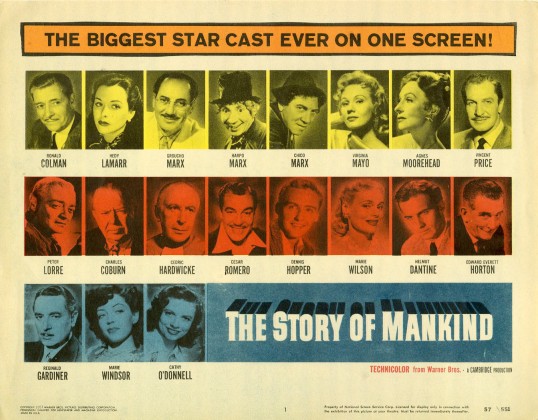
If, last night, you were suffering from insomnia at 3 in the morning, you could have turned on TCM and watched the 1957 faux epic, The Story of Mankind.
I call The Story of Mankind a faux epic because it’s an outwardly big film that turns out to be remarkably small on closer inspection. First off, it claims to the tell the story of Mankind but it only has a running time of 100 minutes so, as you can imagine, a lot of the story gets left out. (I was annoyed that neither my favorite social reformer, Victoria C. Woodhull, nor my favorite president, Rutherford B. Hayes, made an appearance.) It’s a film that follow Vincent Price and Ronald Colman as they stroll through history but it turns out that “history” is largely made up of stock footage taken from other movies. The film’s cast is full of actors who will be familiar to lovers of classic cinema and yet, few of them really have more than a few minutes of screen time. In fact, it only takes a little bit of research on the imdb to discover that most of the film’s cast was made up of performers who were on the verge of ending their careers.
The Story of Mankind opens with two angels noticing that mankind has apparently invented the “Super H-Bomb,” ten years ahead of schedule. It appears that mankind is on the verge of destroying itself and soon, both Heaven and Hell will be full of new arrivals. One of the angels exclaims that there’s already a housing shortage!
A celestial court, overseen by a stern judge (Cedric Hardwicke) is convened in outer space. The court must decide whether to intervene and prevent mankind from destroying itself. Speaking on behalf on humanity is the Spirit of Man. The Spirit of Man is played by Ronald Colman. This was Colman’s final film. In his heyday, he was such a popular star that he was Margaret Mitchell’s first choice to play Rhett Butler in Gone With The Wind. However, in The Story of Mankind, Colman comes across as being a bit bored with it all and you start to get worried that he might not be the best attorney that mankind could have hired.
Even more worrisome, as far as the future of mankind is concerned, is that the prosecutor, Mr. Scratch, is being played by Vincent Price. Making his case with his trademark theatrics and delivering every snaky line with a self-satisfied yet likable smirk on his face, Vincent Price is so much fun to watch that it was impossible not to agree with him. Destroy mankind, Mr. Scratch? Sure, why not? Mankind had a good run, after all…
In order to make their cases, Mr. Scratch and the Spirit of Man take a tour through history. Mr. Scratch reminds us of villains like the Egyptian pharaoh Khufu (John Carradine) and the Roman Emperor Nero (Peter Lorre, of course). He shows how Joan of Arc (Hedy Lamarr) was burned at the stake. The Spirit of Man argues that, despite all of that, man is still capable of doing good things, like inventing the printing press.
And really, the whole point of the film is to see who is playing which historical figure. The film features a huge cast of classic film actors. If you watch TCM on a semi-regular basis, you’ll recognize a good deal of the cast. The fun comes from seeing who tried to give a memorable performance and who just showed up to collect a paycheck. For instance, a very young Dennis Hopper gives a bizarre method interpretation of Napoleon and it’s one of those things that simply has to be seen.
And then the Marx Brothers show up!
They don’t share any scenes together, unfortunately. But three of them are present! (No, Zeppo does not make an appearance but I imagine that’s just because Jim Ameche was already cast in the role of Alexander Graham Bell.) Chico is a monk who tells Christopher Columbus not to waste his time looking for a quicker way to reach India. Harpo Marx is Sir Isaac Newton, who plays a harp and discovers gravity when a hundred apples smash down on his head. And Groucho Marx plays Peter Miniut, tricking a Native American chief into selling Manhattan Island while leering at the chief’s daughter.
And the good thing about the Marx Brothers is that their presence makes a strong argument that humanity deserves another chance. A world that produced the Marx Brothers can’t be all bad, right?
Anyway, Story of Mankind is one of those films that seems like it would be a good cure for insomnia but then you start watching it and it’s just such a weird movie that you simply have to watch it all the way to the end. It’s not a good movie but it is flamboyantly bad and, as a result, everyone should see it at least once.