Film Review: Keanu (dir by Peter Atencio)


12829114_1216777971683294_3106090959957069555_o

“KEANU!”

Meow!

“ARE YOU OKAY, KEANU!?”

Meow!

Greetings, fellow lovers of movies and cats!  So, Jeff and I just saw the new comedy, Keanu.  It’s the first film to star the quickly-becoming legendary comedy team of Keegan-Michael Key and Jordan Peele and it’s full of the type of humor that made their Comedy Central show, Key & Peele, such a success.  Perhaps even more importantly, the film stars an amazingly adorable little kitten!

You’ve seen the trailer, right?  You know how, when Peele first holds up his new kitten, Key immediately starts laughing and says, “Oh my God, that’s the cutest cat I’ve ever seen in my life!?”  Well, he’s not lying.  While I don’t think any cat is cuter than that one that I live with, Keanu the Kitten is definitely the cutest cat that I’ve ever seen in a movie.

Add to that, this kitten can act!  When this kitten stares, you truly believe that he’s listening to the dialogue being exchanged.  When he runs through a gunfight while bullets fly around him, you truly believe that this kitten is running for his life and you breathe a sigh of relief when he survives.  When he meows, your heart melts with each squeaky sound.  This is one amazingly talented kitten!

And it’s not surprising the everyone in the film wants Keanu.  The 17th Street Blips (led by Method Man and created as the result of a merger between the Bloods and the Crips) not only want Keanu but they want to rename him New Jack as well.  Their rival (played by Luis Guzman) wants Keanu and plans to rename him Eglesias.  Two mysterious assassins — the much feared, very sadistic, and always silent Allentown Boys — want Keanu too.  Since they don’t speak, they never say what they want to name him but it would probably be something cool.

And what really makes the film work is that none of them have a reason for wanting Keanu beyond the fact that he is literally the cutest kitten in Los Angeles.  This film is full of dangerous and violent people but all of them love this cat.  Everyone wants Keanu.

Well, I should say that everyone wants Keanu except for Anna Faris, who plays herself.  All Anna Faris wants is a chance to do the latest designer drug, Holy Shit.  (“It’s like smoking crack with God!” Method Man explains.)  It’s probably a good thing that Anna Faris doesn’t want a cat because, as this movie reveals, she also has a potentially dangerous fascination with sharp swords and playing truth or dare.

Of course, Keanu technically belongs to Rell (Jordan Peele).  They say that cats chose their owners and Keanu definitely does that when he shows up outside of Rell’s house.  Rell has just been dumped by his girlfriend and existence has no meaning for him.  But once Keanu shows up, Rell again learns to embrace life.  He spends two weeks taking pictures of Keanu reenacting scenes from classic movies.  But when the 17th Street Blips break into his house, mistakenly thinking that Rell has a supply of Holy Shit, they take Keanu for themselves.

Rell and his cousin Clarence (Keegan-Michael Key) team up to track down and retrieve Keanu from the Blips but there’s a problem.  Rell may brag about growing up in New York and Clarence may have stories about his childhood on the streets of Detroit but both of them are painfully out-of-place in the violent world of Blips and Anna Faris.  (Clarence is obsessed with George Michael while Rell “sounds like John Ritter all the time.”)  Fortunately, Rell and Clarence happen to look exactly like the Allentown Boys.  Method Man makes a deal with them.  If Rell and Clarence — who are now going by the names TekTonic and Sharktank — train the Blips then he will give them Keanu.

(Method Man’s character is actually named Cheddar.  Jeff just pointed out to me that Method Man previously played a character named Cheese on The Wire.)

While Rell struggles to fit in with the Blips, the nominally more straight-laced Clarence (who, unlike Rell, doesn’t even smoke weed) is soon having the time of his life.  It turns out that Clarence specializes in corporate team building and he’s excited to introduce these techniques to Blips.  (During one shootout, Clarence proudly announces, “They’re communicating!”)

Admittedly, Keanu is an uneven film.  It’s essentially a collection skits and some of them are funnier than others.  However, Key and Peele both bring so much commitment to bringing this insane story to life that they literally carry the audience over the occasional rough spot.  It may not be perfect but it’s a film that announces that, whether on TV or in the movies, Key & Peele are a comedic force to be reckoned with.

Plus, that kitten is so damn cute!

(And, in case you were wondering, Keanu Reeves does make an appearance of sorts.)

This film is 90 minutes of laughter and that’s certainly something that we all need right now!  See Keanu!

(Since you’ve probably already seen the trailer for Keanu — here it is, if you haven’t — let’s close this review with some exclusive audition footage.)

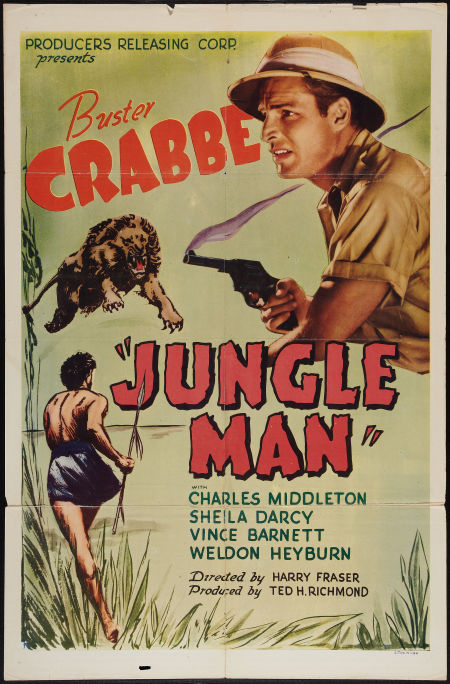
The Fabulous Forties #25: Jungle Man (dir by Harry L. Fraser)


40s

About a month ago, for reasons that I’m sure made sense at the time, I decided it would be fun to watch and review all 50 of the films included in Mill Creek’s Fabulous Forties box set.  If you know anything Mill Creek box sets, then you won’t be surprised to learn that the majority of these 50 films are public domain B-movies.  A few of them have been good, a few of them have been bad, and a few of them have been forgettable.

I have to admit that, as much as I love watching old movies, there’s a part of me that’s more than ready to move onto the next Mill Creek box set, the Nifty Fifties.  But, before I do that, I have to finish up the Forties.  Fortunately, I just watched the 25th film included in the Fabulous Forties and I am happy to say that I am now halfway done with this project!  Yay!

As for the film itself, it’s a 63-minute film from 1941.  Though it was later retitled Drums of Africa, it was originally called Jungle Man.

Jungle Man

As for what Jungle Man is about … well, it’s mostly about stock footage.

There is kind of a plot.  Wealthy Bruce (Weldon Heyburn) and his friend Alex (Robert Carson) want to go to Africa so that they can see the legendary City of the Dead.  Bruce’s fiancée, Betty (Sheila Darcy), decides to accompany them because she wants to visit her brother (Charles Middleton), a missionary.  Once they get to Africa, they also meet a doctor (Buster Crabbe) who is trying to find a cure for a fever that is wiping out the native population.

But really, the plot is mostly just an excuse for stock footage.  We watch as our explorers walk down a jungle trail.  Someone says, “Look up in that tree!”  We cut to grainy footage of a monkey in a tree.  Cut back to everyone looking upward.  Cut back to that monkey in the tree.  Suddenly, we hear a roar on the soundtrack.  Cut to slightly less grainy footage of a tiger running through a field.  Cut back to the explorers saying, “Look out, tiger!”  Cut back to the monkey climbing up higher in the tree.

(Of course, tigers don’t live in Africa but that’s just the type of film this is!)

Even when our heroes finally reach the City of the Dead, we don’t actually see them walking around the city.  Instead, we see them staring into the distance and then immediately cut to some still shots of what Wikipedia identifies as being Cambodia’s Angkor Wat.  Of course, no attempt is really made to match any of the shots.  If Jungle Man was made today, they could just CGI the Hell out of it.  But since it was made in 1941, audiences had to suspend their disbelief and accept shots that didn’t particularly match up with any other shots and a storyline that was pretty much determined by whatever stock footage the producers had available.

On the plus side, it’s only 60 minutes long and some of the stock footage is fun, particularly if you like cute monkeys or fierce tigers.  For the most part, it’s silly but inoffensive.

And you can watch it below!

(I should admit that, as I watched it, I kept thinking about those GEICO commercials where Jane and Tarzan are lost in the jungle and Tarzan refuses to ask for directions.  “Tarzan know where Tarzan go.”  “No, Tarzan does not know where Tarzan go.  Excuse me, do you know where the waterfall is?  The waterfall?”)

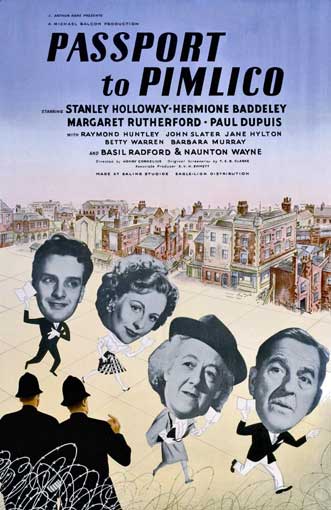
The Fabulous Forties #24: Passport to Pimlico (dir by Henry Cornelius)


Passport_to_Pimlico_film

The 24th film in Mill Creek’s Fabulous Forties box set was the 1949 British comedy, Passport to Pimlico!  Even though Passport to Pimlico is very much a British film (for instance, I had to use Wikipedia to discover the Pimlico is a neighborhood in London) and definitely a product of its time, it’s still a film that felt very relevant to some of the things that all of us in America are dealing with today.  If nothing else, Passport to Pimlico is definitely more memorable than Freckles Comes Home.

Passport to Pimlico opens in London.  World War II may be over but the city is still in the process of rebuilding.  War-time rationing is still in effect and all the residents of Pimlico regularly have to deal with the endless red tape of bureaucracy.  As well, there’s still unexploded German bombs littered around the neighborhood.  When a group of local children accidentally blow one of those bombs up, it leads to the discovery of a previously hidden cellar.  Inside the cellar is everything you could hope to find in a mysterious room: artwork, jewelry, and coins.  There’s also a parchment from the 15th Century, in which the king of England ceded the neighborhood to the final Duke of Burgundy.  Because no one knew that the charter existed, it has also never been revoked.  As a result, all of the citizens of Pimlico are actually citizens of dukedom of Burgundy.

That means two things: First off, the citizens are legally required to live under the laws of Burgundy, despite the fact that the dukedom no longer exists and those laws haven’t been changed since the 1400s.  Secondly, the neighborhood is no longer governed by the restrictive bureaucracy of postwar Britain.  In short, Pimlico — or Burgundy, as it is now called — is a free and independent state.

Soon, the nation of Burgundy is being overrun by greedy businessmen and enthusiastic shoppers.  The British respond by surrounding Burgundy with barbed wire and announcing that no one may cross the border.  The Burgundians react by demanding that anyone riding the underground through their country have a passport or run the risk being kicked off the train.

And things only escalate from there.  The British government is desperate to put Burgundy in its place while the citizens of Burgundy are determined to maintain their independence.  If Passport to Pimlico were made today, this is probably one of those situations that would either end in tragedy or with everyone learning not to question the whims of the government.  Fortunately, Passport to Pimlico was made in 1949 and, as a result, it is a genuinely warm-hearted comedy that celebrates both individual freedom and patriotism.

And really, it’s an enjoyable little film.  The cast is full of British character actors, all of whom deliver their dialogue with just the right amount of snark.  I enjoyed it and I have to admit that I related to it a bit.  As I look at America today and I think about what it’s going to be like in 2017 (regardless of who wins the presidential election because, let’s be honest, they all suck), there’s a part of me that would love a chance to get out of this country and be a Burgundian.

Seriously, come 2017, I’m seceding!

Until then, I guess I can just watch Passport to Pimlico.

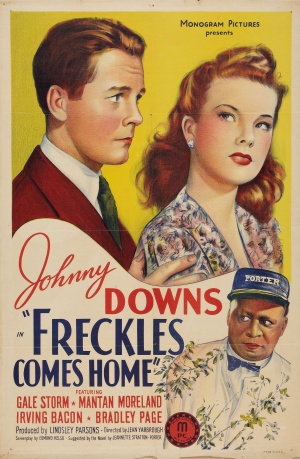
The Fabulous Forties #23: Freckles Comes Home (dir by Jean Yarbrough)


Freckles_Comes_Home_FilmPoster

The 23rd film in Mill Creek’s Fabulous Forties box set was an hour-long “comedy” from 1942.  The name of the film was Freckles Comes Home and I have to admit that I’m struggling to come up with anything to say about it.  That’s the thing about these Mill Creek box sets.  Occasionally, you’ll come across a really good movie and, even more frequently, you’ll come across a really bad movie.  But often times, you find yourself watching filler.  If I had to guess, Freckles Comes Home was probably a movie that was made to act as the 2nd half of a double feature.  Not much money nor effort was put into it.  It’s not terrible and it’s certainly not good.  It’s just sort of there.

With a title like Freckles Comes Home, I was expecting this movie would be about a lost dog but it turns out that I was wrong.  Freckles (played by Johnny Downs) is a human being.  He’s returning home from college because a friend of his has inherited some real estate and isn’t sure what to do about it.  While sitting on the bus home, Freckles spends so much time talking about how much he loves his hometown that the man sitting next to him decides that maybe he’ll make that town his home as well.  Unfortunately, that man is Muggsy Dolan (Walter Sande).  As you would expect with a name like Muggsy, Dolan is a criminal on the run.

Back in town, Freckles attempts to convince his father not to build a road that will go through his friend’s property.  He also romantically pursues a childhood friend named Jane (Gale Storm), despite the fact that everyone insists that Jane can do better than Freckles.  (Personally, I was wondering why — in the year 1942 — a young man like Freckles wasn’t overseas, fighting for his country.  DON’T YOU KNOW THERE’S A WAR ON, FRECKLES!?)  Meanwhile, Muggsy is plotting to rob the town bank…

And then there’s Jeff (Mantan Moreland), who is the porter at the local hotel.  Jeff thinks that he has a machine that will allow him to find buried gold.  And since Jeff is an African-American in a 1940s film, it’s impossible to watch the way the movie treats him without cringing.  There’s a few scenes where Moreland, as an actor, subtly suggests that Jeff is smarter than the movie gives him credit for and certainly, Moreland’s performance is the most memorable in the film but that really doesn’t make the role any less demeaning.

Anyway, Freckles Comes Home was largely forgettable.  I assume that audiences in the 1940s may have enjoyed it (especially if it was included on a double bill with a more interesting movie) but, seen today, there’s just not that much to be said about it.  It exists, it’s something of a time capsule, and that’s pretty much all there is to say about it.


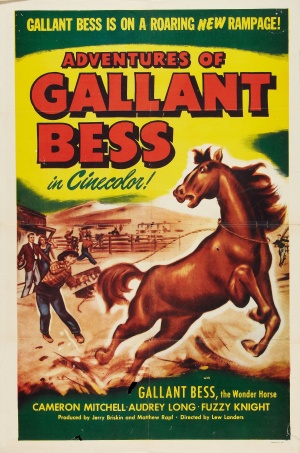
The Fabulous Forties #22: Adventures of Gallant Bess (dir by Lew Landers)


Adventures_of_Gallant_Bess_FilmPoster

For nearly a month now, I’ve been making my way through the 50 films included in Mill Creek’s Fabulous Forties box set.  Like most Mill Creek box sets, the Fabulous Forties is full of public domain films.  Some of them are surprisingly good and some of them are surprisingly bad.  And then there are others that are somewhere right in the middle of bad and good.  These are films that may not be great works of cinematic art but, at the very least, they serve as a time capsule of the period in which they were made.

The 22nd film in the Fabulous Forties box set, 1948’s Adventures of Gallant Bess, is just such a film.  Obviously made to appeal to family audiences, Adventures of Gallant Bess tells a fairly predictable story.  Cowboy Ted Daniels (a youngish Cameron Mitchell) captures a wild mustang named Bess.  Ted and Bess soon become inseparable but, during a visit to the local town, Bess gets riled up and destroys a few cars.  Ted is told that he has to pay for the cars but he doesn’t have any money.  So, he enters the local rodeo.

However, the rodeo is operated by the evil Bud Millerick (James Millican) and Bud wants Bess for his own.  So, he arranges for Ted’s leg to be broken by a bull.  Injured and unable to work, Ted is forced to sell his beloved Bess to Bud.  Once Ted recovers, he discovers that Bud is abusing Bess and forcing her to perform in a demeaning rodeo show.  What’s a cowboy to do but steal back his horse?

You can probably guess everything that happens in Adventures of Gallant Bess just from reading the plot description but it’s still a pretty likable film.  Bess is a wonderful horse and there’s something oddly endearing about the obviously cheap sets and the often melodramatic performances.  Cameron Mitchell, of course, is best known for appearing in films like Blood and Black Lace, The Toolbox Murders, The Demon, The Swarm, and Space Mutiny, so it’s definitely interesting to see him playing a simple and honest cowboy here.

(It’s actually difficult to recognize Mitchell until he smiles.  Once you see that smirk, you know exactly who is playing Ted Daniels.)

Adventures of Gallant Bess was filmed in color, which was a big deal in 1948.  Seen today, it is so saturated with color (and so obviously filmed on sound stages) that the movie actually looks like a live action cartoon.  Seen today, it’s perhaps a little too easy to be dismissive of this old-fashioned film but I imagine that, in the 40s, it was quite a fun movie to watch.

And you can watch it below!

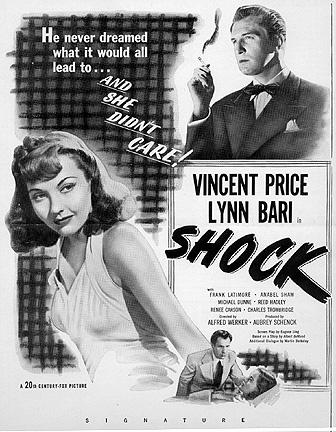
The Fabulous Forties #21: Shock (dir by Alfred L. Werker)


The 20th film in Mill Creek’s Fabulous Forties box set was Frank Capra’s Meet John Doe.  Since I had already watched and reviewed Meet John Doe for last year’s Shattered Politics series of reviews, I decided to skip forward to the next film.

That film turned out to be the 1946 psychological thriller, Shock (not to be confused with Mario Bava’s masterpiece of the same name).

Shock_movie_poster

Shock opens with a young housewife named Jane Stewart (Anabel Shaw) waking from a dream, getting out of bed, looking out a window, and seeing something rather serious happening in the house next door.  A man and a woman are arguing.  Though Jane doesn’t recognize the man, horror fans will immediately realize that he’s Vincent Price, without a mustache.  As Jane watches, the man beats the woman to death.  When Jane’s husband, Lt. Paul Stewart (Frank Latimore), returns home, he discovers that Jane is in a catatonic state.

Paul calls the local cranky physician, Dr. Harvey (Charles Trowbridge), to the house.  Dr. Harvey takes one look at Jane and announces, “She’s in shock!”  (YAY!  WE HAVE A TITLE!)  Paul looks confused so Dr. Harvey goes on to explain, “She’s had a great shock.”  Unfortunately, Dr. Harvey is not trained to deal with shock but he knows someone who is.  That man’s name is Dr. Richard Cross.

Soon Dr. Cross shows up and — OH MY GOD, IT’S VINCENT PRICE!  That’s right — Dr. Cross not only caused Jane’s shock but now he’s going to treat it!  Or is he?  Though Dr. Cross claims to be wracked with guilt over the murder, his nurse, Elaine Jordan (Lynn Bari), is less concerned about it.  In fact, since Elaine is also his mistress, she’s rather happy that Dr. Cross has murdered his wife.  Now, she just has to convince him to murder Jane before she recovers from her shock.

(Interestingly enough, Dr. Cross’s plan involves treating Jane with insulin shock therapy, which would seem to indicate that Dr. Cross has seen Dr. Kildare’s Strange Case too many times.)

I had high hopes for Shock, largely because of the presence of Vincent Price.  From what I’ve read, the box office success of Shock changed the course of Price’s career.  Before Shock, Price was a character actor who occasionally got a good supporting role.  After Shock, he was transformed into the horror icon who we all know and love today.  Shock was the first time that Price was cast in the type of mad scientist role that would later become his trademark.  For that reason, Shock has an important place in the history of cinematic terror.

But, unfortunately, Shock itself is kind of forgettable.  It’s pretty much your standard thriller, one that makes the mistake of revealing Price’s villainy from the start.  (It would have been far more effective if the film tried to shock us with the realization that Price is the bad guy.)  It’s always fun to watch Vincent Price in a movie but he actually gives a rather subdued performance here and, as a result, he’s not as much fun as he would be in his later films.  In other words, Shock is no House On Haunted Hill.

That said, Shock is definitely a piece of film history and, as such, it’s worth watching.  And here it is:


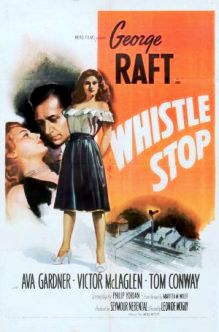
The Fabulous Forties #19: Whistle Stop (dir by Leonide Moguy)


Whistle_stop_poster_small

The 19th film in Mill Creek’s Fabulous Forties box set was 1946’s Whistle Stop and I’m sad to say that I ran into some trouble when I tried to watch it.  As much as I love the Mill Creek box sets, the DVDs within are somewhat notorious for getting easily damaged.  That was the problem that I ran into when I tried to watch Whistle Stop.  From the minute I hit play, the film would randomly pause.  The picture would randomly pixelate.  The sound would randomly vanish.  As you may have picked up, it was all very random but it also made it impossible for me to watch Whistle Stop.

However, like almost every other film that’s ever shown up in Mill Creek box set, Whistle Stop is in the public domain and, therefore, it’s been uploaded to YouTube by dozens of different accounts.  Once I realized that the DVD wasn’t going to work, I switched over to YouTube and I finally got watch Whistle Stop.

Really, I probably shouldn’t have gone to all the trouble.  Of the 19 Fabulous Forties films that I’ve watched so far, Whistle Stop is perhaps the least interesting.  Half of the film is a film noir and the other half if a small town melodrama but, with its convoluted plot and uninspired direction, it really doesn’t work as either.

Mary (Ava Gardner) grew up in a small town but, eventually, she left and went to the big city, hoping to make a new life for herself.  Apparently, she didn’t succeed because, two years later, she returns to the small town.  (The town is so small and obscure that it’s mostly known for its train stop.  Hence, it’s a “whistle stop.”)  When she returns, she discovers that her ex-boyfriend, Kenny Veech (George Raft) has become a loser in her absence.  Kenny is still in love with her but he’s also bitter at her for leaving town.

Making things even worse, from Kenny’s point of view, is that Mary is now dating a sleazy nightclub owner named Lew Lentz (Tom Conway).  Kenny’s best friend, Gitlo (Victor McLaglen), comes up with a plan, in which he and Kenny will kill Lew and make it look like a robbery.  However, Lew has plans of his own and…

You know what?  I’m probably making Whistle Stop sound more interesting than it actually is.  This is one of those films were the plot manages to be absurdly complicated without actually adding up to much. On the plus side, Ava Gardner, one of my favorite of great femme fatales, is beautiful and sultry as Mary and reminded me of why, for several years, Film Noir Femme Fatale was my default Halloween costume.  Tom Conway makes Lew Lentz so amazingly sleazy that you can’t help but admire his commitment to the role.  On the other hand, George Raft is totally miscast and way too handsome and naturally rakish to play a total loser like Kenny Veech.  Watching the film, you can tell that he wasn’t particularly comfortable playing such an insecure and passive character.

Whistle Stop wasn’t particularly memorable but if you want to watch it, you can do so below.  It’s free!

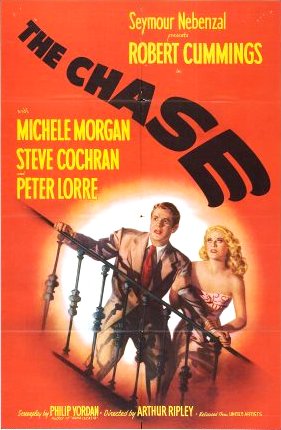
The Fabulous Forties #18: The Chase (dir by Arthur Ripley)


The_Chase_1946_posterThe 18th film in Mill Creek’s Fabulous Forties box set was 1946’s The Chase, which turned out to be a pretty nifty little film noir.  Did I actually just use the word nifty in a film review?  Yes, I did but then again, everyone should use the word “nifty” at least once in their lives.

The Chase tells the story of Chuck Scott (Robert Cummings), whose life is anything but nifty.  When we first meet him, he’s standing outside in the rain, staring into a restaurant, and enviously watching the people eating inside.  Chuck is a returning serviceman.  He helped to win World War II but he’s now returned to a society that has changed in his absence.  He has no money, he has no home, and he suffers from what we would today call PTSD.

Things change for Chuck when he finds the wallet of a man named Eddie Roman (Steve Cochran).  He returns the wallet, discovering that Eddie not only lives in a mansion but he also has a sinister henchman named Gino (Peter Lorre!).  Eddie is so impressed that Chuck returned the wallet and didn’t try to steal any of the money that he offers to put Chuck on the payroll.

Soon, he is working as Eddie’s driver.  Of course, Eddie has an accelerator installed in the backseat, so that he can control how fast the car is going.  Eddie enjoys freaking Chuck out by randomly speeding up the car.  Along with being a spectacularly bad passenger, Eddie also turns out to be a gangster.

When Chuck meets the mysterious Lorna (Michele Morgan), it’s love at first sight but there’s a big problem.  Lorna happens to be married … to Eddie!  Chuck and Lorna flee to Cuba, with Eddie and Gino in pursuit…

Or do they?

Chuck, it turns out, has been suffering from nightmares since he returned from the war.  Often times, he wakes up with amnesia.  Are Eddie, Gino, and Lorna real or are they just figments of Chuck’s dream state?  Is Chuck really living in a film noir or is he just dreaming that he is?

The Chase is an effectively dark little film noir, one that will keep you guessing.  Steve Cochran appears to be having a lot of fun as the cheerfully sociopathic Eddie (and it’s interesting to note that, in the same year as The Chase, Cochran had a supporting role in another film about the struggles of returning servicemen, the Oscar-winning Best Years Of Our Lives) and, of course, Peter Lorre is great as Gino.  Michele Morgan is both sympathetic and enigmatic as Lorna and Robert Cummings does a good job of playing a man who is never quite sure whether he’s awake or he’s asleep.

The Chase is a classic mix of film noir and psychological melodrama.  Watch it below!

Film Review: My Little Sister (dir by Roberto and Maurizio del Piccolo)


If there’s anything that I’ve learned, from my long history of watching horror films, it’s that only fools go camping.  Seriously, nothing good ever comes from wandering around in the woods or sleeping in a tent.  Inevitably, you’re either going to attacked by a zombie while you’re skinny dipping in the nearby pond or a man with a machete is going to show up while everyone’s busy having sex in a tent.  In short, nudity and the great outdoors equals death.

And really, it makes sense.  When you’re camping, you’re in an isolated place and you are totally at the mercy of the elements, the killers, and occasionally the zombies.  There’s a reason why so many horror films center around unlucky campers.  Because, seriously, camping is terrifying!

Just check out My Little Sister, for instance.

My Little Sister is the latest film from directors Roberto and Maurizio del Piccolo.  It opens in the wilderness, with shots of an old woman wandering through the woods.  The old woman looks happy but it’s a disturbing sort of happiness.  First off, she’s wearing a nightgown, which isn’t exactly the most practical wandering around in the woods outfit.  Secondly, her wrists are heavily bandaged.  And finally, she doesn’t really seem to have an easily identifiable reason for being out there in the woods.  She spends a while picking up leaves and smiling at them.  Occasionally, she crawls around in the dirty.  As we watch her, we occasionally cut to black-and-white photographs of an unhappy looking family and headlines about missing tourists.

While the old woman plays with leaves, something far more disturbing is happening in a nearby house.  In one room, a bound and terrified woman (Sofia Pauly) watches as her boyfriend is murdered and another woman is killed with a weed whacker.  Doing the killing is a hunched over, grunting man (Saverio Percudani) who appears to be horribly disfigured…

In another room of the house, an unmoving figure sits in front of a TV and watches grainy footage of a young girl holding an older man a bottle of what appears to be water.  The man pours the liquid on his face and suddenly starts to scream.  Hmmm…apparently, it wasn’t water…

Meanwhile, in the woods, campers Sheila (Holli Dillon) and Tom (Mattia Rossellini) watch as the old woman plays with the leaves and they laugh at her, which may seem mean but I think most of us would probably do the same thing.  Sheila and Tom are supposed to meet up with their friends but their friends are nowhere to be seen.  Instead, there’s just an empty campsite and an eccentric woodsman (David White) warning them to beware of someone that he calls the little sister…

Of course, all of these storylines converge but I’m not going to tell you how.  You may think that you’ve figured out some of it just by reading the review up to this point but My Little Sister has a few surprises up its sleeve.  There’s a little twist at the end that my horror-loving soul absolutely loved.  Let’s just say that, in this film, no one is every truly safe.

My Little Sister plays out like a mix of Friday the 13th, The Texas Chainsaw Massacre, and — believe it or not — Sinister.  At its best, My Little Sister achieves a dreamlike intensity.  The wilderness is filmed to look both beautiful and threatening at the same time and the scenes in the house, in particular, are pure nightmare fuel.  When it comes to a film like this, the effectiveness depends on how much you care about the potential victims and fortunately, both Holli Dillon and Sofia Pauly give totally believable, sympathetic, and relatable performances.  As I watched them try to survive, I kept wondering what I would do if I found myself in the same situation.  I doubt it would end well.

Finally, there’s no way I can finish this review without making a special mention of Lucia Castellano, who gives a really good and genuinely surprising performance as the crazy old woman in the wilderness.  She is both frightening and sympathetic at the same time.

My Little Sister is a brutally effective and entertaining horror film.  Keep an eye out for it!

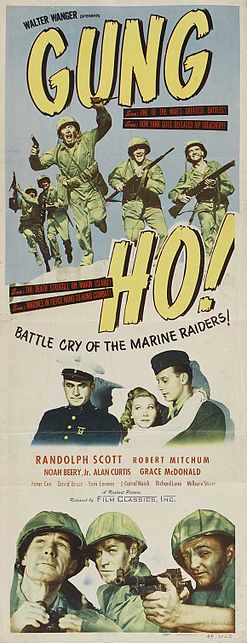
The Fabulous Forties #17: Gung Ho! (dir by Ray Enright)


Gunghopos

The 17th film in Mill Creek’s Fabulous Forties Box Set was the 1943 war film, Gung Ho!

Gung Ho!, which is filmed in a documentary style and features a narrator, opens with a series of job interviews.  A tough lieutenant (J. Carrol Naish) is recruiting Marines to serves in a special unit, one which will only take on the most hazardous of assignments.  The narrator reminds us that the interviews are taking place just a few weeks after the attack on Pearl Harbor and we listen as each interviewee is asked whether or not he is okay with killing members of the Japanese army.

Some of the interviewees hesitate and some don’t but ultimately, all of them are okay with killing.  One (Rod Cameron) explains that he’s already a murderer, having killed someone back in Kentucky.  Another says that he fought in the Spanish Civil War and that he sees his service as being a continuation of the fight against fascism.  Another Marine (Alvan Curtis) says that he’s an ordained minister but he’s willing to do what has to be done.  A Marine named Pig Iron shows up and, since he’s played by a young Robert Mitchum, we know that he’ll get things taken care of.

And then we get to the final interviewee.  He doesn’t have a big role in the film but his one line makes a big impression.  When asked why he doesn’t mind the idea of killing, he replies, “I just don’t like Japs.”

AGCK!

That’s a line that would definitely not make it into a modern version of Gung Ho!  Or, if it did, it would be followed by the interviewee being admonished and then kicked out of the office.  But Gung Ho! was made in 1943, at the height of World War II and in the shadow of Peal Harbor.  As uncomfortable as it may make us today, “I just don’t like Japs,” was probably Gung Ho‘s big applause line when it was originally released.

And really, that’s the main value of a film like Gung Ho!  It’s a well-made but predictable war film but ultimately, it’s most important as a time capsule.  If you want to know the truth about an era’s culture, as opposed to what you may want the truth to be, look at the art.  Read the books.  Watch the movies.  You may not always like what you find but you owe it to yourself to do so.

Anyway, as far the rest of Gung Ho!, it plays out exactly as you would expect.  Under the eye of Lt. Commander Thornwald (Randolph Scott), the men train for combat.  They visit Pearl Harbor and see the sunken remains of ships that are still smoking after being bombed.  And finally, the men fight the Japanese on an island.  Some survive.  Many more of them die.  And the fight continues.

Gung Ho! will probably be best appreciated by fans of war films, which admittedly I am not.  That said, it is an interesting time capsule of 1943 America.  Plus, it features Robert Mitchum!  Admittedly, it’s a small role but he does get two great scenes and … well, he’s Robert Mitchum!  How can you not enjoy watching Robert Mitchum?

And guess what?  You can watch Gung Ho! below!