Cleaning Out The DVR, Again #37: All This And Heaven Too (dir by Anatole Litvak)


(Lisa is currently in the process of trying to clean out her DVR by watching and reviewing all 40 of the movies that she recorded from the start of March to the end of June.  She’s trying to get it all done by the end of July 11th!  Will she make it!?  Keep visiting the site to find out!)
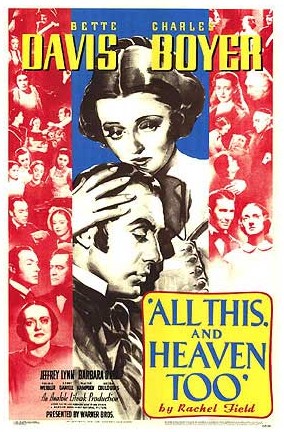
All_this_heaven_movieposter

The 37th film on my DVR was the 1940 film, All This, And Heaven Too.  It originally aired on June 21st on TCM.

All This, and Heaven Too is one of the many melodramatic historical romances in which Bette Davis appeared in the late 30s and early 40s.  These films usually featured Bette as a strong-willed woman who was often condemned for not conforming to the rules of society.  Typically, she would end up falling in love with a man who society said she could not have.  Bette almost always seemed to end up alone, which I guess was the way women who thought for themselves were punished back then.

In this one, Bette plays Henriette Deluzy, a French woman who ends up in America in the 1850s.  When she shows up to start teaching at a private, all-girls school, her students immediately start gossiping about her.  It seems that Henriette was at the center of some sort of European scandal and everyone is speculating about what happened.  Finally, at the start of class, Henriette tells her students that she’s going to tell them the true story of what happened back in France.

It turns out that Henriette was a governess.  She took care of the four children of the Duc de Praslin (Charles Boyer) and his wife, the Duchesse (Barbara O’Neil).  The Duchesse was mentally unstable and soon came to suspect that her husband had fallen in love with Henriette.  Though she may have been insane, it turned out that the Duchesse was correct.  When the Duchesse fired Henriette and then lied to her husband about it, the Duc flew into a rage and murdered his wife.

Under the laws of the time, the Duc could only be judged by his fellow noblemen.  He was told that if he simply confessed and said that Henriette was the one who drove him to commit the murder, he would be set free.  (As opposed to the characters that Bette Davis played in The Letter and The Little Foxes, Henriette was totally innocent.)  Would the Duc confess and allow Henriette to be blamed or would he deny his love for her and sacrifice his life as a result?

All This, And Heaven Too is a rather slow movie and it’s hard not to be disappointed that Henriette is such a boring character.  She’s so innocent and victimized that the role almost seems like a waste of Bette Davis’s talents.  A big production that featured lavish (though black-and-white) recreations of 19th Century France, All This, And Heaven Too was probably a big deal for contemporary audiences and, if you’re a Bette Davis or Charles Boyer completist, you might enjoy it.  But otherwise, it’s really nothing special.

All This, And Heaven Too was among the 10 films nominated for Best Picture of 1940.  However, it lost to Rebecca.

Cleaning Out The DVR, Again #36: Killer Assistant (dir by Danny J. Boyle)


(Lisa is currently in the process of trying to clean out her DVR by watching and reviewing all 40 of the movies that she recorded from the start of March to the end of June.  She’s trying to get it all done by the end of July 11th!  Will she make it!?  Keep visiting the site to find out!)

ka

The 36th film on my DVR was Killer Assistant (also known as simply The Assistant.)

Killer Assistant originally aired on Lifetime on June 20th and it won major points from me just because of the title.  Though often underappreciated, administrative assistants are the glue that hold most offices together.  If there were no administrative assistants, the entire world would literally stop spinning so I’m always happy whenever I see a movie in which the assistants finally get their revenge.

The assistant of the title is … well, he claims his name is David (Brando Eaton).  That’s not his real name, of course.  And he’s really not from a small town in upstate New York despite what he tells everyone.  He may be a shady character who stole someone else’s identity but that doesn’t mean that he’s not a good assistant!  He especially proves to be invaluable to Suzanne Austin (Arianne Zucker), an editor at a fashion magazine.  As Suzanne struggles to put together the magazine’s 50th anniversary edition (all the while being watched by her boss, who bare a probably not coincidental resemblance to Anna Wintour), David proves to be a great source of ideas.  When Suzanne thinks that she’s seen her husband (George Stults) cheating on her, David proves to be a great source of comfort.

Which is another way of saying that they end up having a one night stand.  How passionate do things get?  So passionate that the sex scene is actually shown in slow motion.  (You know that Lifetime is getting serious when they start using the slow mo.)  However, the next morning, Suzanne announces that the previous night was a “mistake” and tells David that he is fired.

David, however, has other ideas.  After all, he already went through the trouble of attacking one of Suzanne’s other assistants just to make sure that he’d be able to keep his job.  David tells Suzanne that he’s not going anywhere.  He’s going to continue to answer the phones for her and schedule meetings for her.  And if she has a problem with that, he’ll just show everyone the little film that he made of the two of them during the previous night.

So, Suzanne is stuck with David.  And David is now flirting with her rebellious teenage daughter, Calista (Natalie Lander).

Anyway, Killer Assistant is rather ludicrous but I enjoyed it because 1) it was about a crazy administrative assistant and 2) it took place at a fashion magazine and was, therefore, full of bitchy dialogue.  Plus, Brando Eaton did a really good job in the role of David.  He was just so clean-cut, helpful, and cheerful, no matter what terrible things he was plotting.  As I watched the film, I found myself imagining a possible spin-off in which Suzanne is a guest judge on Project Runway and David blackmails her into praising the ugliest dress.  It was fun!

(For those keeping track of my efforts to clean out my DVR, that’s 36 films down and 4 to go!)

Cleaning Out The DVR, Again #35: A Father’s Secret (dir by R. D. Braunstein)


(Lisa is currently in the process of trying to clean out her DVR by watching and reviewing all 40 of the movies that she recorded from the start of March to the end of June.  She’s trying to get it all done by the end of July 11th!  Will she make it!?  Keep visiting the site to find out!)

Father's Secret

(MINOR & MAJOR SPOILERS BELOW!)

The 35th film on my DVR (only 5 more films to go!) was A Father’s Secret.  A Father’s Secret originally aired on the Lifetime Movie Network on June 19th.  It’s about a father who has a secret!

Actually, it’s about more than just that.  It’s also about an attorney named Carrie Evans (Willa Ford).  Carrie would appear to have everything.  She has great hair, a great job, a great apartment, and a great boyfriend.  What she does not have is any knowledge of who her mother was.  She’s close to her father, however.  Or, at the very least, she’s close to the man who she thinks is his father.  He’s not actually her father but that’s all a part of the secret.

Carrie is also close to Cagswell Foxx (Daniel Hugh Kelly), the senior partner at the law firm.  Cagswell is rich, old, white, and politically ambitious so we already know that he’s going to turn out to be a bad guy.  Cagswell has assigned Carrie to defend an oil company in a wrongful death lawsuit.  (Boooo!  Oil company!  Hissssssss!)

One night, Carrie is shocked when she receives an envelope that is full of pictures of her undressing.  At first, Carrie assumes that it must have been sent by environmental activist, Greg (Aidan Bristow).  However, Greg tells her that the picture were sent by Cagswell.  Why?  Because Cagswell wants to have something on her, just in case he needs to use it in the future…

Wow, that Cagswell is really evil!

Carrie decides to take a closer look at the details of that wrongful death case.  As she illegally goes though the files in Cagswell’s office, she comes across a picture of a youngish Cagswell with a woman who seems oddly familiar to her.  Carrie decides to discover the woman’s identity and soon learns that the woman has been missing for decades.  And the last person she was seen with?  Cagswell Foxx!

Of course, Cagswell isn’t just interested in covering up crimes and helping out the oil companies.  Cagswell is also running for the U.S. Senate!  Do you think all of this could possibly lead to Carrie challenging Cagswell right in the middle of a political rally?

Of course, it could!

A Father’s Secret is predictable but well-done.  Daniel Hugh Kelly is properly sleazy as Cagswell, while Willa Ford is surprisingly credible as a lawyer.  Director R. D. Braunstein brings a surprising amount of visual flair to this Lifetime film, with the film’s opening montage being especially well-done.  A Father’s Secret is full of melodrama and silly plot twists and, in the end, it’s a lot of fun!

What more can you ask for, really?


Cleaning Out The DVR, Again #34: Revenge Porn (dir by Monika Mitchell)


(Lisa is currently in the process of trying to clean out her DVR by watching and reviewing all 40 of the movies that she recorded from the start of March to the end of June.  She’s trying to get it all done by the end of July 11th!  Will she make it!?  Keep visiting the site to find out!)

Revenge Porn

The 34th film on the DVR was Revenge Porn, which I recorded off of Lifetime on June 18th.

Here’s two important things to know about Revenge Porn:

First of all, when it originally aired, I live tweeted it on twitter, along with several other friends.  Needless to say, we used the hashtag #RevengePorn.  Also needless to say, using #RevengePorn as a hashtag ended up getting me a lot of attention from people who weren’t necessarily watching the film.  I picked up a lot of new followers that night.

(Of course, most of them left once I started to tweet about Big Brother.)

Secondly, when it came time to write this review, I wanted to make sure that I had at least one image to go along with it.  So, innocently, I did a google image search on “Revenge Porn.”  That turned out to be a big mistake.  If you want to find pictures from this film, I suggest that you do a search for “Elisabeth Rohm Lifetime movie.”  It’ll be a lot less traumatic.

As for the film itself, it starts out like a more respectable version of Break-Up Nightmare.  The innocent and college-bound Peyton Harris (Tiera Skovbye) is up in her bedroom, taking topless pictures, while her overprotective parents (Elisabeth Rohm and David Lewis) are downstairs.  In fact, the only real difference between the opening of Break-Up Nightmare and Revenge Porn is that Peyton isn’t taking the pictures for a boyfriend.  Instead, she’s considering whether or not to get a boob job.

Otherwise, the first hour of the film plays out pretty much the same as Break-Up Nightmare.  Peyton’s best friend (Jodelle Ferland) is jealous over Peyton’s great future and, in a moment of spite, sends naked pictures of Peyton to everyone at school.  However, things get even worse when Carl Cook (a thoroughly creepy performance fro Levi Meaden) comes across Peyton’s pictures and posts them on his revenge porn website, ExMyEx.  Cook claims that what he’s doing is perfectly legal and that it’s the fault of his victims for taking naked pictures in the first place.  Peyton’s mom decides to try to bring the website down and Carl seeks revenge…

However, after about an hour of this, the film goes totally crazy.  Angered over their attempts to shut him down, Carl starts to harass the Harrises in every over-the-top way imaginable. Since Carl Cook is a hacker (which, in the world of Lifetime films, is the equivalent of being an MCU-style super villain), there is literally nothing that he can’t do.

Send threatening texts to every member of the family?  Carl can do it!

Send and re-send naked pictures of Peyton to everyone on the planet?  Carl can do it!

Cancel everyone’s credit cards and destroy the family’s finances?  Carl can do it!

Cancel Peyton’s college scholarships?  Carl can do it!

Issue a warrant for Peyton’s father arrest?  Carl can do it!

Eventually, the Harrises even find themselves being chased by a drone, which Carl is apparently controlling from his super villain lair!

When it comes to movies about creepy hackers and naked pictures, Break-Up Nightmare is definitely the one to go with.  But Revenge Porn has its own strengths.  Both Rohm and Skovbye give good performances and, seriously, as played by Levin Meaden, Carl Cook is one of the most loathsome villains to ever appear in a Lifetime movie.

If you’re a fan of the Lifetime way of telling cinematic morality tales, Revenge Porn is one to keep an eye out for.  Hopefully, Lifetime will be do a Revenge Porn/Break-Up Nightmare double feature at some point in the future.

Cleaning Out The DVR, Again #33: The Night Stalker (dir by Megan Griffiths)


(Lisa is currently in the process of trying to clean out her DVR by watching and reviewing all 40 of the movies that she recorded from the start of March to the end of June.  She’s trying to get it all done by the end of July 11th!  Will she make it!?  Keep visiting the site to find out!)

Nightstalker

The next film on my DVR was The Night Stalker.  Though I recorded the film off of Lifetime on June 12th, the film actually made its premiere 8 days earlier when it played at the Seattle International Film Festival.

The Night Stalker tells a story about the real-life serial killer Richard Ramirez.  Ramirez was a drifter and a self-declared Satanist who, in the 1980s, went on a murder spree in Los Angeles and San Francisco.  He was eventually captured, not by the police but by a group of citizens who saw his picture in a newspaper.  Ramirez spent the rest of his life of California’s death row, where he died in 2013.  Despite spending the majority of his life condemned to death, Ramirez was never executed.  Instead, he died of lymphoma.

Of the thousands of serial killers who have haunted America’s nightmares over the past few decades, Ramirez was infamous for both the savagery of his crimes and the fact that he never showed any remorse.  The famous footage of him smirking in the courtroom and shouting, “Hail Satan!” has shown up in a countless number of “World’s Most Evil” cable documentaries.  Ramirez is also infamous for being better-looking than the average serial killer.  From the minute he was arrested to the day of his eventual death, Ramirez had admirers and groupies.

It’s a disturbing story and, for the most part, The Night Stalker does it justice, using Ramirez to tell an intense story about a man without a soul.  This is a seriously dark and disturbing little movies, with the scenes of Ramirez’s abusive childhood and subsequent crimes achieving a nightmarish intensity in a way that you would rarely expect to see on Lifetime.

The film itself deals with a lawyer named Kit (played by Bellamy Young) who interviews Ramirez (Lou Diamond Phillips) during the final days of his life.  Kit is hoping that she can get Ramirez to confess to committing a murder in Texas and help to get a condemned man off of death row.  However, Kit has another reason for wanting to talk to Ramirez.  She was a teenager (played, in flashbacks by Chelle Sherrill) during Ramirez’s crime spree.  (The young Ramirez is played by Benjamin Barrett.)  While Ramirez was murdering the people in her neighborhood, Kit was dealing with her abusive stepfather and her passive mother.  As a result of her childhood, Kit is impulsive and often self-destructive and she hopes that by understanding Ramirez, she can maybe somehow understand how own childhood.

(In many ways, Kit stands in for many of the women who, for various reasons, became obsessed with Ramirez after his arrest and imprisonment.)

As for Ramirez — well, he’s a manipulative asshole.  That’s actually the best that you can say about him.  The film portrays the details of Ramirez’s own abusive childhood but, to its credit, the film never tries to turn Ramirez into a sympathetic character.  The performances of Lou Diamond Phillips and Benjamin Barrett both come together to create a chilling portrait of a man who is literally empty on the inside.

It’s not a perfect film, by any means.  The scenes set in Texas feature a few notably dodgy accents and, occasionally, the film comes close to turning into a Silence of the Lambs rip-off.  But, for the part, this is a thoroughly disturbing and, at times, frightening portrait of life at its worse.  The Night Stalker is a deeply creepy portrait of an all too real evil.  Watch it but be aware that it may lead to nightmares.

Cleaning Out The DVR, Again #32: His Double Life (dir by Peter Sullivan)


(Lisa is currently in the process of trying to clean out her DVR by watching and reviewing all 40 of the movies that she recorded from the start of March to the end of June.  She’s trying to get it all done by the end of July 11th!  Will she make it!?  Keep visiting the site to find out!)

His Double Life

(MINOR SPOILERS)

The 32nd film on my DVR was His Double Life, which I recorded off of the Lifetime Movie Network on June 12th.

His Double Life has a plot that will be familiar to anyone who has ever watched a Lifetime film.  Scarlett (Cristine Prosperi) is still recovering from the trauma of her father’s death in a traffic accident.  It doesn’t help that, five years later, her mother, Linda (Emmanuelle Vaugier), has married her father’s former business partner, Greg (Brian Krause).  Scarlett doesn’t trust Greg.  Admittedly some of that is because she resents Greg trying to take the place of her father but, at the same time, there is definitely something off about Greg.  He tries too hard.  He never seems to be sincere when he’s being friendly.  He practically oozes sleaze.

And yet, somehow, Scarlett seems to be the only person who has any suspicions about Greg.  This is a common theme in Lifetime films.  Even when someone is obviously up to no good, only one person ever seems to notice.  Everyone else just makes excuses for Greg’s behavior.  And you know what?  That’s actually a lot more plausible than a lot of critics are willing to admit.  No one ever wants to admit that their neighbor might be a serial killer.

Or a spy.

Anyway, Scarlett thinks that there’s something wrong with Greg.  So, while visiting home from college, Scarlett decides to follow Greg around.  She sees Greg with another woman and is convinced that she caught him cheating.  However, the next day, the woman turns up dead!

Is Greg a murderer?

Or is he a spy?

You’ll have to watch the movie to find out!

(He’s both.)

His Double Life is an entertaining Lifetime film, with all that implies.  However, there are two things that make this Lifetime film especially memorable.

First off, the film ends with a title card that informs us that, ever since the end of the Cold War, the number of Russian spies in the United States has actually increased.  “They’re your neighbors.  Your friends.  YOUR HUSBANDS!”  Seriously, it was so melodramatic and silly (and intentionally so, I like to believe) that I couldn’t help but love it.

Add to that, His Double Life continues the trend of former Degrassi cast members showing up in Lifetime movies.  Cristine Prosperi is well-remembered for playing, over the course of three seasons, the endearingly quirky Imogen on Degrassi.  Scarlett is a bit more conventional than Imogen but Prosperi still does a great job playing her.  For that matter, Brian Krause also does a good job as the menacing Greg.

Enjoy His Double Life!  Just remember that the person you watch it with could easily be a Russian spy…

Cleaning Out The DVR, Again #31: The Gay Divorcee (dir by Mark Sandrich)


(Lisa is currently in the process of trying to clean out her DVR by watching and reviewing all 40 of the movies that she recorded from the start of March to the end of June.  She’s trying to get it all done by the end of July 11th!  Will she make it!?  Keep visiting the site to find out!)

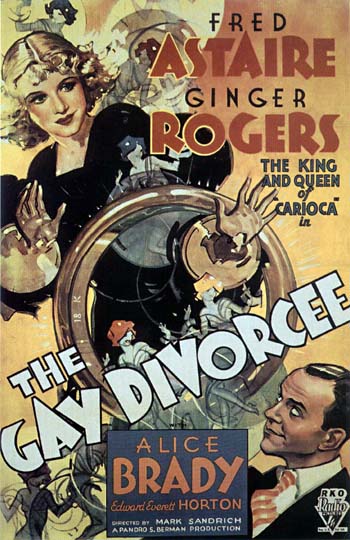
The_Gay_Divorcee_movie_poster

The 31st film on my DVR was the 1934 musical, The Gay Divorcee, which I recorded on June 7th when it aired on TCM.

The Gay Divorcee is a Fred Astaire/Ginger Rogers musical, which means that the plot is less important than the dancing, the singing, and the charm.  The charm is especially important.  Don’t get me wrong — The Gay Divorcee includes some wonderful music, including Night and Day and The Continental, which went on to be the first song to win an Oscar for Best Original Song.  The dancing is incredible, as you would expect from any film featuring Astaire and Rogers.

But it’s the charm that makes The Gay Divorcee especially memorable.  Full of sophisticated dialogue delivered by a cast of wonderful 1930s character actors, The Gay Divorcee offered up an escape to a country that was still reeling from the Great Depression.  Some audiences went to a Warner Bros. gangster film and some audiences went to an Astaire/Rogers musical but what they all had in common was that the movies provided them a break from the harsh realities and hopelessness of everyday life.

As for the plot — well, it’s about rich people doing silly things.  Mimi Glossop (Ginger Rogers) wants to get a divorce from her husband, a gynecologist named Cyril (William Austin).  Apparently, Cyril doesn’t want to give her a divorce so Mimi, her aunt (Alice Brady), and her lawyer (Edward Everett Horton) come up with a plan that could only work in an Astaire/Rogers musical.  Mimi will visit England and, while staying at a properly luxurious hotel, she will pretend to have an affair with Rodolfo Tonetti (Erik Rohodes), a professional gigolo.

However, upon arriving at the hotel, Mimi runs into Guy Holden (Fred Astaire).  Guy is a friend of Rodolfo’s and he also happens to be in love with Mimi.  Mimi, meanwhile, mistakes Guy for the gigolo and they proceed to dance the night away…

Listen, the plot doesn’t matter!  What matters is that The Gay Divorcee features Fred Astaire and Ginger Rogers at their best!  This, after all, is the film that features Fred Astaire singing Cole Porter’s Night and Day…

And, of course, there’s The Continental…

The Gay Divorcee was one of the ten films nominated for best picture of 1934.  However, it lost to an equally charming film of the 1930s, It Happened One Night.

The Gay Divorcee was a fun and needed escape for viewers in the 30s and you know what?  We still need an escape today.


Cleaning Out The DVR, Again #30: The Inherited (dir by Devon Gummersall)


(Lisa is currently in the process of trying to clean out her DVR by watching and reviewing all 40 of the movies that she recorded from the start of March to the end of June.  She’s trying to get it all done by the end of July 11th!  Will she make it!?  Keep visiting the site to find out!)

The-Inherited

The 30th film on my DVR was broadcast on the Lifetime Movie Network on June 5th.  It was aired under the title The Inherited but, according to the imdb, it was originally called Stranger In The House.  I imagine that Lifetime changed the title in order to keep viewers from confusing it with a previous Lifetime film that happened to have the same title.

Anyway, regardless of the title, this is a very confusing movie.  That’s not necessarily a bad thing.  This is just one of those films where, in order to truly understand what’s happening, you have to be willing to give the film some thought.  It’s a film that raises many questions but doesn’t always supply easy answers.  The answers are there but you have to be willing to look for them.

Unfortunately, because this film demands a certain amount of focus on the part of the audience, commercial television is probably the worst place for it to show up.  When the action stops every fifteen minutes for a 3-minute block of commercials, it makes it a little bit difficult to remember what’s happened from one scene to another.

Stranger In The House/The Inherited tells the story of Eve (Jenn Liu) and Tom (Nathan Darrow).  Eve and Tom has just gotten married.  Eve lost her parents when she was younger and — well, to be honest, I’m not sure why the film opens with Eve’s parents dying.  (Later, we find out that Tom’s parents also died when he was young.  Maybe it’s all connected, maybe it isn’t.  I honestly don’t know.)  Tom is a widower.  His first wife died but, in her will, she left Tom her family’s home on the condition that Tom never sell the house.

As soon as Tom and Eve move into the house, strange things start to happen.  Eve thinks that she hears strange noises and she’s upset to discover that Tom has secrets that he hasn’t told her about.  When his former sister-in-law, Wendy (Tammy Blanchard), comes over for dinner, she and Tom get into a huge argument that ends when Wendy’s necklace suddenly tightly wraps around her neck.  Eve thinks there is something terrible in the house but Tom continually says that she’s imagining things.  Fortunately, the housekeeper (Annabella Sciorra) believes Eve and even shares the fact that Tom cooked all of his first wife’s meals before she mysteriously fell ill and died.  Suddenly, Tom’s cooking for Eve…

Soon, Eve doesn’t know who she can trust.  Is the house haunted or is she going crazy?  Is Tom trying to murder her or is Eve just going crazy?  Is the housekeeper Eve’s friend or is Eve just going crazy?  Could the film be any more of a Rebecca rip-off or is Eve just crazy?  Is this film Gaslight or is it The Haunting?

I had to watch the ending a few times before I could tell you for sure.  The Inherited is not always an easy film to follow.  It’s directed in a deliberately dream-like manner, which leads to some memorably surreal scenes but which can also be frustrating when you’re trying to figure out what the Hell’s going on.  Personally, I liked The Inherited because it had a lot of atmosphere, some good acting, and a lot of twists and turns.  But it’s definitely not a film for everyone.  You have to be willing to accept the fact that the movie is never going to make much sense.

On  final note, Jenn Lui not only wrote this film but she also gave herself the lead role.  That was a smart decision because the script is definitely written to her strengths as a performer.  She gives a great performance, one that helps to hold this somewhat uneven film together.

Cleaning Out The DVR, Again #29: You May Now Kill The Bride (dir by Kohl Glass)


(Lisa is currently in the process of trying to clean out her DVR by watching and reviewing all 40 of the movies that she recorded from the start of March to the end of June.  She’s trying to get it all done by July 11th!  Will she make it!?  Keep visiting the site to find out!)

you-may-now-kill-the-bride-lifetime-movie-the-stepsister-obsessed-groom-900x440

The 29th film on my DVR was You May Now Kill The Bride!  You May Now Kill The Bride originally aired on Lifetime on June 4th, during which time I took part in one of the most epic live tweets ever.  This was one of those films that brought out the best in everyone!

First off, You May Now Kill The Bride wins points for having one of the most brilliant titles of all time.  Not only does it tell you exactly what the film is about (i.e., weddings and killings) but it sets the tone perfectly.  When you see a title like You May Now Kill The Bride, you know that there’s no need to even try to take what you’re about to see seriously.  You May Now Kill The Bride says “Sit back and have fun.”

You May Now Kill The Bride tells the story of Nicole (Ashley Newbrough), a 30-s0mething teacher who has yet to get married or have children.  Almost everyone has given up on the idea of Nicole ever finding true love.  And, really, that’s okay because Nicole has a fun-loving best friend named Celine (Aubrey Reynolds), who is always available to come over to the house and get drunk.

However, to everyone’s shock, Nicole meets and falls in love with the handsome and sensitive Mark (Rocky Myers).  Mark asks Nicole to marry him and it’s really great because Mark is not only nice to look at but he owns a really nice house as well.  He also has a stepsister named Audrey (Tammin Sursok) and here’s where things start to get a little bit complicated.

Y’see, Audrey isn’t quite sane.  Not only is she obsessed with her stepbrother but she’s also interested in being Nicole’s best friend at well.  Even though Celine immediately decides that Audrey is crazy, Nicole insists on making Audrey a bridesmaid.

Why not maid of honor?

Well, Celine already has that job.  Or, at least, Celine has that job until she mysteriously ends up getting tossed over the ledge of a parking garage…

Now, it may sound like Audrey is really dangerous but actually, I think she was only trying to help out her new sister-in-law.  During an earlier scene, Nicole announced that she was going to wear perhaps the least flattering wedding dress that I have ever seen in a Lifetime movie.  Celine supported Ncole’s decision.  Audrey, however, immediately started to plot to destroy the dress.

Sometimes, a bridesmaid just has to do what a bridesmaid has to do.

It is true that, plotwise, You May Now Kill The Bride may be a perfectly standard Lifetime story.  But the cast throws themselves into their roles, the dialogue is full of snarkiness, and Tammin Sursok fully commits to playing obsessive Audrey.  This is a film that lives up to the crazy promise of its name.


Cleaning Out The DVR, Again #28: The Turning Point (dir by Herbert Ross)


(Lisa is currently in the process of trying to clean out her DVR by watching and reviewing all 40 of the movies that she recorded from the start of March to the end of June.  She’s trying to get it all done by July 11th!  Will she make it!?  Keep visiting the site to find out!)

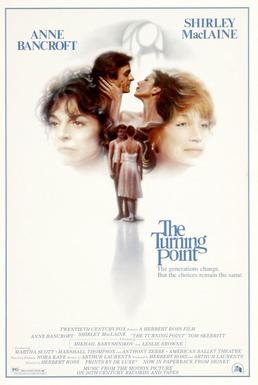
The 28th film on my DVR was the 1977 film The Turning Point.  I recorded it off Indieplex on June 3rd.

I guess I should start this review by admitting that I really have no excuse.  As someone who grew up dreaming of being a prima ballerina and who unknowingly caused her mother to spend an incalculable amount of money of dance classes, dance outfits, dance shoes, dance trips, and all the medical bills that go along with having a klutzy daughter who is obsessed with ballet and as someone who continues to love to dance today, I really have no excuse for not having seen The Turning Point before last night.  Along with The Red Shoes and my beloved Black Swan, The Turning Point is one of three ballet movies to have been nominated for best picture.  It’s a film that, as a result of its box office success, established many of the clichés that continue to show up in dance movies to this day.

Seriously, how had I not seen it before?

And make no mistake about it — The Turning Point is a dance movie.  Don’t get me wrong.  There’s a plot.  Actually, there’s several plots and it’s not incorrect to describe The Turning Point as being something of a soap opera.  But ultimately, all the plots are just window dressing.  Director Herbert Ross started his career as a choreographer with the American Ballet Theater and the characters in The Turning Point are fictionalized portraits of people that he actually knew.  Ross’s love for both ballet and the dancers comes through every frame of The Turning Point and the film’s best moments are when the melodrama takes a backseat to the performances onstage.

But I guess we actually should talk about the melodrama.  Okay, here goes:

Many years ago, DeeDee (Shirley MacClaine) and Emma (Anne Bancroft) both belonged to the same New York ballet company.  DeeDee was the star of the company and was set to play the lead in Anna Karenina when another dancer with the company, Wayne (Tom Skerritt), got her pregnant.  DeeDee not only dropped out of the company but she married Wayne and moved back to his home state of Oklahoma.  (The film suggests, in an oddly regressive moment, that Wayne only slept with DeeDee in order to prove that, despite being a male dancer, he wasn’t gay.)  DeeDee and Wayne opened a dance studio in Oklahoma City while Emma got the lead in Anna Karenina and went on to become a prima ballerina.

18 years later, Wayne and DeeDee’s daughter, Emilia (Leslie Browne), is invited to join the company.  Because Emilia is shy and somewhat naive, DeeDee accompanies her to New York while Wayne stays behind in Oklahoma with their younger children.

Once in New York, DeeDee starts to wonder if she made the right decision when gave up ballet for domesticity.  She run into an old friend, conductor Joe Rosenberg (Anthony Zerbe, not playing a villain for once) and has an affair with him.  Meanwhile, Emma is having an affair with a married man named Carter (Marshall Thompson) and is struggling to accept that she’s getting older and will soon have to retire.  Just as DeeDee regrets giving up dancing, Emma regrets never having children.

Meanwhile, Emilia slowly starts to come into her own and blossom as a dancer.  She even ends up having an affair with the self-centered and womanizing Yuri (Mikhail Baryshnikov), one of the stars of the company.  Emilia and Emma start to grow close, with Emma treating Emilia like her own daughter.  DeeDee finds herself growing jealous of both her daughter and her former best friend.

Needless to say, it all leads to Emma throwing a drink in DeeDee’s face and the two of them having a cat fight on the streets of New York…

The Turning Point is no Black Swan or Red Shoes.  Leslie Browne (who was playing a character based on herself) was a great dancer but not much of an actress so you never care about her the way that you do Natalie Portman in Black Swan.  The dancers are amazing in both films but Darren Aronofsky literally put the audience in Portman’s ballet slippers while Herbert Ross keeps the audience at a distance, allowing them to watch and appreciate the dancers’s passion but not necessarily to experience it with them.

But, with all that in mind, I still enjoyed The Turning Point.  What can I say?  I love dance movies!  Both Shirley MacClaine and Anne Bancroft give excellent performances.  Bancroft apparently had no dance experience before shooting The Turning Point (and it’s hard not to notice that, whenever Emma is performing, the camera focuses on those moving around her as opposed to Emma herself) but she still does a good job of poignantly capturing Emma’s fear of getting older and her joy when she realizes that Emilia looks up to her.  MacClaine, meanwhile, has an amazing scene where she watches her screen daughter perform and, in just a matter of seconds, we watch as every emotion — pride, envy, regret, and finally happiness — flashes across her face.

And, of course, there’s that cat fight.  It’s a silly scene, to be honest.  But seriously, if there was any actress who could convincingly throw a drink in someone else’s face, it was Anne Bancroft.

The Turning Point was nominated for 11 Oscars and it ended up setting a somewhat dubious record when it managed to win exactly zero.  (This perhaps shouldn’t be surprising when you consider its competition included Annie Hall and the first Star Wars.)

Well — no matter!

Though the film may not be perfect, I liked it!

The Turning Point