Lisa Reviews An Oscar Nominee: Zorba The Greek (dir by Michael Cacoyannis)


The 1964 film, Zorba the Greek, tells the story of two very different friends.

Basil (Alan Bates) is a writer.  (“Poetry, essays,” he diffidently says when asked what he writes.)  Basil is British-Greek but, having been raised in the UK, he allows his British side to dominate.  In this film, that means that Basil is very polite and very reserved.  He’s not the type to attempt to flirt with someone who he doesn’t know.  He has never spontaneously broken into dance.  When he is offered a drink, he asks for tea and is shocked to receive rum instead.  If the film was taking place a few decades later, one gets the feeling that Basil would describe Love, Actually as being an okay movie “for people who like that sort of thing.”

And then there’s Zorba (Anthony Quinn).  Unlike the wealthy and well-educated Basil, Zorba is a peasant and he’s proud of it.  He works hard but he plays hard too and there’s nothing that Zorba loves more than the sound of good music.  Zorba not only drinks rum but makes sure that everyone else gets their fill as well.  Zorba dances whenever he feels like it.  Zorba is larger than life, an unfailingly enthusiastic man who is determined to enjoy whatever time he has left in his life.

When Zorba and Basil first meet, Basil is heading to Crete where he’ll be trying to reopoen a mine that was left to him by his father.  As for Zorba, he’s looking for work and, as he explains it, he has tons of experience working as a miner.  Though Basil is, at first, reluctant to hire someone who he’s just met, Zorba talks him into it.  As quickly becomes apparent, the exuberant Zorba can talk people into almost anything.

You can probably guess where all of this is going.  Zorba teaches Basil how to embrace life, which in this film means embracing the Greek side of his heritage.  It takes a while, of course.  Basil is an extremely reluctant protegé and a good deal of the film’s humor comes from just how uncomfortable Basil occasionally gets with his newfound friend.  That said, you don’t have to be a psychic to guess that eventually, the two of them will share a dance on the beach.  It may be predictable but that’s not to say that Zorba the Greek isn’t a good film.  It’s a very good and entertaining movie, featuring a justifiably famous soundtrack and also one of Anthony Quinn’s best and most exuberant performances.

In fact, Quinn is so perfectly cast as Zorba that he occasionally tends to overshadow Alan Bates, who is equally good but in a different way.  In fact, I would say that Bates probably had the more difficult role.  Whereas Zorba (and Quinn) spends the entire movie instigating, Basil (and Bates) spends the entire movie reacting.  It’s difficult to make passivity watchable but Bates manages to do it.

Of course, Zorba isn’t just a comedy about an unlikely friendship.  About halfway through the film, there’s a moment of shocking brutality involving a young widow played by Irene Pappas.  It took me totally by surprise and it left me a bit shaken.  (It also reminded me a bit of another European film featuring Irene Pappas, Lucio Fulci’s Don’t Torture A Duckling.)  It’s a scene that serves as a reminder that 1) not every peasant is Zorba the Greek and 2) friendship and love cannot end darkness but it can make it all a little more bearable.

Zorba the Greek was nominated for Best Picture but it lost to My Fair Lady.

Lisa Reviews An Oscar Nominee: Lost Horizon (dir by Frank Capra)


Long before there was Lost, there was Lost Horizon!

Much like the famous television show, the 1937 film Lost Horizon begins with a group of strangers on an airplane.  They’re people from all walks of life, all with their separate hopes and dreams.  When the plane crashes, they find themselves stranded in an uncharted land and, much like the Lost castaways, they are shocked to discover that they are not alone.  Instead, they’ve found a semi-legendary place that is ruled over by a man who has lived for centuries.  Much as in Lost, some want to return to civilization while others want to remain in their new home.  Both Lost and Lost Horizon even feature a terminally ill woman who starts to recover her health after becoming stranded.

Of course, in Lost, everyone was just flying from Australia to America.  In Lost Horizon, everyone is trying to escape the Chinese revolution.  Among the passengers on the plane: diplomat Robert Conway (Ronald Colman), his irresponsible brother, George (John Howard), a con artist named Henry (Thomas Mitchell), a paleontologist (Edward Everett Horton), and the very ill Gloria (Isabel Jewell).

While Lost featured a plane crash on a tropical island, Lost Horizon features a plane crash in the Himalayas.  In Lost, the sinister Others sent spies to infiltrate the survivors.  In Lost Horizon, the mysterious Chang (H.B. Warner) appears and leads the survivors to a place called Shangri-La.

Shangi-La is a lush and idyllic valley that has somehow flourished in one of the most inhospitable places on Earth.  The happy inhabitants inform the survivors that they never get sick and they never fight.  They’re led by the High Lama (Sam Jaffe), a philosopher who explains that he is several hundred years old.  The valley is full of magic and the Lama tells the survivors that Shangri-La is their new home.

Now, I’ve seen enough horror movies that I spent most of Lost Horizon waiting for the Lama to suddenly reveal that he was a vampire or an alien or something.  Whenever anyone in a movie seems to be too good to be true, that usually means that he’s going to end up killing someone about an hour into the story.  But that didn’t happen in Lost Horizon.  Instead, the Lama is just as wise and benevolent as he claims to be and Shangri-La is as much of a paradise as everyone assumes.  I guess we’re just naturally more cynical in 2018 than people were in 1937.

Of course, the Lama isn’t immortal.  Not even the magic of Shangri-La can prevent the inevitably of death.  The Lama is looking for a successor.  Could one of the survivors be that successor?  Perhaps.  For instance, Robert absolutely loves Shangri-La.  Of course, his brother George is determined to return to the real world.  He has fallen in love with one of the inhabitants of Shagri-La and plans to take her with him, despite the Lama’s warning about trying to leave…

Frank Capra was a huge fan of James Hilton’s book, Lost Horizon, and he spent three years trying to bring it to the big screen.  Based on Capra’s previous box office successes, Colombia’s Harry Cohn gave Capra a budget of $1.25 million to bring his vision of Shangri-La to life.  That may not sound like much today but, at the time, that made Lost Horizon the most expensive movie ever made.  The production was a notoriously difficult one.  (The original actor cast as the elderly Lama was so excited to learn he had been selected that he dropped dead of a heart attack.)  As a result of both its ornate sets and Capra’s perfectionism, the film soon went overbudget.  When Capra finally delivered a first cut, it was over 6 hours long.  Capra eventually managed to edit it down to 210 minutes, just to then have Harry Cohn order another hour taken out of the film.  When Lost Horizon was finally released, it had a running time of 132 minutes.

Seen today, Lost Horizon is definitely an uneven work.  With all the cutting and editing that went on, it’s hard to guess what Capra’s original vision may have been but, in the final version, much more time is devoted to the characters discussing the philosophy of Shangri-La than to the characters themselves.  (It’s always good to see Thomas Mitchell but he really doesn’t get much to do.)  Since you never really feel like you know what any of these characters were like outside of Shangi-La, it’s hard to see how being in Shagri-La has changed them.  You just have to take their word for it.  That said, it’s a visually stunning film.  Capra may have gone over budget creating the look of Shangri-La but it was money well-spent.  If I ever find myself in a magic village, I hope it looks half as nice as the one in Lost Horizon.

Despite all of the drama that went on behind the scenes and a rather anemic box office reception, Lost Horizon was nominated for best picture.  However, it lost to The Life of Emile Zola.

What Lisa Watched Last Night #176: Bad Tutor (dir by Jeff Hare)


Last night, I watched the latest Lifetime film, Bad Tutor!

Why Was I Watching It?

After you watch enough Lifetime films, you come to learn a few things.  For instance, any film that’s called Bad Something is probably going to be worth watching.  Over the years, there have been Bad Students, Bad Teachers, Bad Doctors, Bad Husbands, Bad Assistants, and Bad Realtors.  Really, it was only a matter of time until they got around to a Bad Tutor.

(My hope is that they will follow this up with a film called Bad Tudor, just because I assume all sorts of crazy stuff was going on with the court of Henry VIII.)

What Was It About?

It’s a simple film about three people who have hopes and problems.

For instance, Kelly (Vanessa Marcil) is a widow who is hoping to find a new husband but who also has a rebellious teenage daughter.

Emily (Alex Frnka) is Kelly’s daughter.  She hopes to become a famous singer but first, she has to pass her chemistry midterm.  When the movie starts, she’s currently on the road to getting a D in that class.  Emily says that people are going to be too busy responding to her music to care if she passed chemistry.  Kelly worries that Emily won’t be able to get into a good college with that D following her around.

Devon (Charles Hittinger) is a chemist who claims to be a former teacher.  Devon hopes that he’ll be able to get Emily to fall in love with him, largely because Emily looks just like his dead girlfriend.  Devon’s problem is that he’s batshit insane and the only reason his girlfriend is dead is because he pushed her off of a cliff.

When Kelly meets Devon, she decides that he would be the perfect tutor for Emily.  Little does she suspect that Devon is actually … a bad tutor!

What Worked?

Vanessa Marcil gave a pretty good performance as Kelly.  I liked the fact that, as opposed to the typical perfect Lifetime mother, Kelly not only made mistakes but also owned up to them.

The film’s opening, which started with Devon proposing to his girlfriend and ended with him pushing her off of a cliff, was well-handled.

What Did Not Work?

Here’s the thing: when it comes to Lifetime movies, we all agree, to an extent, to suspend our disbelief.  We accept the fact that characters will sometimes act stupidly and we try not to hold that against them.

But, sometimes, you run into a character who is just so utterly stupid that, try as you may, you just can’t forgive them.  That was the case with Emily in Bad Tutor.  Not only was Emily something of a spoiled brat but she also turned out to be amazingly gullible.  After spending the first half of the movie making fun of the nerdy Devon, Emily changed her tune when Devon claimed to have a friend in the recording industry.  Never did Emily ask for any proof or anything.  Instead, she just ran away from home with Devon.  Looking over her actions, I have to say I’m surprised that she was only failing one class.

Finally, Emily did sing a few times and … well, let’s just hope that she gets into a good college.

“Oh my God!  Just like me!” Moments

I related to Emily, largely because I too was a rebellious teenager who couldn’t sing.

Lessons Learned

I didn’t learn anything because he was a bad tutor.

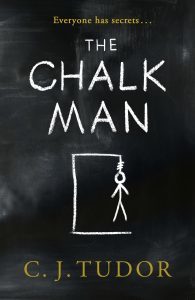
Book Review: The Chalk Man by C.J. Tudor


Last Wednesday night, we got hit by a huge storm.  Around 11:00, after a brilliant flash of lightning, we lost all power.  (The power wouldn’t return for nearly 12 hours.)  Since I didn’t want to go to sleep until the power came back on, I ended up sitting in the living room and reading, by the glow of the flashlight, C.J. Tudor’s The Chalk Man.

In the year 1986, in a small English village, five children stumbled across a mystery.  Eddie, Fat Gav, Metal Mickey, Hoppo, and Nicky followed a series of chalk drawing into the woods and what they found changed both them and the town forever.  Their discovery would not only reveal several carefully held secrets but would also lead to accusations and tragedy.

30 years later, Eddie still lives in the village and that discovery continues to haunt him.  Actually, many things haunt Eddie.  He has yet to recover from watching his father slowly die of Alzheimer’s.  A compulsive thief as a child, he’s now grown up to be a hoarder.  In his more reflective moments, he admits that he’s become an alcoholic.  He’s still a friend to some of his classmates from 1986 but his closest relationship is with his border, the much younger Chloe.  He fears that, as a teacher, he’s not reaching his students.  When Eddie was younger, there was one teacher who reached him, a teacher who was linked to that discovery in the woods.

And then, one night, an old acquaintance shows up on Eddie’s doorstep, bringing with him a business proposal.  And soon, Eddie is once again trying to solve the mysteries of 1986.  Everyone still has their secrets.  No one can claim to be totally innocent.  Not even Eddie.

The debut novel of C.J. Tudor, The Chalk Man alternates between scenes set in 1986 and scenes set in 2016.  Though the structure may bring to mind Stranger Things or Stephen King’s It, The Chalk Man quickly establishes its own identity.  It’s an intriguing book, one that uses its central mystery to explore themes of aging, loss, memory, and prejudice.  While the book has a few flaws that are common to most first novels, it’s still an enjoyable and compulsive read and I look forward to reading what C.J. Tudor comes up with next.

Incidentally, I also look forward to inevitable film version of The Chalk Man.  As long as Ewan McGregor plays the grown-up Eddie, I’ll be happy…


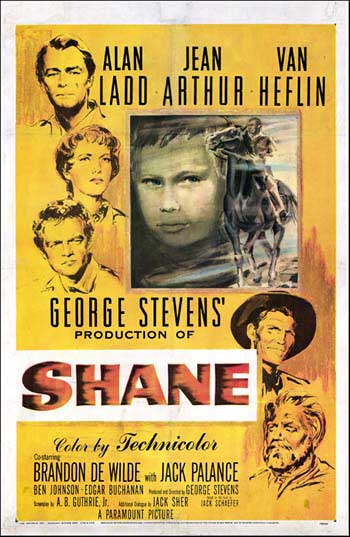
Lisa Reviews An Oscar Nominee: Shane (dir by George Stevens)


“Hey, Shane!  Come back, Shane!”

There’s a few ways in which you can view the 1953 film, Shane.

The more popular view is that it’s a Western about a man named Shane (Alan Ladd) who rides into town and gets a job working for the Starretts, Joe (Van Heflin) and Marian (Jean Arthur).  Joe is a farmer who is determined to hold onto his land, despite the efforts of cattle baron Rufus Ryker (Emile Meyer) to force him off of it.  While we don’t learn much about Shane’s background, it becomes apparent that he’s a man who can fight.  That comes in handy when Ryker brings in a sinister gunfighter named Wilson (Jack Palance).

Another view is that Shane is the story of a man who just wants to settle down but, instead, finds himself continually hounded by an annoying little kid, to the extent that he finally gets involved in a gun battle just so he’ll have an excuse to leave town and get away from the little brat.  Little Joey Starrett (Brandon deWilde) idolizes Shane from the minute that he comes riding up.  When he hears that Shane refused to get into a fight at the local saloon, Joey demands to know whether it was true.  He tells his mom that he loves Shane almost as much as he loves his father.  When Shane does get into a brawl with all of Ryker’s men, Joey stands in the corner and eats candy.  And then, when Shane tries to leave town, Joey runs behind him shouting, “Come back, Shane!  Come back!”

Myself, I think of it as being the story of Frank Torrey (Elisha Cook, Jr.).  Frank is the farmer that’s been nicknamed “Stonewall,” due to his status as a former Confederate and his quick temper.  Stonewall may be smaller than the other farmers but he’s usually the quickest to take offense.  Still, it’s impossible not to like him, largely because he’s played by Elisha Cook, Jr.  When Wilson feels the need to put the farmers in their place, he does so by picking a fight with Torrey.  Standing on a porch in the rain, looking down on the smaller man, Wilson starts to insult both him and the South.  When Torrey finally starts to reach for his gun, Wilson shoots him dead.  While Torrey lies in the mud, Wilson smirks.  It’s a shocking scene, all the more so for being shown in a long shot.  (By forcing those of us in the audience to keep our distance from the shooting, the film makes us feel as powerless as the farmers.)  If you didn’t already hate Wilson and Ryker, you certainly will after this scene.

Shane is a deceptively simple film, one in which many of the details are left open for interpretation.  We never learn anything about Shane’s background.  He’s a man who shows up, tries to make a life for himself, and then leaves.  He’s a marksman and an obviously experienced brawler but, unlike Ryker’s men, he never specifically looks for violence.  In fact, he often seems to avoid it.  Why?  The film doesn’t tell us but there are hints that Shane is haunted by his past.  Shane seems to want a chance to have a life like the Starretts but, once he’s forced to again draw his gun, he knows that possibility no longer exists.

Is Shane in love with Marian Starrett?  It certainly seems so but, again, the film never specifically tells us.  Instead, it all depends on how one interprets the often terse dialogue and the occasional glances that Marian and Shane exchance.  When Shane and Joe get into a fist fight to determine who will face Ryker and Wilson, is Shane really trying to protect Joe or is it that he knows Marian will be heart-broken if her husband is killed?

One thing’s for sure.  Little Joey sure does love Shane.  “Come back, Shane!”  Little Joey follows Shane everywhere, with a wide-eyed look on his face.  To be honest, it didn’t take too long for me to get sick of Little Joey.  Whenever director George Stevens needed a reaction shot, he would cut to Joey looking dumb-founded.  Brandon deWilde was 11 years when he appeared in Shane and he was nominated for an Oscar but he’s actually pretty annoying in the role.  Elisha Cook, Jr. was far more impressive and deserving of a nomination.

I know that many people consider Shane to be a classic.  I thought it was good, as long as the action was focused on the adults.  Alan Ladd plays Shane like a man who is afraid to get too comfortable in any situation and the film works best when it compares his reticence to Wilson’s cocky confidence.  Whenever Joey took center stage, I found myself wanting to cover my ears.

Shane was nominated for Best Picture but lost to From Here To Eternity.

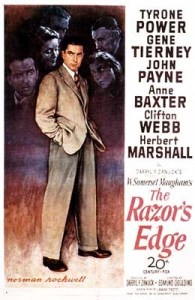
Lisa Reviews An Oscar Nominee: The Razor’s Edge (dir by Edmund Goulding)


Oh, 1919!  What a year.  The Great War had ended, leaving much of Europe devastated.  American soldiers were coming home and, scarred by the horrors they had experienced, becoming members of a lost generation.  The Spanish Flu was infecting millions, on the way to eventually wiping out 3% of the world’s population.  It was a grim time so it’s no surprise that many chose to close their eyes and pretend like everything was fine.  Only a few people were willing to look at the world and say, “There has to be something more.”

The 1946 film The Razor’s Edge tells the story of one such man.  Before the war, Larry Darrell (Tyrone Power, Jr.) was like most of his friends back in Chicago.  He was carefree.  He was wealthy.  He was engaged to marry the beautiful but self-centered Isabel (Gene Tierney).  But then he went off to fight in World War I and the experience changed him.  On the final day of the war, another soldier sacrificed his life to save Larry and Larry is now haunted by that man’s death.  No longer sure about his place in the world, Larry announces that he’s rejecting his former life.

Of course, that’s an easy thing to do when you’re rich.  Larry is lucky enough to have an inheritance that he can live off for a few years.  All of his former friends think that Larry’s just struggling to adjust to being back home and they expect that he’ll get over it soon enough.  Isabel’s uncle, Elliott (Clifton Webb), thinks that Larry’s acting like a total fool.  For Larry’s part, he no longer cares what any of them think.  He’s going to travel the world, seeking enlightenment.

While Larry’s searching, life goes on without him.  Isabel ends up marrying one of Larry’s friends, Gray Maturin (John Payne).  Larry’s best friend from childhood, Sophie (Anne Baxter), suffers a personal tragedy of her own and, when Larry next meets her, she’s living as a drunk on the streets of Paris.  Larry keeps searching for the meaning of it all.  He works in a coal mine.  He discusses philosophy with a defrocked priest.  Eventually, he ends up in the Himalayas, where he studies under a Holy Man (Cecil Humphreys).

It’s an intriguing idea and still a relevant one.  Unfortunately, the movie doesn’t really work because Larry tends to come across as being a little bit full of himself.  I could imagine someone like Henry Fonda working wonders with the role but Tyrone Power seems totally miscast as Larry.  When you look at Power, you find it hard to believe that he’s ever had a bad day, much less a need to spend months hiding in the Himalayas.  He comes across as the last person you would necessarily want to take spiritual advice from.  The fact that Webb, Tierney, Payne, and Baxter are all perfectly cast only serves to enforce just how miscast Power is.  It’s a well-intentioned film with nice production values but it’s never quite compelling.

The Razor’s Edge was based on a novel by W. Somerset Maugham.  Interestingly, the film features Maugham as a character, played by Herbert Marshall.  Even more interesting is the fact that the film was apparently remade in 1984, with Bill Murray cast as Larry Darrell.  I’ve never seen the remake so I have no idea if Murray is an improvement on Power.

(Also, since I’ve been pretty critical of Power in this review, let me recommend Witness For The Prosecution, in which Power is much better cast.)

The Razor’s Edge was nominated for Best Picture but lost to another film about returning vets, The Best Years of Our Lives.

Lisa Reviews An Oscar Nominee: 49th Parallel (dir by Michael Powell)


Hello and welcome to the TSL’s continuing coverage of Oscar Sunday!  Today, along with some other Oscar-related things, I’m going to post reviews of some of the films that have been nominated for best picture over the years!  Let’s start things off with the 1941 Best Picture nominee, 49th Parallel!

Before anything, I should clear up some confusion about this film.  This is a British film about Nazis trying to reach the border between Canada and the U.S.  When it was first released in the UK, it was named after the coordinates of the border.  However, in the actual film, the Nazis never actually go to the 49th Parallel.  Instead, the film concludes at Niagara Falls.  However, it was probably reasonable assume that British audiences would not necessarily know or care whether Niagara Falls was actually located on the 49th Parallel.  Considering that they were currently at war with Germany, they had more important things to concern themselves with.

However, it was apparently felt that American audiences would notice that Niagara Falls wasn’t actually located on the 49th Parallel.  (Personally, I think the British may have been giving us too much credit.)  So, when the film was released in the United States, the title was changed to The Invaders.  When the film was subsequently nominated for Best Picture, it was nominated under the name The Invaders.  I’ve actually come across some online sources that claim that The Invaders and 49th Parallel are two separate films.  No, they’re the same film, it’s just that the film in question has two different titles.  Out of respect to the people who actually made the movie, I’ve decided to use the original title in this review.

When watching 49th Parallel (it’s available on YouTube), it helps to know something about history.  Today, there’s a tendency to overlook the fact that World War II had already been raging for nearly two years before the United States got involved.  Though the U.S. was an ally to Britain, it remained officially neutral until the Japanese bombed Pearl Harbor.  Up until that moment, many prominent Americans were isolationists and took the attitude that the war was Europe’s problem.  (On the other hand, Canada, as a Dominion of the British Empire, followed Britain into the war in 1939.)  Though the 49th Parallel may have been a British film that was largely set in Canada, it was also meant to frighten Americans and hopefully bring them over to the British side.

(When interviewed about the film, screenwriter Emeric Pressbruger said, “”Goebbels considered himself an expert on propaganda, but I thought I’d show him a thing or two.”)

Directed by Michael Powell, 49th Parallel opens with a German U-boat creeping into the waters around Canada.  The Nazis are hoping to disrupt shipping operations but it turns out that they’re no match for the Royal Canadian Navy.  (GO CANADA!)  When the U-boat sinks into the Hudson Bay, only six Nazis manage to survive.  Led by the arrogant Lt. Hirth (Eric Portman), the Nazis attempt to make their way to the border and to the safety of America.

Of course, it doesn’t turn out to be an easy journey.  Not only are the Germans in an unfamiliar country but they also keep running into Canadians.  Without fail, nearly every Canadian they meet is polite but willing to fight and die for his country.  The Canadians themselves are played by actors who, in the 40s, would have been familiar faces.  Laurence Olivier plays a fur trapper, getting top-billing for his cameo appearance.  Raymond Massey, who was best known for playing Abraham Lincoln, shows up as a Canadian solider.  Leslie Howard is the writer who discovers that Nazis have no respect for art.  Anton Walbrook is a German-Canadian farmer who rejects the attempts of Lt. Hirth to bring him over to the Nazi side.  The Canadians are so sympathetic that one of the Nazis is even moved to reject the Third Reich and is promptly executed by his compatriots, showing the audience the foolishness of hoping that the “good Germans” would ever be able to overthrow the bad ones.

It’s pure propaganda but it’s anti-Nazi propaganda so that’s not really a problem.  Powell keeps the story moving at a steady pace and all of the actors get impassioned performances.  You can tell this movie was more than just a job for them.  Instead, it was their way of fighting for their country and hopefully inspiring others to join in the battle against Hitler.  The film is both a love letter to Canada and a plea to the United States to renounce neutrality.  (Interestingly enough, by the time 49th Parallel made it to U.S. screens, America had finally declared war on the Axis Powers.)

49th Parallel was nominated for best picture but it lost to another World War II propaganda film, Mrs. Miniver.

Crown International Pictures’s Only Oscar Nomination


If you’re fan of old movies that used to play in the grindhouses or at the drive-ins, you’re familiar with the Crown International Picture logo.

This logo appeared at the start of some of the most entertaining and cheaply made exploitation films of all time.  These were movies with titles like Malibu Beach, The Teacher, Cavegirl, They Saved Hitler’s Brain, The Sidehackers, My Tutor, Trip With The Teacher, Best Friends, and The Sister-in-Law.  These films may have never been critically acclaimed but they’re still being discovered and loved by viewers today.

Crown International Pictures was founded in 1959 and ceased operations in 1992.  Over the course of 43 years, the studio only received one Oscar nomination.  That was in 1972, for Best Original Song.  Written by Sammy Fain and Paul Francis Webster, Strange Are The Ways Of Love played over the credits for The Stepmother.

In honor of both the Oscars and Crown International Picture, here is Strange Are The Ways Of Love…

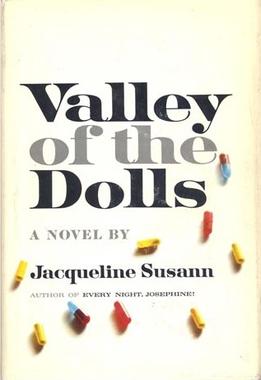
Guilty Pleasure No. 35: Valley of the Dolls by Jacqueline Susann


Way back in January, I took the time to read the 1966 novel, Valley of the Dolls.  While I had already seen the film that this work inspired, this was my first time to read the actual book.

Before I even opened to the front page, I knew that Valley of the Dolls had been a best-seller, that it inspired a countless number of imitations, and that it had a reputation for being really, really bad.  As soon as I started to read the first chapter, I discovered that the book’s reputation was well-earned.  To call author Jacqueline Susann’s prose clunky was a bit of an insult to clunky prose everywhere.

Opening in 1945 and covering 24 years in cultural, sexual, and drug history, Valley of the Dolls starts with Anne Welles leaving her boring home in New England and relocating to New York, where she promptly gets a job at a theatrical agency.  Everyone tells Anne that she’s beautiful and should be trying to become a star but Anne says that she’s not interested in that.  (You’ll be thoroughly sick of Anne’s modesty before reaching the tenth page.)  Everyone says that Anne is incredibly intelligent, even though she never really does anything intelligent.  Everyone says that she’s witty, even though she never says anything that’s particularly funny.  In short, Anne Welles is perhaps the most annoying literary character of all time.  Anne spends about 20 years waiting for her chance to marry aspiring author Lyon Burke.  When she does, Lyon turns out to be a heel and drives Anne to start taking drugs.  I assume it’s meant to be somewhat tragic but who knows?  Maybe all of the pills (or “the dolls” as the characters in the book call them) will give Anne a personality.

They certainly worl wonders for everyone else in the book.  Neely O’Hara is constantly taking pills and she’s the best character in the book.  Unlike Anne, she’s never modest.  She’s never quiet.  She’s actually funny.  Even more importantly, she doesn’t spend the whole book obsessing over one man.  Instead, she’s always either throwing a tantrum or having an affair or abandoning her children or getting sent to a mental institution.  Neely’s a lot of fun.  Unfortunately, we don’t really get to see much of Neely until after having to slog through a hundred or so pages of Anne being boring.

The other major character is Jennifer North, a starlet who was apparently based on Marilyn Monroe.  The parts of the book dealing with Jennifer are actually about as close as Valley of the Dolls actually gets to being, for lack of a better term, good.  In fact, if the book just dealt with Jennifer’s tragice story, it would probably be remembered as a minor classic.  Instead, Jennifer is often overshadowed by Neely (which is understandable since Neely’s insane and therefore capable of saying anything) and Anne (who, as I mentioned before, is the most annoying literary characters of all time).

Why is Valley of the Dolls a guilty pleasure?  A lot of it is because of all of the sexual melodrama and pill-popping, the descriptions of which are often so overwritten that they’re unintentionally hilarious.  Most of it is because Neely O’Hara goes crazy with so much overwrought style.    Whenever the book focuses on Neely, Susann’s inartful prose is replaced with a stream-of-consciousness tour of Neely’s paranoid and petty mind.  Interestingly enough, some of the most infamous scenes from the movie are also present in the novel.  Remember that scene where Neely rips off Helen Lawson’s wig and then flushes it down a toilet?  That’s actually in the book!

Anyway, it’s an incredibly silly but compulsively readable book … or, at least, it is if you can make it through all the boring stuff with Anne at the beginning.  Then again, as annoying as Anne is, she doesn’t exactly get a happy ending.  Perhaps that’s why Valley of the Dolls is such a guilty pleasure.

Previous Guilty Pleasures

  1. Half-Baked
  2. Save The Last Dance
  3. Every Rose Has Its Thorns
  4. The Jeremy Kyle Show
  5. Invasion USA
  6. The Golden Child
  7. Final Destination 2
  8. Paparazzi
  9. The Principal
  10. The Substitute
  11. Terror In The Family
  12. Pandorum
  13. Lambada
  14. Fear
  15. Cocktail
  16. Keep Off The Grass
  17. Girls, Girls, Girls
  18. Class
  19. Tart
  20. King Kong vs. Godzilla
  21. Hawk the Slayer
  22. Battle Beyond the Stars
  23. Meridian
  24. Walk of Shame
  25. From Justin To Kelly
  26. Project Greenlight
  27. Sex Decoy: Love Stings
  28. Swimfan
  29. On the Line
  30. Wolfen
  31. Hail Caesar!
  32. It’s So Cold In The D
  33. In the Mix
  34. Healed By Grace

Music Video of the Day: She Said by Brie Larson (2005, dir by Chris Applebaum)


With this being Oscar Sunday, it’s good to be reminded that everyone had to start somewhere!  Brie Larson rightly won an Oscar for Room but, before that movie, she was just another singer pretending to be a waitress and singing songs of empowerment.

Need proof?

Watch today’s music video of the day and…

ENJOY!