I can never hear MakeDamnSure without thinking about the What’s It Feel Like To Be A Ghost episode of Degrassi.
That’s the episode where aspiring rock star Craig Manning (played by Jake Epstein) returns to Toronto after being on tour and we discover that he’s picked up a nasty cocaine habit. Despite being coked out of his mind, Craig still gets a chance to perform during a Taking Back Sunday show. However, no sooner does Craig get on stage and start to sing then he suddenly gets the worst nosebleed in the history of nosebleeds.
AGCK!
Needless to say, the members of Taking Back Sunday are not impressed.
Of course, before everything went so terribly wrong, Craig had bragged to Taking Back Sunday’s Adam Lazzara about how he performed a “stripped down, acoustic” version of MakeDamnSure in his set. “I’d like to hear that,” Adam replied.
YOU BLEW IT, CRAIG!
Oh well. Fear not. By the time Craig returned for Degrassi Goes Hollywood, he was clean of the drugs and hopefully, he got back together with Ellie.
(Actually, as much as I love Ellie, Craig’s soulmate really was Ashley. Ellie should never have let Sean break up with her…)
(Okay, sorry, I’m getting lost in a Degrassi tangent here…FOCUS, LISA, FOCUS!)
As for the video for MakeDamnSure, it features the band performing in a wind tunnel. There’s a lot of scary and sad imagery but fear not, things work out for the best. It turns out that some people do give a damn.
Just from hearing the plot description, you would probably think that Picasso Trigger is a fairly straight forward film.
Basically, Picasso Trigger (John Aprea) is an international criminal mastermind and a lover of the arts. After he drops a painting of a Picasso Trigger (the fish, not the character) off at the Louvre, he is promptly blown up by an assassin. The assassin was sent by one of his rivals, the evil Miguel Ortiz (Robert Obergon). So now, Picasso is dead and Ortiz is now even more powerful than he was before.
Make sense so far?
It turns out that Picasso Trigger was not the only person that Ortiz hates. Ortiz also has a vendetta against the secret American law enforcement agency that Ortiz blames for the death of his brother. So, Ortiz decides that the time is right to start assassinating all of the members of that agency. The surviving members of the agency have to stop Ortiz before he kills them all.
That wasn’t hard to follow, right?
Now, just try watching the movie.
Seriously, even by the standards of Andy Sidaris, Picasso Trigger is a total mess. It’s a follow-up to Malibu Express and Hard Ticket To Hawaii, which means that Dona Speir and Hope Marie Carlton are back and flying around Hawaii in their airplane. There’s also two more Abilenes to deal with, L.G. Abilene (Guich Kook) and his nephew, Travis (Steve Bond).
For some reason, L.G. sends Travis on a mission to Dallas. It has something to do with what’s going on with Picasso Trigger and Miguel Ortiz but I was never sure what. But the important thing is that Picasso Trigger‘s Dallas scenes were actually shot in Dallas. (I always like seeing my hometown in the movies.) Once Travis arrives in Dallas, he meets another agent named Pantera (Roberta Vasquez). Apparently, Travis and Pantera went to high school together. The mission in Dallas leads to Travis stealing a boat. I’m not sure why.
Anyway, eventually, we get back to Ortiz trying to kill agents and the question of whether Picasso Trigger was actually blown up or not. To be honest, so many people get blown up over the course of the movie that I’m not surprised that even a super secret government agency had a hard time keeping up with who was still around. It turns out that there’s a double agent within the agency. Who could it be!?
One thing that about Picasso Trigger that made a huge impression on me was just how nonchalant everyone was about being targeted for assassination. No one seemed to be too upset about any of it. Travis, for his part, just seemed to be hanging out.
The other interesting thing about Picasso Trigger is that it featured an explosive boomerang. Here’s the thing, though, What if you threw the boomerang and it missed its target? Wouldn’t it come flying back and blow you up? Seriously, I don’t think the government really thought that weapon through.
Anyway, Picasso Trigger is a total mess but it’s likable in its silly way. The film doesn’t take itself seriously, which helps. And hey, it’s a chance to see what Dallas looked like in 1988!
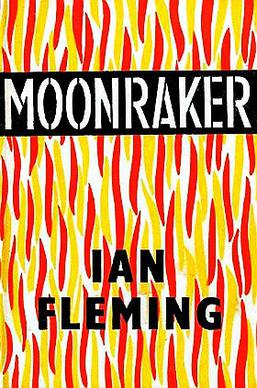
First published in 1955, Moonraker was the third of the original James Bond novels and it was also the first of the series to be totally set in Great Britain. At no point does Bond leave his home country. In fact, he spends a great deal of the book in his office. (If you’ve ever wondered what Bond’s job entails when he’s not on a mission, this is the book to check.) That said, it’s appropriate that Moonraker remains in Bond’s home country because it starts with a very British problem.
Hugo Drax is the most popular man in Britain. Drax was horribly disfigured during the Second World War but, despite all of the scars and a somewhat boorish manner, he has managed to make himself into one of the most important industrialists in the world. Drax is building an immensely powerful nuclear missile, the Moonraker. His missile will keep Britain safe from both the USSR and the USA. At the start of the novel, even Bond admires Drax. Except…
…DRAX CHEATS AT CARDS!
It turns out that M and Drax both play cards at the same club and M is sure that Drax must be cheating. Why would such a powerful man feel the need to cheat? Even more importantly, how can a man be trusted with Britain’s security when he can’t even be trusted to play bridge? Both to prevent a public scandal and to make sure that Drax really can be trusted, M bring Bond to the club so that Bond can beat Drax at his own game.
One bridge game later and suddenly, Bond has been assigned to work at Drax’s laboratory. Already on the case and working as Drax’s secretary is Special Branch officer Gala Brand. Bond being Bond, he discovers that Drax is at the head of a nefarious scheme. He also tries to figure out why Gala Brand is apparently the only woman in the world who is not won over by his manly charm…
Moonraker is one of my favorite Bond novels. Drax is an interesting villain and Fleming makes a good decision by having Bond initially admire the man. Fleming takes a lot of joy in describing both Drax’s bad manners and grotesque appearance. Drax started a tradition of Bond having to face physically unappealing bad guys. After playing a minor role in the first two books, M takes a more central role in Moonraker and we also get a chance to explore his paternal but strict relationship with 007. Gala is one of the few of the so-called Bond girls to be portrayed as being an equal to Bond and the book’s final scene between her and Bond is considerably more poignant than it has any right to be. Finally, Fleming’s love of Britain is evident on every page. If Fleming spent Casino Royale and Live and Let Die being snarky about the places that Bond visited, Moonraker finds both the author and his most famous creation in a surprisingly sentimental mood.
Moonraker came close to being the first James Bond novel to make it to the big screen. In 1955, American actor John Payne pursued the rights to the book, hoping to star as Bond in the film version. However, it would be another 24 years before Moonraker was adapted to film. Other than featuring Drax as a villain, the film version would have little do with the original novel.
Years ago, my family spent a wonderful summer in Hawaii. I’m not a swimmer and I have a morbid fear of drowning but oh my God, I loved walking along the Hawaiian beach. It was the most incredibly beautiful place that I had ever seen. The water was so blue. The trees were so green. And the people … oh my God, the people were so friendly and generous! I have never had more drugs randomly offered to me than when I was walking on the back in Hawaii. Even the screaming homeless people in Hawaii seemed nicer than the screaming homeless people on the mainland.
Of course, the truth is that no place is perfect. Undoubtedly, Hawaii had its dark side. I mean, just look at the 1987 film, Hard Ticket to Hawaii.
Directed by Andy Sidaris and officially the second film in his Triple B (Bullets, Bombs, and Babes) franchise, Hard Ticket To Hawaii has been described as being the greatest B-movie ever move. I don’t know if I’d go that far but it’s certainly the only Andy Sidaris film to ever air on TCM.
Hard Ticket To Hawaii tells the story about … well, actually, it tells a lot of stories. This is a Sidaris film, which means that it’s collection of bad puns, double entendres, cartoonish violence, and totally random scenes that don’t really link up to anything else in the film.
For instance, there’s a scene where a sportscaster interviews two former football players and has a panic attack when he thinks that the N-word has been broadcast on national television. But then it turns out that the feed went out before the word was uttered so … hey, problem solved. And it’s never spoken of again.
And then there’s an aging actress and a sleazy producer and they have a few scenes before they vanish from the film. I’m not sure why they were in the film in the first place. Maybe they were friends of Andy Sidaris.
And then there’s the giant mutant snake. It says something about the narrative strangeness of Hard Ticket To Hawaii that the giant mutant snake is just a relatively minor subplot.
The actual plot begins when two innocent Molokai cops are executed by some smug drug dealers. “Ah!” you say, “it’s going to be a film about drug runners!” No, actually it’s a film about diamond smugglers because the whole drug things get abandoned fairly quickly.
A stash of stolen diamonds is accidentally recovered by Donna (Dona Speir) and Taryn (Hope Marie Carlton). Donna and Taryn work for Molokai Cargo. They transport packages and they take tourists around the island. Except, Donna is also a secret government agent and apparently, Taryn is in the witness protection program.
Anyway, they not only find the stolen diamonds but they also lose the aforementioned mutant snake. With the smugglers determined to get the diamonds, Dona calls in Rowdy Abeline (Ronn Mass), cousin of Cody Abeline who was the lead character in Malibu Express. As soon as Rowdy arrives on the island, he is targeted by an assassin on a skateboard. The assassin is carrying a gun and sex doll but he didn’t consider that Rowdy would have a bazooka in the back of his jeep.
Meanwhile, there’s a guy named Shades who just hangs out on the beach while holding a submachine gun. He’s guarding something and Rowdy knows that he needs to get by Shades. Fortunately, a local woman always play frisbee with Shades.
“Good,” Rowdy says, “I can use that.”
And use that he does.
Now, this may all seem incredibly stupid but last year, the Alamo Drafthouse showed the frisbee scene before a showing of Free Fireand the audience went crazy. Seriously, it’s an iconic scene, even if it doesn’t make any sense. And hey, now I know what to say that next time a total stranger tells me that I have a nice ass.
You too, Pilgrim!
Hard Ticket To Hawaii is insane. (I haven’t even mentioned half of the crazy stuff that happens in this movie.) It makes absolutely no sense but it’s so quickly paced that it doesn’t matter. Hard Ticket To Hawaii cheerfully embraces its weirdness. It may not be any good but it is a lot of fun.
Having recovered from both the horrific torture he suffered in Casino Royale and the suicide of Vesper Lynd, British secret agent James Bond is ready to return to the field. His latest mission takes him to America, where his job is to investigate Mr. Big. Mr. Big is Harlem-based gangster who is suspected of helping to finance Russian operations through his criminal enterprises.
(Specifically, Mr. Big has been selling 17th Century gold coins that are believed to be a part of a legendary pirate treasure that was buried somewhere in Jamaica. Ian Fleming knew his pirate lore and devotes a good deal of the beginning of the book to discussing Sir Henry Morgan.)
In America, Bond partners up with his old friend Felix Leiter but he soon discovers that taking down Mr. Big is not as easy as he thought it would be. Using the fear of voodoo to control his minions, Mr. Big has agents all across America. As well, Mr. Big also has the services of Solitaire, a beautiful Creole fortune teller. The case takes Bond and Felix from New York to Florida to Jamaica. It also costs one of them a leg and an arm. In order to maintain some suspense, I will refrain from revealing who gets attacked by a shark.
Reading the original James Bond novels can be enjoyable but it can also lead to a good deal of culture shock. Because Bond is constantly changing in the movies and the role is regularly recast, we tend to forget just how long the character of James Bond has been around. In the movies, Bond is forever the same age and his villains and their plots continually change to reflect whatever’s going on in the world. In SPECTRE, Blofeld was even reinvented as a bored Christoph Waltz.
The books, however, are frozen in time. They all reflect the attitudes and concerns of the time period in which they were written. That can often make for a fascinating read but it can also leave modern readers cringing. Ian Fleming was a man of his time and he shared both the strengths and the weaknesses of his time and his class. That’s a polite way of saying that, in the Bond novels, Fleming tends to treat anyone who is not British, white, and male with, at best, a patronizingly condescending attitude. (At worst, Fleming treats them with outright disdain.) That’s especially obvious in Live and Let Die, in which Mr. Big and all of his henchmen are black.
Live and Let Die was first published in 1954. Interestingly enough, Fleming doesn’t come across as being as prejudiced as some of his contemporaries. For instance, even when the action moves the American south, the n-word never appears in the book. (Then again, neither do any redneck sheriffs.) I wouldn’t call Fleming a racial progressive but, at the same time, it’s obvious that he means it to be the highest compliment when Bond describes Mr. Big as being the “first great Negro criminal.” But then Fleming introduces us to two sympathetic black characters who do nothing but happily take orders from Bond and then he starts writing dialogue in phonetic dialect and you just find yourself cringing and saying, “Oh my God, Ian, stop it!”
Here’s what does work as far as Live and Let Die is concerned: Mr. Big is a great villain, far less of a wimp than Casino Royale‘s Le Chiffre. As well, James Bond is a far more active character in this book and less whiny than he was in Casino Royale. Bond once again gets tortured but he doesn’t threaten to quit the service just because his finger gets broken. Instead, he seeks revenge.
As an American, it was interesting for me to read Fleming’s thoughts on my home country. While Bond seems quite comfortable in New York, both he and Felix are absolutely miserable in Florida. In fact, Fleming portrays Florida as being Hell on Earth, hot and full of ill-tempered old people. It’s impossible not to be amused by just how viscerally Fleming disliked Florida.
Finally, Fleming’s skills as a storyteller were even stronger in Live and Let Die than in Casino Royale. I mean, whatever else you might say about the book, who can resist that perfect one line dismissal of a opponet: “He disagreed with something that ate him.”
Earlier this year, I decided to reread all of Ian Fleming’s James Bond novels. On this site, I’ve written many times about how much I love all of the James Bond films so I thought it would be interesting, especially since a few years have passed since I originally read them, to reread the original novels.
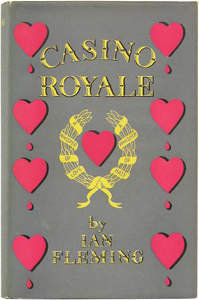
The first Bond novel was Casino Royale. First published in 1953, Casino Royale introduced the world to not only MI6’s James Bond but also to the CIA’s Felix Leiter, the sinister assassins of SMERSH, and the tragic Vesper Lynd.
The story starts with a deceptively simple mission. James Bond has been sent to the Casino Royale, with specific orders to play against and humiliate Le Chiffre, a union boss who works for the Russians. Bond succeeds at his mission but quickly discovers that Le Chiffre is not the type to accept the loss of eighty million francs gracefully. Bond ends up undergoing a truly horrific torture, one that is described in harrowing details by Fleming. While it’s not a spoiler to reveal that Bond survives (after all, Casino Royale was followed by 11 novels and 2 short story collections), it comes at the cost of a terrible scar and a terrible tragedy.
In his first appearance, Bond already possesses several of the traits for which he’s best known. He’s a meticulous eater, a frequent drinker, and a chain smoker. He’s ruthless and is described as being cruelly handsome. When Vesper Lynd first meets him, she exclaims that he looks like Hoagy Carmichael, the British musician who Fleming originally hoped would play Bond in the films.
At the same time, while rereading Casino Royale, I was surprised by how passive Bond was for the majority of the book. Beyond the scene where he plays baccarat with Le Chiffre, Bond really doesn’t take a very active role in his first novel. When he’s captured and tortured, he doesn’t escape through his wits. In fact, he doesn’t escape at all. He’s rescued by SMERSH, who have decided that they no longer need Le Chiffre to launder money for them. After being rescued, he decides to retire from intelligence work and marry Vesper Lynd. Vesper Lynd is a double agent but Bond never figures that out on his own. He only discovers this fact from Vesper’s suicide note.
(Which, of course, leads to the novel famous and bitter final line: “The bitch is dead.”)
In fact, there are times when Bond almost seems to be … well, dorky. Early on, we’re informed that he hopes to create and make a fortune off of a new drink. (Minutes after meeting Vesper, he announces that he’s going to name the drink after her.) When he’s in the hospital recovering from being beaten, he’s hardly the Bond we all know and love. Instead, he’s rather petulant. When he explains that he’s quitting the service, he comes across like an angry teenager announcing that he’s not going to go to school anymore.
As for the novel itself, it’s a quick read and, even after all these years, I can see why it caused a stir when it was originally released. It’s not just that Fleming was telling a spy story that was full of intrigue and deceit. It’s also the Fleming was giving readers a glimpse into a glamorous world that they probably would never have a chance to experience for themselves. Fleming describes the casino with such care and attention to detail that you literally feel like you’re there, watching Bond gamble.
For the record, here’s my favorite line from the book. It occurs shortly after Bond first meets Felix Leiter and discovers that Felix is from my homestate:
“Bond reflected that good Americans were fine people and that most of them seemed to come from Texas.”
And finally, here’s the ingredient for Bond’s drink, the Vesper:
“Three measures of Gordon’s, one of vodka, half a measure of Kina Lillet. Shake it very well until it’s ice-cold, then add a large thin slice of lemon peel.”
(Apparently, some of these ingredients are out-of-date. I rarely drink so I have no idea.)
Casino Royale was followed by Live and Let Die, which I’ll review tomorrow.
Since at least a few people are currently on spring break, this seemed like a good day to pick a video for a song that’s actually called “Spring Break.”
Of course, neither the song nor the video is really about spring break. (Or, at the very least, it’s not about what we usually think of spring break being about.) Instead, the video follows Ex-Cops as the prepare to play at the Museum of Modern Art. It’s a bit of a documentary. Meanwhile, a bicyclist (played by Nickolas Kimbrell, who designed the band’s costumes) rides around New York City, while wearing a variety of politically charged t-shirts and interacting with various New York characters.
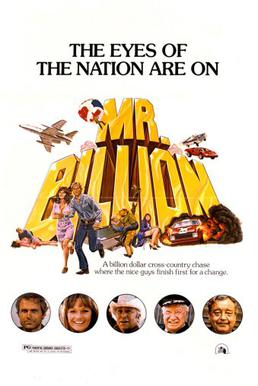
The 1977 film Mr. Billion tells the story of Gudio Falcone (played by Terence Hill, whose real name is Mario Girotti). Guido has got a pretty good life going in Italy. Everyone in his village loves him. He works as an auto mechanic. When we first see him, he speeding around in a red sportscar. When he returns to the garage, he smiles and says, in Italian, “Just like Steve McQueen.” Guido may not be rich but he’s happy.
But that’s all about change!
Well, not the happy part. Guido is pretty much always happy. But he’s about to get rich. It turns out that Guido is the last surviving relative of Antonio Falcone. Years ago, Antonio immigrated to America and founded Falcon Motors. The company eventually made Antonio one of the richest men in the world. Unfortunately, the big Falcon Motors sign eventually fell off the company’s headquarters and it landed right on top of Antonio.
Everyone’s upset about Antonio’s death. Well, everyone but the company’s vice president, John Cutler (Jackie Gleason). John was naturally expecting that he would be named Antonio’s successor and that he would also inherit all of Antonio’s money. Instead, Antonio’s will leaves everything to Guido!
Why?
Because, apparently, Guido never asked Antonio for anything more than a “pair of American cowboy boots.”
Cutler and his sleazy attorney (William Redfield) are soon on the next flight to Italy. When they find Guido, they make sure to compliment him on his cowboy boots. They explain to Guido that he has twenty days to go San Francisco and sign the proper papers. If he’s any later than 20 days he’ll lose the money. Of course, that shouldn’t be a problem since Guido can fly over anytime that he wants…
Except Guido refuses to fly! No, he says that if he’s going to go to America, he’s going to arrive there the same way that Antonio did. He is going to take a boat to New York City and then ride a train all the way to California.
Did you guess that the very next scene would be Guido standing on the dock of a cruise ship, staring at the Statue of Liberty? And did you also also guess that, upon disembarking, he would immediately find himself besieged by reporters, one of whom declares him to now be the world’s most eligible bachelor? If so, good work.
But here’s the big question. Did you also predict that John Cutler would attempt to sabotage Guido’s trip to California and that the sabotage would involve hiring a private detective (Valerie Perrine)? Even more importantly, did you predict that the detective would eventually end up falling in love with simple but honest Guido?
Because that’s totally what happens!
At the time that Mr. Billion was made, Terence Hill was a huge star in Europe but was barely known in the United States. He was best known for appearing in a series of comedic Spaghetti Westerns with Bud Spencer, the majority of which featured Hill as a lazy but likable ne’er do well. In Mr. Billion, Hill is cast as the exact opposite, as an earnest man-of-the-people who is so nice that it’s almost painful. Add to that some major tone problems (the film cannot make up its mind if it wants to be a comedy, an action film, or a romance) and you have a pretty forgettable movie.
And that’s kind of a shame because Terence Hill showed some legitimate charm in the lead role. The role may have been underwritten but all Hill had to do is flash that winning smile and it didn’t matter. It’s unfortunate that Hill didn’t get a more appropriate vehicle for his American debut.
Hi! Are y’all sick of reading about the Oscars yet? I mean, here at the Shattered Lens, we love the Oscars but I’m sure, by this point, some of our readers are ready to move on. Well, don’t worry! We haven’t forgotten about you!
And neither has … Minya, the son of Godzilla!
Oh my God, it’s Minya!
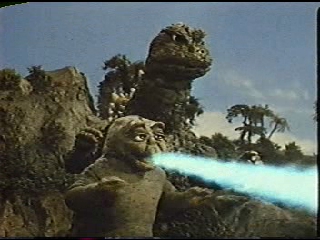
Now, as you can probably tell from this picture above, Minya doesn’t bear that much of a resemblance to his father. I’m going to guess that he got his looks from the mother’s side of the family. We really can’t say for sure because we don’t really get the exact details of how Minya came to be. We get to watch as Minya hatches out of an egg but we’re never sure who laid the egg. For all we know Godzilla laid the egg.
Then again, there’s also some debate as to whether or not Godzilla is actually Minya’s father. When Minya hatches out of the egg, Godzilla shows up on the island to protect him but, before that, it’s not like we ever saw Godzilla actually taking care of the egg or anything. In fact, right before Minya hatched, a bunch of giant preying mantis things were on the verge of eating the egg…
That means that Godzilla is either a really crappy father or this movie is about Godzilla kidnapping a baby monster.
Oh well, it’s probably best not to think too much about it because Minya is absolutely adorable! He can’t really roar that well. And when he tries to breathe atomic fire, he just ends up producing some atomic smoke rings instead. Fortunately, Godzilla does get off his lazy ass long enough to teach Minya how to create flame.
It’s a pretty good thing that Godzilla shows up because remember those giant preying mantises that I mentioned earlier? Well, they are literally everywhere. Minya is definitely going to need Godzilla’s help if he’s going to defeat those things!
Now, admittedly, 1967’s Son of Godzilla may be fun and cute but it shares a flaw in common with a lot of Godzilla movies. There’s way too many humans involved! Seriously, when you watch a movie like this, you’re watching because you want to watch the monsters go at each other. No one cares if Tokyo gets leveled as a result. You just want to see a rubber monster fight.
But these later Godzilla films always seem to make the mistake of bringing in a bunch of humans who act shocked whenever the monsters show up. With the number of times that Godzilla’s destroyed Japan, I would think that people would start taking a more nonchalant attitude towards him. “Oh, it’s Godzilla again. I’ll lock the door. What’s for dinner?” In this case, the humans are a bunch of weather scientists who are hanging out on the island. There’s also a mysterious woman, a native of the island, who shows up because almost every Japanese monster movie made in the 60s and 70s had a mysterious woman living on an island.
Anyway, the humans aren’t important. What’s important is the bond between Godzilla and his son, Minya! Just check these two out!