Today’s horror on the lens comes to us all the way from Canada!
In the 1990 film, The Final Sacrifice, a lot of stuff happens. In fact, the plot is almost as hard to follow as the plot of Raiders of the Living Dead. There’s a cult leader named Satoris, who is always wearing a suit. There’s a bunch of professional wrestlers who wear masks and are always running through the woods. There’s a teenager who looks like a cross between Anthony Perkins and Roddy McDowall. He’s being chased by the cultists but, fortunately, he meets a guy with a mullet. Together, they meet a wiley old prospector and they all work together to discover a lost city or something like that.
That said, The Final Sacrifice is kinda fun, especially if you’re a fan of Candian exploitation films like I am. It might not make much sense but at least it’s weird and that surely must count for something.
I have to admit that I was a little bit hesitant about watching the 2007 film, Diary of the Dead.
It wasn’t that I don’t like zombie movies. In fact, it was the complete opposite. I love zombie films and Night of the Living Dead is one of my favorites. George Romero, of course, went on to make several sequels to Night of the Living Dead. Dawn of the Dead, Day of the Dead, and Land of the Dead are certifiable horror classics. However, I had heard mixed things about the two zombie films that Romero directed after Land of the Dead. Seeing as how Diary of the Dead was Romero’s second-to-last film before he passed away in 2017, I was worried that I would watch the film and discover that I hated it. I didn’t want experience anything that would tarnish Romero’s cinematic legacy. It didn’t help my expectations that Diary of the Dead is a found footage film and the conventions of the found footage genre tend to get on my last nerve.
(Seriously, nothing makes me throw a shoe at a screen quicker than the sound of someone in a horror movie saying, “Are you filming this?”)
But you know what?
I did watch Diary of the Dead and it’s actually not bad. It may not reach the heights of Romero’s other zombie films but it’s definitely a worthwhile companion piece. It opens with news reports about the start of the zombie apocalypse, meaning that Diary of the Dead is meant to take place at roughly the same time as Night of the Living Dead. (Never mind that Diary of the Dead is full of references to YouTube and blogs and other things that most people probably couldn’t even imagine when Night of the Living Dead first came out.) A group of film students are in the woods, filming a terrible mummy movie when they first hear reports of the dead coming back to life. Some say that there’s no way it could be true. Others say that something must be happening but surely the dead aren’t actually coming back to life. They soon discover that the dead have indeed returned.
We follow the students as they travel across Pennsylvania, trying to find a place that’s safe from the Dead and discovering that there’s literally no such place left in America. Along the way, they also discover that the government has no intention of telling the people the truth about what’s happening. In fact, a group of national guardsmen turn out to be just as dangerous as the zombies. In their efforts to survive, the students are forced to rely on an underground network of bloggers and video makers.
Diary of the Dead has all of the usual zombie mayhem that you would expect from a film like this but, at the same time, it’s got a lot more on its mind than just the dead returning to life. Much as he did with Land Of The Dead, Romero uses Diary of the Dead to comment on the state of America under the Patriot Act. With the government using the zombie apocalypse as an excuse to suspend civil liberties and increase their own power, the film’s characters are forced to depend on new and independent information sources. It’s not hard to see the parallel that Romero is making between the War on the Living Dead and the War on Terror. As well, making all of the characters film students allows for some discussion about whether or not horror films should simply concentrate on being scary or whether they should also attempt to deal with real-world issues. The film leaves little doubt where Romero came down on that issue.
On the negative side, Diary of the Dead struggles a bit to overcome the limitations of its low budget and none of the characters are as compelling as Ben in Night of the Living Dead or Fran in Dawn of the Dead. At times, you find yourself wishing that Diary of the Dead featured just one actor who was as into their role as Duane C. Jones or Ken Foree were in Night of the Living Dead and Dawn of the Dead, respectively. But Diary of the Dead still features enough zombies and enough of Romero’s trademark political subtext to be an acceptable addition to Romero’s vision of the apocalypse.
It’s been a few months since I read Room to Dream and I’m still thinking about it. It’s definitely one of the most fascinating and frustrating Hollywood memoirs that I’ve ever read.
It’s fascinating because the book is not only about David Lynch but it’s also by him. Lynch, in his own words, tells us about his childhood, his time as an art student, his struggle to complete Eraserhead, and all the rest. He tells us about directing some of the greatest British thespians of all time in The Elephant Man and also shares with us the frustrations of directing Dune. He tells us about Twin Peaks and how Mulholland Drive went from being a rejected pilot to being an award-winning film.
All of the familiar stories are here. He tells us about the time when he was a child and he saw a naked and bloodied woman stumbling down the street. (This image would later reappear in Blue Velvet.) We hear about how he was essentially homeless while directing Eraserhead and how, during the casting of Blue Velvet, Dennis Hopper called him up and announced that he was Frank Booth. Not surprisingly, Lynch writes extensively about the importance of meditation in both his life and his art.
At the same time, there’s also a lot of new stuff in this book. Did you ever want to know who Lynch believes to have been behind the Kennedy assassination? Well, it’s right there in the first chapter. Want to know how Lynch actually feels about using drugs as a creative aide? It’s in there. Did you know that among the films that David Lynch has been offered (and turned down) were Return of the Jedi, American Beauty, Tender Mercies, and The Ring? You do now. He writes about his occasionally difficult but very real friendship with actor Jack Nance. He writes about some of the legendary actors and producers that he’s met and what’s interesting is that he rarely has a bad word to say about anyone. Even when he writes about how difficult Anthony Hopkins was on the set of the The Elephant Man, Lynch still allows that Hopkins may have just been dealing with stuff in his own life. Lynch comes across as being as generous, artistic, and eccentric as you would hope that he would.
Clocking in at over 600 pages, the book has an interesting format. The book is divided into sections, each one dealing with a different period of Lynch’s life. Each section opens with Kristine McKenna discussing what was happening in Lynch’s life at the time and interviewing Lynch’s friends and collaborators. It’s only after McKenna has given us the facts of what was going on in Lynch’s life that Lynch then gives us his interpretation and recollections of the facts. It makes for a challenging but often interesting read. One thing that immediately becomes clear is that Lynch is far more comfortable talking about his art than talking about his relationships with other people. Lynch comes across as being the epitome of the artist who spend almost of all of his time in his own head. Room to Dream gives us a chance to see the world through Lynch’s eyes and he tends to remember most of the events of his life as if they were just another atmospheric scene in one of his movies.
Lynch discusses his work with such enthusiasm that it’s impossible not to get carried away with him. At that same time, this is not the book to read if you’re expecting Lynch to explain what’s going on underneath the surface of some of his more surrealistic films. If you’re expecting Lynch to explain why Bill Pullman turns into Balthazar Getty in Lost Highway, you’ll be disappointed. If you’re expecting Lynch to explain what’s real and what isn’t in Eraserhead, Mulholland Drive, and Inland Empire, it’s not going to happen. And if you’re expecting to understand the finale of Twin Peaks: The Return after reading Room to Dream, you’re out of luck. If anything, Lynch seems like even more of an enigma, albeit an incredibly likable enigma, after you read Room To Dream than before.
And yes, it can be frustrating but you know what? That’s okay. In fact, it seems appropriate. The brilliance of David Lynch lies in the mystery. When I first heard about Room to Dream, I feared that Lynch would reveal too much and the mystery would be lost. Instead, it’s even more fascinating than ever.
You have to love the utter shamelessness that was often displayed by the Italian horror directors of the 70s and 80s.
Consider this:
In Italy, both Sam Raimi’s Evil Dead and Evil Dead 2 were huge hits. Evil Dead was released under the name Las Casa so, of course, Evil Dead 2 was called La Casa 2.
Now, imagine that you’re Umberto Lenzi, a veteran Italian filmmaker who has directed everything from thrillers to westerns to war movies to gangster dramas. Over the decades, you’ve followed the trends. Whatever genre was popular at the time is the genre that you worked in. It’s now the late 80s and, even though the Italian film industry is in decline, Italian horror movies are still popular enough to make money. So, that’s what you now make. You’ve made cannibal films. You’ve made giallo films. You’ve made zombie films. Now, it’s time to make a haunted house film.
And how do you make sure that people will spend their money to see your haunted house film?
You call it La Casa 3.
Sure, your film has close to nothing to actually do with either one of the Evil Dead films. I mean, there is a deserted house and a scary basement and a message on a tape recorder but otherwise, your film is definitely not a part of the Evil Dead universe. For that matter, your own rather staid directorial style is absolutely nothing like Sam Raimi’s.
Who cares? Just call your movie La Casa 3 and make some of that Evil Dead money for yourself!
Of course, when the film is released in other countries, the name is going to have to be changed. After all, no one outside of Italy knows the significance of La Casa. In some territories, La Casa 3 is actually released under the name Evil Dead 3! However, in the United Sates, it’s known as Ghosthouse.
As for the film itself, it opens with a murder and ends with a lesson about why you should be careful when crossing the street. The film deals with a guy who spends all of his time in his apartment, listening to radio frequencies. He hears someone screaming for help so he drags his girlfriend with him in a search for the source of the scream. When she suggests that maybe it was a prank, he says, “That wouldn’t be ethical!”
Anyway, their search eventually leads them to an abandoned house in New England. If the house looks familiar, it’s because it’s the exact same house that Lucio Fulci used for The House By The Cemetery. It’s a pretty good location, too. Almost all of Ghosthouse’seerie moments are due to the fact that the house is just naturally spooky. Anyway it turns out that the house was the scene of a brutal murder. If you enter the house, you might run into a little girl who is holding a scary clown doll. As quite a few characters discover over the course of this film, the little girl will kill you just as soon as look at you.
As prolific as Umberto Lenzi was, he never really developed a signature style. As opposed to the work of other Italian genre directors — like Dario Argento, Mario and Lamberto Bava, Lucio Fulci, Sergio Martino, Anthony Margheriti, and so many others — it’s rare that you ever watch an Umberto Lenzi film and think to yourself, “That is such an Umberto Lenzi moment. Only Umberto Lenzi could have made this film work.” As a result, Lenzi’s filmography tends to be a bit more uneven than the work of some of his contemporaries.
If you accept a film like Nightmare City as being an example of Lenzi at his most memorable and something like TheHitcher In The Dark as being Lenzi at his most forgettable, Ghosthouse is somewhere in the middle, between those two extremes. It has lots of atmosphere and those looking for gore will get what they’re looking for. At the same time, it doesn’t really add up to much beyond random people coming to the house, seeing something weird, and then dying. If you’re a fan of horror that doesn’t demand much from the audience, Ghosthouse is a diverting enough waste of time. If you’re looking for something deeper, I’d suggest rewatching The House By The Cemetery.
The 1982 film Poltergeist tells the story of the Freeling family.
There’s Steven the father (Craig T. Nelson) and Diana the mother (JoBeth Williams). There’s the snarky teenager daughter, Dana (Dominique Dunne), who has a surprisingly good knowledge of the local motel scene. There’s the son, Robbie (Oliver Robins), who is scared of not only a big ugly tree but also a big ugly clown doll that, for some reason, sits in his bedroom. And then there’s the youngest daughter, Carol Ann (Heather O’Rourke).
They live in a planned community in Orange County, sitting just a few miles away from the cemetery. (Or so they think….) They’ve got a nice house. They’ve got nice neighbors. They’ve got a nice dog. They’re getting a pool in the backyard. There are hints that Steven and Diana may have once done the whole rebellion thing. They still occasionally get high, though they do it with a smugness that somehow manages to make marijuana seem less appealing. But, for the most part, Steven and Diana are happy members of the establishment. Steven sells real estate and is a favorite of his boss, Mr. Teague (James Karen). Diana is a stay-at-home mom who doesn’t get upset when some unseen spirit rearranges all the furniture in the kitchen (seriously, that would drive me crazy). They’re the type of family that falls asleep in front of the TV at night, which is a bit of a mistake as Carol Ann has started talking to the “TV people.”
Strange things start to happen. As mentioned earlier, furniture starts to rearrange itself. Whenever Carol Ann sits down in the kitchen, an unseen force moves her across the floor. Diana, for whatever reason, thinks this is the greatest thing ever. Then, on the night of a big storm, the big ugly tree tries to eat Robbie and Carol Ann goes into a closet and doesn’t come out. Though Carol Ann has vanished, the Freelings can still hear her voice. Apparently, she’s been sucked into another dimension and she’s being encouraged to go into the light.
Of course, this leads to the usual collection of paranormal researchers moving in. The house decides to pick on one unfortunate guy and he ends up not only eating maggot-filled meat but also imagining his face falling apart over a sink. A medium named Tangina (Zelda Rubinstein) comes by and reprimands Steven and Diana for not doing exactly what she says. Of course, it turns out that Tangina isn’t quite as infallible as she claims to be….
To me, Poltergeist is the epitome of a “Why didn’t they just leave the house” type of film. Don’t get me wrong. I understand that once Carol Ann vanished, Diana and Steven had to stay in the house to rescue their daughter. I’m talking about all the stuff that went on before the big storm. Seriously, if a ghost started moving furniture around in the kitchen, I’m leaving the house. At the very least, I’m not going to take my youngest daughter and invite the ghost to push her around the kitchen. Even stranger is that, at the end of the film, the Freelings still don’t leave the house even though the situation with Carol Ann has been resolved. They hire a moving truck and make plans to leave but, instead of spending a night in a hotel, they instead decide to spend one more night in a house that’s apparently possessed by Satan.
Poltergeist is famous for bringing together two filmmakers who really seem like they should exist in different universes. Steven Spielberg produced while Tobe Hooper directed. It seems like it’s impossible to read a review of Poltergeist without coming across speculation as to how much of the film should be credited to Spielberg and how much should be credited to Hooper. It must be said that the film does occasionally feel like it’s at war with itself, as if it can’t decide whether to embrace Spielberg’s middle class sensibilities or Hooper’s counter-culture subversiveness. On the one hand, the emphasis on special effects and the early scenes where the Freelings watch TV and Steven gets into a remote control fight with his neighbor all feel like something Steven Spielberg would have come up with. On the other hand, the obvious joy that the film takes in tormenting the Freelings feels more like Tobe Hooper than Steven Spielberg. Or take the film’s finale, where the special effects are pure Spielberg but the scene of Diana getting assaulted in bed and then thrown around her bedroom feels like pure Hooper. Really, it’s the mix of two sensibilities that make the film compelling. Poltergeist’s planned community is appealing but it’ll still kill you.
Anyway, I like Poltergeist. I certainly prefer the original to the remake. It’s a silly film in many ways but it’s still effective. Once you get over how stupid Diana acts during the first part of the film, JoBeth Williams gives a strong performance as a mother determined to protect her children. And Craig T. Nelson gives a classic over the top performance, especially towards the end of the film. Just listen as he screams, “Don’t look back!” That said, my favorite performance comes from James Karen, who is perfectly sleazy as the outwardly friendly, cost-cutting land developer.
Poltergeist is still a good, scary film. And, if anyone wants to play a lengendary prank this Halloween, show it to someone who has a fear of clowns.
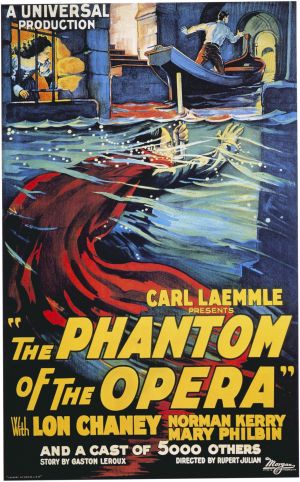
Today’s horror movie on the Shattered Lens is both a classic of silent era and one of the most influential horror films ever made. It’s one that I previously shared in 2013, 2015, and 2106 but it’s such a classic that I feel that it is worth sharing a second (or fourth) time.
First released in 1925, The Phantom of the Opera is today best known for both Lon Chaney’s theatrical but empathetic performance as the Phantom and the iconic scene where Mary Philbin unmasks him. However, the film is also a perfect example of early screen spectacle. The Phantom of the Opera was released during that period of time, between Birth of the Nation and the introduction of sound, when audiences expected films to provide a visual feast and Phantom of the Opera certainly accomplishes that. Indeed, after watching this film and reading Gaston Leroux’s original novel, it’s obvious that the musical was inspired more by the opulence of this film than by the book.
This film is also historically significant in that it was one of the first films to be massively reworked as the result of a poor test screening. The film’s ending was originally faithful to the end of the novel. However, audiences demanded something a little more dramatic and that’s what they got.
Halloween All Year sounds like a great idea to me!
Or, at least, it does until you actually pay attention the lyrics of this song, the majority of which involve a knife and a body on the ceiling. Actually, now that I think about it, I guess part of the appeal of Halloween is that you actually have to wait for it. You wait for 9 months and then suddenly, it’s the greatest 31 days of the year!
As for the video, I like it because it has a prom gone wrong feel to it.
The 1990 film Jacob’s Ladder asks the question, “Who is Jacob Singer?”
Is Jacob (played by Tim Robbins), a soldier serving in Vietnam who has just been severely wounded in an enemy attack and who is now barely clinging to life in a helicopter?
Is Jacob a withdrawn postal worker who lives in 1970s New York with his girlfriend, Jezzie (Elizabeth Pena), and who is haunted by horrifying visions of faceless, vibrating figures and viscous demons? This Jacob is haunted by ill-defined past incidents. Whenever he gets depressed, Jezzie is quick to demand that he snap out of it and that he stop thinking about anything other than the present day. This Jacob can only watch as all of his old friends either sink into paranoia or die. He hears rumors that they all may have been part of some sort of experiment involving LSD. He’s sure that he served in the army but when he attempts to hire an attorney, he’s informed that the army has no record of him ever having served in combat and that they say he was discharged for psychological reasons.
Or is Jacob the husband of Sarah (Patricia Kalember) and the father of Gabe (Macaulay Culkin — yes, that Culkin)? This is the Jacob who occasionally wakes up in bed with his wife and tells her that he’s been having the weirdest dream, one where he was living with “that crazy woman” from the post office, Jezebel?
Which one of these three realities is the truth for Jacob? At times, Jacob himself doesn’t even seem to be sure. Perhaps the one thing that you can be sure about in this movie is that whenever Jacob closes his eyes, he’s going to reopen them and discover that he’s in a different time and place. Jacob spends almost the entire film trying to work out what’s happening in the present, what’s happening in the past, and what’s just happening in his head.
And, to be honest, it all gets a bit pretentious at times. The film’s script has a lot on its mind. In fact, it might have a little bit too much going on. No sooner have you soaked in what the film has to say about denial and acceptance than you’re suddenly getting a crash course in MK-ULTRA and other mind-control conspiracy theories. Whenever Jacob isn’t seeing demons and faceless apparitions, he’s being kidnapped by government agents. There’s so much going on that this film can get a bit exhausting.
Fortunately, the film itself is such a triumph of style that it doesn’t matter that the script is a bit of a mess. Director Adrian Lyne does a great job bringing Jacob’s nightmarish world to life. Jacob seems to live in a world where the skies are permanently overcast and the streets are always wet after a recent storm. When Jacob makes the mistake of walking down a subway tunnel, Lyne frames it as if Jacob is literally following a tunnel into Hell. When a subway train rushes by Jacob, we catch disturbing glimpses of featureless faces facing the windows. When Jacob sees a demon at a party, Lynne films the moment so that, just like Jacob, it takes us a few minutes to realize what we’re seeing. And when Jacob is kidnapped and taken to a Hellish hospital, the scene is nightmarish in its intensity.
Tim Robbins gives a great performance as the emotionally withdrawn and haunted Jacob. (In fact, he’s so good that it makes it all the more sad that he really hasn’t had a decent role since he won an Oscar for 2003’s Mystic River.) He’s matched by Elizabeth Pena, who constantly keeps you wondering if Jezzie truly cares about Jacob or if she’s just another part of the conspiracy that seems to have taken over his life.
Jacob’s Ladder is an intensely effective, if somewhat messy, horror film. Apparently, like almost every other horror film released in the 20th century, it’s currently being remade, with the remake due to released on February 9th. Just in time for Valentine’s Day!
That scene featured a few dozen wealthy cruise ship passengers all getting bisected by a thin wire cord. While a young girl named Kate (Emily Browning) watches, everyone on the ship’s dance floor literally falls to pieces. Torsos slip off of legs. Bodies split in half. The captain’s head literally splits in two. While gallons of blood gush everywhere, people vainly try to reattach their limbs. Actually, some of them can’t even figure out which limb belongs to them. By the time everyone’s collapsed, there’s a lot of arms and legs to sort through.
In short, it’s an absolute mess. I wouldn’t want to be the person assigned to clean up after all that.
It’s also a rather brilliant opening, one that only takes a minute to go from romance and sophistication to bloody dismemberment. It’s definitely the one moment that everyone remembers about Ghost Ship, which is a bit of a problem because, once that scene is done, there’s still 85 minutes of film to sit through. Ghost Ship‘s opening is so shocking and visceral that there’s no way that the rest of the film can live up to it.
As for the rest of the film, it deals with a boat salvage crew. Gabriel Byrne is Murphy, the captain. Julianne Margulies is Maureen Epps, whose name might as well be Ellen Ripley. Ron Eldard is Dodge, who is in love with Epps. And then there’s Karl Urban, Isiah Washington, and Alex Dimitriades, who are all playing characters who you know are going to be doomed as soon as you see them. When they’re told by a pilot named Jack Ferriman (Desmond Harrington) that he’s spotted a ghost ship in international waters, they set out to claim it for themselves.
Of course, what Jack has spotted is the same cruise ship where, forty years before, everyone was chopped in half. After Murphy, Epps, and the crew board the ship, they discover a large amount of gold. They also end up seeing a lot of ghosts, including the young girl from the start of the movie. To their credit, the crew decides to leave the ship as quickly as they can. Unfortunately, after their tugboat explodes, escape appears to be impossible and it becomes obvious that they have been lured to the cruise ship for a very specific purpose.
The film encourages us to wonder what the ship wants from the salvage crew but the answer to that question is never really in doubt. For that matter, it’s not really a shock when it turns out that one member of the boarding party isn’t what he claims to be. Despite being a bit predictable, Ghost Ship isn’t a bad film. It has a reputation for being disappointing but actually it’s an atmospheric and competently directed horror film. Though the characters are all thinly drawn, the talented cast does their best to try to bring them to life. If the film ultimately doesn’t seem to work as well as it should, it’s largely because nothing that follows can match the power of that opening. You watching the film waiting for a scene that’ll match that opening scene and when it never comes, it’s hard not to be disappointed.





 Through the Shattered Lens