Today’s song of the day is not only about D-Day but it was composed and performed by a D-Day veteran. Here is Jim Radford’s The Shores of Normandy. (This was recorded and broadcast 11 years ago.)
Today’s song of the day is not only about D-Day but it was composed and performed by a D-Day veteran. Here is Jim Radford’s The Shores of Normandy. (This was recorded and broadcast 11 years ago.)
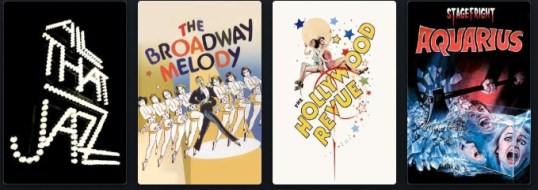
On Sunday, the Tonys will be handed out on and, if you want to watch the ceremony, it’ll be televised on CBS. However, if you’d just rather watch some movies about backstage life, I’ve got a few suggestions.
The Broadway Melody (1929) is a historically important film, in that it was the first sound film and the first musical to win the Oscar for Best Picture. The story is nothing special. Two sisters (Anita Page and Bessie Love) attempt to make the transition for Vaudeville to Broadway. One sister becomes a success and almost loses herself in the process. The other sister remains determined to become a star. Watching the film today, it’s obvious that the cast and the crew were still figuring out how to work with sound. That said, it’s a historical oddity and an interesting look at the film industry making the transition into the sound era. If you’re into that sort of thing — and I certainly am! — the film is now available on Tubi.
Far more entertaining is the same year’s Hollywood Revue of 1929 (1929). Produced by MGM, Hollywood Revue features all of the MGM featured players showing off what they could do. It’s a plotless parade of variety acts, hosted by the suave Conrad Nagel and featuring everyone from Joan Crawford to Marion Davies to Buster Keaton, Laurel & Hardy, Lionel Barrymore, John Gilbert, and Jack Benny! The goal here was to not only show off MGM’s roster of stars but also to show audiences that MGM knew how make sound pictures. It’s actually a really fun little movie. The cast appears to be having fun and there’s something really enjoyable about seeing so many talented people all in one movie. It also features a song called Singin’ In The Rain. The film can be viewed on YouTube.
Bob Fosse’s All That Jazz (1979) is a masterpiece, following choreographer Joe Gideon (Roy Scheider) as he directs both a film and a musical at the same time while popping pills, having heart attacks, and flirting with the Angel of Death (Jessica Lange). The scene where Gideon watches as his daughter and his girlfriend perform a dance routine that they’ve prepared for him is one of the most heartfelt moments that I’ve ever seen in a movie. The film’s surreal ending manages to be satirical, heart-breaking, oddly funny, and sad. Fosse based Gideon on himself and sadly, they both shared the same fate. It can be viewed on Tubi.
Finally, Michele Soavi’s Stage Fright (1987) is one of the best horror films to ever be set in a theater. Have you ever wondered why the victims in slasher films don’t just leave the house or the theater? Have you ever said, “Don’t split up, you idiots!” Well, in this one, everyone sticks together and everyone tries to leave and it doesn’t do a bit of good. (Unfortunately, their director has a cocaine problem.) This film has an absolutely brilliant opening sequence. I always laugh when the Marilyn Monroe look-alike starts playing the saxophone. The much-missed Giovanni Lombardo Radice has a small role. Director Soavi appears as a cop who asks, “Do you think I look like James Dean?” The film is on Tubi.
(Check out last week’s Weekend Films here!)

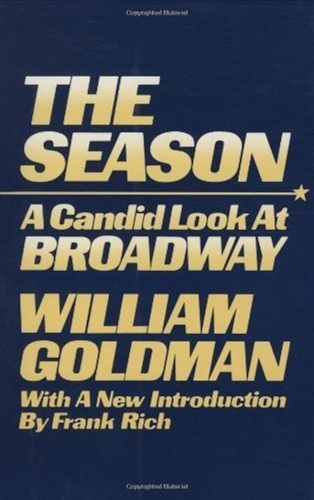
With the Tony Awards scheduled to be held and televised on Sunday, this weekend might be a good time to read William Goldman’s The Season.
First published in 1969, The Season was William Goldman’s very opinionated and very snarky look at the 1967-1968 Broadway season. Best known as a screenwriter, Goldman took the money that he made from selling the script for Butch Cassidy and the Sundance Kid and spent a year going to Broadway show after Broadway show. Many shows, he sat through multiple times. The book features his thoughts on not just the productions but also the culture around Broadway. Apparently, when the book was published, it was considered controversial because Goldman suggested that most Broadway critics played favorites and didn’t honestly write about the shows that they reviewed. Goldman suggested that some performers were viewed as being untouchable while other worthy actors were ignored because they weren’t a part of the clique. Today, that seems like common sense. One need only look at a site like Rotten Tomatoes to see how pervasive groupthink is amongst film critics and also how carefully most reviews are written to ensure that no one loses access to the next big studio event. In 1969, however, people were apparently a bit more naive about that sort of thing.
It’s an interesting book, especially if you’re a theater nerd like me. That said, it’s also a bit of an annoying book. There’s a smugness to Goldman’s tone, one that is actually present in all of Goldman’s books and essays and yes, aspiring screenwriters, that includes Adventures In The Screen Trade. He clearly believed himself to be the smartest guy in the room and he wasn’t going to let you forget it. It makes for a somewhat odd reading experience. On the one hand, Goldman’s style is lively. Goldman holds your interest. On the other hand, there will be times when you’ll want to throw a book across the room. When he hears two women talking about their confusion as to why they didn’t enjoy a show as much as they had hoped, Goldman describes walking up to them and offering to tell them. It comes across as being very condescending.
That said, Goldman makes up for it in the chapters in which he explores some of the more troubled productions of the season. His barbed dismissals of some of Broadway’s most popular performers still packs a punch and it remains relevant today as there are, to put it mildly, more than a few acclaimed performers who have been coasting on their reputations and their fandoms for more than a decade. Goldman passed away in 2018. One can only imagine what he would think of today’s celebrity-worshipping culture.
Finally, The Season does feature one beautiful chapter and it should be read by anyone who appreciates the character actors who carry movies and plays while the stars get all the credit. Goldman’s look at play called The Trial of Lee Harvey Oswald features a powerful profile of actor Peter Masterson. Goldman writes about a play that closed after 7 nights and which was not critically acclaimed but he turns the chapter into a celebration of truly good acting. It’s the chapter that makes the rest of the book worth the trouble.
Oh hey, it’s yet another behind-the-scenes style music video. Look at all the effort that goes into shooting a Miley Cyrus video, everyone!
Oh well. Even if I am a bit cynical about this video’s format, at least Miley’s improved as a performer over the past few years.
Enjoy!
Happy birthday, Mark Wahlberg!
You got the touch
You got the power
After all is said and done
You’ve never walked, you’ve never run
You’re a winner
You got the moves, you know the streets
Break the rules, take the heat
You’re nobody’s fool
You’re at your best when when the going gets rough
You’ve been put to the test, but it’s never enough
You got the touch
You got the power
When all hell’s breaking loose
You’ll be riding the eye of the storm
You got the heart
You got the motion
You know that when things get too tough
You got the touch
You never bend, you never break
You seem to know just what it takes
You’re a fighter
It’s in the blood, it’s in the will
It’s in the mighty hands of steel
When you’re standing your ground
And you never get hit when your back’s to the wall
Going to fight to the end and you’re taking it all
You got the touch
You got the power
When all hell’s breaking loose
You’ll be riding the eye of the storm
You got the heart
You got the motion
You know that when things get too tough
You got the touch
You’re fighting fire with fire
You know you got the touch
You’re at your best when when the road gets rough
You’ve been put to the test, but it’s never enough
You got the touch
You got the power
You got the touch
You got the power
Lyrics: Stan Bush
Today is Angelina Jolie’s 50th birthday.
As I sit here writing this, Jolie is very much a respectable figure, one who doesn’t appear in as many movies she once did. When she does act, it’s almost always in the type of big and rather glossy films that inevitably seem to be destined to be described as potential Oscar contenders. She’s so identified with the work that she does for UNHCR that it can be argued that she’s even better known now as a human rights activist than as an actor. (On Wikipedia, her career is listed as being “actress, director, humanitarian.”) Angelina Jolie has made the move from acting to directing and even though none of her directorial efforts have been especially memorable, they still tend to get a lot of attention because she’s Angelina Jolie. Angelina Jolie is definitely a part of the establishment and, let me make this very clear, there’s nothing wrong with that! She’s still a good actress. She seems to be far more sincere about her activism than many of her fellow Hollywood performers. Personally, I think the efforts to get her to run for political office have been a little over-the-top (and they seem to have died down after an attempted presidential draft in 2016) but again, she’s earned her success and she deserves it.
That said, it can sometimes be surprising to remember that, before she became so acceptable, Angelina Jolie was Hollywood’s wild child, the estranged daughter of Jon Voight who talked openly about being bisexual, using drugs, struggling with her mental health, and playing with knives in bed. This was the Jolie who, long before she married Brad Pitt, was married to Billy Bob Thornton and used to carry around a vial of his blood. This was the Angelia Jolie who had tattoos at a time when that actually meant something and who went out of her way to let everyone know that she was a badass who wasn’t going to let anyone push her around. This was the Angelina Jolie who was dangerous and unpredictable and who wore her wild reputation like an empowering badge of honor.
That’s the Angelina Jolie who starred in Gia.
Made for HBO in 1998, Gia was a biopic in which Jolie played Gia Carangi, one of the first supermodels. The film followed Gia, from her unhappy childhood (represented by Mercedes Ruehl as Gia’s mother) to her early modeling days when she was represented by the famous Wilhelmina Cooper (Faye Dunaway) to her struggles with heroin and cocaine to her eventual AIDS-related death. During the course of her short life, Gia falls in love with a photographer’s assistant named Linda (Elizabeth Mitchell) but, as much as Linda tries to help her, Gia simply cannot escape her demons.
That Gia is a fairly conventional biopic is not a shock, considering that it was directed by the reliably banal Michael Cristofer. He starts the film with people talking about their memories of Gia and he doesn’t get anymore imaginative from there. That the film works and is memorable is almost totally due to performances of Elizabeth Mitchell and Angelina Jolie, both of whom give such sincere and honest performances that they make you truly care about Gia and Linda. Jolie, in particular, portrays Gia as being an uninhibited and impulsive agent of chaos, one who follows her immediate desires and who makes no apology for who she is and what she does. There’s a lot of physical nudity in this film but the important thing is that Jolie allows Gia’s soul to be naked as well. There’s nothing hidden when it comes either the character or Jolie’s empathetic and passionate performance.
Jolie won an Emmy for her performance in Gia and her work in this film led to her being cast in 2000’s Girl, Interrupted, the film for which she would win the Oscar for Best Supporting Actress. Since then, Jolie’s become, as I said at the start of this review, very much a member of America’s cultural establishment. My hope, though, is that someday, someone will give Jolie a role that will remind viewers of who she was before she became respectable. I think she still has the talent to take audiences by surprise.
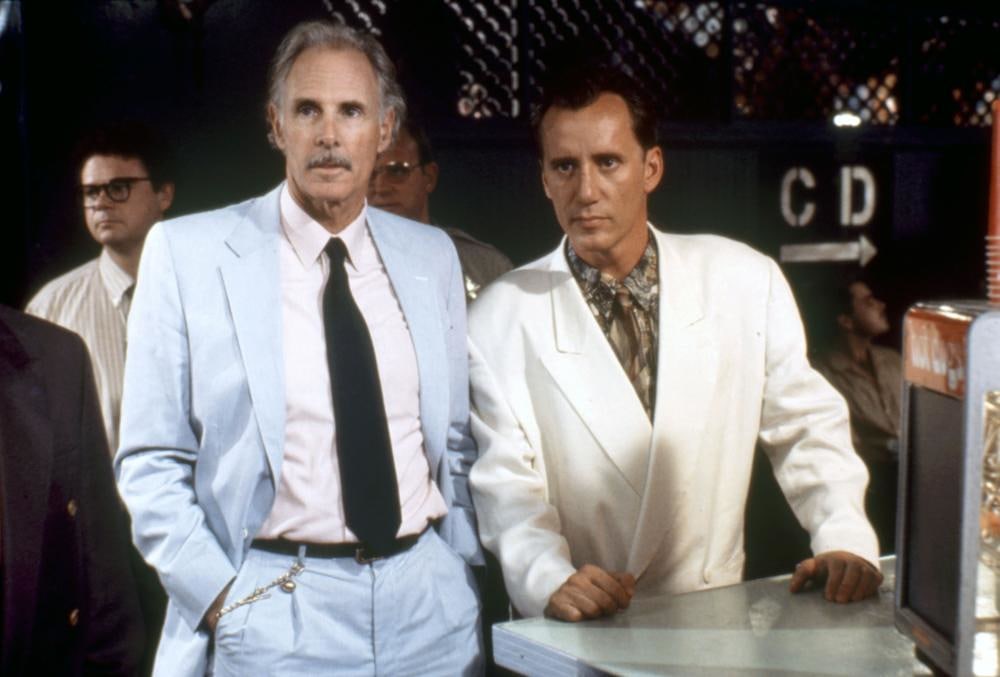
Gabriel Caine (James Woods) is a fast-talking con man fresh out of prison who’s already set up his next big scam. Along with his partner Fitz (Oliver Platt), Caine is targeting Diggstown, a small, boxing-obsessed community ruled over by the corrupt John Gillon (Bruce Dern). Gillon controls the town because he rigged a fight that left local boxing legend Charles Macum Diggs (Wilhelm von Homburg) completely brain-damaged. The scam involves getting Gillon to take a $100,000 bet that 48 year old “Honey” Roy Palmer (Louis Gossett Jr.) can defeat any ten Diggstown fighters in one 24-hour period. Once the fights start, you can bet that both sides will have lots of surprises up their sleeves, but the question is who will be standing when the final bell rings?!!
Since today is Bruce Dern’s 89th birthday, I decided to watch DIGGSTOWN, one of my favorite movies featuring the birthday boy. A box office flop when it was released in 1992, making less than $5 million at the box office, the reputation for the film seems to have gotten stronger over the years. The film has an excellent cast! James Woods exudes cockiness and intelligence as conman, Gabriel Caine. He somehow pulls off the feat of being both sleazy and very likable, which is a testament to Woods’ skills as an actor. Louis Gossett Jr. is great as “Honey” Roy Palmer. I remember when I first saw the trailer for DIGGSTOWN, I thought he was too old for the role. After watching it though, he’s able to make the boxing scenes work, especially when you consider some of the help he’s given as part of the con. With the huge personalities of Woods and Bruce Dern surrounding him, Gossett’s more grounded performance anchors the film. Bruce Dern is perfectly cast as the villainous scuzzbucket, Gillon. He’s the type of guy you really want to see get his comeuppance at the end. Now that I think about it, Gillon is such an A-hole, Caine can’t help but seem likable in comparison! Finally, I did want to give a shout out to Oliver Platt, who’s extremely funny in his role as Caine’s partner in con. It’s one of the first movies I remember seeing Platt in, and he’s great!
For DIGGSTOWN to really work though, the boxing scenes need to work and the con needs to be smart. Director Michael Ritchie (THE BAD NEWS BEARS) does a good job setting up both. The boxing sequences are well choreographed by Benny “The Jet” Urquidez, and you can’t help but root for the old guy as his opponents keep on coming. Of the 10 fights, some are funny, some are quick, and some are very intense depending on the situation. Ritchie is able to keep the stakes high enough during the boxing scenes to make sure we remain invested in the story. It’s a nice balancing act as the con plays out in the background of each fight. And what a con it is! I won’t spoil it for you, but it’s a stroke of genius that resulted in a massive amount of satisfaction for this audience member!
Overall, DIGGSTOWN is one of those movies I’m sure to watch every few years. With its great cast, punchy sense of humor, and genius triple-twist of an ending, I can’t imagine anyone leaving disappointed. I highly recommend it!
The trailer is included below:
As Brad mentioned earlier, today is Bruce Dern’s birthday!
Bruce Dern is a favorite actor of mine. He’s one of those performers who, over the course of his very long career, has appeared in all sorts of different and occasionally odd films, sometimes as a lead but most often as a character actor. He appeared in biker films, westerns, literary adaptations, and Oscar-winners. He killed John Wayne in The Cowboys. He introduced Peter Fonda to acid in The Trip. (Dern, for his part, has said that he the only person on the set of that film who has never done acid.) He captured the trauma of Vietnam in Coming Home. He played one of the great hyperactive cops in The Driver. He came close to playing Tom Hagen in The Godfather and was the original choice for the attorney who was eventually played by Jack Nicholson in Easy Rider.
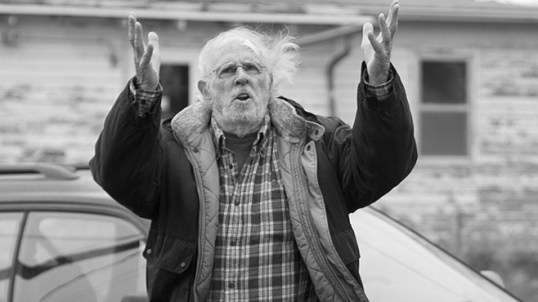
In 2013’s Nebraska, he broke my heart.
In Nebraska, Dern plays Woody Grant, an elderly man who is convinced that he’s won a million-dollar sweepstakes. Everyone around him, including his wife (June Squibb) and his oldest son (Bob Odenkirk), realizes that the sweepstakes is a scam and that Woody has actually won nothing. But Woody is convinced that a million dollars is waiting for him. All he has to do is somehow make it from Montana to Nebraska. At first, Woody attempts to walk along the interstate. When that doesn’t work and the police end up arresting him and sending him home, his youngest son, David (Will Forte), agrees to drive Woody down to Lincoln, Nebraska. David knows that there’s not any money waiting for Woody but, unlike his mother and his older brother, David hasn’t given up on the idea of connecting with his father.
Nebraska is a road movie, with the majority of the film following David and Woody as the drive through rural and smalltown America. They stop off in Woody’s former hometown, where they meet Woody’s brother (Rance Howard) and also Woody’s former business partner, a bully named Ed (Stacy Keach). Ed is convinced that Woody stole money from him. Woody blames Ed for the loss of his air compressor. Their anger has simmered for years and, at first, it’s tempting to assume that it’s simply one of those grudge matches that old men seem to have a weakness for. But Ed turns out to truly be a rotten human being and Woody …. well, Woody his own problems but at least he’s not as bad as Ed.
Before I say anything else, I want to praise the entire cast. June Squibb, Bob Odernkirk, Stacy Keach, Rance Howard, Melinda Simonsen (who has a small role as a receptionist in Lincoln), they all bring their characters to memorable life. Will Forte is the heart of the film, trying to keep his family together and standing up for his father when it matters. If you only know Will Forte as MacGruber, you need to see Nebraska. That said, this film is dominated by Bruce Dern’s poignant, sad, and often very funny performance as Woody Grant. Woody is a flawed character and Dern wisely doesn’t try to sentimentalize or downplay any of those flaws. He drinks too much, he neglected his family when he was younger, he holds a grudge, and he’s incredibly stubborn. But, as played by Dern, you just can’t help but like Woody and hope that he finds some sort of happiness. Even though the viewer, like everyone else in Woody’s life, knows that the sweepstakes is a scam, it’s still hard not to spend the film hoping that Woody will prove everyone wrong when he makes it to Nebraska.
Nebraska was nominated for Best Picture while both Bruce Dern and June Squibb picked up acting nominations. That year, the Best Picture race was dominated by 12 Years A Slave. Matthew McConaughey won Best Actor for Dallas Buyers Club while Lupita Nyong’o won Best Supporting Actress for 12 Years A Slave. Alexander Payne lost Best Director to Gravity’s Alfonso Cuaron. Gravity also won the Oscar for Best Cinematography, defeating Nebraska’s gorgeous black-and-white imagery.
Oscars or not, Nebraska is a wonderful, late career showcase for the great Bruce Dern.
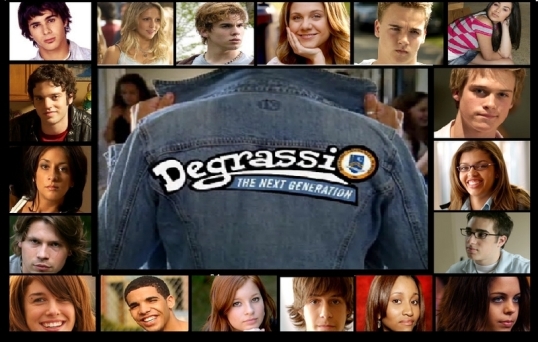
Today, the Shattered Lens wishes a happy birthday to Shane Kippel!
Shane Kippel, as I’m sure I don’t have to tell you, played Spinner Mason on Degrassi: The Next Generation. He started out as the school bully but, by the time the third season began, he was pretty much the heart of the ensemble. How cool was Shane Kippel? He was so cool that Spinner ended up getting held back three times just so there would be an excuse to keep Kippel on the show!
(“What type of idiot fails his own language!?” Spinner once said when confronted with his grade in English. Oh, Spinner!)
Today’s song of the day features Shane Kippel on drums. From Degrassi, here is Downtown Sasquatch with Dust!
(The other members of the band are Jake Epstein on vocals, Aubrey Graham on guitar, and Adamo Ruggiero on bass.)
In honor of Tony Curtis’s birthday, today’s song of the day comes from one of his best films, 1960’s Spartacus!
 Through the Shattered Lens