The year is 1937 and “Big Boy” Caprice (Al Pacino) and his gang of flamboyant and often disfigured criminals are trying to take over the rackets. Standing in their way is ace detective Dick Tracy (Warren Beatty), the yellow trench-wearing defender of the law. Tracy is not only looking to take down Caprice but he and Tess Trueheart (Glenne Headly) are currently the guardians of The Kid (Charlie Korsmo), a young street kid who witnessed one of Caprice’s worst crimes. Tracy’s investigation leads him through a rogue’s gallery of criminals and also involves Breathless Mahoney (Madonna), who has witnessed many of Caprice’s crimes but who also wants to steal Tracy’s heart from Tess.
Based on the long-running comic strip, Dick Tracy was a labor of love on the part of Warren Beatty. Not only starring but also directing, Tracy made a film that stayed true to the look and the feel of the original comic strip (the film’s visual palette was limited to just seven colors) while also including an all-star cast the featured Madonna is an attempt to appeal to a younger audience who had probably never even heard of Dick Tracy. When Dick Tracy was released, the majority of the publicity centered around Madonna’s participation in the film and the fact that she was dating Beatty at the time. Madonna is actually probably the weakest element of the film. More of a personality than an actress, Madonna is always Madonna no matter who she is playing and, in a film full of famous actors managing to be convincing as the members of Dick Tracy’s rogue gallery, Madonna feels out of place. Michelle Pfeiffer would have been the ideal Breathless Mahoney.
It doesn’t matter, though, because the rest of the film is great. It’s one of the few comic book films of the 90s to really hold up, mostly due to Beatty’s obvious enthusiasm for the material and the performances of everyone in the supporting cast who was not named Madonna. Al Pacino received an Oscar nomination for playing Big Boy Caprice but equally good are Dustin Hoffman as Mumbles, William Forsythe as Flaptop, R.G. Armstong as Pruneface, and Henry Silva as Influence. These actors all create memorable characters, even while acting under a ton of very convincing makeup. I also liked Dick Van Dyke as the corrupt District Attorney. Beatty knew audience would be shocked to see Van Dyke not playing a hero and both he and Van Dyke play it up for all its worth. Beatty embraces the comic strip’s campiness while still remaining respectful to its style and the combination of Danny Elfman’s music and Stephen Sondheim’s songs provide just the right score for Dick Tracy’s adventures. The film can be surprisingly violent at times but the same was often said about the Dick Tracy comic strip. It wasn’t two-way wrist radios and trips to the Moon. Dick Tracy also dealt with the most ruthless and bloodthirsty gangsters his city had to offer.
Dick Tracy was considered to be a box office disappointment when it was originally released. (Again, you have to wonder if Beatty overestimated how many fans Dick Tracy had in 1990.) But it holds up well and is still more entertaining than several of the more recent comic book movies that have been released.
In the 1981 film Reds, Warren Beatty plays Jack Reed, the radical journalist who, at the turn of the century, wrote one of the first non-fiction books about Russia’s communist revolution and then went on to work as a propagandist for the communists before becoming disillusioned with the new Russian government and then promptly dying at the age of 32.
Diane Keaton plays Louise Bryant, the feminist writer who became Reed’s lover and eventually his wife. Louise found fame as one of the first female war correspondents but then she also found infamy when she was called before a Congressional committee and accused of being a subversive.
Jack Nicholson plays Eugene O’Neill, the playwright who was a friend of both Reed and Bryant’s and who had a brief affair with Bryant while Reed was off covering labor strikes and the 1916 Democratic Convention.
Lastly, Maureen Stapleton plays Emma Goldman, the anarchist leader who was kicked out of the country after one of her stupid little dumbass followers assassinated President McKinley. (Seriously, don’t get me started on that little jerk Leon Czolgosz.)
Together …. well, I was going to say that they solve crimes but that joke is perhaps a bit too flippant for a review of Reds. Reds is a big serious film about the left-wing activists at the turn of the century, one in which the characters move from one labor riot to another and generally live the life of wealthy bohemians. Reed spends the film promoting communism, just to be terribly disillusioned when the communists actually come to power in Russia. For a history nerd like me, the film is interesting. For those who are not quite as obsessed with history, the film is extremely long and the scenes of Reed and Bryant’s domestic dramas often feel a bit predictable, especially when they’re taking place against such a large international tableaux. At its best, the film is almost a Rorschach test for how the viewer feels about political and labor activists. Do you look at Jack Reed and Louise Bryant and see two inspiring warriors for the cause or do you see two wealthy people playing at being revolutionaries?
Reds was a film that Warren Beatty spent close to 20 years trying to make, despite the fact that the heads of the Hollywood studios all told him that audiences would never show up for an epic film about a bunch of wealthy communists. (The heads of the studio turned out to be correct, as the film was critically acclaimed but hardly a success at the box office.) It was only after the success of the 1978, Beatty-directed best picture nominee Heaven Can Wait that Beatty was finally able to get financing for his dream project. He ended up directing, producing, and writing the film himself and he cast his friend Jack Nicholson as O’Neill and his then-romantic partner Diane Keaton as Louise Bryant. (Gene Hackman, Beatty’s Bonnie and Clyde co-star, shows up briefly as one of Reed’s editors.) One left-wing generation’s tribute to an early left-wing generation, Reds is fully a Warren Beatty production and, for his efforts, Beatty was honored with the Oscar for Best Director. That said, the Reds lost the award for Best Picture to another historical epic, Chariots of Fire. Chariots of Fire featured no communists and did quite well at the box office.
The film is good but a bit uneven, especially towards the end when we suddenly get scenes of Louise Bryant trudging through Finland as she attempts to make it to Russia to be reunited with Reed. The film actually works best when it features interviews with people who were actual contemporaries of Reed and Bryant and who share their own memoires of the time. In fact, the interviews work almost too well. The “witnesses,” as the film refers to them, paint such a vivid picture of the Reed, Bryant, and turn of the century America that Beatty’s attempt to cinematically recreate history often can’t compete. One can’t help but feel that Beatty perhaps should have just made a documentary instead of a narrative film.
(Interestingly enough, many of the witnesses were people who were sympathetic to Reed’s politics in at the start of the century but then moved much more to the right as the years passed. Reed’s friend and college roommate, Hamilton Fish, went on to become a prominent Republican congressman and a prominent critics of FDR.)
That said, Jack Nicholson gives a fantastic performance as Eugene O’Neill, adding some much needed cynicism to the film’s portrayal of Reed and Bryant’s idealism. Keaton and Beatty sometime both seem to be struggling to escape their own well-worn personas as Bryant and Reed but Beatty does really sell Reed’s eventually disillusionment with Russia and the scene where he finally tells off his Russian handler made me want to cheer. Fans of great character acting will want to keep an eye out for everyone from Paul Sorvino to William Daniels to Edward Herrmann to M. Emmet Walsh and IanWolfe, all popping up in small roles.
Reds is not a perfect film but, as a lover of history, I enjoyed it.
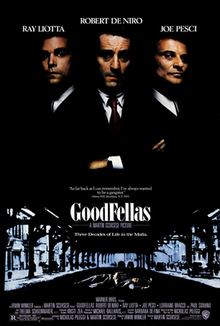
First released in 1990 and continuously acclaimed ever since, Goodfellas did not win the Oscar for Best Picture.
I’m always a bit surprised whenever I remember that. Goodfellas didn’t win Best Picture? That just doesn’t seem right. It’s not the other films nominated that year were bad but Goodfellas was so brilliant that it’s hard to imagine someone actually voting for something else. Seriously, it’s hard to think of a film that has been more influential than Goodfellas. Every gangster film with a soundtrack of kitschy tunes from the 6os and 70s owes huge debt to Goodfellas. Every actor who has ever been cast as a wild and out-of-control psycho gangster owes a debt to Joe Pesci’s performance as Tommy DeVito. When Ray Liotta passed away two years ago, we all immediately heard him saying, “I always wanted to be a gangster.” Robert De Niro’s Jimmy Conway remains the epitome of the ruthless gangster. For many, Paul Sorvino’s neighborhood godfather redefined what it meant to be a crime boss. Lorraine Bracco made such an impression as Karen Hill that it somehow seemed appropriate that she was one of the first people cast in The Sopranos, a show that itself would probably have not existed if not for Goodfellas. Frank Sivero, Samuel L. Jackson, Tobin Bell, Debi Mazer, Vincent Gallo, Ileana Douglas, Frank Vincent, Tony Sirico, Michael Imperioli, Tony Darrow, Mike Starr, Chuck Low, all of them can be seen in Goodfellas. It’s a film that many still consider to be the best of Martin Scorsese’s legendary career. Who can forget Robert De Niro smoking that cigarette while Sunshine of Your Love blared on the soundtrack? Who can forget “Maury’s wigs don’t come off!” or “Rossi, you are nothing but whore!?” Who can forget the cheery Christmas music playing in the background while De Niro’s Jimmy Conway grows more and more paranoid after pulling off the biggest heist of his career?
Plus, it’s a Christmas movie!
And yet, it did not win Best Picture.
Myself, whenever I’m sitting behind a garbage truck in traffic, I immediately start to hear the piano coda from Layla. For that matter, whenever I see a helicopter in the sky, I flash back to a coke-addled Henry Hill getting paranoid as he tries to pick up his brother from the hospital. Whenever I see someone walking across the street in the suburbs, I remember the scene where Henry coolly pistol-whips the country club guy and then tells Karen to hide his gun. I always remember Karen saying that she knows that many of her best friends would have run off as soon as their boyfriend gave them a gun to hide but “it turned me on.” It would have turned me on as well. Henry might be a gangster and his friends might be murderers but he doesn’t make any apologies for who he is, unlike everyone else in the world.
But it did not win Best Picture.
How many people have imitated Joe Pesci saying, “How am I funny?” How many times did Pesci and Frank Vincent have to listen to people telling them to “go home and get your fucking shinebox?” A lot of people remember the brutality of the scene where Pesci and De Niro team up to attack Vincent’s crude gangster but I always remember the sound of Donavon’s Atlantis playing on the soundtrack.
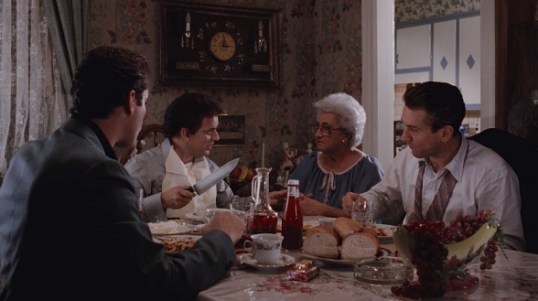
And then there’s Catherine Scorsese, showing up as Tommy’s mom and cooking for everyone while Vincent struggles to escape from the trunk of a car. “He is content to be a jerk,” Tommy says about Henry Hill. Just a few hours earlier, Tommy was apologizing to Henry for getting blood on his floor.
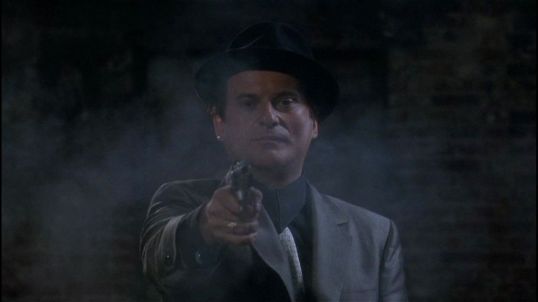
Goodfellas is a fast-paced look at organized crime, spanning from the 50s to the early 80s. Ray Liotta plays Henry Hill, who goes from idolizing gangsters to being a gangster to ultimately fearing his associates after he gets busted for dealing drugs. It’s a dizzying film, full of so many classic scenes and lines that it feels almost pointless to try to list them all here or to pretend like whoever is reading this review doesn’t remember the scene where the camera pans through the club and we meet the members of the crew. (“And then there was Pete The Killer….”) Goodfellas is a film that spend two hours showing us how much fun being a gangster can be and then thirty minutes showing us just how bad it can get when you’re high on coke, the police are after you, and you’ve recently learned that your associates are willing to kill even their oldest friends. No matter how many times I watch Goodfellas, I always get very anxious towards the end of the film. With the music pounding and the camera spinning, with Henry looking for helicopters, and with all of his plans going wrong over the course of one day, it’s almost a relief when Bo Dietl points that gun at Henry’s head and yells at him, revealing that Henry has been captured by the cops and not the Gambinos. Karen desperately running through the house, flushing drugs and hiding a gun in her underwear, always leaves me unsettled. It’s such a nice house but now, everything is crashing down.
There’s a tendency to compare Goodfellas to The Godfather, as their both films that re-imagine American history and culture through the lens of the gangster genre. I think they’re both great but I also think that they are ultimately two very different films. If The Godfather is sweeping and operatic, Goodfellas is the film that reminds us that gangsters also live in the suburbs and go to cookouts and that their wives take care of the kids and watch movies while the FBI searches their home. If The Godfather is about the bosses, Goodfellas is about the blue collar soldiers. The Godfather represents what we wish the Mafia was like while Goodfellas represents the reality.
Goodfellas is one of the greatest films ever made but it lost the Best Picture Oscar to Dances With Wolves, a film that left audiences feeling good as opposed to anxious. To be honest, Martin Scorsese losing Best Director to Kevin Costner feels like an even bigger injustice than Goodfellas losing Best Picture. One can understand the desire to reward Dances With Wolves, a film that attempts to correct a decades worth of negative stereotypes about Native Americans. But Scorsese’s direction was so brilliant that it’s truly a shame that he didn’t win and that Lorraine Bracco didn’t win Best Supporting Actress. It’s also a shame that Ray Liotta wasn’t nominated for playing Henry Hill. At least Joe Pesci won an Oscar for redefining what it meant to be a gangster.
Goodfellas is proof that the best film doesn’t always win at the Oscars. But it’s also proof that a great film doesn’t need an Oscar to be remembered.
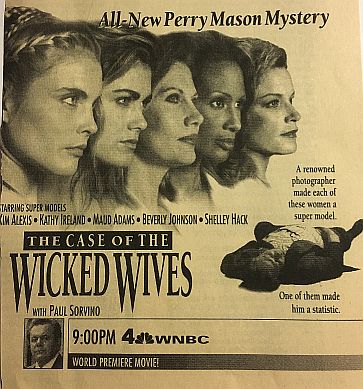
Famed fashion photographer David Morrison (Eric Braeden) has fallen on hard times but things are looking up. The American Museum of Art wants to do a retrospective of his work. He just has to get the permission of his current wife, Dee (Kathy Ireland), and his four ex-wives (Shelley Hack, Kim Alexis, Maud Adams, and Beverly Johnson). All of them are super models who owe their careers to David but four of them hate his guts and Dee isn’t happy when she sees evidence that he has been cheating on her. When David turns up dead, Dee is arrested. She claims that she’s innocent but the prosecution is sure that they have an airtight case.
This sounds like a case for Perry Mason!
However, Perry’s out of town so it falls to Perry’s never previously mentioned best friend, Tony Caruso (Paul Sorvino), to solve The Case of the Wicked Wives! With the help of Perry’s tireless associates, Della Street (Barbara Hale) and Ken Malansky (William R. Moses), Caruso works to solve the case and prove the Dee is innocent. He also prepares many pasta dinners and frequently sings.
So, where was Perry? As everyone knows, Raymond Burr played Perry Mason for 9 seasons in the 50s and the 60s. 20 years after the show aired its final episode, Burr returned to the role in a series of highly rated, made for television movies. Unfortunately, Burr died in 1993 with several movies left to be filmed. In his will, Burr specifically requested that production on the remaining films continue so that the cast and crew wouldn’t lose their jobs. Since the role of Mason obviously could not be recast that soon after Burrs’s death, it was decided that the remaining movies would feature guest lawyers. Enter Paul Sorvino.
The Case of the Wicked Wives was the first Perry Mason film to be made after Burr’s death. As his replacement, Tony Caruso has much in common with Mason, including the ability to make the guilty confess in open court. Unlike Mason, Caruso is also obsessed with cooking elaborate spaghetti dinners and singing operatic arias. This movie came out just a year after Sorvino left Law & Order to specifically pursue his opera career. Sorvino sings a lot in The Case of the Wicked Wives, sometimes in court. Unfortunately, a love of singing and pasta are the only two personality traits that are really given to Caruso. Through no fault of Paul Sorvino’s, Caruso is never as compelling a character as the coolly calculating Mason. Mason could trick anyone into confessing through perfectly asked questions. Caruso is more into courtroom stunts that would get most lawyer disbarred.
Because the mystery itself is a dud, the main reason to watch The Case of the Wicked Wives is for the wives. Who wouldn’t want to keep Kathy Ireland from being wrongly convicted? All of the wives get at least one big moment to shine and tear up the scenery. You’ll guess who the murderer is long before anyone else in court.
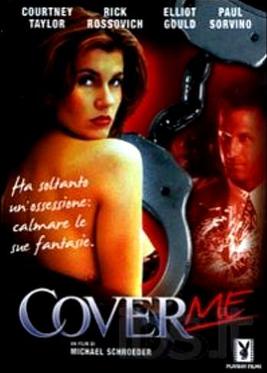
A serial killer is stalking Los Angeles, killing the models who have appeared in an adult magazine. Because they’re not very good at their jobs, neither Sgt. Bobby Colter (Rick Rossovich) nor Detective J.J. Davis (Paul Sorvino!) have come up with any leads that could lead them to the murderer. Facing a dead end, they come up with a brilliant idea. Maybe a cop could go undercover as an erotic model! Fortunately, Bobby just happens to be dating a surprisingly attractive cop named Holly (Courtney Taylor). You have to love it when a plan comes together.
At first, Holly is hesitant but, realizing that there’s no other possible way to get the killer off the streets (because it’s certainly not like Bobby or J.J. could actually do any police work on their own), she agrees to pose for some pictures. Soon, she’s appearing in the magazine, working as a stripper, and discovering that she enjoys her new uninhibited lifestyle. Meanwhile, the killer has noticed her. The killer, by the way, is Dimitri (Stephen Nichols), who frequently disguises himself as a woman and who is driven to kill by his mother. Dimitri’s identity is revealed early on in the film so this doesn’t count as a spoiler. Cover Me is a mystery but it’s a mystery where everyone figures it all out except for the people who are supposed to be figuring it out.
Cover Me was one of the many direct-to-video films that found a home on late night Cinemax in the 90s. These films were advertised as being “erotic thrillers,” though there was usually little about them that was either erotic or thrilling. Cover Me was produced by Playboy and distributed by Paramount, which means that Hugh Hefner probably used to show up on set, wearing his sea captain’s hat and asking the strippers if they wanted to come back to the mansion and help him look for his Viagra. Because it’s a Playboy film, Cover Me has higher production values than the typical 90s erotic thriller but it’s still interesting that a company best known for publishing an adult magazine would produce a film about a killer targeting nude models. In the 70s, Playboy produced things like Roman Polanski’s adaptation of MacBeth, a cinematic triumph regardless of how one feels about Polanski as a human being. By the time the 90s rolled around, they were producing slightly less classy versions of Stripped to Kill.
Still, Cover Me is better than many of the other erotic thrillers that came out during the direct-to-video era. That doesn’t mean that it was a good movie, of course. There’s a reason why “Skinemax” was go-to punchline during the 1990s. As opposed to many of the other movies of the era and the genre, Cover Me has a talented cast that tries to make the best of the material that they’ve been given. I don’t know how Rick Rossovich went from appearing in The Terminator and Top Gun to starring in something like Cover Me but he delivers his lines with a straight face, which could not have always been easy. Paul Sorvino, Elliott Gould, and Corbin Bernsen are also on hand, all playing their parts like pros. (Between L.A. Law and Psych, Bernsen was a mainstay in these type of films, almost always playing either a pimp, a pornographer, or a strip club owner.) Finally, there’s Courtney Taylor, who is actually pretty good in the role of Holly. Though the role really only calls for her to be sexy, Taylor still plays it with a lot of conviction. Taylor’s performance is natural and likable and she sells even the most clichéd dialogue. Just as when she starred in the fourth Prom Night film, Taylor is always better than her material. Unfortunately, Courtney Taylor appears to have stopped acting around 2000.
Cover Me was shot at the same time as an early CD-Rom game called Blue Heat, where I guess the player would step into Holly’s shoes and try to solve the case. Because the company that developed the game went out of business before the game was published, Blue Heat didn’t come out until two years after Cover Me. I’ve never played the game but, from what I’ve read online, it was a point-and-click game where you could go to various places in Los Angeles and search for clues and interrogate suspects. The game came with multiple endings, depending on the decisions you made. Did anyone ever play this game? Let me know in the comments!
As for Cover Me, it’s not great but it’s also not terrible, which is high praise when it come to late night CInemax.
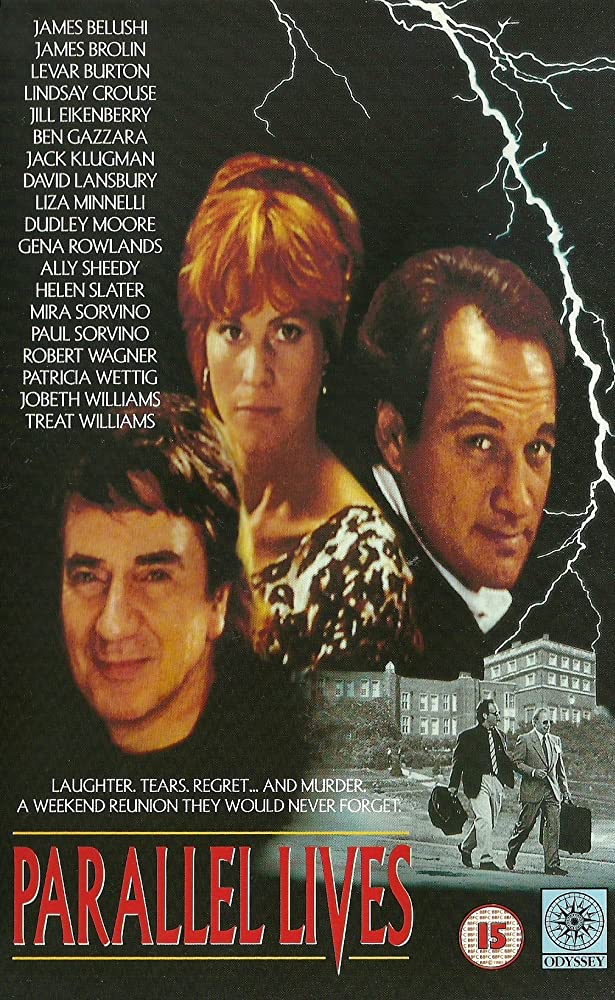
A large group of people gather together one weekend for a fraternity/sorority reunion. Since college, some of them have become rich and powerful. Some of them are now famous. Some of them are now seedy and disreputable. They all have college memories, though there’s such a wide variety of age groups represented that it’s hard to believe that any of them actually went to college together. After the men spend the day playing practical jokes and touch football and the women spend the night talking about their hopes and dreams, they wake up the next morning to discover the someone has murdered Treat Williams. A pony-tailed sheriff (Robert Wagner) shows up to question everyone.
Parallel Lives was made for Showtime with the help of the Sundance Institute. Today, it’s a forgotten film but, for some reason, it was very popular with American Airlines during the summer of 1997. That summer, when I flew to the UK, Parallel Lives was one of the movies that we were shown. (It was the second feature. The first feature was Down Periscope, a submarine comedy starring Kelsey Grammar. Fourteen year-old me enjoyed Down Periscope but, in retrospect, it wasn’t much of a flight.) A month and a half later, when I flew back to the U.S., Parallel Lives was again one of the films shown on the flight! For that reason, I may be the only person on the planet who has not forgotten that a film called Parallel Lives exists.
Parallel Lives, I later learned, was an entirely improvised film. The huge cast were all given their characters and a brief outline of the film’s story and they were then allowed to come up with their own dialogue. Unfortunately, no one did a very good job of it and the men were reduced to bro-ing it up while the women spent most of the movie having extended group therapy. The story doesn’t add up too much and, even when I rewatched it from an adult’s perspective, I wasn’t sure what I was supposed to get out of everyone talking about how different the real world was from college. Technically, the film’s a murder mystery but you can’t improvise a successful murder mystery. This film proves that point.
Of course, it doesn’t help that there are 26 characters, all trying to get a word in at the same time. Some of the roles don’t make much sense. Dudley Moore shows up, playing an imaginary friend. (How do you improvise being a figment of someone’s imagination?) James Brolin introduces himself to everyone as being, “Professor Doctor Spencer Jones” and that appears to be as far as he got with his improv. Ben Gazzara is a gambler and Mira Sorvino is the prostitute that he brings to the reunion while Mira’s father, Paul Sorvino, moons the camera several times. Jack Klugman is a senator with Alzheimer’s and Patricia Wettig is his daughter. The majority of the movie centers around Jim Belushi, playing a reporter and falling in love with JoBeth Williams. Liza Minnelli, Helen Slater, Levar Burton, Lindsay Crouse, Matthew Perry, Ally Sheedy, and Gena Rowlands all have small roles. How did so many talented people come together to make such a forgettable movie and why did American Airlines decide it was the movie to show people on their way to another country? That’s the true mystery of Parallel Lives.
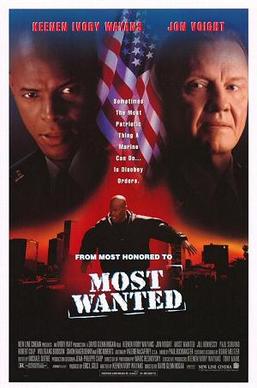
James Dunn (Keenan Ivory Wayans) is an army sergeant with a talent for getting framed for crimes that he didn’t commit.
During the Gulf War, Dunn’s superior officer orders Dunn to shoot a shepherd boy. Dunn refuses and, when the two men get into a fight over a gun, his commanding officer is accidentally shot and killed. The army refuses to listen to Dunn’s explanation. He’s convinced of murder and sentenced to death. However, while Dunn is on his way to Leavenworth, he is rescued by Col. Casey (Jon Voight). Casey explains that he is giving Dunn a chance to join a super secret vigilante group that targets evil doers. Yes, Dunn will be expected to assassinate people but they’ll all be bad. With no other options available to him, Dunn agrees to work for Casey.
Dunn’s first target is the corrupt owner of a pharmaceutical company (played by Robert Culp) but — surprise — it turns out that the target was actually the First Lady and that the entire plan was to set up Dunn as a patsy! Now a “most wanted” fugitive, Dunn is forced to go on the run with a doctor (Jill Hennessy) who recorded the assassination with a camcorder. (Remember, Most Wanted was made during the days of the landline phones.) With Casey and his second-in-command (played by Wolfgang Bodison) determined to kill him and with only Paul Sorvino (as the head of the FBI) doubting the official story, Dunn has to find a way to reveal the truth.
Though he was subsequently overshadowed by his brothers, Damon and Marlon, Keenan Ivory Wayans was a really big deal in the 90s. As the man behind In Living Color, he proved that black comedians and writers could be just as funny (and, in many cases, funnier) than their white counterparts over at Saturday Night Live. It can be argued Jim Carrey, Jamie Foxx, David Alan Grier, and Jennifer Lopez would not have the careers that they have today if not for Keenan Ivory Wayans. (All of them first found fame as members of the In Living Color ensemble, Carrey, Foxx, and Grier as cast members and Lopez as a “fly girl.”) Most Wanted was Wayans attempt to transform himself into an action hero (perhaps not coincidentally, a year before Most Wanted was released, Damon Wayans had a minor hit with Bulletproof).
Keenan Ivory Wayans not only starred in Most Wanted but he also wrote the script and it’s interesting just how straight the action is played. It would be natural to expect Wayans to turn the movie into a spoof but there’s little intentional humor to be found in Most Wanted. Most Wanted takes itself seriously and the end result is an adequate but hardly memorable action movie, with Wayans jumping off of buildings and fighting off the bad guys. The action scenes are well-shot if not particularly imaginative but, unfortunately, Wayans doesn’t really have the screen presence necessary to be a believable action hero. Both the character of James Dunn and Wayans’s performance are just too bland to really be compelling. Far more interesting are Jon Voight and Paul Sorvino, who are both entertainingly hammy in their roles.
There’s one good scene in Most Wanted, where Dunn finds himself being chased by what appears to be the entire population of Los Angeles. Otherwise, this one is adequate but forgettable.
The 1971 The Panic in Needle Park tells the story of two young lover in New York City.
Helen (Kitty Winn) is an innocent runaway from Indiana who, when we first meet her, has just had a back alley abortion. Her boyfriend, Marco (Raul Julia), doesn’t seem to be too concerned about her or anyone else for that matter. Instead, it’s Marco’s dealer, Bobby (Al Pacino), who checks in on Helen and who visits her when she eventually ends up in the hospital. It’s also Bobby who gives her a place to stay after she gets out of the hospital.
Bobby is a small-time dealer. He’s not book smart but he knows how to survive on the streets and it’s hard not to be charmed by him. He literally never stop talking. As he explains it to Helen, he’s been in jail 8 times but he’s not a bad guy. His brother, Hank (Richard Bright, who also co-starred with Pacino in The Godfather films), is a burglar and he legitimately is a bad guy but he and Bobby seem to have a close relationship. Bobby also swears that he’s not a drug addict. He just occasionally indulges. It doesn’t take long to discover that Bobby isn’t being completely honest with either Helen or himself.
Together, Bobby and Helen ….
Well, they don’t solve crimes. In fact, they really don’t do much of anything. That’s kind of the problem with movies about drug addicts. For the most part, drug addicts are boring people and there’s only so many times that you can watch someone shoot up before you lose interest. Heroin may make the addicts feel alive but, with a few notable exception (Trainspotting comes to mind), it’s always been a bit of a cinematic dead end. The film takes a documentary approach to Bobby and Helen’s descent into addiction and it’s not exactly the most thrilling thing to watch.
Bobby and Helen live in an area of New York that’s known as needle park, largely due to the fact that it’s full of addicts. It’s a place where people sit on street corners and nod off and where everyone’s life is apparently fueled by petty crime. An unlikable narcotics detective (Alan Vint) occasionally walks through the area and tries to talk everyone into betraying everyone else. It turns out that being a drug addict is not like being in the mafia. Everyone expects you to betray everyone else.
As I said, it’s a bit of a drag to watch but you do end up caring about Bobby and Helen. They come across as being two essentially decent people who have gotten caught up in a terrible situation. Even when they piss you off, you still feel badly for them because you know that they’ve surrendered control of their lives to their addictions. It helps that they’re played by two very appealing actors. This was only Al Pacino’s second film and his first starring role but he commands the screen like a junkie James Cagney. Meanwhile, making her film debut, Kitty Winn gives a sympathetic and likable performance as Helen. You watch Winn’s vulnerably sincere performance and you understand why Helen would have looked for safety with undeserving losers like Marco and Bobby and, as a result, you don’t hold it against her that she seems to be addicted not just to heroin but also to falling for the wrong men. Helen does a lot of stupid things but you keep hoping that she’ll somehow manage to survive living in needle park.
Pacino, of course, followed-up The Panic In Needle Park with The Godfather. As for Kitty Win, she won best actress at Cannes but the role didn’t lead to the stardom that it probably should have. Her best-known role remains playing the nanny in The Exorcist.
“These straight-to-video, schlocky films I was getting were giving me an ulcer, basically because I was the only one on the set that cared about anything… Between that and my biological clock, I decided to give it all away.”
— Linda Kozlowksi, on why she retired from acting
When Linda Kozlowski talked about the “shlocky films” that soured her on acting, Backstreet Justice was probably high on the list. Kozlowski may have found fame co-starring with her then-husband Paul Hogan in the Crocodile Dundee films but, in Backstreet Justice, there’s neither an Australian nor a sense of humor to be found.
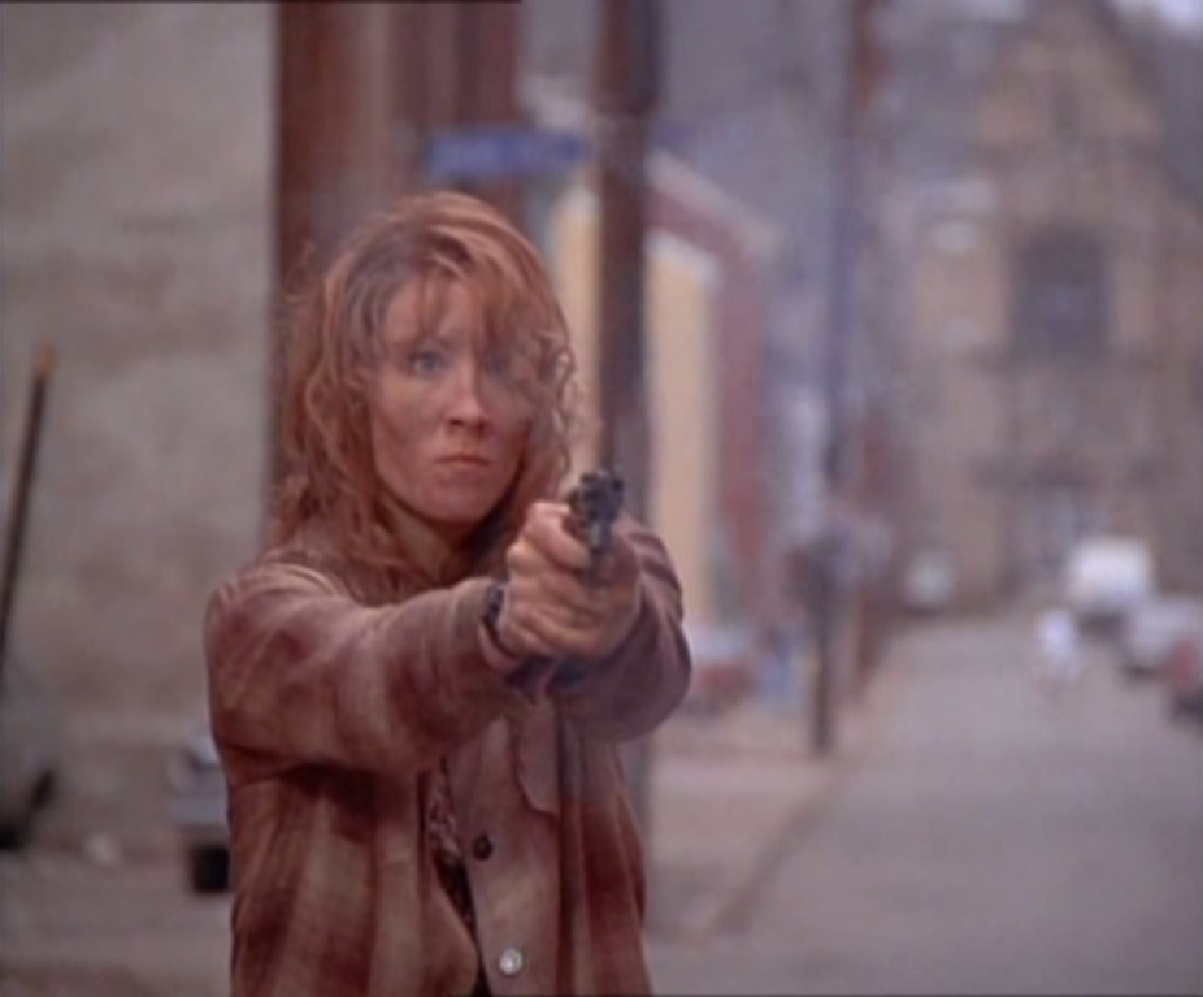
Kozlowski plays Keri Finnegan, a tough and streetwise private investigator in Philadelphia. Her late father was a policeman who was accused of corruption while her mentor (Hector Elizondo) is the district attorney. Most of the cops hate Keri, especially Captain Giarusso (Paul Sorvino). The one exception is her lover, Nick Donovan (John Shea).
The residents of Philadelphia’s worst neighborhood have hired Keri to protect them. For the past two years, a murderer has lurked among them. With the police showing no interest in solving the crimes, the neighborhood turns to Keri. Keri’s investigation leads her to believe that the murders are being carried out be corrupt cops but Keri isn’t prepared for just how far up the corruption goes.
For a straight-to-video film, Backstreet Justice has a surprisingly good cast, with Paul Sorvino, Hector Elizondo, John Shea, Tammy Grimes, and Viveca Lindfors all appearing in supporting roles. Linda Kozlowski holds her own opposite her better-known co-stars and is believable in the film’s many action scenes. The movie has a good sense of urban squalor and captures the desperation of people living in a dying neighborhood. The main problem with the film is that the central mystery is never that interesting and the solution is one that most people will see coming from miles away. For all the violence and scenes of people chasing each other, Backstreet Justice is still a boring movie.
With the exception of one surprisingly explicit sex scene, Backstreet Justice could easily pass for a made-for-TV film or a pilot for a Keri Finnegan television series. Instead, it was just another straight-to-video thriller and another reason for the talented Linda Kozlowski to leave acting behind. Her final film appearance was in 2001’s Crocodile Dundee in Los Angeles.
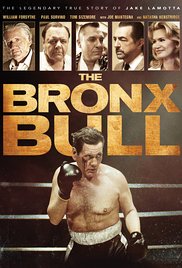
New York in the 1930s. Jake LaMotta (Morean Aria) is a tough street kid who is pushed into fighting by his abusive father (Paul Sorvino) and who is taught how to box by a sympathetic priest (Ray Wise). When Jake finally escapes from his Hellish home life, it is so he can pursue a career as a professional boxer. Ironically, the same violent nature that nearly destroyed him as a youth will now be the key to his future success.
In the late 60s, a middle-aged Jake LaMotta (William Forsythe) testifies before a government panel that is investigating that influence of the Mafia in professional boxing. LaMotta testifies that, during his professional career, he did take a dive in one of his most famous matches. LaMotta goes on to pursue an entertainment career which, despite starring in Cauliflower Ears with Jane Russell, never amounts too much. He drinks too much, fights too much, and gets into arguments with a ghost (Robert Davi). He also gets married several times, to women played by everyone from Penelope Ann Miller to Alicia Witt. The movie ends with Jake happily walking down a snowy street and a title card announcing that Jake is now 95 years old and married to his seventh wife. (The real Jake LaMotta died on September, 9 months after the release of The Bronx Bull.)
The Bronx Bull is a largely pointless movie about the later life of the antisocial boxer who was previously immortalized in Martin Scorsese’s Raging Bull. In fact, The Bronx Bull was originally announced and went into production as Raging Bull II. Then the producers of the original Raging Bull found out, filed a lawsuit, and the film became The Bronx Bull. Because of the lawsuit, The Bronx Bull could cover every aspect of Jake’s life, except for what was already covered in Raging Bull. In fact, Scorsese’s film (which undoubtedly had a huge impact on LaMotta’s later life) is not even mentioned in The Bronx Bull.
William Forsythe does what he can with the role but, for the most part, Jake just seems to be a lout with anger issues. With a cast that includes everyone from Tom Sizemore to Cloris Leachman to Bruce Davison, the movie is full of familiar faces but none of them get too much of a chance to make an impression. Joe Mantegna comes the closest, playing Jake’s best friend. The Bronx Bull was not only shot on the cheap but it looks even cheaper, with studio backlots unconvincingly filling in for 1930s Bronx. The film’s director, Martin Guigui, occasionally tries to throw in a Scorsesesque camera movement and there are a few black-and-white flashbacks but, for the most part, this is the mockbuster version of Raging Bull.
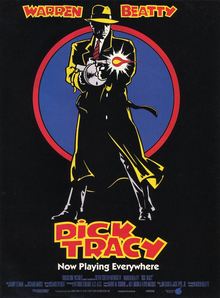 The year is 1937 and “Big Boy” Caprice (Al Pacino) and his gang of flamboyant and often disfigured criminals are trying to take over the rackets. Standing in their way is ace detective Dick Tracy (Warren Beatty), the yellow trench-wearing defender of the law. Tracy is not only looking to take down Caprice but he and Tess Trueheart (Glenne Headly) are currently the guardians of The Kid (Charlie Korsmo), a young street kid who witnessed one of Caprice’s worst crimes. Tracy’s investigation leads him through a rogue’s gallery of criminals and also involves Breathless Mahoney (Madonna), who has witnessed many of Caprice’s crimes but who also wants to steal Tracy’s heart from Tess.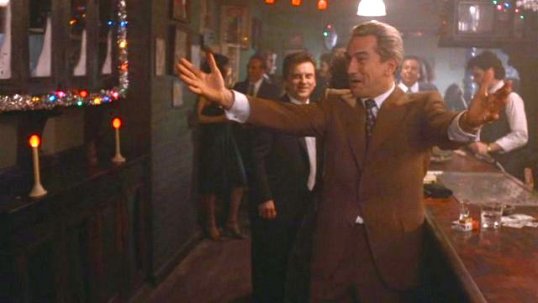

 New York in the 1930s. Jake LaMotta (Morean Aria) is a tough street kid who is pushed into fighting by his abusive father (Paul Sorvino) and who is taught how to box by a sympathetic priest (Ray Wise). When Jake finally escapes from his Hellish home life, it is so he can pursue a career as a professional boxer. Ironically, the same violent nature that nearly destroyed him as a youth will now be the key to his future success.
 Through the Shattered Lens