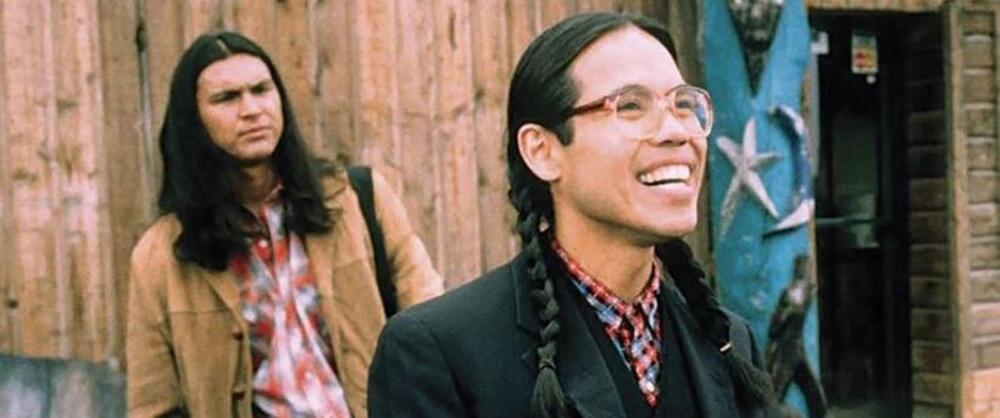
There’s a scene early in SMOKE SIGNALS where Victor Joseph, played by Adam Beach, tries to teach Thomas Builds-the-Fire (Evan Adams) how to be a real Indian. He ends the scene with “This ain’t Dances-with-Salmon you know?!” It’s a funny exchange, but it also clues the audience in on the fact that this isn’t going to be your typical Hollywood movie about Indians. Directed by Chris Eyre and written by Sherman Alexie, it’s the first feature-length film written, directed, and produced by Native Americans to reach a wide audience both in the United States and beyond. As such, we get a story that feels fresh while tackling a variety of difficult subjects with humor and optimism.
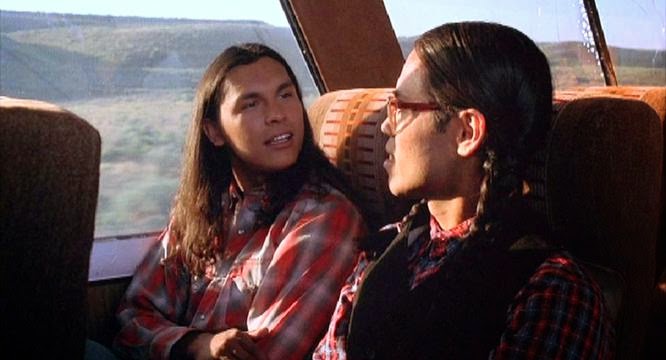
The story focuses on Victor as he travels from the Coeur d’Alene Indian Reservation in Idaho to Phoenix, Arizona to retrieve his father’s possessions after learning that he’s passed away. His father abandoned him and his mother when he was just a boy, and he’s clearly been scarred by the situation. Along for the ride, mainly because he can afford to pay their bus fare, is Thomas Builds-the-Fire, his nerdy and talkative friend. From this point, the film becomes a road trip, and we follow along as they make it to Arizona and back. While there is funny stuff along the way, the movie is mostly interested in observing Victor as he comes to terms with the trauma and pain left behind when his dad went away.
I’ve always liked Adam Beach, and he’s very good here as Victor. His character spends a lot of the movie angry at the world, but from time to time, he’ll flash this big, wonderful smile. It’s a nice inside-out performance as he seems to be simmering on the inside and just trying not to explode. And then there’s Evan Adams, whose Thomas is awkward and optimistic, and who loves to tell big stories about Victor’s dad. For example, they have this awesome exchange where Thomas tells Victor that his dad looks like Charles Bronson. As Bronson’s biggest fan, I can tell you that Victor’s dad, played by Gary Farmer, looks nothing like Charles Bronson. The scene has a nice punchline as Thomas tells him that he doesn’t mean the Charles Bronson from the first DEATH WISH, but more like the Charles Bronson of DEATH WISH 5! The movie has several unexpected scenes like this, and the genuine chemistry between these two guys is what makes the movie work for me. I believe it when their characters begin to understand and appreciate each other, and it’s their emotional connection that gives the film some staying power even after the credits roll.
There are some additional performances that I enjoyed. I mentioned Gary Farmer, who plays Victor’s dad. His Arnold Joseph is not the most sympathetic character in the world, as he chooses to run away from a guilt that he can never deal with. Somehow, by the end, we have some understanding of his actions. And then there’s Irene Bedard as Suzy Song, the young lady who befriends Victor’s dad and calls his mom when he passes away. Best known for being the voice of Pocahontas in the Disney animated classic, she conveys kindness and compassion in her relatively small role. Tantoo Cardinal is good as Victor’s mom, and Tom Skerritt even shows up in a cameo as a police chief in Arizona. Sherman Alexie’s screenplay, based on his book “The Lone Ranger and Tonto Fistfight in Heaven,” is simple, yet full of depth, and it’s brought to life by an excellent cast.
Even though SMOKE SIGNALS was made almost thirty years ago, it’s still a very relevant film to this day. It’s funny, it tackles difficult subjects that are universal to all of us, and it’s told from a Native American perspective that we seldom see. In other words, it feels like we’re dealing with real people, not the romantic caricatures or noble victims that Hollywood still tries to push on us in movies about Indians. It’s not a flashy film in any way, and that’s okay. It’s one of those movies that understands its characters and trusts the audience enough to just hang out and observe them. Anchored by an excellent performance from Adam Beach, it’s a perfect example of how movies can be a lot better when Hollywood gets out of the way and let’s genuine, talented people tell their stories.
I watched SMOKE SIGNALS on the Paramount Plus streaming service.