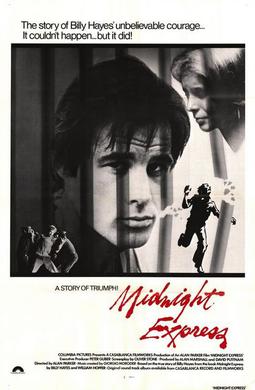
Spring Breakdown #1: Midnight Express (dir by Alan Parker)


Since it’s currently Spring Break, I figured that I would spend the next two weeks reviewing films about people on vacation.  Some of the films will be about good vacations.  Some of the films will be about bad vacations.  But, in the end, they’ll all be about celebrating those moments that make us yearn for the chance to get away from it all.

Take Midnight Express, for instance.  This 1978 film (which was nominated for six Oscars and won two) tells the story of what happens when a carefree college student named Billy Hayes decides to spend his holiday in Turkey.

When the film begins, Billy Hayes (played by Brad Davis), is at an airport in Turkey.  He’s preparing to return home to the United States.  His girlfriend, Susan (Irene Miracle), informs him that Janis Joplin has just died.  When Billy responds by making a joke, Susan accuses him of not taking anything seriously.  What Susan doesn’t realize is that Billy actually has a lot on his mind.  For one thing, he’s got several bricks of hashish taped around his waist.  He purchased it from a cab driver and he’s planning on selling it to his friends back in the United States.  Unfortunately, Billy’s not quite as clever as he thinks he is.  Because of recent terrorist bombings, the Turkish police are searching everyone before they board their plane.  Billy finds himself standing out in the middle of the runway with his hands up in the air, surrounded by gun-wielding Turkish policemen.

Billy finds himself stranded in a country that he doesn’t understand, being interrogated by men whose language he cannot speak.  An enigmatic American (Bo Hopkins) shows up and assures Billy that he’ll be safe, as long as he identifies the taxi driver who sold him to the drugs.  Billy does so but then makes the mistake of trying to flee from the police.  In the end, it’s the American who captures him and, holding a gun to Billy’s head, tells him not to make another move.

Soon, Billy is an inmate at Sağmalcılar Prison.  He’s beaten when he first arrives and it’s only days later that he’s able to walk and think clearly.  He befriends some of the other prisoners, including a heroin addict named Max (John Hurt) and an idiot named Jimmy (Randy Quaid).  Billy watches as the prisoners are tortured by the fearsome head guard (Paul L. Smith) and listens to the screams of inmates being raped behind closed doors.  After being told that his original four-year sentence has been lengthened to a 30-year sentence, Billy starts to degenerate.  When Susan visits, Billy end up pathetically masturbating in front of her.  When another prisoner taunts Billy, Billy bites out the man’s tongue, an act that we see in both close up and slow motion.  If Billy has any hope of regaining his humanity, he has to escape.  He has to catch what Jimmy calls the “midnight express…..”

Midnight Express is a brutal and rather crude film.  Though it may have been directed by a mainstream director (Alan Parker) and written by a future Oscar-winner (Oliver Stone), Midnight Express is a pure grindhouse film at heart.  There’s not a subtle moment to be found in the film.  The camera lingers over every act of sadism while Giorgio Moroder’s synth-based score pulsates in the background.  When Billy grows more and more feral and brutal in his behavior, it’s hard not to be reminded of Lon Chaney, Jr. turning into The Wolf Man.  The film may be incredibly heavy-handed but it’s nightmarishly effective, playing out with the intensity of a fever dream.

As for the cast, Brad Davis wasn’t particularly likable or sympathetic as Billy.  On the one hand, he’s a victim of an unjust system, betrayed by his own country and tortured by another.  On the other hand, Billy was an idiot who apparently thought no one would notice all that hash wrapped around his chest.  That said, Davis’s unlikable screen presence actually worked to the film’s advantage.  If you actually liked Billy, the film would be unbearable to watch.  Before Davis was cast, Dennis Quaid and Mark Hamill were both considered for the role.  If either of those actors has been cast, Midnight Express would be too intense and disturbing to watch.  For instance, it would be depressing to watch Dennis Quaid rip a man’s tongue out of his mouth.  You would be like, “No, Mr. Quaid, you’ll never recover your humanity!”  But when Brad Davis does it, you’re just like, “Eh.  It was bound to happen sometime.”

For more effective are John Hurt and Bo Hopkins.  Hurt and Hopkins both have small roles but they both make a big impression, if just because they’re the only two characters in the film who aren’t either yelling or crying all of the time.  While everyone else is constantly cursing their imprisonment, Hurt is quietly sardonic.  As for Hopkins, we’re supposed to dislike him because he’s with the CIA and he sold out Billy.  But honestly, no one made Billy tape all that hash to his chest.  Finally, you’ve got Randy Quaid and Paul L. Smith, who both glower their way through the film.  Smith is wonderfully evil while Randy Quaid is …. well, he’s Randy Quaid, the loudest American in Turkey.

Midnight Express was such a success at the box office that it caused an international incident.  There’s not a single positive Turkish character to be found in the entire film and it’s impossible not to feel that the film is not only condemning Turkey’s drug policies but that it’s also condemning the entire country as well.  The Turkish prisoners are portrayed as being just as bad as the guards and even Billy’s defense attorney comes across as being greedy and untrustworthy.  Watching the film today can be an awkward experience.  It’s undeniably effective but it’s impossible not to cringe at the way anyone who isn’t from the west is portrayed.  In recent years, everyone from director Alan Parker to screenwriter Oliver Stone to the real-life Billy Hayes has apologized for the way that the Turkish people were portrayed in the film.

Despite the controversy, Midnight Express was a huge box office success and it was nominated for best picture.  It lost to another controversial film about people imprisoned in Asia, The Deer Hunter.


Music Video of the Day: Drive by R.E.M. (1992, directed by Peter Care)


“It’s a subtle, political thing. Michael specifically mentions the term ‘bush-whacked’. But if you want to take it like ‘Stand’, that’s cool, too. You like to think that you can appreciate these songs on any level you want to. I have a lot of records I listen to when I’m just doing the dishes. Like Ride records. I really like Ride a lot. And I have no idea what the songs are about. And I really don’t care. I don’t even worry about it. Lyrics are the last thing I listen to, unless someone is hitting me over the head with it.”

— R.E.M.’s Peter Buck on Drive

Drive may have written to encourage young people to get involved in politics and to vote but I have always thought that the video was about the dangers of crowd surfing.  The video was filmed over two nights at Los Angeles’s Sepulveda Dam.  According to Michael Stipe, both Oliver Stone and actor River Phoenix showed up for the filming: “Oliver had been drinking and they got into a fight in my trailer. It was fun to watch. And it kind of fueled the energy that this video, from beginning to end, kind of carries through it.”

This video was one of several videos that Peter Care directed for R.E.M.  Care also directed videos for Bruce Springsteen, Tina Turner, Depeche Mode, and Fine Young Cannibals.  Care has also directed one feature film, The Dangerous Lives of Altar Boys.

Supposedly, Adam Scott is an extra in the video.  I have yet to spot him.

A Scene That I Love: The Opening of Scarface


Produced by Martin Bregman, directed by Brian De Palma, written by Oliver Stone, and starring Al Pacino, the 1983 remake of Scarface is one of the best-known, most iconic gangster films ever made.  It opened to mixed reviews but it’s gone on to be recognized as a classic.  Everyone can quote the script:  “Say hello to my little friend!” “In this country, you gotta make the money first. Then when you get the money, you get the power. Then when you get the power, then you get the women.”  “Say goodnight to the bad guy!”

Scarface starts with one of my favorite opening scenes of all time.  Powered by Giorgio Moroder’s score, the opening credits of Scarface play out over footage of the real-life Mariel boatlift.  Combined with footage of Fidel Castro ranting that Cuba does not need the Marielitos, this opening gives real-world credibility to everything that follows.  We then segue from the actual boatlift to Al Pacino as Tony Montana, answering questions with that shit-eating grin on his face.

Listen to the interrogation scene carefully and you’ll hear both Charles Durning and Dennis Franz, dubbing the lines of the actors who played the immigration agents.

Here Are The Satellite Nominations!


la-la-land

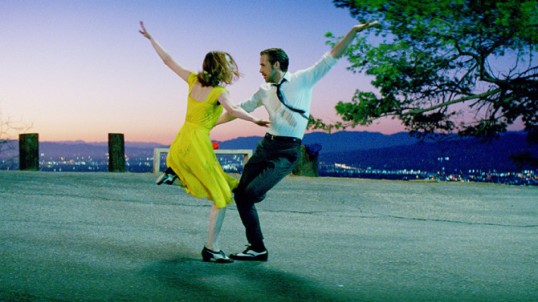
The International Press Academy — a.k.a. the Oscar precursor that nobody cares about — announced their nominees for the best of 2016 earlier today and it was a very good day for a film that I cannot wait to see, La La Land!

Here are the Satellite nominations!

Special Achievement Award Recipients

Mary Pickford Award- Edward James Olmos
Tesla Award- John Toll
Auteur Award- Tom Ford
Humanitarian Award- Patrick Stewart
Best First Feature- Russudan Glurjidze “House of Others”
Best Ensemble: Motion Picture- “Hidden Figures”
Best Ensemble: Television- “Outlander”

Actress in a Motion Picture

Annette Bening, “20th Century Woman”
Emma Stone, “La La Land”
Natalie Portman, “Jackie”
Ruth Negga, “Loving”
Taraji P. Henson, “Hidden Figures”
Meryl Streep, “Florence Foster Jenkins”
Isabelle Huppert, “Elle”
Amy Adams, “Nocturnal Animals”

Actor in a Motion Picture

Casey Affleck, “Manchester by the Sea”
Ryan Gosling, “La La Land”
Joseph Gordon-Levitt, “Snowden”
Viggo Mortensen, “Captain Fantastic”
Joel Edgerton, “Loving”
Andrew Garfield, “Hacksaw Ridge”
Tom Hanks, “Sully
Denzel Washington, “Fences”

Actress in a Supporting Role

Helen Mirren, “Eye in the Sky”
Michelle Williams, “Manchester by the Sea”
Nicole Kidman, “Lion”
Octavia Spencer, “Hidden Figures”
Naomi Harris, “Moonlight”
Viola Davis, “Fences”
 Actor in a Supporting Role

Jeff Bridges, “Hell or High Water”
Mahershala Ali, “Moonlight”
Dev Patel, “Lion”
Lucas Hedges, “Manchester by the Sea”
Eddie Murphy, “Mr. Church”
Hugh Grant, “Florence Foster Jenkins”

Motion Picture

“La La Land”
“Moonlight”
“Manchester by the Sea”
“Lion”
“Jackie”
“Hacksaw Ridge”
“Loving”
“Hell or High Water”
“Nocturnal Animals”
“Captain Fantastic”
“Hidden Figures”
“Fences”

 Motion Picture, International Film

“The Happiest Day in the Life of Olli Maki”- Finland
“Toni Erdmann”- Germany
“Julieta”- Spain
“A Man Called Ove”- Sweden
“The Salesman”- Iran
“The Ardennes”- Belgium
“Ma’ Rosa”- Philippines
“The Handmaiden”- South Korea
“Elle”- France
“Paradise”- Russia

Motion Picture, Animated or Mixed Media 
Title of Film
“Zootopia”
“Kubo and the Two Strings”
“Moana”
Finding Dory”
“My Life As a Zucchini”
“The Jungle Book”
“The Red Turtle”
“Miss Hokusai”
“Trolls”
“Your Name”

Motion Picture, Documentary

“Gleason”
“Life Animated”
“O.J.: Made in America”
“13th”
“The Ivory Game”
“The Eagle Huntress”
“Tower”
“Fire at Sea”
“Zero Days”
“The Beatles: Eight Days a Week”

Director

Barry Jenkins, “Moonlight”
Kenneth Lonergan, “Manchester by the Sea”
Mel Gibson, “Hacksaw Ridge”
Damien Chazelle, “La La Land”
Tom Ford, “Nocturnal Animals”
Pablo Larrain, “Jackie”
Denzel Washington, “Fences”

Screenplay, Original

Barry Jenkins, “Moonlight”
Damien Chazelle, “La La Land”
Kenneth Lonergan, “Manchester by the Sea”
Taylor Sheridan, “Hell or High Water”
Matt Ross, “Captain Fantastic”
Yorgos Lanthimos/Efthymis Filippou, “The Lobster”

Screenplay, Adapted

Andrew Knight/Robert Schenkkan, “Hacksaw Ridge”
Luke Davis, “Lion”
Kieran Fitzgerald/Oliver Stone, “Snowden”
Justin Marks, “The Jungle Book”
Allison Schroeder, “Hidden Figures”
Todd Komarnicki, “Sully”

Original Score

Rupert Gregson Williams, “Hacksaw Ridge”
Justin Hurwitz, “La La Land”
Lesley Barber, “Manchester by the Sea”
John Williams, “The BFG”
John Debney, “The Jungle Book”
Hans Zimmer, “Hidden Figures”

Original Song

“Audition”- ‘La La Land’
“City of Stars”- ‘La La Land’
“Dancing with Your Shadow”- ‘Po’
“Can’t Stop the Feeling”- ‘Trolls’
“I’m Still Here”- ‘Miss Sharon Jones’
“Running”- ‘Hidden Figures’

Cinematography

John Toll, “Billy Lynn’s Long Halftime Walk”
Linus Sandgren, “La La Land
James Laxton, “Moonlight”
Simon Duggan, “Hacksaw Ridge”
Jani-Petteri Passi, “The Happiest Day in the Life of Olli Maki”
Bill Pope, “The Jungle Book”

Visual Effects

“The Jungle Book”
“Billy Lynn’s Long Halftime Walk”
“Doctor Strange”
“The BFG”
“Sully”
“Deadpool”

Film Editing

Tom Cross, “La La Land
Joi McMillon/Nat Sanders, “Moonlight”
Tim Squyres, “Billy Lynn’s Long Halftime Walk”
Alexandre de Francheschi, “Lion”
John Gilbert, “Hacksaw Ridge”
Steven Rosenblum, “The Birth of a Nation”

Sound (Editing and Mixing)

La La Land
“Billy Lynn’s Long Halftime Walk”
“Hacksaw Ridge”
“The Jungle Book”
“Allied”
“13 Hours: The Secret Soldiers of Benghazi”

Art Direction and Production Design

David Wasco, “La La Land
Barry Robinson, “Hacksaw Ridge”
Jean Rabasse, “Jackie”
Christophe Glass, “The Jungle Book”
Gary Freeman, “Allied”
Dan Hennah, “Alice Through the Looking Glass”

Costume Design

Colleen Atwood, “Alice Through the Looking Glass”
Eimer Ní Mhaoldomhnaigh, “Love & Friendship”
Courtney Hoffman, “Captain Fantastic”
Madeline Fontaine, “Jackie”
Mary Zophres, “La La Land
Alexandra Byrne, “Doctor Strange”

A Halloween Film Review: Seizure (1974, directed by Oliver Stone)


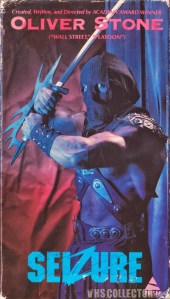
seizure1Everyone had to start somewhere and, long before he became one of the leading political provocateurs of American cinema, Oliver Stone was just another struggling film school grad who was looking for a chance to make a name for himself.  Like many aspiring filmmakers, Stone made his directorial debut with a low-budget horror film.
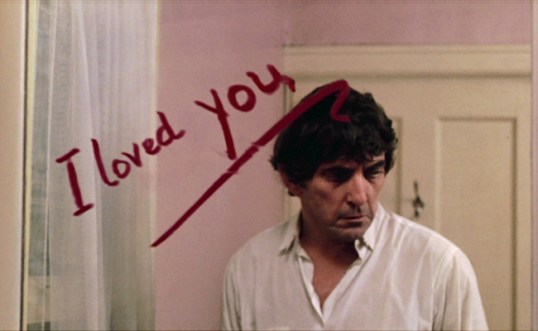
Filmed in Quebec and featuring an eclectic cast that included a soap opera star, a former Warhol superstar, a faded teen idol, a past Bond girl, and a future Bond villain, Seizure stars Jonathan Frid (of Dark Shadows fame) as Edmund Blackstone.  Edmund is a horror novelist who is described as being “a modern-day Edgar Allan Poe.”  When Edmund’s rich friends get together for the weekend, they are terrorized by three maniacs: the Queen of Evil (Martine Beswick), a mute giant called the Jackal (Henry Judd Baker), and a psychotic dwarf named The Spider (Hervé Villechaize).  

All of Edmund’s guests face the inevitability of death in a different way.  Playboy Mark Frost (Troy Donahue) is too concerned with pursuing pleasure to realize that he’s in danger.  Businessman Charlie Hughes (Joseph Sirola) gets out his wallet and tries to buy his way out of trouble.  Mikki (Mary Woronov), Charlie’s much younger wife, strips down to her underwear and runs away.  Eunice Kahn (Anne Meachem) jumps out of a window after the Spider ticks her into using an aging cream.  Eunice’s husband, philosopher Serge (Roger de Koven), faces death with stoicism.  Edmund’s brother-in-law, Gerald (Richard Cox), is a long-haired hippie who accidentally gets shot in the head by Edmund and dies saying, “You bastard!”  Edmund’s wife (Christina Pickles) tries to protect her son (Timothy Ousey) and Edmund reveals himself to be the first of the many flawed father figures who would appear in Stone’s films.

seizure_dvdreview_splash650

If not for the identity of its director, Seizure would be a forgotten film.  In fact, it seems to be a film that Stone wishes was forgotten.  He rarely mentions it in interviews and usually describes Seizure as being a “learning experience” and there’s really nothing about Seizure that would make you think the director would go on to win three Oscars.  It’s a slow and talky movie that is just occasionally weird enough to be interesting.  Seizure‘s philosophical digressions are pure Stone but otherwise, it’s hard to see any sign of the director that Stone would become in Seizure.

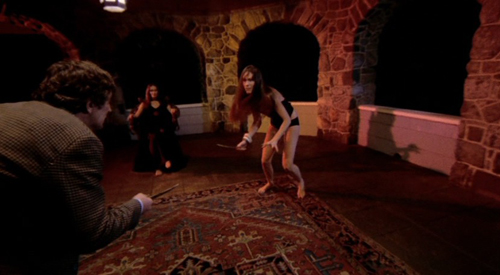
Still, what other movie features Jonathan Frid and Mary Woronov having a knife fight while Martine Beswick and Hervé Villechaize watch?

seizure_10

Shattered Politics #54: Dave (dir by Ivan Reitman)


Dave Poster

Way back in 1919, the terrible U.S. President and tyrannical dictator Woodrow Wilson* suffered a stroke that left him semi-paralyzed and unable to perform his duties.  By all standards, Wilson should have been removed from office, if just temporarily.  However, in those pre-Internet days, it was a lot easier to hide the truth about Wilson’s physical and mental condition.  While Wilson spent his days locked away in his bedroom, his wife Edith would forge his signature on bills.  Whenever anyone asked for the President’s opinion, Edith would give her opinion and then assure everyone that it was actually the President’s.

(And really, as long as you were promoting eugenics and white supremacy, it probably was not difficult to imitate Wilson’s opinions.)

Of course, back then, people were used to the idea of never seeing their President in public.  Hence, it was very easy for Wilson to remain sequestered in the White House.  If a similar situation happened today, it’s doubtful that anyone could successfully keep the public from finding out.  When we don’t see the President every day, we wonder why.  How, in this day and age, could a Presidential incapacitation be covered up?

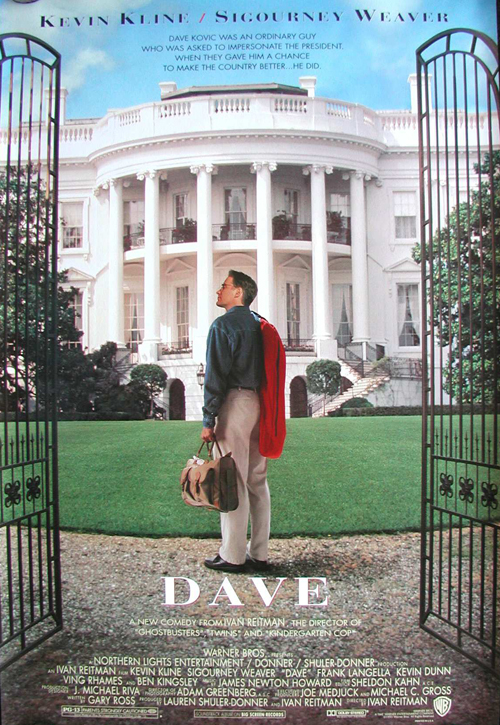
The 1993 film Dave offers up one possible solution.

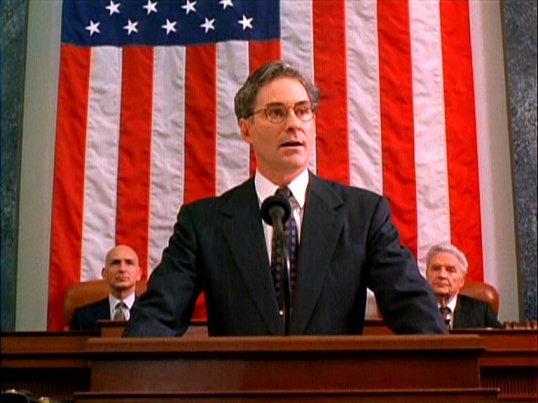
Dave is the story of two men who happen to look exactly like Kevin Kline.  One of them is named Bill Mitchell and he’s the arrogant and corrupt President of the United States.  The other is named Dave Kovic.  He’s a nice guy who runs a temp agency and who has a nice side job going as a professional Bill Mitchell imitator.

So, when Bill has a stroke while having sex with a white house staffer (Laura Linney), it only makes sense to recruit Dave Kovic to pretend to the President.  White House Chief of Staff Bob Alexander (played by Frank Langella, so you know he’s evil) tells Dave that Vice President Nance (Ben Kingsley) is insane and corrupt.  Dave agrees to imitate the President.  Of course, Alexander’s main plan is to convince Nance to resign and then get Dave to appoint him as Vice President.  Once Alexander is Vice President, it will be announced that Mitchell has had another stroke and then Alexander will move into the Oval Office.

However, what Alexander did not take into account was just how much Dave would enjoy being President.  From the moment that he joyfully shouts, “God Bless, America!,” Dave’s enthusiasm starts to win the public over.  Suddenly, people are realizing that President Mitchell isn’t such a bad President after all.  Even more importantly, Dave wins over the first lady (Sigourney Weaver) who, previously, had little use for her philandering husband.  When Alexander claims that there’s no money in the budget to continue funding a program for the homeless, Dave calls in his best friend, an accountant named Murray (Charles Grodin), and has him rewrite the budget…

And you know what?

Dave is one of those films that tempts me to be all cynical and snarky but, ultimately, the film itself is so likable and earnest that I can even accept the idea that one accountant could balance the budget through common sense alone.  I’ll even accept the idea that Dave could come up with a program that would guarantee everyone employment without, at the same time, bankrupting the country.  Kevin Kline is so enthusiastic in the lead role and the film itself is so good-natured that it almost feels wrong to criticize it for being totally implausible.

Sometimes, you just have to appreciate a film for being likable.

Dave—–

* For those of you keeping count, that’s the third time in two weeks that I’ve referred to Woodrow Wilson as being  a dictator.  Before anyone points out that some historians rank Wilson as being in the top ten of President, allow me to say that I don’t care.  I DO WHAT I WANT!

44 Days of Paranoia #30: Nixon (dir by Oliver Stone)


For our latest entry in the 44 Days of Paranoia, we take a look at Oliver Stone’s 1995 presidential biopic, Nixon.

Nixon tells the life story of our 37th President, Richard Nixon.  The only President to ever resign in order to avoid being impeached, Nixon remains a controversial figure to this day.  As portrayed in this film, Nixon (played by Anthony Hopkins) was an insecure, friendless child who was dominated by his ultra religious mother (Mary Steenburgen) and who lived in the shadow of his charismatic older brother (Tony Goldwyn).  After he graduated college, Nixon married Pat (Joan Allen), entered politics, made a name for himself as an anti-communist, and eventually ended up winning the U.S. presidency.  The film tells us that, regardless of his success, Nixon remained a paranoid and desperately lonely man who eventually allowed the sycophants on his staff (including James Woods) to break the law in an attempt to destroy enemies both real and imagined.  Along the way, Nixon deals with a shady businessman (Larry Hagman), who expects to be rewarded for supporting Nixon’s political career, and has an odd confrontation with a young anti-war protester who has figured out that Nixon doesn’t have half the power that everyone assumes he does.

Considering that his last few films have been W., Wall Street: Money Never Sleeps, and SavagesI think it’s understandable that I’m often stunned to discover that, at one point in the distant past, Oliver Stone actually was a worthwhile director.  JFK, for instance, is effective propaganda.  Nixon, which feels a lot like an unofficial sequel to JFK, is a much messier film than JFK but — as opposed to something like Savages — it’s still watchable and occasionally even thought-provoking.  Thanks to Hopkins’ performance and, it must be admitted, Stone’s surprisingly even-handed approach to the character, Nixon challenges our assumptions about one of the most infamous and villified figures in American history.  It forces us to decide for ourselves whether Nixon was a monster or a victim of circumstances that spiraled out of his control.  If you need proof of the effectiveness of the film’s approach, just compare Stone’s work on Nixon with his work on his next Presidential biography, the far less effective W.

(I should admit, however, that I’m a political history nerd and therefore, this film was specifically designed to appeal to me.  For me, half the fun of Nixon was being able to go, “Oh, that’s supposed to be Nelson Rockefeller!”)

If I had to compare the experience of watching Nixon to anything, I would compare it to taking 10 capsules of Dexedrine and then staying up for five days straight without eating.  The film zooms from scene-to-scene, switching film stocks almost at random while jumping in and out of time, and not worrying too much about establishing any sort of narrative consistency.  Surprisingly nuanced domestic scenes between Anthony Hopkins and Joan Allen are followed by over-the-top scenes where Bob Hoskins lustily stares at a White House guard or Sam Waterston’s eyes briefly turn completely black as he discusses the existence of evil.  When Nixon gives his acceptance speech to the Republican Convention, the Republican delegates are briefly replaced by images of a world on fire.  Familiar actors wander through the film, most of them only popping up for a scene or two and then vanishing.  The end result is a film that both engages and exhausts the viewer, a hallucinatory journey through Stone’s version of American history.

Nixon is a mess but it’s a fascinating mess.

Other Entries In The 44 Days of Paranoia 

  1. Clonus
  2. Executive Action
  3. Winter Kills
  4. Interview With The Assassin
  5. The Trial of Lee Harvey Oswald
  6. JFK
  7. Beyond The Doors
  8. Three Days of the Condor
  9. They Saved Hitler’s Brain
  10. The Intruder
  11. Police, Adjective
  12. Burn After Reading
  13. Quiz Show
  14. Flying Blind
  15. God Told Me To
  16. Wag the Dog
  17. Cheaters
  18. Scream and Scream Again
  19. Capricorn One
  20. Seven Days In May
  21. Broken City
  22. Suddenly
  23. Pickup on South Street
  24. The Informer
  25. Chinatown
  26. Compliance
  27. The Lives of Others
  28. The Departed
  29. A Face In The Crowd

44 Days of Paranoia #6: JFK (dir by Oliver Stone)


JFK-John-F-Kennedy-DVD-Yon-OLIVER-STONE__76044126_0When I first decided to do this series of reviews of conspiracy-themed films, I knew that I would eventually have to review the 1991 Oliver Stone film JFK.

JFK is one of those films that continues to divide audiences.  Those who think that John F. Kennedy was killed by a conspiracy tend to love this film and are given to describing JFK as being “one of the most important films ever made.”  Those who believe that Lee Harvey Oswald was the lone assassin dismiss Stone’s film as being left-wing propaganda.  Just check out  the message board at the imdb if you need evidence of just how worked up people get over this film and its subject matter.

It seems that very few of the people who criticize or praise JFK ever review it as a work of cinema.  Instead, they focus on the film’s politics.  If I criticize the film for wasting the talents of Sissy Spacek or featuring one of Kevin Costner’s least interesting performances then I’m running the risk of having to deal with angry conspiracy theorists telling me that I need to open my eyes to the reality of American history.  On the other hand, if I praise Tommy Lee Jones’s wonderfully decadent turn as one of the film’s conspirators, chances are that someone is going to accuse me of being a naive leftist.

Then again, perhaps that reaction is to be expected.  Oliver Stone is one of our most political and least subtle filmmakers.  His movies are specifically designed to challenge the status quo.  For that reason, it’s not surprising to discover that Stone considers JFK to be the best of all of his films.

JFK is based (rather loosely, some claim) on the true story of New Orleans District Attorney Jim Garrison (played by Kevin Costner) and how, in 1967, he charged businessman Clay Shaw (played by Tommy Lee Jones) with being a part of a conspiracy to kill John F. Kennedy.  Shaw was eventually acquitted and both Jim Garrison and his investigation remain controversial to this day.

JFK courts controversy immediately with its portrayal of Jim Garrison.  I’ve read several accounts of the Garrison investigation and the one thing that they all seem to agree on is that Jim Garrison was a flamboyant, bigger-than-life figure who enjoyed publicity.  Even among those who believe that Garrison uncovered some valuable evidence as a result of his investigation, there is a good deal of ambiguity about Garrison’s motives.  However, in Stone’s film, Jim Garrison is played by Kevin Costner and is portrayed as being an incorruptible, all-American idealist.  It’s not that Costner gives a bad performance.  Instead, it’s just a rather uninteresting one, especially when one compares Costner’s Garrison to some of the stories about the real-life Garrison.

However, as the film unfolds, it becomes obvious that Stone is using Costner’s blandness to the film’s advantage.  Over the course of three hours, JFK slowly peels back layers of secrecy and cover-ups and reveals the shadow world that, according to Stone, lurks underneath everyday reality.  Costner’s Garrison might not be interesting but he is a stable presence.  He anchors the film, giving us someone to relate to while the film itself grows more and more bizarre.

While Costner’s might give the least interesting performance of his career in this film, the same cannot be said of the rest of the cast.  JFK is full of familiar faces, many of whom are only on-screen for a few minutes but all of which play an important role in creating Stone’s shadow universe.  Kevin Bacon, Gary Oldman, Joe Pesci, Michael Rooker, Donald Sutherland, and Tommy Lee Jones; they all have small roles but every single one of them makes an undeniable impression.  Whether you agree with the film’s conclusions are not, it’s impossible not to enjoy JFK for the chance to spot a bunch of familiar faces giving memorably bizarre performances.

But ultimately, its impossible to review JFK without considering the film’s conclusions.  JFK makes the case that John F. Kennedy was killed as the result of a massive right-wing conspiracy that involved the military, business interests, the CIA, the FBI, anti-Castro Cubans, and the mafia.  By the end of the film, the question becomes less who killed JFK and more who didn’t kill JFK.

Myself, I’m not going to claim to be enough of an expert on the Kennedy assassination to argue whether JFK is accurate or if it’s just propaganda.  However, as a film reviewer, I can say that it’s a very well-made and powerful film but it’s also one of those films that works better the first time you see it than the second time.

The first time you see it, the film overwhelms you.  It leaves you convinced that yes, there was a conspiracy and yes, everyone was involved and yes, Jim Garrison was right!  It convinces you so thoroughly that you end up using exclamation points, just to make sure everyone knows how convinced you are.

However, with each subsequent time that you view JFK, you became a bit more aware of just how manipulative and one-sided it truly is.  You become a bit more aware of the technique underneath the outrage and, if you’re a smart film watcher, you remember that JFK is a recreation as opposed to being a historical document.  You become more and more aware that Stone approached the material with a destination in mind and, like any good director, he has specifically shaped the material to make sure that you reach that destination at the end of the journey.

That was certainly my experience with JFK.  I first saw it in high school and it convinced me that JFK was the victim of a conspiracy.  Then, when I was in college, I watched it for a second time and, though I still believed the film’s conclusions, I also found myself much more aware of how the film’s length and Stone’s direction were designed to beat the audience into submission.  When I saw the film a third time, I found myself resenting the film’s manipulative nature and, as a result, I found it a lot more difficult to accept Stone’s conclusions.

However, when I rewatched the film last night for this review, I was surprised to discover that JFK actually holds up pretty well.  It’s still way too long (and, unlike a lot of other reviewers, I am not impressed by the droning speech that Costner delivers at the end of film) and Stone’s lack of subtlety does backfire on a few occasions.  However, perhaps because I was finally watching the film as entertainment as opposed to judging the film on its political or historical merits, I discovered that JFK is a watchable and entertaining film, one that does a pretty good job of making Stone’s case.  If nothing else, it’s worth watching just for the chance to see the wonderfully snarky performances of Tommy Lee Jones, Kevin Bacon, and Gary Oldman.

Perhaps the best thing that I can say about JFK is that its the type of film that will inspire smart people to do their own research and come to their own conclusions, which may or may not be the same conclusions that Oliver Stone reaches.

And, honestly, isn’t that the most that we can ask of any film?

JFK

A Quickie With Lisa Marie: Savages (dir. by Oliver Stone)


For the past 5 months,  every time I’ve gone to the movies, I’ve seen the trailer for Oliver Stone’s new film, Savages.  It’s a pretty exciting trailer, featuring sex, violence, and Taylor Kitsch’s abs.  Despite Oliver Stone’s recent track record of making preachy, boring films, that trailer got a lot of people excited about the prospect of seeing Savages

Well, the film has been released, I’ve seen it, and you know what?  Sometimes, trailers lie.

Savages is the story of Chon, Ben, and O.  Chon (Taylor Kitsch) and Ben (Aaron Johnson) sell the greatest weed in the world and O (Blake Lively) is the woman who loves both of them at the same time.  O, by the way, is short for Ophelia and she narrates the film in such a monotonous style that I have to admit that I was shocked to discover that she actually knew she was named after Hamlet’s doomed girlfriend.  Chon is a violent former Navy SEAL while Ben is a laid-back buddhist who wants to get out of the drug business so he can devote his time to environmental activism. (Zzzzzzzzzz….)

Ben’s marijuana becomes so legendary that soon, a Mexican drug cartel led by Salma Hayek decides that both Ben and Chon are going to work exclusively for them.  Ben and Chon refuse so Hayek sends Benicio Del Toro to kidnap O and hold her hostage until Ben and Chon come around.  Ben and Chon, however, have plans of their own…

On the positive side, Hayek, Del Toro, and John Travolta (playing a corrupt DEA agent) all give excellent performances that would seem to indicate that they — as opposed to everyone else involved with Savages — understand that they’re appearing in an expensive B-movie.  They openly devour every piece of scenery in the film and have a fun time wringing every ounce of melodrama out of their pulpy dialogue.  These three actors are fun to watch and it’s a shame that the same can’t be said for the other half of the film’s main cast.

Jennifer Lawrence was originally cast in the role of O but she dropped out of Savages so that she could star in The Hunger Games.  The role was recast with Blake Lively, who looks like she could be Jennifer Lawrence’s older sister but who, as an actress, has never exhibited the type of wounded determination that has become Lawrence’s trademark.  As played by Lively, O is such a passive character that it’s difficult to really care that much about whether she survives or doesn’t.  Instead of being a strong, independent woman who is unashamed of her lifestyle, O just comes across as a spoiled and vapid pawn, a possession who is traded between the film’s various players.  It doesn’t help that Lively delivers her heavy-handed narration in a flat monotone that makes her come across less like a hard-boiled survivor and more like a spoiled rich girl trying to sound jaded.  Every time I heard her refer to Chon and Ben as being “my guys,” I just wanted to scream at the screen, “No, you stupid bitch, you belong to them!  They don’t belong to you!”

As for “her guys,” Taylor Kitsch is believable as a killer but not as a stoner.  (Kitsch’s character comes across as if he’s been snorting cocaine as opposed to smoking weed.)  Aaron Johnson, meanwhile, is a very believable stoner but he’s a lot less believable once his character becomes a killer.  Unfortunately, neither Kitch nor Johnson show much in the way of charisma in this film and that’s a shame because both of them have shown in the past that they are capable of giving good performances.  (Seriously,  just check out Aaron Johnson’s performance in the criminally underrated John Lennon biopic, Nowhere Boy.)  With neither Chon nor Ben being all that interesting, the film ultimately becomes a rather empty display of style.

And there’s no denying it — Savages has got style to burn.  Oliver Stone shows here that — despite such anemic recent films as Wall Street: Money Never Sleeps — he still knows how to film an explosion.  Unfortunately, there’s not much going on beneath all of that style and the end result is a film that mostly succeeds in making both sex and violence boring.