As I was watching The Red Dress, I found myself thinking that it had to be one of the most deliberately paced Lifetime film that I had ever seen. It moved slowly, taking its time to tell its story and, as far as I could tell, attempting to build up a certain atmosphere of existential doom. (In many ways, it reminded me of the trailer for Angelina Jolie’s By The Sea.) It really wasn’t paced right for TV but that’s probably because it really wasn’t made for TV.
From the occasionally blanked out lines of dialogue to a blurred hint of sideboob, it was obvious that The Red Dress was a theatrical film that somehow ended up making its American premiere on the Lifetime Movie Network. What would have worked just fine when watched in one uninterrupted 90 minute viewing worked less well when stretched out to two hours and frequently interrupted by commercials for Liberty Mutual Insurance. The film, itself, frequently plays with time and makes heavy use of flashbacks. It’s not necessarily a complicated story but it’s still one that requires a bit of concentration. It’s not always easy to concentrate when you have to deal with a commercial about an insane person who named her car Brad.
As for the story that the movie tells, Patricia (Rachel Skarsten) and Rainer (Callum Blue) are young, rich, married, and maybe in love. Of course, Patricia did have an affair with Rainer’s business partner, James (Sean Maguire). And, after Patricia announced that she was pregnant, Rainer did start to feel like “an appendage.” As for the baby, it died in a mysterious fire that may or may not have been arson.
With Patricia in a deep depression, Rainer suggests that they move to a beachfront house in Malta. It’s here that Rainer can spend all of his time floating in the pool and Patricia can deal with the constant nightmares that make it impossible for her to sleep. At times, being in Malta seems to bring the spark back to their marriage. But then there are other times when Patricia suspects that Rainer is keeping a secret from her.
And then there’s the mysterious girl who Patricia keeps seeing. The girl seems to always be heading towards a castle that lies in the distance, lit up with a crimson glow that makes it seem like it belongs in a Jean Rollin film or maybe Inception‘s Limbo. Patricia suspects that the girl may have been kidnapped by the mysterious local hunter, Angelo (John Rhys-Davies). Rainer, however, seems to believe that the solution to everything is for Patricia to take more pills.
The Red Dress doesn’t really work as a film, largely because Rainer and Patricia are such unlikable characters that you really don’t care what happens to them. Far too often, they put the idle into idle rich. As well, the film’s final twist is not as much of a surprise as the film seems to think it is. You’ll see it coming. That said, I did like the look of a film. Malta is a great location and the film takes advantage of that fact.
As for the film’s title, it refers to a dress that Patricia wears in a few of the flashbacks. And you know what? It is a really nice dress.
It’s always interesting to me when my favorite exploitation and grindhouse filmmakers end up making a movie for Lifetime. It happens a lot more that you might expect and it’s always undeniably fun to see how they adapt their own sensibilities to the requirements of the network. For instance, last year, Fred Olen Ray gave Lifetime both River Raft Nightmare and The Christmas Gift.
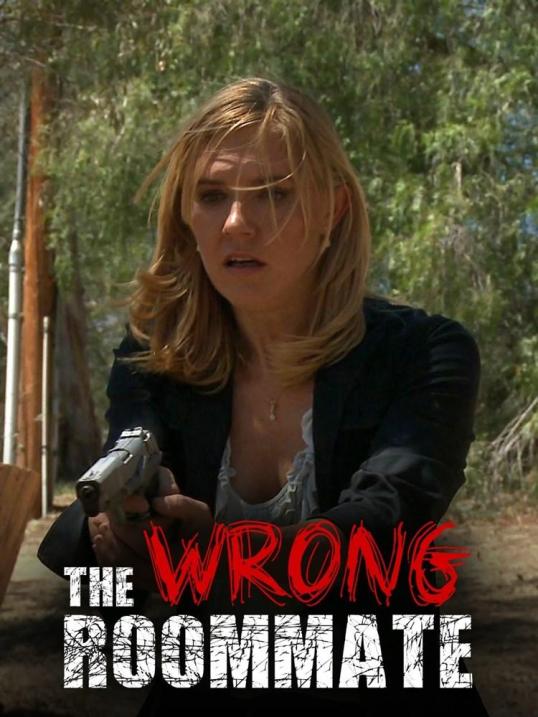
And then, in January of this year, David DeCoteau gave us The Wrong Roommate. As far as Lifetime films are concerned, The Wrong Roommate is pure perfection. It gives the viewer everything that she could possibly want from a Lifetime film. There’s melodrama. There’s romance. There’s an untrustworthy ex-fiance. There’s a mysterious artist who is both hot and dangerous and who has got like the most incredible abs. There’s a big fancy house and lots of pretty clothes and there’s even a sex-positive best friend who is eager to help her BFF rebuild her life. I enjoyed The Wrong Roommate when I first watched it and I enjoyed it when I rewatched it earlier today. But as I watched The Wrong Roommate, I wondered how members of the typical Lifetime viewing audience would have reacted to seeing some of DeCoteau’s other 122 films, like Sorority Babes in the Slimeball Bowl-O-Rama or Bigfoot vs. D.B. Cooper.
It’s DeCoteau’s background in B-movies that made him the perfect director for The Wrong Roommate. Like many filmmakers, DeCoteau began his career working with Roger Corman and then later worked with Charles Band. These are filmmakers who understood how to tell a story. Above all else, Roger Corman and his best students all understood the importance of storytelling. They understood the importance of keeping the audience entertained.
And, whatever else one may say about it, The Wrong Roommate is a terrifically entertaining film.
The film opens with a man getting run over by a car. That man is Prof. Floyd and he’s played by Eric Roberts. From the minute that I saw that Eric Roberts was going to be in The Wrong Roommate, I assumed that he would be playing another one of his trademark crazy stalker roles but instead, Roberts is one of the good guys here. He’s actually playing a sympathetic character. It’s clever casting because, even once it starts to become clear that he’s not going to kill anyone, you’re still uncertain about him because he’s played by Eric Roberts. Eric Roberts as a good guy keeps the audience off-balance and tells them not to take anything for granted.
That said, Roberts only has a supporting role here. The film is about Laurie Valentine (Jessica Morris). Laurie has just broken up with her controlling jerk of a fiancee, Mark (William McNamara). And now, she’s rebuilding her life. Her best friend (Dominique Swain) has gotten her a job teaching at the local college. And her older sister has invited Laurie to spend the summer at her mansion. The only catch is that Laurie has to look after her rebellious 17 year-old niece, Ricki (Brianna Joy Chomer).
After moving in, Laurie discovers that there’s someone else living on the estate. Alan (Jason-Shane Scott) is staying in the guest house. Ricki has a huge crush on him and soon, so does Laurie. And why not? Alan has amazing abs, spends all of his time shirtless, and he’s an artist! He specializes in wood work and there’s nothing sexier than a man who is good with his hands and his wood…
But, wait a minute!
If Alan’s so great, why does he stage a break-in at the house?
Why doesn’t he ever seem to be surprised when Mark drops by the mansion?
And, of course, we have to consider the fact that Alan has installed a secret webcam in Laurie’s bedroom so that he can watch her undress on his laptop.
Hmmmm…something might not be quite right….
You’ll probably be able to guess what’s going on within the first 30 minutes of the film but who cares? This is a fun movie and David DeCoteau’s direction strikes a perfect balance between melodrama and parody. The film looks great, the cast looks great, and I was jealous of that big house. The Wrong Roommate is wonderful entertainment, in the best tradition of Corman, Band, and DeCoteau.
No, that image above is not my sister‘s latest discovery for artwork of the day. Instead, it’s the only promo image that I’ve been able to find for a film called Flashback. Flashback premiered on the Lifetime Movie Network on January 31st. Because I was on a road trip when it originally aired, I had to set the DVR to record it. I watched the film earlier today and I jotted down a few notes for my review. Then, because I desperately needed the space on my DVR, I erased the recording. I assumed that I would be able to get any other details I needed from the film’s imdb page.
Big mistake.
Unlike some obscure films, Flashback actually does have a page on the imdb. But there’s next to no information about the movie! There’s a brief (but surprisingly accurate) plot description. Three members of the cast are listed. Jeffrey Roy is listed as being the adr mixer. But otherwise, no director is listed. No producer. No writers. It’s very odd.
After doing a few more fruitless Google searches, I quickly looked through my notes. Maybe I had jotted down the director’s name. Of course, I did not.
The lesson here is not to take the imdb for granted as a resource. Especially when it comes to fairly obscure Lifetime films.
I would especially like to be able to name the director and writer responsible for Flashback because it actually tells a very heartfelt story and attempts to deal with a serious issue. The films tell the story of Samantha (Roxanne McKee), a soldier with the National Guard who has just returned from Iraq. While Samantha struggles to maintain an outward normalcy, she is actually suffering from severe PTSD. (When we first see her, she’s holding a gun and hiding in a bathroom stall while her friends throw her a welcome home party.) In Iraq, Samantha was involved in a friendly fire incident that led to the death of two soldiers. Back home, she finds herself being stalked by another soldier (Tim Rozon), who blames her for the incident. What gives this story a twist is that Samantha herself is unsure about what actually happened. Whenever she tries to remember, she just has hazy flashbacks to a battle in Iraq.
(And, let it be said, the battle scenes were surprisingly well-done for what appeared to be a rather low-budget film. The director did a good job of creating and capturing the feel of total chaos and confusion.)
And, in many ways, Flashback is a standard Lifetime film. Even while Samantha is being stalked, she enters into a relationship with yet another soldier (Steve Lund), who is politically ambitious and has secrets of his own. The whole thing even includes, as almost every Lifetime film does, a chase and confrontation at an isolated cabin. But then the film ends with some statistics about PTSD and suicide and with two final words on the screen: “For Cathy.” It’s a powerful moment and I’d like to give the director proper credit. So, if you are the director or you know the director, leave a comment and let us know so that we can give credit where credit is due.
(UPDATE: Val has just informed me that this film was directed by Claude Desrosiers. — LMB)
The other great thing about Flashback is that it featured Stacey Farber in the role of Samantha’s best friend! If you’re a fan of Degrassi, like me and Valerie Troutman, then you will immediately recognize Stacey from her role as Ellie Nash! Ellie was always my favorite character on Degrassi, largely because, as a redheaded film lover who used to dress exclusively in black and who has had some experience with rubber band therapy, I related to her in so many ways. And while I remain a fan of the show, it definitely lost something when Stacey Farber left the show. (That said, at least Ellie finally ended up with the totally hot Craig Manning! Go, Ellie!)
Anyway, it’s interesting seeing Stacey Farber play a character who suggests that the best way for Samantha to deal with wartime trauma is to go on a shopping spree. (That said, I probably would have made the same suggestion. Shopping is always a good fallback remedy.) But she does a good job in her role (as does the entire cast) and it was nice to see that, for her, there is life after Degrassi.
In fact, I’m going to end this review with three of my favorite Ellie gifs.
The image above is a still from a film called Wrong Swipe. The women are sisters. Anna (Anna Hutchison, who may be best known for playing doomed Jules in The Cabin In The Woods) is an uptight law school student who spends way too much time studying. Her sister, Sasha (Karissa Lee Staples), decides that Anna desperately needs to get laid so she goads her into downloading the Swipe app.
What’s Swipe?
Well, for one thing, it’s an app with a really bad name. But, beyond that, it’s kinda like Match.com for people who specifically want to run the risk of being stalked by a psycho. If a user finds a profile that she likes, she “swipes” the profile. The app uses the phone’s GPS to send you an alert whenever someone who you’ve swiped is nearby.
“Your crush is 100 feet away…”
So, Anna joins Swipe. In order to make sure that her sister understand how it all works, Sasha decides to swipe some random guy’s profile. That random guy just happens to be Todd (Blake Berris), the creepy guy who sits behind Anna in her criminal justice class. Now, Todd thinks that Anna has a crush on him.
“You swiped me!” Todd says, at one point.
Anna goes on a few other Swipe dates. She reconnects with a guy she vaguely knew in high school, Nate (Kevin Joy) but it turns out that Nate is kind of a jerk and plus, he attempts to drug her drink during their date. Uh-oh, Nate’s not a good guy!
Then Anna meets Pete (Philipp Karner). Pete is sweet and sensitive and handsome. Anna and he have an immediate connection and, as you watch them together, you just know that they’re eventually going to end up in a commercial for Swipe.com. Anna and Pete will be sitting in front of a fireplace. Anna will say, “I joined Swipe.com and two days later, look what I found.” And then Pete will say…
Well, actually, Pete won’t say anything. Pete ends up getting murdered. Sorry, Anna. Could Pete’s murder be somehow connected to the anonymous threatening messages that Anna has been getting ever since she joined Swipe?
In case you hadn’t already guessed, Wrong Swipe is a Lifetime film. It aired on February 13th, just in time for Valentine’s Day. There are a few things that you can always be sure about when it comes to Lifetime films. You can always be sure that men will be untrustworthy, mom will always be right, and the bonds of sisterhood will never be broken. You can also always be sure that using any sort of technology will lead to grave misfortune. I’ve lost track of how many Lifetime films I’ve seen about terrible things happening as a result of someone spending too much time online.
(It’s kinda like that film Disconnect, except more fun and less preachy.)
With Wrong Swipe, Lifetime exposes the dangers of online dating for the hundredth time. At this point, Lifetime has gone from being Television For Women to being the “You Kids And Your Goddamn Gadgets!” Network. That said, there’s a certain charm to how predictable it all is. Lifetime is all about the melodrama and Wrong Swipe has plenty of that. It may be familiar but it’s comfortable at the same time.
Wrong Swipe was probably at its best when it dealt with the bond between Anna and Sasha. Their relationship reminded me of my relationship with my sisters. At the same time, it was hard not to wonder how Anna could possibly have randomly met so many weird men in such a short amount of time. One of them, of course, had to be weird because he was the psycho who was stalking her. But the others were just red herrings who all happened to act like psychos even if they weren’t the psycho. In fact, all of the men were so over-the-top in their suspicious behavior that it actually made it easy to figure out who the stalker was because he was the only suspect who wasn’t totally and completely obvious.
One final note: Wrong Swipe is unique for actually showing Anna doing a Google search. Usually, Lifetime films will come up with a fake search engine for its characters to use but Wrong Swipe went ahead and just used google. That said, Anna was not using quotation marks when she typed in her search terms so it probably took her far longer than necessary to find what she was looking for.
As for whether or not you should make it a point to see Wrong Swipe the next time it comes on TV … eh. It’s nothing special but if you enjoy Lifetime films, it’s okay.
Before I talk too much about the last night’s Lifetime premiere, Pregnant at 17, I want to share something with you. As of 10:00 pm on the night at February 20th, this is the imdb plot description, which was posted by Reel One Entertainment:
When Sonia finds out her husband of 10 years is having an affair, she decides to get to know the young woman, Chelsea, he’s fallen in love with. Chelsea, a free-spirit who believes in polyamory, brings a happiness and fulfillment to Sonia that she’s never experienced before– especially since her miscarriage which left her depressed and hopeless. The three form a polyamorous relationship until an unexpected turn of events sends all of their lives into a tailspin.
Wow, that sounds like a lot of fun, doesn’t it!? Certainly, this is the first time that I’ve seen the term “polyamory” used in a plot description since Utopia went off the air!
However, by the time you read this review, I imagine that the plot description will probably have been changed because it’s absolutely inaccurate. It is true that Sonia (Josie Bissett) does find out that her husband, Jeff (Roark Critchlow), is having an affair with Chelsea (Zoe De Grand Maison). However, Chelsea is not a polyamorous free spirit. Instead, she’s a 17 year-old girl who works at an ice cream parlor. (The name of the parlor is Stella Lama.) And, though Jeff does have an affair with her, he never falls in love with Chelsea. In fact, when Chelsea tells him that she’s pregnant (at 17!), he promptly attempts to pay her off.
That’s right — Pregnant at 17 is yet another installment in Lifetime’s endless series of “…at 17” films. Over the past few years, we’ve seen everything from Betrayed At 17 to Stalked At 17 to Framed At 17 to Accused at 17. Seriously, it’s not easy being a 17 year-old girl on Lifetime! The worst things are always happening to you. Since I had a lot of melodrama in my life when I was 17, I always enjoy and relate to the “…at 17” movies. Pregnant at 17 was a film that I could especially relate to because it was about a girl who had both red hair and a boyfriend named Jeff!
Even without the promised softcore polyamory, Pregnant at 17 was still wonderfully melodramatic in the way that only a good Lifetime film can be. After Sonia discovers that Chelsea has been sleeping with her husband, she goes down to the ice parlor to confront her. However, within seconds of their first meeting, Chelsea is offering Sonia free ice cream and talking about how difficult her life is. Sonia feels sorry for Chelsea and, instead of confronting her, ends up befriending her.
And Chelsea really needs a friend! Not only has she been abandoned by her married boyfriend but she’s also being stalked by Greg Foster (Rogan Christopher). Apparently, before she met Jeff, Chelsea witnessed Greg robbing a convenience store. Chelsea identified Greg to the police and Greg has spent the last year in jail. Now, he’s out and he wants revenge! Helping Greg is his sister, Laren (Corina Bizem). We know that Laren is dangerous because she wears way too much dark eyeliner.
When Sonia confronts Jeff about his affair, he replies, “You’re not perfect, either.” Guys, if you’re reading this — if you are ever caught cheating, do not attempt to excuse your actions by saying, “You’re not perfect, either.” SERIOUSLY, THAT IS THE WORST POSSIBLE THING YOU CAN SAY IN THOSE CIRCUMSTANCES.
(Forgive me for the all caps but I think this is an important message to impart. If I can teach a lesson, I am always happy to do so.)
Now, at this point, I was thinking about a friend of mine who found out that her boyfriend was cheating on her and she responded by supergluing his penis to his stomach. (Yes, that is a true story and yes, the person who suggested it to her was inspired by Reservoir Dogs.) However, Sonia doesn’t go that far. Instead, she just makes Jeff sleep in the guest room. The next morning, Jeff gets hit by a car and ends up laid up at the hospital.
That now means that there’s extra room in Sonia’s house! And who better to move in but her husband’s pregnant mistress!? Of course, by doing so, Sonia is now being stalked by the same people who have been stalking Chelsea…
Seriously, being pregnant at 17 is the least of Chelsea’s problems. This is pure Choas at 17.
And no, there’s no polyamory. There’s no threesomes. I know that the plot description promised a threesome but that’s not the type of movie that Pregnant at 17 is. This is not Carnal WishesorBig Bad Mama. And really, that’s okay. Pregnant at 17 is a lot of fun, just the way it is. This film epitomizes everything that we love about Lifetime movies. It’s so over the top that watching it is a pure delight.
Both Josie Bissett and Zoe De Grande Maison also deserve a lot of credit for fully committing to their roles. Bissett, who was so good in A Mother’s Instinct, gives another excellent performance here. Meanwhile, Maison does all of us redheads proud!
Keep an eye out for Pregnant at 17! You will not be disappointed.
Okay, maybe I’m being a bit too quick to dismiss the possibility that Amityville: The Awakening could be a great film but …
No, it’s not going to happen. I love horror movies. I love grindhouse films. I think they deserve a lot more respect than they receive. But I just cannot enthusiastic about this film or this trailer. From the minute that poor Jennifer Jason Leigh says, “Home sweet home,” the trailer promises your standard PG-13 horror movie.
(Yes, I know the movie has been rated R but this trailer screams PG-13. You want to see an R-rated Amityville film? Go see 1980’s Amityville: The Possession. Now, that is pure nightmare fuel…)
There were two reasons why I watched the 1958 film Auntie Mame.
First off, as I’ve mentioned before, TCM has been doing their 31 Days of Oscar this month. They’ve been showing a lot of films — both good and bad — that were nominated for best picture. Since it’s long been my goal to see and review every single film that has ever nominated for best picture, I have made it a point to DVR and watch every best picture nominee that has shown up on TCM this month. Auntie Mame was nominated for best picture of 1958 and was broadcast on TCM this month so I really had no choice but to watch it.
My other reason for wanting to see Auntie Mame was because, when I was 19, I was cast in a community theater production of Mame. (Mame, of course, is the musical version of Auntie Mame.) Though everyone who saw the auditions agreed that I should have played the role of Gloria Upson, I was cast in the ensemble. (Gloria was played by the daughter of a friend of the director. Typical community theater politics.) As a member of the ensemble, I didn’t get any lines but I still had fun. In the opening party scene, I dressed up like a flapper and I got to show off my legs. And then in another scene, I was an artist’s model and I got show off my cleavage. (If you don’t use being in the ensemble as an excuse to show off what you’ve got, you’re doing community theater wrong.) Towards the end of the play, I appeared as one of Gloria’s friends and whenever she delivered her lines, I would make sure to have the most over-the-top reactions possible. She may have stolen the part but I stole the scene. It was a lot of fun.
But, even while I was having fun, I have to admit that I didn’t care much for Mame. It was an extremely long and kind of annoying show and there’s only so many times you can listen to someone sing We Need A Little Christmas before you’re tempted to rip out the hair of the actress who stole the role of Gloria Upson from you.
So, when I recently sat down and watched Auntie Mame, I was genuinely curious to see if the story itself worked better without everyone breaking out into song. After all, Auntie Mame was the number one box office hit of 1958, it was nominated for best picture, and it was apparently so beloved that it inspired a musical! There had to be something good about it, right!?
Right.
Auntie Mame tells the story of Mame Dennis (Rosalind Russell, attempting to be manic and just coming across as hyper) who is rich and quirky and irrepressibly irresponsible. When her brother dies, Mame suddenly finds herself entrusted with raising his son, Patrick (played, as a child, by the charmless Jan Hadzlik and, as an adult, by the stiff Roger Smith). Mame is a wild nonconformist (which I suppose is easy to be when you’ve got as much money as she does) and she tries to teach Patrick to always think for himself. However, once Patrick grows up and decides that he wants to marry snobby Gloria Upson, Mame decides maybe Patrick shouldn’t think for himself and goes out of her way to prevent the wedding.
Auntie Mame is an episodic film that follows Mame as she goes through a series of oppressively zany adventures. When the Great Depression hits, she’s forced to work as an actress, a saleswoman, and a telephone operator and she’s not very good at any of them. She does eventually meet and marry the wealthy Beauregard Jackson Pickett Burnside (Forrest Tucker). As you can probably guess from the man’s name, he’s supposed to be from the south. (And yet Tucker plays the role with a western accent…) He loves Mame but then he ends up falling off a mountain. So much for Beau.
(In the production of Mame that I appeared in, Beau was played by this 50 year-old guy who simply would not stop hitting on me and every other girl in the cast and who was always “accidentally” entering the dressing room while we were all changing. Whenever Mame mentioned Beau’s death, all of us ensemble girls would cheer backstage.)
Anyway, as a film, Auntie Mame doesn’t hold up extremely well. I can understand, to an extent, why it was so popular when it was first released. It was an elaborate adaptation of a Broadway play and, in 1958, I’m sure that its theme of nonconformity probably seemed somewhat daring. When you watch it today, though, the whole film seems almost oppressively heavy-handed and simplistic. It’s easy to embrace Mame’s philosophy when everyone else in the film is essentially a sitcom creation.
As I mentioned previously, Auntie Mame was nominated for best picture. However, it lost to the musical Gigi.
Louise Beavers and Fredi Washington in Imitation Of Life
The 1934 film Imitation of Life opens with Delilah Johnson (Louise Beavers) standing on the back porch of a house owned by widowed mother Bea Pullman (Claudette Colbert). Delilah says that she’s come for the housekeeping position. Bea tells her that there is no housekeeping position and quickly figures out that Delilah has the wrong address. As Delilah wonders how she’s going to get to the other side of town in time to interview for the job, Bea hears her toddler daughter falling into the bathtub upstairs. After Bea rescues her daughter, she agrees to hire Delilah as a housekeeper.
The rest of the film tells the story of their friendship. It turns out that, because she knows an old family recipe, Delilah can make the world’s greatest pancakes. Bea decides to go into business, selling Delilah’s pancakes and using Delilah as the product’s mascot. Soon Delilah’s smiling face is on billboards and she’s known as Aunt Delilah. When it comes time to incorporate the business, Bea and her partner, Elmer (Ned Sparks), offer Delilah 20% of the profits. They tell Delilah that they’re all going to be rich but Delilah protests that she doesn’t want to be rich. She just wants to take care of Bea and help to raise Bea’s daughter.
Delilah, incidentally, is African-American while Bea is white.
Despite the fact that Imitation of Life is considered to be an important landmark as far as Hollywood’s depiction of race is concerned, I have to admit that I was really uncomfortable with that scene. First off, considering that Delilah was the one who came up with recipe and her face was being used to sell it, it was hard not to feel that she deserved a lot more than just 20%. Beyond that, her refusal felt like it was largely included to let white audiences off the hook. “Yes,” the film says at this point, “Delilah may be a servant but that’s the way she wants it!”
It was a definite false note in a film that, up to that point and particularly when compared to other movies released in the 30s, felt almost progressive in its depiction of American race relations. Up until that scene, Bea and Delilah had been portrayed as friends and equals but, when Delilah refused that money, it felt like the film had lost the courage of its convictions.
However, there’s a shot that occurs just a few scenes afterwards. Several years have passed. Bea is rich. Delilah is still her housekeeper but now the house has gotten much larger. After having a conversation about Delilah’s daughter, Bea and Delilah walk over to a staircase and say goodnight. Bea walks upstairs to her luxurious bedroom while, at the same time, Delilah walks downstairs to her much smaller apartment. It’s a striking image of these two women heading different directions on the same staircase. But it also visualizes what we all know. For all of Delilah’s hard work, Bea is the one who is sleeping on the top floor. It’s a scene that says that, even if it couldn’t openly acknowledge it, the film understands that Delilah deserves more than she’s been given. It’s also a scene that reminds us that even someone as well-intentioned and kind-hearted as Bea cannot really hope understand what life is truly like for Delilah.
The film itself tells two stories, one of which we care about and one of which we don’t. The story we don’t care about deals with Bea and her spoiled child, Jessie (Rochelle Hudson). Jessie develops a crush on her mom’s boyfriend, Steve (Warren William). It’s really not that interesting.
The other story is the reason why Imitation of Life is a historically important film. Delilah’s daughter, Peola (Fredi Washington), is of mixed-race ancestry and is so light-skinned that she can pass for white. Throughout the film, Peola desperately denies being black and, at one point, stares at herself in a mirror and demands to know why she can’t be white. When Peola goes to school, she tells her classmates she is white and is mortified when Delilah shows up at her classroom. When Peola gets older, she attends an all-black college in the South but, eventually, she runs away.
When Delilah tracks her daughter down, Peola is working as a cashier in a restaurant. When Delilah confronts her, she is almost immediately confronted by the restaurant’s owner, who angrily tells her that the restaurant is a “whites only” establishment. Peola pretends not to know her mother.
Beyond the confrontation between Peola and Delilah, that scene in the restaurant is important for another reason. It’s the only time that the film provides any direct evidence as to why Peola wants to pass for white. Oh, don’t get me wrong. We all know why Peola thinks that society will treat her differently if it believes that she’s white. (And we also know that she’s right.) But this scene is the first time that the film itself acknowledges the fact that, in America, a white girl is going to have more opportunities than a black girl. Up until that point, white audiences in 1934 would have been able to dismiss Peola as just being selfish or unappreciative but, with this scene, the film reminds viewers that Peola has every reason to believe that life would be easier for her as a white girl than as an African-American. It’s a scene that would hopefully make audiences consider that maybe they should be angrier with a society that allows a restaurant to serve only whites than they are with Peola. It’s a scene that says to the audience, “Who are you to sit there and judge Peola when you probably wouldn’t even allow Delilah to enter the theater and watch the movie with you?”
Imitation of Life was nominated for best picture of the year and, though it lost to It Happened One Night, Imitation of Life is still historically important as the first best picture nominee to attempt to deal with racism in America. (Despite a strong pre-nomination campaign, Louise Beavers failed to receive a nomination. It would be another 5 years before Hattie McDaniel would be the first African-American nominee and winner for her role as Mammy in Gone With The Wind. Interestingly enough, McDaniel got the role after Beavers turned it down.)
Following the box office success of Imitation of Life, there were several films made about “passing.” The majority of them starred white actresses as light-skinned African-American characters. Imitation of Life was unique in that Fredi Washington, who played Peola, actually was African-American. As will be obvious to anyone who watches Imitation of Life, Fredi Washington had both the talent and the beauty to be a major star. However, she was considered to be too sophisticated to play a maid or to take on any of the comedy relief roles that were usually given to African-American performers. (And, as an African-American, no major studio would cast her in a lead or romantic role.) As such, her film career ended just three years after Imitation of Life and she spent the next 50 years as a stage performer and a civil rights activist. (For an interesting look at the history of African-Americans in the film industry, I would suggest checking out Donald Bogle’s Bright Boulevards, Bold Dreams: The Story of Black Hollywood.)
Like Peola, Washington herself could have passed for white. She was often asked if she was ever tempted to do so. I’m going to end this review with the answer that she gave to a reporter from The Chicago Defender:
“I have never tried to pass for white and never had any desire, I am proud of my race. In ‘Imitation of Life’, I was showing how a girl might feel under the circumstances but I am not showing how I felt. I am an American citizen and by God, we all have inalienable rights and wherever those rights are tampered with, there is nothing left to do but fight…and I fight. How many people do you think there are in this country who do not have mixed blood, there’s very few if any, what makes us who we are, are our culture and experience. No matter how white I look, on the inside I feel black. There are many whites who are mixed blood, but still go by white, why such a big deal if I go as Negro, because people can’t believe that I am proud to be a Negro and not white. To prove I don’t buy white superiority I chose to be a Negro.”
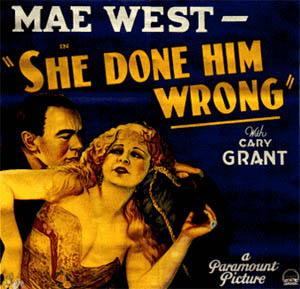
When watching the 1933 film She Done Him Wrong, it helps to know a little something about American history.
It helps to know that the film was made at the tail end of the failed progressive experiment known as prohibition, an attempt to ban liquor in the U.S. which only served to make people idolize criminals and feel nostalgic for the time when you could just safely hang out in a saloon and get drunk with bunch of shady characters.
It helps to know that this film was made at a time when America was struggling through the Great Depression and, more than ever, movies were seen as an escape from reality. The Depression also created a situation where, much like today, most Americans felt as if they were on the outside of the good life and, as a result, the most successful films of the time deal with outsiders getting something over on the smug and judgmental insiders.
It also helps to know that She Done Him Wrong was one of the last of the pre-Code films. Though, by modern standards, the film may seem outwardly tame, the innuendo and subtext is anything but. In fact, She Done Him Wrong was considered to be so racy that some people were actually scandalized when it became the biggest box office success of 1933. (These were largely the same people who, 13 years before, celebrated the passage of prohibition.) The infamous production code was largely instituted to make sure that a film like She Done Him Wrong could never be given another chance to corrupt filmgoers.
What exactly made She Done Him Wrong so controversial?
Well, it took place in a saloon in 1890s. The saloon is owned by Gus (Noah Beery), who uses it as a front for prostitution and counterfeiting. This is a film that features a lot of people drinking a lot of alcohol and it’s also a film that goes so far as to suggest that having a drink or two is not necessarily the worst thing in the world. Captain Cummings (Cary Grant) runs a city mission that has opened up next to the bar and the film devotes a lot of time to poking fun at Cummings’s upright morality. (Of course, Cummings has a secret of his own, one which suggests that his crusading attitude is just a convenient disguise.) Though it would be repealed by the end of the year, Prohibition was still the law of the land when She Done Him Wrong was released and it’s fun to see how much the film has at the law’s expense. That’s the type of fun that would basically be banned by the Production Code.
The Production Code would also require that all criminals be punished for their crimes by the end of a film. In She Done Him Wrong, singer Lady Lou (Mae West) stabs to death the viscous Russian Rita (Rafaela Ottiano) and basically gets away with it. It’s true that Lou was acting in self-defense but what makes She Done Him Wrong unique (for its time) is that Lou shows no remorse and that the killing is handled rather flippantly. When the police, who have been searching the saloon for another criminal, burst into the room after Rita has been stabbed, Lou fools them by placing Rita’s corpse in a chair and combing her hair. (“Haven’t you ever seen anyone comb someone’s hair before?”) After the police leave, Lou has her bodyguard dispose of the body and Rita is never mentioned again. Again, this is something that would never be allowed happen under the Production Code.
And then there’s the naked painting of Lou that hangs in the saloon. Whenever it’s shown a screen, a man in a hat happens to be standing in just the right position to block the viewer from seeing the entire portrait. Again, this would never have been allowed to happen under the Production Code.
And perhaps the biggest indication that this is a Pre-Code film is Mae West herself. Reportedly, She Done Him Wrong was an extremely toned down version of West’s stage act but what was heard on-screen would certainly be enough to throw the guardians of decent society into a panic. Nearly every line that she utters in this film is a double entendre but it’s not only what Mae West says. It’s the way that she says it. West may not have been a great actress but she had enough attitude that she didn’t need to be. With every line, with every glance, with every movement, Mae West announces that she not only has sex but she enjoys it too. In the Pre-Code days, that was unusual. Once the Production Code went into effect, such a portrayal would be impossible.
As for the film itself — well, it’s pretty much just an excuse for Mae to be Mae. There’s a plot, of course. Lady Lou has many suitors and they all converge on the saloon at the same time. However, Lou’s got her eye on the upstanding Captain Cummings. (He’s a man in uniform, after all.) It’s not a great film by any stretch of the imagination but, if you’re into film history or if you’re curious to see how American social mores have changed (and occasionally, not changed) over the years, She Done Him Wrong is a must see.
She Done Him Wrong is only 66 minutes long and it’s the shortest film to ever receive an Oscar nomination for best picture. It received no other nominations and lost to Cavalcade.
Reportedly, Ernest Hemingway hated the 1932 film adaptation of his great novel, A Farewell To Arms. The novel, of course, tells the story of ambulance driver Frederic Henry (played in the film by Gary Cooper), his service in World War I, and his doomed love affair with an English nurse named Catherine (played by the very American Helen Hayes). The novel was acclaimed for being tough and unsentimental. The film is the exact opposite, revealing itself to be more typical of the work of director Frank Borzage than Ernest Hemingway.
How romantic was Borzage’s adaptation of A Farewell to Arms? It was so romantic that it even changed the novel’s famous ending. The novel ended with Catherine dying and Frederic Henry walking away, alone and in the rain. The film, however, ended with Catherine miraculously recovering. Never mind, of course, that having Catherine survive pretty much defeated the entire purpose of the story. What was important was to give American audiences a happy ending!
However, European audiences got a more downbeat ending. In the European version, Catherine does die. After she dies, Frederic picks up her body and looks up into heaven, which is certainly far more dramatic (and, in its way, sentimentally spiritual) than anything to be found in Hemingway’s novel. If, like me, you see A Farewell To Arms on TCM, you’ll see the European ending.
So, yes, I can understand why Hemingway would have hated this film. But I have to admit that I rather enjoyed it. The film adaptation makes for terrible Hemingway but it’s great Borzage. Borzage specialized in making grand, lyrical, and sweeping romantic melodramas and that’s what his version of A Farewell To Arms truly is. Helen Hayes may not be convincingly English and Gary Cooper may be a bit overly earnest for a Hemingway hero but they both look good together and they have great chemistry. (Plus, Adolphe Menjou gives a good supporting performance as Frederic’s best friend.) As a director, Borzage keeps the story moving at a steady pace and plays up the romance in every single scene. There’s a great sequence that’s filmed entirely from the wounded Frederic’s point-of-view as he’s brought into a hospital and looked over by a series of officious nurses. We see everything through Frederic’s eyes until Catherine finally enters the room and kisses him. Only then do we see Frederic and Catherine together, leaving us with no doubt that these two belong together. A Farewell To Arms may not be a great literary adaptation but it is a great cinematic romance.
A Farewell To Arms was nominated for best picture but it won to a largely forgotten film called Cavalcade.