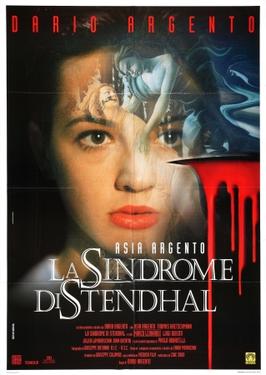
Today’s song of the day is the Theme from The Stendhal Syndrome. Composed by Ennio Morricone, this piece of music creates a perfectly creepy atmosphere for Dario Argento’s 1996 film, The Stendhal Syndrome. Argento’s later, post-Opera films are often treated rather dismissively by critics but I’ve always liked The Stendhal Syndrome. I definitely like Morricone’s score.
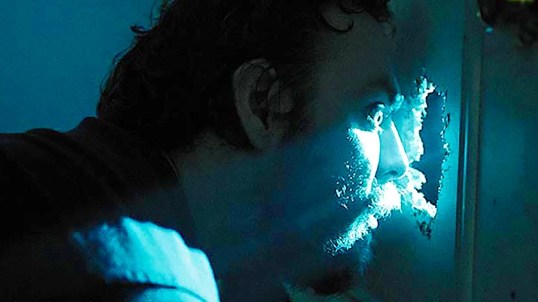
A man named Hank (Jeremy Gardner), who owns a pretty nice house out in the country, is holding a shotgun. He’s just shot a hole through his front door. Later, when the sun rises, he’ll walk around his land, carrying his gun and searching for anything that shouldn’t be there. When an unfamiliar car drives down the road, he fires at it.
Hank has a few reasons for being paranoid. He’s convinced that there’s something out there. For the past two weeks, Hank claims that there’s been a monster scratching at the front door. His friends tell him that it’s probably just a bear but Hank swears that it’s not. It’s too big and strong and strange to be a bear. It’s a monster, Hank swears.
Most of his friends assume that Hank is losing it. It probably doesn’t help that Hank started talking about this monster around the same time that his girlfriend Abby (Brea Grant), left him. Hanks claims that he has no idea why Abby left. He assumes that she’s down in Florida with an old boyfriend but he doesn’t know for sure. Whenever anyone suggests that he might want to think about why he and Abby are having problems, Hank steers the conversation back to the monster that he claims is trying to break into the house.
Hank spends his nights waiting for the monster and thinking about Abby. We see flashbacks to his relationship with Abby and what we immediately notice is that they always seem to be happy. In Hank’s memories, we never see them fighting or any hints that there was ever any trouble in their relationship. Yet, no one seems to be surprised that Abby left Hank so, obviously, it was clear to everyone else that Abby wasn’t happy. Are we seeing real memories of Hank and Abby or are we just seeing things the way that Hank has chosen to remember them?
After Midnight is a hybrid of a horror movie and a relationship drama. It’s definitely not a film for everyone. It moves at its own deliberate pace. Some of the dialogue is a bit overwritten and I’m still not really sure how Hank managed to get away with firing a shotgun at a moving car. (The film explains that he’s got a relative on the police force but it still seems like a bit of a stretch.) There’s a very lengthy scene that is just made up of a largely static shot of Abby and Hank talking about their relationship. It’s one of those scene that you’re either going to love or you’re going to hate. Myself, I liked the fact that the film was just as concerned with Abby and Hank as a couple as it was with whatever was hiding in the darkness. It helped that Gardner and Grant were a likable and believable couple. That said, if you’re only watching this film for the horror elements, you’ll probably get annoyed.
However, After Midnight also features what is perhaps one of the greatest jump scares that I’ve ever seen. It occurs towards the end of the film so yes, it does demand a little bit of patience on your part. But that patience will be rewarded! Seriously, I’m not going to spoil it but I will say that I literally fell off my couch in shock when it happened. It was a perfectly executed moment and one that entirely justified that patience required to reach it.
After Midnight is on Prime. It’s not for everyone but I liked it.
Today’s song of the day comes to use from Ennio Morricone’s score for Umberto Lenzi’s 1974 giallo Spasmo.
As I was listening to this music, I took a few minutes to think about all of the directors with whom Morricone worked over his career. Sergio Leone, Dario Argento, Quentin Tarantino, Roland Joffe, Sergio Corbucci, Umberto Lenzi, Terrence Malick, Lucio Fulci, Mario Bava, Don Seigel, John Carpenter, Brian DePalma, Franco Zefferelli, Barry Levinson, and so many more, all of them collaborated with Morricone. His music brought to life the work of so many artists. That’s certainly the case with Spasmo.
As far as states go, Arkansas usually doesn’t get much respect. In a country where much of the culture is dominated by city-dwelling secular liberals, Arkansas is a state the remains stubbornly rural, religious, and conservative. If your grandparents were a state, they’d probably look a lot like Arkansas. Arkansas is viewed as being old-fashioned and when it does make the news, it’s usually not for anything that anyone in the state particularly wants to brag about. Democrats will always view Arkansas as being the home of Mike Huckabee. Republicans will never forgive the state for springing the Clintons on the rest of the nation. (Interestingly enough, Mike Huckabee and Bill Clinton both grew up in the same tiny town.) Little Rock has gangs and government corruption. Hot Springs has gamblers looking to hide out from the mob. Fouke has the Boggy Creek Monster while Ft. Smith is best-known for having once been home to the hanging judge, Isaac Parker. You get the idea. When it comes to the way that the rest of the country views the state, it often seems as if poor Arkansas just can’t catch a break.
With all that in mind, I have to say that I really love Arkansas. My paternal grandparents lived in Arkansas and I’ve still got relatives all over the state. Arkansas was one of the many states where my family lived while I was growing up. (The others were — deep breath — Texas, Oklahoma, New Mexico, Colorado, and Louisiana.) We would stay in Arkansas for months at a time, depending on how well my mom and dad were getting along at the time. It’s an unpretentious state, one that’s full of friendly, no-nonsense people and beautiful countryside. I have a lot of good memories of Arkansas. It’s always in the back of my mind that, wherever I’m living, I can always just go back to Arkansas and spend the rest of my life living in a small town with my cousins. Of course, I’d probably end up miserable over the lack of movie theaters. Whenever I’m living in the city, I find myself yearning for the simplicity and decency of the country. Whenever I’m in the country, I find myself missing the excitement of the city.
The Natural State (as Arkansas is officially nicknamed) is not only the setting for some of my most cherished memories. It’s also the setting for a film called, appropriately enough, Arkansas. The directorial debut of actor Clark Duke, Arkansas tells the story of four very different men. Kyle Ribb (Liam Hemsworth) is quiet and rather stoic. Swin Horn (Clark Duke) is talkative, eccentric, and perhaps a bit too cocky for his own good. They both work at a national park, where their boss is a veteran ranger named Bright (John Malkovich). Of course, it doesn’t take a lot of effort to notice that neither Kyle nor Ribb really seem to do much work at the park. And, for that matter, Bright certainly does own a big and impressive house for someone who has spent the majority of his life as a ranger….
Kyle, Swin, and Bright are actually drug dealers. They transport drugs all over the southern half of the United States. Kyle and Swin are supervised by Bright. Bright, meanwhile, reports to the mysterious Frog. Kyle and Swin have never actually met Frog and there are rumors that he might not even exist. Of course, the film has already revealed to us that Frog (played by Vince Vaughn) does exist and is a local pawnshop owner.
Kyle narrates the film, informing us that the difference between Southern organized crime and Northern organized crime is that, in the South, it’s not all that organized. As Kyle explains it, the infamous Dixie Mafia is not so much an organization as it’s just a collection of undisciplined lowlifes who have no real integrity or loyalty to anyone else. When you become a drug dealer in the South, you’re a drug dealer for life. There’s no going back if you change your mind. You start out at the bottom of the ladder and, whenever someone above you if either murdered or imprisoned, you get your chance to move up. No one is ever sure who is working for who or who can be trusted. Every order from the boss is examined and re-examined as the two dealers try to figure out whether or not they’ve won the trust of the mysterious Frog.
Unfortunately for Kyle and Swin, a misunderstanding leads to violence and several deaths. With no way to directly communicate with Frog to let him know what exactly happened, Kyle and Swin know that their lives could be in danger. The film follows Kyle and Swin as they prepare for their ultimate meeting with Frog while, at the same time, detailing in flashback how Frog himself eventually came to his position of power. Throughout the entire film, we watch as history repeats itself. As Kyle said, once you’re a drug dealer, you’re a drug dealer for life.
Arkansas is a surprisingly low-key film. Kyle, Swin, Bright, and Frog all manage to be both very laid back and very aggressive at the same time. (Anyone who has spent anytime with a large group of rednecks will understand what I’m talking about.) As a director, Clark Duke is as interested in capturing the rhythms of every day life in Arkansas as he is in orchestrating the inevitable violence that results from all of the film’s betrayals and mistakes and some of the best scenes in the film just feature Kyle and Swin talking about nothing in particular while driving down the interstate. The film’s mix of cheerful goofiness and existential horror will be familiar to anyone who has ever gotten lost on the way to Hot Springs.
Liam Hemsworth and Clark Duke are sympathetic in the lead roles, though Hemsworth’s Southern accent does slip a few times. Swin meets a woman (Eden Brolin) in a grocery store and their subsequent romance manages to be both creepy and touching at the same time. John Malkovich is, as usual, wonderfully eccentric. That said, the film is pretty much dominated by Vince Vaughn, who plays Frog as being both dangerously ruthless and also as someone who understands that his eventual downfall is inevitable. Frog came to power by betraying his boss and, as played by Vaughn, Frog is very much aware that he’s destined to eventually be betrayed as well. Frog has made peace with both his place in the world and the reality of his situation and, in many ways, that makes him an even more dangerous character than he would be otherwise. He has nothing to lose and he knows it.
Obviously, I liked Arkansas, both the state and the movie. It’s an well-done work of Southern pulp.
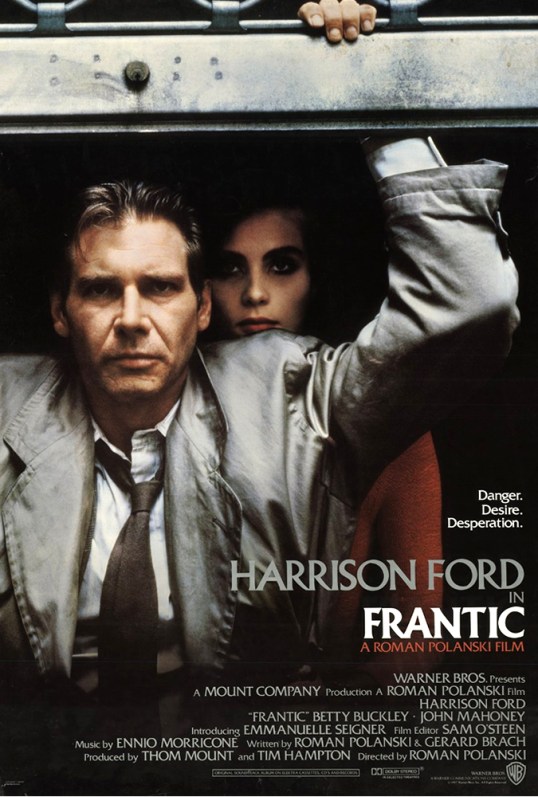
Today’s song of the day comes from the 1988 film, Frantic. This composition, like all of the other songs of the day that we’ve featured over the past two weeks, was composed by the great Ennio Morricone.
Today’s song of the day comes from The Legend of 1900, a 1998 film that probably deserves to be a bit better known than it is. The film’s score was composed by the great Ennio Morricone. Today’s song from Morricone is The Legend of the Pianist.
After you watched Carlito’s Way, you may have asked yourself, “Gee, I wonder how Carlito came to power in the first place? I wonder what he was like when he was young….”
Now, keep in mind, you may have asked yourself that. I did not ask myself that. To be honest, I didn’t really care. Carlito’s Way pretty much told me everything that I needed to know about Carlito’s past. Just the fact that people on the street respected him as soon as he got out of prison and that everyone was trying to get him to restart his life of crime told me that Carlito was obviously a big deal in the past. So, I didn’t really need a prequel.
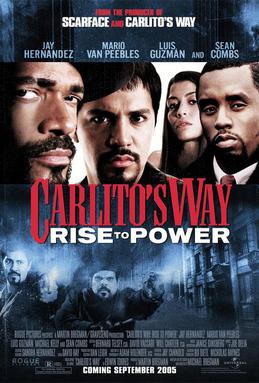
But, obviously, the people behind the 2005 film, Carlito’s Way: Rise to Power, disagreed. I guess I can understand their logic. When you’ve got a hit film, it’s only natural to try to do a follow-up. And when the first film ends with the main character dying, you really don’t have much choice but to do a prequel. And let’s give credit where credit is due. Long before the movies were made, Carlito Brigante was the main character of two novels written by Edwin Torres. Carlito’s Way: Rise To Power is based on the first of those novels and Torres reportedly said that he appreciated that the prequel stuck close to what he had written. So, it’s not like they just made up this film’s plot out of thin air.
That said, it’s still not a very good film. It takes place in the 60s, with young Carlito (Jay Hernandez) working his way up the ladder in New York’s drug chain. His partners, who he met in jail, are Earl (Mario Van Peebles) and Rocco (Michael Kelly). When they’re release from jail, they find themselves in the middle of drug war between Hollywood Nicky (Sean Combs) and the Bottolota Family, led by Artie (Burt Young). The three friends play the two sides against each other while also dealing with all of the usual betrayals and random violence that one normally expects to find in a movie like this. Luis Guzman shows up, playing a coke-snorting hitman named Nacho. It’s a bit disconcerting since Guzman played a different character in Carlito’s Way but it’s still always good to see Luis Guzman.
Anyway, the main problem with Carlito’s Way: Rise to Power can be seen in the casting of the main characters. Carlito’s Way had Al Pacino, Sean Penn, and John Leguizamo. Rise To Power has Jay Hernandez and Mario Van Peebles. Whatever gritty authenticity the film may be aiming for vanishes as soon as Mario Van Peebles looks straight at camera and smiles at his reflection. As for Jay Hernandez, he’s a likable actor but he’s the exact opposite of intimidating. You’d probably say yes if he asked you to prom but he does’t exactly come across like someone who could take over the New York drug racket. When Sean Combs is the most dangerous person in your movie, you’re looking at trouble.
Director Michael Bregman attempts to imitate a bit of Brian De Palma’s style from the first film and Jay Hernandez does his best to sound Pacino-like in his voice-over narration but the end result is flat and predictable. This is an offer that you can refuse.
It’s been a week so I guess it’s time for me to get back to reviewing mob movies, right? Usually, I do my best not to take such a long break in-between reviewing films — especially when it’s a themed-series of reviews — but I just got busy this week. It happens. Luckily, even when we get busy, the movie’s remain ready to be watched and reviewed.
Last week, I reviewed Scarface and The Untouchables, two gangster films from Brian De Palma. It only seems right to return to my look at the gangster genre by considering another Brian De Palma film. Released in 1993, Carlito’s Way reunites De Palma with Scarface’s Al Pacino. In Scarface, Pacino played a Cuban named Tony who was determined to get into the drug trade. In Carlito’s Way, Pacino plays a Puerto Rican named Carlito who is desperate to escape the drug trade.
Carlito’s Way opens with Carlito getting released from prison in 1975. He’s spent the past five years serving time on a drug conviction. Originally, Carlito was sentenced to 30 years but his friend and attorney, David Kleinfeld (Sean Penn), managed to get the conviction thrown out on a technicality. Now a free man, Carlito finds himself torn between two options. He can either get involved, once again, in the drug trade or he can go straight. Returning to his life of crime will mean once again doing something that he’s good at but it will also require him to deal with people who he can’t stand, like the sleazy Benny Blanco (John Leguizamo). Going straight will mean escaping from New York with his girlfriend, a dancer named Gail (Penelope Ann Miller). The problem is that it takes money to start a new life and there are people in New York who have no intention of allowing Carlito to leave.
Of the three De Palma-directed gangster films that I’ve recently watched, Carlito’s Way is probably the weakest. De Palma has always been a frustratingly uneven director and Carlito’s Way contains some of his worst work and some of his best. For instance, there’s a brilliant sequence where Carlito goes to a hospital to get revenge on someone who betrayed him and it is perhaps one of DePalma’s best set pieces. But then there’s other scenes where DePalma’s trademark style feels rather empty and counterproductive. Just when you’re starting to sympathize with Carlito’s predicament, DePalma will suddenly toss in a fancy camera trick and remind you that you’re just watching a film and that Carlito Brigante is just a character in that film. That technique worked well in the satiric Scarface and the mythological Untouchables but it often feels unnecessary in Carlito’s Way.
Al Pacino plays Carlito and, like DePalma’s direction, the end result is a bit uneven. On the one hand, Pacino and Penelope Ann Miller have a likable chemistry, even if Carlito and Gail don’t really make sense as a couple. On the other hand, this is one of those films where Pacino does a lot of yelling. Sometimes it works and sometimes, it’s just too theatrical to be effective. It’s hard not to compare Pacino’s performance here with his slyly humorous work in Scarface. Tony Montana yelled because he genuinely enjoyed getting on people’s nerves. The way that Tony expressed himself told us everything that we needed to know about the character. Carlito yells because that was Al Pacino’s trademark at the time the film was made.
The best thing about the film is Sean Penn’s performance as David Kleinfeld. Kleinfeld is one of the sleaziest character to ever appear in a movie and Penn seems to be having a good time playing him. (Watching the film, I found myself wishing that Penn was willing to have that much fun with all of his roles.) Penn doesn’t make Kleinfeld into a straight-out villain. Instead, he portrays Kleinfeld as being a somewhat nerdy guy who thought it would be fun to pretend to be a gangster and who has snorted too much cocaine to understand the amount of trouble that he’s brought upon himself. Just check out Penn in the scene where he’s dancing at a disco. There’s a joy to Penn’s performance in Carlito’s Way that you typically don’t see from him as an actor. He’s actually fun to watch in Carlito’s Way.
It’s a flawed film but fortunately, the movie’s good moments are strong enough to help carry the audience over the weaker moments. The movie often threatens to collapse under the weight of its own style but it seems like whenever you’re on the verge of giving up on the film, De Palma’s kinetic camerawork will calm down enough to allow you to get at least mildly invested in Carlito’s predicament or Sean Penn’s amoral dorkiness will create an amusing moment and you’ll think to yourself, “Okay, let’s keep giving this a chance.” Carlito’s Way may not be an offer that you can’t refuse but it’s still fairly diverting.
For today’s song of the day comes from Ennio Morricone’s score for John Carpenter’s remake of The Thing. Desolation is an aptly named composition because this song capture the feel of isolation and paranoia that has made Carpenter’s film a classic.
That’s what we ask ourselves after every school shooting, isn’t it? Because the perpetrators are usually not around to explain themselves, there’s a tendency to look to the shooter’s parents and to demand to know how they could have allowed things to get so out of control. The assumption almost always is that the parents were negligent. If only the shooter’s mother or father had done a better job, we’re led to believe, the tragedy could have been prevented. It’s human nature. When faced with an unspeakable tragedy, people need someone to blame.
Of course, an actual examination of the history of most school shooting does reveal some bad parents but it also reveals parents who did their best under difficult circumstances or who were as fooled by their children as everyone else in the world. Yes, there are the parents who gave their obviously unstable children guns. But there are other parents who tried to get their children help and who tried to be tough disciplinarians and who sincerely believed that that their children were doing better in school or life or whatever. And if a parent does suspect that their child is a sociopath, what are they to do? Are they supposed to stop loving that child and cast them away? Too often, the trauma of violence leads people to seek out easy answers but often times, those easy answers are not there. We forget that no one sets out to raise a monster.
M.O.M. Mother of Monsters is a found footage film that attempts to explore some of these issues. Abbey Bell (Melinda Page Hamilton) is a single mom who suspects that her 16 year-old son, Jacob (Bailey Edwards), might be a psychopath. So, she plants hidden cameras around her house and she obsessively films their every interaction. She says that she’s doing it so that she can prove that her son is dangerous and also so she can help all of the other mothers out there who are struggling to raise psychotic children.
And yes, Jacob is certainly obnoxious. He’s frequently angry and he makes inappropriate jokes about killing people. He spends a lot of his time locked away in his room and he throws a fit when Abbey tries to take away his Playstation. He’s casually racist and he listens to loud and angry music and he’s a habitual liar. From the time he was 6 years-old, he’s been drawing disturbing pictures. The question, though, is whether he’s the next school shooter or if he’s just a 16 year-old boy.
Not helping matter is that Abbey herself seems to be even more unstable than her son. Abbey gets as mad at her own mother as Jacob does at her and she continually talks about whether or not evil is hereditary. Throughout the film, there are dark hints about an incident that occurred before Jacob was born. When we’re told that Abbey majored in psychology, we find ourselves wondering if she’s trying to use Jacob an his bed behavior to justify her own fears and obsessions. Who is the bigger threat, Jacob or Abbey? The film keeps you guessing all the way up to its violent conclusion.
The first two thirds of M.O.M. works pretty well. Though I’m usually not a fan of the found footage genre, M.O.M. actually comes up with a believable justification for the constant filming. It also makes good use of its low budget, setting almost all of the action in one claustrophobic house. Bailey Edwards and especially Melinda Page Hamilton do a great job playing the two main characters and the film keeps you guessing as to whether Abbey is right to be concerned or if she’s projecting her own instability onto her son.
Unfortunately, the final third of the film features a plot twist that just didn’t work for me. While I imagine that it will work for some people, it was just a bit too implausible for me to accept and the twist’s clumsy execution took me out of the film’s carefully constructed reality. The film went from being an intriguing character study of two damaged people to just being another found footage thriller. As such, the film’s final disturbing image didn’t quite have the power that it perhaps would have if not for that final twist.
That said, the first part of the film was undeniably effective and that’s enough for me to recommend it. If nothing else, this film identities Tucia Lyman as a director to watch out for. According to the imdb, this was first narrative feature film and she did a good job using the familiar rules of the found footage genre to tell an intriguing story. I look forward to her second film.