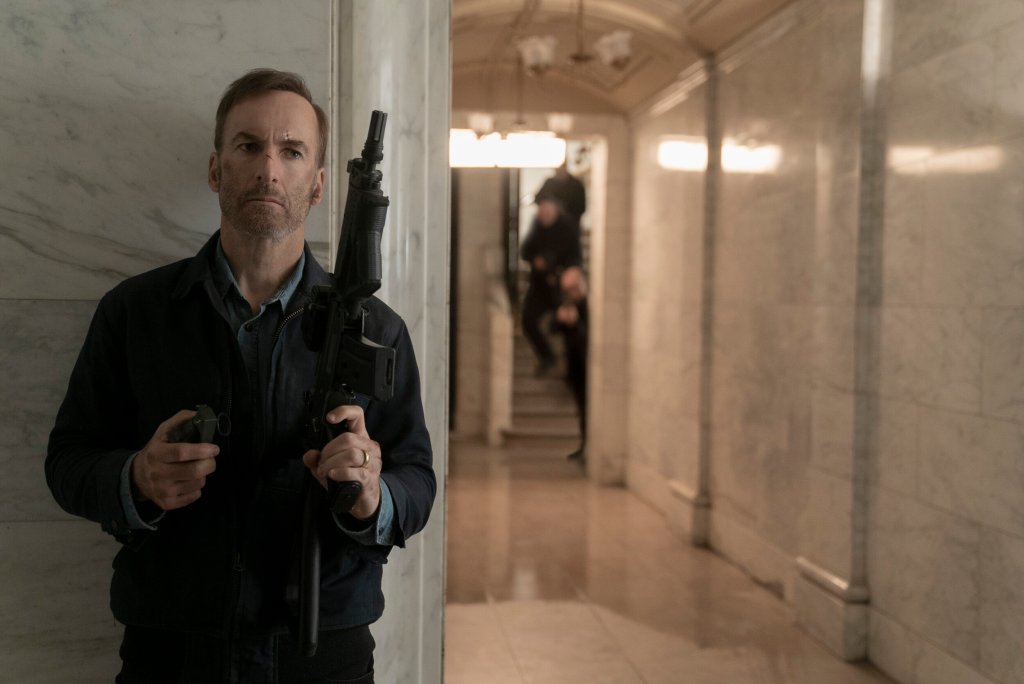
Live Tweet Alert – #MondayMuggers present NOBODY (2021), starring Bob Odenkirk!


Every Monday night at 9:00 Central Time, my wife Sierra and I host a “Live Movie Tweet” event on X using the hashtag #MondayMuggers. We rotate movie picks each week, and our tastes are quite different. Tonight, Monday July 7th, we are showing NOBODY (2021), starring Bob Odenkirk, Aleksey Serebryakov, Connie Nielsen, Michael Ironside, Colin Salmon, RZA, and Christopher Lloyd.

The plot: A docile family man slowly reveals his true character after his house get burglarized by two petty thieves, which, coincidentally, leads him into a bloody war with a Russian crime boss.

So, if you think you might enjoy watching a “nobody” turn into a badass and take on the Russian mafia, and you’ve about 90 minutes to spare, then we’ve got the movie for you! Join us tonight for #MondayMuggers and watch NOBODY. It’s on Amazon Prime! I’ve included the trailer below:

Trailer: Nobody 2


Ilya Naishuller’s 2021 action-comedy Nobody caught everyone by surprise. Many thought it was just a quick cash-grab to take advantage of the success with the John Wick action series. Nobody was released in the middle of the pandemic, yet it was received very positive reviews from critics and audiences, alike.

It was a no-brainer that a sequel would be greenlit. It took awhile to happen but most of the cast and crew are back with the exception of director Ilya Naishuller. Indonesian director Timo Tjahjanto now takes the director’s seat with some new, but familiar faces (Sharon Stone and Colin Hanks) joining the previous cast (Bob Odenkirk, Colin Salmon, Connie Nielsen, Christopher Lloyd and RZA).

From this first trailer, Nobody 2 looks to retain the action-comedy tone of the first, but with the visual flair of Timo Tjahjanto (see The Night Comes for Us for example of how batshit crazy his action turn out).

Nobody 2 arrives in theaters on August 15, 2025.

STARSHIP TROOPERS and Hell’s Half Acre – Taking my love of the movies on down the road (Part 4)!


2022 was a big year for my wife Sierra and I when it comes to “movie tourism.” I’ve already discussed our trips to Pennsylvania and Colorado to celebrate my healthy obsession with the late, great action movie icon Charles Bronson. In that same year, we spent some time in the beautiful city of Casper, Wyoming. About 40 miles from Casper is a place called “Hell’s Half Acre.” Sierra lived in Casper for 18 years, and she told me that the movie STARSHIP TROOPERS was filmed there. I had no idea. I had watched the movie way back in late 90’s because it was directed by Paul Verhoeven, the Dutch director who had made a star out of Rutger Hauer before coming to America and directing films like ROBOCOP, TOTAL RECALL, and BASIC INSTINCT. I remember it being graphically violent, but I honestly didn’t remember much about it. The fact that it was filmed out in the middle of nowhere outside of Casper piqued my interest, and I was determined to know more.

In a nutshell, STARSHIP TROOPERS stars Casper Van Dien as Johnny Rico, a young man who joins the military after graduation to become a citizen, and because of his love for his high school sweetheart Carmen (Denise Richards). As part of his service, he finds himself in a war against the bug aliens of Klendathu. Every day is a battle for survival as the soldiers try to save the human race. Aside from Van Dien and Richards, director Verhoeven has assembled an excellent supporting cast that includes veterans like Michael Ironside, Clancy Brown, and even Rue McClanahan. Maybe it’s because I visited the location, but I enjoyed the movie much more now, than I remember enjoying it back in the 90’s.

Hell’s Half Acre stood in for the alien planet of Klendathu in STARSHIP TROOPERS. It’s an interesting looking area that reminds me of the look of the Grand Canyon when viewed from afar. It turned out to be the perfect place for an alien planet, even if there was always a chance that the cast and crew might run into a rattlesnake or two. Here’s a picture I took of the sign on the premises that tells you a little more about Hell’s Half Acre.

The picture at the top of the article shows how Hell’s Half Acre is used in the movie to represent the alien planet of Klendathu. Here’s an image of the movie’s star, Casper Van Dien, on location. I met several people in Casper who remember when the actors and the crew were staying in Casper during filming, and they all spoke very positively of Van Dien. I also find it interesting that Casper Van Dien is filming this movie just outside of Casper, Wyoming. What are the chances?

Here are few of the pictures we took on our visit. I sent the picture below to my son while we were out of town and asked him if he knew where we were. His guess was The Grand Canyon!

Making movies is one hell of a business, and visiting Hell’s Half Acre was a great reminder of the imagination it takes to create movie magic. It was also a fun way to spend part of day, especially for a movie lover like me!

The Films of 2024: Late Night With The Devil (dir by Colin Cairnes and Cameron Cairnes)


Late Night With The Devil is a truly frightening film.

Jack Deloy (David Dastmalchian) is the host of Night Owls, a late-night talk show.  Deloy has spent his entire television career competing against The Tonight Show With Johnny Carson.  Deloy has a loyal audience.  He has several Emmy awards.  But he has never been able to beat The Tonight Show in the ratings.  Even when he interviewed his dying wife (Georgina Haig) and got the biggest ratings of his career, he still finished second to Johnny Carson.  After his wife died, Deloy went into seclusion before eventually returning to his show.

It’s Halloween night in 1977 and Deloy is hosting a live broadcast of Night Owls.  He and his producer (John Quong Tart) are convinced that they’re finally going to achieve their goal of winning the ratings race.  On the show, they have the medium Christou (Faysal Bazzi).  They have Carmichael Haig (Ian Bliss), a pompous former magician who now makes his living by exposing charlatans.  They have parapsychologist June Ross-Mitchell (Laura Gordon) and Lilly (Ingrid Torelli), a young woman who claims to be possessed by a demon that she calls Mr. Wiggles.  Deloy’s sidekick Gus McConnell (Rhys Auteri) fears that it’s not a good idea to mess with the occult on Halloween night but Deloy is determined to get those ratings.  In fact, Deloy is willing to do just about anything for the ratings.

Opening with narration from Michael Ironside and introduced as being a documentary about what happened that mysterious night, Late Night With The Devil is a found footage horror film but, unlike a lot of films of the genre, it doesn’t get bogged down with people saying stuff like, “Are we recording?” or “Are you getting this?”  Instead, the film’s directors actually make good use of the format, suggesting that there might still be a spark of inspiration to be found in the found footage genre.  The contrast between the grainy color of the show and the stark black-and-white footage of what went on whenever the show went to commercial is one of the things that makes Late Night With The Devil so memorable.  It keeps the audience from getting too comfortable with what they’re watching and it’s a reminder that what one sees in a controlled environment (like a talk show) is often meant to hide the chaos lurking under the surface.  Towards the end of the episode, when the color footage goes from being grainy to suddenly being very bright and vivid, it’s truly unsettling.  (The film does such a good job of keeping the audience off-balance that the directors can even get away with abandoning the found footage format at a key moment.)  Late Night With The Devil does a wonderful job recreating the look and feel of an old late night talk show.  One look at the Night Owls set and you can literally smell the combination of stale cigarettes and outright desperation.  Looking at the ugly set and the tacky clothes, it’s easy to buy that we actually are watching some long-buried archival footage from 1977.  One reason why the film is frightening is because it feels authentic.

(And yes, it feels authentic despite the inclusion of some AI-images.  AI was used to create the intertitles that appear whenever Night Owls goes to commercial.  They appear for less than a minute and, if not for the online controversy, I never would have noticed them.)

David Dastmalchian plays Jack Deloy as being a showman who is an expert at manipulating the audience and who will do anything to get people to watch.  Still, even the most jaded horror fan will be shocked to see how far Jack Deloy is willing to go to win the ratings race.  (For all the supernatural elements of the film, nothing is more disturbing than its portrayal of human avarice.)  A major subplot deals with Jack’s membership in the Grove, a society of the wealthy and powerful that is based on the very real Bohemian Grove.  Bohemian Grove is, of course, a favorite of conspiracy theorists who assume that the rich and famous are up to all sorts of nefarious deeds whenever they gather for their annual meeting.  Those conspiracy theorists will find much to appreciate about Late Night With The Devil and Dastmalchian’s performance.  (Of course, one can also read Jon Ronson’s Them, which features an entire chapter about Ronson traveling to Bohemian Grove and discovering that what was advertised as being a day of dorky fun for the rich and powerful actually was just that.)

Obviously, many films did influence Late Night With The Devil.  The end credits begin with a land acknowledgment but it could have just as easily contained a film acknowledgment.  “The filmmakers acknowledge the influence of The Exorcist, Cannibal Holocaust, The Last Exorcism, the careers of James Randi, Uri Geller, and Sylvia Browne, Michelle Remembers, The Conjuring franchise, The Larry Sanders Show, the films of David Cronenberg, and Ghostwatch.”  It’s a testament to the skill of the directors and the cast that, despite all the obvious influence, Late Night With The Devil stands as an original and genuinely unsettling work of art.

McBain (1991, directed by James Glickenhaus)


In the year 1973, Bobby McBain (Christopher Walken) was an American POW, fighting for his life in a North Vietnamese prison camp that was run by a general so evil that he wore a necklace of human ears.  Luckily, on the last day of the war, McBain was rescued by Roberto Santos (Chick Vennerra).  When Bobby asked how he could ever repay Santos, Santos gave him half of a hundred dollar bill and told him that someday, Santos would give him the other half.  McBain swears that he will be ready when the day comes to get the other half.  I guess he’s like Caine in Kung Fu, waiting for the chance to snatch the pebble from his master’s hand.

15 years later, McBain is a welder in New York.  One day, while sitting in a bar, he watches as Santos is executed on live television after a failed attempt to overthrow the dictator of Colombia.  Shortly afterwards, McBain is approached by Santos’s sister (Maria Conchita Alonzo), who asks McBain to help her finish Santos’s revolution.  McBain tells her a long story about attending Woodstock and then reunites with his Vietnam War buddies, Frank (Michael Ironside!), Eastland (Steve James), Dr. Dalton (Jay Patterson), and Gil (Thomas G. Waites).  After killing a bunch of drug dealers, stealing their money, and harassing Luis Guzman, the gang heads for Colombia.

I wonder how many people have watched this movie over the years with the expectation that it would be a live action version of the famous Rainier Wolfcastle film that was featured in several episodes of The Simpsons.  Unfortunately, this movie has nothing to do with the Simpsons version of McBain.  (Sorry, no “Bye, book.”)  Instead, it’s just another strange and overlong action film from director James Glickenhaus.  The film mixes scene of total carnage with dialogue that often seems to be going off on a totally unrelated tangent, like McBain’s musings about what Woodstock ultimately stood for.  Walken doesn’t seem to be acting as much as he’s parodying his own eccentric image.  Walken takes all of his usual quirks and trademark vocal tics and turns them up to 11 for this movie.

Even though the movie is twenty minutes too long, it still feels like scenes are missing.  Alonzo leaves Colombia on a mule and then is suddenly in New York.  (The mule is nowhere to be seen.)  We don’t actually see Walken recruiting the majority of his team.  Instead, they just show up in his house.  Once the action moves to Colombia, it turns out that overthrowing the government is much simpler than it looks.  While the rebels lay down their lives while attacking the palace, McBain and his crew pretty much stroll through the movie without receiving even a scratch.  Maybe welders should be put in charge of all of America’s foreign policy adventures.  It couldn’t hurt.

With its hole-filled plot and confusingly edited combat scenes, McBain isn’t great but 80s action enthusiasts should enjoy seeing Michael Ironside and Steve James doing their thing.  Others will want to see it just for Christopher Walken’s characteristically odd performance.  He may not be Rainier Wolfcastle but, for this movie, Christopher Walken is McBain.

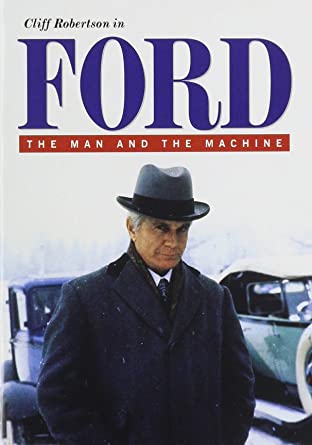
Miniseries Review: Ford: The Man and The Machine (dir by Allan Eastman)


Henry Ford changed the world, for both the better and the worst.

Starting from his own small workshop in Dearborn, Michigan, Henry Ford designed the first mass-produced automobile.  He transformed cars from being a luxury item to being something that nearly every family owned.  He created the concept of the assembly line.  He argued that workers needed to be paid a livable wage and he also advocated for an 8-hour workday.  At a time when every facet of American life was heavily segregated, he encouraged his factories an auto dealerships to hire black employees.  He was a pacifist, who took part in a widely-ridiculed but apparently sincere effort to try to convince the leaders of the world to just stop fighting.

Unfortunately, Henry Ford was also something of an unhinged lunatic, a man whose skill at engineering and his empathy for his underpaid workers did not necessarily translate into a sophisticated understanding of anything else.  When the workers in his factories tried to unionize, Ford employed violent strike breakers and he felt that most of the population were like a children and therefore incapable of governing themselves.  He understood how to make car but he also fell for all sorts of quack science and was a believer in reincarnation.

Worst of all, he was a rabid anti-Semite, who blamed almost all of the world’s problems on “Jewish bankers” and who played a huge role in popularizing a scurrilous work called The Protocols of Elder Zion in America.  Claiming to lay out the details of a Jewish plot to secretly control the world, The Protocols were a ludicrous document but many people believed them because they were promoted by Henry Ford, who was as big a celebrity in the early 20th Century as all of the social media influencers are today.  All these years later, The Protocols are still cited by anti-Semites.  A series of anti-Semitic editorials (which Ford later claimed to have signed off on but not actually written) were published in Germany under the title The International Jew, the World’s Foremost Problem.  Hitler wrote of his admiration for Ford in Mein Kampf.  Ford, it should be noted, did keep his distance from Hitler, though whether that was due to a personal distaste or the threat of an economic boycott is not known.  (Jewish leaders had already organized one successful boycott of Ford in the 20s, which led to Ford closing down his newspaper and offering up an apology.)  At the Nuremberg Trials, many of the Nazis said that they had first been introduced to anti-Semitism through the writings of Henry Ford.  Reportedly, when Ford saw newsreel footage of the concentration camps, he was so overcome with emotion that he collapsed from a stroke.

(Two years ago, when Nick Cannon regurgitated the usual anti-Semitic conspiracy theories on a podcast, he was pretty much saying the exact same thing that Henry Ford said at the start of the 20th Century.  Later, under threat of economic boycott, both Ford and Cannon would off up half-hearted apologies for their statements.  Ford continued to make cars.  Cannon continues to host a handful of television shows.  How does that work?)

First broadcast over two nights in 1987, Ford: The Man and the Machine was a Canadian miniseries about the long and controversial life of Henry Ford.  Cliff Robertson played Henry Ford.  Hope Lange played his wife while Heather Thomas played his mistress.  R.H. Thomson played Ford’s son, the sensitive Edsel.  Michael Ironside played Harry Bennett, a sinister figure who was hired to break up union activity and who eventually became Ford’s right-hand man.  If I remember correctly, I believe Canadian law actually required that Michael Ironside appear in almost every Canadian film and television show made in the 80s and the 90s.  His glowering presence and menacing line delivery practically shouted out, “Don’t mess with Canada,” and he does bring a note of genuine danger to his performance here.

Ford: The Man and the Machine opens in the late 20s, with an aging Henry Ford already starting to lose control of his mental faculties.  A series of flashbacks then show how Ford built his first engine, his first car, and eventually his first factory.  We watch as Ford goes from being an enthusiastic, self-taught engineer to being one of the most powerful men in the world.  Along the way, Ford grows arrogant.  The same stubbornness that led to his early success also leads to his later problems.  For all of his ability, Ford’s ego and his refusal to reconsider his conclusions leaves him vulnerable to both flattery and manipulation, whether it’s coming from the White House of Woodrow Wilson, from his own executives, or from the authoritarians who rose to power in Europe following the first World War.  As portrayed in the movie, he’s a loving father who also flies into a rage when Edsel designs a car on his own.  He loves his wife but he keeps a mistress.  He loves his family but he’ll always prefer to spend time working on his cars than spending time with them.  Henry Ford changes the world but his own hubris makes it impossible for him to change with it.

The miniseries is built around Cliff Robertson’s performance as Ford and Robertson does an excellent job in the role, convincingly playing Ford as he goes from being an enthusiastic dreamer to a paranoid millionaire to a doddering old man, a Bidenesque figuredhead who is only nominally in charge of his own company.  Neither the film nor Robertson shy away from showing us Henry Ford’s flaws.  Instead, both the production and the actor offer up a portrait of a complex man who transformed the way that people lived but who couldn’t escape from his own prejudices and resentments.  Ford: The Man and The Machine is a history lesson but it’s a valuable one.  If you’re a student of history, you’ll find much to think about in this miniseires.

For the record, I do drive a Ford and it’s a good car.  However, I tell myself that it’s named after Gerald Ford.
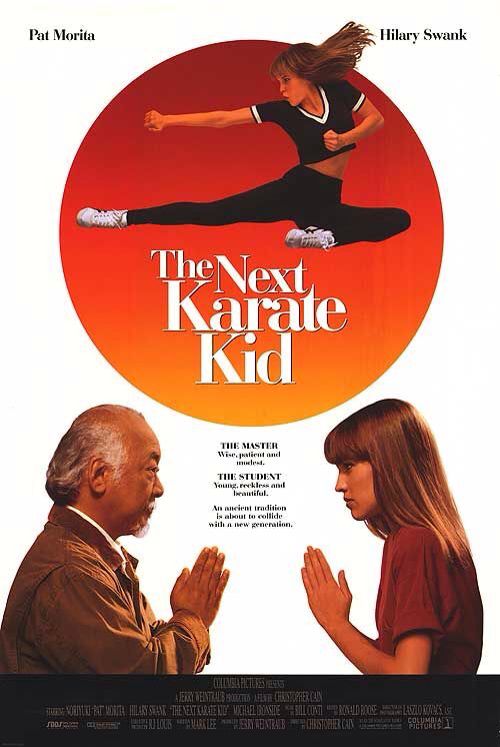
Insomnia File #52: The Next Karate Kid (dir by Christopher Cain)


What’s an Insomnia File? You know how some times you just can’t get any sleep and, at about three in the morning, you’ll find yourself watching whatever you can find on cable or Netflix? This feature is all about those insomnia-inspired discoveries!

If, over the next few weeks, you find yourself having trouble getting to sleep, you might be tempted to log onto Netflix and watch the fourth season of Cobra Kai.  That’s certainly what I’m planning to do over the course of the next few days.  However, before you watch Cobra Kai, you should make sure that you’ve seen all of the earlier Karate Kid films because you never know who might show up on the show.  I mean, if Thomas Ian Griffith is coming back, anyone could be coming back!  And that includes Julie Pierce, the young karate student at the center of 1994’s The Next Karate Kid.

Julie (played by Hillary Swank) is a troubled teenager.  She lives in Boston with her grandmother.  She attends a high school that is run by a weirdly fascistic self-defense instructor named Colonel Dugan (Michael Ironside), who teaches all of the jocks to be tough, ruthless, and to show no mercy.  When Julie’s grandmother leaves to for Los Angeles so that she can relax, Julie’s new caretaker is an old family friend who turns out to be Mr. Miyagi (Pat Morita).

At first, Julie wants nothing to do with Miyagi.  She’s still angry about the death of her parents in a car crash.  All she wants to do is take care of a falcon that lives on the roof of the school.  She does like a boy named Eric McGowen (Chris Conrad) but Eric is also friends with the members of Colonel Dugan’s paramilitary gang, the so-called Alpha Elite.  She needs someone who can understand her and her anger and, at first, Miyagi doesn’t seem like he’s capable of doing and of that.  But then Miyagi discovers that Julie has a natural talent for jumping on top of cars and this leads to….

Well, you know what it leads to.  It’s The Next Karate Kid!  Ralph Macchio was 33 years old when this film was first released and was a bit too old to still be playing a kid so the film’s producers tried to reboot the franchise by giving Miyagi a new student.  The Next Karate Kid pretty much hits all of the story beats from the first film, though it does change things up by not featuring a karate tournament.  Instead, it all leads to a post-prom fight between Miyagi and Dugan.  This film is your only chance to see Pat Morita face off against Michael Ironside and that’s got to be worth something.

The Next Karate Kid does not have a particularly good reputation and, watching the film, I understood why.  There’s very little of the spontaneity or the wit that made the first film memorable.  That said, I did appreciate Michael Ironside’s villainous turn.  If Hillary Swank doesn’t necessarily give the type of performance that would make you think, “Future two-time Oscar winner!,” she still does a good job of portraying the anger that’s at the heart of the character.  If nothing else, The Next Karate Kid deserves some credit for taking Julie’s anger seriously as opposed to just writing it off as being a “teen girl thing.”  The Next Karate Kid wasn’t as bad as I expected but it was still hard not shake the feeling that it was largely unnecessary.

That’s said, I still look forward to Julie’s eventual visit to Cobra Kai.

Previous Insomnia Files:

  1. Story of Mankind
  2. Stag
  3. Love Is A Gun
  4. Nina Takes A Lover
  5. Black Ice
  6. Frogs For Snakes
  7. Fair Game
  8. From The Hip
  9. Born Killers
  10. Eye For An Eye
  11. Summer Catch
  12. Beyond the Law
  13. Spring Broke
  14. Promise
  15. George Wallace
  16. Kill The Messenger
  17. The Suburbans
  18. Only The Strong
  19. Great Expectations
  20. Casual Sex?
  21. Truth
  22. Insomina
  23. Death Do Us Part
  24. A Star is Born
  25. The Winning Season
  26. Rabbit Run
  27. Remember My Name
  28. The Arrangement
  29. Day of the Animals
  30. Still of The Night
  31. Arsenal
  32. Smooth Talk
  33. The Comedian
  34. The Minus Man
  35. Donnie Brasco
  36. Punchline
  37. Evita
  38. Six: The Mark Unleashed
  39. Disclosure
  40. The Spanish Prisoner
  41. Elektra
  42. Revenge
  43. Legend
  44. Cat Run
  45. The Pyramid
  46. Enter the Ninja
  47. Downhill
  48. Malice
  49. Mystery Date
  50. Zola
  51. Ira & Abby

Film Review: Top Gun (dir by Tony Scott)


Oh, where to even begin with Top Gun?

First released in 1986, Top Gun is a film that pretty much epitomizes a certain style of filmmaking.  Before I wrote this review, I did a little research and I actually read some of the reviews that were published when Top Gun first came out.  Though it may be a considered a classic today, critics in 1986 didn’t care much for it.  The most common complaint was that the story was trite and predictable.  The film’s reliance on style over substance led to many critics complaining that the film was basically just a two-hour music video.  Some of the more left-wing critics complained that Top Gun was essentially just an expensive commercial for the military industrial complex.  Director Oliver Stone, who released the antiwar Platoon the same year as Top Gun, said in an interview with People magazine that the message of Top Gun was, “If I start a war, I’ll get a girlfriend.”

Oliver Stone was not necessarily wrong about that.  The film, as we all know, stars Tom Cruise as Pete “Maverick” Mitchell, a cocky young Navy flyer who attends the TOPGUN Academy, where he competes with Iceman (Val Kilmer) for the title of Top Gun and where he also spends a lot of time joking around with everyone’s favorite (and most obviously doomed) character, Goose (Anthony Edwards).  Maverick does get a girlfriend, Charlie (Kelly McGillis), but only after he’s had plenty of chances to show both how reckless and how skilled he can be while flying in a fighter plane.  Though the majority of the film is taken up with scenes of training and volleyball, the end of the film does give Maverick a chance to prove himself in combat when he and Iceman end up fighting a group of ill-defined enemies for ill-defined reasons.  It may not be an official war but it’s close enough.

That said, I think Oliver Stone was wrong about one key thing.  Maverick doesn’t get a girlfriend because he started a war.  He gets a girlfriend because he won a war.  Top Gun is all about winning.  Maverick and Iceman are two of the most absurdly competitive characters in film history and, as I watched the film last weekend, it was really hard not to laugh at just how much Cruise and Kilmer got into playing those two roles.  Iceman and Maverick can’t even greet each other without it becoming a competition over who gave the best “hello.”  By the time the two of them are facing each other in a totally savage beach volleyball match, it’s hard to look at either one of them without laughing.  And yet, regardless of how over-the-top it may be, you can’t help but get caught up in their rivalry.  Cruise and Kilmer are both at their most charismatic in Top Gun and watching the two of them when they were both young and fighting to steal each and every scene, it doesn’t matter that both of them would later become somewhat controversial for their off-screen personalities.  What matters, when you watch Top Gun, is that they’re both obviously stars.

“I’ve got the need for speed,” Tom Cruise and Anthony Edwards say as they walk away from their plane.  The same thing could be said about the entire movie.  Top Gun doesn’t waste any time getting to the good stuff.  We know that Maverick is cocky and has father issues because he’s played by Tom Cruise and Tom Cruise always plays cocky characters who have father issues.  We know that Iceman is arrogant because he’s played by Val Kilmer.  We know that Goose is goofy because his nickname is Goose and he’s married to Meg Ryan.  The film doesn’t waste much time on exploring why its characters are the way they are.  Instead, it just accepts them for being the paper-thin characters that they are.  The film understands that the the most important thing is to get them into their jets and sends them into the sky.  Does it matter that it’s sometimes confusing to keep track of who is chasing who?  Not at all.  The planes are sleek and loud.  The men flying them are sexy and dangerous.  The music never stops and the sun never goes down unless the film needs a soulful shot of Maverick deep in thought.  We’ve all got the need for speed.

In so many ways, Top Gun is a silly film but, to its credit, it also doesn’t make any apologies for being silly.  Instead, Top Gun embraces its hyperkinetic and flashy style.  That’s why critics lambasted it in 1986 and that’s why we all love it in 2020.  And if the pilots of Top Gun do start a war — well, it happens.  I mean, it’s Maverick and Iceman!  How can you hold it against them?  When you watch them fly those planes, you know that even if they start World War III, it’ll be worth it.  If the world’s going to end, Maverick’s the one we want to end it.


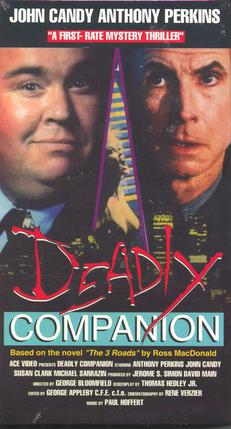
Monster Chiller Horror Theatre: Deadly Companion (1980, directed by George Bloomfield)


Deadly Companion starts with John Candy sitting in a mental institution and snorting cocaine while happily talking to his roommate, Michael Taylor (Michael Sarrazin).  Michael has been in the institution ever since the night that he walked in on his estranged wife being murdered.  Because of the shock, he can’t remember anything that he saw that night.  When his girlfriend Paula (Susan Clark) comes to pick Michael up, Michael leaves the institution determined to get to the truth about his wife’s murder.  Once Michael leaves, John Candy disappears from the movie.

Michael suspects that his wife was killed by her lover, Lawrence Miles (Anthony Perkins) but there is more to that night than Michael is remembering.  Deadly Companion is a typical low-budget shot-in-Toronto thriller from the early 80s, with familiar Canadian character actors like Michael Ironside, Al Waxman, Kenneth Welsh, and Maury Chaykin all playing small roles.  Michael Sarrazin is a dull lead but Anthony Perkins gets to do what he did best at the end of his career and plays a thoroughly sarcastic bastard who gets the only good lines in the film.

What’s interesting about Deadly Companion isn’t the predictable plot and it’s certainly not Michael Sarrazin.  Instead, what’s strange is that several cast members of SCTV show up in tiny supporting roles, though none of them get as much of a chance to make as big an impression as John Candy.  Deadly Companion is a serious thriller that just happens to feature Candy, Joe Flaherty, Eugene Levy, Catherine O’Hara, and Dave Thomas.  It’s strange to see Michael Sarrazin trying to figure out who killed his wife while Eugene Levy loiters in the background.  It leaves you waiting for a punchline that never comes.

The SCTV people are in the film because it was directed by George Bloomfield, who also directed several episodes of SCTV.  Since this film was made before SCTV really broke into the American marketplace, it was probably assumed that no one outside of Canada would ever find the presence of John Candy in a dramatic murder mystery distracting.  Of course, when Deadly Companion was later released on VHS in the late 80s, Candy and the SCTV crew were all given top billing.

A Mardi Gras Film Review: Mardi Gras For The Devil (dir by David A. Prior)


A maniac is holding New Orleans hostage!  He’s committed a series of savage, Satanically-influenced homicides and the police cannot seem to even slow him down!  The entire city is terrified!

Well, actually … New Orleans doesn’t seem to be scared at all.  In fact, no one in this movie seems to be all that disturbed by all of the brutal murders that are happening around them.  Some people would probably say that’s because this film takes place during Mardi Gras and everyone’s too drunk to notice.  Why worry about being murdered when all you have to do to get a bunch of cheap beads is flash a boob?  Add to that, this is New Orleans.  New Orleans is a very forgiving city.

Anyway, regardless of whether people care or not, there’s a Satanic murderer prowling through the city.  Who is the killer?  Could he possibly be that guy who always dresses in black, who has a perfectly trimmed beard, and who is always throwing back his head and laughing before doing something evil?  The guy’s name is Bishop and he’s played by everyone’s favorite Canadian character actor, Michael Ironside.  As far as Michael Ironside villains are concerned, Bishop is pretty frightening though he’s nowhere near as a frightening as Darryl Revok.  I mean, he does a lot of evil stuff but he doesn’t actually make anyone’s head explode.

Detective Mike Turner (Robert Davi) is obsessed with stopping Bishop.  Unfortunately, Detective Turner doesn’t appear to be very good at his job.  I mean, everyone he knows he keeps getting seriously injured.  His first partner dies.  His second partner gets run over by a bus.  His ex-wife (Lesley-Anne Down) ends up trapped in a pool.  His girlfriend (Lydie Denier) ends up getting tied up in a barn while a time bomb ticks down across from her.  Fortunately, a few of these people do manage to survive.  Turner may not be a very good cop but, fortunately, Bishop isn’t that good of a serial killer.

It soon becomes apparent that Bishop has a motive for all of his murders, one that goes beyond the usual serial killer weirdness.  It turns out that Bishop’s murders are actually sacrifices and he has given his soul to Satan.  Giving your soul to the devil apparently gives you the power to do whatever the script needs you to do at any particular moment in the movie.  Fortunately, it also leaves you with a weakness that can be exploited whenever the movie decides to come to an end.

Am I saying that Mardi Gras For the Devil makes no sense?  I most definitely am!  However, that’s actually the film’s charm.  The film was made with so little concern for continuity and narrative logic that it plays out like a fever dream.  The cast is surprisingly good for a film like this, which means that everyone delivers the strangest of lines with the utmost sincerity.  Michael Ironside plays his role without a hint of subtlety, which is exactly the type of bad guy that a film like this requires.  Meanwhile, Robert Davi brings a weary cynicism to his role.  You can just hear him thinking, “Satanic serial killers?  I’m too old for this shit.”  Combine that with a fiery ending that doesn’t even try to make sense and you have a movie that, perhaps through no intention of the film’s director, manages to create and sustain a very surreal atmosphere.  The film may not be any good but it’s hard to look away from.

Though the film takes place at Mardi Gras and was released, in some countries, as both Mardi Gras For The Devil and Mardi Gras Nightmare, it actually has very little do with Mardi Gras.  The opening scenes were shot during a Mardi Gras parade but that’s about it.  The film was also released under the title Night Trap, which is a woefully generic title.  You can find the movie on YouTube.