4 Or More Shots From 4 Or More Films is just what it says it is, 4 shots from 4 of our favorite films. As opposed to the reviews and recaps that we usually post, 4 Shots From 4 Films lets the visuals do the talking!
102 years ago, on this date, Marlon Brando was born in Omaha, Nebraska. One of the greatest of American actors and one of the main reasons why so many young actors became enamored with the Method, Marlon Brando played many roles in our culture. When he was young, he was a Broadway bad boy. When he went out to Hollywood, he became a legitimate movie star. In the 60s, he was a cautionary tale as his career suffered a series of notorious flops. In the 70s, he made a comeback and, in during the final years of his career, he was as known for his eccentricities as for his talent. It’s a shame that those eccentricities overshadowed Brando as an actor. When he wanted to be, he was one of the best to ever appear on stage or in the movies.
In honor of the wonderful, tragic, and talented Marlon Brando, it’s time for….
4 Shots From 4 Marlon Brando Films
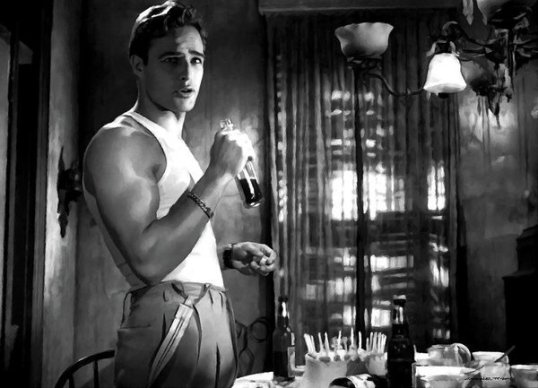
A Streetcar Named Desire (1951, dir by Elia Kazan, DP: Harry Stradling)
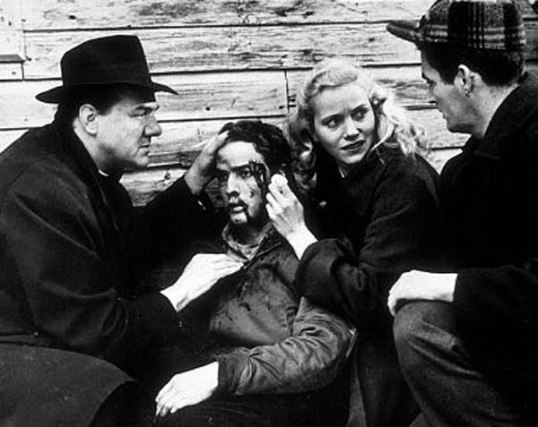
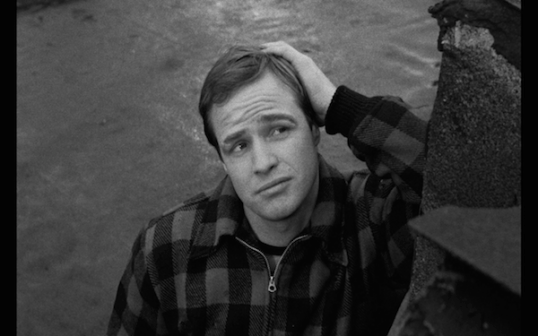
On The Waterfront (1954, dir by Elia Kazan, DP: Boris Kaufman)
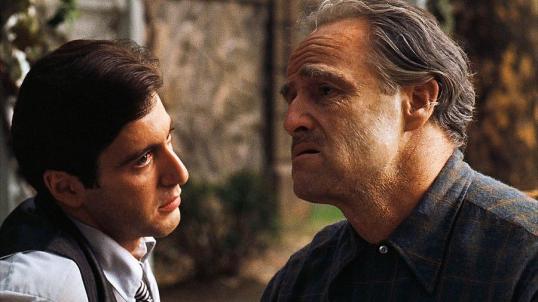
The Godfather (1972, dir by Francis Ford Coppola, DP: Gordon Willis)
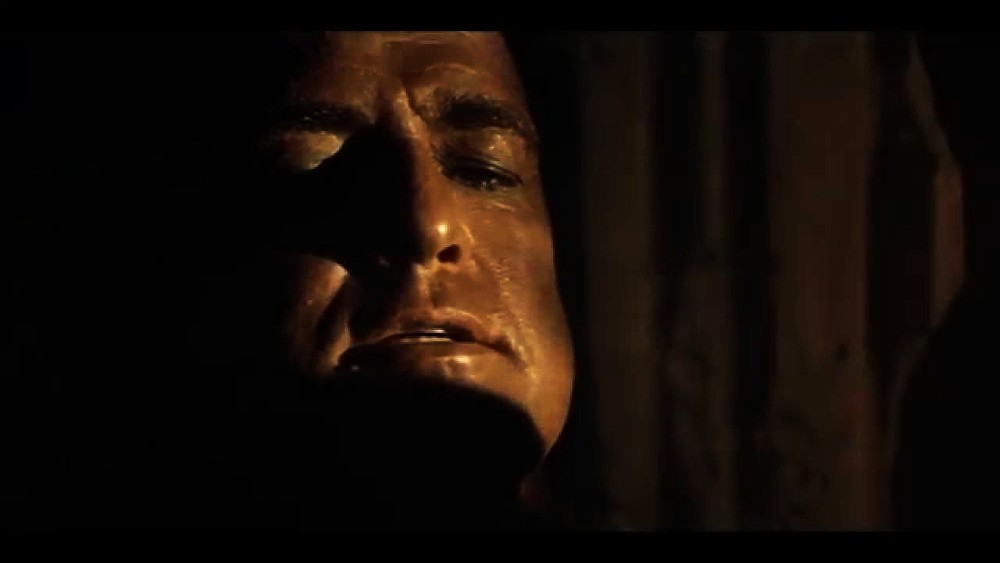
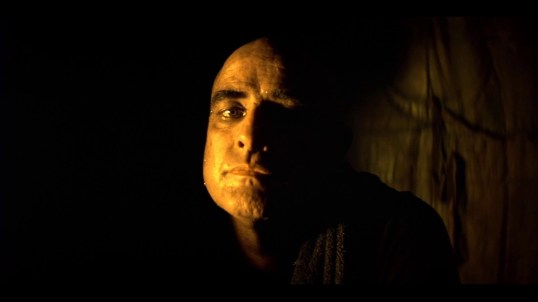
Apocalypse Now (1979, dir by Francis Ford Coppola, DP: Vittorio Storaro)
Lenny Montana started out as a boxer and a wrestler. He eventually ended up working as a bouncer and a bodyguard for the leadership of the Colombo Crime Family. However, Montana achieved his immortality as a result of veteran tough guy actor Timothy Carey turning down the role of Luca Brasi in The Godfather. Brasi was the Corleone Family’s most feared enforcer and Carey, who had made a career out of playing psychos, was one of the most feared men in Hollywood, one who was rumored to have pulled a gun on more than a few directors. (For the record, Stanley Kubrick loved him.) When Carey turned down the role in favor of doing a television series, Francis Ford Coppola offered the role to Lenny Montana. Montana may not have had Carey’s screen acting experience but he brought real-life authenticity to the role. When Michael says that Luca Brasi is a “very scary man,” one look at Lenny Montana confirms it. Unfailingly loyal to the family and willing to do anything for the Don, Luca Brasi represents the Family’s strength. When Luca Brasi is killed, you know that the old era of the Corleones is ending as well. Without Luca, the Corleones are in deep trouble.
My favorite Luca Brasi scene comes at the beginning of the film. Surprised to be invited to Connie’s wedding, Luca wants to thank the Don personally. Nervous about acting opposite Marlon Brando, Montana flubbed his lines. The scene, with the flub, was kept in the film and it served to humanize both Luca and Don Corleone. (The Don’s smile was due to the fact that Marlon Brando was having trouble not laughing.) It’s a nice little scene, one that reminds us that even gangsters are human.
The scene below is from the 1953 film, Julius Caesar. This Oscar-nominated Shakespearean adaptation had a cast that was full of distinguished actors. James Mason played Brutus. The great John Gielgud played Cassius. Louis Calhern was Caesar while other roles were filled by Deborah Kerr, Greer Garson, Edmond O’Brien, George Macready, John Hoyt, Edmund Purdom. and a host of other distinguished thespians. And yet, the best performance in the film came from an actor who, at the time, no one considered to be a Shakespearean. Marlon Brando brought his method intensity to the role of Mark Antony and the result was a performance that is still electrifying today.
Here is Marlon Brando in Julius Caesar, giving one of the best performances to not win an Oscar. Remember this the next time someone defends a film or a performance by saying that it won an Oscar. Sometimes, the best does not win. Most of the time, the best cannot even be identified until several years have passed. It’s hard to argue with William Holden winning a long overdue Oscar for his work in 1953’s Stalag 17 but still, the power of Brando’s performance is impossible to deny.
1979’s Apocalypse Now reimagines the Vietnam War as pop art.
Jim Morrison sings The End in the background as slow-motion helicopters pass in front of a lush jungle. The jungle erupts into flame while in a dingy hotel room, Captain Benjamin Willard (Martin Sheen) gets drunks, practices his karate moves, and smashes a mirror before collapsing to the floor in tears. The next morning, the hung-over and bandaged Willard ends up at a U.S. military base where he has a nice lunch with Lt. General Corman (G.D. Spradlin) and Col. Lucas (Harrison Ford) and a nearly silent man wearing an undone tie. Willard is asked if it’s true that he assassinated an enemy colonel. Willard replies that he did not and that the operation was classified, proving that he can both lie and follow military protocol. Willard is told that a Col. Walter Kurtz (Marlon Brando) has gone rogue and his mission is to go into Cambodia and terminate his command with “extreme” prejudice. It’s a famous scene that features G.D. Spradlin delivering a brilliant monologue about good and evil and yet it’s often missed that Willard is getting his orders from Roger Corman and George Lucas.
(Roger Corman was the mentor of director Francis Ford Coppola while the pre-Star Wars George Lucas was Coppola’s business partner. Indeed, Apocalypse Now was originally somewhat improbably planned to be a George Lucas film.)
Up the river, Willard heads on a patrol boat that is populated with characters who could have come out of an old World War II service drama. Chief (Albert Hall) is tough and no-nonsense. Lance (Sam Bottoms) is the goofy comic relief who likes to surf. Clean (Laurence Fishburne) is the kid who is obviously doomed from the minute we first see him. Chef (Fredric Forrest) is the overage, tightly-wound soldier who just wants to find mangoes in the jungle and who worries that, if he dies in a bad place, his soul won’t be able to find Heaven. The Rolling Stones are heard on the boat’s radio. Soldiers on the other patrol boats moon the boat and toss incendiary devices on the roof. It’s like a frat prank war in the middle of a war.
Colonel Bill Kilgore (Robert Duvall) is a badass calvary officer whose helicopter raids are legendary amongst the enemy and a dedicated surfer who tries to turn every night into the equivalent of an AIP Beach Party film. He’s a brilliant warrior who speaks with Malibu accent (“Charlie don’t surf!”) and who doesn’t flinch when a bomb goes off near him. “I love the smell a napalm in the morning,” he says and, for a few moments, you really wish the film would just abandon Willard so we could spend more time with Kilgore. “Some day this war is going to end,” he says with a reassuring nod, showing a non-neurotic attitude that is the opposite of Kurtz’s. Willard says that he could tell Kilgore was going to get through the war without even a scratch and it’s true. Kilgore doesn’t try to rationalize or understand things. He just accepts the reality and adjusts. He’s a true surfer.
The film grows progressively more surreal the closer the boat heads up the river and gets closer to Cambodia. A USO show turns violent as soldiers go crazy at the sight of the Playboy Bunnies, dressed in denim outfits and cowboy hats and twirling cap guns like the love interest in a John Wayne western. A visit to a bridge that is built every day and blown up every night is a neon-lit, beautiful nightmare. Who’s the commanding officer? No one knows and no one cares.
The closer Willard gets to Kurtz, the stranger the world gets. Fog covers the jungles. A tiger leaps out of nowhere. Dennis Hopper shows up as a photojournalist who rambles as if Billy from Easy Rider headed over to Vietnam instead of going to Mardi Gras. Scott Glenn stands silently in front of a temple, surrounded by dead bodies that feel as if they could have been brought over from an Italian cannibal film. Kurtz, when he shows up, is an overweight, bald behemoth who talks in riddles and who hardly seem to be the fearsome warrior that he’s been described as being. “The horror, the horror,” he says at one point in one of the few moments that links Apocalypse Now to its inspiration, Joseph Conrad’s Heart of Darkness.
Directed by near-communist Francis Ford Coppola and written by the unapologetically right-wing John Milius, Apocalypse Now is actually less about the reality of Vietnam and more about how the images of the war shaped pop culture the world over. It’s a reminder that Vietnam was known for being the first television war and that counterculture was not just made up of dropouts but also of writers, actors, and directors. Kurtz may say that Willard’s been sent by grocery store clerks but actually, he’s been sent by the B-movie producers who first employed and mentored the directors and the actors who would eventually become the mainstays of the New Hollywood. The film subverts many classic war film cliches but, at the same time, it stays true to others. Clean dying while listening to a tape recording of his mother telling him not to get shot and to come home safe is the type of manipulative, heart-tugging moment that could have appeared in any number of World War II-era films. And while Coppola has always said the film was meant to be anti-war, Col. Kilgore remains the most compelling character. Most viewers would probably happily ride along with Kilgore while he flies over Vietnam and plays Wagner. The striking images of Vietnam — the jungle, the explosions, the helicopters flying through the air — stay in the mind far more than the piles of dead bodies that appear in the background.
It’s a big, messy, and ultimately overwhelming film and, while watching it, it’s hard not to get the feeling that Coppola wasn’t totally sure what he was really trying to say. It’s a glorious mess, full of stunning visuals, haunting music, and perhaps the best performance of Robert Duvall’s legendary career. The film is too touched with genius to not be watchable but how one reacts overall to the film will probably depend on which version you see.
The original version, which was released in 1979 and was nominated for Best Picture, is relentless with its emphasis on getting up the river and finding Kurtz. Willard obsesses on Kurtz and really doesn’t have much to do with the other people on the boat. It gives the story some much-needed narrative momentum but it also makes Kurtz into such a legendary badass that it’s hard not to be disappointed when Willard actually meets him. You’re left to wonder how, if Kurtz has been living in the jungle and fighting a brutal and never-ending guerilla war against the communists, he’s managed to gain so much weight. Brando, who reportedly showed up on set unprepared and spent days improvising dialogue, gives a bizarre performance and it’s hard to view the Kurtz we meet as being the Kurtz we’ve heard about. As strong as the film is, it’s hard not to be let down by who Kurtz ultimately turns out to be.
In 2001 and 2019, Coppola released two more versions of the film, Redux and The Final Cut. These versions re-inserted a good deal of footage that was edited out of the original cut. Most of that footage deals with Willard dealing with the crew on the boat and it’s easy to see why it was cut. The scenes of Willard bonding with the crew feel out of character for both Willard and the rest of the crew. A scene where Willard arranges for Clean, Lance, and Chef to spend time with the Playboy bunnies seems to go on forever and features some truly unfortunate acting. Worst of all, Redux totally ruins Kilgore’s “I love the smell of napalm in the morning” monologue by having Willard suddenly steal his surf board. Again, it’s out of character for Willard and it actually feels a bit disrespectful to Duvall’s performance to suddenly turn Kilgore into a buffoon.
But then there are moments that do work. I actually like the lengthy French Plantation scene. By the time Willard, Lance, and Chef stumble into the plantation, the journey upriver has gotten so surreal that it makes a strange sort of sense that they would run into a large French family arguing politics while a clown tries to keep everyone distracted. The new versions of the film are undeniably disjointed but they also shift the focus off of finding Kurtz and place it more on Willard discovering how weird things are getting in Vietnam. As such, it’s less of a disappointment when Kurtz actually shows up. Much as with the French Plantation scene, the journey has become so weird that Kurtz being overweight and pretentious feels somehow appropriate.
What all the versions of the film have in common is that they’re all essentially a neon-lit dream of pop cultural horror. Is Apocalypse Now a horror film? Critic Kim Newman argued that it owed a lot to the genre. Certainly, that’s the case when Willard reaches the temple and finds himself surrounded by corpses and and detached heads. Even before that, though, there are elements of horror. The enemy is always unseen in the jungle and, when they attack, they do so quickly and without mercy. In a scene that could almost have come from a Herzog film, the boat is attacked with toy arrows until suddenly, out of nowhere, someone throws a very real spear. Until he’s revealed, Kurtz is a ghostly figure and Willard is the witch hunter, sent to root him out of his lair and set his followers on fire. If the post-60s American horror genre was shaped by the images coming out of Vietnam then Apocalypse Now definitely deserves to be considered, at the very least, horror-adjacent.
Apocalypse Now was controversial when it was released. (It’s troubled production had been the talk of Hollywood for years before Coppola finally finished his film.) It was nominated for Best Picture but lost to the far more conventional Kramer vs Kramer. Robert Duvall was the film’s sole acting nominee but he lost the award to Melvyn Douglas’s turn in Being There. Douglas was very good in Being There and I imagine giving him the Oscar was also seen as a way of honoring his entire career. That said, Duvall’s performance was amazing. In his relatively brief screen time, Duvall somehow managed to take over and ground one of the most unruly films ever made. The Oscar definitely should have gone to him.
As for the film itself, all three versions, flaws and all, are classics. It’s a film that proves that genius can be found in even the messiest of productions.
“I’ve seen horrors… horrors that you’ve seen. But you have no right to call me a murderer. You have a right to kill me. You have a right to do that… but you have no right to judge me. It’s impossible for words to describe what is necessary to those who do not know what horror means. Horror… Horror has a face… and you must make a friend of horror. Horror and moral terror are your friends. If they are not, then they are enemies to be feared. They are truly enemies! I remember when I was with Special Forces… seems a thousand centuries ago. We went into a camp to inoculate some children. We left the camp after we had inoculated the children for polio, and this old man came running after us and he was crying. He couldn’t see. We went back there, and they had come and hacked off every inoculated arm. There they were in a pile. A pile of little arms. And I remember… I… I… I cried, I wept like some grandmother. I wanted to tear my teeth out; I didn’t know what I wanted to do! And I want to remember it. I never want to forget it… I never want to forget. And then I realized… like I was shot… like I was shot with a diamond… a diamond bullet right through my forehead. And I thought, my God… the genius of that! The genius! The will to do that! Perfect, genuine, complete, crystalline, pure. And then I realized they were stronger than we, because they could stand that these were not monsters, these were men… trained cadres. These men who fought with their hearts, who had families, who had children, who were filled with love… but they had the strength… the strength… to do that. If I had ten divisions of those men, our troubles here would be over very quickly. You have to have men who are moral… and at the same time who are able to utilize their primordial instincts to kill without feeling… without passion… without judgment… without judgment! Because it’s judgment that defeats us.”
My latest “Scenes I Love” Monologue Edition comes courtesy of the great Marlon Brando as Col. Kurtz from Francis For Coppola’s magnus opus, Apocalypse Now.
The scene is the Kurtz monologue describing the horror he has seen and how it has shaped his thought process and concept on how to fight the enemies he has been tasked to fight and also condemned for the methods he has used to achieve results.
Shot and framed with Brando’s face half in shadows as he describes how the horrors he has seen and committed is just a reflection of the war they’re fighting and how emotions and judgment from those who have not experience and committed such horrors is the path to defeat.
Brando’s time in front of the camera is not very much in the whole runtime of the film, but from beginning to end his shadowy presence looms over everyone and this 5-minute monologue becomes the exclamation mark that succinctly explains the entire theme of the film: “In an insane world, the mad men are the ones who are sane”.
What’s an Insomnia File? You know how some times you just can’t get any sleep and, at about three in the morning, you’ll find yourself watching whatever you can find on cable or streaming? This feature is all about those insomnia-inspired discoveries!
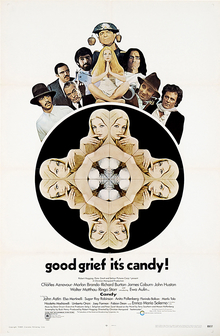
If you find yourself having trouble getting to sleep tonight, you can always pass the time by watching the 1968 film, Candy. It’s currently on Tubi.
Based on a satirical novel by Terry Southern and Mason Hoffenberg, Candy follows Candy Christian (Ewa Aulin), a naive teenager from middle America as she has a number of increasingly surreal adventures, the majority of which end with her getting sexually assaulted by one of the film’s special guest stars. It’s very much a film of the 60s, in that it’s anti-establishment without actually seeming to know who the establishment is. It opens with a lengthy sequence that appears to be taking place in outer space. It ends with an extended sequence of Candy walking amongst the film’s cast and a bunch of random hippies. Director Christian Marquand appears as himself, directing the film. Yep, this is one of those films where the director and the film crew show up and you’re supposed to be say, “Far out, I didn’t realize I was watching a movie, man.”
The whole thing is a bit of a misfire. The novel was meant to be smut that satirized smut. The film isn’t really clever enough to work on any sort of real satirical level. As was the case with a lot of studio-made “psychedelic” films in the 60s, everything is a bit too obvious and overdone. Casting the Swedish Ewa Aulin as a character who was meant to represent middle America was just one of the film’s missteps. Based on The Graduate, Mike Nichols probably could have made a clever film out of Candy. The French Christian Marquand, a protegee of Roger Vadim’s, can not because he refuses to get out of the film’s way. It’s all jump cuts, flashy cinematography, and attempts to poke fun at American culture by someone who obviously knew nothing about America beyond the jokes told in Paris.
That said, the main reason that anyone would watch this film would be for the collection of guest stars who all show up and try to take advantage of Candy. Richard Burton plays an alcoholic poet named MacPhisto and his appearance goes on for far too long. (Burton, not surprisingly, appears to actually be drunk for the majority of his scenes.) Ringo Star — yes, Ringo Starr — plays a Mexican gardener who assaults Candy after getting turned on by the sight of MacPhisto humping a mannequin. When Emmanuel’s sisters try to attack Candy, she and her parents escape on a military plane that is commanded by Walter Matthau. Landing in New York, Candy’s brain-damaged father (John Astin) is operated on by a brilliant doctor (James Coburn) who later seduces Candy after she faints at a cocktail party. Candy’s uncle (John Astin, again) also tries to seduce Candy, leading to Candy getting lost in New York, meeting a hunchback (Charles Aznavour), and then eventually ending up with a guru (Marlon Brando). Candy’s adventures climax with a particularly sick joke that requires a bit more skill to pull off than this film can afford.
If you’re wondering how all of these famous people ended up in this movie, you have Brando to thank (or blame). Christian Marquand was Brando’s best friend and Marlon even named his son after him. After Brando agreed to appear in the film, the rest of the actors followed. Brando, Burton, and Coburn received a share of the film’s profits and Coburn later said that his entire post-1968 lifestyle was pretty much paid for by Candy. That seems appropriate as, out of all the guest stars, Coburn i the only one who actually gives an interesting performance. Burton is too drunk, Matthau is too embarrassed, Starr is too amateurish, and Brando is too self-amused to really be interesting in the film. Coburn, however, seems to be having a blast, playing his doctor as being a medical cult leader.
Candy is very much a film of 1968. It has some value as a cultural relic. Ultimately, it’s main interest is as an example of how the studios tried (and failed) to latch onto the counterculture zeitgeist.
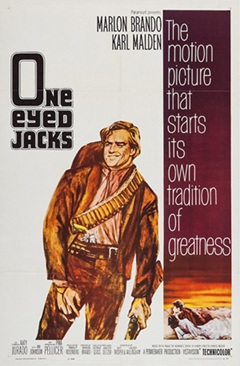
Rio (Marlon Brando), a young outlaw in the Old West, is betrayed by his partner and mentor Dad Longworth (Karl Malden) and ends up spending five years in a Mexican prison. When Rio escapes, he gets together a new gang and heads for Monterey, California. He wants to both get his revenge on Longworth and also rob the local bank. Things get complicated when Rio actually confronts Longworth and suddenly realizes that he can’t bring himself just to gun the man down in cold blood. Rio is not as ruthless of an outlaw as he thought he was.
However, Rio then meets and falls in love with Louisa (Pina Pellicer), Longworth’s stepdaughter Longworth is willing to do whatever he has to keep Rio away from Louisa and, when Rio starts to think about going straight in an effort to win Louisa’s love, his new gang turn out to be even less trustworthy than his old partners.
A teenage rebellion film disguised as a western (and it’s not a coincidence that the main bad guy is named Dad), One-Eyed Jacks was Marlon Brando’s only film as a director. The film was originally meant to be directed by Stanley Kubrick, who was working from a script written by a once-in-a-lifetime combination of Rod Serling and Sam Peckinpah. Kubrick and Brando worked together to develop the film, with Brando insisting on Karl Malden as Dad. (Kubrick wanted to cast Spencer Tracy.) Ultimately realizing that working on One-Eyed Jacks would mean essentially taking orders from his star, Kubrick stepped down from directing so he could focus on Lolita and Brando took over as director. The film finally went into production in 1958 and would not be released until 1961. Brando’s perfectionism was blamed for the film going massively overbudget and, when it was finally released, One-Eyed Jacks was the first of Brando’s films to lose money. The combined box office failures of One-Eyed Jacks and the remake of Mutiny on the Bounty left Brando in the cinematic wilderness for much of the 60s.
As for the film itself, One-Eyed Jacks takes what should have been a simple story and attempts to turn into an epic. Rio spends a good deal of time brooding and the film seems to brood right along with him. What starts out as a western becomes a forbidden love story as Rio and Louisa fall for each other. Dad Longworth may be an outlaw-turned-sheriff but Malden plays him more as a possessive father who can’t handle that his two stepchildren — Rio and Louisa — are both turning against him and his strict rules. Brando obviously viewed the film as being something bigger than a standard western. Sometimes, his direction works and he does manage to get the epic feel that he was going for. Other times, the film itself seems to be unsure what direction it wants to go in telling its story. This is method directing.
Ultimately, One-Eyed Jacks is an interesting experiment, one that doesn’t really work but which still features Charles Lang’s outstanding cinematography and one of Karl Malden’s best performances. As Brando’s only directorial effort, the film is a curiosity piece, one that will be best enjoyed by western fans who have the patience for something a little different. And, for what it’s worth, based on the film’s visual beauty and the performances that he gets from the cat, I think Brando could have developed into a fine director with a little more experience. However, it was not to be.
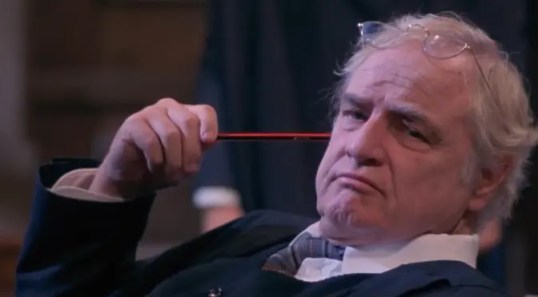
In 1990, Marlon Brando received his final Academy Award nomination when he was nominated for his supporting performance in 1989’s A Dry White Season.
Brando played Ian McKenzie, a human rights lawyer who lives and work in South Africa at the height of the Apartheid regime. When we first see McKenzie, he’s sitting in his office and complaining about how all the flowers surrounding him have given him a permanent allergy. When Ben Du Toit (Donald Sutherland) explains that he’s trying to learn the truth about why his gardener and his gardener’s son both died in the custody of South Africa’s “special branch,” McKenzie replies that bringing the case would be a waste of time. McKenzie makes several dismissive comments about the case and tells Du Toit that pursing the matter would lead to Du Toit becoming a pariah himself. Only when Du Toit says that he’ll just find another lawyer to pursue the manner does McKenzie agree to take the case. His comments may have seemed callous but they were McKenzie’s way of testing Du Toit’s commitment to actually getting to the truth.
Up until the death of his gardener, Ben Du Toit was someone who blindly believed in the system. A former rugby star and a teacher, Ben grew up in South Africa and is proud to call himself a “true African.” (In one of the film’s best scenes, Ben’s driver, Stanley — played by Zakes Mokae, — informs Ben that being an African in South Africa means not being allowed to vote and having to carry identification papers everywhere with him.) When the gardener’s son is first arrested, Ben repeatedly says, “He must have done something.” When Ben’s gardener is arrested, Ben believes that it’s all just a terrible mistake and that he’ll be released soon. Even after the gardener is killed, Ben initially believes the official story that the death was a suicide. It’s only after Stanley takes Ben to the funeral home and shows him the gardener’s tortured body that Ben finally comes to realize that he was tortured to death by Captain Stolz (Jurgen Prochow).
Still, Ben is naive enough to assume that McKenzie will be able to get some sort of justice. In court, McKenzie easily exposes the flaws in Stolz’s story. When Stolz claims that the dead man’s injuries were the result of the man throwing himself against the bars of his cell, McKenzie mentions that the man’s back was injured and then asks if he was throwing himself backwards. Stolz smirks and says that the man was “an animal.” McKenzie may be a brilliant lawyer but it’s a foregone conclusion that he’s going to lose the case. Stolz is exonerated and the expression on McKenzie’s face is one that indicate that he is not surprised at all.
It’s a small role. Brando gets less than ten minutes of screentime but he makes perfect use of them and shows that, even in the latter half of his career, Brando could still give a good performance when he cared about the material. Both Brando and Susan Sarandon took small roles in this anti-Apartheid drama because they believed in the message. Sarandon’s casting is a bit distracting. She never becomes the journalist she’s playing, instead she just seems like a movie star lending her name to a cause that she believes in. But Brando becomes Ian McKenzie and he expertly reveals the absurd lengths to which the Apartheid government will go to excuse its actions.
The majority of the film deals with Ben Du Toit and his slow-awakening about the truth of the country that he calls home. Upon realizing the truth about the country’s government and its actions, Du Toit declares that he can no longer go back to being who he once was and it costs him his family, his home, and ultimately his life. Donald Sutherland does a wonderful job, portraying Du Toit’s growing understanding of what’s actually happening in South Africa. Wisely, the film doesn’t portray Du Toit as being a saint. It fully understands that Du Toit only started to care about Apartheid when it effected somebody that he knew and fortunately, Stanley is always there to call Du Toit out whenever he starts to forget about his own role in supporting the system that he now opposes. It’s a powerful and heartfelt film, one that is well-known for Brando’s performance but works just as well when Brando is off-screen as well.
4 Or More Shots From 4 Or More Films is just what it says it is, 4 shots from 4 of our favorite films. As opposed to the reviews and recaps that we usually post, 4 Shots From 4 Films lets the visuals do the talking!
101 years ago, on this date, Marlon Brando was born in Omaha, Nebraska. One of the greatest of American actors and one of the main reasons why so many young actors became enamored with the Method, Marlon Brando played many roles in our culture. When he was young, he was a Broadway bad boy. When he went out to Hollywood, he became a legitimate movie star. In the 60s, he was a cautionary tale as his career suffered a series of notorious flops. In the 70s, he made a comeback and, in during the final years of his career, he was as known for his eccentricities as for his talent. It’s a shame that those eccentricities overshadowed Brando as an actor. When he wanted to be, he was one of the best to ever appear on stage or in the movies.
In honor of the wonderful, tragic, and talented Marlon Brando, it’s time for….
4 Shots From 4 Marlon Brando Films
A Streetcar Named Desire (1951, dir by Elia Kazan, DP: Harry Stradling)
On The Waterfront (1954, dir by Elia Kazan, DP: Boris Kaufman)
The Godfather (1972, dir by Francis Ford Coppola, DP: Gordon Willis)
Apocalypse Now (1979, dir by Francis Ford Coppola, DP: Vittorio Storaro)



 Through the Shattered Lens