From 1954’s On The Waterfront, here’s the scene that won Marlon Brando his first Oscar.
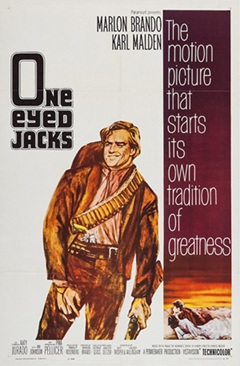 Rio (Marlon Brando), a young outlaw in the Old West, is betrayed by his partner and mentor Dad Longworth (Karl Malden) and ends up spending five years in a Mexican prison. When Rio escapes, he gets together a new gang and heads for Monterey, California. He wants to both get his revenge on Longworth and also rob the local bank. Things get complicated when Rio actually confronts Longworth and suddenly realizes that he can’t bring himself just to gun the man down in cold blood. Rio is not as ruthless of an outlaw as he thought he was.
However, Rio then meets and falls in love with Louisa (Pina Pellicer), Longworth’s stepdaughter Longworth is willing to do whatever he has to keep Rio away from Louisa and, when Rio starts to think about going straight in an effort to win Louisa’s love, his new gang turn out to be even less trustworthy than his old partners.
A teenage rebellion film disguised as a western (and it’s not a coincidence that the main bad guy is named Dad), One-Eyed Jacks was Marlon Brando’s only film as a director. The film was originally meant to be directed by Stanley Kubrick, who was working from a script written by a once-in-a-lifetime combination of Rod Serling and Sam Peckinpah. Kubrick and Brando worked together to develop the film, with Brando insisting on Karl Malden as Dad. (Kubrick wanted to cast Spencer Tracy.) Ultimately realizing that working on One-Eyed Jacks would mean essentially taking orders from his star, Kubrick stepped down from directing so he could focus on Lolita and Brando took over as director. The film finally went into production in 1958 and would not be released until 1961. Brando’s perfectionism was blamed for the film going massively overbudget and, when it was finally released, One-Eyed Jacks was the first of Brando’s films to lose money. The combined box office failures of One-Eyed Jacks and the remake of Mutiny on the Bounty left Brando in the cinematic wilderness for much of the 60s.
As for the film itself, One-Eyed Jacks takes what should have been a simple story and attempts to turn into an epic. Rio spends a good deal of time brooding and the film seems to brood right along with him. What starts out as a western becomes a forbidden love story as Rio and Louisa fall for each other. Dad Longworth may be an outlaw-turned-sheriff but Malden plays him more as a possessive father who can’t handle that his two stepchildren — Rio and Louisa — are both turning against him and his strict rules. Brando obviously viewed the film as being something bigger than a standard western. Sometimes, his direction works and he does manage to get the epic feel that he was going for. Other times, the film itself seems to be unsure what direction it wants to go in telling its story. This is method directing.
Ultimately, One-Eyed Jacks is an interesting experiment, one that doesn’t really work but which still features Charles Lang’s outstanding cinematography and one of Karl Malden’s best performances. As Brando’s only directorial effort, the film is a curiosity piece, one that will be best enjoyed by western fans who have the patience for something a little different. And, for what it’s worth, based on the film’s visual beauty and the performances that he gets from the cat, I think Brando could have developed into a fine director with a little more experience. However, it was not to be.
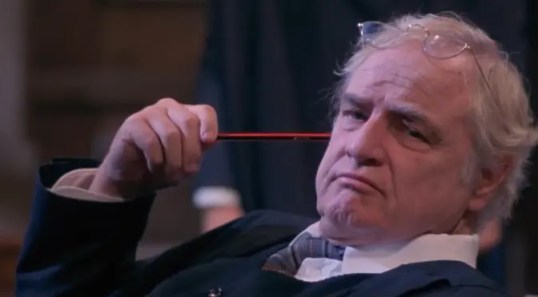
In 1990, Marlon Brando received his final Academy Award nomination when he was nominated for his supporting performance in 1989’s A Dry White Season.
Brando played Ian McKenzie, a human rights lawyer who lives and work in South Africa at the height of the Apartheid regime. When we first see McKenzie, he’s sitting in his office and complaining about how all the flowers surrounding him have given him a permanent allergy. When Ben Du Toit (Donald Sutherland) explains that he’s trying to learn the truth about why his gardener and his gardener’s son both died in the custody of South Africa’s “special branch,” McKenzie replies that bringing the case would be a waste of time. McKenzie makes several dismissive comments about the case and tells Du Toit that pursing the matter would lead to Du Toit becoming a pariah himself. Only when Du Toit says that he’ll just find another lawyer to pursue the manner does McKenzie agree to take the case. His comments may have seemed callous but they were McKenzie’s way of testing Du Toit’s commitment to actually getting to the truth.
Up until the death of his gardener, Ben Du Toit was someone who blindly believed in the system. A former rugby star and a teacher, Ben grew up in South Africa and is proud to call himself a “true African.” (In one of the film’s best scenes, Ben’s driver, Stanley — played by Zakes Mokae, — informs Ben that being an African in South Africa means not being allowed to vote and having to carry identification papers everywhere with him.) When the gardener’s son is first arrested, Ben repeatedly says, “He must have done something.” When Ben’s gardener is arrested, Ben believes that it’s all just a terrible mistake and that he’ll be released soon. Even after the gardener is killed, Ben initially believes the official story that the death was a suicide. It’s only after Stanley takes Ben to the funeral home and shows him the gardener’s tortured body that Ben finally comes to realize that he was tortured to death by Captain Stolz (Jurgen Prochow).
Still, Ben is naive enough to assume that McKenzie will be able to get some sort of justice. In court, McKenzie easily exposes the flaws in Stolz’s story. When Stolz claims that the dead man’s injuries were the result of the man throwing himself against the bars of his cell, McKenzie mentions that the man’s back was injured and then asks if he was throwing himself backwards. Stolz smirks and says that the man was “an animal.” McKenzie may be a brilliant lawyer but it’s a foregone conclusion that he’s going to lose the case. Stolz is exonerated and the expression on McKenzie’s face is one that indicate that he is not surprised at all.
It’s a small role. Brando gets less than ten minutes of screentime but he makes perfect use of them and shows that, even in the latter half of his career, Brando could still give a good performance when he cared about the material. Both Brando and Susan Sarandon took small roles in this anti-Apartheid drama because they believed in the message. Sarandon’s casting is a bit distracting. She never becomes the journalist she’s playing, instead she just seems like a movie star lending her name to a cause that she believes in. But Brando becomes Ian McKenzie and he expertly reveals the absurd lengths to which the Apartheid government will go to excuse its actions.
The majority of the film deals with Ben Du Toit and his slow-awakening about the truth of the country that he calls home. Upon realizing the truth about the country’s government and its actions, Du Toit declares that he can no longer go back to being who he once was and it costs him his family, his home, and ultimately his life. Donald Sutherland does a wonderful job, portraying Du Toit’s growing understanding of what’s actually happening in South Africa. Wisely, the film doesn’t portray Du Toit as being a saint. It fully understands that Du Toit only started to care about Apartheid when it effected somebody that he knew and fortunately, Stanley is always there to call Du Toit out whenever he starts to forget about his own role in supporting the system that he now opposes. It’s a powerful and heartfelt film, one that is well-known for Brando’s performance but works just as well when Brando is off-screen as well.
4 Or More Shots From 4 Or More Films is just what it says it is, 4 shots from 4 of our favorite films. As opposed to the reviews and recaps that we usually post, 4 Shots From 4 Films lets the visuals do the talking!
101 years ago, on this date, Marlon Brando was born in Omaha, Nebraska. One of the greatest of American actors and one of the main reasons why so many young actors became enamored with the Method, Marlon Brando played many roles in our culture. When he was young, he was a Broadway bad boy. When he went out to Hollywood, he became a legitimate movie star. In the 60s, he was a cautionary tale as his career suffered a series of notorious flops. In the 70s, he made a comeback and, in during the final years of his career, he was as known for his eccentricities as for his talent. It’s a shame that those eccentricities overshadowed Brando as an actor. When he wanted to be, he was one of the best to ever appear on stage or in the movies.
In honor of the wonderful, tragic, and talented Marlon Brando, it’s time for….
4 Shots From 4 Marlon Brando Films
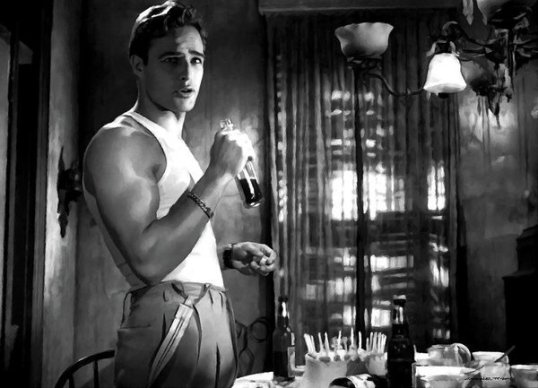
A Streetcar Named Desire (1951, dir by Elia Kazan, DP: Harry Stradling)
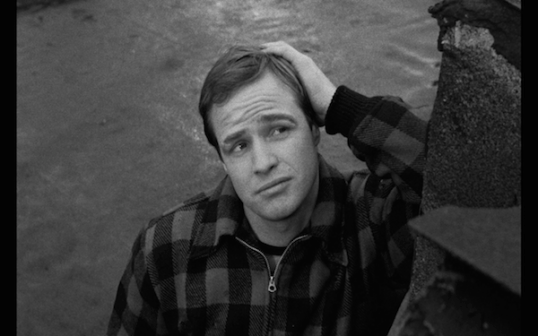
On The Waterfront (1954, dir by Elia Kazan, DP: Boris Kaufman)
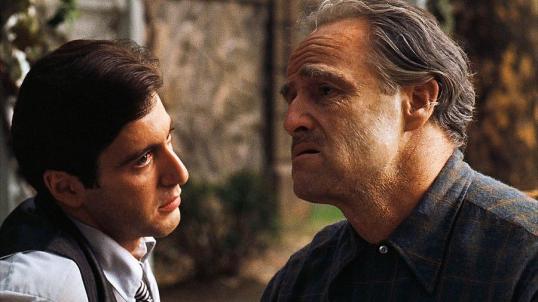
The Godfather (1972, dir by Francis Ford Coppola, DP: Gordon Willis)
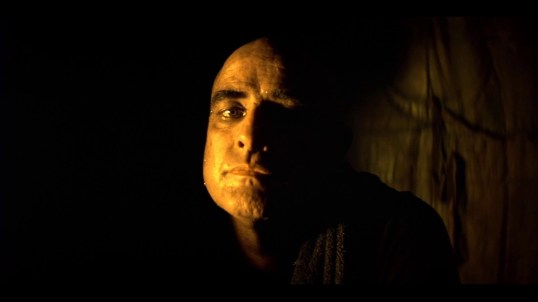
Apocalypse Now (1979, dir by Francis Ford Coppola, DP: Vittorio Storaro)
Beware the Ides of March!
The scene below is from the 1953 film, Julius Caesar. This Oscar-nominated Shakespearean adaptation had a cast that was full of distinguished actors. James Mason played Brutus. The great John Gielgud played Cassius. Louis Calhern was Caesar while other roles were filled by Deborah Kerr, Greer Garson, Edmond O’Brien, George Macready, John Hoyt, Edmund Purdom. and a host of other distinguished thespians. And yet, the best performance in the film came from an actor who, at the time, no one considered to be a Shakespearean. Marlon Brando brought his method intensity to the role of Mark Antony and the result was a performance that is still electrifying today.
On YouTube, someone referred to this as being “the world’s greatest speech delivered by the world’s greatest actor.” Sounds good to me!
Here is Marlon Brando in Julius Caesar:
Poor, tragic Blanche DuBois.
In 1951’s A Streetcar Named Desire, the emotionally fragile Blanche (played by Vivien Leigh) has come to New Orleans to live with her younger sister, Stella (Kim Hunter). From an old and formerly wealthy Southern family, Blanche has recently lost both her job as a teacher and the plantation where she and Stella grew up. Even before that, she lost her husband to suicide. And now Blanche has been reduced to living with Stella in the run-down apartment that she shares with her brutish husband, Stanley Kowalksi (Marlon Brando).
Stanley is tough and blue-collar, an earthy gambler whose bad manners stand in sharp contrast to Blanche’s attempts to present herself as being an elegant Southern belle. Stanley, who is convinced that Blanche has money that she’s hiding from her sister, goes out of his way torment Blanche. Stella, who is pregnant, tries to keep the peace between her sister and the man who claims to love her, his family, and the Napoleonic code. (“Stella!” Stanley yells at one point, the cry of a wounded animal who desperately needs his mate.) Blanche ends up going on a tentative date with Mitch (Karl Malden), one of Stanley’s co-workers, Stanley, who sees Blanche as a threat to the life that he’s created for himself, goes out of his way to destroy even that relationship. Blanche has secrets of her own and Stanley is determined to dig them up and use them to his own advantage. When Blanche refuses to allow Stanley to destroy the fantasy world that she’s created for herself, Stanley commits an act of unspeakable violence.
Based on the play by Tennessee Williams, A Streetcar Named Desire is a recreation of the film’s legendary Broadway production. Elia Kazan, who directed the theatrical production, does the same for the film. Marlon Brando, Kim Hunter, and Karl Malden recreate their stage roles and many of the minor characters are also played by the same actors who played them on stage. The only major change to the cast is Vivien Leigh, who replaces Jessica Tandy in the role of Blanche. Tandy had won a Tony for playing the role of Blanche but the film’s producer insisted on an actress who had more box office appeal. After both Bette Davis and Olivia de Havilland (both of whom would have had too strong of a personality to be believably pushed around by Stanley) declined the role, Vivien Leigh was cast. Leigh has played Blanche on the London stage and, perhaps even more importantly, her own fragile mental health mirrored much of what Blanche had gone through before moving to New Orleans.
A few changes were made to the play. In the play, it’s made clear that Blanche’s husband committed suicide after he was caught having an affair with another man. In the film, Blanche simply says that her husband was too sensitive. The film also includes a few scenes that are set outside of the apartment in an attempt to open up the play. (That said, the film still comes across as being rather stagey.) In the play, it’s made clear what Stanley does to Blanche while Stella is at the hospital. The film leaves it ambiguous, though still providing enough hints for the audience to figure it out on their own. Finally, the film ends with a suggestion that Stanley will ultimately suffer for his bad behavior. It’s hardly a happy ending but it’s still not as dark as what happens in the play.
The film definitely retains its theatrical origins. It’s very much a filmed play and again, it can feel rather stagey. But the performance are so strong that it really doesn’t matter. A Streetcar Named Desire was the first film to win three of the acting awards, with Oscars going to Hunter, Malden, and Leigh. Marlon Brando was nominated for Best Actor but did not win, largely because he was competing against Humphrey Bogart who, himself, had never won an Oscar. (The Brando snub would be rectified when he later won for On The Waterfront.) Brando’s performance as Stanley still holds up today. He’s so ferociously charismatic that it’s actually a bit scary to watch him. One can see what drew Stella to him, even though Stanley is very much not a good man. It’s a performance that will definitely take by surprise anyone who knows Brando only from his later years, when he was known for his weight and his oft-stated boredom with acting. A Streetcar Named Desire shows just how brilliant an actor Marlon Brando was at the start of his career. The intensity of Brando’s method acting matches up perfectly with Vivien Leigh’s more traditional style of acting and the film becomes not just the story of a domineering brute and a fragile houseguest but also a metaphor for the death of the antebellum South. If Blanche represents a genteel past that may have never existed, Stanley represents the brutality of the 20th Century.
Along with the similarly dark A Place In The Sun, A Streetcar named Desire was considered to be a front runner for the 1951 Best Picture Oscar. In the end, though, the voters went for the much less depressing An American In Paris.

A Streetcar Named Desire (1951, dir by Elia Kazan, DP: Harry Stradling)
Yesterday, it was announced that the legendary screenwriter Robert Towne had passed away. One of the premier talents of Hollywood’s second Golden Age, Towne was rightly remembered as the man who wrote the intelligent and challenging scripts for films like Chinatown, The Last Detail, and Shampoo.
Towne was also a well-known script doctor, one whose work was not always credited but which always contributed to the overall quality of the films to which he contributed. In 1971, when Francis Ford Coppola realized that he needed a scene for The Godfather that would allow Vito to open up to his son and successor, Michael, Robert Towne was the man who wrote the scene. The result was one of the best moments in a film that is full of great dialogue.

Continuing our tribute to the great Marlon Brando, today’s scene that I love comes from The Godfather.
In this scene, a self-pitying Johnny Fontane (Al Martino) discusses his career problems with Marlon Brando’s Vito Corleone. Johnny is losing his voice. Johnny is up for a role in a big movie but he worries that the producer will never allow him to appear in the film. Johnny says he doesn’t know what to do and he sheds a tear….
….and that’s not a smart thing to do when you’re talking to Don Corleone.
This scene contains some of the best moments of The Godfather. Al Martino was a professional singer with little acting experience. (While Johnny Fontane was a major character in Mario Puzo’s book, he only appeared in two scenes in the film version. Coppola later said that he thought the Johnny Fontane chapters were so poorly written that he would have turned down the film if he had to include too much of the character.) In order to get an effective performance out of Martino, Brando did not warn him that he would actually be slapping him. During one take, Brando got so aggressive that he knocked off Martino’s toupee and caused Robert Duvall to start laughing. It was all worth it, though. Martino was thoroughly convincing as Johnny Fontane and Marlon Brando won (but did not accept) his second Oscar for Best Actor.
4 Or More Shots From 4 Or More Films is just what it says it is, 4 shots from 4 of our favorite films. As opposed to the reviews and recaps that we usually post, 4 Shots From 4 Films lets the visuals do the talking!
One hundred years ago and on this date, Marlon Brando was born in Omaha, Nebraska. One of the greatest of American actors and one of the main reasons why so many young actors became enamored with the Method, Marlon Brando played many roles in our culture. When he was young, he was a Broadway bad boy. When he went out to Hollywood, he became a legitimate movie star. In the 60s, he was a cautionary tale as his career suffered a series of notorious flops. In the 70s, he made a comeback and, in during the final years of his career, he was as known for his eccentricities as for his talent. It’s a shame that those eccentricities overshadowed Brando as an actor. When he wanted to be, he was one of the best to ever appear on stage or in the movies.
In honor of the wonderful, tragic, and talented Marlon Brando, it’s time for….
4 Shots From 4 Marlon Brando Films
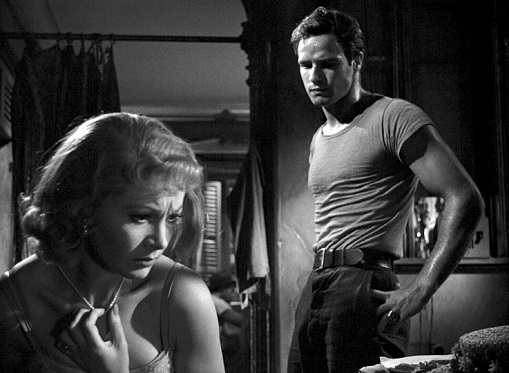
A Streetcar Named Desire (1951, dir by Elia Kazan, DP: Harry Stradling)
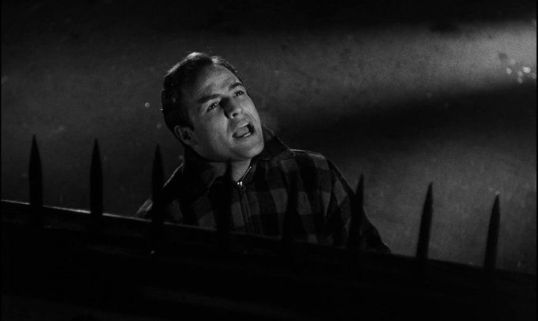
On The Waterfront (1954, dir by Elia Kazan, DP: Boris Kaufman)
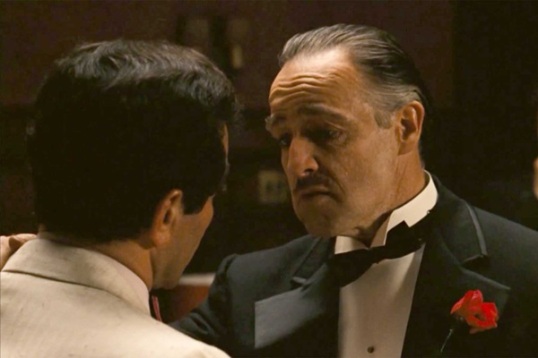
The Godfather (1972, dir by Francis Ford Coppola, DP: Gordon Willis)
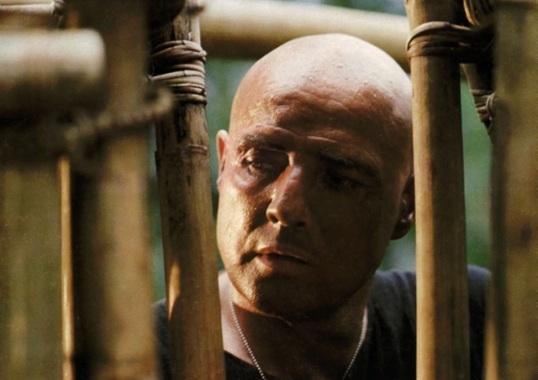
Apocalypse Now (1979, dir by Francis Ford Coppola, DP: Vittorio Storaro)
97 years ago, on this date, Lenny Montana was born in Brooklyn, New York.
Montana started out as a boxer and a wrestler. He eventually ended up working as a bouncer and a bodyguard for the leadership of the Colombo Crime Family. However, Montana achieved his immortality as a result of veteran tough guy actor Timothy Carey turning down the role of Luca Brasi in The Godfather. Brasi was the Corleone Family’s most feared enforcer and Carey, who had made a career out of playing psychos, was one of the most feared men in Hollywood, one who was rumored to have pulled a gun on more than a few directors. (For the record, Stanley Kubrick loved him.) When Carey turned down the role in favor of doing a television series, Francis Ford Coppola offered the role to Lenny Montana. Montana may not have had Carey’s screen acting experience but he brought real-life authenticity to the role. When Michael says that Luca Brasi is a “very scary man,” one look at Lenny Montana confirms it. Unfailingly loyal to the family and willing to do anything for the Don, Luca Brasi represents the Family’s strength. When Luca Brasi is killed, you know that the old era of the Corleones is ending as well. Without Luca, the Corleones are in deep trouble.
My favorite Luca Brasi scene comes at the beginning of the film. Surprised to be invited to Connie’s wedding, Luca wants to thank the Don personally. Nervous about acting opposite Marlon Brando, Montana flubbed his lines. The scene, with the flub, was kept in the film and it served to humanize both Luca and Don Corleone. (The Don’s smile was due to the fact that Marlon Brando was having trouble not laughing.) It’s a nice little scene, one that reminds us that even gangsters are human.

