When mob boss Angelo (Anthony Quinn) is assassinated on the orders of the son of a former rival, bodyguard Frankie Delano (Sylvester Stallone) takes it upon himself to protect Angelo’s daughter, Jennifer (Madeleine Stowe). The problem is that Jennifer, who was adopted by a normal couple, doesn’t know that she is the daughter of a mobster. Her life and her marriage are already falling apart even before Frankie reveals the truth to her. All she wants to do is disappear into the pages of a romance novel written by her favorite writer, Marcello (Raoul Bova) but Marello is not quite what he seems.
Sylvester Stallone has had a long career, full of high points (Rocky, First Blood, The Expendables, Creed) and low points (too many to list). AvengingAngelo, made at a time when it was assumed that the aging Stallone would never again play Rocky Balboa or John Rambo, is a moderate low point. It’s no Rocky but it’s still better than Stop! Or My Mom Will Shoot! Overall, it’s not very good and a lot of the humor falls flat but Stallone and Madeleine Stowe are both likable and they have a few moments that display what seems like genuine chemistry. It’s still a slow movie that awkwardly mixes comedy and action but it was not the disaster that I was expecting it to be when I first found it on Tubi. It’s more forgettable than bad. If there is anything to really regret when it comes to AvengingAngelo, it’s that Anthony Quinn did not get a more memorable swan song.
AvengingAngelo was Stallone’s second movie to go straight to video. It’s easy to forget not but the conventional wisdom in 2002 really was that Stallone was washed up. There were jokes about whether or not he would follow Schwarzenegger’s lead and go into politics. Stallone, however, proved all the naysayers wrong, proving that he could still throw punches as Rocky Balboa and John Rambo while The Expendables revealed a Stallone who could finally laugh at himself. Avenging Angelo turned out to be not the end of Stallone’s career but instead just a detour. Say what you will about the man and his movies, Sylvester Stallone is an American institution.
Opening with a swarm of helicopters spaying for medflies and ending with an earthquake, 1993’s Short Cuts is a film about life in Los Angeles.
An ensemble piece, it follows several different characters as they go through their own personal dramas. Some of them are married and some of them are destined to be forever single but they’re all living in varying states of desperation. Occasionally, the actions of one character will effect the actions of another character in a different story but, for the most part, Short Cuts is a portrait of people who are connected only by the fact that they all live in the same city. There are 22 principal characters in Short Cuts and each one thinks that they are the star of the story.
Jerry Kaiser (Chris Penn) cleans the pools of rich people while, at home, his wife, Lois (Jennifer Jason Leigh), takes care of their baby and works as a phone sex operator. Jerry’s best friend is a makeup artist named Bill (Robert Downey, Jr.) who enjoys making his wife, Honey (Lili Taylor), looks like a corpse so that he can take her picture. One of her photographs is seen by a fisherman (Buck Henry) who has already discovered one actual corpse that weekend. He and his buddies, Vern (Huey Lewis) and Stuart (Fred Ward), discovered a dead girl floating in a river and didn’t report it until after they were finished fishing. (The sight of Vern unknowingly pissing on the dead body is one of the strongest in director Robert Altman’s filmography.)
Stuart’s wife, Claire (Anne Archer), is haunted by Stuart’s delay in reporting the dead body. A chance meeting Dr. Ralph Wyman (Matthew Modine) and his wife, artist Marian (Julianne Moore), leads to an awkward dinner between the two couples. Claire works as a professional clown and Ralph ends up wearing her clown makeup while his marriage falls apart.
Earlier, Claire was stopped and hit on by a smarmy policeman named Gene Shepard (Tim Robbins), who just happens to be married to Marian’s sister, Sherri (Madeleine Stowe). Gene is already having an affair with Betty Weathers (Frances McDormand), the wife of a helicopter pilot named Stormy (Peter Gallagher). When Stormy discovers that Betty has been cheating, he takes a creative revenge on her house.
Doreen Pigott (Lily Tomlin) lives in a trailer park with her alcoholic husband, Earl (Tom Waits). Driving home from her waitressing job, Doreen hits a young boy. The boy says he’s okay but when he gets home, he passes out. His parents, news anchorman Howard Finnegan (Bruce Davison) and his wife, Anne (Andie MacDowell), rush him to the hospital, where his doctor is Ralph Wyman. As Howard waits for his son to wake up, he has a revealing conversation with his long-estranged father (Jack Lemmon, showing up for one scene and delivering an amazing monologue). Meanwhile, a baker named Andy (Lyle Lovett) repeatedly calls the Finnegan household, wanting to know when they’re going to pick up their son’s birthday cake.
Based on the short stories of Raymond Carver and directed by Robert Altman, Short Cuts can sometimes feel like a spiritual descendent of Altman’s Nashville. The difference between this film and Nashville is that Short Cuts doesn’t have the previous film’s satiric bite. As good as Nashville is, it’s a film that can be rather snarky towards it character and the town in which it is set. Nashville is used as a metaphor for America coming apart at the seams. Short Cuts, on the other hand, is a far more humanistic film, featuring characters who are flawed but, with a few very notable exceptions, well-intentioned. If Nashville seem to be a portrait of a society on the verge of collapse, Short Cuts is a film about how that society ended up surviving.
It’s not a perfect film. There’s an entire storyline featuring Annie Ross and Lori Singer that I didn’t talk about because I just found it to be annoying to waste much time with. (The Ross/Singer storyline was the only one not to be based on a Carver short story.) The conclusion of Chris Penn’s storyline wasn’t quite as shocking as it was obviously meant to be. But, flaws and all, Altman and Carver’s portrait of humanity does hold our attention and it leaves us thinking about connections made and sometimes lost. Seen today, Short Cuts is a portrait of life before social media and iPhones and before humanity started living online. It’s a time capsule of a world that once was.
What were those years in your life where movies really became something special to you? I’d say mine began in around 1984 and extended all the way through about 1991, when I headed off to college and the realities of the world started kicking in. Our family got our first VCR around 1984, and this is when I first truly began to fall in love with the cinema. These are the years when I would spend every moment I could in our local video stores inspecting every film in their stock. So many of my favorite movies came out during this time and hold a sense of nostalgic value in my life even now. One of those movies is STAKEOUT, an action comedy from 1987 starring Richard Dreyfuss and Emilo Estevez.
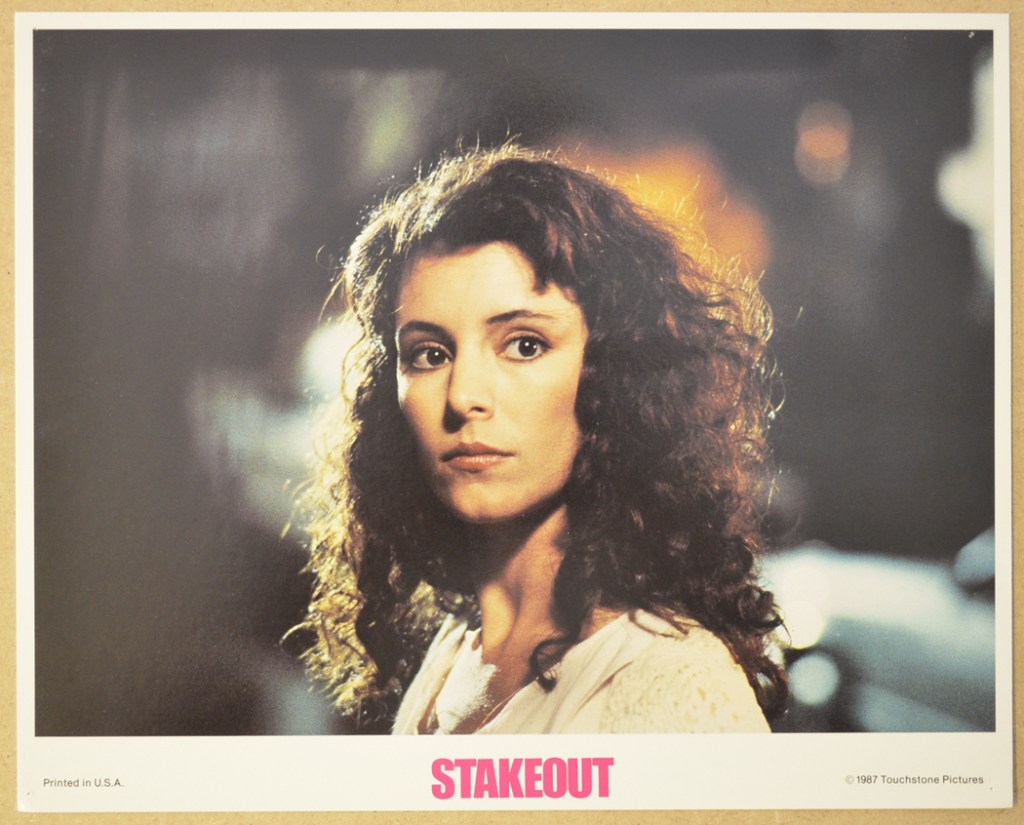
STAKEOUT begins with Richard “Stick” Montgomery (Aidan Quinn) escaping from prison, where he has been sent for killing an FBI agent a year earlier. Enter Seattle police detectives Chris Lecce (Richard Dreyfuss) and Bill Reimers (Emilio Estevez). They are assigned to stakeout the home of Montgomery’s beautiful ex-girlfriend Maria (Madeleine Stowe). In order to listen to her phone conversations, Chris impersonates a telephone repairman and meets her when he goes into her home to install the “bugs.” As fate would have it, he runs into Maria again at the local grocery store when he’s gone out to buy some supplies and donuts. She asks him to give her a ride home when she discovers she has a flat tire on her bike. He reluctantly gives her a ride home, but once he’s there, he puts up her groceries, she makes him a spicy dinner, and then he not so reluctantly makes love to her… all while his partner Bill is across the street waiting for his donuts. As you might imagine, this complicates the entire situation. And meanwhile, “Stick” Montgomery keeps making his way Seattle and Maria’s house where he stashed his cash before going away to prison.
STAKEOUT is one of those movies that our family rented in the late ‘80’s, and I immediately fell in love with. It’s my favorite kind of movie, the buddy cop film. Richard Dreyfuss and Emilio Estevez have a really nice chemistry together, and they come across as old friends. Even though there’s quite a bit of violence, the movie has a playful streak that I enjoy. There’s a series of running gags where Chris and Bill play practical jokes back and forth with the cops who relieve them on the stakeout each day, played by Dan Lauria and Forest Whitaker. The movie even throws in a little self-referential humor. In order to relieve the boredom of the stakeout, Estevez’ character is asking Dreyfuss movie trivia questions. He asks him to identify the movie where the line “this is no boating accident!” is from! Dreyfuss’ character has no idea. These are fun moments for me.
Another thing I love about STAKEOUT is the presence of the gorgeous Madeleine Stowe, who was making her first major film appearance. Seeing the film for the first time as a teenager of 14 years old made me a fan of hers for life. I’m not saying the movie was made specifically for 14-year-old boys, but it certainly wasn’t trying to push us away with its ad campaign that prominently featured the lovely Ms. Stowe. I’ll also point out that Aidan Quinn is effective and intimidating as the escaped murderer Richard “Stick” Montgomery. The fact that his character really does seem dangerous helps to make the film even more exciting when everything finally comes to a head. Veteran Director John Badham has made some really good movies in his career, including SATURDAY NIGHT FEVER (1977), BLUE THUNDER (1983), THE HARD WAY (1991), and NICK OF TIME (1995), to name a few. He knows what he’s doing, and I really started following his work based on how much I enjoyed STAKEOUT.
As much as I enjoy STAKEOUT, it’s one of those movies I don’t hear that much about these days even though it was a substantial box office hit. There was a misguided sequel made in 1993, ANOTHER STAKEOUT, that brought back Dreyfus, Estevez, and director Badham. I remember watching the sequel in the 90’s, but I honestly don’t remember anything about it. One of the reasons I enjoy writing about movies is because it gives me an opportunity to share a part of who I am, the things I enjoy, and maybe even serve as a reminder to others of films like STAKEOUT. I don’t think of these movies often myself, but when I was looking at my DVD collection earlier today, I smiled when I saw it and happily pulled it off the shelf to watch it again for the first time in several years!
What’s an Insomnia File? You know how some times you just can’t get any sleep and, at about three in the morning, you’ll find yourself watching whatever you can find on cable? This feature is all about those insomnia-inspired discoveries!
Earlier today, If you were having trouble getting to sleep around one in the morning, you could have turned over to TCM and watched the 1990 action film, Revenge.
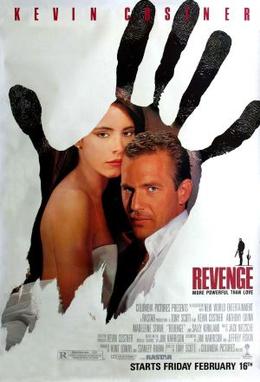
Revenge is an almost absurdly masculine film about two men who are in love with the same woman and who, as a result, end up trying to kill each other and a lot of other people.
Jay Cochran (Kevin Costner) is a U.S. Navy aviator who, when we first see him, is doing the whole Top Gun thing of flying in a fast jet and making jokes while his navigator worries about dying. Interestingly enough, Top Gun and Revenge were both directed by Tony Scott so perhaps this opening scene was meant to be a self-reference. Well, regardless of intent, it’s a scene that goes on forever. This is Jay’s last flight, as he’s due to retire. We go through an extended retirement party, where everyone has a beer and Jay gives one of those bullshit sentimental speeches that men always give in films like this.
Jay has been invited to estate of Tibbey (Anthony Quinn), who is a Mexican gangster. Tibbey and Jay are apparently old friends, though it’s never quite explained how the youngish Jay knows the not-very-youngish Tibbey. Tibbey is one of those gangster who is incapable of doing anything without first talking about what an amazing journey it’s been, going from poverty to becoming one of the most powerful men in Mexico.
Tibbey apparently wants to play tennis with Jay and take him hunting. Jay decides that he’d rather have an affair with Tibbey’s much younger wife, Miryea (Madeleine Stowe). Miryea is upset that Tibbey doesn’t want to have children because he feels that pregnancy would ruin her body. When Tibbey finds out about the affair, he sends Miryea to a brothel and Jay to the middle of the desert. That’s Tibbey’s revenge!
Except, of course, Jay doesn’t die because he’s Kevin Costner and if he died, the movie would end too quickly. So, Jay fights his way back from the desert, intent on not only finding Miryea but getting his own revenge on Tibbey!
(It’s hard to take a bad guy named Tibbey seriously, even if he is played by Anthony Quinn.)
Revenge goes on for way too long and neither Tibbey nor Jay are really sympathetic enough to be compelling characters. You never really believe in Tibbey and Jay’s friendship, so the whole betrayal and revenge aspect of the film just falls flat. On the plus side, youngish Kevin Costner is not half as annoying as cranky old man Costner. Anthony Quinn was one of the actors who was considered for the role of Don Corleone in The Godfather and, watching him here, you can kind of see him in the role. He would have been a bit of a crude Corleone but Quinn had an undeniably powerful and magnetic screen presence. In Revenge, Quinn chews up and spits out all of the scenery and is not subtle at all but it’s entertaining to watch him because he’s Anthony Quinn.
Anyway, Revenge ends with a tragedy, as these things often do. Anthony Quinn never says, “Revenge is a dish best served cold,” and that, to me, is a true missed opportunity.
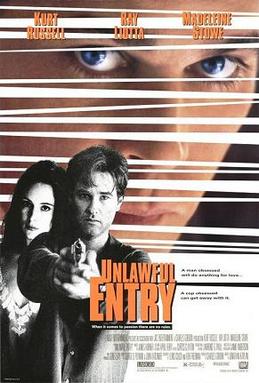
The upscale and complacent life of Michael and Karen Carr (Kurt Russell and Madeleine Stowe) is interrupted one night when a burglar breaks into their home via their skylight. The intruder briefly holds a knife to Karen’s throat before taking off. Shaken by the encounter, the Carrs are very happy when a seemingly friendly cop, Officer Pete Davis (Ray Liotta). offers to help them cut through all the red tape and get a security system installed in their house.
At first glance, Pete seems like the perfect cop but actually, he’s a mentally unstable fascist who quickly becomes obsessed with Karen. When Pete offers Michael his nightstick so that Michael can use it on the man who earlier broke into his house, Michael refuses. That’s all that Pete needs to see to decide that Michael’s not a real man and that Karen would be better off with him. Even after Michael orders Pete to stay away from his home, Pete continues to drop by so that he can spy on the couple. When Michael complains, Pete frames him by planting cocaine at his house. When Michael says that he’s innocent, no one believes him. Why would they? Pete’s a decorated cop who is keeping the streets safe. Michael is just a homeowner. While Michael sits in jail, the increasingly violent and unhinged Pete makes plans to make Karen his own.
“Who watches the watchmen?” as the old saying goes. Unlawful Entry is an efficient and no-nonsense thriller that was ahead of its time as far as its portrayal of a policeman abusing his authority is concerned. Jonathan Kaplan was trained in the Roger Corman school of filmmaking so he doesn’t waste any time getting to the story and he even finds a role for Dick Miller. Ray Liotta, fresh off of his performance in Goodfellas, is perfectly cast as the manipulative and misogynistic Pete while Kurt Russell is once again the ideal everyman. Madeleine Stowe, who was one of the best actresses of the 90s, does not get to do much beyond be menaced but she does it well. Whatever happened to Madeleine Stowe? Kurt Russell’s career is still going strong and Ray Liotta still appears regularly in gangster movies and Chantix commercials. Isn’t it about time for a Madeleine Stowe comeback?
It has been nearly two years since the death of Alan Rickman and it is a loss that film lovers are still feeling today. When Rickman was with us, it was easy to take him for granted. It was only after his death that many started to look at the films he made, both the good ones and the bad ones, and realizing just how much Rickman brought to every role he played.
Take Closet Land, for instance. This was made early in Rickman’s film career. It is a very theatrical film, all taking place on one set and featuring only two major roles. Madeleine Stowe plays the Victim, a writer of children’s books whose latest autobiographical work deals with a girl who uses her imagination to escape from unhappiness. Alan Rickman plays the Interrogator, a government functionary who demands that the Victim confess to hiding anti-government propaganda in her books. When the Victim refuses to sign the confession, the Interrogator continually switches techniques in his attempt to break her, trying everything from physically torturing her to blindfolding her and pretending to be other people to even claiming that he abused her when she was younger.
There are many problems with Closet Land but Alan Rickman’s performance is not one of them. Rickman is hypnotically malevolent as the otherwise cultured Interrogator and the most fascinating part of the movie is watching him switch back and forth from being a harried bureaucrat just doing his job and a manipulative sociopath who views the Victim’s sanity as a trophy for him to claim. Closet Land is too stagey and heavy-handed to be effective but Rickman’s performance reminds us of what a great actor we lost when we lost Alan Rickman.
The time around the late 1990’s saw a slew of filmmakers who seemed to have been influenced by the filmmaking style of one Michael Bay. In 1998 one such film which had a certain Michael Bay look to it was the crime thriller The General’s Daughter by filmmaker Simon West (fresh off his success from the previous year’s Con-Air). This film adaptation of the Nelson DeMille novel of the same name starred John Travolta when he was still enjoying the second renaissance of his career brought on by his role in Pulp Fiction.
The General’s Daughter was pretty much a crime procedural wrapped around the secretive and insular world of military life. It has Chief Warrant Officer Paul Brenner (played by Travolta) of the Army’s CID investigating what seems to be the apparent rape and murder of a female officer who also happens to be the daughter of the base’s commandant and political-minded general. Brenner’s soon joined by another CID agent, Sara Sunhill (Madeleine Stowe), who must now navigate the insular world which makes up the officer ranks of the military. They find suspects cropping up faster than they could handle and the one prime suspect in base psychologist Col. Moore (James Wood in an over-the-top performance) has secrets about the victim that could jeopardize the lives and career of not just most of the officers on the base but the victim’s own father. This set-up and the basic understanding of the plot should make for a great thriller, but the by-the-numbers direction by Simon West and the over-the-top performances by too many of the characters in the film sinks The General’s Daughter before it could soar.
The story in of itself really has nothing to drag down the film. From the beginning the screenplay does a great job in tossing red herrings to keep the true murderer secret until the very end. It’s these red herrings which manages to bring out the ultimate reason as to the death of Capt. Elisabeth Campbell (Leslie Stefanson) and how a traumatic event in her past became the one major link which would lead to her death early in the film. It’s how these events were acted out which brings down the script. It’s been said that great performances could raise a mediocre script, but the same could be said for the opposite. Very average to bad performances could drag down a great script.
Travolta’s performance was good enough most of the time. He’s especially good when pouring on the Southern charm to try and gain an advantage over those he’s interacting with, but when he suddenly switches over to tough Army investigator that he goes from just beyond campy to over the line into full-blown camp. The same could be said for pretty much everyone in the film from Stowe’s character who manages to just stand around doing nothing but act as a sort of “gal Friday” for Travolta’s character until the very end when she suddenly becomes a crack investigator to help move the plot along. Clarence Williams III really hams it up as the base general’s right-hand man and one would wonder if he realized he wasn’t actually in a grindhouse or exploitation film when it was time to act.
Despite the performances dragging the film down I must admit that The General’s Daughter was quite watchable and entertaining to a certain level. It’s the film’s inadequacies which also makes it quite a disposable fare that should’ve been more. One wonders how the film would be done today with a different set of actors and a filmmaker who knew the nuances of how to navigate around a thriller. Until the inevitable remake from Hollywood gets greenlit (the way things get remade now it’s bound to happen) it’s this version of The General’s Daughter that’d be on record and it’s a film that has too many bad performances for a great screenplay to overcome. A film that ultimately remains mildly entertaining but forgettable in the end.
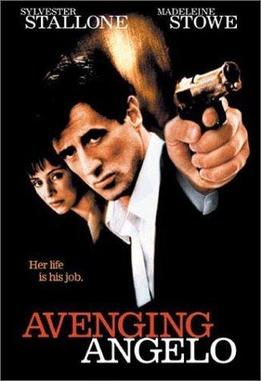 When mob boss Angelo (Anthony Quinn) is assassinated on the orders of the son of a former rival, bodyguard Frankie Delano (Sylvester Stallone) takes it upon himself to protect Angelo’s daughter, Jennifer (Madeleine Stowe). The problem is that Jennifer, who was adopted by a normal couple, doesn’t know that she is the daughter of a mobster. Her life and her marriage are already falling apart even before Frankie reveals the truth to her. All she wants to do is disappear into the pages of a romance novel written by her favorite writer, Marcello (Raoul Bova) but Marello is not quite what he seems.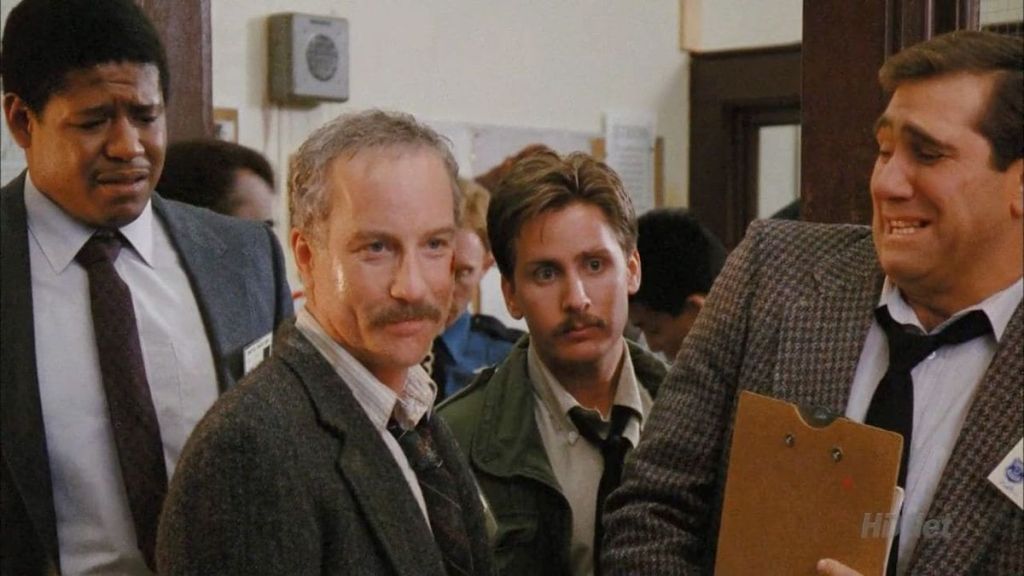
 It has been nearly two years since the death of Alan Rickman and it is a loss that film lovers are still feeling today. When Rickman was with us, it was easy to take him for granted. It was only after his death that many started to look at the films he made, both the good ones and the bad ones, and realizing just how much Rickman brought to every role he played.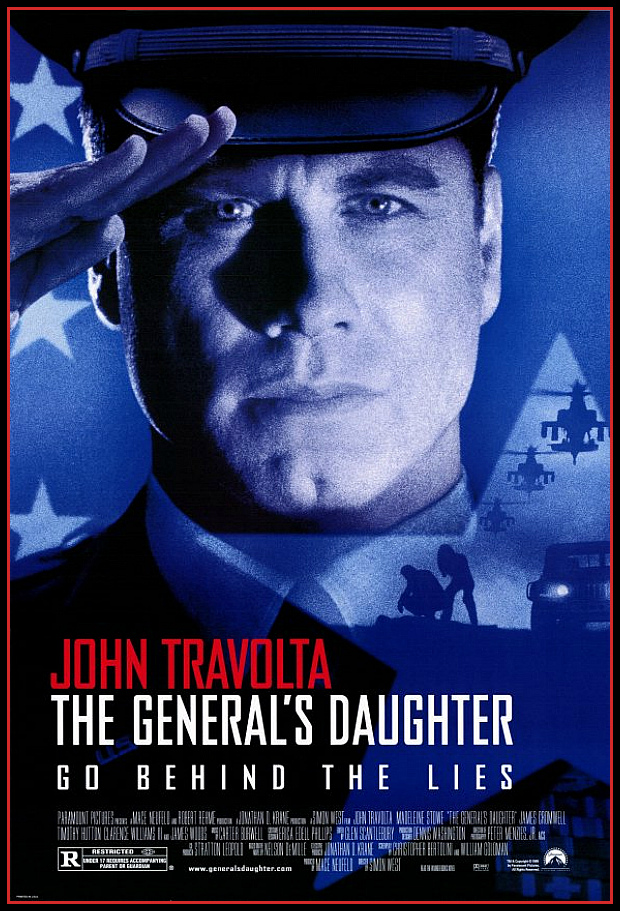
 Through the Shattered Lens