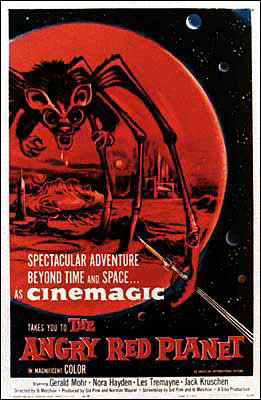
Guilty Pleasure #121: The Angry Red Planet (dir by Ib Melchior)


1960’s The Angry Red Planet opens with the return of the first manned space flight to Mars.  When the rocketship reaches Earth, NASA is stunned to discover that only two members of the crew — Iris “Irish” Ryan (Naura Hayden) and Colonel Thomas O’Bannion (Gerald Mohr) — are still alive and that O’Bannion seems to have been infected by an intergalactic fungus of some some sort.  Iris tells the story about what happened during their fateful trip to Mars.

I always enjoy the cheap science fiction films of the 50s and 60s, especially the ones that were made before America even conquered the Moon or really even went into space.  Not having anything to really guide their vision of space travel, these films almost always trotted out the old war movie stereotypes and dressed them in a shiny space suit.  In The Angry Red Planet, there’s gravity in space and Prof. Theodore Gettell (Les Termayne) smokes a pipe on the ship.  Warrant Officer Sam Jacobs (Jack Kruschen, who, the same year this film came out, gave an Oscar-nominated performance in The Apartment) reads comic books and wonders if there will be any life on Mars.  Meanwhile, O’Bannion flirts outrageously with Iris and everyone drinks coffee.

The film starts out as a standard low budget sic-fi flick, complete with sexist humor and scientific gobbledeegook, but things pick up once the crew actually reaches Mars.  Of course, the Mars that they find has plant life and looks absolutely nothing like the Mars that we all know and love.  That’s a part of the film’s charm.  Whenever the crew leaves their rocket and explores the Martian landscape, the film suddenly becomes red-tinted.  The tinting works far better than it really has any right to.  That said, I did look away from the screen a few times.  My eyesight is already bad enough without burning it up by watching a tinted movie.

The highlight of the film is…. well, sometimes it’s better just to let the visuals do the talking.
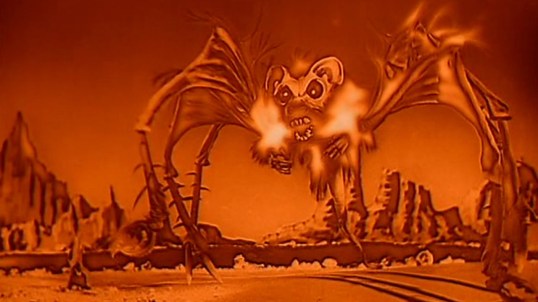
As soon as this fellow showed up, I knew that I was watching some sort of classic.

The Angry Red Planet is a thoroughly silly and implausible movie but, like most guilty pleasures, it’s also a lot of fun.  It’s one of the least accurate science fiction films ever made and I love it.

Previous Guilty Pleasures

  1. Half-Baked
  2. Save The Last Dance
  3. Every Rose Has Its Thorns
  4. The Jeremy Kyle Show
  5. Invasion USA
  6. The Golden Child
  7. Final Destination 2
  8. Paparazzi
  9. The Principal
  10. The Substitute
  11. Terror In The Family
  12. Pandorum
  13. Lambada
  14. Fear
  15. Cocktail
  16. Keep Off The Grass
  17. Girls, Girls, Girls
  18. Class
  19. Tart
  20. King Kong vs. Godzilla
  21. Hawk the Slayer
  22. Battle Beyond the Stars
  23. Meridian
  24. Walk of Shame
  25. From Justin To Kelly
  26. Project Greenlight
  27. Sex Decoy: Love Stings
  28. Swimfan
  29. On the Line
  30. Wolfen
  31. Hail Caesar!
  32. It’s So Cold In The D
  33. In the Mix
  34. Healed By Grace
  35. Valley of the Dolls
  36. The Legend of Billie Jean
  37. Death Wish
  38. Shipping Wars
  39. Ghost Whisperer
  40. Parking Wars
  41. The Dead Are After Me
  42. Harper’s Island
  43. The Resurrection of Gavin Stone
  44. Paranormal State
  45. Utopia
  46. Bar Rescue
  47. The Powers of Matthew Star
  48. Spiker
  49. Heavenly Bodies
  50. Maid in Manhattan
  51. Rage and Honor
  52. Saved By The Bell 3. 21 “No Hope With Dope”
  53. Happy Gilmore
  54. Solarbabies
  55. The Dawn of Correction
  56. Once You Understand
  57. The Voyeurs 
  58. Robot Jox
  59. Teen Wolf
  60. The Running Man
  61. Double Dragon
  62. Backtrack
  63. Julie and Jack
  64. Karate Warrior
  65. Invaders From Mars
  66. Cloverfield
  67. Aerobicide 
  68. Blood Harvest
  69. Shocking Dark
  70. Face The Truth
  71. Submerged
  72. The Canyons
  73. Days of Thunder
  74. Van Helsing
  75. The Night Comes for Us
  76. Code of Silence
  77. Captain Ron
  78. Armageddon
  79. Kate’s Secret
  80. Point Break
  81. The Replacements
  82. The Shadow
  83. Meteor
  84. Last Action Hero
  85. Attack of the Killer Tomatoes
  86. The Horror at 37,000 Feet
  87. The ‘Burbs
  88. Lifeforce
  89. Highschool of the Dead
  90. Ice Station Zebra
  91. No One Lives
  92. Brewster’s Millions
  93. Porky’s
  94. Revenge of the Nerds
  95. The Delta Force
  96. The Hidden
  97. Roller Boogie
  98. Raw Deal
  99. Death Merchant Series
  100. Ski Patrol
  101. The Executioner Series
  102. The Destroyer Series
  103. Private Teacher
  104. The Parker Series
  105. Ramba
  106. The Troubles of Janice
  107. Ironwood
  108. Interspecies Reviewers
  109. SST — Death Flight
  110. Undercover Brother
  111. Out for Justice
  112. Food Wars!
  113. Cherry
  114. Death Race
  115. The Beast Within
  116. Girl Series
  117. Gone in 60 Seconds
  118. Swordfish
  119. Marked For Death
  120. The Internship

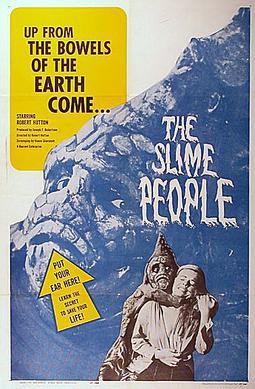
The Slime People (1963, directed by Robert Hutton)


Pilot Tom Gregory (Robert Hutton) lands his private plane in Los Angeles and is shocked to discover that the city is surrounded by a thick fog and that it appears to be nearly deserted.  A chance meeting with a professor named Galbraith (Robert Burton) and his two daughters (Susan Hart and Judee Morton) leads the group to a television station where they watch a news report about how Los Angeles has been surrounded by a “hardened fog.”  No one can escape the fog and no one can escape the Slime People, reptilian humanoids who have ascended from their underground lair and declared war on the surface world.  There appears to only be, at most, six Slime People but I guess that’s all you need to conquer Los Angeles.

The Slime People is a Z-grade horror film that features a lot of stock footage, monsters that would not be out of place in a Jon Pertwee-era Doctor Who serial, and an out-of-control fog machine.  The fog machine is actually the star of the show.  There’s so much fog in this movie that it’s often impossible to see the actors or the Slime People.  It’s a shame because, considering that the production ran out of money after 9 days and the majority of the actors were never paid, the Slime People costumes are not that bad.

Along with the fog and the costumes, the other memorable thing about The Slime People is that none of the survivors seem to be particularly upset about any of the horror that they’ve just experienced.  One young soldier (William Boyce) takes the time to ask one of the professor’s daughters if she’ll be available to date once the crisis ends.  It’s a tribute to the American youth of the 1960s that not even an attack from underground dwellers could stop date night.


Horror On TV: Raggedy Ann and Raggedy Andy in The Pumpkin That Wouldn’t Smile (dir by Chuck Jones)


Awwww, that poor pumpkin!  Well, hopefully, he’s smiling now!

This animated special originally aired on Halloween night in 1979.  I would imagine that the crying pumpkin probably traumatized children across America.  Hopefully, all the kids were out trick or treating when this aired.  Myself, I remember that when I was a kid, I would help my mom carve a pumpkin every year.  And then I would get so depressed when we later had to throw it out.  Seriously, I would get really attached to those jack o’lanterns.

Anyway, this cartoon is before my time but I have a feeling that, if I had been around to watch it, I would have been depressed for a whole year afterwards.

Enjoy!

Horror Film Review: The Monster of the Piedras Blancas (dir by Irvin Berwick)


Welcome the town of Piedras Blancas, California!

This small town is a sleepy coastal village, one that is dominated by a lighthouse sitting near the coast.  The town has a lovely beach and friendly citizens.  The storekeeper, Mr. Kocheck (Frank Arvidson), is a bit of a know-it-all.  The town constable (Forrest Lewis) has the very easy job of keeping peace in the town.  Little Jimmy (Wayne Berwick) is the annoying little kid who everyone in town looks after.  Little Jimmy is the type who will walk right into the local store and go behind the counter.  What a perfect town!

The only problem, when it comes to Piedras Blancas, is that some of the townspeople are a bit superstitious, especially when it comes to a belief in monsters that stalk the sea and the beach.  The lighthouse keeper, Sturges (John Harmon), worries that there is a monster hiding in a nearby cave so he often goes down there and leaves food to keep the monster from attacking the town.  Still, Sturges worries about his teenager daughter, Lucille (Jeanne Carmen), who has a habit of going down to the beach at night, stripping down to her underwear, and swimming in the ocean.  Seriously, if anything is going to attract a horror movie monster, it’s that!

And there is a monster in the cave and yes, the Monster does eventually go on a rampage.  As the bodies start to pile up and some of the town’s most beloved citizens are taken out, local scientist Sam Jorgensen (Les Tremayne) speculates that the creature could be a prehistoric amphibian who has somehow survived into the modern era.

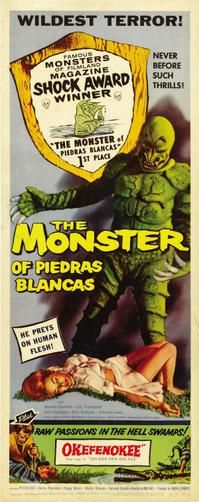
Independently produced and first released in 1959, The Monster of Piedras Blancas was clearly inspired by the success of The Creature From The Black Lagoon, with the boat crew replaced by the citizens of the town and Jeanne Carmen stepping into the role that was played by Julia Adams.  The film was produced by Jack Kelvan, who also supervised the creation of the suit that Ricou Browning wore when he played the Gil-Man in The Creature From The Black Lagoon.  And just, as with The Creature of Black Lagoon, the monster is the most effective part of The Monster of Piedras Blancas.  Here he is!

Now, in close-up and still frame, you can tell that it’s obviously a rubber suit but, when seen in the shadows and stalking people on the beach, the monster is truly menacing.  Whether the monster is ripping off someone’s head or carrying around the lighthouse keeper’s daughter, the monster is frightening to watch.  I wouldn’t want to live anywhere near him.  If the Creature From The Black Lagoon was often more misunderstood than malicious, The Monster of Piedras Blancas is just downright mean.

The Monster of Peidras Blancas does a good job of creating an ominous atmosphere, especially in the shots of Sturges heading down to the cave and the panicked townspeople walking through the town while carrying the body of the Monster’s latest victim with them.  The film’s pace is a bit slow and the performances are inconsistent but the Monster definitely makes an impression.

Horror On TV: Raggedy Ann and Raggedy Andy in The Pumpkin That Wouldn’t Smile (dir by Chuck Jones)


Awwww, that poor pumpkin!  Well, hopefully, he’s smiling now!

This animated special originally aired on Halloween night in 1979.  I would imagine that the crying pumpkin probably traumatized children across America.  Hopefully, all the kids were out trick or treating when this aired.  Myself, I remember that when I was a kid, I would help my mom carve a pumpkin every year.  And then I would get so depressed when we later had to throw it out.  Seriously, I would get really attached to those jack o’lanterns.

Anyway, this cartoon is before my time but I have a feeling that, if I had been around to watch it, I would have been depressed for a whole year afterwards.

Enjoy!

Shattered Politics #10: A Man Called Peter (dir by Henry Koster)


A_Man_Called_Peter

Occasionally, I’ll see a film like Crime of Passion or Bigger Than Life and I’ll say, “Wow, that’s really subversive for a movie that came out in the 1950s!”

And it’s true.  We tend to think of the 1950s as being a time when conformity ruled all.  It was a time of innocence and chastity, when cinema heroes all wanted to have a house in the suburbs and loving couples slept in separate beds and nobody ever questioned anything.  Of course, the truth of the matter is that there were a lot of films released in the 50s that challenge that perception.

And then again, there were also films like 1955’s A Man Called Peter.

A Man Called Peter is a biopic about Peter Marshall (played by Richard Todd), a Scottish immigrant who came to the United States, became a Presbyterian minister, and then eventually became the Chaplain of the United States Senate.  (That means that he would open each session of the Senate with a prayer and occasionally provide spiritual counsel to the senators.)  I recently watched it on Netflix, specifically because I thought it might be appropriate for this series of political reviews.

And it is, but just barely.

It actually takes the film a while to get to the part where Peter Marshall becomes the Senate Chaplain.  First, we watch him as a boy in Scotland, trying to stow away on a boat heading for America.  Then, several years later, he’s out walking on a foggy night.  He trips over a tree root and, as he lies on the ground, he announces that God has told him to 1) pursue a career as a minister and 2) to do so in America.  (I have to admit that I was raised Catholic so I have no idea whether he was having a typical Presbyterian spiritual experience or not.  But the film certainly takes it seriously.)

Peter ends up in America where he ministers to a church in Atlanta, marries Catherine (Jean Peters), and then eventually ends up at a church in Washington, D.C.  When he eventually is asked to serve as Chaplain of the Senate, both he and the film go out of their way to avoid taking any definite position on any issue.  Instead, Peter gives prayers that encourage the senators to put partisan bickering aside and work together to make the United States the best country in the world.

Having now watched all 120 minutes of A Man Called Peter, I can safely that this is a film that epitomizes everything that we always assume to be true about the 1950s.  From the film’s view of marriage to religion to politics, A Man Called Peter is perhaps one of the most stereotypically 1950s  movies ever made.  This is such a 1950s movie that it’s even filmed in CinemaScope!

(And speaking of CinemaScope, A Man Called Peter looks great but it’s perhaps one of the least intimate biopics that I’ve ever seen.  You can see every inch of the surrounding landscape but the human beings get lost.)

For me, the film’s most 1955 moment comes when Catherine first discovers that her husband has been reassigned to Washington, D.C.  She and Peter are on their honeymoon when they get a telegram telling them that their new home in Washington is ready.  Catherine is shocked.  Peter says that he didn’t want to interrupt their honeymoon by telling her that they’re not going home to Atlanta.  Instead, they’re going to an entirely new city and an entirely new life.  (In other words, Peter has decided to say goodbye to Catherine’s family and friends.)

“Aren’t you pleased?” Peter asks her.

Cheerfully, Catherine replies, “Well, who wouldn’t be?”

Ah, the 50s.