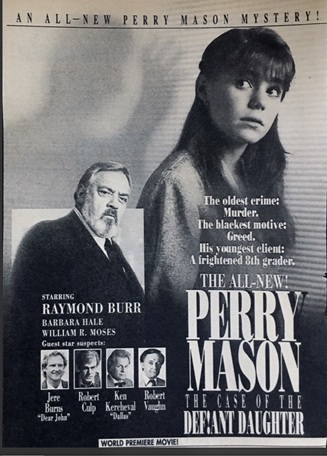
Perry Mason (Raymond Burr) and Ken Malansky (William R. Moses) are in Las Vegas for a boxing match but you know how it is when you’re the world’s most famous defense attorney. Perry can’t even go to Nevada without getting drawn into a court case. This time, David Benson (John Posey) is accused of shooting a blackmailer named Richard Stuart (Robert Culp). David’s teenage daughter, Melanie (Jenny Lewis), convinces Perry to take the case. She also tries to investigate on her own. It turns out that Richard Stuart was blackmailing several people. The suspects include Robert Vaughn, Jere Burns, Ken Kercheval, and Kevin Tighe.
I went back and forth on this entry. The best thing about this movie were the other suspects, who were all flamboyant Las Vegas characters. However, Melanie was sometimes annoying, even though it was understandable that she would be upset about her father being accused of murder. But I do think it was interesting to see how Perry related to Melanie. There’s a really sad subtext to the movie because Perry’s entire life is about his work. His friends are other attorneys. He doesn’t seem to have a family. While defending David, Perry became a surrogate father for Melanie but, at the end of the movie, Perry was once again alone.
In the end, The Case of the Desperate Daughter won me over. It was entertaining to see Perry in a different setting and dealing with characters who were more memorable than the usual cast of suspects. Even Perry Mason needed an occasional change of scenery.
Every Monday night at 9:00 Central Time, my wife Sierra and I host a “Live Movie Tweet” event on X using the hashtag #MondayMuggers. We rotate movie picks each week, and our tastes are quite different. Tonight, Monday February 24th, we’re watching THE SEVEN-UPS starring Roy Scheider, Tony Lo Bianco, Ken Kercheval, Richard Lynch, and Bill Hickman.
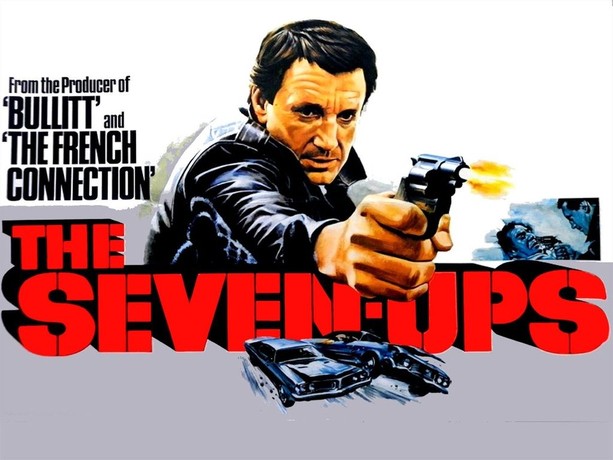
THE SEVEN-UPS is about an elite New York City police unit, led by detective Buddy Manucci (Roy Scheider). The unit is nicknamed the “seven-ups” based on their ability to secure convictions and jail sentences of 7 years and up. While working a job, one of his fellow seven-ups is killed, and Buddy will do anything to find the men who did it.
I wrote a full review of THE SEVEN-UPS just last week because it’s truly a great movie and features one of the best car chase sequences ever put on film. Rather than repeat a lot of those same facts, I’m including a link to my review below, which also includes the trailer for the film:
I’m guessing it started with JAWS (1975) and JAWS 2 (1978) since they played often on Fox-16 out of Little Rock when I was a kid, but I’ve been a fan of actor Roy Scheider for as long as I can remember. He’s one of those actors who has his own section in my massive collection of physical movie media. I’ve read about every film he’s ever made, and I’ve watched most of them. Surprisingly, THE SEVEN-UPS is the first Roy Scheider film I’ve written about on The Shattered Lens.
NYPD detective Buddy Manucci (Roy Scheider) leads a team of elite cops, known as the “seven-ups.” They’ve acquired this nickname because most of the criminals they arrest receive sentences that are 7 years and longer, which makes their superiors on the force very happy. Granted, the team does use a variety of unorthodox methods to find and arrest the criminals, which can also rub their superiors and some of their fellow cops the wrong way. Buddy’s childhood friend Vito Lucia (Tony Lo Bianco), an undertaker by trade who has his finger on the pulse of the criminal activities in his community, serves as an important snitch for the team, with his information often leading to major busts. Unbeknownst to Buddy, prominent members of various organized crime families and other white-collar criminals start getting kidnapped and held for ransom in the community. Buddy’s unaware of the full extent of the kidnappings, but he asks his old friend / snitch Vito about this when he actually witnesses the abduction of a crooked bail bondsman he’s following named Festa. We know that Vito is the mastermind behind all of the kidnappings, and his two main henchmen, Moon (Richard Lynch) and Bo (Bill Hickman), are impersonating cops just long enough to confuse and abduct the various criminals. When the Seven-Ups stake out a funeral meeting of various mobsters in the area, squad member Ansel (Ken Kercheval) is killed as part of a screwed-up abduction attempt. Buddy spots Moon and Bo trying to flee the area and tries to chase them down in an incredible car chase that ends when Buddy is almost decapitated in a violent collision with a parked 18-wheeler. With one of their own dead and with the wild chases through the streets, the members of the team are placed on suspension and even investigated as suspects for the kidnappings. Not content to just lay low during their suspensions, the seven-ups continue to try to figure out what’s going on, doing whatever it takes to get the information they need. When Buddy and his group start applying incredible pressure to some of the local mobsters about who shot Ansel, he gets information that ties the killing and the kidnappings to his friend Vito. This time when he meets with Vito, Buddy feeds him false information, thus setting a trap to bring the whole operation down.
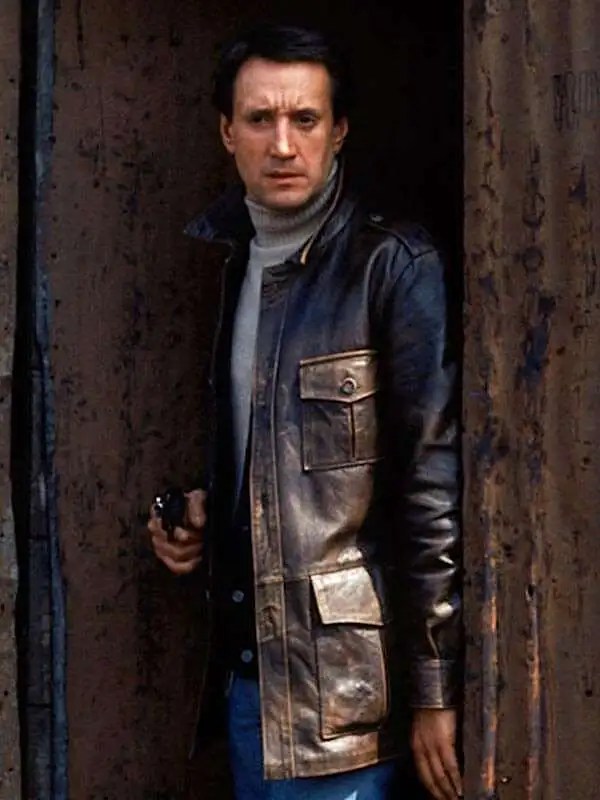
After viewing THE SEVEN-UPS again for the first time in a while, it continues to be my opinion that this movie is severely underrated. It’s a great cop film from the early 70’s, anchored by an excellent lead performance from Roy Scheider, who’s wearing one of the coolest leather jackets in the history of cinema. Coming in hot off the heels of THE FRENCH CONNECTION (1971), and with many connections to the Oscar winner, it seems that somehow this great film has fallen through the cracks over the years. I mean, how often do you hear people talk about this movie? THE SEVEN-UPS is directed by Philip D’Antoni, his only directorial credit, although he did serve as the Producer for both BULLITT (1968) and THE FRENCH CONNECTION. D’Antoni clearly values a good car chase sequence. THE SEVEN-UPS contains a thrilling car chase, which really isn’t that big of a surprise when you learn that stunt coordinator Bill Hickman, who plays the bad guy Bo in this film, coordinated the car chase sequences in BULLITT and THE FRENCH CONNECTION. This film features my personal favorite car chase sequence from any film that I’ve seen to date. Don Ellis composed the memorable musical score, a service that he also provided in THE FRENCH CONNECTION. I point out all of these ties to THE FRENCH CONNECTION because, in my humble opinion, the talent behind that film created another classic in THE SEVEN-UPS.
Complimenting Roy Scheider’s lead performance, THE SEVEN-UPS has a strong supporting cast. Tony Lo Bianco, Ken Kercheval (of DALLAS fame), Bill Hickman, and Richard Lynch are all quite memorable in their respective roles. I also like the 1973 New York City setting for the film. In movies like this and the following year’s DEATH WISH, we get to see a New York that no longer exists. To me, this only adds to the gritty realism of the film.
Overall, THE SEVEN-UPS is a movie I recommend without any reservations. If you’re a fan of 70’s cop thrillers, you simply can’t go wrong with this one.
When it comes to conspiracy theories involving presidential assassinations, the theories surrounding JFK may get all the attention but it’s the theories surrounding the death of Abraham Lincoln are usually far more plausible.
Unless, of course, it’s the theories that are pushed in the 1977 docudrama, The Lincoln Conspiracy.
A mix of documentary-style narration and really cheap-looking historical reenactments, The Lincoln Conspiracy essentially indicts almost everyone who was alive in 1865 as being a part of either the conspiracy or the subsequent cover-up. Really, it’s remarkable how many historical figures are implicated in this film.
With the Civil War coming to a close, President Lincoln (John Anderson) hopes to pursue a generous reconstruction policy for the former Confederate States. Secretary of War Edwin Stanton (Robert Middleton), Senator Ben Wade (Dick Callinan), and a host of other are all opposed to this plan, both because they want vengeance and they also want to make as much money as possible off of the Southern cotton fields. They come up with a plan to impeach Lincoln but, in order to draw up the articles, they have to make sure that Lincoln is not seen for a few days. When Col. Lafayette Baker (John Dehner) discovers that an actor named John Wilkes Booth (Bradford Dillman) is planning on kidnapping Lincoln, Stanton and his conspirators decide to give Booth their unofficial support. However, when the plan changes at the last minute and Stanton decides that it would actually be a bad idea to kidnap Lincoln, an angry Booth decides to just kill Lincoln, Andrew Johnson, and William Seward.
Booth succeeds in shooting Lincoln and making his escape. The other members of Booth’s group all fail in their assignments. Andrew Johnson becomes president. Though grievously wounded, William Seward survives. Booth flees to Canada and …. oh, you thought Booth died? No, that was just a look alike who was shot by a bizarre soldier named Boston Corbett. By allowing everyone to believe that Booth was killed, Stanton is able to cover up any role he and his allies played in inspiring the assassination. Unfortunately, Col. Baker keeps a diary and it seems like he might be planning on revealing the truth but he dies mysteriously before he can.
(And, to give the film some credit, Col. Baker’s sudden death at 41 was an odd one. And, though it’s not really explored in the film, Boston Corbett, the man who shoot Booth, really was a weirdo who was described by contemporaries as being a religious fanatic who castrated himself and claimed to hear the voice of God.)
It’s a big conspiracy theory that is presented in The Lincoln Conspiracy. In fact, it’s a bit too big to really be taken seriously. The film pretty much accuses everyone in Washington of having a part in the assassination. The film itself has the cheap look of a community theater production and the use of Dr. Samuel Mudd as a narrator only adds to the film’s silliness. If you’re a fan of gigantic and thoroughly implausible conspiracy theories, as I am, the film is entertaining in its way. If nothing else, Bradford Dillman certainly looks like how most people probably imagine John Wilkes Booth to have looked. Otherwise, The Lincoln Conspiracy is far-fetched and not at all realistic, which is why I assume that a lot of people in 1977 probably believed every word of it.
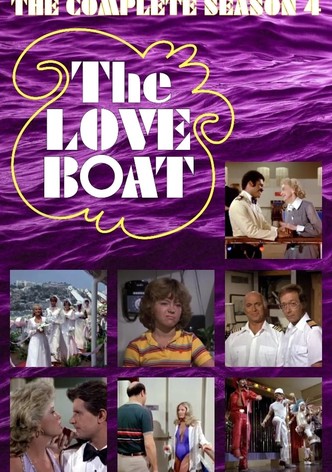
Welcome to Retro Television Reviews, a feature where we review some of our favorite and least favorite shows of the past! On Wednesdays, I will be reviewing the original Love Boat, which aired on ABC from 1977 to 1986! The series can be streamed on Paramount Plus!
This week, Hollywood royalty boards the Love Boat!
Episode 4.23 “The Duel/Two For Julie/Aunt Hilly”
(Dir by Ray Austin, originally aired on March 14th, 1981)
Who is Aunt Hilly?
She’s Olivia de Havilland!
And who is Aunt Hilly’s latest husband, Col. Von Ryker?
He’s Joseph Cotten, making his final screen appearance before retiring from acting!
Even for a show that was known for featuring stars from Hollywood’s Golden Age, de Havilland and Cotten are welcome additions to this episode of The Love Boat. They bring a lot of class to the ship, both as themselves and as the characters that they’re playing. It’s not just all of the wonderful Hollywood history that they bring with them. It’s also that they both give charming performances, showing that they still had the screen presence that made them stars to begin with.
Hilly is Captain Stubing’s aunt, a wealthy woman who has devoted so much of her life to work that she missed out on spending much time with her family. She wants to make up for the past by arranging for Vicki to attend an exclusive private school in Switzerland. Captain Stubing is reluctant but ultimately, he agrees that it would be best for Vicki to be able to have friends her own age and to get a formal education as opposed to just receiving lessons from the occasionally mentioned but never-seen tutor who apparently lives on the Love Boat.
However, Col. Van Ryker knows that Vicki would be happier on the boat and that Hilly is just trying to deal with her own guilt over her strained relationship with her son, Conrad. With the Colonel’s gentle help, Hilly realizes that it would be better for Vicki to stay with Captain Stubing.
Now, to be honest, I do kind of wonder if it’s a good idea for Vicki to live on the boat. I mean, does she really have any friends outside of the members of the crew, all of whom are much older than her? Personally, I think going to school is Switzerland and spending her summers on the Love Boat would have been a great idea. But no matter! This was a sweet story. What I really appreciated is that, even though they were on opposite sides, both the Captain and the Aunt had the best of intentions and motivations. It would have been easy to just portray Hilly as being a snob who thought living on a cruise ship was beneath the dignity of a Stubing. Instead, she was a genuinely nice woman trying to do what she felt was the right thing. Gavin MacLeod, Jill Whelan, Olivia de Havilland, and Joseph Cotten all did wonderful work with this story.
The other two stories were overshadowed by Cotten and de Havilland. In the sillier of the two, Linda Cristal played a woman who tried to make her husband jealous by flirting with Doc Bricker. Her husband (Alejandro Rey) reacted by challenging Doc to a duel. Isaac and Gopher tried to convince the husband that Doc was an experienced and deadly duelist. Again, it was just as silly as it sounds.
Meanwhile, Julie had two men (Ken Kercheval and Dack Rambo) hitting on her. The two men were also competing to be the new vice president of Don Ameche’s company. In the end, Julie remained single and good for her.
One silly story. One boring story. And one story that was so good that the other two stories didn’t matter. This was a great cruise.
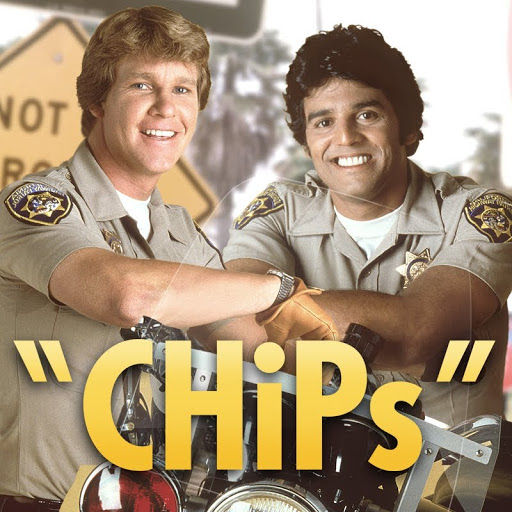
Welcome to Late Night Retro Television Reviews, a feature where we review some of our favorite and least favorite shows of the past! On Mondays, I will be reviewing CHiPs, which ran on NBC from 1977 to 1983. The entire show is currently streaming on Freevee!
This week’s episode is all about mistakes.
Episode 2.12 “High Explosive”
(Dir by Barry Crane, aired on December 9th, 1978)
This week’s episode features Jon Baker competing in a rodeo. That’s not really a surprise. Since the show began, it’s been established that Baker is a cowboy at heart and this episode is certainly not the first time that he’s mentioned growing up on a ranch in Wyoming. (Larry Wilcox, himself, grew up in Wyoming and had some real-life rodeo experience.) What is interesting is to listen to how the various actors pronounce the word rodeo.
Most of them, to their credit, pronounce it correctly. A rodeo — that is, an event involving cowboys, steers, clowns, and all the rest — is pronounced “road-ee-oh.” That’s how Larry Wilcox, Robert Pine, and the majority of the cast pronounce it. Erik Estrada and Paul Linke, however, both pronounce it “Roe-Day-Oh,” as in the famous street in Beverly Hills. Just a tip to any of our readers up north: Down here in the southwest, we pronounce it with a “dee” and not a “day.”
As for the rest of the episode, it’s all about mistakes. For instance, ambulance driver Brad Holmes (Steve Oliver) loses his job after he gets arrested for reckless driving. Desperate for money and not wanting to tell his wife that he lost his job, he agrees to transport a huge amount of old and unstable dynamite and he steals an ambulance with which to transport it! Not smart. Brad is an even worse driver with the explosives in the ambulance. Ponch and Baker chase him down and Brad crashes on a playground. While Ponch and Baker arrest Brad, a bunch of kids pick up the dynamite. UH-OH! Fortunately, Brad helps Ponch and Baker get the dynamite back. He asks Ponch and Baker to put in a good word with the judge.
(Yeah …. I don’t know how many good words you can really put in for someone who used a stolen ambulance to transport highly unstable explosives through a heavily populated area of Los Angeles.)
Meanwhile, 14 year-old Barry (Ike Eisenmann) accidentally shoots a car with his pellet gun. The car crashes. The driver, Mary Barnes (Roseanne Katon), survives with minor injuries but her sister nearly dies. Mary says that she wants to press charges against Barry. She doesn’t care that he’s only 14. Baker and Ponch arrange for Mary to spend the day at the rodeo with Barry, so that she can see that he’s just a scared kid who didn’t mean to hurt anyone. Barry is from Utah and lonely and Baker and Ponch feel sorry for him.
But you know what? The fact of the matter is that Barry is 14. He’s not some 10 year-old kid. He’s a teenager. He’s old enough to know better than to shoot a pellet gun around a busy highway. Barry is a lonely kid and that sucks. But again, he nearly killed someone and he caused a huge wreck. I’m on Mary’s side. Throw the book at Barry. Letting Barry get away with doing something that stupid isn’t going to be good for him or anyone else. Mary, however, disagrees with me. Barry’s off the hook and he even gets to go to the rodeo.
What a frustrating episode! Ponch and Baker let me down but at least one of them knows how to pronounce rodeo.
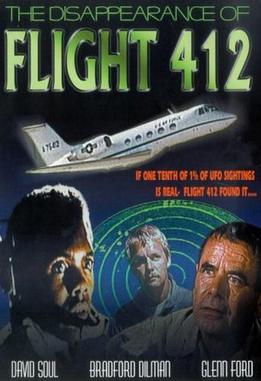
Because of recent electrical surges aboard its aircrafts, the commander of the Whitney Air Force Base 458th Radar Test Group sends a four-man crew up in Flight 412 to try to figure out what’s happening. Colonel Pete Moore (Glenn Ford) and Major Mike Dunning (Bradford DIllman) assume that it will just be a routine flight. Instead, they find themselves at the center of a government cover-up when Captain Bishop (David Soul) and the other members of the crew spot what appears to be a UFO. When two jets are sent out to intercept the object, the jets vanish.
Suddenly, Flight 412 is ordered to land at a seemingly deserted military base in the desert. When they do, the airplane is impounded and the crew is forced to undergo an 18-hour debriefing led by government agents. The agents demand that the crew members sign a statement saying that they didn’t see anything strange in the air before the jets vanished. Until all four of the men sign the release, the crew of Flight 412 are officially considered to be missing and will not be released until they agree to deny what they saw.
Meanwhile, Col. Moore tries to learn what happened to his men but the government, led by Col. Trottman (Guy Stockwell), is not eager to tell him.
This movie was made-for-television, at a time when people claiming to have been abducted by aliens was still a relatively new phenomenon. It was also made during the Watergate hearing and in the wake of the release of the Pentagon Papers, so the film’s sinister government conspiracy probably felt relevant to viewers in a way that it wouldn’t have just a few years earlier. I appreciated that the movie took a semi-documentary approach to the story but that it tried to be serious and even-handed. The film shows how witnesses can be fooled or coerced into saying that they saw the opposite of what they actually did see. Unfortunately, The Disappearance of Fight 412 is ultimately done in by its own cheapness. The overreliance on familiar stock footage doesn’t help the film’s credibility and there’s too many familiar faces in the cast for the audience to forget that they’re just watching a TV movie. The Disappearance of Flight 412 doesn’t really succeed but it is still interesting as an early attempt to make a serious film about the possibility of alien abduction and the government covering up the existence of UFOs.. Three years after this film first aired, Steven Spielberg would introduce these ideas to an even bigger audience with Close Encounters of The Third Kind.
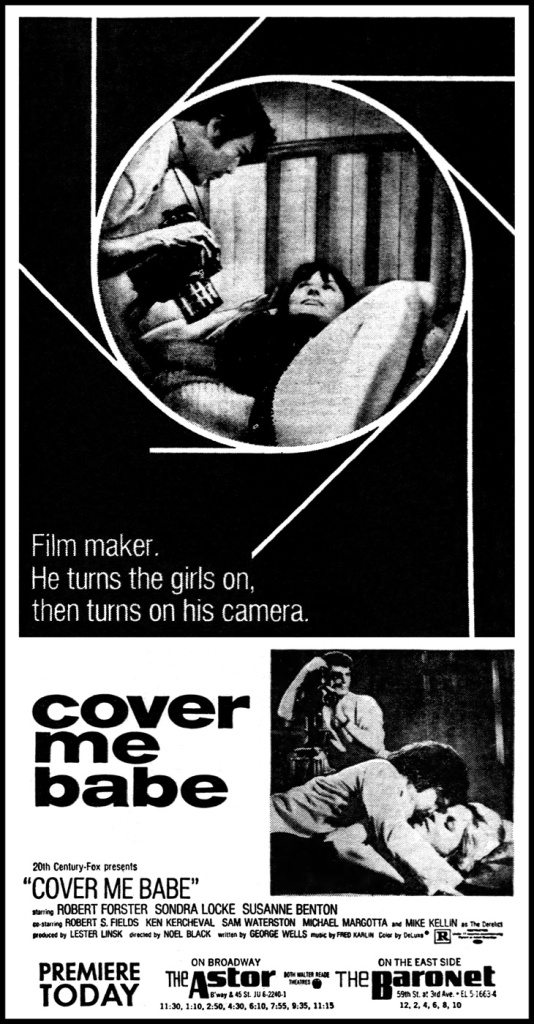
I don’t know if I’ve ever come across a non-horror film that featured a more off-putting lead character than Tony, the protagonist of 1970’s Cover Me, Babe.
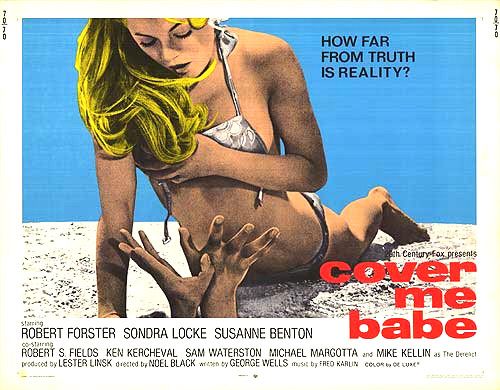
A film student, Tony (Robert Forster, even in 1970, who was too old for the role) aspires to make avant-garde films. Everyone in the film continually raves about how talented Tony is. The footage that we see, however, tends to suggest that Tony is a pretentious phony. The film opens with footage of a student film that Tony shot, one that involves his girlfriend, Melisse (Sondra Locke) sunbathing in the desert and getting groped by a hand that apparently lives under the sand. It was so self-consciously arty that I assumed that it meant to be satirical and that we were supposed to laugh along as Tony assured everyone that it was a masterpiece. And, to be honest, I’m still not sure that Cover Me, Babe wasn’t meant to be a satire on film school pretension. I mean, that explanation makes about as much sense any other. (Hilariously enough, Tony’s film had the same visual style as the film-within-a-film around which the storyline of Orson Welles’s The Other Side of the Wind revolved. At least in the case of Welles, we know that his intent was satirical.)
Tony is not only pretentious but he’s also a bit of a prick. He treats Melisse terribly and he manipulates everyone around him. He wanders around the city with his camera, filming random people and then editing the footage together into films that feel like third-rate Godard. He answers every criticism with a slight smirk, the type of expression that will leave you dreaming of the moment that someone finally takes a swing at him. Tony’s arrogant and he treats everyone like crap but, for whatever reason, everyone puts up with him because …. well, because otherwise there wouldn’t be a movie. Of course, eventually, everyone does get sick of Tony because otherwise, the movie would never end.
A Hollywood agent (Jeff Corey) calls up Tony and offers to get him work in Hollywood. Tony is rude to the guy on the phone. Tony meets a big time producer who could get Tony work. Tony’s rude to him. Guess who doesn’t get a job? Tony has to get money to develop his latest film from one of his professors so he’s rude to the professor. Guess who doesn’t get any money? Tony cheats on his loyal girlfriend. Tony’s cameraman (played by a youngish Sam Waterston) walks out when Tony tries to film two people having sex. By the end of the movie, no one wants anything to do with Tony. Tony goes for a run on the beach. He appears to be alienated and disgruntled. We’re supposed to care, I guess.
The problem with making a movie about an arrogant artist who alienates everyone around him is that you have to make the audience believe that the artist is talented enough to justify his arrogant behavior. For instance, if you’re going to make a movie about a painter who is prone to paranoid delusions and obsessive behavior, that painter has to be Vincent Van Gogh. He can’t just be the the guy who paints a picture of two lion cubs and then tries to sell it at the local art festival. You have to believe that the artist is a once-in-a-lifetime talent because otherwise, you’re just like, “Who cares?” The problem with Cover Me, Babe is that you never really believe that Tony is worth all of the trouble. The film certainly seems to believe that he’s worth it but ultimately, he just comes across as being a jerk who manipulates and mistreats everyone around him.
That said, from my own personal experience, a lot of film students are jerks who treat everyone them like crap. So, in this case, I think you can make the argument that Cover Me, Babe works well as a documentary. The fact of the matter is that not every film student is going to grow up to be the next Scorsese or Tarantino or Linklater. Some of them are going to turn out to be like Tony, running along the beach and wondering why no one agrees with him about George Stevens being a less interesting director in the 50s than he was in the 30s. As a docudrama about the worst people that you’re likely to meet while hanging out on campus, Cover Me, Babe is certainly effective. Otherwise, the film is a pretentious mess that’s done in by its unlikable protagonist. Everyone in the film says that Tony has what it takes to be an important director but, if I had to guess, I imagine he probably ended up shooting second unit footage for Henry Jaglom before eventually retiring from the industry and opening up his own vegan restaurant in Vermont. That’s just my guess.
Actually, Stallone plays Johnny Kovak, a laborer who becomes a union organizer in 1939. Working with him is his best friend, Abe Belkin (David Huffman). In the fight for the working man, Abe refuses to compromise to either the bosses or the gangsters who want a piece of union. Johnny is more pragmatic and willing to make deals with ruthless mobsters like Vince Doyle (Kevin Conway) and Babe Milano (Tony Lo Bianco). Over thirty years, both Johnny and Abe marry and start families. Both become powerful in the union. When Johnny discovers that union official Max Graham (Peter Boyle) is embezzling funds, Johnny challenges him for the presidency. When a powerful U.S. senator (Rod Steiger) launches an investigation into F.I.S.T. corruption, both Johnny and Abe end up marked for death.
Obviously based on the life and mysterious disappearance of Jimmy Hoffa, F.I.S.T. was one of two films that Stallone made immediately after the surprise success of Rocky. (The other was Paradise Alley.) F.I.S.T. features Stallone in one of his most serious roles and the results are mixed. In the film’s quieter scenes, especially during the first half, Stallone is surprisingly convincing as the idealistic and morally conflicted Kovak. Stallone is less convincing when Kovak has to give speeches. If F.I.S.T. were made today, Stallone could probably pull off the scenes of the aged, compromised Johnny but in 1978, he was not yet strong enough as an actor. Far better is the rest of the cast, especially Conway, Lo Bianco, and Boyle. If you do see F.I.S.T., keep an eye on the actor playing Johnny’s son. Though he was credited as Cole Dammett, he grew up to be Anthony Keidis of the Red Hot Chili Peppers.
The box office failures of both F.I.S.T. and Paradise Alley led Stallone back to his most famous role with Rocky II. And the rest is history.
What’s an Insomnia File? You know how some times you just can’t get any sleep and, at about three in the morning, you’ll find yourself watching whatever you can find on cable? This feature is all about those insomnia-inspired discoveries!
If, at one in the morning on Wednesday, you were suffering from insomnia, you could have turned over to TCM and watched the 1970 film, Rabbit Run. That’s what I did.
Rabbit Run is the epitome of a dumb lug film. In a dumb lug film, a male character finds himself living an unfulfilling life but he can’t figure out the reason. Why can’t he figure it out? Because he’s a dumb lug, with the emphasis on dumb. Usually, the viewer is supposed to sympathize with the dumb lug because he doesn’t mean to hurt anyone and everyone else in his world is somehow even more annoying than he is. Typically, the dumb lug will have an emotionally distant wife who refuses to have sex with him and who is usually portrayed as being somehow at fault for everything bad that has happened in the dumb lug’s face. (Want to see a more recent dumb lug film than Rabbit Run?American Beauty.) Ever since the silent era, there have been dumb lug films. In particular, male filmmakers and critics seem to love dumb lug films because they allow them to pat themselves on the back for admitting to being dumb while, at the same time, assuring them that everything is the fault of the wife or the girlfriend or the mother or the mother-in-law.
In Rabbit Run, the dumb lug is named Harry Angstrom (James Caan), though most people still remember him as Rabbit, the high school basketball star. Harry’s life peaked in high school. Now, he’s 28 and he can’t hold down a job. He’s married to Janice (Carrie Snodgress), who spends all of her time drinking and watching TV. He has a son and another baby is on the way. One day, when the pregnant Janice asks him to go out and get her a pack of cigarettes, Harry responds by getting in his car and driving all the way from Pennsylvania to Virginia.
When he returns to Pennsylvania, Rabbit doesn’t go back to his wife. Instead, he drops in on his former basketball coach (Jack Albertson) and begs for advice on what he should do. The coach, it turns out, is more than little creepy. He also has absolutely no practical advise to give. He does introduce Rabbit to a part-time prostitute named Ruth (Anjanette Comer). Rabbit quickly decides that he’s in love with Ruth and soon, he’s moved in with her.
Meanwhile, there’s all sorts of little things going on. Rabbit gets a job working as a gardener. Rabbit befriends the local Episcopal minister (Arthur Hill), even while the minister’s cynical wife (Melodie Johnson) tries to tempt Rabbit away from both his wife and his mistress. Rabbit both resents and envies the sexual freedom of the counter culture, as represented by his younger sister. And, of course, Janice is pregnant…
Rabbit Run is based on a highly acclaimed novel by John Updike. I haven’t read the novel so I can’t compare it to the film, beyond pointing out that many great works of literature have been turned into mediocre movies, largely because the director never found a way to visually translate whatever it was that made the book so memorable in the first place. Rabbit Run was directed by Jack Smight, who takes a rather frantic approach to the material. Since Rabbit Run is primarily a character study, it needed a director who would be willing to get out of the way and let the actors dominate the film. Instead, Smight overdirects, as if he was desperately trying to prove that he could keep up with all the other trendy filmmakers. The whole movie is full of extreme close-ups, abrupt jump cuts, intrusive music, and delusions of ennui. You find yourself wishing that someone had been willing to grab Smight and shout, “Calm down!”
(On the plus side, as far as the films of 1970 are concerned, Smight’s direction of Rabbit Run still isn’t as bad as Richard Rush’s direction of Gettting Straight.)
James Caan actually gives a likable performance as Rabbit, which is good because Rabbit would be totally unbearable if not played by an actor with at least a little genuine charisma. There’s nothing subtle about Caan’s performance but he makes it work. You never like Rabbit but, at the same time, you don’t hate him.
Unfortunately, there’s nothing subtle about the rest of the cast either. Something rather tragic happens about 80 minutes into the film and, as much as I knew I shouldn’t, I still found myself giggling because Carrie Snodgress’s performance was so bad that it was impossible for me to take any of it seriously. Even worse is Arthur Hill, as the minister who won’t stop trying to help Rabbit out. I eventually reached the point where, every time that sanctimonious character started to open his mouth, I found myself hoping someone would hit him over the head and knock him out. Among the major supporting players, only Anjanette Comer is allowed a chance to be something more than just a sterotype. Like Caan, she does the best that she can but ultimately. this is James Caan’s movie.
It’s a disappointing movie but it did not put me to sleep. Give credit for that to James Caan, who is the only reason to see Rabbit Run.
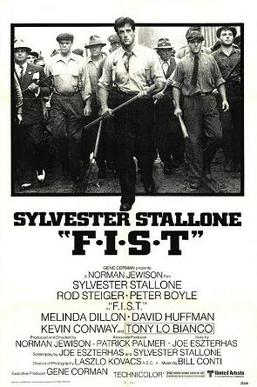 Sylvester Stallone is Jimmy Hoffa!
 Through the Shattered Lens