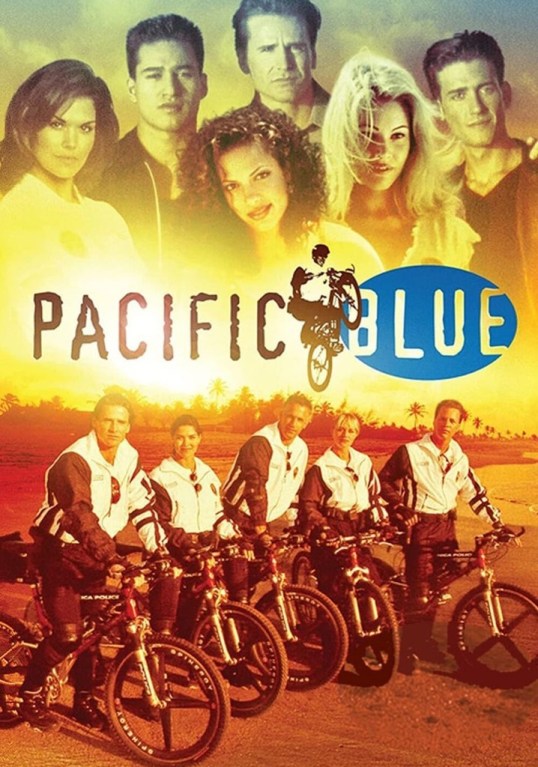
Welcome to Late Night Retro Television Reviews, a feature where we review some of our favorite and least favorite shows of the past! On Tuesdays, I will be reviewing Pacific Blue, a cop show that aired from 1996 to 2000 on the USA Network! It’s currently streaming everywhere, though I’m watching it on Tubi.
This week, the bicycle cops investigate a 50 year-old cold case.
Episode 4.17 “Scarlet Rose”
(Dir by Paul Brown, originally aired on March 7th, 1999)
In the 1940s, Santa Monica was shaken by the brutal murder of an actress nicknamed the Scarlet Rose. Her ghost is said to haunt the ballroom where she used to dance and where it’s believed she met her still-unknown murderer. Now, after nearly 50 years, the ballroom is reopening as the Scarlet Rose Ballroom.
Bobby Cruz, who has long been haunted by the stories about the Scarlet Rose, attends the grand opening, where everyone is dressed like it’s the 1940s and swing dancing. When he meets Lily (LuAnne Ponce), he’s stunned because she looks just like the Scarlet Rose. Lily explains that she is Scarlet’s granddaughter and that she’s looking not only for the truth about who killed her grandmother, but also for what happened to a valuable necklace Scarlet owned.
Bobby suspects that Walter (William Schallert), an older man who hangs around the club, might have had something to do with Scarlet’s murder. He also suspects that it might somehow be linked to a recent robbery at a jewelry store. He takes his suspicions to T.C.
“We are going undercover!” T.C. announces.
Yes, this is yet another episode in which the members of Pacific Blue go undercover. These episodes never make sense to me, because the members of Pacific Blue are bicycle cops. They’re not detectives. They’re not trained to go undercover. They’re trained to ride around on their bikes, hand out traffic tickets, and secure crime scenes until the real detectives can show up.
In this episode, going undercover means that Monica gets a job singing at the club while Cory and Jamie hang out at the bar and glare at everyone like the two biggest killjoys in existence. It isn’t just that it doesn’t make any sense for these people to be working undercover. It’s also that none of them are particularly good at it. Cory and Jamie may be dressed up like 1940s femme fatales, but they still give off an immediate cop vibe.
For the record, the case of the Scarlet Rose is solved. It turns out that she was murdered by an associate of Los Angeles gangster Mickey Cohen. Considering that Cohen was a real person, it feels a little unfair to pin a fictional murder on him, but I guess Pacific Blue felt that, since he wasn’t around to complain, it wouldn’t be a problem.
(The Scarlet Rose was clearly based on the Black Dahlia murder case. It seems like every few years, someone publishes a book claiming to have solved the Black Dahlia case. Former LAPD detective Steve Hodel built an entire literary career out of accusing his late father of being responsible for the Dahlia’s murder and practically every other unsolved murder in California.)
A few positive things can be said about this episode. The 1940s-style costumes were to die for. The real-life band Jumpin’ Jimes provided the episode with a great soundtrack, and the swing dance scenes were nicely choreographed. The Scarlet Rose Ballroom looked like a fun place to hang out. Not even the dour presence of Cory and Jamie could suck the fun out of that place. Finally, old pro William Schallert gave a good performance as a potential suspect who wasn’t entirely what he seemed to be.
In other words, this was actually a pretty good episode of Pacific Blue. I’ll never understand why the bicycle cops were investigating a 50-year-old cold case, but whatever. It was still an entertaining episode.

