Embracing the Melodrama Part II #74: Perfect (dir by James Bridges)


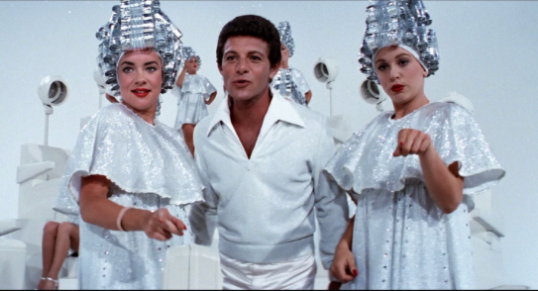
PerfectOkay,before reviewing the 1985 film Perfect, I have three things to say.

Number one, I nearly captioned the picture above “John Travolta, Jamie Lee Curtis, and Little Xenu.”  And then I laughed and laughed.  But, in the end, I resisted temptation because I’m an adult now.

Number two, Perfect came out in June in 1985, a few months before I was born.  As a result, I have no idea what the 1985 reviews looked like.  However, it still seems to me that you’re taking a big risk when you give a movie a title like Perfect, especially when the movie itself is far from perfect.  How many reviews opened with, “Perfect fails to live up to its name…”

And finally, as a result of seeing both this film and Staying Alive, I have to say, “What the Hell, John Travolta?”  Seriously, what the Hell was going on?  John Travolta gave a great performance in the 1970s, with Saturday Night Fever.  And then in the 1990s, he was good in Pulp Fiction, Get Shorty, Face/Off, Primary Colors, and a few others.  (For our purposes here, we shall pretend that Battlefield Earth never happened.)  Even though most of Travolta’s recent films have been forgettable, his performances have generally been adequate.

So, seriously, John — what was going on in the 80s?  Because judging from both Perfect and Staying Alive, John Travolta apparently totally forgot how to act during that decade.  When I reviewed Staying Alive, I said that Travolta’s performance managed to create a whole new definition of bad.  But he’s actually even worse in Perfect.  It helped, of course, that in Staying Alive, Travolta’s character was supposed to be stupid.  In Perfect, on the other hand, he’s actually supposed to be a brilliant reporter.

Or, at the very least, he’s supposed to be brilliant by the standards of Rolling Stone.  Travolta plays Adam Lawrence, an award-winning reporter for Rolling Stone.  The magazine, by the way, plays itself and so does its publisher, Jann Wenner (though his character is technically named Mark Roth).  What’s interesting is that the film itself doesn’t necessarily paint a flattering picture of Rolling Stone or Jann Wenner, though admittedly a lot of that is due to the fact that Wenner himself gives a performance that is even worse than Travolta’s.  It’s impossible to watch Perfect without thinking about the fact that Adam is writing for the same magazine that would eventually put Dzokhar Tsarnaev on the cover and publish the UVA rape story.

Anyway, if I seem to avoiding talking about the exact plot of Perfect, that’s because there’s not really much of a plot to describe.  Adam, a hard-hitting investigative journalist, is doing research on a story about how people are hooking up at gyms.  Wenner agrees.  “We haven’t done L.A. in a while!” he says.  Adams joins the a gym called the Sports Connection, which he is soon calling “The Sports Erection” because he’s a super clever reporter.  He falls in love with an aerobics instructor, who is played by Jamie Lee Curtis.  She doesn’t trust reporters but is eventually won over by Travolta’s … well, who knows?  Mostly she’s won over because the plot needs some conflict.  She gets on Adam’s computer and she types, “Want to fuck?”  Adam says sure but then tries too hard to dig into the dark secret from her past.  “You’re a sphincter muscle!” she shouts as him.  Adam writes a compassionate and balanced article about the Sports Connection.  Wenner edits the article and turn it into a sordid hit piece.  (And again, you wonder why Wenner agreed to play himself.)  Feelings are hurt, issues are resolved, and eventually everyone takes an aerobics class.

Honestly, the entire movie is mostly just a collection of scenes of Jamie Lee Curtis and John Travolta working out.  And, in all fairness, Curtis does about as well as anyone could in this terrible film.  Travolta, on the other had … well, just check out the scene below and maybe you’ll understand why I had a hard time concentrating on Travolta’s acting.

Perfect fails to live up to its name.

Embracing the Melodrama Part II #70: Staying Alive (dir by Sylvester Stallone)


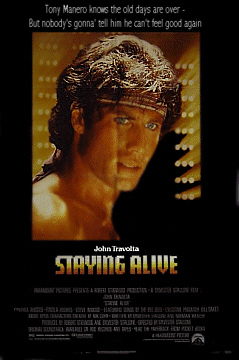
StayingaliveOh my God, this is so bad.

The 1983 film Staying Alive is a sequel to Saturday Night Fever.  That’s right, Tony Manero’s back!  And, if possible, he’s even dumber than before.

Actually, that’s not fair.  The whole point of Saturday Night Fever was that Tony really was not that dumb.  He was poorly educated.  He was a prisoner of his culture and his economic situation.  If he acted stupid, it was because he lived in a world that distrusted intelligence.  If he was selfish, it was because that was his way of dealing with his own insecurities.  If we got frustrated with him, it’s because we knew he was capable of more than he realized he was.  In Saturday Night Fever, John Travolta gave such good performance and Tony was such a carefully drawn character that we forgave him for the many times that he let us down.

But, in Staying Alive, Tony is just an idiot.  Somehow, he’s managed to escape Brooklyn.  He now works as a waiter and a dance instructor and goes on auditions for Broadway shows.  He has no contact with his old friends.  (He never even mentions the night that one of them jumped off a bridge.)  He lives in one of those scary New York flophouses — apparently the same one that Travis Bickle called home in Taxi Driver — but otherwise, Tony’s doing pretty well for himself.  The only problem is that Tony is now a complete and total moron.

That really is the only conclusion that one can draw from John Travolta’s performance here.  It’s not just that Travolta gives a bad performance in a role for which he was once nominated for an Oscar.  It’s that Travolta gives such a bad performance that he actually transcends the accepted definition of bad.  He resurrects all the tics from his Saturday Night Fever performance but he goes so overboard with them that you feel like you’re watching someone do an imitation of John Travolta playing Tony Manero than actually watching John Travolta.

Speaking of self-parody, Staying Alive was directed by Sylvester Stallone.  Now, I know that when you think of the ideal director for a dance movie, Sylvester Stallone is probably the first name that comes to mind.

As for the film itself, Tony gets a job working in the chorus of a Broadway show called Satan’s Alley and, wouldn’t you know it, he eventually replaces the male lead.  Tony finds himself torn between the bitchy (and, somewhat inevitably, British) star of the show (Finola Hughes) and his long-suffering, on-and-off again girlfriend Jackie (Cynthia Rhodes).

Jackie, incidentally, is also the lead singer in a band.  The band’s guitarist, Carl, is in love with her.  Guess who plays Carl?  Frank Stallone!  That’s right, the director’s brother.  There is a hilarious scene where Carl plays guitar while shooting a death glare at Tony.  Frank really nails that death glare.

But, ultimately, the main appeal of Staying Alive is that we get to see Satan’s Alley, which is probably the most unintentionally hilarious fake Broadway show to ever be immortalized on film.  Satan’s Alley is about one man’s journey into Hell and… well, that really sums it up, doesn’t it?  If you asked someone who has never danced, never listened to music, and perhaps never actually stepped outside of their bedroom to write a Broadway musical, chances are that they would come up with something like Satan’s Alley.

And they’d probably cast Tony Manero as the lead!

Embracing the Melodrama Part II #57: Saturday Night Fever (dir by John Badham)


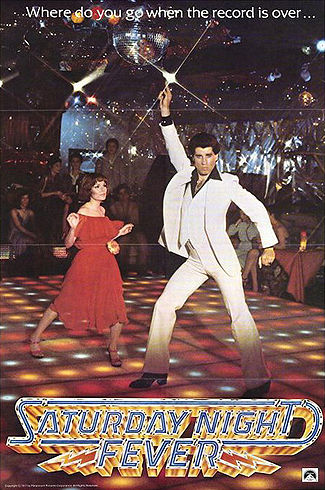
Saturday_night_fever_movie_posterHere’s a little bit of trivia about the iconic 1977 film Saturday Night Fever.

First off, according to the imdb, Saturday Night Fever was the first mainstream Hollywood film to ever use the term “blow job.”  That actually took me by surprise.  I mean, with all of the risks that the major studios took in the 70s, it still took them until 1977 to have someone say “blow job” in a movie?  But somehow, it seems appropriate that it would turn up in Saturday Night Fever.  We tend to think of Saturday Night Fever as being a movie where the soundtrack is nonstop disco and John Travolta dances in that iconic white suit.  But actually, Saturday Night Fever is a film about four guys who neither understand nor respect women.

When Tony (John Travolta), Joey (Joseph Cali), Double J (Paul Pape), and Bobby (Barry Miller) go down to that disco, it’s because they want to get laid.   Joey and Double J take turns having sex with insecure Annette (Donna Pescow) and, afterwards, Tony scornfully ask her if she‘s proud of herself.  When Bobby discovers that his girlfriend is pregnant, he is so terrified of having to be a father that he becomes suicidal.  As for Tony, he looks down on the women who are so eager to dance with him.  When he enters a dance contest with Stephanie (Karen Lynn Gorney), he can’t handle the fact that she wants more out of her life than just being his latest partner.

So, it makes sense that this would be the first mainstream movie to feature someone talking about a blow job because that’s what these boys are obsessed with.  Sexually primitive, hypocritically puritanical, and emotionally repressed, a blow job is all the intimacy that these boys can handle.

Another piece of trivia: while John Travolta was always the first choice for Tony Manero, several actors were seen for the roles of Joey and Double J.  At one point, both Ray Liotta and David Caruso were nearly cast in the role of Tony’s friends.  Imagine this: in some alternative universe, while white-suited John Travolta rules over the dance floor, Ray Liotta and David Caruso are standing in the background and cheering him on.

Of course, if Liotta and Caruso had been cast, it would be a totally different movie.  Whenever you watch Saturday Night Fever, you’re surprised by how much John Travolta totally dominates the film.  Even though the film devotes a good deal of time to Annette, Stephanie, Bobby and to Tony’s brother who has recently left the priesthood, Tony Manero is the only character that you remember.  That’s largely because Travolta is the only one of them who gives a truly memorable performance.

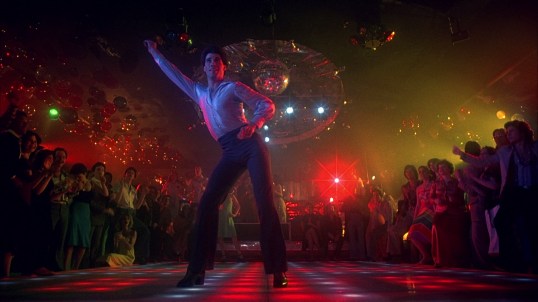
In theory, it’s easy to laugh at the thought of Travolta in that white suit, striking a dramatic pose on that cheap-looking dance floor.  But then you watch the film and you realize that Travolta truly did give a great performance.  And, to your surprise, you don’t laugh at Tony with his white suit because you know that the only time Tony has any control over his life is when he’s dancing.  He may work in a paint store.  He may regularly get slapped around by his family.  He may not be very smart or sensitive.  But when Tony’s dancing, he’s a king and you’re happy that he at least has one thing in his life that he can feel good about.

Even if he is kind of a jerk.

Of course, it helps that Tony is a really good dancer.  There’s actually a lot more going on in Saturday Night Fever than you might think but ultimately, it’s a dance movie and it’s one of the best.

Embracing the Melodrama Part II #55: The Tenth Level (dir by Charles S. Dubin)


10thlevelI first found out about the 1976 made-for-tv movie The Tenth Level while I was doing some research on the Milgram experiment.  The Milgram experiment was a psychological experiment that was conducted, under the direction of Prof. Stanley Milgram, in 1961.  Two test subjects were placed in two separate room.  One test subject was known as the “Learner” and he was hooked up to a machine that could deliver electric shocks.  The other subject was the “Teacher.”  His job was to ask the Lerner questions and, whenever the Learner gave an incorrect answer, the Teacher was supposed to correct the error by pushing a button and delivering the electric shock.  With each incorrect answer, the shock would get worse.

Of course, what the Teacher did not know was that the Lerner was an associate of Prof. Milgram’s and that pushing the button did not actually deliver a shock.  The Lerner would intentionally give wrong answers and, after the Teacher pushed each subsequent button, the Lerner would groan in pain and eventually beg the Teacher to stop.  The test was to see how long the Teacher would continue to push the buttons.

The study found that 65% of the Teachers, even when the Lerner stopped responding, continued to push the buttons until delivering the experiment’s final 450-volt shock.  It was a surprising result, one that is often cited as proof that ordinary people will do terrible things if they’re ordered to do so by an authority figure.

The Tenth Level is loosely based on the Milgram experiment.  Prof. Stephen Turner (William Shatner) is a psychology professor who conducts a similar experiment.  Turner claims that he’s looking for insight into the nature of blind obedience but some of his colleagues are skeptical.  His best friend (Ossie Davis) thinks that Turner is mostly trying to deal with the guilt of being a WASP who has never had to deal with discrimination.  His ex-wife, Barbara (Lynn Carlin), thinks that the experiment is cruel and could potentially traumatize anyone who takes part in it.  Turner, meanwhile, is fascinated by how random people react to being ordered to essentially murder someone.

Eventually, a good-natured carpenter/grad student, Dahlquist (Stephen Macht), volunteers.  At first, Turner refuses to allow Dahlquist to take part because he’s previously met Dahlquist and Dahlquist is a friend of one of Tuner’s assistants.  However, Dahlquist literally begs to be allowed to take part in the experiment and Turner relents.

Unfortunately, the pressure of administering shocks proves to be too much for Dahlquist and he has a 70s style freak-out, which essentially means that the screen changes colors and everything moves in slow motion as he smashes up the room.  As a result of Dalquist’s violent reaction, Turner is called before a disciplinary committee and basically put on trial.

The Tenth Level is an interesting film.  On the one hand, the subject matter is fascinating and, if nothing else, the film deserves some credit for trying to seriously explore the ethics of psychological experimentation.  On the other hand, this is a film from 1976 that features William Shatner giving numerous monologues about the nature of man.  And, let us not forget, this is William Shatner before he apparently developed a sense of humor about himself.  That means that, in this film, we get the Shatner that inspired a thousand impersonations.  We get the Shatner who speaks precisely and who enunciates every single syllable.  And let’s not forget that Shatner is paired up with Ossie Davis, an actor who was never exactly subtle himself.

The end result is a film that is both thought-provoking and undeniably silly.  This is a film that will make you think even while it inspires you to be totally snarky.

(Also of note, John Travolta supposedly makes his film debut in the Tenth Level.  Apparently, he plays a student.  I have yet to spot him.)

You can watch it below!

Shattered Politics #63: Primary Colors (dir by Mike Nichols)


Primaryposter

Jack Stanton (John Travolta) is the charismatic governor of an unnamed Southern state.  After spending his entire life in politics, Jack is finally ready to run for President.  Even more ready is his equally ambitious wife, Susan (Emma Thompson).  Jack proves himself to be a strong candidate, a good speaker who understands the voters and who has the ability to project empathy for almost anyone’s situation. He’s managed to recruit a talented and dedicated campaign staff, including the flamboyant Richard Jemmons (Billy Bob Thornton), Daisy Green (Maura Tierney), and journalist Henry Burton (Adrian Lester).  Henry is the son of a civil rights leader and, as soon as they meet, Jack talks about the first time that he ever heard Henry’s father speak.  Within minutes of first meeting him, Henry believes in Jack.

The problem, however, is that there are constant hints that Jack may not be worthy of his admiration.  There’s the fact that he’s a compulsive womanizer who is given to displays of temper and immaturity.  When one of Jack’s old friends reveals that Jack may have impregnated his daughter, Jack and Susan respond with a pragmatic ruthlessness that takes Henry by surprise.

When one of Jack’s mistresses threatens to go public, Henry is partnered up with Libby (Kathy Bates) and sent to dig up dirt on her and her sponsors.  When the former governor of Florida, Freddie Picker (Larry Hagman), emerges as a threat to derail Jack’s quest for the nomination, Henry and Libby are again assigned to research Picker’s background.  Libby is perhaps the film’s most interesting character.  Recovering from a mental breakdown, Libby has no trouble threatening to shoot one political opponent but she’s still vulnerable and idealistic enough that it truly hurts her when Jack and Susan repeatedly fail to live up to her ideals.  As an out lesbian, Libby is perhaps the only character who has no trouble revealing her true self and, because of her honesty, she is the one who suffers the most.

First released in 1998 and based on a novel by Joe Klein, Primary Colors is an entertaining and ultimately rather bittersweet dramedy about the American way of politics.  John Travolta and Emma Thompson may be playing Jack and Susan Stanton but it’s obvious from the start that they’re meant to be Bill and Hillary Clinton.  And while it takes a few minutes to get used to Travolta’s attempt to sound Southern, this is ultimately one of his best performances.  As played by Travolta, Jack Stanton is charming, compassionate, self-centered, and ultimately, incredibly frustrating.  One reason why Primary Colors works is because we, as an audience, come to believe in Jack just as much as Henry does and then we come to be just as disillusioned as Libby.  Emma Thompson’s performance is a little less obviously based on Hillary.  Unlike Travolta, she doesn’t attempt to imitate Hillary’s voice or mannerisms.  But she perfectly captures the steely determination.

Primary Colors captures both the thrill of believing and the inevitability of disillusionment.  It’s definitely a film that I will rewatch in the days leading up to 2016.

Halloween Horrors 2013 : “Carrie” (1976)


Carrie-Poster


Over at my “main” site — http://trashfilmguru.wordpress.com , for those who don’t know, don’t care, either, or both — I’ve been doing what every other goddamn movie blog in the universe does in the month of October: namely, review a bunch of random horror flicks. But come on — you didn’t think I was just gonna sit back and let Lisa Marie, Arleigh, Leonard Wilson, and everybody else have all the fun here on TTSL, did you?

Nah. I just had to muscle in and opine on a few macabre movie delights on these digital “pages” before the month was out, as well. And I might as well start with the one everybody’s talking about right now, Carrie, the 1976 classic directed, in his inimitable style, by Brain DePalma, based on the runaway best-seller by Stephen King, and starring Sissy Spacek as quite likely the most hapless horror heroine in history.

This film is significant for a number of reasons, not the least of which being that it was the first King “property” to be adapted for the big screen, thus announcing the arrival of a major new player on the scene who would go on, of course, to have a veritable industry of celluloid “translations” of his work sprout up over the ensuing decades, some of which were clearly — oh, wait, people these days are talking about a different Carrie altogether? One that just came out last week?

Well, I saw that one, too, but fuck it — I feel like reviewing this one first.

carrie_mother


Let’s backtrack to that “horror’s most hapless heroine” claim for a minute, shall we? It might sound like a bold claim, but I swear it’s true — think about it for a minute : poor Carrie White starts the movie by having her first period in the shower at school, she thinks she’s dying because her religious whack-job of a mom is too chickenshit to tell her about menstruation, she gets teased mercilessly by all the girls who witness her uncomfortable (to say the least) entry into womanhood, she has no friends to speak of, she’s stuck with a bunch of telekinetic powers that she doesn’t understand or know how to effectively control, she’s the butt of every cruel joke her classmates play, she has to listen to her idiot mother blather nonsense 24/7,  she gets invited to the prom as by the most popular kid in school strictly as an act of misguided charity, and then, just when she’s granted one moment of respite from the nonstop parade of tragedy that comprises her existence when she’s crowned world’s most unlikely  prom queen, she gets a bucket full of pig blood dumped all over her, freaks out and kills everybody with her “mind powers,” and goes home from the best/worst night of her life to find that mommie dearest has decided to kill her in Jesus’ name.

Talk about a gal who just can’t catch a break.

carrie1976-0372


Sure, it all seems a bit over the top — okay, it all is a bit over the top — but DePalma pulls out all the stops to draw you into this sordid little world of revival tent-reject parents (Piper Laurie), evil high school bitches (Nancy Allen), pussy-whipped wannabe-tough guys (John Travolta), well-meaning but ultimately ineffectual teachers (Betty Buckley), semi-guilt-ridden classmates (Amy Irving), jocks with out of control white-guy ‘fros (William Katt), and grounds the whole heady mixture in a turn-for-the-ages performance by Spacek that really makes you feel for the poor kid even — maybe especially — when she finally snaps. His always-stylish-and-inventive use of sound, split screen, and slow-burn tension keep you pretty well fixated on the proceedings throughout, and all in all you’ve just gotta say this still holds up as a pretty impressive cinematic achievement.

Of course, King hit on a fairly inventive little gimmick from the outset here — plenty of horror stories, fairy tales, fables, and probably even  nursery rhymes are little more than thinly-disguised metaphors for the onset of puberty and the scary transition from childhood into the ‘adult” world, but here he just dispensed with the pretense and doubled-down by ripping the mask off and piling the real, actual, non-metaphorical point on top of the , as we say in modern parlance, “genre trappings,” and as a result ended up penning a scary story for the ages.

Sissy_Spacek_as_Carrie_White,_1976


Classic visuals — you know, like the one reproduced directly above — hammer the point home in memorable fashion, to be sure, and what Carrie lacks in subtlety it definitely makes up for in sheer, shock-ya-senseless power. Audiences went wild for this flick back in ’76, and while that might not be saying much because they also went apeshit for every cheesy “patriotic” bicentennial gimmick, knick-knack, gee-gaw, and useless item of “home decor” that came out that year, in this case they were absolutely right — this is a nifty little barnburner of a movie that has aged as well as any wine you care to mention.

Carrie is aviailable on DVD and Blu-Ray from MGM, and it’s also currently playing on Netflix’s instant streaming queue, where it can be found under no less than three category headers — “horror,” “Halloween favorites,” and “cult movies.” So go check it out already — or check it out again already, as the case may be — and we’ll talk about that other  movie with the same title next time around.

Horror On The Lens: The Devil’s Rain (dir by Robert Fuest)


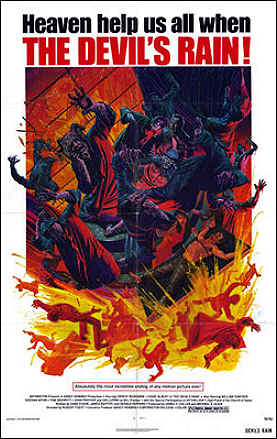
TheDevilsRain

Satanic priest Jonathan Corbis (Ernest Borgnine) has spent decades pursuing the Preston family.  The Prestons, it turns out, have a book of powerful Satanic magic in their possession.  After Corbis causes the Preston patriarch to melt in the rain, Mark Preston (William Shatner) decides to confront Corbis and his followers…

Released in 1975, the Devil’s Rain was presumably made to capitalize on the success of films like Rosemary’s Baby and The Exorcist.  The film itself is a bit incoherent but it’s worth watching just to see shameless overactors William Shatner and Ernest Borgnine acting opposite each other.  The cast also includes Ida Lupino, Keenan Wynn, Tom Skerritt, and Eddie Albert, which means that there’s not a single bit of scenery that doesn’t get chewed at some point.

If watch carefully, you can spot John Travolta making his screen debut towards the end of the film.

Dance Scenes I Love: Saturday Night Fever


70s_films_saturday_night_fever1

There’s no way that you can post a series of classic dance sequences without including at least one scene from Saturday Night Fever.  Even though this scene is nearly 40 years old, it still perfectly captures the excitement and the promise and the pure exhilaration of spending a night out dancing.

That said, I still don’t understand how anyone could mistake John Travolta for Al Pacino.

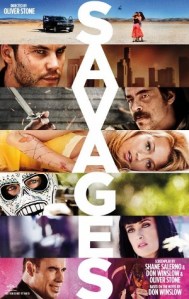
A Quickie With Lisa Marie: Savages (dir. by Oliver Stone)


For the past 5 months,  every time I’ve gone to the movies, I’ve seen the trailer for Oliver Stone’s new film, Savages.  It’s a pretty exciting trailer, featuring sex, violence, and Taylor Kitsch’s abs.  Despite Oliver Stone’s recent track record of making preachy, boring films, that trailer got a lot of people excited about the prospect of seeing Savages

Well, the film has been released, I’ve seen it, and you know what?  Sometimes, trailers lie.

Savages is the story of Chon, Ben, and O.  Chon (Taylor Kitsch) and Ben (Aaron Johnson) sell the greatest weed in the world and O (Blake Lively) is the woman who loves both of them at the same time.  O, by the way, is short for Ophelia and she narrates the film in such a monotonous style that I have to admit that I was shocked to discover that she actually knew she was named after Hamlet’s doomed girlfriend.  Chon is a violent former Navy SEAL while Ben is a laid-back buddhist who wants to get out of the drug business so he can devote his time to environmental activism. (Zzzzzzzzzz….)

Ben’s marijuana becomes so legendary that soon, a Mexican drug cartel led by Salma Hayek decides that both Ben and Chon are going to work exclusively for them.  Ben and Chon refuse so Hayek sends Benicio Del Toro to kidnap O and hold her hostage until Ben and Chon come around.  Ben and Chon, however, have plans of their own…

On the positive side, Hayek, Del Toro, and John Travolta (playing a corrupt DEA agent) all give excellent performances that would seem to indicate that they — as opposed to everyone else involved with Savages — understand that they’re appearing in an expensive B-movie.  They openly devour every piece of scenery in the film and have a fun time wringing every ounce of melodrama out of their pulpy dialogue.  These three actors are fun to watch and it’s a shame that the same can’t be said for the other half of the film’s main cast.

Jennifer Lawrence was originally cast in the role of O but she dropped out of Savages so that she could star in The Hunger Games.  The role was recast with Blake Lively, who looks like she could be Jennifer Lawrence’s older sister but who, as an actress, has never exhibited the type of wounded determination that has become Lawrence’s trademark.  As played by Lively, O is such a passive character that it’s difficult to really care that much about whether she survives or doesn’t.  Instead of being a strong, independent woman who is unashamed of her lifestyle, O just comes across as a spoiled and vapid pawn, a possession who is traded between the film’s various players.  It doesn’t help that Lively delivers her heavy-handed narration in a flat monotone that makes her come across less like a hard-boiled survivor and more like a spoiled rich girl trying to sound jaded.  Every time I heard her refer to Chon and Ben as being “my guys,” I just wanted to scream at the screen, “No, you stupid bitch, you belong to them!  They don’t belong to you!”

As for “her guys,” Taylor Kitsch is believable as a killer but not as a stoner.  (Kitsch’s character comes across as if he’s been snorting cocaine as opposed to smoking weed.)  Aaron Johnson, meanwhile, is a very believable stoner but he’s a lot less believable once his character becomes a killer.  Unfortunately, neither Kitch nor Johnson show much in the way of charisma in this film and that’s a shame because both of them have shown in the past that they are capable of giving good performances.  (Seriously,  just check out Aaron Johnson’s performance in the criminally underrated John Lennon biopic, Nowhere Boy.)  With neither Chon nor Ben being all that interesting, the film ultimately becomes a rather empty display of style.

And there’s no denying it — Savages has got style to burn.  Oliver Stone shows here that — despite such anemic recent films as Wall Street: Money Never Sleeps — he still knows how to film an explosion.  Unfortunately, there’s not much going on beneath all of that style and the end result is a film that mostly succeeds in making both sex and violence boring.

Quickie Review: The General’s Daughter (dir. by Simon West)


The time around the late 1990’s saw a slew of filmmakers who seemed to have been influenced by the filmmaking style of one Michael Bay. In 1998 one such film which had a certain Michael Bay look to it was the crime thriller The General’s Daughter by filmmaker Simon West (fresh off his success from the previous year’s Con-Air). This film adaptation of the Nelson DeMille novel of the same name starred John Travolta when he was still enjoying the second renaissance of his career brought on by his role in Pulp Fiction.

The General’s Daughter was pretty much a crime procedural wrapped around the secretive and insular world of military life. It has Chief Warrant Officer Paul Brenner (played by Travolta) of the Army’s CID investigating what seems to be the apparent rape and murder of a female officer who also happens to be the daughter of the base’s commandant and political-minded general. Brenner’s soon joined by another CID agent, Sara Sunhill (Madeleine Stowe), who must now navigate the insular world which makes up the officer ranks of the military. They find suspects cropping up faster than they could handle and the one prime suspect in base psychologist Col. Moore (James Wood in an over-the-top performance) has secrets about the victim that could jeopardize the lives and career of not just most of the officers on the base but the victim’s own father. This set-up and the basic understanding of the plot should make for a great thriller, but the by-the-numbers direction by Simon West and the over-the-top performances by too many of the characters in the film sinks The General’s Daughter before it could soar.

The story in of itself really has nothing to drag down the film. From the beginning the screenplay does a great job in tossing red herrings to keep the true murderer secret until the very end. It’s these red herrings which manages to bring out the ultimate reason as to the death of Capt. Elisabeth Campbell (Leslie Stefanson) and how a traumatic event in her past became the one major link which would lead to her death early in the film. It’s how these events were acted out which brings down the script. It’s been said that great performances could raise a mediocre script, but the same could be said for the opposite. Very average to bad performances could drag down a great script.

Travolta’s performance was good enough most of the time. He’s especially good when pouring on the Southern charm to try and gain an advantage over those he’s interacting with, but when he suddenly switches over to tough Army investigator that he goes from just beyond campy to over the line into full-blown camp. The same could be said for pretty much everyone in the film from Stowe’s character who manages to just stand around doing nothing but act as a sort of “gal Friday” for Travolta’s character until the very end when she suddenly becomes a crack investigator to help move the plot along. Clarence Williams III really hams it up as the base general’s right-hand man and one would wonder if he realized he wasn’t actually in a grindhouse or exploitation film when it was time to act.

Despite the performances dragging the film down I must admit that The General’s Daughter was quite watchable and entertaining to a certain level. It’s the film’s inadequacies which also makes it quite a disposable fare that should’ve been more. One wonders how the film would be done today with a different set of actors and a filmmaker who knew the nuances of how to navigate around a thriller. Until the inevitable remake from Hollywood gets greenlit (the way things get remade now it’s bound to happen) it’s this version of The General’s Daughter that’d be on record and it’s a film that has too many bad performances for a great screenplay to overcome. A film that ultimately remains mildly entertaining but forgettable in the end.