Retro Television Review: Alexander The Great (dir by Phil Karlson)


Welcome to Retro Television Reviews, a feature where we review some of our favorite and least favorite shows of the past!  This Thursdays, I will be reviewing Alexander The Great, which was filmed in 1963 but didn’t air on CBS until 1968.  The show can be found on YouTube!
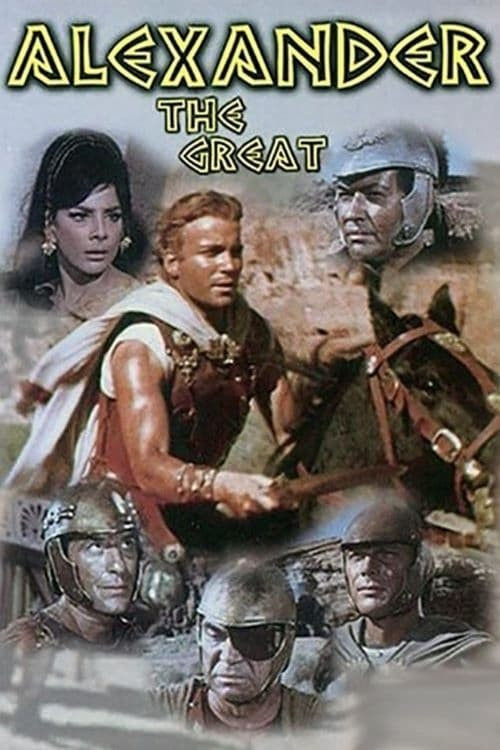
This week, we take a look at William Shatner and Adam West in Alexander The Great, a pilot that never became a series.

Episode 1.1 “Alexander The Great”

(Dir by Phil Karlson, originally aired on January 26th, 1968)

Greek leader Alexander the Great (a very blonde William Shatner) is determined to defeat the forces of King Darius and conquer all of Persia.  But, before he can fight his latest battle, he has to rescue his kidnapped best friend Cleander (Adam West), calm the nerves of his mentor Antigonus (Joseph Cotten), and deal with two insubordinate generals (John Cassavetes and Simon Oakland).  Only then will Alexander be ready to defeat the fearsome, beheading-obsessed Persian general, Memmon (Cliff Osmond, wearing a truly horrifying wig and fake beard).

This hour-long episode features a lot of talking, a lot of scheming, and one good battle scene.  Unfortunately, that good battle scenes becomes a lot less impressive once you discover that it was lifted from the 1959 film, The Giant of Marathon.  As for the scheming, it’s not really a surprise when the generals plays by Cassavetes and Oakland reveal that they’re planning on assassinating Alexander during the battle.  Both characters are so obviously villainous that their very presence amongst the ranks will lead most viewers to doubt whether Alexander is truly the tactical genius that everyone seems to think he is.

For most viewers, the main appeal of Alexander the Great will be the chance to see William Shatner and Adam West playing best friends.  This pilot was made before Shatner was cast as Captain Kirk and West as Batman.  While West gives a relatively sober performance as Cleander, Shatner shows that he had all of his famous acting tics long before he boarded the Enterprise.  Shatner delivers every line as if he’s expecting to be handed an Emmy at any moment.  The halting cadence is present.  The overly dramatic punctuation is present.  The habit of telegraphing every line and emotion by moving his head is present.  This is the type of performance that feels more like William Shatner imitating himself than actually trying to play a character.  Today, we’re all used to William Shatner poking fun at his reputation so it’s always a bit jarring to watch something like Alexander the Great and see just how seriously Shatner used to take himself.

Alexander the Great ends with Alexander achieving victory over both Memmon and his own duplicitous generals.  He buries Antigonous, who was earlier murdered by the mutineers.  And then, with a big smile on his face, Alexander hopes on his horse and rides off with Cleander and his surviving generals.  Watching Shatner riding his horse, it becomes obvious that, had this pilot become a show, it would have been a western that just happened to take place in ancient Greece and which featured togas and mini-skirts instead of chaps and hats.

This pilot was shot in 1963 but it was rejected by the network and shelved.  In 1968, when West was Batman and Shatner was Kirk, the pilot was taken out of storage and aired as an episode of an anthology show.  Needless to say, it didn’t lead to a series.  Adam West later poked fun at the pilot in his autobiography, saying that it was the greatest waste of an hour ever made.  I think West was a bit too hard on the pilot.  It’s not terrible as much as it’s just bland.  No production featuring not only Shatner and West but also Joseph Cotten, Simon Oakland, and John Cassavetes has a right to be this mild.

One does wonder how, if the pilot had become a series, it would have deal with Alexander eventually drinking himself to death.  Imagine what Shatner and West could have done with that!

The Daily Horror Grindhouse: Savage Weekend (dir by David Paulsen)


Savage_Weekend_poster

Filmed in 1976 but not released until 1979, Savage Weekend is the story of a brave boom mic that takes a trip to upstate New York for the weekend and ends up witnessing a lot of decadent behavior and, eventually, a few gruesome murders.  Sadly, the brave little boom mic apparently has no social skills because everyone pretends like they don’t see it, even though it shows up a few dozen times, always floating at the top of the screen.

It’s also the story of Otis (William Sanderson), a local redneck (I’ve never been to upstate New York but I still find it amusing how movies always portray it as being a step away from Deliverance country) who spends his time talking to his father’s gravestone.  Apparently, when Otis was younger, he found out his girlfriend was cheating on him so he branded her with an H.  Why an H?  Because, we’re told, Otis doesn’t know how to spell whore.

Well, okay then…

Actually, if you’ve watched any number of these type of films, you’ll immediately recognize William Sanderson.  Sanderson played a countless number of backwoods weirdos and he always did a pretty good job.  (He also played the poignantly sympathetic J.F. Sebastian in Blade Runner.)  Interestingly enough, in real life, Sanderson has a law degree.

Savage Weekend, incidentally, has a brilliant opening.  After running through the woods, a woman finds herself cornered by Otis.  As Otis approaches her, he gives her a strange little half-smile.  It’s super creepy and scary and the rest of the film never lives up to it.

That said, Savage Weekend is an interesting film, even if it’s not a particularly good one.  I’m not sure if it’s intentional or if it’s a happy byproduct of the filmmaker’s general incompetence but Savage Weekend has a truly surreal feel to it.  It moves at a deliberate, almost dream-like pace.  Characters appear and then vanish for lengthy periods of time.  Plot points are raised and then abandoned.  As a result of an inconsistent script, much is hinted at without ever being truly revealed.  It makes for a very odd viewing experience.

Plotwise, it’s your standard slasher film.  A group of people find themselves in an isolated location and are picked off, one-by-one, by a masked killer.  Whereas most slasher films feature teenage victims, Savage Weekend is distinguished by the fact that all of the victims are adults and they’re all way too old and successful to justify continually making the type of stupid decisions necessary for a slasher movie to work.  Two of them, Robert (Jim Doerr) and Jay (Devin Goldenberg), are stockbrokers.  Marie (Marilyn Hamlin) is the ex-wife of the Governor of New York’s press secretary.  (At one point, someone mentions that the governor was corrupt and apparently committed suicide.  It’s one of those plot points that comes out of nowhere.)  Meanwhile, Marie’s sister, Shirley (Caitlin O’Heany), is accompanied by her best friend, Nicky (Christopher Allport).  Nicky is flamboyantly gay and, shortly after being introduced, he single-handedly beats up three rednecks and then dramatically announced, “I was raised in the Bronx!”

Since the first murder doesn’t take place until an hour into the film, we spend more time than usual getting to know our victims but none of them behave in any sort of consistent manner, which adds to the film’s dreamlike feel.  Nicky clutches a barbed wire fence while watching Shirley fool around with Jay.  Marie appears to be on the verge of touching herself while listening to the story about Otis branding his girlfriend.  Later, a good deal of screen time is devoted to Marie and another redneck milking a cow, with the camera zooming in on the milk shooting out of the udders.  While being stalked by the killer, Nicky puts on makeup while a lingerie-clad Shirley dances through the house while tango music plays on the soundtrack.

It all just feels very odd and strangely paced, as if huge chunks of the script were either not filmed or left on the editing room floor.  But that oddness (along with the boom mic) is exactly what makes Savage Weekend an interesting movie.

Embracing the Melodrama Part II #55: The Tenth Level (dir by Charles S. Dubin)


10thlevelI first found out about the 1976 made-for-tv movie The Tenth Level while I was doing some research on the Milgram experiment.  The Milgram experiment was a psychological experiment that was conducted, under the direction of Prof. Stanley Milgram, in 1961.  Two test subjects were placed in two separate room.  One test subject was known as the “Learner” and he was hooked up to a machine that could deliver electric shocks.  The other subject was the “Teacher.”  His job was to ask the Lerner questions and, whenever the Learner gave an incorrect answer, the Teacher was supposed to correct the error by pushing a button and delivering the electric shock.  With each incorrect answer, the shock would get worse.

Of course, what the Teacher did not know was that the Lerner was an associate of Prof. Milgram’s and that pushing the button did not actually deliver a shock.  The Lerner would intentionally give wrong answers and, after the Teacher pushed each subsequent button, the Lerner would groan in pain and eventually beg the Teacher to stop.  The test was to see how long the Teacher would continue to push the buttons.

The study found that 65% of the Teachers, even when the Lerner stopped responding, continued to push the buttons until delivering the experiment’s final 450-volt shock.  It was a surprising result, one that is often cited as proof that ordinary people will do terrible things if they’re ordered to do so by an authority figure.

The Tenth Level is loosely based on the Milgram experiment.  Prof. Stephen Turner (William Shatner) is a psychology professor who conducts a similar experiment.  Turner claims that he’s looking for insight into the nature of blind obedience but some of his colleagues are skeptical.  His best friend (Ossie Davis) thinks that Turner is mostly trying to deal with the guilt of being a WASP who has never had to deal with discrimination.  His ex-wife, Barbara (Lynn Carlin), thinks that the experiment is cruel and could potentially traumatize anyone who takes part in it.  Turner, meanwhile, is fascinated by how random people react to being ordered to essentially murder someone.

Eventually, a good-natured carpenter/grad student, Dahlquist (Stephen Macht), volunteers.  At first, Turner refuses to allow Dahlquist to take part because he’s previously met Dahlquist and Dahlquist is a friend of one of Tuner’s assistants.  However, Dahlquist literally begs to be allowed to take part in the experiment and Turner relents.

Unfortunately, the pressure of administering shocks proves to be too much for Dahlquist and he has a 70s style freak-out, which essentially means that the screen changes colors and everything moves in slow motion as he smashes up the room.  As a result of Dalquist’s violent reaction, Turner is called before a disciplinary committee and basically put on trial.

The Tenth Level is an interesting film.  On the one hand, the subject matter is fascinating and, if nothing else, the film deserves some credit for trying to seriously explore the ethics of psychological experimentation.  On the other hand, this is a film from 1976 that features William Shatner giving numerous monologues about the nature of man.  And, let us not forget, this is William Shatner before he apparently developed a sense of humor about himself.  That means that, in this film, we get the Shatner that inspired a thousand impersonations.  We get the Shatner who speaks precisely and who enunciates every single syllable.  And let’s not forget that Shatner is paired up with Ossie Davis, an actor who was never exactly subtle himself.

The end result is a film that is both thought-provoking and undeniably silly.  This is a film that will make you think even while it inspires you to be totally snarky.

(Also of note, John Travolta supposedly makes his film debut in the Tenth Level.  Apparently, he plays a student.  I have yet to spot him.)

You can watch it below!