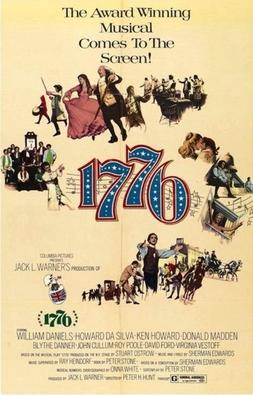
The year is 1776. The British have landed in Canada and are now marching towards New York with the intention of putting down a revolultion that has sprung up over issues like unfair taxation. In Philadelphia, John Adams (William Daniels) is frustrated by the refusal the second Continental Congress to take up debate on whether or not the 13 North American colonies should announce their official independence from Britian. Every day, Adams steps into the chamber and demands that the Congress take some action. And, every day, his fellow deletates sing, “Sit down, John!”
Yes, you read that correctly. They sing it.
Based on a 1969 Broadway musical, 1776 features a lot of singing, a lot talking, and not much else. This is a film about the debate surrounding the writing of the Declaraiton of Independence that sometimes feels as if it’s telling its story in real time. It’s no shock when Benjaming Franklin (Howard Da Silva) continually falls asleep at his desk or when Thomas Jefferson (Ken Howard) sings that he’d rather be home. This is a nearly 3-hour film that feels like 3 months. Some films about the Revolutionary War emphasize the brilliance of the Founding Fathers. Some films emphazie the struggle to be free. Other films emphasize the daily violence of serving in the army. 1776 captures the monotony of being trapped in a room full of cranky middle-aged men who will not stop talking. The film dutifully captures every debate and controversy. When John Adams shouts at everyone to get on with it, it’s hard not to sympathize until you realize that Adams himself is a huge reason why nothing ever seems to get done. There’s only so many hours in the day that can be devoted to singing songs.
Perhaps the most shocking thing about 1776 is that it was realsed in 1972. Nothing about 1776 suggests that it’s a product of the same era in which Bob Fosse was redefining the musical with Caberet and Francis Ford Coppola was refefining the historial epic with The Godfather and John Boorman was risking the lives of Burt Reynolds and Jon Voight to capture a weekend rafting trip. There’s nothing about Peter R. Hunt’s direction to suggest that this film was made in the same era that saw Robert Altman playfully reinventing genres ranging from the service comedy to the detective film to the ensemble musical. At a time when American directors were rebelling against convention and experimenting with new ways to tell stories, 1776 is a lengthy, dramatically inert and stagebound Broadway adaptation. In style and look, it feels like a cinematic product of the 1950s or the early 60s, a film that was made when Hollywood’s only competition was from television. Even Thomas Jefferson’s longing for his wife (Blythe Danner) is played discreetly. When she finally does show up in Philadelphia, Jefferson closes the shudders. When John Adams and Benjamin Franklin notice that the shudders are still closed hours later, it’s treated as a moment for everyone in the audience to turn red as they try not to giggle. They’re having sex, the audience is meant to think, Good thing they’re married! It’s a moment that feels as natural and human as Sandra Dee looking over her shoulder and winking as she goes off with Troy Donahue.
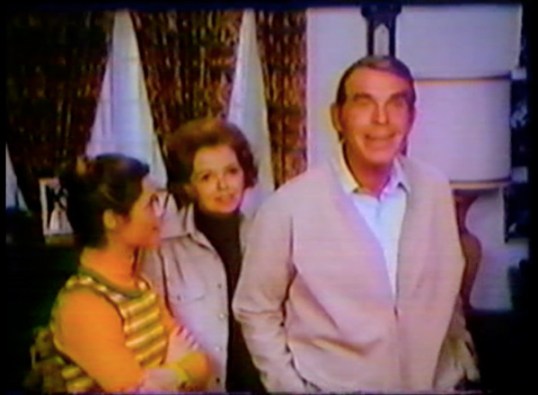
The key to understanding 1776 is to be found in the opening credits. “Produced by Jack Warner.” By the time 1776 went into production, Warner had been a Hollywood mogul for 54 years. He started his career in the silent era and he built Warner Brothers into one of Hollywood’s most successful studios. When he was younger, he was the one breaking the rules, making gangster movies and turning actor like James Cagney, Humphrey Bogart, and Edward G. Robinson into stars. However, by the time he made 1776, Warner was the last of a dying breed. Despite having greenlit Bonnie and Clyde, one of the seminal “Now Hollywood” productions, the older Jack Warner had little use for the Hollywood counterculture. 1776 was reportedly a pet project for Jack Warner, a film that he took a strong hand in producting and which he expected would sweep the box office and the Oscars. Warner recruited the majority of the show’s Broadway cast to appear in the film. Warner personally ordered the remove of a musical number that seemed to discreetly critcize the Vietnam War. Warner even went on TV to promote the film. During an interview on the Merv Griffin Show, Warner launched into a triade about “pinko commies.” I imagine Warner had a point about the communists but it still was probably not the right way to promote the film in the 1970s. While other films invited the counterculture into Hollywood, 1776 was essentially Jack Warner shouting, “Stay off my lawn!” with the voice of William Daniels.
1776 was a last attempt to hold onto the old way of making movies. It was a film about a revolution that was desgined to thwart another revolution. The Continental Congress was menaced by the British. Jack Warner was menaced by the shadows of Coppola, Scorsese, and Friedkin. It would be Jack Warner’s final film as a producer. He died in 1974, still one of the towering figures in the history of Hollywood. Of the old time moguls, only Adolph Zuker and Darryl F. Zanuck outlasted Jack Warner.
When Hamilon first came out in 2025, it was often described as being the antidote to 1776. Hamilton was entertaining where 1776 was stodgy. Well, maybe. 1776 may lack great songs but it doesn’t really have any truly bad ones either. Instead, it’s just a very middle-of-the-road show, inoffensive and designed to keep the tourits happy. Hamilton was viewed as being revolutionary when it was released but now it feels a bit gimmicky, with both the show and the almost religious initial enthusiasm for it feeling like somewhat embarassing artifacts from a different era. (From the coverage during the Hamilton’s heyday, you would think no one but Lin-Manuel Miranda had ever written about Alexander Hamilton or Aaron Burr before.) There is a great film to be made about the Continental Congress but it probably doesn’t invovle any singing.
As for 1776, William Daniels is amusing when he gets frusrated and Blythe Danner is far prettier than the real Martha Jefferson and the film itself is a forgettable tribute to the great men who foudned a great country.
Previous Icarus Files:
- Cloud Atlas
- Maximum Overdrive
- Glass
- Captive State
- Mother!
- The Man Who Killed Don Quixote
- Last Days
- Plan 9 From Outer Space
- The Last Movie
- 88
- The Bonfire of the Vanities
- Birdemic
- Birdemic 2: The Resurrection
- Last Exit To Brooklyn
- Glen or Glenda
- The Assassination of Trotsky
- Che!
- Brewster McCloud
- American Traitor: The Trial of Axis Sally
- Tough Guys Don’t Dance
- Reach Me
- Revolution
- The Last Tycoon
- Express to Terror
- 1941
- The Teheran Incident
- Con Man
- Looker