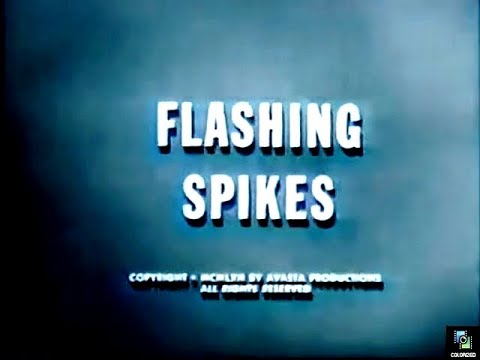
When infielder Bill Riley (Patrick Wayne) makes an error that costs his team the game, sports columnist Rex Short (Carleton Young) claims that he witnessed Bill being paid off by Slim Conway (James Stewart). Slim is a former player who was banned from Major League Baseball after he was accused of taking a bribe from a gambler.
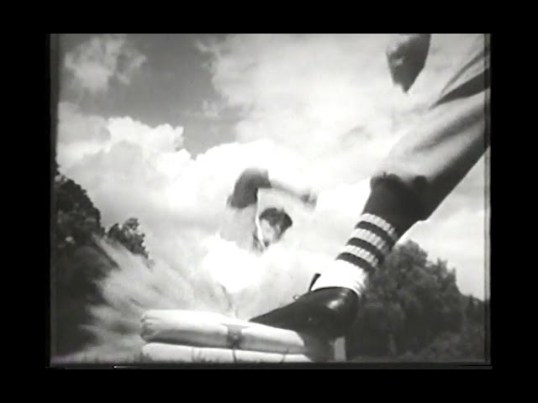
Most the movie is a flashback, showing how Bill first met Slim when Slim was playing for a barnstorming team of former major leaguers. That was my favorite part of the movie. Slim and a collection of old, worn-out men stumble out of their bus and even though they might move a little slower and they might need to stretch a little more before swinging a bat, they still show up a cocky team made up of young local players. Even after the crowd nearly riots when they realize that Slim is one of the players, the old players keep their cool and their eye on the game. After Bill spikes Slim while sliding into home plate, Bill apologizes. Slim remembers the young man’s humility and, working with one of the few friends that he has left in the game, Slim helps Bill get his chance in the Majors.
Usually, when my sister yells at me to come watch something because “it’s got baseball!,” I’m prepared for it turn out to just be a movie with one scene of someone holding a bat. I’m glad that she called me to come watch FlashingSpikes with her because it really is a good and loving celebration of my favorite game. Even after Slim is treated so unfairly by the press, the League, and even some of the fans, he never stops loving the crack of the bats and the cheers of the crowd. FlashingSpikes is unabashedly pro-baseball and Slim stands in for every player who was ever unfairly railroaded out of the game by scandal mongers like Rex Short.
First released in 1979, ….And Justice For All will always be remembered for one scene.
Yell it with me, “YOU’RE OUT OF ORDER! THE WHOLE TRIAL IS OUT OF ORDER! THEY’RE OUT OF ORDER!”
When attorney Arthur Kirkland (Al Pacino) starts screaming in the middle of the courtroom, it’s a cathartic moment. We’ve spent nearly two hours watching as Arthur deals with one insane situation after another. One of Arthur’s partners, Warren (Larry Bryggman), cares more about his car than actually delivering the right documents to a judge. Another of Arthur’s partners, Jay (Jeffrey Tambor), has a nervous breakdown and, after shaving his head, ends up throwing cafeteria plates at people in the courthouse. Arthur has three clients, one of whom is indigent, one of whom is innocent, and one of whom is a wealthy and despised judge (John Forsythe) who has been accused of a rape that Arthur suspects he committed. The system offers no mercy for Arthur’s innocent (or, at the very least, harmless) clients while going out of it’s way to defend the judge. Meanwhile, another judge (Jack Warden), is driven to take suicidal risks, like flying a helicopter until it runs out of fuel and comes down in a nearby harbor. The assistant district attorney (Craig T. Nelson) only cares about his political ambitions and finally, after one incident after another, Arthur snaps. And it’s cathartic because we’re all on the verge of snapping as well.
That final moment, with its signature Al Pacino rant, is such a strong and iconic scene that it’s easy to forget that the film itself is actually rather uneven. The script, by Barry Levinson and Valerie Curtin, owes a good deal to the work of Paddy Chayefsky. Just as Chayefsky often wrote about men being driven mad by institutional failure, ….And Justice For All features character after character snapping when faced with the screwed-up realities of the American justice system. The final “out of order” speech is obviously meant to be this film’s version of Howard Beale’s “I’m as mad as Hell and I’m not going to take it!” speech from Network and, much like George C. Scott in the Chayefsky-written The Hospital, Arthur spends a lot of time talking about what he doesn’t like about his job. The thing that sets ….And Justice For All apart from the best works of Chayefsky is that Levinson, Curtin, and director Norman Jewison all take Arthur Kirkland at his word while one gets the feeling that Chayefsky would have been a bit more willing to call out Arthur on his self-righteousness. Arthur has every right to be angry when Warren forgets to give a judge an important document while Warren is substituting for him in court. At the same time, Arthur is the one who trusted Warren to do it. In the end, the document was not about one of Warren’s client. In fact, Warren knew absolutely nothing about the case or Arthur’s client. The document was about Arthur’s client and Arthur was the one who decided trust someone who had consistently shown himself to not be particularly detailed-orientated. One gets the feeling that Chayefsky would not have let Arthur off the hook as easily as Levinson, Curtin, and Jewison do. Arthur’s perpetual indignation can sometimes be a little hard to take.
It’s a very episodic film. Arthur goes from one crisis to another and sometimes, you do have to wonder if Arthur has ever had any human or legal interactions that haven’t ended with someone either going insane or dying. There’s no gradual build-up to the film’s insanity, it’s right there from the beginning. And while this means the narrative often feels heavy-handed, it also makes that final speech all the more cathartic. It’s an uneven film and, of all of the characters that Pacino played in the 70s, Arthur is probably the least interesting. But that final rant makes up for a lot and, fortunately, Pacino was just the actor to make it memorable. For all it’s flaws, the final few minutes of ….And Justice For All make the film unforgettable.
With the season already underway, football players are going on strike! They want better contracts. They want more money. They want …. well, they want a lot of stuff. Meanwhile, the fans just want to know who is going to make the playoffs. There are only four games left in the season and the Washington Sentinels need to win three of them to make it into the playoffs. The owner of the team (Jack Warden) recruits burned-out coach McGinty (Gene Hackman) to take over a team that will be made up of replacement players. McGinty says that he wants to pick his own players and he doesn’t want any interference from the team’s owner. Anyone want to guess how long that’s going to last?
McGinty’s team is made up of the usual collection of quirky misfits who show up in movies like this. Tight End Brian Murphy (David Denman, who later played Roy on The Office) is deaf. One of the offensive linemen is a former SUMO wrestler. Orlando Jones plays a receiver who has a day job at a grocery store. The kicker (Rhys Ifan) is a Welsh soccer player. (Okay, a footballer, I don’t care, call it whatever you want.) Jon Favreau plays a berserk defender who is a member of the police force. Leading them on the field is Shane Falco (Keanu Reeves), a quarterback with a confidence problem. Cheering for them from the sidelines and falling in love with Shane is bar owner-turned-head-cheerleader Annabelle (Brooke Langton). Backing up Annabelle is a cheer squad made up of former strippers, the better to distract the other teams.
It’s not often you see a film where the heroes cross a picket line but that’s what happens with The Replacements. Then again, it’s not like the folks on strike are driving trucks or unloading freight for a living. They’re multi-millionaires who want even more money and don’t even care about whether the team wins or loses. When the replacement players actually start to win games and become beloved in the city, the striking players react by starting a bar brawl. In the end, striking quarterback Eddie Martell (Brett Cullen) doesn’t even stick with his principles. He crosses the picket line and creates a quarterback controversy, just in time for the last game of the season.
The Replacements is thoroughly predictable but also very likable. The cast gels nicely, with Hackman especially standing out as the gruff but caring coach. Keanu Reeves is not totally believable as a quarterback with a confidence problem. You take one look at Reeves and you don’t believe he’s had an insecure day in his life. But, as an actor, he’s so likable that it doesn’t matter. The same goes for the entire cast, whether they’re on the playing field or singing I Will Survive in jail. I don’t particularly care much about football but I did enjoy The Replacements.
Today, we wish a happy birthday to actor, director, and producer Warren Beatty!
This wonderfully-acted scene that I love comes from Beatty’s 1978 film, Heaven Can Wait. In this scene Warren Beatty plays a character who attempts to convince his friend (Jack Warden) that he has come back from the dead and is inhabiting the body of an old millionaire. (Watch the film, it makes sense.) James Mason plays the erudite angel that only Beatty can see.
Today is not only St. Patrick’s Day! It’s also Kurt Russell’s birthday!
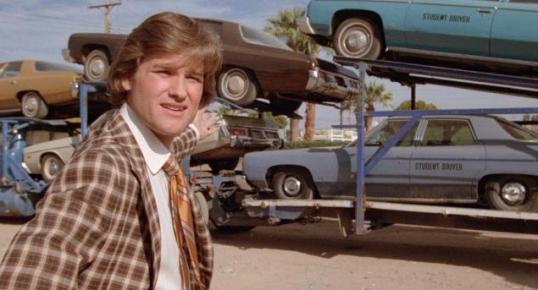
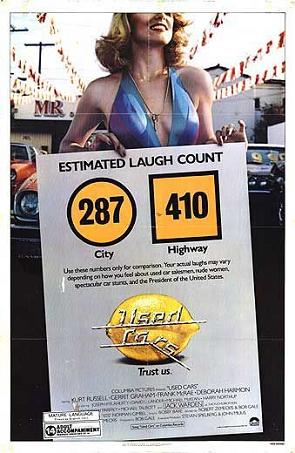
Today’s scene that I love comes from one of my favorite Kurt Russell movies, the wonderful 1980 comedy, Used Cars! In this scene, Kurt’s ambitious used car salesman promotes his senate candidacy and gets some important advice from his mentor (Jack Warden). This scene features both Russell and Warden at their considerable best. Needless to say, if you haven’t watched this film, you need to!
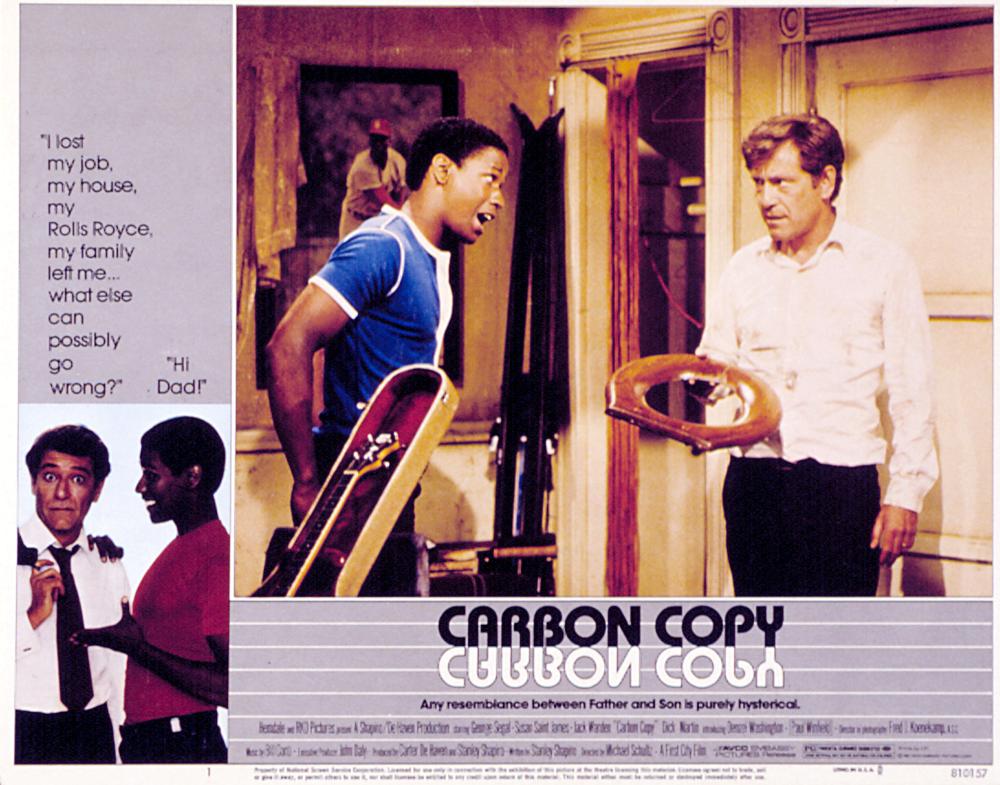
Every Monday night at 9:00 Central Time, my wife Sierra and I host a “Live Movie Tweet” event on X using the hashtag #MondayMuggers. We rotate movie picks each week, and our tastes are quite different. Tonight, Monday March 3rd, we’re watching CARBON COPY starring George Segal, Susan Saint James, Jack Warden, Dick Martin, Paul Winfield, and “introducing” Denzel Washington.
CARBON COPY is the story about a rich, white corporate executive (George Segal) who finds out that he has an illegitimate black son (Denzel Washington). This creates a variety of issues for him at home, at work, and in his social circles.
Although CARBON COPY was chosen by Sierra, I’m looking forward to watching it for the first time for several reasons:
This is the theatrical film debut of one of the all-time great actors in Denzel Washington. Everyone has to start somewhere, and it will be interesting to see Denzel at the very beginning.
George Segal starred in a movie with Rod Steiger called NO WAY TO TREAT A LADY (1968). My dad used to always tell me about this movie. I bought it on DVD and added it to my collection simply because my dad loved it. I even took it to their house one year for our annual Christmas celebration so we could watch it together. That doesn’t have anything to do with CARBON COPY, but it’s always given me a reason to appreciate Segal.
George Segal reportedly turned down the lead role in the film ARTHUR (1981) in order to make CARBON COPY. I enjoyed ARTHUR when I watched it growing up. It will be interesting to see how the two films compare.
Director Michael Shultz also directed movies like COOLEY HIGH (1975), CAR WASH (1976), GREASED LIGHTNING (1977), WHICH WAY IS UP (1977), and BUSTIN’ LOOSE (1981) leading up to CARBON COPY. It will be interesting to see how he handles the material.
So, join us tonight for #MondayMuggers and watch CARBON COPY! It’s on Amazon Prime.
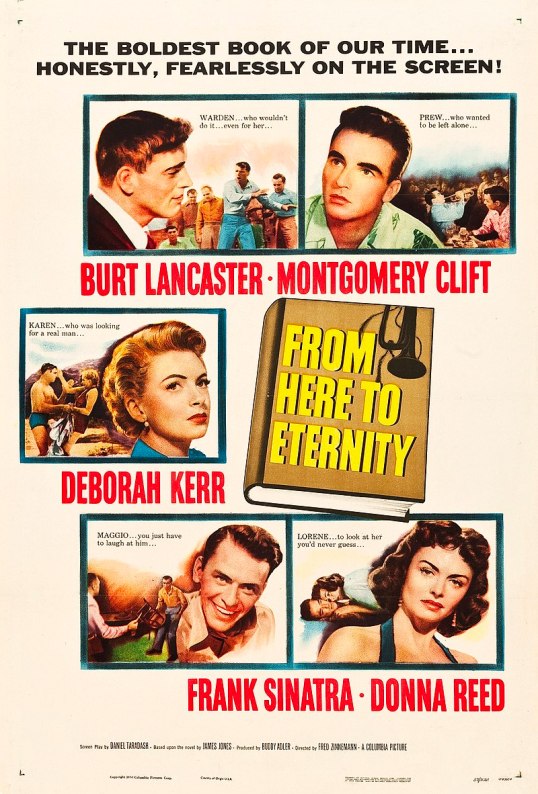
“The boldest book of our time,” shouts the poster art for 1953’s From Here To Eternity, “honestly, fearlessly brought to the screen!”
And indeed, James Jones’s novel was brought to the screen about as boldly as a studio film could be brought in 1953. The book told the story of several soldiers in the days immediately before the attack on Pearl Harbor. The Production Code was still in effect and, as a result, a few changes were made to the film’s plot. Donna Reed played Lorene, a character who is described as being a “hostess” at social club but who, in the book, worked at a brothel that was popular with the soldiers from a nearby army base. In the book, an unfaithful husband gives his wife a venereal disease that leads to her getting a hysterectomy. In the movie, Karen’s (Deborah Kerr) hysterectomy was the result of a miscarriage that occurred after she discovered her husband was being unfaithful. The book was critical of the Army and featured officers who faced no consequences for their actions. The movie definitely presents the enlisted men as being at the mercy of officers but the worst of the officers is ultimately disciplined. The movie was made with the cooperation of the U.S. Army and, as a result, the film’s villains — like Captain Holmes (Philip Ober) and the monstrous Fatso Judson (Ernest Borgnine) — were portrayed as being aberrations who did not represent the Army as a whole. That said, the film version of From Here To Eternity is still a powerful, moving, and daring film. What couldn’t be shown on screen is still suggested. One might not see the specifics of what Fatso Judson does to Maggio (Frank Sinatra) in the stockade but it’s not difficult to figure out.
The film follows one company of soldiers as they laugh, fight, and fall in love while stationed in Hawaii. They spend time training for a war that most of them think will never come. Captain Holmes is more concerned with his regimental boxing team than the prospect of going to war and is confused when Private Prewitt (Montgomery Clift) refuses to stop back into the ring. Prewitt, who takes pride in his ability as a bugler, quit boxing after he blinded an opponent in the ring but Holmes doesn’t care. Holmes wants another trophy for his office. He orders Sgt. Warden (Burt Lancaster) to make life Hell for Prewitt until Prewitt agrees to box. Warden, who has seen a lot of officers come and go and who has been tempted to become an non-commissioned officer himself, is having an affair with Holmes’s wife, Karen. Meanwhile, Prewitt and his friend Maggio spend their time looking forward to the weekends they’re allowed to spend off the base. Prewitt has fallen in love with Lenore but, as with all the men in From Here To Eternity, Prewitt’s true love is for the army. Even with Holmes pressuring him to box, Prewitt’s loyalty is to the men with whom he serves. There’s a lot of drama, a lot of death, and a lot of romance. This is the film in which Burt Lancaster and Deborah Kerr make out on the beach while the tide rolls in. But, when Pearl Harbor is attacked, all of the drama and all of the romance is forgotten as America goes to war.
From Here To Eternity is one of the best films of the 1950s and certainly one of the more worthy winners for Best Picture. Intelligently directed, wonderfully acted, deliriously romantic, and finally rather sad, it’s a film that embraces the melodrama without ever hitting a false note. Burt Lancaster’s rugged weariness, Montgomery Clift’s method sensitivity, Frank Sinatra’s naturalism, Ernest Borgnine’s crudeness, Deborah Kerr’s classiness, and Donna Reed’s earnestness all come together to create a film in which the characters feel real and alive. Warden, Prewitt, Lenore, Karen, and Maggio are all interesting, multi-faceted people, trying to find some sort of happiness in the shadow of an inevitable war. The viewer may sometimes have mixed feelings about their actions (and Borgnine’s Judson is one of the most loathsome roles that the normally likable Borgnine ever played) but you never cease to care about them and their stories. With all of the characters and the affairs and the secrets, From Here To Eternity can feel like a soap opera but it’s also a portrait of a world that is on the verge of changing forever.
A few years ago, I attended a screening of From Here To Eternity at the Dallas Angelika. This is a film that definitely deserves to be seen on the big screen. From the famous scene on the beach to the attack on Pearl Harbor to the tragic final moments, this is a big movie that deals with big emotions and big moments. It’s one of the best.
On New Year’s Eve in 1972, a tragedy struck in the Aegean Sea. Just as the clock hit midnight and its passengers wished each other a happy new year, the cruise ship Poseidon was capsized by a tidal wave. The majority of the ship’s crew and passengers were killed in the disaster but a small group managed to climb up through the wreckage and make their way to the ship’s hull, where they were rescued. Gene Hackman sacrificed his life so that Ernest Borgnine, Red Buttons, Jack Albertson, Carol Lynley, and Pamela Sue Martin could all survive.
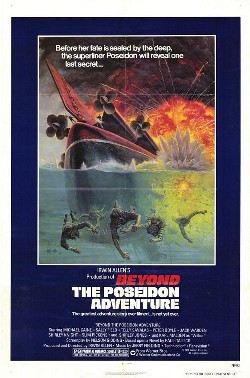
We all know the story of The Poseidon Adventure and some of us have even been goaded by our sisters into singing There’s Got To Be A Morning After for karaoke night at Grandpa Tony’s. (Grandpa Tony’s has since shut down but, for a while, it was the best place in Dallas for nachos and karaoke.) But do you know the story of what happened after that initial group of survivors was rescued from the ship? Have you gone Beyond The Poseidon Adventure?
First released in 1979, Beyond The Poseidon Adventure picks up directly from where the first film ended. Mere minutes after the rescue helicopter flies off, a tugboat pulls up alongside the still capsized wreck of the Poseidon. Needing money to pay off his debts, Captain Mike Turner (Michael Caine) has decided to declare salvage rights and claim all of the cash and jewelry that he can find in the wreckage. Accompanying him is his mentor Dead Meat (Karl Malden) and his protegee, Annoying and Cutesy (Sally Field). Actually, Dead Meat is named Wilbur but, as soon as Karl Malden starts to dramatically grab at his chest, viewers will know that he’s destined to heroically sacrifice himself. Annoying and Cutesy’s real name is Celeste. Sally Field gives perhaps the worst performance of her career as the almost always perky Celeste. This movie came out the same year that Sally Field appeared in the film for which she won her first Oscar, Norma Rae. I have to imagine that Field was happy to win that Oscar because it meant she would never have to do another film like Beyond The Poseidon Adventure.
Before the tugboat crew can begin to explore the Poseidon, another boat shows up. This boat is captained by Stefan Svevo (Telly Savalas), who claims to be a doctor who is responding to an S.O.S. from the capsized ship. Svevo and his crew insist on accompanying the tugboat crew into the Poseidon. It’s obvious from the start that Svevo is not actually a benevolent doctor. For one thing, the men accompanying him are armed. For another thing, he’s played by veteran screen villain Telly Savalas.
The two crews finally enter the ship and …. hey, there’s even more people on the boat! At the end of The Poseidon Adventure, we were told that only six people had survived the disaster but apparently, that was just a damn lie. The ship is literally crawling with people who still haven’t gotten out. (Why didn’t the people who rescued the first batch of survivors check to make sure that they had gotten everyone?) There’s Tex (Slim Pickens), who says he’s from “Big D” and talks about how he owns an oil well (as we all do in Big D). There’s Frank Mazzetti (Peter Boyle, basically playing the same loudmouth that Ernest Borgnine played in the first film) and his daughter Theresa (Angela Cartwright) and Theresa’s new boyfriend, Larry (Mark Harmon). There’s a nurse (Shirley Jones) and a blind man (Jack Warden) and his wife (Shirley Knight). There’s Susanne (Veronica Hamel), the cool femme fatale who has a connection to Svevo.
While Svevo searches for a crate of plutonium (what the Hell was that doing on the Poseidon?), Mike tries to get the survivors to safety. That means once again climbing up to the hull while the ship shakes and the engines continue to explode. Both the first film and the sequel feature the exact same footage of the engines exploding. At this rate, I guess the Poseidon might finally sink sometime this year.
Directed by Irwin Allen (who produced the first film), Beyond The Poseidon Adventure is about as bad as a film could be. The first film had plenty of silly moments but it also had the entertaining spectacle of Gene Hackman and Ernest Borgnine competing to see who could yell the loudest. Beyond the Poseidon Adventure has Michael Caine and Telly Savalas both looking bored while Peter Boyle complains, “That was the worst New Year’s Party I’ve ever been to!” and Sally Field says stuff like, “I’ve been to Anzio! It’s the pits!” At one point, Slim Pickens says that he’s as phony as a three dollar bill. The same could be said of this film. Beyond The Poseidon Adventure looks and feels cheap and generates none of the suspense of the first film.
As Beyond The Poseidon Adventure ended, I found myself worrying that there might be other passengers still stuck on the ship. I mean, apparently, it’s very easy to not only survive on a capsized cruise ship but also to be overlooked by professional rescue crews. Unfortunately, there was not another sequel so those folks were just out of luck.
Today, the Shattered Lens wishes a happy birthday to director Robert Zemeckis!
Today’s scene that I love comes from Zemeckis’s 1980 comedy, Used Cars! In this scene, used car salesman Gerrit Graham interrupts a televised presidential address so that he can demonstrate the best way to deal with inflation.
(Of course, he does the demonstration at a rival used car lot.)
Jack Warden watches as his cars blow up while Graham’s boss (Kurt Russell) tries to keep his business partner (Deborah Harmon) from noticing what is happening on the television.
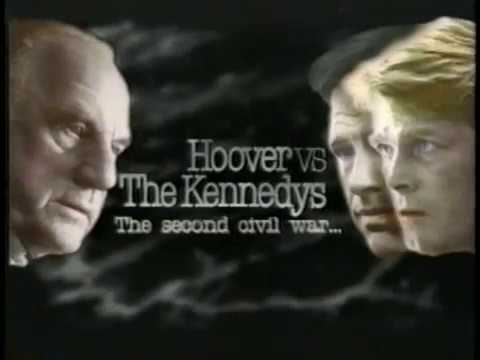
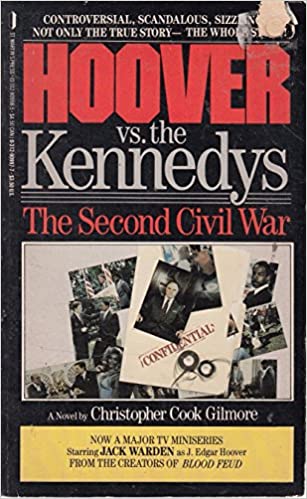
The year is 1961 and the young and dynamic John F. Kennedy (Robert Pine) has been elected president. While the rest of the nation waits to see how Kennedy will lead, FBI director J. Edgar Hoover (Jack Warden) is convinced that he will continue to do what he’s always done. As he explains it to his aide and only friend, Clyde Tolson, Hoover is a longtime friend of President Kennedy’s father, Joseph (Barry Morse). Hoover knows how the Kennedys made their money and he also knows that the Kennedys probably stole the election.
Hoover quickly discovers that John F. Kennedy isn’t going to be like the other presidents under which he has served. Kennedy appoints his self-righteous brother, Robert (Nicholas Campbell), as attorney general and Robert immediately sets out to make Hoover’s life unbearable. When Hoover brings the brothers evidence that civil rights leader Martin Luther King (Leland Gantt) is not only associating with known radicals but that he also cheats on his wife, John and Bobby just laugh at him. While John pursues an affair with Marilyn Monroe (Heather Thomas) and Bobby tries to reign in the FBI’s excesses, Hoover continues to collect information for his files and schemes to outlast both Kennedys.
Hoover vs. The Kennedys was a made-for-TV movie, one of the many films that have been made about the conflicts between the Kennedys and J. Edgar Hoover. Since a good deal of the film is made up of Hoover and the Kennedy Brothers snapping at each other on the phone and then telling their closest aides about how much they dislike each other, it seems hyperbolic to call their relationship the “second civil war.” Though the film does go as far as to suggest that Hoover didn’t make much of an effort to investigate the background of Lee Harvey Oswald, it doesn’t go any further when it comes to the theories surrounding John Kennedy’s assassination. As well, the film is one of the rare ones to not speculate that Hoover and Clyde Tolson were more than just friends. Instead, Hoover vs. The Kennedys concentrates more on all of the scandalous stories surrounding the Kennedy brothers. The mob connections. The womanizing. The arrogance. It’s all recreated here. Perhaps because this was a Canadian production, Hoover vs The Kennedys doesn’t portray anyone positively.
The acting is a mixed bag. Nicholas Campbell is believably abrasive as Bobby while Robert Pine was several years too old to be a convincing JFK. Heather Thomas is an adequate Marilyn Monroe while Leland Gantt comes across as too emotional to be a believable Martin Luther King. (In Gantt’s defense, the movie does not seem to know what to do with the character of King, treating the civil rights icon like a prop to be trotted out whenever some Hoover/Kennedy conflict is needed.) The film’s best performance comes from Jack Warden, who plays Hoover as being a puritanical hypocrite who knows that, no matter who tries to push him out, he’s not going anywhere unless he wants to. Hoover outlasted several presidents and Warden portrays him as being the ultimate political survivor.
As far as Kennedy films are concerned, Hoover vs. The Kennedys is okay but it doesn’t offer up anything new. Some of the most important roles are miscast and the movie never goes into much depth, beyond repeating all of the usual rumors. Jack Warden’s a good J. Edgar Hoover, though. The movie is not easy to find but it has been uploaded on to YouTube. And, if you can’t find the movie, you can always order the novelization off of Amazon.
 Through the Shattered Lens