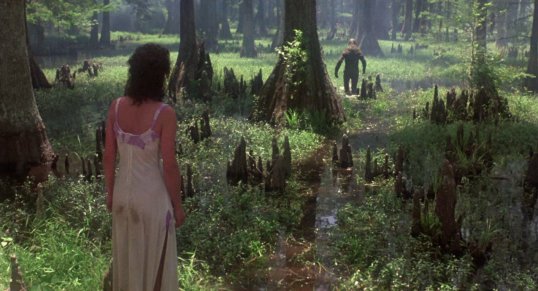
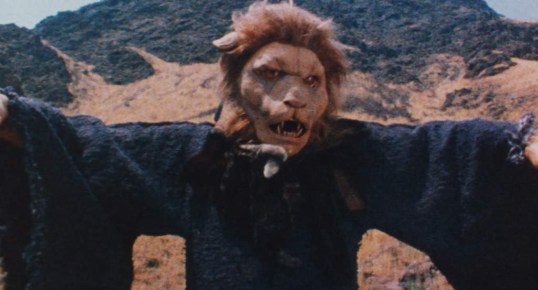
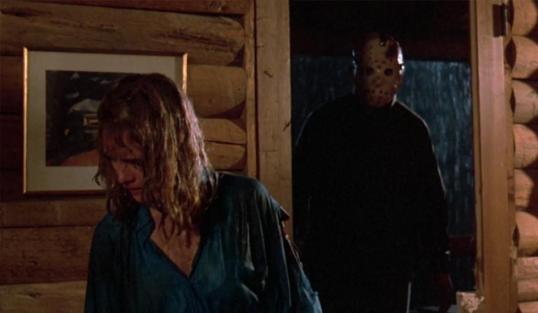
4 Or More Shots From 4 Or More Films is just what it says it is, 4 shots from 4 of our favorite films. As opposed to the reviews and recaps that we usually post, 4 Shots From 4 Films lets the visuals do the talking!
4 Shots From 4 Horror Films
The Shining (1980, dirby Stanley Kubrick, DP: John Alcott)
Swamp Thing (dir by Wes Craven, DP: Robbie Greenberg)
Scalps (1983, dir by Fred Olen Ray, DP: Larry Van Loon and Cynthia Webster)
Friday the 13th: The Final Chapter (1984, dir by Joseph Zito, DP: João Fernandes)
This song appears on the Pet Sematary 2 soundtrack, which might be the best soundtrack to have never been given an official release. In the film, this is the song that plays over the end credits. The video follows the film’s story of the dead rising back to life.
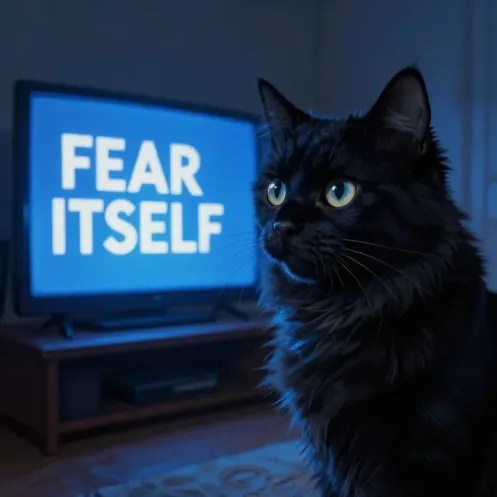
For our final episode of Fear Itself, we have Echoes. In this episode, a man discover that he was a killer in a previous life. Director Rupert Wainwright also directed the remake of The Fog. Does anyone remember that remake?
Though this episode was meant to air in 2008, the show went on hiatus and was then cancelled before it could air. It was finally released in 2009, as a part of the Fear Itself box set.
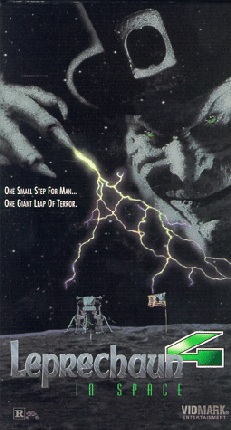
In the far future, the Leprechaun (Warwick Davis) is living on another planet where he’s trying to marry a space princess and he’s interfering with Earth’s mining operations. A bunch of Space Marines show up and take the Leprechaun out. One of the Marines decides to take a leak on the Leprechaun’s remains. The reborn Leprechaun later springs out of the Marine’s penis, which I guess is one of those leprechaun powers that usually goes unmentioned. The Space Marines are in trouble and so is the franchise. A sudden trip into space is usually a pretty good sign that you’ve run out of ideas.
I was hoping that this one, like the second and the third Leprechaun films, would turn out to be better than I remembered but no, it was still pretty crappy. Obviously, continuity has never been too big a deal in these movies but what is an Irish leprechaun doing on a different planet and why does it now take a group of Space Marines to stop him whereas once all it took was Jennifer Aniston? Sending the Leprechaun into space sounds like it should work but the action is slow and the script is lacking in even providing a few good one liners. I don’t think much thought was given to the film, beyond tossing the little guy into orbit.
As always, Warwick Davis is the strength of the franchise. He’s the main reason why I always want these movies to be better than they actually are. Otherwise, Leprechaun 4 doesn’t even work on a camp level. The movie ends with a giant leprechaun hand giving everyone the finger. Was that meant to be for the Space Marines or the audience?
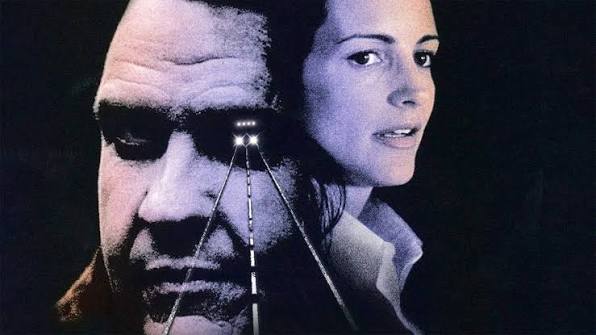
BLACKTOP opens on stand-up comic David (Lochlyn Munro) in the middle of his act at an out of the way truckers bar. His girlfriend Sylvia (Kristin Davis) is at the show, and she doesn’t look very happy. After the show, we find out that David & Sylvia’s relationship is not in a good place at all. She wants to settle down and get married, and he wants to keep performing his shows even though his career is going nowhere. When he tells her he’s agreed to perform three more nights the next weekend at that same place, she blows a gasket and wants to get out of there. Conveniently, a nice trucker named Jack (Meat Loaf), who she had only just met a little earlier, is there handy, and she asks him for a ride out of town in his truck, Goliath. He happily agrees, almost too happily, because it turns out he just might be a serial killer. Sensing something’s off and wanting to get his girlfriend back, David takes off after them, hoping to find them before she becomes the next victim.
That’s the basis for this “mad trucker” thriller that premiered on HBO back in October of 2000. If the story sounds ludicrous to you, just know that it is. It takes a completely stupid decision to kick off the events of the story. Seriously Sylvia, David may be a bit of a loser, but do you have to abandon him and ride off into the night with a trucker you don’t know, who looks like Meat Loaf, just to make a point?!! Don’t you think you may be overreacting?!! Some might say that I’m making too big of a deal about this, that it’s just a plot device to set the story of “terror in a big rig” in motion. You are correct in some ways, but her moronic decision stuck with me through the rest of the movie. Later, when she was supposed to be tough, smart and resourceful, I kept thinking about her dumb decision that put her in this predicament, and how many people had already been killed or seriously maimed because of it.
The story also includes these silly little details like Jack leaving clues for David along the way so that he can have a chance to find them. Somehow Jack can perfectly predict David’s exact route and speed so he can place all these notes at the perfect places on the road, with some of them pretty complicated. And he does this without Sylvia even noticing. Sylvia isn’t exactly the most observant person around. Nothing proves this any more than a scene where Jack has Sylvia sit close to him so he can show her how to drive the big rig. While he’s giving her tips, David is trying to drive up and save her. The mad trucker does all this swerving and slamming on breaks and sliding and plays it all off like he’s just showing her some easy and safe driving moves. Sylvia never realizes David is anywhere near them, and since Jack hasn’t gone full psycho yet, she doesn’t seem to care. Maybe I’m just not that big of a fan of Kristin Davis, either. I never really liked her on SEX AND THE CITY, and I don’t like her that much in this either, even though I did kind of like the scenes where she took off her shirt and wandered around in her bra.
Not to sound like this is pick on Kristin Davis day, because I didn’t care for Lochlyn Munro as David either. He was supposed to be this stand-up comic, but he wasn’t funny at all. I mean some people were laughing because the script said so, but he’s lucky tomatoes weren’t being thrown at him. I found everything bland and boring about him, even though he drove a Red 1959 Edsel. That was actually kind of funny, as he kept taking on the big rig with it. I don’t think I’ve ever seen an Edsel / Peterbilt duel in a movie before, but it happens here several times.
By far the best part of BLACKTOP for me was watching Meat Loaf as Trucker Jack. Loaf had played a villainous trucker in BLACK DOG with Patrick Swayze a couple of years earlier, so the filmmakers must have reasoned that the public wanted more. I’ll admit that his character in this does seem awfully nice at first, and the people around seem to think he’s a pretty good guy too. But he also has this look in his eyes, and when he stops turning on the charm, he’s ready to kill. He’s a kind and empathetic ear to Kristin’s character one moment, and then he’s cutting off someone’s ear with his big knife the next. He’s fixing a nice meal for Kristin one moment, and then he’s shooting at David right in front of her with his high-powered rifle the next. Once she sees that side of him, she starts trying to fight back, and that’s when he gets to go over the top. When he gets to be crazy Trucker Jack, the kind of guy who hangs sides of beef along with murdered victims in the freezer in his truck; those were my favorite parts of the movie.
I know my review sounds very critical in places, and I don’t want to come off too hard on the film. If you’re looking for some solid big rig stunt driving work, and a very simple story featuring a psychopathic truck driver, you could have some fun with this one. Meat Loaf has some fun in his role, so if you’re a fan you should enjoy his work. Just keep your expectations low and don’t ever think that any of the characters are about to make some smart decisions. That seems to be the recipe for enjoying this trip down the BLACKTOP!
Lis and I have been rewatching the Twilight movies this October. Yesterday, we watched New Moon and then Eclipse.
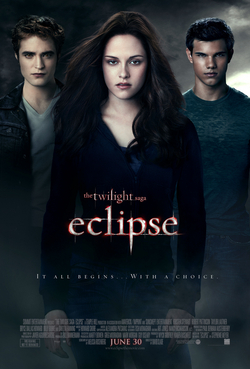
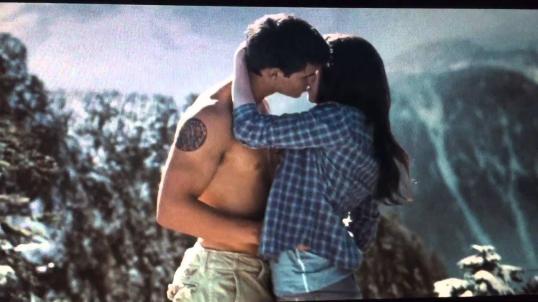
In Eclipse, Edward (Robert Pattinson) and the Cullens have returned to Forks because Edward was just so depressed not being near Bella (Kristen Stewart), and Bella somehow flew all the way to Italy to be with him without getting in very much trouble with her father. Edward has asked Bella to marry him, but Bella is upset that Edward won’t “change me,” and she’s also wondering if maybe she and Jacob (Taylor Lautner) are meant to be more than just friends. The first time I saw this movie, I was Team Edward all the way, but now I see Jacob as being the better choice because he could provide her with a stable and protective home without having to transform her into a supernatural creature beforehand.
While Bella is trying to choose between Edward and Jacob, vampire Victoria Sutherland (Bryce Dallas Howard) is gathering an army of “newborn” vampires to attack the Cullens and kill Bella to get revenge for the death of her lover, James, in the first Twilight film. Alice (Ashley Greene) is having visions of the newborns attacking. The Cullens enter an alliance with the werewolves to keep Bella safe.
There’s a lot going on in this movie. I feel bad for anyone who watched Eclipse as their first Twilight movie because they probably had no idea why Dakota Fanning showing up with her red eyes was such a big moment. Even while Bella is trying to pick between Edward and Jacob and get ready for the big battle, life goes on in Forks. She goes to her high school graduation, where Jessica (Anna Kendrick) is the valedictorian. She’s living both the life of a teenager and being vampire-stalked at the same time. Her father even tries to have “the talk” with her, but it’s not necessary. Edward doesn’t want to turn her into a vampire and he doesn’t want to have sex before marriage. He’s a 104-year-old virgin. That’s how strongly he believes in waiting for someone you love. That’s one of those things that seems sweet the first time you hear it and then obsessive the second time.
I liked Eclipse, even if parts of it seem pretty dumb now. My sister and I both agreed that it was foolish of Bella to ask Edward to make her a vampire before she even knew if they were sexually compatible. Becoming a vampire is an even bigger commitment than going exclusive. But it’s a fantasy. The big battle at the end is exciting and it actually happens instead of just being Alice having a vision. Edward proves that he can fight just as well as Jacob. I still think Jacob would be the better provider.
Today’s Horror on the Lens come to us for director Larry Buchanan.
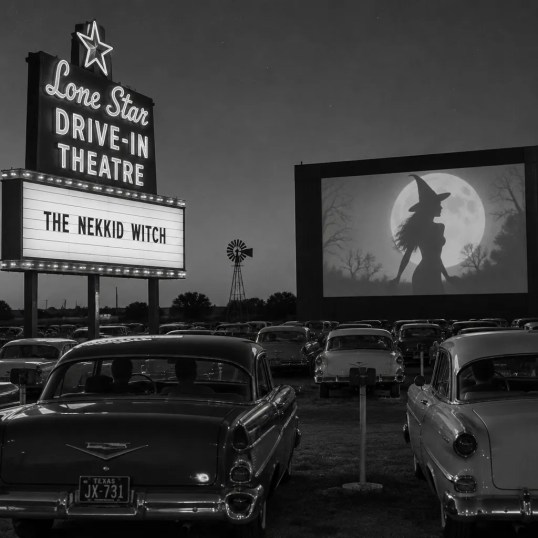
Larry Buchanan was not only born in Texas but he made most of his films here too. In 1964’s The Naked Witch, a college student is doing a research project on the German-speaking villages in Central Texas. It’s while visiting one such village that this idiot accidentally brings an ancient witch back to life. In many ways, this is a typical Buchanan film. The budget is low and the plot is sometimes incoherent. But the film is also fairly atmospheric. In my case, it helps that I’ve actually spent time in Central Texas and I know how creepy things can sometimes get out there.
The youtuber didn’t have a title card; so, I made a scary ghost. I hope that it didn’t scare you too much! This is a parody of “It Follows”, the horror movie based on an STD that follows the next person and kills them. I always liked “It Follows” because if you were a child of the 90s, AIDS always the big warning that if you had sex, you would die. I would always ask; “why can’t I just use a condom?” and the response was always the same- “You’d risk your life for sex?” and me being me, I would respond with – “I thought that I already established that?” and they would pearl clutch.
In this short, the protagonist is a virgin who no one wants; so, he befriends the “It Follows” puritanical evil spirit and does ride-alongs with it as it explodes its victims. I thought it was fairly funny. There were some actual stars in the films and it appeared to have an actual budget, which gave me some nepobaby vibes. The films were ok, but I couldn’t understand how the budget would be this big, but then I saw that the channel has 1 million subscribers and 1 million views even for this short; so, I guess people have low standards.
I mean, it’s not horrible- just aggressively mediocre. If you’re a wonder bread as a burger bun kind of guy, this is for you.
Hi, everyone! Tonight, on twitter, I will be hosting one of my favorite films for #MondayMania! Join us for 2021’s Cheer For Your Life!
You can find the movie on Prime and then you can join us on twitter at 9 pm central time! (That’s 10 pm for you folks on the East Coast.) See you then!