Horror Film Review: The Incredible Shrinking Man (dir by Jack Arnold)


Some films should never be remade and that’s certainly the case with 1957’s The Incredible Shrinking Man.

Why does Scott Carey (played by Grant Williams) start to shrink? While the film does offer up a vague explanation involving chemicals that altered his molecular structure, the film doesn’t waste too much time on the reasons. Instead, what’s important is that he is shrinking. Every day, Scott Carey finds himself getting smaller and smaller and nobody can do anything to stop it. Even the scientific cure proves itself to be only temporary. It’s not just that Scott is getting smaller physically. His confidence is also shrinking. Everything that used to define him as a human being is disappearing. When the press learns that he’s shrinking, he loses his dignity. When he lashes out at the world around him, he loses his self-respect. When he gets angry at his wife, he loses his security. Finally, he’s small enough that, even though he can still speak, he’s essentially lost his voice. He loses the world that he knows and discovers an entirely different world existing within the reality that he once took for granted.

The film is famous for the scene in which Scott, who has been reduced to living in a dollhouse, is attacked by a cat. (Officially, the cat that attacks Scott later played Audrey Hepburn’s cat in Breakfast at Tiffany’s. Rumor has it, though, that Orangey the Cat was actually several different cats who all used the same name.) The cat attack is certainly a bravura bit of filmmaking on the part of director Jack Arnold. Whenever our cats get upset over getting fed a minute or two late, I’m reminded of Scott opening the door of the dollhouse and seeing that giant cat staring in at him. That said, for me, the scariest moment in the film comes at the start when Scott is enveloped in the strange mist that will eventually cause him to start shrinking. It’s such an atmospheric and creepy scene but Arnold is smart enough not to overplay anything. Scott and his wife originally dismiss it as nothing. That’s what most of us do when something strange happens. It’s a scene that also captures the random cruelty of Scott’s fate. If he had simply gone below deck on his boat, he never would have started to shrink. If his wife had remained on deck with him, she would have shrunk with him and Scott wouldn’t have had to face his fate alone.

Jack Arnold is truly the often-unsung hero of The Incredible Shrinking Man. He took the material seriously. Even more importantly, he stuck with screenwriter Richard Matheson’s ending. When the studio insisted that the film should end with Scott returning to his full height, Arnold refused to shoot it and, amazingly, the studio didn’t make him. Even when test audiences said that they would have liked the film better if Scott had returned to his original height, the studio released Jack Arnold’s version of the film. Not many studios would have the guts to do that today. (Then again, after 20 years of comic book movies, audiences would probably just assume that Scott was going to turn into a superhero and not get upset.) The film ends with the triumph of Scott defeating a spider, but it also ends with Scott still shrinking and we’re left to wonder what could be smaller than microscopic.

I’m normally not a huge fan of science fiction but The Incredible Shrinking Man is a great film. Occasionally, there will be a report of someone wanting to remake it. Hopefully, it’ll never happen. The Jack Arnold/Richard Matheson version is the only one we need.
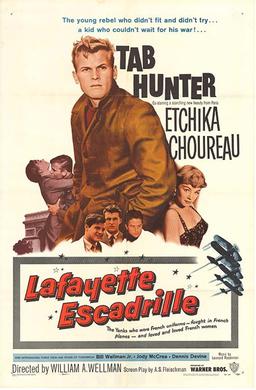
Lafayette Escadrille (1958, directed by William Wellman)


In the days leading up to World War I, spoiled rich kid Thad Walker (Tab Hunter) flees Boston after getting hit with a car theft charge and ends up in Paris.  He befriends a group of American expatriates (including David Janssen, Will Hutchins, Jody McCrea, and William Wellman, Jr.) and eventually joins the French Air Force as a members of the Lafayette Escadrille.  Thad also falls in love with a French prostitute named Renee (Etchika Choureau) and, after Thad strikes a French officer, he goes on the run with her.

I always wonder how many people have watched this film over the years because of the presence of a young Clint Eastwood in the cast, just to discover that he doesn’t get many lines and his character is largely interchangeable with the other young actors playing the members of the Lafayette Escadrille.  This is a Tab Hunter movie, meaning that the action is dominated by Hunter’s sincere but bland screen persona.  Director William Wellman wanted to cast Paul Newman in the lead role and that would have been something to see.  Instead, the studio insisted on Hunter.  They also insisted that Wellman change the film’s ending so that Hunter could survive instead of getting shot down on his very first mission.  William Wellman was so disgusted with the studio that he retired from directing.

What had to make it all especially galling for the director was that Lafayette Escadrille was based on his own life.  His son, William Wellman Jr., plays “Bill Wellman” in the film and Thad was based on actual friend of Wellman’s.  The film was meant to be a tribute to his friends, many of whom did not survive World War I.  Instead, the studio insisted that it be just another Tab Hunter service comedy.  The best scenes are the ones where it’s just Thad and his friends trying to make it through basic training.  Unfortunately, those scenes are overshadowed by Thad on the run.

The film is still there for those of us who enjoy catching future stars.  Clint Eastwood, David Janssen, Tom Laughlin, Will Hutchins, Brett Halsey, and Jody McCrea are all present and accounted for.  Rumor has it that James Garner can spotted in the background but I couldn’t find him and Garner had already co-starred with Brando in Sayonara when this move was made so I doubt he was doing background work.  Tab Hunter’s blandness sinks the production but the rest of the cast would go on to better things.

Cleaning Out The DVR: Picnic (dir by Joshua Logan)


Original_movie_poster_for_the_film_Picnic

Tonight, I continued to clean out the DVR by watching the 1955 film Picnic.

Now, Picnic is kind of a strange film.  It’s one of those films from 50s that takes place in a small town where everyone is obsessed with sex but, since it’s the 1950s, nobody can just come out and say that they’re talking about sex.  So, instead, all of the dialogue is very discreet.  For instance, when Madge Owen (Kim Novak) talks to her mother, Flo (Betty Owens), about her date with her boyfriend, Alan (Cliff Robertson), Madge confesses that they spent the night kissing.  Flo asks if Madge if they have done anything more than kiss but, of course, she never comes straight out and says what “more” would be.  The audience knows what she’s talking about but it’s as if the world would actually end if anyone actually uttered the word.  “Oh mom!”  an embarrassed Madge says before confirming that she and Alan haven’t done anything more than kiss.

Flo desperately wants Madge to marry Alan because Alan is rich and his father owns the town’s grain elevator.  Marrying Alan would allow Flo to move up in the town’s strict social hierarchy.  However, Madge isn’t sure that she loves Alan.  Certainly, Alan seems to be a good man with a good future but he’s not a romantic.  Instead, he is someone who has his entire life already mapped out for him.

On Labor Day, a stranger comes to town.  His name is Hal Carter and he shows up riding on a freight train.  He’s come into town to see his old friend, Alan.  It turns out that Hal and Alan went to college together and were members of the same fraternity.  Hal was a star football player but he eventually flunked out of school and has spent the last few years drifting around the country.  However, Hal is now ready to settle down and he wonders if his old roommate Alan can get him a job at the grain elevator.

Now, here’s the strange part.  Hal is played by William Holden.  When he made Picnic, William Holden was 38 years old and looked closer to being 45.  (By contrast, Cliff Robertson, in the role of his former college roommate, was 32 and looked like he was 25.)  Hal spends a lot of time talking about his traumatic childhood and how he is finally ready to settle down and start acting like an adult.  In short, Hal talks like a 30 year-old but he looks like he’s nearly 50.  It’s odd to watch.  But even beyond the age issue, William Holden was an actor who always came across as being both confident and cynical.  Hal is a secret romantic with a deep streak of insecurity.  As great an actor as he may have been, William Holden is so thoroughly miscast here that it actually becomes fascinating to watch.  It brings a whole new subtext to the film as you find yourself wondering why no one is town finds it strange that a middle-aged man is still struggling to deal with his childhood.  When all the town’s young women ogle that shirtless Hal, it’s as if he’s wandered into a town populated only by teenagers with daddy issues.

(Paul Newman played the role of Hal in a Broadway production of Picnic.  And really, that’s who the ideal Hal would have been, a young Paul Newman.)

The majority of the film takes place at the town’s Labor Day picnic, where almost every woman in town is driven to distraction by the sight of Hal dancing.  Even the spinster teacher, Rosemary (Rosalind Russell), is so turned on by Hal’s masculinity that she makes a pass at him and accidentally rips his shirt.  Of course, some of Rosemary’s behavior is due to the fact that she’s drunk.  Her date, the befuddled Howard Bevans (Arthur O’Connell), made the mistake of being whiskey to the picnic.

Hal also dances with Madge’s 13 year-old sister, Millie (Susan Strasberg).  I have to admit that, even though I related strongly to Madge, Millie was my favorite character in the film.  Millie wears glasses and can recite Shakespeare from memory.  She knows that everyone around her is full of it and she’s willing to call them on it.  Of course, Millie herself ends up with a crush on Hal and it’s a dream for her when she finally gets to dance with him.

(Strasberg was 17 years old but is believable as a 13 year-old.  At the same time, since Hal appears to be nearly 50, his sudden closeness to Millie carries an icky, if unintentional, subtext.)

But then Madge suddenly appears, wearing a pink dress and literally emerging from the black night.  She starts to sway to the music.  As she slowly approaches Hal, he forgets about Millie and soon is dancing with Madge.  It’s actually a rather striking scene, one that so full of dream-like sensuality that it almost seems more like it was directed by surrealist David Lynch as opposed to the usually workmanlike Joshua Logan.

(In the video below, the scene freezes about 12 seconds in, before starting up again at the 16 second mark.  This is a glitch with the upload and is not present in the actual film.)

Needless to say, a drifter can’t just come into town and steal his ex-roommate’s girlfriend without drama following.  Picnic starts out as a slightly overheated examination of small town morality and then, after about an hour, it goes the full melodrama route, complete with police chases, stolen cars, a fist fight in an ornate mansion, and a lot of big speeches about the importance of love.  Needless to say, it’s all a lot of fun.

Picnic was nominated for best picture of the year.  However, it lost to the far more low-key Marty.