1989’s American Rickshaw opens in Florida. Scott Edwards (played by Olympic gymnast Mitch Gaylord) is a college student who pays the bills by pulling a rickshaw through the streets of Miami. One day, he sees an elderly Asian woman (Michi Koba) sitting by herself at a bus stop. When it starts to rain, he offers her a free ride home. Though Scott was just being nice, it turns out that this is the most important thing he’s ever done. The woman is a witch, and when Scott is subsequently implicated in the murder of the son of televangelist Rev. Mortom (Donald Pleasence), she uses her powers to help him escape both the police and the hitman trying to track him down. The witch, aided by both a cat and a cobra, has a history of her own with the duplicitous Rev. Mortom.
American Rickshaw is an odd hybrid of a film. In many ways, it’s a standard action film. Gaylord plays Scott as a lovable loser who gets set up by a stripper named Joanna (Victoria Prouty) and Jason Mortom (Gregg Todd Davis). While Joanna seduces Scott on a boat, Jason hides behind a two-way mirror with a video camera. When Scott hears Jason behind the mirror, he breaks Jason’s camera and leaves the boat with a videotape he thinks features him and Joanna. Only later does he discover that he grabbed the wrong tape. When Scott returns for the correct tape, he discovers that Jason has been murdered. With the hitmen determined to get the tape Scott did take, he ends up getting chased all over Miami.
At the same time, it’s a horror film. The witch uses her powers to help Scott, which means there are scenes of hitmen suddenly seeing a snake approaching them. The witch’s cat also shows up and stares at the ocean until Scott finally realizes he’s meant to dive in so he can find a clue. It’s established that the witch has a magical past with the demonic Rev. Mortom and that Mortom himself is involved in his own son’s murder. “He’s the devil!” Mortom’s wife (Judy Clayton) yells at one point, and it turns out she’s pretty much right.
This, of course, is all a polite way of saying that the film doesn’t make much sense, but anyone familiar with the films of Sergio Martino will not be surprised to hear that. Like many of the great Italian horror and thriller directors, Martino was always more interested in a few strong set pieces than in a coherent plot. American Rickshaw is more about the chase than the destination, and there are enough weird moments to keep things entertaining. Mitch Gaylord is just as blandly engaging here as he was in American Anthem. (“Steve Tevere has thrown a tripus!”) What Gaylord may have lacked in range, he made up for with earnestness.
Of course, the main attraction here is Donald Pleasence, playing the televangelist with an appropriately predatory glint in his eyes. Pleasence doesn’t get a lot of scenes, but, as always, he’s a memorable presence and he commands the screen whenever he does show up. The reverend is such a strange character that it’s hard to think of any actor other than Donald Pleasence in the role.
American Rickshaw is one of those films that seems to get a lot of bad reviews, largely from people who aren’t familiar with the unique style of Italian exploitation films. Personally, I think it’s impossible not to enjoy something as weird as this film. Seriously, how can anyone resist Donald Pleasence and Mitch Gaylord in the same movie?
“I fear that the only way to stop those possessed by the spirits of the book is through the act of… bodily dismemberment.” — Professor Knowby
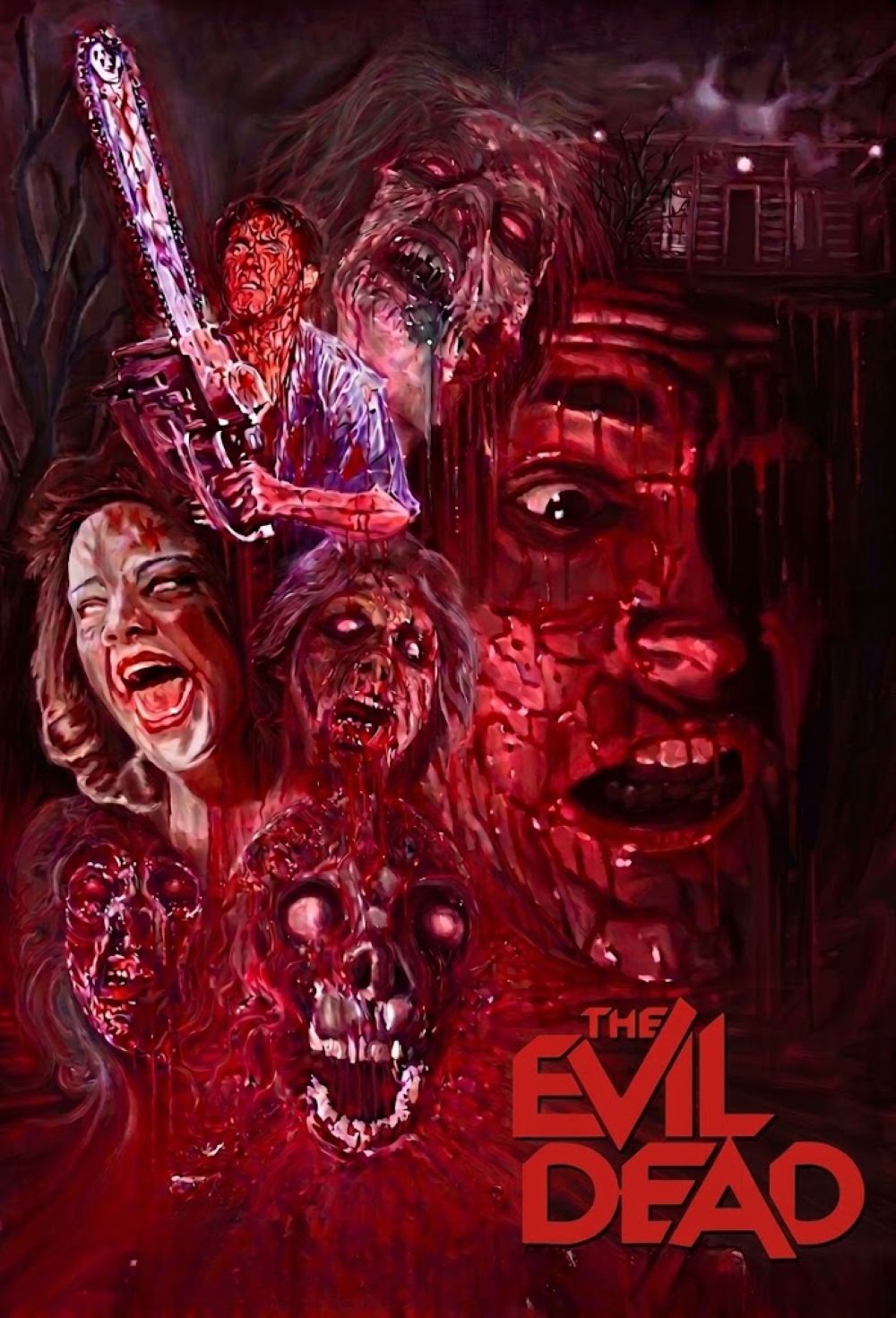
The Evil Dead is the kind of movie that feels like it should not have become a classic, at least not by conventional standards. It was made cheaply, filmed under brutal conditions, packed with unknown actors, and built around an extremely simple premise: five college friends head to an isolated cabin in the woods, unwittingly awaken an ancient evil, and spend the rest of the night being torn apart by demonic forces. Yet more than four decades later, Sam Raimi’s 1981 horror debut remains one of the most energetic, inventive, and genuinely nasty independent films ever made. It is rough around the edges in ways that are impossible to ignore, but those rough edges are a major part of its appeal. The Evil Dead feels handmade, hungry, and a little bit unhinged.
The story starts with Ash Williams, his girlfriend Linda, Ash’s sister Cheryl, and their friends Scotty and Shelly arriving at a remote Tennessee cabin for what is supposed to be a relaxing getaway. It is one of the most familiar setups in horror history now, but Raimi and his collaborators made it feel threatening before the real violence even begins. The cabin is decrepit, damp, and isolated to an almost absurd degree. There is no real sense of civilization nearby. The forest itself seems hostile, with tangled trees, strange sounds, and an atmosphere that makes the woods feel less like a location and more like a living organism surrounding the characters.
The group soon discovers a cellar beneath the cabin, where they find an ancient book bound in flesh, a dagger, and a tape recording left by an archaeologist. The recording describes the Necronomicon, a book of demonic incantations, and naturally the characters make the worst possible decision by playing the tape aloud. That act releases the evil presence that has been lurking in the forest, and the movie moves quickly from creepy cabin story to all-out supernatural nightmare. The concept is simple, but it gives Raimi room to focus on mood, visual invention, and escalation rather than complicated mythology.
What makes The Evil Dead special is how aggressively Raimi directs it. Even in his first feature, he had a style that was impossible to mistake for anyone else’s. The camera is constantly moving, lunging through the woods, creeping around corners, tilting at unnatural angles, and racing toward people as if the audience has become the demon’s point of view. The famous “demon-cam” shots are still startling because of how physical they feel. The camera does not glide elegantly. It charges. It crashes through the environment. It feels like something has broken loose and is hunting the characters.
That restless filmmaking gives the movie a personality far larger than its budget. Raimi turns limitations into an advantage. The cabin becomes a maze of shadows, floorboards, trap doors, windows, and hidden spaces. A cheap-looking hallway can suddenly become terrifying because the editing, sound design, and camera movement make it feel unstable. Raimi understands that horror does not always come from seeing a monster clearly. Sometimes it comes from the sense that the camera itself has stopped behaving normally, that the space around the characters is warping, and that even the trees outside are watching them.
The special effects are another major reason the film still has such a devoted following. They are obviously practical, often messy, and occasionally so exaggerated that they cross into dark comedy, but they have a tactile quality that modern digital effects often lack. The possessed characters look genuinely diseased and wrong: pale skin, dead eyes, rotting makeup, distorted faces, and unnatural movements. When the deadites attack, they do not simply become generic zombies. They taunt their friends, laugh at them, imitate their voices, and enjoy causing emotional pain. That cruel playfulness makes them more disturbing than ordinary monsters.
The makeup work on the possessed Cheryl, Shelly, and Linda remains especially effective because it turns familiar faces into grotesque masks. Ellen Sandweiss, Betsy Baker, and Theresa Tilly bring an unsettling intensity to those transformations, switching from frightened victims to shrieking, mocking demons. The performances are broad and theatrical, but that is exactly what the material needs. Nothing in The Evil Dead is subtle for very long. The film keeps pushing the characters past the point of normal human behavior until they are laughing, screaming, convulsing, and bleeding all over the cabin.
Bruce Campbell’s Ash is interesting because he is not yet the wisecracking, chainsaw-handed cult hero he would become in the sequels. In The Evil Dead, Ash is mostly an ordinary young man who slowly realizes he is trapped in a situation beyond comprehension. Campbell is still charismatic, and there are flashes of the physical comedy and wild-eyed determination that would define the character later, but this version of Ash is more vulnerable. He panics, hesitates, and suffers. By the end, he looks exhausted in a way that feels earned, covered in sweat, dirt, blood, and trauma.
That difference gives the original movie its own identity within the larger Evil Dead series. Evil Dead II would remake and expand many of the first film’s ideas with more money, more comedy, and a much more overtly cartoonish sensibility. Army of Darkness would take Ash into full fantasy-adventure mode. Those later films are arguably more polished and more immediately entertaining, especially for viewers who love Campbell’s comedic performance. But The Evil Dead has a rawness that the sequels never tried to reproduce. It is a horror movie first, even when its excesses become funny.
The film’s tonal shifts are one of its most fascinating qualities. Raimi clearly understands that grotesque violence can become absurd if it is pushed far enough, and the movie occasionally seems aware of its own madness. A possessed hand reaches through a window. A character gets stabbed with a pencil in one of the film’s most infamous scenes. Bodies erupt in streams of colored goo rather than realistic blood. The final destruction of the deadites is so elaborate that it feels like Raimi and his effects team were determined to empty every container of slime they had available. It is disgusting, but it is also gleefully imaginative.
At the same time, The Evil Dead can be more unpleasant than people remember. Its treatment of Cheryl in the woods is difficult to watch and remains one of the film’s most controversial moments. The scene is meant to establish the cruelty and violation associated with the demonic force, but it is not necessary to enjoy the movie, and it has aged badly compared with the more comic-book brutality of later entries. Raimi himself would move away from that kind of material in the sequels. It is worth acknowledging because the scene changes the tone of the film and may be a deal-breaker for some viewers.
The sound design helps make the movie feel more oppressive than its modest production would suggest. The woods groan, doors bang, voices echo from impossible places, and the demonic chants on the tape recording create a sense that something ancient has been invited into the cabin. Joseph LoDuca’s score adds another layer of unease, using shrill strings and harsh musical stabs to make even quiet scenes feel unstable. The soundtrack is not trying to be elegant. It is trying to make the viewer tense up, and it succeeds.
There is also something inspiring about the movie’s independent spirit. Raimi, Campbell, producer Robert Tapert, and their crew famously made the film through determination, ingenuity, and a willingness to endure conditions that sound miserable in retrospect. You can feel that effort on screen. Every strange camera angle, handmade prop, and splattering effect carries the energy of filmmakers trying to prove they can do something bigger than their resources should allow. The Evil Dead does not hide its budget. It turns that budget into part of its legend.
For horror fans, the movie is essential not because it is flawless, but because it is so alive. It captures the feeling of discovering a forbidden VHS tape or stumbling into a midnight screening where the audience is laughing, cringing, and yelling at the screen. It is scary in places, silly in others, and relentlessly committed to its own bizarre nightmare logic. Raimi would go on to make superhero movies, westerns, thrillers, and studio blockbusters, but the wild visual imagination that defined his career is already fully visible here.
The Evil Dead is a scrappy, blood-soaked supernatural horror movie that earns its reputation through pure filmmaking nerve. Its story may be basic, its acting may be uneven, and some of its material has not aged gracefully, but the movie’s pace, practical effects, demonic imagery, and manic camerawork remain unforgettable. It feels less like a carefully manufactured horror product than a curse someone managed to put on film. That is why it still works: Raimi and his team did not just make a movie about evil invading a cabin. They made the entire movie feel possessed.
In 2025’s Amityville La Llorona, a couple (played by director Jamie Grefe and Sloane Tower) move into a house and spend the entire time arguing about every little thing. Eventually, the husband has visions of a mysterious woman (Skya Theobold) and a strange figure who keeps shouting, “Mama! Mama!” The film is only 63 minutes. Unfortunately, the dialogue is largely improvised and it takes forever for anything to actually happen in the movie. I felt every one of those 63 minutes.
Since there’s really not a helluva lot to say about the film, let’s talk about La Llorona.
The legend of La Llorona is a well-known one in Mexico and the southwestern half of the United States. It’s a story that I was told by both my mom and my aunts and, as a result, I never went off with a stranger while I was growing up. Of course, I also had some pretty intense nightmares but that’s kind of the point. If someone tells you the story of La Llorona and you don’t end up having a nightmare about being drowned by a weeping woman, they didn’t tell the story correctly.
La Llorona was originally named Maria. She lived, in a rural village, with her family and she was famous for both her beauty and her virtue. When a wealthy nobleman saw her and immediately proposed to her, Maria accepted. However, the nobleman’s father was upset that his son was marrying into a poor family and he refused to accept Maria as his daughter-in-law. Maria and her husband ended up having two sons and living in a house by the river. Maria’s husband doted on their sons but he ignored her and eventually, Maria learned that he was having an affair.
In a fit of blind rage, Maria drowned her children in the river. After realizing what she had done, Maria died of grief. However, when she arrived at the gates of Heaven, she was asked why her children were not with her. When Maria explained that she had lost them, she was told that she would not be allowed to enter Heaven until she found them. Now, known as La Llorona (or “the weeping woman”), she wanders the Earth, crying and looking for her children.
Where does one find La Llorona? It depends on who is telling the story. Some stories say that you’ll only see her near a body of water. My mom used to tell me that La Llorona could be anywhere, including under my bed or in the bedroom closet. Regardless of where you might find her, La Llorona is always wearing her wedding dress and she’s always sobbing. Approach her and she’ll grab you and either kidnap you or drown you, all the while begging for forgiveness. Many have seen La Llorona but few have survived to tell the story.
“And thatis why we do not talk to strangers,” my mother would say while I looked out the bedroom window, searching for the sight of La Llorona walking through the Texas night.
Though Skya Theobold’s character is credited as being La Llorona in Amityville La Llorana, she doesn’t have much in common with the true La Llorona. Then again, this film also has nothing to do with any of the previous Amityville films. Amityville, as either a town or franchise, is never mentioned in this film. Normally, I’m willing to cut an exploitation film a little bit of slack when it comes to having a misleading title. Usually, that’s just a part of the game. In this case, though, it just serves to remind me of how cool a film about the real La Llorona visiting the real Amityville house would have been.
As I mentioned earlier, the dialogue in this film appears to have been improvised. One of the unfortunate things about improv is that everyone thinks that can they do it. They think that as long as they’re given a scene to play, they’ll be able to come up with appropriately compelling dialogue. This film proves that is not always the case. As I watched Amityville La Llorona, I found myself hoping that Michael Scott would kick open a door and shout, “MICHAEL SCARN, FBI!”
Michael Scarn in Amityville. Now that would be a movie!
In 1973’s Psychomania, Tom Latham (Nicky Henson) is the leader of The Living Dead, a motorcycle gang identified by their skull masks, their bad attitude, and their bizarre love of folk music. Under Tom’s leadership, the members of The Living Dead terrorize the small English town in which they live. They also spend a lot of time hanging out at the cemetery. Tom is death-obsessed. While talking to his girlfriend, Abby (Mary Larkin), Tom suggests that they should kill themselves. “Not that again, Tom,” Abby sighs.
One of the more clever aspects of Psychomania is that, for all of his attempts to be a nihilistic rebel who refuses to conform to the demands of society, Tom is actually a spoiled rich kid who is devoted to his mother (Beryl Reid) and who is still looked after by his butler, Shadwell (George Sanders). Tom’s followers may all be from the lower classes, but Tom most definitely is not. Instead, Tom is very much aware that his mother and Shadwell worship a toad god that can give its followers eternal life, but only if they kill themselves first. After Tom does kill himself, the members of The Living Dead bury him sitting on his motorcycle. He later bursts out of the ground on that same motorcycle and leads his followers on a rampage. Soon, nearly every member of The Living Dead has committed suicide and come back to life as an immortal. The only holdout is Abby.
Psychomania is an enjoyable, chaotic combination of genres. When they first appear, Tom and The Living Dead feel as if they came straight over from one of the many British films about the ’60s rivalry between the rockers and the mods. The Living Dead love their motorcycles and their leather jackets, and they’re not going to let anyone tell them what to do. They’re the type of characters who have appeared in countless biker films. It’s easy to imagine Tom looking at himself in a mirror and trying to imitate Marlon Brando as he says, “What have you got?” However, the film then adds a dash of the witchcraft films popularized by Hammer and Amicus in the late ’60s. Indeed, Tom’s fussy mother and the urbanely sinister Shadwell almost feel like parodies of the type of characters who appeared in those films. (It’s impossible not to smile when the giant toad appears.) The Living Dead then literally become the living dead and prove themselves to be just as relentless as the zombies in the films of George Romero. (That said, the self-amused bikers have more in common with the sanity-deprived characters in Romero’s The Crazies than with the shambling corpses of Night of the Living Dead.) The film ends on a note of sudden reversal, one that brings to mind countless Roger Corman films that featured villains who just didn’t know when to quit.
With all those different genres mashed together, it’s no surprise that Psychomania’s tone is all over the place. Moments of humor and parody are mixed with scenes of the resurrected Living Dead terrorizing their small town and Tom’s mother worrying, along with Shadwell, that perhaps Tom was too immature to be given immortality. Between the suicide montage, the giant toad, and the sight of Tom being buried while sitting on his motorcycle, Psychomania is relentlessly strange and all the more enjoyable for it. Director Don Sharp doesn’t let the action lag, and the film’s mix of bright color, biker imagery, and campy magic combine to make it a truly enjoyable work of pop art.
George Sanders committed suicide shortly after completing this film. He left behind a note that reportedly read, “I’m bored.” He doesn’t have a huge role in Psychomania, but his performance is one of the most memorable things about the film. He imbues Shadwell with a wonderful sense of arch disdain. He may have raised Tom, but that doesn’t mean he has to like him.
Let’s give some credit to the Amityville franchise. It simply does not stop.
In November 1974, 23-year-old Ronald DeFeo Jr., a heroin user, murdered his entire family in their home at 112 Ocean Avenue in Amityville, New York. After realizing no one was going to buy his original claim that the Mafia killed everyone but left him alive, he eventually said a demon had possessed him. Some people believed that story because some people will believe anything that involves demonic possession.
A family called the Lutzes moved into the Amityville murder house, lasted a few weeks, then fled and claimed they’d been haunted by the same demons that drove DeFeo to kill. It was a stupid story, but it fed the 1970s obsession with the apocalypse and demonic possession. That was the decade of The Exorcist and The Omen. A “non-fiction” novel was published and became a bestseller. In 1979 a movie was made and became a hit. In the years since, there have been dozens upon dozens of films with “Amityville” in the title. Some are actual Amityville films. Most are generic low-budget horror that just borrowed the name. What they all have in common is the claim that DeFeo was possessed by Satan and that the Lutzes weren’t lying about the house being haunted. If there really is an Amityville Demon, it’s probably furious by now. These films do not make it look good.
In 2024’s Amityville A.I., Stuart Birdsall (William Childress) is the latest person to move into a house in the Amityville area. (It doesn’t appear to be the original house, though a few shots suggest they share the same attic windows.) Stuart is developing an A.I. and he’s convinced he’ll get the work done in the new place. Unfortunately the house is possessed, and soon so is his program. Even worse, the demon starts possessing the other electronic devices in the neighborhood. Stuart’s neighbor owns a sex doll that is soon running around saying, “Do you want to have sex?” while flashing a knife.
Amityville A.I. mixes demonic possession with the current moral panic around artificial intelligence and data centers. To be honest, Stuart’s A.I. doesn’t seem particularly practical. Its name is VIC 3000 and it is clearly riffing on HAL 9000 from 2001: A Space Odyssey. Setting Vic up means lugging around a lot of bulky equipment. There are several scenes of Stuart staring at diagrams on his laptop, and it’s never quite clear what any of it has to do with VIC or why anyone would pick VIC over the other A.I. options out there. Perhaps that’s why the demon starts messing with him. Hubris, not artificial intelligence, will be the downfall of .… well, it feels a bit too dramatic to say humanity. How about Amityville? Hubris will be the downfall of Amityville.
That said, I actually enjoyed Amityville A.I. It’s a low-budget movie that looks like a low-budget movie, but it commits to the bit. The sight of Stuart being chased by a psychotic, smiling sex doll belongs in the Amityville Hall of Fame. Whether it’s the demon, the A.I., or just his own twisted mind, Stuart is put through the wringer, and the film does tap the fear a lot of people have right now: that A.I. is both convenient and destined to destroy us.
If the first Amityville film’s message was that you should just leave the house, this one suggests you should consider disconnecting. Good luck with that.
Every Horrorthon, I like to bring out an old favorite of mine. Lisa Marie’s Favorite Grindhouse and Exploitation Film Trailers used to be a regular feature here on the Shattered Lens. Every week, I would share some of my favorite grindhouse and exploitation film trailers. Unfortunately, it turned out that YouTube only had a limited amount of good trailers and I soon found myself having to reuse trailers to keep the series going. As a result, this feature went from being a weekly thing to a holiday thing.
Well, it’s the holidays!
Here are six of my favorite horror trailers! I will definitely be watching all six of these this October!
(Be warned, some of the trailers are not safe for work and feature quite a bit of blood and violence.)
1989’s The Phantom of the Opera opens in what was then-modern day Manhattan.
Christine Day (Jill Schoelen) is a young opera singer who is searching for the perfect audition piece. Her friend, Meg (Molly Shannon), suggests that she use an obscure opera piece called Don Juan Triumphant. The opera was written by Erik Destler, a mysterious composer who was accused of murdering several opera singers in the 1800s. That morbid fact only makes Christine all the more convinced that she should use the piece in her audition and you know what? I would probably feel the same way. If nothing else, it would certainly appeal to my subversive side.
Even after Christine imagines seeing blood seeping off the pages of the opera, she remains committed to auditioning with it. Unfortunately, at the audition, a sandbag falls on her head. She’s knocked unconscious and, when she wakes up, she finds herself in 1885 London. She’s an understudy for a diva named La Carlotta (Sharon Lawrence). Carlotta has skill and technique but her singing lacks emotion. She hits each note perfectly but she brings no deeper meaning to her performances. Christine may lack Carlotta’s polish but she sings with emotion. For that reason, Carlotta is jealous of Christine. Meanwhile, Erik Destler (Robert Englund), who lives in the sewers of London’s opera house and who wears a mask over his disfigured face, feels that Christine is the only one who can do his work justice and he’s willing to go to any length to make sure that she’s the one who performs on stage.
At the time he made The Phantom of the Opera, Robert Englund was still regularly playing Freddy Krueger. The film’s version of Erik Destler does owe a bit to Krueger. Erik is as ruthless as Freddy, he’s good with a quip, he’s just as willing to kill, and, needless to say, he also has a face that will haunt your nightmares. That said, Erik is also a creative artist, which is something that Freddy never was. If Freddy was motivated by revenge, Erik is motivated by a desire to see his work come to life the way that he’s always imagined it. Erik murders to help Christine (regardless of whether or not Chrsitine actually wants the help) whereas Freddy killed because he enjoyed it. Englund gives a good performance as Erik, occasionally playing the role with the type of broadness that is to expected from a B-horror film but also still offering hints of the artist that Erik once was. Englund is well-matched with Jill Schoelen, who brings a likable energy to Christine.
Produced by Menahem Golan and Harry Alan Towers, The Phantom of the Opera is an entertaining B-movie, one that is obviously not meant to be taken too seriously. Director Dwight H. Little keeps the action moving at a steady pace, the sets and the costumes are to die for, the kills are unapologetically bloody, and the film even manages to put an interesting twist on the whole “it was all dream!” thing. The Phantom of the Opera is an enjoyably macabre showcase for two of the best horror performers of the 80s and 90s, Jill Schoelen and Robert Englund.
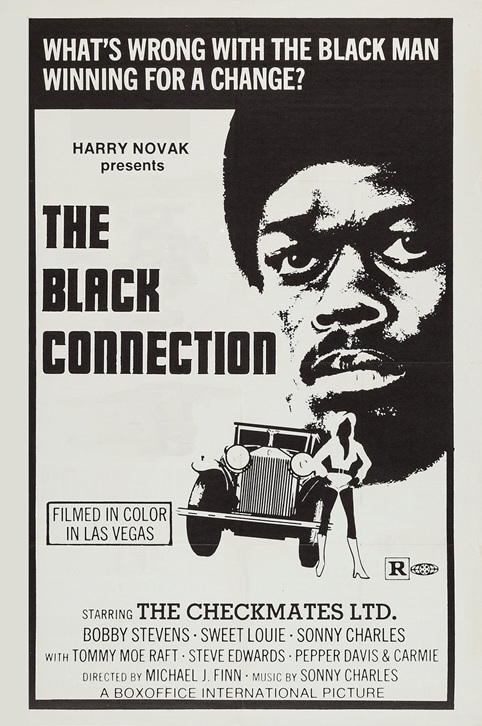
Miles Carter (Bobby Stevens) is a smooth-talking Vegas drug dealer who owes the Mafia a good deal of money due to some missing cocaine. Knowing that he’s in trouble but still confident that he can outsmart a bunch of goombahs in ill-fitting suits, Miles heads to Albuquerque so he can make another drug deal that will net him enough money to pay off the mob. But Miles isn’t actually planning on paying back the mob. Instead, he’s planning on taking whatever money he makes and then fleeing to Mexico. However, the Mafia has an assortment of overweight hit men with bad haircuts and they’ve all been sent to take down Miles.
That’s the plot of 1974’s The Black Connection. Or, at least, I think that’s the plot. It’s not a particularly easy film to follow. The film starts out with nearly thirty minutes of minor characters talking to each other and making phone calls. Once Miles does finally show up, it’s difficult to really know what he’s trying to pull because 1) the dialogue is so muddled that it’s nearly impossible to make out and 2) Bobby Stevens was not a particularly good or compelling actor. Instead, he was the lead singer for a band called The Checkmates, ltd. His bandmates appear in minor roles and also perform the film’s rather generic score. Bobby Stevens supposedly came up with the story for The Black Connection but it’s interesting to note that, in the opening credits, there’s no “written by” credit. Instead, someone is credited with being a script supervisor. That would perhaps explain why the film doesn’t really seem to be complete story as much as it’s just a bunch of random scenes that have been strung together.
The Black Connection is not a long film but I would still say that it’s probably about 60% filler. This is one of those films where no one does anything without announcing that they’re going to do it and then debating whether or not they should actually do it before doing it. It’s revealed that phones make Miles paranoid and yet the entire film is full of people talking and talking and talking on the phone. I lost track of how many shots there were of people dialing a landline and then waiting for someone to answer. There were also multiple shots of people in phone booths. At times, the film felt as if it should have been put in a time capsule so that, decades later, people could experience what it was like to live in the days before the invention of the iPhone.
There are a few scenes that work or, at the very least, are watchable. A scene in which a fat mobster shows off his karate skills is interesting because …. well, he’s a fat mobster. A scene in which two other mobsters grin while firing their guns into a car is notably gruesome and made all the more disturbing by the joy that the mobsters take in their work. Finally, the film ends on a downbeat note that would probably be more effective if not for the buckets of fake blood that were apparently splattered around right before the director shouted, “Action!”
This film was produced by the infamous Harry H. Novak. It’s nowhere near as sleazy as some of Novak’s other films. That’s actually kind of a shame. Sometimes, sleaze is the only thing that can save a film this inept.
When my mom was dying in 2008 and then when my Dad was in hospice care in 2024, I learned just how important nurses were.
While the doctors that I dealt with were often brusque and overworked, the nurses were the ones who always took the time to answer my questions. While the doctors took an attitude of, “Death happens,” the nurses were the ones who were willing to show compassion. They were the ones who seemed to understand the pain that both myself and my sisters were going through. The nurses were the ones who seemed to care. Even when it comes to something simple like getting my ADHD prescription renewed, I always feel more relaxed when I’m dealing with a nurse than dealing with a doctor.
(Don’t get me wrong. I understand why doctors so often avoid a personal connection with their patients. As Doctor Warshaw (Richard Stahl) puts it in 1970’s The Young Doctors, “mourning is reserved for loved ones.” It may sound cold but it’s the truth.)
When my Dad was in home hospice, we had a nurse the came by the house every day. She was cool and professional but still always seemed to care. She was also a chain-smoker and there were more than a few days that I stepped outside with her. She always had an extra cigarette for me. Usually, I don’t smoke because I have asthma but, at that time, I was so stressed that the calming effect of smoking made the risk worth it. Knowing that the nurse would always arrive early in the morning helped me deal with a very difficult time. At a time when everything felt like it was spinning out of control, the nurse was someone upon whom I could depend. After my father died, I struggled to adjust to a lot of things, including the absence of the nurse. I discovered I missed the nurse’s professional presence. I missed talking about my feelings while burning a cigarette down to its filter.
In short, I have a lot of respect for nurses. They have a difficult job, one that I certainly could not do. But I’m thankful for all that they’ve done for me, my family, and other people’s families.
With all that in mind, I watched 1970’s The Student Nurses earlier today.
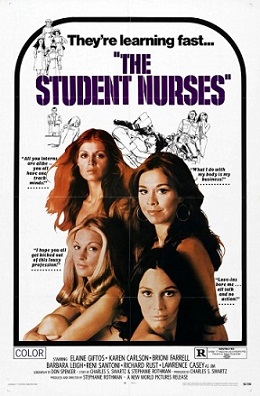
The Student Nurses tells the story of four women who are studying to be nurses while working at the local hospital. Phred (Karen Carlson) is introduced when she’s attacked by a crazed patient. Later, she falls for a doctor named Jim (Lawrence P. Casey). Sharon (Elaine Giftos) grows close to a terminally ill patient (Darrell Larson) and discovers the wisdom of Dr. Warshaw’s admonition about mourning. Priscilla (Barbara Leigh), who is regularly admonished for the length of her skirt and for never wearing a bra, meets a charismatic drug dealer named Les (Richard Rust). Les is all about dropping the acid on the beach but he’s not about sticking around when his girlfriend gets pregnant. And finally, Lynn (Brioni Farrell) meets a Latino political activist named Victor Charlie (Reni Santoni) and discovers that some people just aren’t rich enough to go to the hospital. When Victor shoots a cop during a raid on his headquarters, Lynn is forced to make a difficult decision.
The Young Nurses is almost legendary because of its status as a politically-themed exploitation film. It’s a Roger Corman production so there’s a lot of nudity. But director Stephanie Rothman used the genre to explore themes of class conflict and feminism. All four of the nurses are portrayed as being strong and independent women who have sex because they want to and who feel no shame about their decisions. For a 1970 film, that was a big deal. Interestingly, considering the film’s reputation, it’s actually fairly even-handed when it comes to the differing worldviews of the nurses. One of the nurses decides that she wants to serve in the Army Nurse Corps, even if that means going to Vietnam. Another ends up bragging about the gun that she’s carrying in her glove compartment, just in case anyone tries to stand in the way of the revolution. The film treats both of their decisions with respect. The important thing, the film seems to be saying, is that all of them are in control of their own future.
It’s an exploitation film, make no doubt about it. Today, we might talk about the film’s politics and its feminist subtext but I kind of doubt that’s what made the film a box office success in 1970. That said, Stephen Rothman brings some imagination to even the film’s most exploitive scenes. When Priscilla drops acid on the beach, Rothman slowly introduces more and more people to the scene, leaving us to wonder, just as Priscilla does, whether they’re real or their just a part of her trip. All four of the lead actresses are well-cast and fans of great character actors will probably enjoy seeing Reni Santoni playing someone other than a cop or a doctor.
Finally, like so many exploitation films, The Student Nurses is a true time capsule. The music, the clothes, the groovy slang, this is a film that proudly announces that it was made in 1970. We may not have time machines but at least we have the movies.
I have no idea if The Student Nurses is a realistic portrayal of what it was like to be a student nurse in 1970. That said, it’s an entertaining film and, in its grindhouse way, a tribute to the nurses who do so much.
In 1976’s Grizzly, something is making a national park a lot less inviting.
Campers are turning up dead. Bloody body parts are being found buried underneath leaves. It’s obvious that a bear is to blame but reports seem to indicate that this isn’t just any bear. This is a super bear, standing 8 feet tall and capable of knocking down an observation tower and picking up a helicopter. This is the most dangerous bear known to man and the park has to be closed.
Closing the park during tourist season!? Surely not!
Does this all sound familiar? Grizzly came out a year after Jaws. In all fairness to Grizzly, there were a lot of movies that ripped-off Jaws. As a matter of fact, there are still movies ripping off Jaws. The Jaws films eventually ended up ripping off themselves with three sequels. Still, it’s hard to ignore just how blatantly Grizzly rips off Jaws. We get shots from the bear’s point of view. Christopher George plays the sheriff who keeps demanding that the park be closed down until the bear has been taken care of. Andrew Prine is the hippie bear expert. Richard Jaeckel is the crotchety old man who knows more about bears that just about anyone else in the world. In Jaws, they needed a bigger boat. In Grizzly, they need a bigger helicopter. Jaws features scenes of people fleeing from the water. Grizzly features an unintentionally funny shot of hundreds of panicked campers fleeing down the side of a mountain.
Grizzly is Jaws, without the water and without the wit. And yet, in its own grim way, it works well enough. The fact of the matter is that bears are scary and the bear in Grizzly is really, really big. The gore effects are memorably grotesque and, perhaps even more so than Jaws, Grizzly goes out of its way to establish that anyone can die. As for the actors, I’ve always enjoyed seeing Christopher George in films like this. He was one of those actors who always seemed to try to give a convincing performance, even when he was appearing in a film that no one would mistake for a classic. Richard Jaeckel and Andrew Prine also do their best to bring their characters to life.
Finally, I should mention that the film ends on a properly silly and over-the-top note. Actually, it’s not that much different from the ending to Jaws. It’s just that Jaws was made with such skill that even the silly moments worked. Grizzly was directed by William Girdler, who was no Steven Spielberg. At the end of Grizzly, I found myself shouted, “Why didn’t someone just do that in the first place!?” Then again, if they had, we never would have gotten all of those point of view shots of the bear wandering through the forest while growling like an 70s obscene phone caller.
As a final note, I defy anyone to watch Grizzly without imagining Werner Herzog narrating the bear’s activities. It cannot be done!