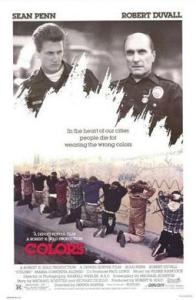
Los Angeles in the 80s. Beneath the California glamour that the rest of America thinks about when they think about L.A., a war is brewing. Bloods vs Crips vs the 21st Street Gang. For those living in the poorest sections of the city, gangs provide everything that mainstream society refuses to provide: money, a chance to belong, a chance to advance. The only drawback is that you’ll probably die before you turn thirty. Two cops — veteran Hodges (Robert Duvall) and rookie McGavin (Sean Penn) — spend their days patrolling a potential war zone. Hodges tries to maintain the peace, encouraging the gangs to stay in their own territory and treat each other with respect. McGavin is aggressive and cocky, the type of cop who seems to be destined to end up on the evening news. With only a year to go before his retirement, Hodges tries to teach McGavin how to be a better cop while the gangs continue to target and kill each other. The cycle continues.
Colors was one of the first and best-known of the “modern gang” films. It was also Dennis Hopper’s return to directing, 17 years after the notorious, drug-fueled disaster of The Last Movie. Hopper took an almost documentary approach to Colors, eschewing, for the most part, melodrama and instead focusing on the day-to-day monotony of life in a war zone. There are parts of Colors that are almost deliberately boring, with Hodges and McGavin driving through L.A. and trying to stop trouble before it happens. Hopper portrays Hodges and McGavin as being soldiers in a war that can’t be won, combatants in a concrete Vietnam. Colors is nearly 20 years old but it holds up. It’s a tough and gritty film that works because of the strong performances of Duvall and Penn. The legendary cinematographer Haskell Wexler vividly captures the harshness of life in the inner city. Actual gang members served as extras, adding to the film’s authentic, documentary feel. Among the actors playing gang members, Don Cheadle, Trinidad Silva, Glenn Plummer, and Courtney Gains all make a definite impression. In a small but important role, Maria Conchita Alonso stands in for everyone who is not a cop and who is not a gang member but who is still trapped by their endless conflict.
One person who was not impressed by Colors was future director John Singleton. Boyz ‘n The Hood was largely written as a response to Colors‘s portrait of life in South Central Los Angeles.
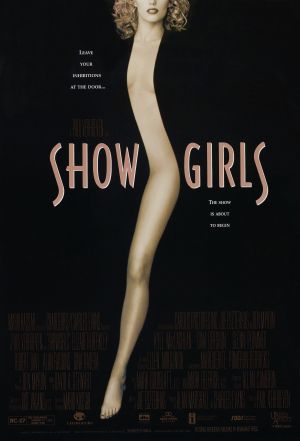
Showgirls in the 1995 film that, 20 years after it was first released, is still held up as the standard by which all subsequent bad films are judged. The story behind the production is legendary. Screenwriter Joe Ezsterhas was paid a then-record sum to write a script that ripped off All About Eve and featured lines like, “Come back when you’ve fucked some of that baby fat off,” and “You’re the only who can get my tits poppin’ right!” (And let’s not forget the heroine’s oft-repeated catch phrase, “It doesn’t suck.”) A major studio specifically hired Paul Verhoeven with the understanding that he was going to give them an NC-17 rated film. And finally, the lead role was given to Elizabeth Berkley, an actress whose previous experience amounted to co-starring on Saved By The Bell.
(And, let’s be honest, the only reason Jessie Spano was a tolerable character was because she wasn’t Screech.)
Berkley plays Nomi Malone, a sociopath who wants to be a star. She hitchhikes her way to Las Vegas where, as is destined to happen to anyone who shows up in Vegas or New York with a clunky suitcase, she is promptly robbed of all of her possessions. “Fuck! Fuck! Fuck! Fuck!” she yells, showing off the very expensive dialogue that was written for her by Joe Ezsterhas. Eventually, Nomi starts to take her frustration out on a random car. The car, it turns out, belongs to sweet-natured Molly (Gina Revara), who is a seamstress for a tacky Vegas show called Goddess.
(Seriously, Goddess makes Satan’s Alley from Staying Alive look like a work of quiet genius.)
Soon, Nomi is living in Molly’s trailer and working as a stripper at the Cheetah Club. The Cheetah Club is owned by Al, who is amazingly sleazy but who is also played by Robert Davi. Robert Davi is one of those actors who knows how to make terrible dialogue interesting and it’s instructive to watch him perform opposite Elizabeth Berkley and the rest of the cast. Whereas the majority of the cast always seems to be desperately trying to convince themselves that their dialogue is somehow better than it actually is, Davi knows exactly what he’s saying. Watching his performance, it’s obvious that Davi understood that he was appearing in a bad film so he figured that he might as well enjoy himself.
The same can be said of Gina Gershon, who plays Cristal Connors, the star of Goddess. Sexually voracious Cristal is basically a male fantasy of what it means to be bisexual. Cristal hires Nomi to give a lapdance to her sleazy boyfriend, Zack (Kyle MacLachlan, giving a good performance despite having to spend the entire film with hair in his eyes) and then arranges for her to be cast in the chorus of Goddess. There’s absolutely nothing subtle about Gershon’s performance and that’s why it’s perfect for Showgirls. It’s been argued that Showgirls is essentially meant to be a huge in-joke and, out of the huge cast, only Gershon, Davi, and occasionally MacLachlan seem to be in on it.
Certainly, it’s apparent that nobody bothered to tell Elizabeth Berkley. Berkley gives a performance of such nonstop (and misdirected) intensity that you end up feeling sorry for her. She’s just trying so hard and she really does seem to think that she can somehow make Nomi into a believable character. And it’s actually a bit unfair that Elizabeth is always going to be associated with this film because I doubt any actress could have given a good performance in a role as inconsistently written as Nomi. One second, Nomi is a wide-eyed innocent who is excited about living in Las Vegas. The next second, she’s screaming, “FUCK OFF!” and threatening strangers with a switch blade. She may be a survivor (and I imagine that’s why we’re supposed to root for her) but she’s also humorless, angry, and apparently clinically insane.
Hilariously, we’re also continually told, by literally everyone else in the movie, that she’s a great dancer, despite the fact that we see absolutely no evidence of this fact. Check out this scene below, where Nomi dances with a lot of enthusiasm and little else.
Once Nomi is cast in Goddess, she promptly sets out to steal both the starring role and Zack from Cristal. Nomi’s cunning plan, incidentally, amounts to fucking Zack in his pool and shoving Cristal down a flight of stairs. Nomi’s finally a star but when a Satanic rock star named Andrew Carver (William Shockley) comes to town, Nomi is confronted with the sordid truth about Las Vegas and, because this long film has to end at some point, Nomi must decide whether to take a stand or…
Well, you can guess the rest.
(Incidentally, I like to assume that Andrew Carver was meant to be a distant cousin of the great short story writer Raymond Carver.)
There seems to be two schools of thought when it comes to Showgirls.
Some critics claim to Showgirls is just crap. They say that it’s a terrible film with bad dialogue, bad acting, and terrible direction. These critics view Joe Eszterhas as being the villain of this tale, a misogynist who conned the studios into paying two million dollars for a terrible script.
And then other critics claim that Showgirls is crappy on purpose. They claim that Verhoeven meant for the film to be a satire of both American culture and Hollywood showbiz dramas. For these critics, Verhoeven used Eszterhas’s terrible script and Elizabeth Berkley’s inexperience to craft a subversive masterpiece.
Myself, I fall somewhere in between. Based on Verhoeven’s other films — Starship Troopers comes immediately to mind — I think his intent with Showgirls probably was meant to be satirical and subversive. But, at the same time, I would argue that Verhoeven’s intent doesn’t change the fact that Showgirls is a surprisingly boring film. For all the sex and the nudity and the opulent costumes and sets and all of the over-the-top dialogue, Showgirls is never really that interesting of a film. It barely even manages to reach the level of being so-bad-that-it’s-good. Instead, it’s slow, it’s draggy, and — satiric or not — the bad performance, the bad dialogue, and the nonstop misogyny get a bit grating after a few minutes.
Of course, that’s why you should never watch Showgirls alone. Showgirls is a film that you have to watch as a part of a group of friends so that you can all laugh together and shout out snarky comments. The first time I ever saw Showgirls was at a party and it was a lot of fun. But, for this review, I rewatched the film on Netflix and I was surprised by how much of a chore it was to sit through the entire running time. This is one of those films — like Birdemic and The Room — that you have to watch with a group. You watch for the experience, not the film.
The most recent entry in the Guilty Pleasure series had Lisa Marie waxing poetically about the idealistic teacher in the “jungle” film The Principal. I counter and follow this up with a similar-themed film called The Substitute that came and went very quickly in the theaters (I’m not even sure if it did or just went straight to video) in 1996.
The Substitute stars veteran actor Tom Berenger (you may remember him in such films as Platoon, Major League and Sniper) as a Vietnam vet mercenary who ends up substituting as the substitute teacher for his girlfriend’s high school class as she recovers from an attack that has left her unable to teach. The girlfriend was played by one Diane Venora who in the very same year was in another little film called Heat by Michael Mann. These two polar opposite films in terms of their “quality” just shows you that when it comes to acting, unless one was a recognizable name then any role is a good role it seems.
Getting back to the film, Berenger’s character is the titular substitute in one of Miami’s worst inner-city high schools where, as the film’s tagline proudly proclaims, the most dangerous things about it was the students. That is until Berenger’s character shows up to find out who attacked his girlfriend and bring down the wrath of God himself (or at least Berenger’s character and members of his old mercenary team).
The film isn’t what one would call very subtle. We clearly see either two types of teachers in this school. There’s Berenger and his girlfriend who care for the young teens (the former woth tough love and the latter going about it in a more liberal sense) and then there are those who have given up on the school and just cashing in on a paycheck. This goes to the extreme with the school’s principal (played by Ernie Hudson) who begins to suspect that the new substitute might be more than he appears.
It’s the passive-aggressive interaction between the two roles played by Berenger and Hudson that made for some of the more hilarious sequences in the film.
Oh, another thing the film also involves a dangerous high school gang that uses the school as if it’s their own little fiefdom and the local drug kingpin using it as a way station to move heroin into the Miami inner-city school system. Oh, did I happen to mention that Marc Anthony plays the leader of the high school gang, because he sure does.
The Substitute almost plays out like how a teacher fed up with the inattentiveness of his students and the stress of doing a thankless job imagines the perfect scenario to “clean-up” the high school. It’s not through coddling and talking things out with the students. It’s about using military tactics to take out the dangers of gangs and drug dealers and tough love on those who are still worth saving.
Some have called the film as blatantly racist while others have pointed out how it is just an extreme version of the longstanding storyline of the educated and civilized white man saving the “natives” from themselves. What this film has over other school films of similar themes is how it doesn’t try to sugarcoat and hide behind ideals when it comes to it’s story. Plus, it’s such a guilty pleasure to see a typical 80’s action flick dressed up to be a late 90’s film. They really don’t make films like this anymore.
 Los Angeles in the 80s. Beneath the California glamour that the rest of America thinks about when they think about L.A., a war is brewing. Bloods vs Crips vs the 21st Street Gang. For those living in the poorest sections of the city, gangs provide everything that mainstream society refuses to provide: money, a chance to belong, a chance to advance. The only drawback is that you’ll probably die before you turn thirty. Two cops — veteran Hodges (Robert Duvall) and rookie McGavin (Sean Penn) — spend their days patrolling a potential war zone. Hodges tries to maintain the peace, encouraging the gangs to stay in their own territory and treat each other with respect. McGavin is aggressive and cocky, the type of cop who seems to be destined to end up on the evening news. With only a year to go before his retirement, Hodges tries to teach McGavin how to be a better cop while the gangs continue to target and kill each other. The cycle continues.