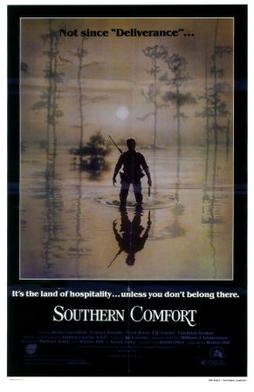
The Unominated #21: Southern Comfort (dir by Walter Hill)


Though the Academy of Motion Picture Arts and Sciences claim that the Oscars honor the best of the year, we all know that there are always worthy films and performances that end up getting overlooked.  Sometimes, it’s because the competition too fierce.  Sometimes, it’s because the film itself was too controversial.  Often, it’s just a case of a film’s quality not being fully recognized until years after its initial released.  This series of reviews takes a look at the films and performances that should have been nominated but were, for whatever reason, overlooked.  These are the Unnominated.

1981’s Southern Comfort takes place in 1973.  While America tries to wind down its presence in Vietnam, a squad of nine National Guardsmen take part in war games in the Louisiana bayous.  The squad is led by the ineffectual Sgt. Crawford Poole (Peter Coyote) while other members include the trigger-happy Lonnie Reece (Fred Ward), the weed-smoking Tyrone Cribbs (T.K. Carter), the cowardly Private Simms (Franklyn Seales), and the tightly-wound Coach Bowden (Alan Autry).  Poole may be in charge but most of the members of the squad seem to look up to the laid-back and friendly Private Spencer (Keith Carradine).  The newest member of the squad is Charles Hardin (Powers Boothe), a sober-minded transfer from Texas who doesn’t seem to get along with anyone but Spencer.

With the exception of Poole and Hardin, no one takes the weekend maneuvers seriously until they find themselves lost in the bayou and it becomes obvious that Poole has no idea what he’s doing.  When they come across some canoes that belong to some Cajun trappers, they decide to “borrow” them.  When the trappers protest, Reece fires his weapon at them.  Reece’s gun is loaded with blanks but the trappers don’t know that.  They fire back, killing Poole.

The national guardsmen now find themselves lost and being stalked by the trappers, a largely unseen force that always seems to attack out of nowhere.  The men have no idea where they are.  The trappers, on the other hand, have lived in the swamps their entire lives.  The guardsmen bicker and argue over the best way to respond.  Some want to fight back and some just want to get back to civilization.  One-by-one, the men are picked off until only two remain.

Though the film is a somewhat heavy-handed metaphor for the Vietnam War, Southern Comfort is still a deeply affecting and suspenseful mix of horror and action.  Director Walter Hill keeps the action moving at a quick pace and the film, which was shot on location and featured scenes shot during an actual Cajun celebration, perfectly captures the languid yet ominous atmosphere of the bayous.  As soon as the men see those canoes unattended, we know that they’re going to steal them and that they are making the biggest mistake of their lives.  Keith Carradine and Powers Boothe both give powerful performances in the lead roles and the members of the supporting cast — especially Alan Autry and Fred Ward — make a strong impression as well.  I especially liked the performance of Brion James, who has a small role as a one-armed Cajun who is more crafty than he looks.

Being a mix of horror and action, it’s probably not a shock that Southern Comfort was ignored by the Academy.  At the very least, I would have found room for Ry Cooder’s original score and Andrew Laszlo’s haunting cinematography.

Previous Entries In The Unnominated:

  1. Auto Focus 
  2. Star 80
  3. Monty Python and The Holy Grail
  4. Johnny Got His Gun
  5. Saint Jack
  6. Office Space
  7. Play Misty For Me
  8. The Long Riders
  9. Mean Streets
  10. The Long Goodbye
  11. The General
  12. Tombstone
  13. Heat
  14. Kansas City Bomber
  15. Touch of Evil
  16. The Mortal Storm
  17. Honky Tonk Man
  18. Two-Lane Blacktop
  19. The Terminator
  20. The Ninth Configuration

Film Review: Short Cuts (dir by Robert Altman)


Opening with a swarm of helicopters spaying for medflies and ending with an earthquake, 1993’s Short Cuts is a film about life in Los Angeles.

An ensemble piece, it follows several different characters as they go through their own personal dramas.  Some of them are married and some of them are destined to be forever single but they’re all living in varying states of desperation.  Occasionally, the actions of one character will effect the actions of another character in a different story but, for the most part, Short Cuts is a portrait of people who are connected only by the fact that they all live in the same city.  There are 22 principal characters in Short Cuts and each one thinks that they are the star of the story.

Jerry Kaiser (Chris Penn) cleans the pools of rich people while, at home, his wife, Lois (Jennifer Jason Leigh), takes care of their baby and works as a phone sex operator.  Jerry’s best friend is a makeup artist named Bill (Robert Downey, Jr.) who enjoys making his wife, Honey (Lili Taylor), looks like a corpse so that he can take her picture.  One of her photographs is seen by a fisherman (Buck Henry) who has already discovered one actual corpse that weekend.  He and his buddies, Vern (Huey Lewis) and Stuart (Fred Ward), discovered a dead girl floating in a river and didn’t report it until after they were finished fishing.  (The sight of Vern unknowingly pissing on the dead body is one of the strongest in director Robert Altman’s filmography.)

Stuart’s wife, Claire (Anne Archer), is haunted by Stuart’s delay in reporting the dead body.  A chance meeting Dr. Ralph Wyman (Matthew Modine) and his wife, artist Marian (Julianne Moore), leads to an awkward dinner between the two couples.  Claire works as a professional clown and Ralph ends up wearing her clown makeup while his marriage falls apart.

Earlier, Claire was stopped and hit on by a smarmy policeman named Gene Shepard (Tim Robbins), who just happens to be married to Marian’s sister, Sherri (Madeleine Stowe).  Gene is already having an affair with Betty Weathers (Frances McDormand), the wife of a helicopter pilot named Stormy (Peter Gallagher).  When Stormy discovers that Betty has been cheating, he takes a creative revenge on her house.

Doreen Pigott (Lily Tomlin) lives in a trailer park with her alcoholic husband, Earl (Tom Waits).  Driving home from her waitressing job, Doreen hits a young boy.  The boy says he’s okay but when he gets home, he passes out.  His parents, news anchorman Howard Finnegan (Bruce Davison) and his wife, Anne (Andie MacDowell), rush him to the hospital, where his doctor is Ralph Wyman.  As Howard waits for his son to wake up, he has a revealing conversation with his long-estranged father (Jack Lemmon, showing up for one scene and delivering an amazing monologue).  Meanwhile, a baker named Andy (Lyle Lovett) repeatedly calls the Finnegan household, wanting to know when they’re going to pick up their son’s birthday cake.

Based on the short stories of Raymond Carver and directed by Robert Altman, Short Cuts can sometimes feel like a spiritual descendent of Altman’s Nashville.  The difference between this film and Nashville is that Short Cuts doesn’t have the previous film’s satiric bite.  As good as Nashville is, it’s a film that can be rather snarky towards it character and the town in which it is set.  Nashville is used as a metaphor for America coming apart at the seams.  Short Cuts, on the other hand, is a far more humanistic film, featuring characters who are flawed but, with a few very notable exceptions, well-intentioned.  If Nashville seem to be a portrait of a society on the verge of collapse, Short Cuts is a film about how that society ended up surviving.

It’s not a perfect film.  There’s an entire storyline featuring Annie Ross and Lori Singer that I didn’t talk about because I just found it to be annoying to waste much time with.  (The Ross/Singer storyline was the only one not to be based on a Carver short story.)  The conclusion of Chris Penn’s storyline wasn’t quite as shocking as it was obviously meant to be.  But, flaws and all, Altman and Carver’s portrait of humanity does hold our attention and it leaves us thinking about connections made and sometimes lost.  Seen today, Short Cuts is a portrait of life before social media and iPhones and before humanity started living online.  It’s a time capsule of a world that once was.

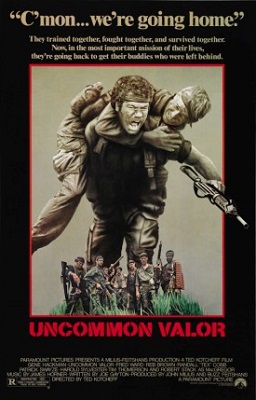
Uncommon Valor (1983, directed by Ted Kotcheff)


Retired Marine Colonel Jason Rhodes (Gene Hackman) and oilman Harry MacGregor (Robert Stack) share a tragic bonf.  Both of them have sons that served in Vietnam and are listed as being MIA.  Believing that their sons are still being secretly held in a POW camp in Loas, Rhodes and MacGregor put together a team to sneak into Southeast Asia and rescue them.

With MacGregor supplying the money and Rhodes leading the mission, the team includes Blaster (Red Brown), Wilkes (Fred Ward), Sailor (Randall “Tex” Cobb), and Charts (Tim Thomerson), all of whom served with Rhodes’s son.  Also joining in his helicopter pilot Curtis Johnson (Harold Sylvester) and former Marine Kevin Scott (Patrick Swayze), whose father was also listed as being MIA in Vietnam.  After a rough start, the group comes together and head into Laos to bring the prisoners home!

Uncommon Valor is one of the many movies released in the 80s in which Vietnam vets returned to Asia and rescued those who were left behind.  In the 80s, there was a very strong belief amongst many Americans that soldiers were still being held prisoner in Vietnam, Cambodia, and Laos and Hollywood was quick to take advantage of it.  The box office success of Uncommon Valor set the stage for films like Rambo and Missing In Action, film in which America got the victory that it had been denied in real life.

What set Uncommon Valor apart from the films that followed was the cast.  Not surprisingly, Gene Hackman brings a lot more feeling and nuance to his performance as the obsesses Col. Rhodes than Sylvester Stallone and Chuck Norris brought to their trips to Vietnam.  The film surrounds Hackman with a quirky supporting cast, all of whom represent different feelings about and reactions to the war in Vietnam.  Fred Ward’s character suffers from PTSD.  Randall “Tex” Cobb, not surprisingly, is a wild man.  Patrick Swayze’s character is trying to make the father he’ll never know proud.  Robert Stack and Gene Hackman represent the older generation, still trying to come to terms with everything that was lost in Vietnam and still mourning their sons.  The raid on the POW camp is exciting but it doesn’t feature the type of superhuman action that’s present in other POW-rescue films.  Col. Rhodes and his soldiers are ordinary men.  Not all of them survive and not all of them get what they want.

Uncommon Valor started out as a screenplay from Wings Hauser, though he’s not present in the cast of the final film and he was only given a “story” credit.  John Milius served as producer. Director Ted Kotcheff is best-known for First Blood, another action film about America’s struggle to come to terms with the Vietnam War.

Film Review: Swing Shift (dir by Jonathan Demme)


1984’s Swing Shift begins in 1941.  Kay (Goldie Hawn) and Jack Walsh (Ed Harris) are a young married couple in California.  At first glance, they seem to have the perfect life.  Jack works all day and comes home and has a beer and tells his wife how much he loves her.  Kay spends her day cleaning up around the house and when her husband comes home, she sits down next to him and tells him how much she loves him.  Whenever their neighbor, Hazel (Christine Lahti), walks by their bungalow, Jack mutters that she’s a tramp.  Hazel sings in a sleazy nightclub and dates a shady fellow named Biscuit (Fred Ward) and that’s just not what respectable people do!

When the Japanese bomb Pearl Harbor, Jack enlists in the Navy.  Kay suggests that she could get a job while he’s gone but Jack is firm.  He doesn’t want his wife working.  However, after Jack leaves, Kay is motivated by both boredom and her patriotic duty to apply for a job in an armaments factory.  With all of the men overseas fighting, their wives have been implored to do their part for the war effort.

Kay works the swing shift, along with Hazel and a trumpet player named Lucky (Kurt Russell).  (Lucky sweetly declines to explain why he’s called Lucky.)  Despite some early antagonism, Hazel and Kay becomes friends.  Kay starts to come out of her shell, especially where Lucky is concerned.  How will Jack react when he returns home?

The late director Jonathan Demme described directing Swing Shift as being one of the worst experiences of his career.  Demme’s original cut of the film was an ensemble piece that was a drama with comedic moments.  Star Goldie Hawn was reportedly not happy with Demme’s original cut and the film was essentially taken away from the director.  Screenwriter Robert Towne was brought in to write some additional scenes.  (Even before Towne was brought in, at least four writers had written a draft of the script and the screenplay itself was finally credited to a non-existent “Rob Morton.”)  Some scenes were reshot.  The film itself was reedited.  The end result was a film that focused primarily on Kay and made her relationships with Hazel, Jack, and Lucky far less complex.  Jonathan Demme walked away from the film, retaining his directorial credit but pointedly requesting that the film not be advertised as a “Jonathan Demme film.”  Later in life, Demme declined to discuss either Swing Shift or the experience of working with Goldie Hawn.

Watching the studio cut of Swing Shift on Prime, I could understand many of Demme’s objections.  It’s a film that’s full of good performances and some stylish visuals but it really doesn’t have much narrative momentum and, especially when it comes to Kay’s friendship with Hazel, it does feel like certain scenes are missing.  Hazel is remarkably quick to forgive someone who she believes has spent years calling her a tramp.  As well, there’s a lot of interesting characters in the background, many of whom are played by regular members of the Jonathan Demme stock company.  (Charles Napier, Susan Peretz, Holly Hunter, Roger Corman, Lisa Peilkan, Sudie Bond, and Stephen Tobolowsky all have small roles.)  Watching the film, one gets the feeling that they all probably had more to do in Demme’s original cut.

That said, I have to admit that I still enjoyed the studio cut of Swing Shift, flaws and all.  A lot of that is due to the performances of Hawn and Russell.  (Christine Lahti received a Supporting Actress Oscar nomination for her performance in this film.  She’s okay, though I don’t really think she deserved a nomination over someone like Elizabeth Berridge in Amadeus or Tuesday Weld in Once Upon A Time In America.)  Hawn does a wonderful job portraying Kay’s transformation from being a rather meek housewife to someone who can put a plane together without a moment’s hesitation.  Hawn and Russell began their legendary romance on the set of Swing Shift and their chemistry is strong enough to carry the film over plenty of rough spots.  At its best, Swing Shift inspired me to wonder what I would have done if I had been alive in the 1940s.  Would I have ended up cutting my hair and working in a factory?  Would I have waited at home from my ‘husband or sweetheart” (as the film refers to them) to come home?  Or would I have run off with Lucky and followed him from town to town?  Swing Shift is a good film that could have been great and, by many accounts, actually was great before it was recut.  (Even with the reediting, enough of Demme’s trademark humanity comes through to make the scenes in the factory memorable.)  In the end, Swing Shift isn’t perfect but I still enjoyed it.

14 Days of Paranoia #6: The Player (dir by Robert Altman)


1992’s The Player tells the story of Griffin Mill (Tim Robbins).

It’s not easy being Griffin Mill.  From the outside, of course, it looks like he has the perfect life.  He’s a studio executive with a nice house in Hollywood.  He’s young.  He’s up-and-coming.  Some people, especially Griffin, suspect that he’ll be the president of the studio some day.  By day, he sits in his office and listens to pitches from respected screenwriters like Buck Henry.  (Henry has a great idea for The Graduate II!)  During the afternoon, he might attends dailies and watch endless takes of actors like Scott Glenn and Lily Tomlin arguing with each other.  Or he might go to lunch and take a minute to say hello to Burt Reynolds.  (“Asshole,” Burt says as Griffin walks away.)  At night, he might go to a nice party in a big mansion and mingle with actors who are both young and old.  He might even run into and share some sharp words with Malcolm McDowell.

But Griffin’s life isn’t as easy as it seems.  He’s constantly worried about his position in the studio, knowing that one box office failure could end his career.  He fears that a new executive named Larry Levy (Peter Gallagher) is after his job.  Two new screenwriters (Richard E. Grant and Dean Stockwell) keep bugging him to produce their downbeat, no-stars anti-capitol punishment film.  His girlfriend (Cynthia Stevenson) wants to make good movies that mean something.  Even worse, someone is sending Griffin threatening notes.

It doesn’t take long for Griffin to decide that the notes are coming from a screenwriter named Dave Kahane (Vincent D’Onofrio).  Griffin’s attempt to arrange a meeting with Dave at a bar so that Griffin can offer him a production deal instead leads to Griffin murdering Dave in a parking lot.  While the other writers in Hollywood mourn Dave’s death, Griffin starts a relationship with Dave’s artist girlfriend (Great Scacchi) and tried to hide his guilt from two investigating detectives (Whoopi Goldberg and Lyle Lovett).  Worst of all, the notes keep coming.  The writer, whomever they may be, is now not only threatening Griffin but also seems to know what Griffin did.

After spend more than a decade in the industry wilderness, Robert Altman made a critical and commercial comeback with The Player.  It’s a satire of Hollywood but it’s also a celebration of the film industry, featuring 60 celebrities cameoing as themselves.  Everyone, it seems, wanted to appear in a movie that portrayed studio execs as being sociopathic and screenwriters as being whiny and kind of annoying.  The Player both loves and ridicules Hollywood and the often anonymous men who run the industry.  Largely motivated by greed and self-preservation, Griffin may not love movies but he certainly loves controlling what the public sees.  In the end, only one character in The Player sticks to her values and her ideals and, by the end of the movie, she’s out of a job.  At the same time, Griffin has a social life that those in the audience can’t help but envy.  He can’t step out of his office without running into someone famous.

The Player is one Altman’s most entertaining films, with the camera continually tracking from one location to another and giving as a vision of Hollywood that feels very much alive.  Tim Robbins gives one of his best performances as Griffin Mill and Altman surrounds him with a great supporting cast.  I especially liked Fred Ward as the studio’s head of security.  With The Player, Altman mixes melodrama with a sharp and sometimes bizarre comedy, with dialogue so snappy that the film is as much a joy to listen to as to watch.  That said, the real attraction of the film is spotting all of the celebrity cameos.  (That and cheering when Bruce Willis saves Julia Roberts from certain death.)  Altman was a director who often used his films to explore eccentric communities.  With The Player, he opened up his own home.

Previous entries in 2025’s 14 Days Of Paranoia:

  1. The Fourth Wall (1969)
  2. Extreme Justice (1993)
  3. The Lincoln Conspiracy (1977)
  4. Conspiracy (2007)
  5. Bloodknot (1995)

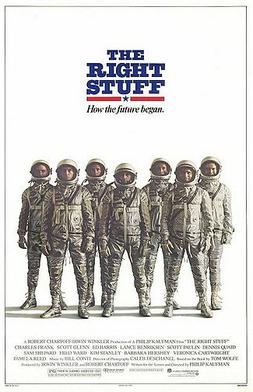
Lisa Marie Reviews An Oscar Nominee: The Right Stuff (dir by Philip Kaufman)


There’s a brilliant scene that occurs towards the end of 1983’s The Right Stuff.

It takes place in 1963.  The original Mercury astronauts, who have become a symbol of American ingenuity and optimism, are being cheered at a rally in Houston.  Vice President Lyndon Johnson (Donald Moffat) stands on a stage and brags about having brought the astronauts to his supporters.  One-by-one, the astronauts and their wives wave to the cheering crowd.  They’re all there: John Glenn (Ed Harris), Gus Grissom (Fred Ward), Alan Shephard (Scott Glenn), Wally Schirra (Lance Henrisken), Deke Slayton (Scott Paulin), Scott Carpenter (Charles Frank), and the always-smiling Gordon Cooper (Dennis Quaid).  The astronauts all look good and they know how to play to the crowd.  They were chosen to be and sold as heroes and all of them have delivered.

While the astronauts are celebrated, Chuck Yeager (Sam Shepard) is at Edwards Air Force Base.  Yeager is the pilot who broke the sound barrier and proved that the mythical “demon in the sky,” which was whispered about by pilots as a warning about taking unnecessary risks, was not waiting to destroy every pilot who tried to go too fast or too high.  Yeager is considered by many, including Gordon Cooper, to be the best pilot in America.  But, because Yeager didn’t have the right image and he had an independent streak, he was not ever considered to become a part of America’s young space program.  Yeager, who usually holds his emotions in check, gets in a jet and flies it straight up into the sky, taking the jet to the edge of space.  For a few briefs seconds, the blue sky becomes transparent and we can see the stars and the darkness behind the Earth’s atmosphere.  At that very moment, Yeager is at the barrier between reality and imagination, the past and the future, the planet and the universe.  And watching the film, the viewer is tempted to think that Yeager might actually make it into space finally.  It doesn’t happen, of course.  Yeager pushes the jet too far.  He manages to eject before his plane crashes.  He walks away from the cash with the stubborn strut of a western hero.  His expression remains stoic but we know he’s proven something to himself.  At that moment, the Mercury Astronauts might be the face of America but Yeager is the soul.  Both the astronauts and Yeager play an important role in taking America into space.  While the astronauts have learned how to take care of each other, even the face of government bureaucracy and a media that, initially, was eager to mock them and the idea of a man ever escaping the Earth’s atmosphere,  Chuck Yeager reminds us that America’s greatest strength has always been its independence.

Philip Kaufman’s film about the early days of the space program is full of moments like that.  The Right Stuff is a big film.  It’s a long film.  It’s a chaotic film, one that frequently switches tone from being a modern western to a media satire to reverent recreation of history.  Moments of high drama are mixed with often broad humor.  Much like Tom Wolfe’s book, on which Kaufman’s film is based, the sprawling story is often critical of the government and the press but it celebrates the people who set speed records and who first went into space.  The film opens with Yeager, proving that a man can break the sound barrier.  It goes on to the early days of NASA, ending with the final member of the Mercury Seven going into space.  In between, the film offers a portrait of America on the verge of the space age.  We watch as John Glenn goes from being a clean-cut and eager to please to standing up to both the press and LBJ.  Even later, Glenn sees fireflies in space while an aborigines in Australia performs a ceremony for his safety.  We watch as Gus Grissom barely survives a serious accident and is only rescued from drowning after this capsule has been secured.  The astronauts go from being ridiculed to celebrated and eventually respected, even by Chuck Yeager.

It’s a big film with a huge cast.  Along with Sam Shepherd and the actors who play the Mercury Seven, Barbara Hershey, Pamela Reed, Jeff Goldblum, Harry Shearer, Royal Dano, Kim Stanley, Scott Wilson, and William Russ show up in roles both small and large.  It can sometimes be a bit of an overwhelming film but it’s one that leaves you feeling proud of the pioneering pilots and the brave astronauts and it leaves you thinking about the wonder of the universe that surrounds our Earth.  It’s a strong tribute to the American spirit, the so-called right stuff of the title.

The Right Stuff was nominated for Best Picture but, in the end, it lost to a far more lowkey film, 1983’s Terms of Endearment.  Sam Shepard was nominated for Best Supporting Actor but lost to Jack Nicholson.  Nicolson played an astronaut.

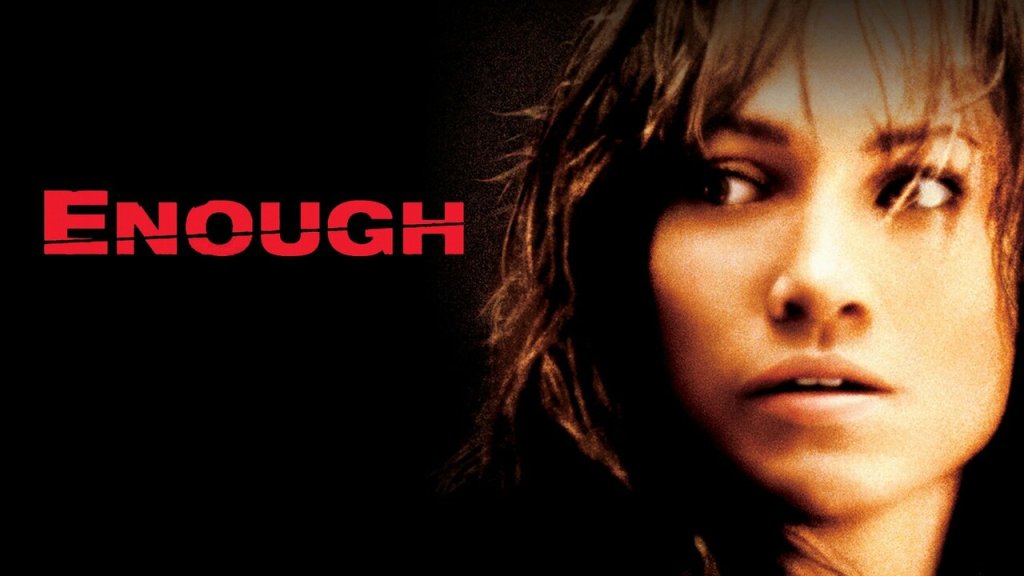
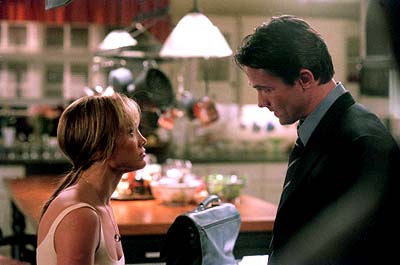
Jennifer Lopez has had ENOUGH (2002)! 


This morning I got up to make coffee for me and my wife. When I came back to our room, she had started the movie ENOUGH (2002) with Jennifer Lopez on the new projector that she bought me for Christmas. I’m not that big of a fan of Lopez, but I decided I’d go ahead and sit down to sip on my coffee prior to starting my day. I ended up watching the whole movie! 

Jennifer Lopez plays Slim, a waitress in a diner in L.A., who meets a rich guy named Mitch Hiller (Billy Campbell) who impresses her when he gets rid of this rude jerk (Noah Wyle) trying to hit on her. Mitch and Slim get along famously, eventually getting married and having a cute little girl named Gracie. Everything seems perfect in their little world. Unfortunately, things aren’t what they seem, and one night Slim checks her husband’s pager. She calls the number and discovers Mitch has been cheating on her. When she confronts him about the affair, his entire countenance changes, and he begins beating the crap out of her. After the altercation, and before heading out to continue his affair, Mitch warns Slim not to leave because he refuses to live without her. With the help of her friend Ginny (Juliette Lewis) and a couple of others, Slim takes Gracie and they escape from Mitch. With all his money and connections, Mitch is able to track her down no matter where she goes. Feeling like she has no other options, Slim turns to her wealthy, estranged father, Jupiter (Fred Ward). He provides her the funds she needs to set up a new life and identity. Unfortunately, that damn Mitch tracks her down again. Narrowly escaping, Slim decides that she’s done running. She sends Gracie away with Ginny and begins training rigorously in self defense techniques. This time she’s taking the fight to Mitch with plans to end this shit once and for all. 

If you’re looking for a realistic drama about the effects of spousal abuse on the family unit and then across the larger society, ENOUGH is not the movie for you. This movie is more for the Charles Bronson crowd, where the bad guys are truly evil and the audience is in complete agreement with their need to perish. This is a formula that continues to work even if you have to completely suspend your disbelief. For example:

-Is it realistic that Mitch would be able to conceal what a complete and total asshole he is for many years from Slim, but then one night turn out to practically be the sidekick of Satan?

-Is it realistic that Mitch would be able track Slim and Gracie down time and time again, no matter where she goes across the country, even after she uses her Dad’s resources to change her identity?

-Is it realistic that Slim would be able to get enough self defense training in a short period of time to be able to confront the extremely fit Mitch at the end and kick his ass? 

While the setup is probably not the most realistic, we have to see images of Mitch beating up Slim on multiple occasions, even trying to kill her at one point. We also see him knock little Gracie to the ground and hurt her. We see him terrorizing her and anyone who tries to help her. This audience member just wanted to see Mitch pay.

I don’t really have any close connections to the main actors in ENOUGH, but they all do their jobs well enough to keep me involved. I have always been a fan of its director, Michael Apted. He’s made a few movies that I really like in CLASS ACTION (1991) with Gene Hackman, THUNDERHEART (1992) with Val Kilmer, and BLINK (1993) with Madeleine Stowe. He’s a more than competent director who knows how to get a reaction from his audience. This certainly may not reflect his best work, but he still handles the material in a professional manner. 

My final word on ENOUGH… I enjoyed the film in the same way I like the 3 piece combo at KFC, which I really do enjoy. I know it’s probably not the best stuff out there, but the classic formula still works, and I’m satisfied when it’s all gone! 

See the trailer for ENOUGH below:

Late Night Retro Television Reviews: Gun 1.6 “Father John”


Welcome to Late Night Retro Television Reviews, a feature where we review some of our favorite and least favorite shows of the past!  On Tuesdays, I will be reviewing Gun, an anthology series that ran on ABC for six week in 1997.  The entire show is currently streaming on Tubi!

Tonight, we finish up Gun!

Episode 1.6 “Father John”

(Dir by Jeremiah S. Chechik, originally aired on May 31st, 1997)

Father John, the final episode of Gun, is also one of its worse.  The only thing keeping it from being the absolute worst is that Robert Altman directed that episode that dealt with the country club presidency and then there was that episode with Daniel Stern as the guy having an elaborate Hollywood fantasy and, of course, there was last week’s episode with Kirsten Dunst…. actually, now that I think about it, of the six episodes of Gun that were produced, Father John is in the top 3 but only by default.

The episode stars Fred Ward as John Farragut, a newspaper columnist who is also a recovering alcoholic and who is always struggling to keep up with his alimony payments to his ex-wife, Joyce (Brooke Adams).  John doesn’t have much faith in the world but he has always worshiped his Uncle John, a priest for whom he was named.  When Uncle John dies, nephew John is shocked to discover that his uncle not only died with a lot of money hidden away in his room but that he also owned the pearl-handled gun that appears in every episode of this series.  What secrets were being hidden by Uncle John!?

Nephew John sets out to find out.  At first, he assumes that his Uncle must have been having an affair with a woman named Gloria (Angela Alvarado) but he then comes to learn that Gloria (whose real name is Gabriella) is a refugee who was rescued from a sex trafficking ring by his uncle.  Uncle John had the gun to protect Gabriella and now, it’s time for his nephew to continue to protect her.

It sounds pretty straight-forward and, to be honest, there really aren’t any unexpected twists in this episode.  That said, the episode itself is incredibly overwritten.  We not only get to watch as living John tries to solve a very simple mystery but, even worse, we have to listen to his narration as he tells us the details of what he’s doing.  Of course, we can already see what he’s doing so it all feels a bit redundant.  The narration itself is so hard-boiled that it feels almost like a parody of the detective genre and I found myself wondering why anyone would want to read anything written by a man whose narration is essentially a collection of clichés.  John Farragut is the type of guy who says, “If you sleep with dogs, you wake up with fleas,” as if he think he’s the first person to ever come up with it.  Surprisingly, Fred Ward is very much miscast as John Farragut.  With his weathered face and his weary tone, it’s hard to buy Ward as someone who 1) still hero-worships anyone and 2) would still be crying about having never met his father.  Farragut appears to be nearly 50 and he’s still whining about stuff that most people get over or have figured out by the time they graduate college.  Farragut’s actions often only make sense if you accept that idea that he is impossibly naïve about the world and that’s not the feeling one would ever get from a character played by Fred Ward.

With this episode, Gun ends on a boring note but, then again, it was never a particularly exciting series to begin with.  For all the notable actors who appeared in Gun, it’s hard to think of any stand-out episodes or performances.  If I had to rank the episodes, it would go something like this:

  1. Ricochet 
  2. Columbus Day
  3. Father John
  4. The Hole
  5. The Shot
  6. All The President’s Women

That’s not a very impressive list, to be honest.  Gun perhaps would have worked better if there had been some sort of continuity as far as the gun itself was concerned.  Perhaps the show would have worked if there had been a feeling of the gun following a natural journey from owner to owner.  Instead, it just randomly showed up in each story and sometimes, it was important and, far more often, it was just a prop.  The show certainly had nothing to say about American gun culture.  It was an uneven show.  The opening credits featured U2 covering Happiness Is Warm Gun and Bono’s overbaked interpretation of the lyrics felt appropriate for this show’s flashy but shallow style.

Next week, there will be a new show in this time slot.  What will it be?  Uhmmmm …. ask me next week.

Guilty Pleasure No. 62: Backtrack (dir by Dennis Hopper)


Sometimes, you see a film that is just so weird and incoherent that you can’t help but love it.

Of course, it also helps if the film has a once-in-a-lifetime cast of actors who you would never expect to see acting opposite each other.

For me, that’s certainly the case with 1990’s Backtrack.  Directed by Dennis Hopper, Backtrack is a film about an artist (Jodie Foster, channeling Jenny Holzer) who witnesses a mob murder committed by Joe Pesci, Dean Stockwell, Tony Sirico, and John Turturro.  An FBI agent played by Fred Ward suggests that the artist should go into the witness protection program but she doesn’t want to give up her life as a New York sophisticate who creates challenging LED displays and who can eat Sno Balls whenever she gets the craving for one.  (Yes, this is a plot point.)  Turturro and Sirico break into the artist’s apartment and kill her boyfriend, who is played by a wide-eyed Charlie Sheen.  The artist puts on a blonde wig and goes on the run, eventually getting a job in advertising.

Realizing that his men can’t get the job done, mob boss Vincent Price decides to hire a legendary hitman played by Dennis Hopper (who also directed this film) to track down the artist.  However, the hitman becomes fascinating with the artist’s work, finds pictures of her posing in black lingerie, and immediately falls in love with her.  Not only does he wants to save her life but he wants her to wear the same lingerie exclusively for him.  (Yes, this is a pretty big plot point.)  At first, the artist refuses and views the hitman as being some sort of pathetic perv.  But then she discovers that he’s covered her bed with Sno Balls….

Meanwhile, a young Catherine Keener shows up as the girlfriend of a trucker who briefly considers giving the artist a ride to Canada.

And then Bob Dylan shows up, handling a chainsaw.

And there’s Helena Kallianiotes, the outspoken hitch-hiker from Five Easy Pieces, yelling at Joe Pesci!

And there’s Dennis Hopper’s The Last Movie co-star, Julie Adams!  And there’s Toni Basil!  And there’s director Alex Cox!

Dennis Hopper not only starred in Backtrack but he also directed and it’s obvious that he placed a call into just about everyone he knew.  In fact, one could argue that the only thing more shocking than Vincent Price showing up as a mob boss is that Peter Fonda, Karen Black, Elliott Gould, Robert Walker Jr., and Kris Kristofferson are nowhere to be found in the film.  Hopper’s first cut of Backtrack was reportedly 3 hours long but the studio cut it down to 90 minutes, renamed it Catchfire, and Hopper insisted on being credited as Alan Smithee.  Later, Hopper released a two-hour version with the Backtrack title and his directorial credit restored.

Regardless of which version you see, Backtrack is an odd film.  It’s hardly the first film to be made about a hit man falling for his target.  What distinguishes this film is just how bizarre a performance Dennis Hopper gives in the role of the hitman.  It’s as if Hopper gave into every method instinct that he had and the end result was a mix of Blue Velvet‘s Frank Booth and the crazed photojournalist from Apocalypse Now.  Jodie Foster’s cool intelligence makes her the ideal choice for a conceptual artist but it also makes it hard to believe that she would fall for a jittery hitman and, in her romantic scenes with Hopper, Foster often seems to be struggling to resist the temptation to roll her eyes.  Somehow, their total lack of romantic chemistry becomes rather fascinating to work.  They are two talented performers but each appears to be acting in a different movie.  What’s interesting is that I think a movie just about Hopper’s spacey hitman would be interesting (and, if you’ve ever seen The American Friend, it’s hard not to feel that such a movie already exists) but I think a movie about just about Foster’s artist and her life in New York would be just as fascinating.  Taken as individuals, the artist and the hitman are both compelling characters.  Taken as a couple, they don’t belong anywhere near each other.

But let’s be honest.  This is a film that most people will watch for the parade of character actors delivering quirky dialogue.  Even if one takes Hopper and Foster out of this mix, this is an amazingly talented cast.  One need only consider that John Turturro did Do The Right Thing before appearing in this film while Joe Pesci and Tony Sirico did Goodfellas immediately afterwards.  This film features a once-in-a-lifetime cast, made up of actors who were apparently told to do whatever they felt like doing.  Turturro plays up the comedy.  Sirico plays his role with cool menace.  Stockwell barely speaks above a whisper.  Fred Ward plays the one sane man in a world of lunatics. Vincent Price delivers his line as if he’s appearing in one of Roger Corman’s Poe films and somehow, it makes sense that, in the world of Backfire, an Italian gangster would have a snarky, mid-Atlantic accent.

It’s an odd little film, an example of 80s filmmaking with a 70s sensibility.  While it’s not touched with the lunatic genius that distinguished Hopper’s The Last Movie, Backtrack is still something that should be experienced at least once.

Previous Guilty Pleasures

  1. Half-Baked
  2. Save The Last Dance
  3. Every Rose Has Its Thorns
  4. The Jeremy Kyle Show
  5. Invasion USA
  6. The Golden Child
  7. Final Destination 2
  8. Paparazzi
  9. The Principal
  10. The Substitute
  11. Terror In The Family
  12. Pandorum
  13. Lambada
  14. Fear
  15. Cocktail
  16. Keep Off The Grass
  17. Girls, Girls, Girls
  18. Class
  19. Tart
  20. King Kong vs. Godzilla
  21. Hawk the Slayer
  22. Battle Beyond the Stars
  23. Meridian
  24. Walk of Shame
  25. From Justin To Kelly
  26. Project Greenlight
  27. Sex Decoy: Love Stings
  28. Swimfan
  29. On the Line
  30. Wolfen
  31. Hail Caesar!
  32. It’s So Cold In The D
  33. In the Mix
  34. Healed By Grace
  35. Valley of the Dolls
  36. The Legend of Billie Jean
  37. Death Wish
  38. Shipping Wars
  39. Ghost Whisperer
  40. Parking Wars
  41. The Dead Are After Me
  42. Harper’s Island
  43. The Resurrection of Gavin Stone
  44. Paranormal State
  45. Utopia
  46. Bar Rescue
  47. The Powers of Matthew Star
  48. Spiker
  49. Heavenly Bodies
  50. Maid in Manhattan
  51. Rage and Honor
  52. Saved By The Bell 3. 21 “No Hope With Dope”
  53. Happy Gilmore
  54. Solarbabies
  55. The Dawn of Correction
  56. Once You Understand
  57. The Voyeurs 
  58. Robot Jox
  59. Teen Wolf
  60. The Running Man
  61. Double Dragon

Live Tweet Alert: Join #FridayNightFlix for Backtrack!


As some of our regular readers undoubtedly know, I am involved in a few weekly live tweets on Twitter and Mastodon.  I host #FridayNightFlix every Friday, I co-host #ScarySocial on Saturday, and I am one of the five hosts of #MondayActionMovie!  Every week, we get together.  We watch a movie.  We tweet our way through it.

Tonight, at 10 pm et, #FridayNightFlix has got 1990’s Backtrack, an enigmatic thriller starring Jodie Foster, Dean Stockwell, Joe Pesci, John Turturro, Vincent Price, Fred Ward, Charlie Sheen, Tony Sirico, Bob Dylan, and Dennis Hopper (who also directed).


If you want to join us this Friday, just hop onto twitter, start the movie at 10 pm et, and use the #FridayNightFlix hashtag!  It’s a friendly group and welcoming of newcomers so don’t be shy.

Backtrack is available on Prime and Tubi!  See you there!