Today’s horror on the lens in 1978’s House of Evil!
When Richard Crenna buys a new house, he recruits a few friends to help him fix it up. Unfortunately, it turns out that the house is haunted by the devil himself. House of Evil — which is also known as The Evil — is an entertaining little time waster. If the idea of being in a house with the devil doesn’t scare you, just check out some of those the 1970s fashion choices!
Some of y’all may have noticed that, whenever I don’t have much to say about a movie, I’ll usually start things about be praising either the film’s title or its poster art.
With that in mind, the 1979 film The Dark has got a great title. I mean, what self-respecting horror film could actually resist a movie called The Dark? It’s a title that promises horror and blood and no holds barred morbidity! And really, the title is so brilliant that it almost doesn’t matter that the film itself come no where close to delivering.
And finally, just check out the poster art!
Seriously, that’s a great poster! If I had been alive in 1979, I totally would have wanted to see this movie just because of the poster. Not only is the film called The Dark but the poster literally promises that this movie is going to be — and I quote — “A chilling tale of alien terror!”
Woo hoo!
Of course, The Dark didn’t start out as a chilling tale of alien terror. The Dark is one of those films where what happened behind the camera is far more interesting than what was actually filmed. The story behind The Dark is a classic tale of low-budget, exploitation filmmaking:
Originally, The Dark was going to be a story about a zombie decapitating people in Los Angeles. The zombie had once been a Confederate soldier who ended up resorting to cannibalism. As originally envisioned, the Dark would feature numerous scenes of that dead Confederate wandering around with a big axe that it would use to chop off heads.
Tobe Hooper, who was hot as a result of having directed The Texas Chainsaw Massacre, was brought in to direct. However, after just a few days of shooting, he was replaced. Depending on which version you read, Hooper was either fired or he walked off the set. Either way, all accounts seem to agree that Hooper didn’t see eye-to-eye with the film’s producers. (One of those producers was Dick Clark, the same guy who always used to host ABC’s New Year’s special.)
With Hooper gone, a new director was brought in. That director was John “Bud” Cardos, who had previously had a drive-in hit with Kingdom of the Spiders. Cardos finished the film but he had no emotional investment in it and that’s obvious when you watch The Dark today. Visually, The Dark looks and feels like an old cop show, the type that you might expect to turn up on a cable station that is specifically programmed to appeal to the elderly.
The film that Cardos completed featured a Confederate zombie with an axe. However, the producers showed that film to a preview audience and quickly discovered that nobody cared about a Confederate with an axe.
So, they made some changes.
At the time, Alien was the most popular film at the box office so the producers thought, “Why not add some special effects, redub some dialogue, and make our Confederate zombie into an alien?” Sure, why not?
Hastily, The Dark was reedited. All shots featuring the zombie with an axe were removed from the film. Instead, whenever the monster attacked, the film now featured a freeze frame of the monster’s face with some hastily added laser beams shooting out of his eyes. This would be followed by a freeze frame of the victim and stock footage of an explosion….
(That said, there’s still plenty of references to the alien removing people’s heads…)
Interestingly, there’s still a scene in the film in which a police detective suggests that the creature might be a zombie. “Zom-bies!?” his superior yells, “I don’t want to hear those two words again!” Well, don’t worry. It’s not a zombie! It’s an alien!
(You do have to wonder why an alien would be wearing jeans and flannel shirt but, then again, why would a Confederate zombie be wearing jeans and a flannel shirt? It’s a strange world.)
As you’ve probably already guessed, The Dark is a bit of a mess. The alien is going around Los Angeles and blowing people up. (Though a few times, he also rips off their heads because … well, we already went into that.) The father of one of the victims is a burned out writer and he’s played by William Devane. (This is the same William Devane who has played the President in nearly every movie and TV show ever made. Words cannot begin to express how bored Devane appears to be in this movie. Oddly, with his hair long and graying, Devane bears an uncanny resemblance to Law & Order SVU‘s Richard Belzer.) The father is investigating, even though the lead detective (played by Richard Jaeckel) tells him not to. A reporter (Cathy Lee Crosby) is also investigating. And then there’s a psychic (Jacquelyne Hyde) and the psychic somehow knows what the monster is and who is going to die next.
The characters do eventually cross paths. When the detective meets the reporter, the detective announces that he’s going to kill the killer. “38 caliber justice?” the reporter replies. “If he’s dead, he can’t kill again!” the detective explains and he kind of has a point.
(Making it even stranger is that, while the detective and the reporter talk, there’s a political protest gong on behind them. The protest consists of people jumping up and down.)
It’s all really messy because, while watching the movie, you get the feeling that none of the actors knew what anyone else was filming. It’s like six different films with six different tones and they’ve all been smashed together. It’s also not particularly scary because ultimately, the zombie alien is just a freeze frame with some hastily added laser beams. (It doesn’t help that the lasers occasionally go “pew pew” when they’re fired.)
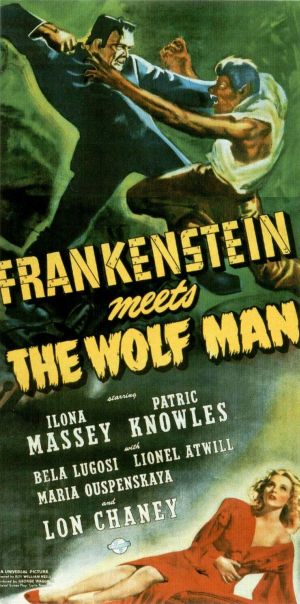
Long before Batman v. Superman, there was Frankenstein Meets The Wolf Man!
Released in 1943, Frankenstein Meets The Wolf Man was the first of the Universal horror movies to feature the monsters meeting. (Dracula would join both Frankenstein’s Monster and the Wolf Man in later films.) In our current age of the MCU and Zack Snyder super hero movies, that might not seem like a big deal but I’m sure it was huge in 1943. Were the Universal Monster Movies the first example of a shared cinematic universe? To be honest, I have no idea but it sounds good so let’s go with it.
Frankenstein Meets The Wolf Man starts, as so many Frankenstein films have, with a little bit of grave robbing. Except, this time, the grave robbers aren’t looking for body parts. Instead, they break into the Talbot family crypt because they’ve heard that Larry Talbot was buried with a lot of jewelry and money. As the grave robbers wander around the crypt, they recap for us everything that happened in The Wolf Man. Finally, they open up Larry’s coffin and are confronted with the dead body of Larry Talbot himself! (Larry is, once again, played by Lon Chaney, Jr.)
Unfortunately for our grave robbing friends, there’s a full moon out. As soon as the moonlight shines on Larry, he comes back to life and promptly transforms into … THE WOLF MAN!
After killing one of the robbers, the Wolf Man runs out of the tomb. The next morning, once again human and alive, Larry Talbot wakes up in some bushes. He’s arrested by the police. He’s sent to a mental hospital. He transforms a few more times and kills a few more stock characters. And during all of this, Larry tells anyone who will listen that he just wants to be cured of his condition so that he can die and stay dead.
It was at this point that it occurred to me that Larry Talbot is perhaps the whiniest werewolf in film history.
Eventually, Larry decides that maybe the famous Dr. Ludwig Frankenstein could help him! So, he breaks out of the hospital and travels to Germany (though, since the film was made during World War II, we’re never specifically told that he’s in Germany). Accompanying him is Malena (Maria Ouspenkaya), the gypsy woman from the first Wolf Man.
In Germany a generic Eastern European country, Larry finds out that Dr. Frankenstein is dead and his research is missing. Larry does, however, discover the frozen body of Frankenstein’s Monster (now played by Bela Lugosi). After reviving the monster, Larry is upset to discover that the Monster not only doesn’t know where to find Frankenstein’s research but that, after dealing with their crap for four movies, the Monster doesn’t really seem to care about doing anything other than harassing the local villagers.
Fortunately, Larry does get to meet Ludwig’s widow (Illona Massey) and get a chance to tell her about how much he wishes he was dead. Probably just to get him to shut up about how terrible his existence is, the widow agrees to help Larry. She gives him Ludwig’s research and Larry believes that he’s finally found a way to end both his life and the Monster’s!
Unfortunately, it doesn’t quite work that way. For one thing, Larry is working with a scientist (played by Patric Knowles) who doesn’t think that the Monster needs to be destroyed. Secondly, Larry keeps forgetting to keep track of the lunar cycles. That full moon is continually taking him by surprise.
It all leads to a final battle between Frankenstein’s Monster and the Wolf Man. It only lasts for a little less than 10 minutes so it’s hard not to be a bit disappointed but at least no one talks about having a mother named Martha.
(Can you imagine that conversation?
“Growl growl growl growl”
“Why you say Martha?”
“Growl growl.”
“But Monster’s mother named Martha!”
“Growl!”
“Friends!”
“growl…”)
(It’s been seven months since that damn movie came out and, here at the Shattered Lens, we’re still getting mileage out of “But my mother was named Martha!” jokes.)
Frankenstein Meets The Wolf Man isn’t necessarily a good movie but it is a lot of fun to watch. It helps, of course, if you’ve seen the other Universal horror films. Part of the fun is spotting members of the Universal stock company, like Lionel Atwill and Dwight Frye, and seeing who they’ll be playing this time around. One thing that I did legitimately appreciate is that the film made at least some sort of an effort to maintain a continuity with both The Wolf Man and Ghost of Frankenstein. It appears that some actual thought was put into explaining how both the Wolf Man and the Monster were still around after the events of the last two films. That shows more respect for the audience that you’ll find in most modern films.
This October, I’m going to be doing something a little bit different with my contribution to 4 Shots From 4 Films. I’m going to be taking a little chronological tour of the history of horror cinema, moving from decade to decade.
Today, we continue the 1960s!
4 Shots From 4 Films
Blood and Black Lace (1964, dir by Mario Bava)
2,000 Maniacs (1964, dir by Herschell Gordon Lewis)
The Cabinet of Dr. Caligari is a film that I’ve shared three times previously on the Shattered Lens. The first time was in 2011 and then I shared it again in both 2014 and 2015. Well, you know what? I’m sharing it again because it’s a classic, it’s Halloween, and everyone should see it!
Released in 1920, the German film The Cabinet of Dr. Caligari is one of those films that we’ve all heard about but far too few of us have actually seen. Like most silent films, it requires some patience and a willingess to adapt to the narrative convictions of an earlier time. However, for those of us who love horror cinema, The Cabinet of Dr. Caligari remains required viewing. Not only did it introduce the concept of the twist ending (M. Night Shyamalan owes his career to this film) but it also helped to introduce German expressionism to the cinematic world.
My initial reaction to The Cabinet of Dr. Caligari was that it simply wasn’t that scary. It was certainly interesting to watch and I was happy that I was finally experiencing this film that I had previously only read about. However, the film itself was obviously primitive and it was difficult for my mind (which takes CGI for granted) to adjust to watching a silent film. I didn’t regret watching the film but I’d be lying (much like a first-year film student) if I said that I truly appreciated it after my first viewing.
But you know what? Despite my dismissive initial reaction, the film stayed with me. Whereas most modern films fade from the memory about 30 minutes after the end credits,The Cabinet of Dr. Caligari has stuck with me and the night after I watched it, I even had a nightmare in which Dr. Caligari was trying to break into my apartment. Yes, Dr. Caligari looked a little bit silly staring through my bedroom window but it still caused me to wake up with my heart about to explode out of my chest.
In short, The Cabinet of Dr. Caligari passes the most important test that a horror film can pass. It sticks with you even after it’s over.
For the curious who have 74 minutes to spare and an open mind to watch with, here is Robert Wiene’s The Cabinet of Dr. Caligari…
Most Likely To Die is a slasher film about a group of old friends who gather at a remote house for the weekend. It’s their high school reunion and almost everyone’s looking forward to getting caught up on old times. What they don’t know is that there is a killer in their midst and that killer is going to kill them one by one. Even worse, he’s going to do it in a way that ironically comments on their senior year superlatives.
Fortunately, everyone received a superlative that lends itself to an ironic death. Seriously, this killer is just lucky that Most Likely To Eat Anything was friends with Most Likely To Break Hearts and Most Likely To Be Put On Ice. Just imagine if Most Likely To Kill A Psycho had shown up for the weekend? And what if he had brought his wife, Most Likely Not To Split Up In The Face Of Danger? That would have screwed everything up!
Who is the killer? Well, the natural suspect is John Daughtery. He was the outcast who all the kids made fun of. They even vandalized his yearbook entry, declaring him to be “Most Likely To Die.” John was pretty upset about that but then it got even worse when a gun was discovered in his locker! That pretty much ruined John’s life!
But maybe it’s not John. Maybe it’s Tarkin, the groundskeeper. Tarkin used to own a liquor store but he lost it when it was discovered that he was selling alcohol to underage kids. Could Tarkin be looking for revenge? Or is he just a perv who obsessively hangs around outside a certain bedroom window? Tarkin, incidentally, is played by Jake Busey and, whenever Busey shows up in a slasher film, you know he’s either going to be the murderer or the film’s biggest red herring.
Then again, maybe this killer is Perez Hilton!
Seriously, Perez Hilton is in this movie and it’s not stunt casting. Perez actually plays a real character and, at no point, does he wink at the audience and go, “It’s me, Perez!” Perez gives a far better performance than you might expect. His work here is, at the very least, on par with Paris Hilton’s performance in House of Wax.
Or maybe the killer is … someone else!
Honestly, if you’ve ever seen a slasher movie before, you’ll guess who the killer is. Most Likely To Die does offer up a typical, last-minute slasher movie twist but it won’t take you by surprise. In fact, there’s really nothing surprising about Most Likely To Die. That said, for fans of the slasher genre, Most Likely To Die is entertaining and fairly well-done. It doesn’t redefine the genre but it’s well-acted, the house is a creepy location, the murders are properly gory and mean-spirited, and the film does what it does with a certain panache. If you’re a horror fan, there are worse (and, it should be noted, definitely better) ways to waste your time.
Most Likely To Die made its premiere at Film4 FrightFest in 2015 and it had a very limited release earlier this year. It’s now available on Netflix, where it can be watched by anyone with 80 minutes to kill.
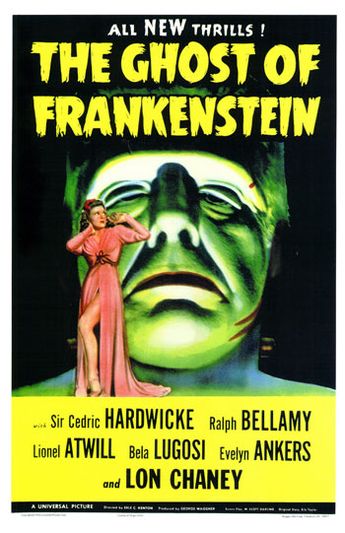
In 1942, three years after Son of Frankenstein, Universal Pictures continued the story of the Frankenstein family with The Ghost of Frankenstein!
However, The Ghost of Frankenstein was a far different film from the three that came before it. The budget was lower. The story was less complicated. The running time was much shorter. Whereas the previous films in the franchise clearly took place in Germany, the setting for The Ghost of Frankenstein is less easily defined. (Considering that the film was made during World War II, this isn’t surprising.) The biggest change is that, in The Ghost of Frankenstein, the monster is not played by Boris Karloff. Instead, the role is taken by Lon Chaney, Jr. Chaney’s hulking frame was perfect for the monster but his face is never as expressive as Karloff’s. Whereas Karloff turned the monster into as much of a victim as a victimizer, Chaney plays the monster like a … well, a monster.
Returning from Son of Frankenstein, Bela Lugosi is back as Ygor. At the start of the film, we learn that Ygor actually wasn’t killed at the end of Son of Frankenstein. Instead, he was just wounded. He’s spent the last few years hiding out in the old castle, trying to once again revive the monster. When the villagers attempts to blow up the castle, he and the monster flee.
It turns out that there’s one other Frankenstein son. His name is Ludwig and he’s played by a very dignified Sir Cedric Hardwicke. Ludwig, who has been hiding his identity and denying the family legacy, has a successful medical practice in another village. Working with his assistants, Dr. Kettering (Barton Yarbrough) and the bitterly jealous Dr. Bohmer (Lionel Atwill, who played a far different role in Son of Frankenstein), Ludwig has developed a procedure in which a damaged brain can be removed from the skull, repaired, and then stuck back inside the skull…
Uhmmm … wow, I have no idea what to say about that. That’s quite a medical breakthrough, though…
When Ygor and the monster show up in the village, searching for Ludwig, the monster ends up getting arrested. The local prosecutor (played by Ralph Bellamy, Cary Grant’s romantic rival in both The Awful Truth and His Girl Friday) asks Ludwig to examine the prisoner. Ludwig is shocked to discover that the prisoner is his father’s creation!
Ygor wants Ludwig to perform a brain transplant on the Monster. At first, Ludwig is hesitant but then he’s visited by Henry Frankenstein’s ghost. (Since Colin Clive died 5 years before Ghost of Frankenstein went into production, Hardwicke plays both Ludwig and Henry.) The ghost asks Ludwig to perfect the monster.
Ludwig finally relents and agrees to give the monster a new brain. Ludwig wants to use the brain of kindly colleague but Ygor has different plans…
The Ghost of Frankenstein is only 67 minutes long but, oddly, it still feels just a little bit draggy. Director Erle C. Kenton does a workmanlike job but, at no point, does Ghost feature the wit that distinguished James Whale’s films or Rowland V. Lee’s work on Son of Frankenstein. Chaney is not a particularly interesting monster but Bela Lugosi is a lot of fun as Ygor. With Chaney showing even less emotion than he usually did and Hardwicke appearing to be occasionally embarrassed by the whole film, it falls to Lugosi to keep the audience awake and he manages to do just that. Lugosi’s performance may be overly theatrical but that’s exactly what The Ghost of Frankenstein needed.
The Ghost of Frankenstein is occasionally entertaining but ultimately forgettable. It’ll best be enjoyed by Universal horror completists.
This October, I’m going to be doing something a little bit different with my contribution to 4 Shots From 4 Films. I’m going to be taking a little chronological tour of the history of horror cinema, moving from decade to decade.
Today, we start the 1960s!
4 Shots From 4 Films
Psycho (1960, dir by Alfred Hitchcock)
The Pit and the Pendulum (1961, dir by Roger Corman)
Today’s horror on the lens is a science fiction/horror film from 1977!
In The Incredible Melting Man, the first manned spaceflight to Saturn does not go well. Three astronauts went up but only one came down. And that one astronaut is both kinda crazy and melting! Seriously, it’s a big mess.
Apparently, one of the victims of the incredible melting man is played by director Jonathan Demme. See if you can spot him! It’ll be fun.
(I’m not really sure what Jonathan Demme looks like so you’ll probably have better luck with it than me.)
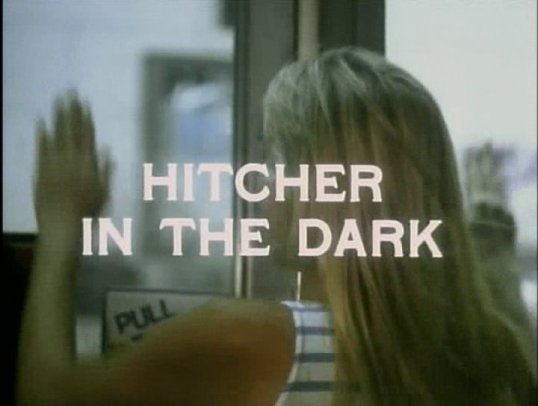
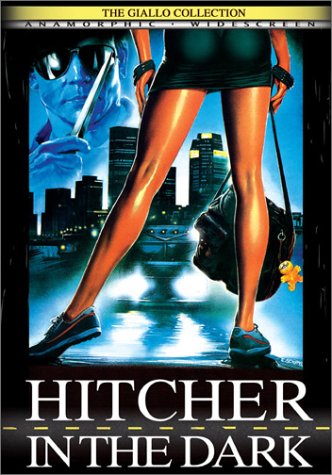
So, I just reviewed a thriller called Road Games, which is about something bad that happens to hitchhikers. And, as I was finishing up that review, I suddenly realized that I now had the perfect excuse to say a few words about Umberto Lenzi’s 1989 horror/thriller, Hitcher In The Dark!
The Hitcher In The Dark is a film that I specifically bought earlier this year so that I could review it in October. I thought that Hitcher In The Dark was a great title. Plus, I haven’t reviewed that many Umberto Lenzi films, despite the fact that he is one of the most prolific directors in the history of Italian cinema. Hitcher in the Dark? I thought, Hell yeah, I’ll review that!
But then I watched the movie and I discovered that there’s really not that much to say about it. There’s a reason why this is one of Lenzi’s more obscure films. (He directed it around the same time that he made the infamous Black Demons.) Not that much happens in Hitcher In The Dark. It tells the story of a psycho rich boy, who is played by Joe Balogh. Joe Balogh was also the lead in Black Demons. In that film, his character was named Dick. All through Black Demons, the other actors were always wandering around and yelling, “Dick! Dick! We need Dick! I need Dick! Please, show me Dick!” Hitcher In The Dark is never that much fun.
Instead, Balogh’s character is named Mitch. He’s obsessed with his dead mother, so he drives around Florida and kills people. Because she resembles a framed stock photo that he keeps on him at all times, Mitch kidnaps Daniela (Josie Bissett) and tries to turn her into his mother. The rest of the film is pretty much made up of Daniela escaping and then getting captured again. Her boyfriend (Jason Saucier) is also searching for her. He goes up into random gas stations and says, “Have you seen a blonde girl?” Eventually, he stumbles across both her and Mitch. Why not? Florida’s not that big!
Anyway, there are three things that set Hitcher In The Dark apart. First off, there’s the fact that Mitch spends almost the entire movie driving the most awkward vehicle imaginable, a gigantic RV. Somehow, Mitch manages to kidnap and kill undetected while driving the most conspicuous thing possible. Seriously, check this monster out:
And there are two lines of dialogue that are so weird that they deserve to be enshrined in some sort of Hall of Fame.
When the police pull Mitch over and notice that he has a cut on his hand (from where Daniela earlier stabbed him with a fork), Mitch smoothly explains, “It’s just a scratch. I was cleaning my spear.”
AND THE POLICE NOD AND LET HIM GO!
The other line comes early in the film. When Mitch ignores a girl who has been hitting on him, she snaps, “Hey! Who do you think you are!? Mickey Rourke!?”
Seriously, Hitcher In The Dark may not be very memorable or good but those three things made it all worthwhile!





 Through the Shattered Lens