As of now, this micro short has only been viewed 71 times. I haven’t seen this yet, but I am slightly hopeful that it won’t be hot garbage. Here we go!
This short is only 2 minutes and 18 seconds and he starts with…exposition. UGHHGH.
The protagonist, who I will refer to as Mr. Exposition-pants, is walking in the woods on his phone and explaining in great detail why he is there. Apparently, Mr. Exposition-pants took a photography class and is now taking pictures in the woods. Got all that? If not, please rewind and he’ll go over it again for 25% of the film’s total length!
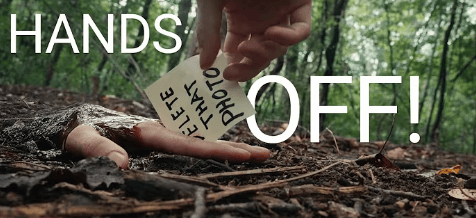
Mr. Exposition-pants finds a severed hand and calls the police? No, he takes a photo and sees another hand that has a note that reads – “Delete that photo”. He does eventually call the police and it’s a demon on the other end. Then, I couldn’t understand what was happening.
You could watch this film or literally do ANYTHING else.
In 2017’s Victory by Submission, Tommy Hendricks (Brett Prieto) is a UFC fighter who thinks that he wants to be champion more than anything else in the world. He’s following in the footsteps of his boxer father (Alan Autry) and also his older brother (Josh Thomson), an up-and-coming UFC fighter who was killed in Iraq. When Tommy allows himself to be trained by the ruthless Steve Henderson (James Price), he wins his chance to go up against the most dangerous man in the world, UFC champion Crazy Dan McGuire (Casey Olson). But will he be willing to sacrifice his soul for victory?
For what it is—a fighting film with a faith-based theme—it isn’t bad. The story won’t take anyone by surprise, but the fights are well-directed and the actors all give decent performances. Speaking for myself, I appreciated the film’s message, which was that there are some things that are more important than seeing how much blood you can spill in the ring. The conclusion of the fight was a bit unbelievable. When an angry Steve said that the fans were upset because they felt like they had been cheated out of the money that they paid for the tickets to see the fight, I couldn’t help but feel that, as sleazy as he was, he kind of had a point.
Eric Roberts does appear in this film, playing a very enthusiastic fight promoter. It’s a small role but it’s always nice to see Eric in an energetic mood.
Previous Eric Roberts Films That We Have Reviewed:
Some films should never be remade and that’s certainly the case with 1957’s The Incredible Shrinking Man.
Why does Scott Carey (played by Grant Williams) start to shrink? While the film does offer up a vague explanation involving chemicals that altered his molecular structure, the film doesn’t waste too much time on the reasons. Instead, what’s important is that he is shrinking. Every day, Scott Carey finds himself getting smaller and smaller and nobody can do anything to stop it. Even the scientific cure proves itself to be only temporary. It’s not just that Scott is getting smaller physically. His confidence is also shrinking. Everything that used to define him as a human being is disappearing. When the press learns that he’s shrinking, he loses his dignity. When he lashes out at the world around him, he loses his self-respect. When he gets angry at his wife, he loses his security. Finally, he’s small enough that, even though he can still speak, he’s essentially lost his voice. He loses the world that he knows and discovers an entirely different world existing within the reality that he once took for granted.
The film is famous for the scene in which Scott, who has been reduced to living in a dollhouse, is attacked by a cat. (Officially, the cat that attacks Scott later played Audrey Hepburn’s cat in Breakfast at Tiffany’s. Rumor has it, though, that Orangey the Cat was actually several different cats who all used the same name.) The cat attack is certainly a bravura bit of filmmaking on the part of director Jack Arnold. Whenever our cats get upset over getting fed a minute or two late, I’m reminded of Scott opening the door of the dollhouse and seeing that giant cat staring in at him. That said, for me, the scariest moment in the film comes at the start when Scott is enveloped in the strange mist that will eventually cause him to start shrinking. It’s such an atmospheric and creepy scene but Arnold is smart enough not to overplay anything. Scott and his wife originally dismiss it as nothing. That’s what most of us do when something strange happens. It’s a scene that also captures the random cruelty of Scott’s fate. If he had simply gone below deck on his boat, he never would have started to shrink. If his wife had remained on deck with him, she would have shrunk with him and Scott wouldn’t have had to face his fate alone.
Jack Arnold is truly the often-unsung hero of The Incredible Shrinking Man. He took the material seriously. Even more importantly, he stuck with screenwriter Richard Matheson’s ending. When the studio insisted that the film should end with Scott returning to his full height, Arnold refused to shoot it and, amazingly, the studio didn’t make him. Even when test audiences said that they would have liked the film better if Scott had returned to his original height, the studio released Jack Arnold’s version of the film. Not many studios would have the guts to do that today. (Then again, after 20 years of comic book movies, audiences would probably just assume that Scott was going to turn into a superhero and not get upset.) The film ends with the triumph of Scott defeating a spider, but it also ends with Scott still shrinking and we’re left to wonder what could be smaller than microscopic.
I’m normally not a huge fan of science fiction but The Incredible Shrinking Man is a great film. Occasionally, there will be a report of someone wanting to remake it. Hopefully, it’ll never happen. The Jack Arnold/Richard Matheson version is the only one we need.
As I was discovering my love of movies in the 80s, the first director I ever fell for was Brian De Palma. There was a time when people would ask me what my favorite movie was, and I’d answer BLOW OUT. Fox 16 out of Little Rock played the film often, and its style absolutely blew me away. Later, as a young teenager, my family was at our local video store, and we rented THE UNTOUCHABLES. I was sulking because I wanted to rent something different, but my brother wanted THE UNTOUCHABLES, and he won out that night. I remember watching the movie that evening, and I’m so glad my brother got his selection because I loved it so much. To this day, we still laugh about that night and how happy I was to discover that I was wrong. Which brings me back to RAISING CAIN. As an obsessed De Palma fan, I was very excited about RAISING CAIN when it was being released in 1992, and I eagerly watched it in the theater on opening weekend. I watched it again on VHS when it was released a little later, but I haven’t watched it now in many years. It seemed like the time was right for a revisit.
The film stars John Lithgow as Dr. Carter Nix, a child psychologist whose work involves studying the development of children. He’s also a husband and father, living with his wife Jenny (Lolita Davidovich) and their young daughter, Amy. At first glance, Carter seems like a devoted father who just happens to take his work very seriously, but we soon learn that all is not well in the Nix household. It seems that Carter has multiple personalities, and not all of them have the best of intentions. Jenny’s life and relationships are also more complicated than they might initially seem, and the farther the story progresses, the more dangerous things become for her and Amy!
With RAISING CAIN, I wanted to revisit a movie from my past that really meant something to me when it was released, but that has kind of fallen by the wayside since. What’s interesting is that I bought the 2016 Shout Factory Blu-ray release many years ago and had never even opened the package. I finally decided to crack it open and see what all I had. I was surprised to learn that the Blu-ray included two distinct cuts of the film: the theatrical cut, which was the only version I’d ever seen before, and the newer “Re-cut.” The Re-cut is a version that was put together by Dutch filmmaker Peet Gelderblom that followed along with De Palma’s draft script. What’s interesting is that De Palma has given this cut his full endorsement and called it the version he really wanted. Naturally, I decided to check them both out for fun, because I wanted to know which one I preferred. I mean, just because De Palma preferred the Re-cut doesn’t necessarily mean that I would! And to be honest, I knew that spending all this time with early 90s Brian De Palma again would be a blast, regardless of which cut I was watching.
No matter how you slice it, a big part of what makes RAISING CAIN work is John Lithgow. He seems to be having a ball playing multiple personalities, and he also plays his own unhinged father. At times, his shift in personality is abrupt and obvious, while at other times, he holds back, and we aren’t sure which personality is at the front until he acts, and sometimes violently. These moments create some of the most effective surprises in the film. Lolita Davidovich is just so beautiful, and she’s very good as Jenny. Her marriage and family life aren’t as good as they appear on the surface, and she also has unresolved feelings for Jack (Steven Bauer), a man she had known and fallen in love with prior to her marriage. Jack just happens to show back up in her life as our story begins. As crazy as the story gets, and even though Davidovich makes her own share of questionable decisions, she’s still someone we can root for as the story moves forward. I also want to shout out Frances Sternhagen, who has a supporting role as Dr. Lyn Waldheim, whose knowledge of Carter’s past becomes important as the mystery unfolds. She nails the role.
I do think that a person’s enjoyment of RAISING CAIN could be affected by how much they’re willing to go along with De Palma’s directorial excesses. It’s easy for me, because that’s one of the main things I love about his movies. The stylish camerawork and sometimes over the top performances and situations are what drew me in in the first place. However, I can also freely admit that there are times when the film’s outrageous situations and performances become so exaggerated that what could be a genuinely disturbing psychological thriller can get lost as style threatens to take over substance. That’s part of the fun for me, but I do understand how it could take others out of the story. One of the best things about movies is their subjective nature, and while the film works for me, it may not for everyone.
After watching both the theatrical cut and the Re-cut, I have to admit that I think the newer version works a little better. The main reason is that it keeps more of its cards close to the vest when it comes to Carter’s personalities, building more suspense and making some of the later revelations that much more effective. I enjoyed the experience of approaching the story from a different angle. It didn’t suddenly turn RAISING CAIN into a completely different movie for me, and I still love both versions, but it did give me a new appreciation for what De Palma’s true vision was.
For me, RAISING CAIN still holds up as a super entertaining psychological thriller that gives John Lithgow plenty of room to show off his talents. It’s a true “De Palma film,” so it might get a little carried away with its own twists and turns, but I really enjoyed revisiting the theatrical cut and especially discovering the new cut. Neither version will take over those spots I’ve reserved for BLOW OUT, THE UNTOUCHABLES, or DRESSED TO KILL, but that’s fine and dandy. I still loved it, and after all this time, I’m glad I finally opened that Blu-ray!
I saw that actor Tom Skerritt passed away on October 21st. During his career he appeared in classics like ALIEN, TOP GUN, and STEEL MAGNOLIAS. I enjoyed him as well in his B-movies like FIGHTING BACK and OPPOSING FORCE. But the first movie I thought of when I heard of his passing was A RIVER RUNS THROUGH IT, one of my favorites when I was growing up. He was so good as the minister and father to Craig Sheffer and Brad Pitt. To celebrate his life and career, I thought I’d share this fun scene from the film. Rest in peace, sir!
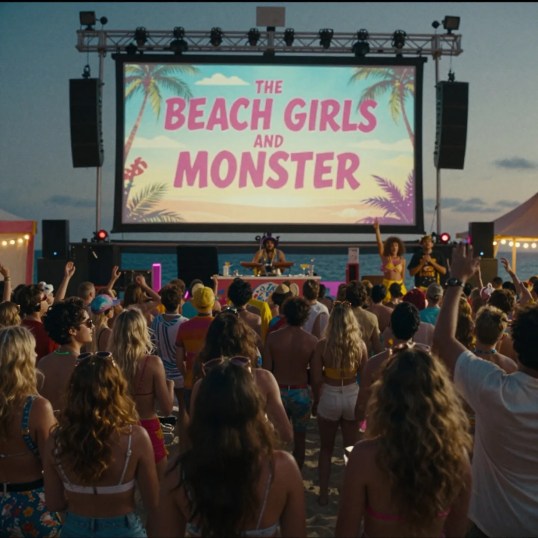
In 1965’s The Beach Girls and the Monsters, a monster that might be a mutated barracuda is hiding out on the beach and killing teenagers. Can Dr. Otto Lindsay (played by the film’s director, Jon Hall) figure out how to defeat the monster? Will Otto’s son Richard (Arnold Lessing) ever stop surfing long enough to get back to studying science? Will Otto’s much younger wife Vicky (Sue Casey) seduce the troubled and crippled sculptor Mark (Walker Edmiston)? And will it ever occur to anyone to just go to a different beach?
Complete with a ludicrous monster, a great soundtrack, tons of dancing, melodramatic acting, and a twist ending that will surprise no one, The Beach Girls and the Monster is low-budget favorite of mine. It’s also, I think, a perfect movie to watch on a rainy October Saturday.
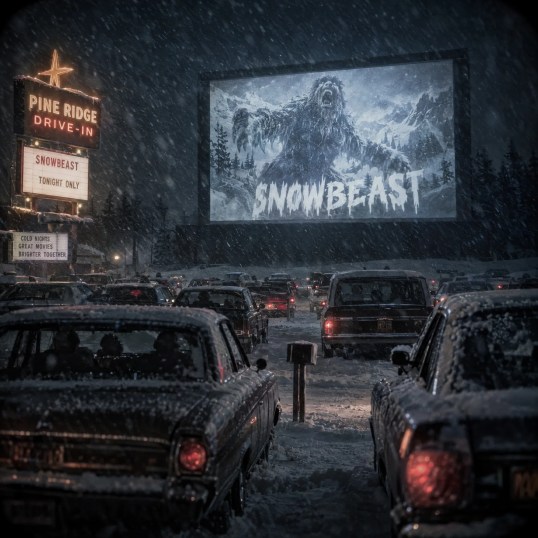
A killer yeti is ruining a resort’s Snow Carnival. Can Bo Svenson, Clint Walker, and Robert Logan set aside their differences and work together to defeat the monster before Sylvia Sidney is forced to shut the whole thing down? Let’s hope so!
Originally made for television in 1977 and subsequently included in a hundred Mill Creek box sets, Snowbeast is an surprisingly enjoyable and, at times, rather intense little horror movie. There’s nothing scarier than an angry yeti!
As some of our regular readers undoubtedly know, I am involved in a few weekly watch parties. On Twitter, I host #FridayNightFlix every Friday and I co-host #ScarySocial on Saturday. On Mastodon, I am one of the five hosts of #MondayActionMovie! Every week, we get together. We watch a movie. We tweet our way through it.
Tonight, at 10 pm et, I will be hosting #FridayNightFlix! Join us for The Giant Spider Invasion!
If you want to join us this Friday, just hop onto twitter, find The Giant Spider Invasion on Prime, start the movie at 10 pm et, and use the #FridayNightFlix hashtag! I’ll be there happily tweeting. It’s a friendly group and welcoming of newcomers so don’t be shy.
Today’s song of the day comes from the 1971 film, Vampyros Lesbos. The Vampires’ Sound Incorporation was a band specifically formed to do the soundtrack for Jess Franco’s classic portrait of Eurotrash decadence. This song found renewed popularity in the 90s when Quentin Tarantino included it on the Jackie Brown soundtrack.
I like this song. It’s great driving music and it sounds like something that a vampire would actually listen to.
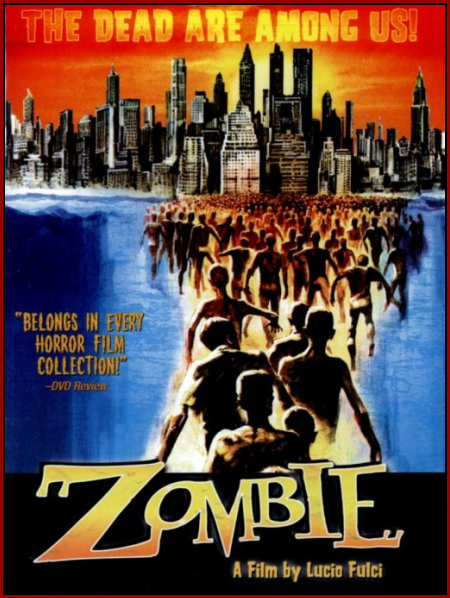
In this scene from 1979’s Zombi 2, a group of humans try to destroy the zombies that are invading a small hospital on an isolated island. Director Lucio Fulci later pointed out, in many interviews, that he used the same clips of Al Cliver throwing a Molotov cocktail and firing a shotgun multiple times in the scene.
Two things to note about this scene:
First off, it captures what is truly scary about zombies. They are relentless. They do not stop coming. No matter how many you destroy, there’s always another one following behind it.
Secondly, Italian zombies actually looked like decaying walking corpses that are on the verge of falling apart. That was one huge difference between the Italian zombie films and many of the ones that were made in America.