Here’s the latest edition of Lisa Marie’s Favorite Grindhouse and Exploitation Trailers. (I know, I know — worst intro paragraph evuh! Following the tradition of the Pieces trailer, which can be found below, I’m keeping things simple. I’ll be back to my usual complicated self next week.)
Believe it or not, this was directed by Abel Ferrara, the same man who directed Ms. 45. Fear City is one of the few Ferrara films that I haven’t seen but the trailer just oozes sleaze doesn’t it? And speaking of sleaze, maybe that’s what all the men in this film were putting in their hair. Seriously, why not call it Gel City? And how about Billy Dee Williams there, sounding like the angel of the final judgment? Shut up, Billy Dee Williams!
This is one of Lucio Fulci’s final films and you’re either going to love it or you’re going to hate it. The film is surprisingly meta for an Italian horror film not directed by Michele Soavi. This is the one where Fulci plays himself and attempts to personally answer his critics. Anyway, the reason I love this trailer is because of the cat puppet that appears at the end. It’s so cute! (Ignore the quote from Clive Barker — he’s almost as much of a whore as Stephen King.)
I imagine this is another film that’s “exactly what you think it is.” I love trailers that show off what was considered to be chic and decadent in the past. This is one is from the 70s. (Surprised?)
While the rich people were partying in London, cannibals were apparently ruling the streets of Atlanta. According to actor John Saxon, starring in Cannibal Apocalypse made him suicidal. Cannibal Apocalypse is actually a pretty good film with an anti-war subtext and it features a great supporting performance from Giovanni Lombardo Radice so seriously — shut up, John Saxon! (Actually, Saxon gives a really great performance here — of course, his character is meant to be suicidal — and he’s the main reason that Cannibal Apocalypse works.)
Much like Cannibal Apocalypse, Cannibal Man is actually an allegory of alienation that’s disguised as a horror movie. Cannibal Man is a seriously strange movie and highly recommended.
One of my favorite movies of all time is Joe D’Amato’s haunting 1979 romance Beyond The Darkness. Not only is it one of the best Italian films ever (and the best film ever directed by D’Amato) but I think it’s also one of the best films ever made.
One reason the film is so effective is because of its soundtrack, which was composed and performed by (who else?) Goblin. The music will be familiar to any Italian horror fan, largely because it was reused by about a thousand other movies that came out in the years after Beyond The Darkness. (Director Bruno Mattei, in particular, was fond of it.)
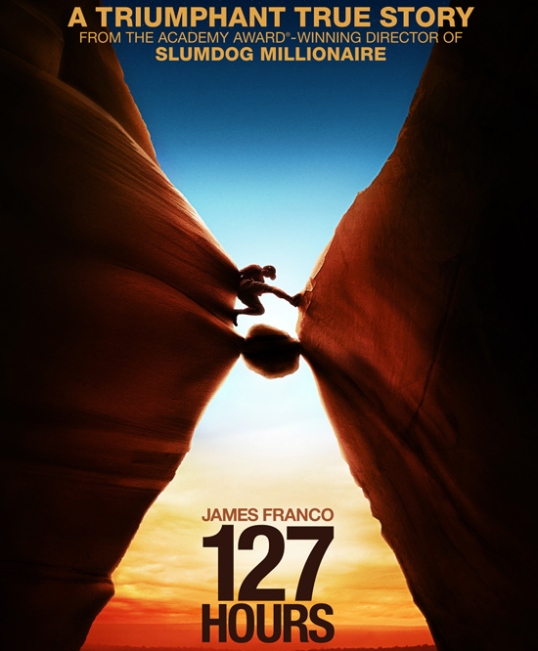
Last Friday night, my friend Jeff and I went down to the Plano Angelika and saw Danny Boyle’s new film, 127 Hours.
I have to admit that I was a little bit uneasy about seeing this film. First off, it’s a movie based on the true story about a mountain climber who spent 5 days trapped in a narrow canyon. I am intensely claustrophobic, to the extent that I’ve had panic attacks just from finding myself trapped in a crowded grocery store aisle. (Seriously, why does everyone in the world have to go shopping for La Choy Sweet and Sour sauce at the same time I do?) Secondly, the trapped climber eventually escaped by using a dull knife to saw off his right arm. I mean, ewwwwww!
But I knew I had to see the film for three reasons. Number one, it stars James Franco who I’m kinda in love with. Number two, Danny Boyle is one of my favorite directors. And, finally, 127 Hours is probably going to be nominated for best picture. So, I worked up my courage and I tried not to think about the various news reports about audience members passing out while watching the film, and I went to the movie. And I’m glad I did because 127 Hours is one of the best films that I’ve seen in quite some time.
James Franco plays Aron Ralston, a cocky but likable guy who decides to spend the weekend hiking across some place called Blue John Canyon. (Sorry, I’m not really an outdoorsey type of girl.) He tells no one of his plans and the only people who know he’s even at the canyon are two girls that he meets while there. The girls have gotten lost in the canyon and they accept Aron’s help in finding whatever grand archeological thing it is that they’re looking for. (See previous apology.)
I have to be honest here. As I watched these two girls go off with a perfect stranger, a part of me wanted to be all like, “Oh, I would never do something as stupid as go off with some stranger I met out in the middle of nowhere.” But, then again, this isn’t just some stranger. This is James Franco. So, I’ll refrain from passing judgment. I just hope that the girls had their pepper spray with them.
(The two girls, by the way, are played by Kata Mara and Amber Tamblyn. I loved Joan of Arcadia. Can you believe they cancelled it for Ghost Whisperer? Not cool, CBS.)
Anyway, after frolicking in an underground pool, Aron and the girls part company. They invite him to come to a party the next night. They tell him to just look for a big, inflatable Scooby Doo. Aron agrees, walks off, and promptly finds himself trapped in a canyon when a boulder falls on top of him and pins his right arm against the canyon wall. As quickly as that, Aron goes from being a carefree adventurer to literally being a prisoner, isolated and alone. As Franco screams for help, Boyle pulls the camera upward from Aron until eventually he’s a barely noticeable speck surrounded by a barren (and otherwise unpopulated) desert. It’s a moment that you know is coming but it’s still shocking and devastating because it stands in such stark contrast to the film’s first 20 minutes when both Boyle and Franco filled each scene with a sense of constant motion. Suddenly, everything has stopped and we’re as trapped as Aron.
The rest of the film is pretty much a one-man show. We watch as Aron spends the next five days fighting to just survive. He tries to chip away at the rock with a knife (yes, that knife). He talks to his camera, keeping a diary and leaving messages for his family. He fights off hungry ants and tries to conserve his water. He even manages to invent a pretty neat little pulley system to try to move the rock. Finally, he starts to hallucinate, seeing everything from his family disdainfully watching his predicament to a gigantic inflatable Scooby Doo stalking him in the canyon. And finally, of course, he starts to cut off his arm.
He also finds some time to think about the life he led up to the moment he found himself trapped underneath the rock. This is where Boyle really shines because, in the hands of most directors, these scenes probably would have been very maudlin and heavy-handed. However, Boyle presents these scenes in an almost impressionistic style. We see hints of the life that Aron has led but Boyle never comes out and blatantly says that, up until this point, Aron never been willing to truly connect with others. We sees scenes of Aron’s ex-girlfriend breaking up with him but we’re never specifically told what led to her leaving him. And we don’t need to be. Boyle presents us with the evidence and trusts us to draw the correct conclusion.
I am very proud to say that I watched the entire film without once having a panic attack though I did start to feel a little bit light-headed when Aron really started to get into sawing off his arm. At this point, I did end up burying my head in Jeff’s shoulder and watching the scene out of the corner of my eye. At the same time, it’s an oddly exhilarating sequence because we know that the only way Aron will survive is by cutting off his arm and, as a result of Franco’s performance, we really do want Aron to survive.
In retrospect, 127 Hours really is the ultimate guy film in that the film basically celebrates a guy who gets stranded in the desert for five days yet manages to survive without ever once having to ask for directions. However, as a result of the whole experience, he comes to realize he should have been nicer to his ex-girlfriend which means that chicks like me can enjoy the movie as well. My main concern is that the film is such a total guy flick that we might see a sudden epidemic of men amputating their limbs in order to show that they can handle it as well as James Franco did. As we left the theater, I assured Jeff that he didn’t have to chop off his hand just to impress me. Hopefully, he listened.
James Franco is generating a lot of Oscar buzz for his performance here and he should be. Franco is one of those performers who is so pretty that it’s easy to forget that he’s actually a pretty good actor. I thought he deserved a nomination for his performance in Milk. He deserves the Oscar for his performance here.
Along with a best actor nod for Franco, it seems likely that 127 Hours will also pick up nominations for best picture and best director. Interestingly enough, Boyle will probably find himself competing with the man he beat two years ago, David Fincher (previously nominated for The Curious Case of Benjamin Button and a probable nominee this year for The Social Network.) This is somehow appropriate as Danny Boyle has consistently proved himself to be the director that David Fincher is supposed to be and, by being a massively hyped film that lives up to all the praise, 127 Hours is the anti-Social Network. While The Social Network uses a “true” story as an excuse to judge and ridicule, 127 Hours uses its true story to celebrate humanity, flaws and all. Whereas Fincher seems to only celebrate film, Boyle celebrates life.
I read earlier that film producer Dino De Laurentiis died on Wednesday. He was 91 years old and he either produced or helped to finance over a 150 movies. He started his career with Federico Fellini and went on to produce two of the iconic pop art films of the 60s, Roger Vadim’s Barbarella and Mario Bava’s Danger: Diabolik. Then in the 70s he went through the most infamous stage of his career when he produced several overblown “event” films like the 1976 remake of King Kong. However, even while De Laurentiis was devoting his time and effort to critically reviled attempts at spectacle, he was also supporting the visions of independent directors like David Lynch. In the 21st Century, De Laurentiis was probably best known for producing the Hannibal Lecter films.
De Laurentiis, born in Naples, was a Southern Italian and, not surprisingly, was one of those legendary, larger-than-life moguls who built his career walking on the thin line between the Mainstream and the Grindhouse. Hollywood is run by people who try to be De Laurentiis but De Laurentiis was the real thing.
Dino De Laurentiis, R.I.P.
(On a personal note, De Laurentiis produced one of my favorite films of all time, Bound. And I’m a fourth-Southern Italian myself. Southern Italians are the best.)
As I’m sure I’ve mentioned before, I’ve always loved to dance. Before I embraced the movies, my life was about dancing. I was going to be Prima Ballerina and my mom paid for several years of ballet class to help me reach that goal. I obsessed on it the way that I obsess, today, on Lucio Fulci and Jean Rollin. However, my brilliant career was cut short by two things — 1) I’m about as graceful as a Clydesdale and 2) I ended up tumbling down a flight of stairs when I was 17 and essentially shattering my ankle. Actually, I guess those two things might be connected. Anyway, I can’t complain because giving up my affected love of ballet allowed me to discover my very true love of film. I was never really a great dancer (though I was, and am, very enthusiastic) but I’m very good at watching movies.
However, I still love to dance and I still love movies — even mainstream movies — that feature dancing. That’s why I’m so looking forward to seeing Black Swan next month. Until then, here’s 6 of my favorite dance scenes from the movies.
Let’s start off with one of my favorite “dance” scenes of all time, my man Giovanni Lombardo Radice and Lorraine De Selle breaking it down in Ruggero Deodato’s The House On The Edge of the Park. The man in yellow is David Hess.
If anyone’s ever wondered why I was crushing on Joseph Gordon-Levitt in Inception (as opposed to Tom Hardy, Cillian Murphy, or Leonardo DiCaprio), it was largely because of this scene from (500) Days Of Summer.
Murder Rock is kinda sorta like my own personal Holy Grail — it’s a grindhouse dance movie directed by Lucio Fulci! Plus, it costars Christian Borremeo, who co-starred in The House on the Edge Of The Park and Dario Argento’s Tenebrae.
Okay, so I think Nine was definitely the worst the movie of 2009. Yes, even worse than Avatar. However, I love this scene and I love the song featured in it, Cinema Italiano. Yes, technically, it’s a really terrible song that displays an astounding ignorance of Italian cinema. If anything, the lyrics appear to be describing the French New Wave. True, the song do make reference to “neo-realism” but you get the feeling no one involved with Nine ever saw Open City or The Bicycle Thief. But the thing is do damn catchy that I still find myself singing it in the shower. Like me, Kate Hudson is obviously not much of a singer or a dancer but she’s very enthusiastic.
An Unmarried Woman was apparently very groundbreaking in 1978. Seen now, it seems like a better title for it would be An Unmarried Woman Who Can Still Afford A Penthouse Apartment In New York City. Still, the late, great Jill Clayburgh’s performance holds up well and I like the film if just because it’s still one of the few movies out there that’s willing to acknowledge that an unmarried woman can still be a sensual, happy woman. The scene below captures perfectly the exhilarating joy of just surrendering to the music and dancing. Plus, for me, this is one of those “Hey, I do that too!” scenes. In fact, my ankle is still hurting as a result of rewatching this film last Friday.
Werner Herzog’s Bad Lieutenant: Port of Call New Orleans was one of the best films of 2009. There. I said it. And I know that there’s a lot of people out there who would disagree with me on this. They would say that, at best, this film was memorable because of Nicolas Cage’s manic performance and nothing else. Well, you know what?
Those people are wrong. End of story.
Here’s one of my favorite scenes from Bad Lieutenant, one that features everything that makes this film one of the unacknowledged masterpieces of the 21st Century: Nicolas Cage going crazy, senseless violence, dancing souls, and an iguana.
Sometimes, you have to be careful which films you choose to watch over the course of the day.
Such as, last Friday night, I heard the news that Jill Clayburgh had died and I ended up watching An Unmarried Woman. This, along with the fact that I also watched the Black Swan trailer, led to me dancing around the house in my underwear, en pointe in bare feet, and doing a half-assed pirouette in the living room. And I felt pretty proud of myself until I woke up Saturday morning and my ankle (which I don’t think has ever properly healed from the day, seven years ago, that I fell down a flight of stairs and broke it in two places) literally felt like it was on fire. That was my body’s way of saying, “You ain’t living in a movie, bitch. Deal with it.”
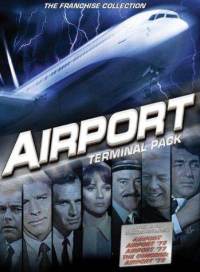
So, come Sunday, I decided to play it safe by watching something that I was sure wouldn’t lead to any imitative behavior on my part. Since I had previously reviewed Earthquake on this site, I decided that I would devote some time to the movies that started the entire 1970s disaster movie genre — Airport. Watching Airport led to me watching Airport’s three sequels.
I was able to do this largely because I own the Airport Terminal Pack, a two-disk DVD collection that contains all four of the Airport films and nothing else. There’s no special features or commentary tracks. That’s probably a good thing because these films are so extremely mainstream that I doubt the commentary tracks would be all that interesting except to people who love “Me and Jennings Lang had the same lawyer…” style stories.
The movies are a mixed bag of ’70s sexism, mainstream greed, and casts that were described as being “all-star” despite the fact that they featured very few stars. They’re all worth watching as time capsules of a past time. Some of them are just more worthy than others.
Below are my thoughts on each individual film in the collection…
Airport (directed by George Seaton)
First released in 1970, Airport was nominated for 10 Academy Awards (including best picture), broke box office records, and started the whole 70s disaster movie trend. It also has to be one of the most boring, borderline unwatchable movies ever made. The fact that I managed to sit through the whole thing should be taken as proof that I’m either truly dedicated to watching movies or I’m just insane. Take your pick.
Anyway, the film is painstakingly detailed account of the every day operations of an airport. Yeah, sounds like a lot of fun, doesn’t it? Burt Lancaster runs the airport. His brother-in-law Dean Martin flies airplanes. Both of them have mistresses but we’re told that’s okay because Lancaster’s wife expects him to talk to her and Martin’s wife is cool with him fucking around as long as he comes home at night. I would be tempted to say that this is a result of the film having been made in 1969 and released in 1970 but actually, it’s just an introduction to the sexual politics of the typical disaster film. Men save the day while women get in the way. And if you think things have changed, I’d suggest you watch a little film calledf 2012…
The only interesting thing about the film is that Lancaster’s mistress is played by Jean Seberg who, ten years earlier, had helped change film history by co-starring in Jean-Luc Godard’s classic film Breathless. Nine years later, after years of being hounded by the American press and the FBI for her radical politics, Seberg committed suicide.
Airport 1975 (directed by Jack Smight)
As opposed to its predecessor, Airport 1975 is actually a lot of fun in its campy, silly way. This is the one where a small private plane (flown by Dana Andrews, the star of the wonderful film noir Laura) collides with a commercial airliner. The entire flight crew is taken out and head stewardess Karen Black has to pilot the plane despite the fact that she’s obviously cross-eyed. Luckily, since Black is a stewardess, she has a pilot boyfriend who is played by Charlton Heston. Heston talks her through the entire flight despite the fact that she was earlier seen trying to pressure him into not treating her like an idiot. Anyway, Heston does his usual clench-jaw thing and if you need a drinking game to go with your bad movie, just take a shot every time Heston calls Black “honey.” You’ll be drunk before the plane lands.
There’s some other stuff going on in this movie (for instance, Gloria Swanson appears as “herself” and doesn’t mention Sunset Boulevard or Joseph Kennedy once!) but really, all you need to know is that this is the film where Karen Black acts up a storm and random characters keep saying, “The stewardess is flying the plane!?”
Odd trivia fact: Airport 1975 was released in 1974.
Airport ’77 (directed by Jerry Jameson)
In Airport ’77, a group of art thieves attempt to hijack an airplane which, of course, leads to the airplane crashing into the ocean and somehow sinking down to the ocean’s floor without splitting apart. The crash survivors have to try to figure out how to get to the surface of the water before they run out of oxygen.
In this case, our resident sexist pilot is Jack Lemmon who has a really ugly mustache. He wants to marry head stewardess Brenda Vaccarro. Vaccarro doesn’t understand why they have to get married to which Lemmon responds, “Because I want a wife and kids!” The film also gives us Lee Grant as a woman who is married to Christopher Lee but who is having an affair with another man. She also drinks a lot and dares to get angry when she realizes that the airplane is underwater. While this sort of behavior is acceptable from Dean Martin, Charlton Heston, and Jack Lemmon, the film punishes Lee Grant by drowning her in the final minutes.
Technically, Airport ’77 is probably the best of the Airport films. The cast does a pretty good job with all the melodrama, the film doesn’t drag, and a few of the scenes manage to generate something resembling human emotion. (For instance, when the blind piano player died, I had a tear in one of my freaky, mismatched eyes.) Unfortunately, the movie’s almost too good. It’s not a lot of fun. Everyone plays their roles straight so the silly plot never quite descends into camp and the key to a good disaster film is always camp. This film also has the largest body count of the series, with most of the cast dead by the end of the movie. (And, incidentally, this film did nothing to help me with my fear of water…)
The Concorde: Airport ’79 (directed by David Lowell Rich)
The last Airport movie is also the strangest. Some people have claimed that this film was meant to be a satire of the previous Airport films. I can understand the argument because you look at film like Concorde and you say, “This must be a joke!” However, the problem with this theory is that there are moments of obvious “intentional” humor in this film (i.e., J.J. from Good Times smokes weed in the plane’s bathroom, another passenger has to go to the bathroom whenever she gets nervous) and none of them show any evidence of the type of wit and outlook necessary to come up with anything this silly on purpose. Add to that, the film’s story is credited to Jennings Lang, a studio executive. Studio execs do not take chances. (Plus, the actual script was written by Eric Roth, who went on to write the amazingly humorless The Curious Case of Benjamin Button).
No, this film is meant to be taken seriously and oh my God, where do I start?
Our pilots are George Kennedy and Alain Delon. The head stewardess (and naturally, Delon’s girlfiend) is played by Sylvia “Emanuelle” Kristel who, at one point, says, “You pilots are such men!” “Hey, they don’t call it a cockpit for nothing, honey,” Kennedy replies.
Meanwhile, Robert Wagner is trying to destroy the Concorde because one of the passengers is his girlfriend who has proof that Wagner has been selling weapons to America’s enemies. So, he attempts to blow the plane up with a guided missile and when that fails, he sends a couple of fighter planes after them. Kennedy responds by opening up the cockpit window — while breaking the sound barrier mind you — and firing a flare gun at their pursuers.
After this, there’s stop over in Paris where Delon arranges for Kennedy to sleep with a prostitute who assures Kennedy that he made love “just like a happy fish.”
The next day, everyone returns to the exact same Concorde — despite the fact that just a day earlier they’d nearly been blown up by a squadron of fighter planes — and take off on the second leg of the flight. Let me repeat that just to make sure that we all understand what this film is asking us to believe. After nearly getting blown up by a mysterious squad of fighter planes, everybody shows up the next morning to get on the exact same plane.
Oh, and it never occurs to Wagner’s ex-girlfriend that Wagner might have something to do with all of this.
Now sad to say, Concorde is the one of those films that’s a lot more fun to talk about than to actually watch. It should be a lot more fun in its badness than it actually is. Still, the movie has just enough camp appeal to make it fun in a “what the fuck…” sorta way.
And that’s how the Airport series comes to an end.
This edition of Lisa Marie’s Favorite Grindhouse and Exploitation Trailers is a sentimental and sad occasion for me. I’m a Scorpio (and, seriously, who is shocked to hear that, right?). What that means is that I’ve got a birthday coming up this Tuesday. I’ll be turning 25. I’ll be a quarter of a century old. So, this will be my last installment of this series as a young woman. Next weekend, when I post the next installment, I’ll be an adult.
Unfortunately, I didn’t really think about this until I’d already selected my trailers for this installment. So, I wish I could say that there’s some sort of deep meaning behind why I picked any of these posts. But there’s not, with the exception of I Drink Your Blood. And my selection of I Drink Your Blood has less to do with my birthday and more with the fact that it’s the 17th greatest movie ever made.
Anyway, let’s get to the trailers and try not to think about the fact that I’m getting old…
Two things I love about the trailer: the pompous opening 40 seconds (I loved it when Exploitation mocks the Mainstream through imitation) and the presence of Marjoe “Bad, not evil” Gortner.
This is the Mexican version of Jaws. Not only was it directed by the infamous Rene Cardona, Jr. but it stars the original HUGO STIGLITZ!
3) Prisoner of Paradise
Prisoner of Paradise (which I have never seen) is apparently a hardcore war film from the 70s that starred John C. Holmes’s cock. The star does not appear in this trailer. Instead, we get things blowing up followed by something else blowing up which is followed up by something — wait for it — blowing up. And then, suddenly, we’re on the beach.
Speaking of blowing things up…Machine Gun McCain is one of the many Italian crime thrillers that came out in the late 60s. They were not only far more violent than American thrillers but usually a lot more interesting too. Earlier on Saturday, I bought this movie on DVD. The guy working the register looked at it and said, “I’d watch this first because Britt Ekland’s in it.”
While the Italians were exploiting the Mafia, Americans were exploiting motorcycle gangs. Hell’s Bloody Devils is a typical example with a typically 1970 political subtext. It was directed by Al Adamson who, years later, was apparently murdered and buried in cement.
I Drink Your Blood was released on a double bill with an old black-and-white zombie films called I Eat Your Skin. All the scenes in the trailer below are from I Drink Your Blood. I love the trailer because it is just classic grindhouse. However, I Drink Your Blood is also one of the best films ever made. The 18th best, to tell the truth. Seriously.
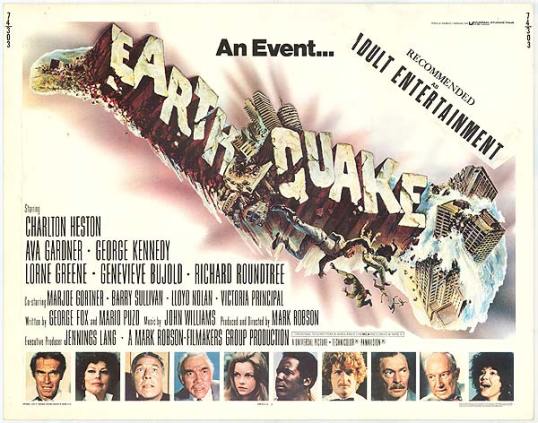
Since it’s impossible for me to talk about anything without somehow relating it to a movie, I guess it makes sense that my reaction to San Francisco winning the World Series was to write a review of the award-winning, 1974 disaster film Earthquake. If the Rangers had won, I would have been obligated to write up a review of No Country For Old Men.
So, Earthquake is one of those movies from the 70s in which a large group of different characters had to deal with some sort of cataclysmic disaster that could, in theory, have happened in reality as well as up on the movie screen. There were apparently about 2,000,000 of these films made between 1970 and 1980 and they all had titles like Hurricane, Tornado, Big Fire, Asbestos, Flash Flood, Lava Flow, Khardashian, Avalanche, and, of course, Earthquake. These movies always featured an “all-star” cast of people that nobody had ever actually heard of and I guess part of the fun was trying to guess who would survive and who would die. Apparently, they were the 1970s version of Dancing With The Stars. Call it Dying With Celebrities.
Earthquake is one of best known of these films. Apparently, it made a lot of money in 1974 and it won Academy Awards for its earthquake effects. Bleh. Whatever. Have you ever really sat down and looked at a list of the movies that have won at least one Academy Award since they first started handing those things out? Earthquake is like a 6 hour movie and Los Angeles doesn’t start shaking until halfway through. The Earthquake itself only lasts for 15 minutes and it’s kind of impressive to watch but it’s 15 minutes out of 360.
Before the earthquake hits, we get to meet the usual cross-section of humanity. Charlton Heston is an architect who is married to Ava Gardner who is the daughter of Heston’s boss, who is played by an actor named Lorne Greene who appears to be younger than either Heston or Gardner. Heston has a mistress who is played by Genevieve Bujold who is really pretty, sweet, and boring. Gardner is none of these things but she is a foul-mouthed alcoholic who fakes suicide attempts so I was pretty much on her side as far as the whole love triangle is concerned. After the Earthquake, Heston and Greene and a bunch of accident-prone extras are stuck in the ruins of sky scraper. Heston grimaces a lot in this film but you know what? Say what you will about Charlton Heston’s politics or his clenched-teeth acting style, the man knew how to wear an ascot.
While Heston is torn between Gardner and Bujold (a plot development that reportedly inspired the famous Sartre play No Exit), Richard Roundtree just wants to jump over stuff on his motorcycle. That’s right — John Shaft is in this movie and we can dig it. He’s a professional daredevil. He’s also a surprisingly dull actor. Who would have guessed that, without a theme song playing, Shaft would turn out to be so boring? Still, there’s a really cool scene where Roundtree tries to ride his motorcycle through Los Angeles in the middle of the earthquake and the film is worth watching for his all-flare stunt daredevil costume if nothing else. Plus, Roundtree’s playing a character named Miles here and I like that name.
There’s another subplot. It involves George Kennedy as a blue-collar cop who does what he has to do to try to maintain the peace before and after the Earthquake. Bleh. I mean, Kennedy actually gives a pretty good performance and he’s probably the most likable character in the film but seriously — Bleh.
And finally, this collection of humanity is rounded out by an aspiring actress (played by actress Victoria Principal who, four years earlier, had made history by being the first woman to successfully seduce actor Anthony Perkins and no, I don’t want to go into how I know that) and the psychopathic grocery store manager who is obsessed with her. The grocery store manager is played by former child evangelist and 70s exploitation icon Marjoe Gortner. Much as in the later film Starcrash, Gortner projects a remarkably unlikable vibe that works well for his character. He also has a really bad perm and a mustache and his performance is so sublimely bad that it’s actually pretty good. As for Principal, her character here is apparently the owner of 1974’s most ginormous afro and, like most women in the 70s, really should have considered wearing a bra. It’s hard to really judge Principal’s performance because any time she’s on-screen, you just start thinking, “Oh my God, she had sex with Norman Bates but somehow, she thinks she’s too good for Marjoe Gortner?”
These are the characters that we follow as Los Angeles is destroyed on-screen. None of them are really much more than cardboard cut outs but there’s something oddly comforting about how shallow and predictable they all are. Add to that, most of them end up dead so if you do dislike them, you’ll find a lot to enjoy. You’ll especially enjoy the film’s final few moments unless, like me, you can’t swim and you’re terrified of drowning. If you’re like me, that scene might give you nightmares.
Flawed as it may be, I still have to recommend this movie as 1) a time capsule and 2) as a quintessential piece of American camp. Every line of dialogue, every performance, every image, and every scene in Earthquake simply screams 1974. I guess the best way to look at Earthquake is to think about it as if the movie’s a time machine. You might not like where the machine takes you but you’re still going to get into the damn thing and, once you find yourself stuck in Iowa in the year 1835, you’ll find someway to force yourself to be entertained because otherwise, you’re just hanging out in Iowa in 1835.
In honor of the holiday, here’s a Halloween-themed clip from one of the greatest films ever made — Ms. 45, the movie that proved that the Grindhouse is often more sincerely pro-woman than the mainstream.
(Big spoiler warning: This scene is actually the end of the film so if you’re the type of little toadsucker that’s always crying “You should have warned me boo hoo,” consider yourself warned.)