Trailer: Helen Alone


I haven’t heard much about Helen Alone, beyond the fact that it’s an independent film, it’s the directorial debut of Henrik Bech Poulsen, and it was filmed in my home state of Texas.  According to its imdb page, it’s scheduled to be released on August 1st.

And, based on the trailer, I’m looking forward to seeing it.  The trailer has a nicely surreal feel to it.  As someone who spent her teen years living in the Texas suburbs, there was a lot in this to which I could definitely relate.

Trailer: The Rover


A lot of people are probably going to be inclined to dismiss The Rover out-of-hand simply because it stars Robert Pattinson.  I suggest that, if those people need proof that Pattinson is capable of more than Twilight, they should go watch Cosmopolis.

And besides, even if you aren’t a fan of Pattinson’s, you should still be willing to take a chance on The Rover because it was directed by David Michod, who previously directed the absolutely brilliant Animal Kingdom, and it co-stars the great Guy Pearce.

The Rover will be released in the summer of 2014.


44 Days of Paranoia #42: The Manchurian Candidate (dir by Jonathan Demme)


For our next entry in the 44 Days of Paranoia, we take a look at the 2004 remake of The Manchurian Candidate.  (You can read my review of the original by clicking on this sentence.)

During the first Gulf War, when a platoon of soldiers is attacked by Iraqi forces, their lives are saved by Sgt. Raymond Shaw (Liev Schrieber).  Raymond receives the congressional medal of honor and is eventually elected to the U.S. House of Representatives.  In many ways, Shaw is continuing the family business.  Not only was his father a Senator but so is his powerful and calculating mother (Meryl Streep).  As the film opens, Raymond Shaw has just been nominated for the vice presidency.  A strife-torn America looks to Shaw to save the country.  After all, he’s a war hero.

Or is he?

Major Ben Marco (Denzel Washington), who was a member of Shaw’s platoon, has spent the last few years having nightmares in which he and the other members of the platoon — including Shaw — were captured, brainwashed, and had implants inserted into their bodies.  When Marco discovers that the other members of his platoon have been having the exact same nightmare, he starts to investigate on his own.

When I first started watching this version of The Manchurian Candidate, my initial response was to go, “Bleh!  Remake!”  There’s a reason why most film bloggers automatically despise any and all remakes.  Usually, they add little to the original version and they rarely improve over what was previously there.  Even worse, remakes often times seem to be directed by some of the worst hacks in Hollywood.  What’s more insulting — to have your movie remade or to have it remade by Brett Ratner?

However, Jonathan Demme is not your typical Hollywood hack and that became quickly obvious as I watched his remake of The Manchurian Candidate.  Both Demme’s direction and the screenplay by Daniel Pine and Dean Georgaris show a lot of respect for the original while also providing a few surprises of their own.  Demme creates a convincing portrait of a society that has been consumed by secrecy and is now running the risk of collapsing under the weight of conspiracy.

Unfortunately, the remake doesn’t quite capture the satiric bite of the original.  One of the things that made the original Manchurian Candidate so memorable was the fact that both sides of the ideological divide were ultimately portrayed as being empty, shallow, and ultimately destructive.  The ultimate message was that neither the left nor the right should be trusted.  The remake is a lot more specific about who the villains are and what they believe in and, as a result, its attempts at social and political commentary are a lot more predictable.  The original Manchurian Candidate could both entertain you and make you think.  The remake is very entertaining but never quite thought-provoking.

While it can’t hope to improve on the original, the remake of The Manchurian Candidate is a well-made and compelling action film that features a trio of great performances from Denzel Washington, Liev Schrieber, and especially Meryl Streep.  As her performance here shows, Meryl really should be playing more villains because her performance here is not only impressive but also fun to watch.

Other Entries In The 44 Days of Paranoia 

  1. Clonus
  2. Executive Action
  3. Winter Kills
  4. Interview With The Assassin
  5. The Trial of Lee Harvey Oswald
  6. JFK
  7. Beyond The Doors
  8. Three Days of the Condor
  9. They Saved Hitler’s Brain
  10. The Intruder
  11. Police, Adjective
  12. Burn After Reading
  13. Quiz Show
  14. Flying Blind
  15. God Told Me To
  16. Wag the Dog
  17. Cheaters
  18. Scream and Scream Again
  19. Capricorn One
  20. Seven Days In May
  21. Broken City
  22. Suddenly
  23. Pickup on South Street
  24. The Informer
  25. Chinatown
  26. Compliance
  27. The Lives of Others
  28. The Departed
  29. A Face In The Crowd
  30. Nixon
  31. The Hunger Games: Catching Fire
  32. The Purge
  33. The Stepford Wives
  34. Saboteur
  35. A Dark Truth
  36. The Fugitive
  37. The Day of Jackal
  38. Z
  39. The Fury
  40. The Manchurian Candidate (1962)
  41. Shattered Glass

A Death-Defying Quickie With Lisa Marie: Rollercoaster (dir by James Goldstone)


Recently, despite my longstanding fear of heights and my refusal to ever ride one in real life, I watched a film called Rollercoaster.  First released in 1977, Rollercoaster recently made its debut on TCM.  I was hesitant about watching it but then Robert Osborne assured me that it was an entertaining film and, seriously, who can say no to Robert Osborne?

An unnamed bomber (Timothy Bottoms) is going from amusement park to amusement park and blowing up roller coasters.  He wants money and, even more importantly, he wants the money to be delivered to him by safety inspector Harry Caulder (George Segal).  Will the FBI back off long enough for Harry to deal with the bomber?  Will the bomber ever smile?  Finally, will Harry be able to save the day while, at the same time, trying to quit smoking and bond with his daughter?

Roller Coaster is about 30 minutes too long and it’s never quite as exciting as it should be.  My mind kept wandering during the climax, which is not a good thing when the film is supposed to be a race against time.  However, at the same time, when taken on its own dated terms, Roller Coaster is a lot of fun.  Even if director James Goldstone (who also directed the far more surreal Brother John) struggles a bit with keeping the action moving at a steady pace, he still directs with a good eye for detail and gets good performances out of the majority of the film’s cast.

Since I best know George Segal for playing cantankerous father figures on about a thousand different sitcoms, it took me a few minutes to get used to the idea that he was the main character here.  While Segal does have several funny lines in Rollercoaster, he is also totally convincing and likable as the film’s hero.  Timothy Bottoms is equally convincing as the unnamed bomber.  The fact that we learn little about the bomber’s motivations or background just serve to make Bottoms’s cold performance all the more chilling.

As for the supporting cast, Henry Fonda is the biggest distraction, snarling his way through his role as Segal’s jerk of a boss.  Oddly enough, Fonda showed up in a lot of disaster films in the 70s, usually playing authority figures and usually only appearing in two or three scenes.  Whenever Henry Fonda shows up in a film like this, overacting and looking somewhat humiliated, it’s best just to close your eyes and think of 12 Angry Men and then realize that even great actors sometimes just needed a paycheck.  Richard Widmark is far more convincing, playing the stuffy FBI agent who doesn’t have much use for George Segal.  Finally, for those of you who enjoy spotting future Oscar nominees in unlikely roles, 13 year-old Helen Hunt makes her film debut here as Segal’s daughter, who just wants to ride the rollercoaster one time.

Ultimately, the best recommendation that I can give to Rollercoaster is to say that it’s a quintessentially 70s films and hence, it’s a piece of history.  Not only is the film full of 70s fashion, 70s hair, and 70s stereotypes (just check out the long-haired teenagers joking about getting high while unknowingly sitting on top of a bomb) but the film also features a performance from a band called Sparks that is so 70s that the cast of Dazed and Confused might as well have been watching them in the audience and going, “Alright, alright, alright…”

(I have to admit that I had never heard of Sparks before I saw this film.  I looked them up on Wikipedia and I discovered that not only is the band still performing but that the lead singer claims that appearing in Rollercoaster was the band’s biggest regret.  Personally, I think he’s being too hard on both the band and the film.  Sure, they seem painfully out-of-place but I dare anyone to get the borderline annoying sound of “Big Boy” out of their head.)

For those of us who were born a few decades too late to experience it firsthand, Rollercoaster is our chance to spend two hours living in the 70s.

A Psychedelic Quickie With Lisa Marie: The Big Cube (dir by Tito Davison)


I recently discovered that I have about 66 movies recorded on my DVR.  A few of these, like Bend it Like Beckham and Thirteen, are films that I always make it a point to watch whenever they show up on television.  But the majority of them are movies that I just happened to spot while going through the guide and I thought they looked intriguing.  These are movies that I have not been in any hurry to watch but, at the same time, I’m still glad to know that they’re waiting for me whenever I do feel like watching them.

Well, that time has come.  In the month of February, TCM is going to be showing a lot of old Oscar nominees which means that I need to make some space on the DVR.  For the past week, I’ve been going through all of my recorded films and watching them.  While many of them turned out to be rather forgettable, I’ve also come across quite a few that, regardless of quality, made me happy I had taken the time to set them to be recorded.

Case in point: The Big Cube.

What makes The Big Cube such a memorable film?

Four words: Lana.  Turner.  On.  Acid.

The Big Cube was first released in 1969, a fact that’s obvious during every minute of the film.  Lana Turner plays Adriana Roman, a famous stage actress who, following the final performance of a hilariously (and unintentionally) bad play, announces that she is retiring from the theatre so that she might marry the fabulously wealthy Charles Winthrop (Dan O’Herlihy).

Charles has a daughter, a spoiled brat named — wait for it — Lisa (Karin Mossberg).  Interestingly enough, despite the fact that Charles speaks with a pronounced Irish accent, Lisa speaks with a thick Swedish accent that makes the majority of her dialogue almost impossible to understand.  (Adding to the film’s general strangeness is that all of Mossberg’s dialogue is dubbed, which makes you wonder why the film’s producers didn’t, at the very least, hire a voice-over actress who could have at least sounded somewhat believable as Charles’s daughter.)  Lisa is resentful of Adriana, viewing her as competition for both her father’s affection and his money.

Since this movie was made in 1969, Lisa also spends all of her time hanging out with hippies who, in this film, are presented as being the equivalent of pure evil.  They hang out at a “hip” nightclub known as Le Dream where they spend their time secretly slipping sugar cubes laced with LSD into the drinks of strangers.  Or, as one random hippy puts it, “I’m going to cube that mother!”

The source of all of this LSD is Johnny (George Chakiris), a medical student who ends up dating Lisa and conspiring to drive her stepmother insane.  Each night, they secretly slip Adriana LSD, which leads to Lana Turner bugging out her eyes while multi-colored spiral graphs appear on the walls around her.  (And again, we’re reminded that this film was made in 1969, when all you needed to do to let the audience know someone was having a bad trip was to make excessive use of a zoom lens and color filters.)

Eventually, all of this leads to Adriana being struck with amnesia.  How can her mind be fixed?  Could the solution possibly be for Adriana’s playwright friend (Richard Egan) to write a play that reveals the conspiracy against Adriana and then to cast Adriana in the lead role?  And is it possible that along with restoring Adriana’s mind, this play will also allow her to return to the stage and discover that Egan is secretly in love with her?

The Big Cube deserves to be seen just because it’s such a weird and over-the-top film but, beyond that, it’s fascinating as a piece of history.  In 1969, mainstream Hollywood filmmakers were still struggling to figure out how to deal with the counterculture and, even more importantly, how to continue to appeal to young filmgoers who no longer had much in common with the establishment.  The end result were a collection of films that either tried desperately and earnestly to prove that, despite all appearances to contrary, the Hollywood studios really did understand and sympathize with the disaffected youth of America or films like The Big Cube in which old school movie stars like Lana Turner were menaced by long-haired men and amoral girl in miniskirts.

Perhaps not surprisingly, the evil hippy films are a lot more fun than the good hippy films and, as far as evil hippy films are concerned, The Big Cube is one of the more entertaining, even if most of the film’s pleasures are unintentional.  Not only do you get to watch some of the most evil hippies in history but you also get the once-in-a-lifetime experience of seeing Lana Turner on acid!

Seriously, what better way is there to spend 90 minutes?

(Even better, by watching The Big Cube, I could finally delete it from DVR and make some room for the next episode of Downton Abbey….)

What Lisa Marie Watched Last Night #98: Lizzie Borden Took An Axe (dir by Nick Gomez)


(This post contains spoilers.)

Last night, I watched the brilliant Lifetime film, Lizzie Borden Took An Axe.

Why Was I Watching It?

First off, as everyone who reads this site should know by now, I love Lifetime movies.  Add to that, I also happen to like true crime films.  (It’s not for nothing that my twitter bio reads, “Just a sweet little thing with morbid thoughts.”)  So, it’s really not so much a question of why I was watching it as how could I not watch it?

What Was It About?

On a hot summer day in 1892, both Andrew Borden and his wife are hacked to death.  Suspicion is immediately cast upon their daughter Lizzie (Christina Ricci), a free-spirited Sunday School teacher who is also known for being a compulsive shop lifter.  Is Lizzie guilty or was the crime committed by her older sister Emma (Clea Duvall) or the maid or a mysterious stranger who was seen around town on the day of crime?  Though the case itself remains officially unsolved, this film makes a pretty convincing argument that Lizzie was guilty and was only acquitted because nobody, in 19th century America, could bring themselves to believe that a woman was capable of such a violent crime.

What Worked?

It all worked.  Lizzie Borden was one of the greatest Lifetime movies that I’ve ever seen.  It took all of the elements that we expect from a good Lifetime movie — scandal, sex, and girls literally getting away with murder — and pushed them to such an extreme that the end result was absolutely brilliant.  Christina Ricci and Clea Duvall both gave great performances and Nick Gomez directed with an eye towards the surreal, the morbid, and the darkly humorous.

The scene towards the end where Lizzie whispered her confession to Emma was one of the best in the history of Lifetime.

What Did Not Work?

As I said above, it all worked.

“Oh my God!  Just like me!” Moments

I related to the Borden family maid, Bridget Sullivan, because she was Irish and hated having to wash windows.

Lessons Learned

Lizzie Borden was guilty….maybe.

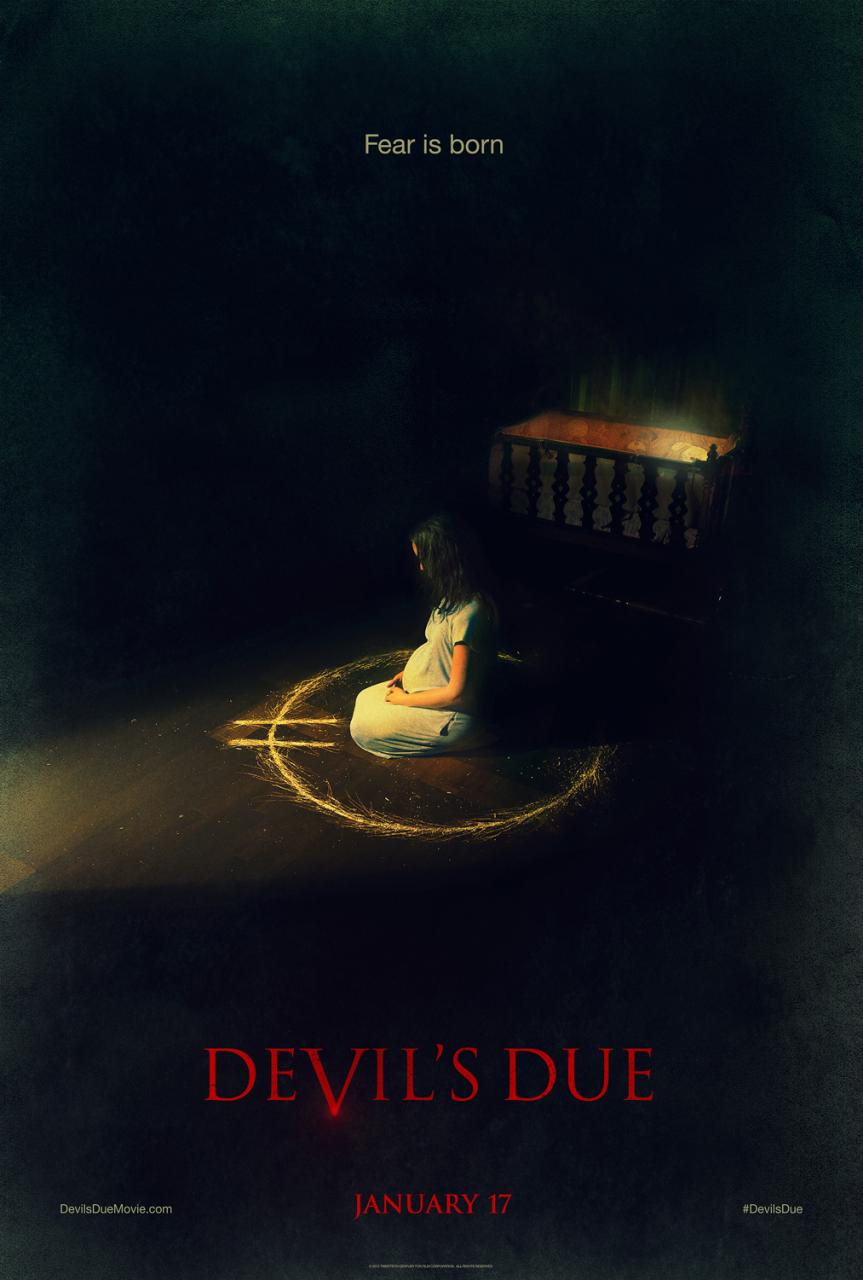
“Devil’s Due” — (Hopefully) What Not To Expect When You’re Expecting


hr_Devils_Due_5

So, it’s January, and you know what that means — “found footage” horror is back.

Seriously, just when you think this cinematic trend has breathed its last gasp, it’s back —  usually during the post-holiday period, when studios are eager to dump off material that they think is going to play to a limited (at best) audience. And then something funny happens — one of these “hand-held horrors, ”  sometimes even a pretty lousy one at that, ends up ruling the roost at the box office for a week or two (The Devil Inside, anyone?), easily recouping its meager production costs, and the Hollywood suits decide to green-light a few more similar productions figuring that, hey, there’s life in this old horse yet.

And so there seems to be. But you do have to wonder — again! — if this persistent sub-genre has finally run its course, now that we’ve had found-footage zombie flicks, found-footage monster flicks, found-footage exorcism flicks, found-footage ghost flicks, and, in the case of the movie we’re here to discuss today, Devil’s Due, found footage Antichrist flicks.

Arriving as this movie did hot on the heels of Paranormal Activity : The Marked Ones, my initial thought was that this co-directed effort from Matt Betinelli-Olpin and Tyler Gillett (who also collaborated on a less-than-stellar segment in the less-than-stellar horror anthology V/H/S) looked like another spin-off from the PA franchise, by way of Polanski’s classic Rosemary’s Baby, and while that’s generally not too far off the mark, it also doesn’t mean this isn’t actually a pretty good film. In point of fact, it is — even if it doesn’t sound like it could, or perhaps even should, be.

Lisa Marie’s nice little write-up on these digital “pages” a week or so back got me sufficiently intrigued to go out and see this thing, and I have to say I’m glad that I did, for while its premise — not to mention its stylistic trappings — are miles away from being original, it was at the very least a deftly-handled, well-constructed, reasonably-well-acted affair that, while utterly predictable, still offered enough of a unique take on its subject matter to seem modestly refreshing and “new.”

Even though it’s not. But hey, cinema relies on at least temporary suspension of disbelief, right?

The set-up is as basic as they come (and as you’d probably expect) : mysterious orphan girl Samantha (Allison Miller) grows up and marries semi-annoying yuppie scumbag Zach (Zach Gilford), they honeymoon in the Dominican Republic, a night of debauchery and excess in a mysterious underground club ends with, we find out later, her getting pregnant, and said pregnancy is beset by weird health complications, mysterious super-powers being bestowed upon the expectant mother, strangers watching their house (one of whom bears an uncanny resemblance to the cab driver who escorted them to their night-to-remember-that-they-don’t-remember in the DR), and whaddya know? A few dead deer feasts, mysterious home invasions, and psychic attacks on priests later, Samantha’s all set to give birth to Satan’s own flesh n’ blood.

On a purely personal level,  I have to confess that Antichrist stories usually fall pretty flat with me since one usually needs to believe in Christ first in order to believe in his evil counterpart —   since I don’t, then,  I’m kind of hobbled when it comes to buying into the whole central premise here, but what the heck? Devil’s Due is paced so as not to give even viewers like myself too much time to dwell on the details, and hey, at least their “let’s record every moment of our lives for posterity” is a better pretext for all the “home movie” footage we’re getting here than some of the limp set-ups we’ve been served by other entries in this admittedly over-crowded field.

In the “minus” column, our intrepid young (I’m assuming, at any rate) directors do come a bit too close to over-playing their hand at the end — they needn’t go nearly as OTT in the effects department as they do in order to drive home their climax — but on the whole, and against all odds, their finished product by and large actually works. And on a cold January afternoon, that’s enough for me.

Devil’s Due may not be a new horror classic by any stretch of the imagination, but it does go some way towards showing that a  “hand-held horror” movie can still be effective — provided, of course, that it’s in the right hands.
44 Days of Paranoia #41: Shattered Glass (dir by Billy Ray)


For our latest entry in the 44 Days of Paranoia, we take a look at one of the best films of the first decade of the 21st Century, 2003’s Shattered Glass.

Shattered Glass tells the true story of Stephen Glass (played, in a surprisingly brilliant way, by Hayden Christensen), a smart and charming journalist who, through a combination of showmanship and carefully calculated moments of vulnerability, has established himself as one of the top reporters at one of the top political magazines in America, The New Republic.  As the film begins, we find Glass at his old high school, giving advice to a classroom of adoring student journalists.  As the self-assured Glass talks about his career, we see scenes of him investigating, pitching, and writing his stores at the New Republic.  It’s here that we see the other side of Glass — not only is he a good writer but he’s a good salesman.  While the rest of his coworkers struggle to pitch dry-sounding stories about Congress, Glass puts on a show as he vividly describes articles about everything from offering his services as a boxing expert to witnessing drug-fueled hijinks at a Young Republican meeting.

However, as the film progresses, we see yet another side to Stephen Glass.  Not only is he a talented writer and an enthusiastic showman but he’s also a pathological liar.  When the head of the Young Republicans challenges Stephen’s article, New Republican editor Mike Kelly (Hank Azaria) investigates and, despite being initially suspicious, is eventually won over by Stephen’s apparent earnestness.

Later, after Kelly has left the magazine and been replaced by new editor Chuck Lane (Peter Sarsgaard), Stephen turns in an article entitled “Hacker Heaven.”  In the article, Stephen writes about witnessing a 12 year-old computer hacker being given a million dollar contract from a company known as Jukt Micronics.  The only problem is that a reporter at Forbes (Steve Zahn) checks the facts in Stephen’s articles and can find no evidence of a company called Jukt Micronics ever existing.

As Lane starts to look into Stephen’s reporting, it starts to become obvious to him that Stephen not only made up the events of “Hacker Heaven” but that he may have falsified several other stories as well.  Already struggling to fill the shoes of the popular Kelly, Lane now finds himself having to investigate one of his most popular reporters.

Shattered Glass is one of those fascinating and unusually intelligent films that I always make a point of watching whenever it shows up on cable.  Not only does it tell a genuinely interesting story but it also features excellent performances from Sarsgaard, Azaria, Chloe Sevigny, and especially Melanie Lynesky.

Even more importantly, it features a revelatory lead performance from Hayden Christensen.  Fairly or not, Christensen is always going to be associated with Star Wars.  In Attack of the Clones and Revenge of the Sith, Christensen didn’t seem like he was a very good actor but then again, did anyone comes out of those films looking better than before they went in?  As bad as Christensen may have been in those two films, he’s absolutely brilliant in Shattered Glass.  He plays Stephen Glass with a puppy dog eagerness to please that is deceptively charming and likable.  It’s only as the film progresses that the audience realizes that there’s nothing behind that affable facade.  Instead, it becomes apparent that he’s a sociopath who lies to hide the fact that his existence is ultimately an empty one.  It’s an amazing performance and one that will make you think twice before blindly accepting the analysis of any of the journalistic “experts” who are regularly trotted out on any of the news shows.

Shattered Glass is also a film that should be seen just so viewers can appreciate the brilliant way that Peter Sarsgaard delivers the line, “This doesn’t seem like a real business card to me.”

Shattered Glass needs to be seen.

Other Entries In The 44 Days of Paranoia 

  1. Clonus
  2. Executive Action
  3. Winter Kills
  4. Interview With The Assassin
  5. The Trial of Lee Harvey Oswald
  6. JFK
  7. Beyond The Doors
  8. Three Days of the Condor
  9. They Saved Hitler’s Brain
  10. The Intruder
  11. Police, Adjective
  12. Burn After Reading
  13. Quiz Show
  14. Flying Blind
  15. God Told Me To
  16. Wag the Dog
  17. Cheaters
  18. Scream and Scream Again
  19. Capricorn One
  20. Seven Days In May
  21. Broken City
  22. Suddenly
  23. Pickup on South Street
  24. The Informer
  25. Chinatown
  26. Compliance
  27. The Lives of Others
  28. The Departed
  29. A Face In The Crowd
  30. Nixon
  31. The Hunger Games: Catching Fire
  32. The Purge
  33. The Stepford Wives
  34. Saboteur
  35. A Dark Truth
  36. The Fugitive
  37. The Day of Jackal
  38. Z
  39. The Fury
  40. The Manchurian Candidate (1962)


Guilty Pleasure No. 16: Keep Off The Grass


It’s been a while since I shared any of those wonderfully dramatic Sid Davis educational films that were designed to encourage our parents to stay in school, stay healthy, and stay American.

With that in mind, here’s Keep Off The Grass.  Initially filmed in 1969, Keep Off The Grass tells the story of what happens when Tom’s parents find out that Tom thinks that marijuana is no big deal.  At both the insistence of his father and the local cops, Tom takes a serious look at his stoner friends and discovers that they’re all a bunch of losers.  As is typical of a Sid Davis educational film, there’s a disapproving narrator who is quick to make sure we all know that all of Tom’s friends kinda sorta suck.

Enjoy Keep Off The Grass!

Previous Guilty Pleasures:

  1. Half-Baked
  2. Save The Last Dance
  3. Every Rose Has Its Thorns
  4. The Jeremy Kyle Show
  5. Invasion USA
  6. The Golden Child
  7. Final Destination 2
  8. Paparazzi
  9. The Principal
  10. The Substitute
  11. Terror In The Family
  12. Pandorum
  13. Lambada
  14. Fear
  15. Cocktail

What Lisa Watched Last Night #97: Flowers in the Attic (dir by Deborah Chow)


This weekend, I watched the Lifetime original movie Flowers in the Attic.

Flowers in the Attic

Why Was I Watching It?

How could I not watch it?  From the minute Lifetime first started to air commercials for it back in November, I knew I was going to watch Flowers in the Attic.  What especially captured my attention was the way Flowers in The Attic was referred to as being “the book you weren’t allowed to read.”  Even though I hadn’t even heard of the book before I saw the commercials, that tag line hooked me.  The forbidden is always so inviting.

Add to that, every time I mentioned Flowers in the Attic on Twitter, Mason Dye (who played Christopher in the film) always favorited my tweet.  That was so sweet that there was no way I couldn’t watch the movie.

What Was It About?

The time is the 1950s.  The recently widowed Corrine (Heather Graham) returns to her childhood home in Virginia.  As Corrine explains to her children, she comes from a rich family but was disowned when she left home.  Now, her plan is to make up with her disapproving father and inherit his fortune once he dies.  Corrine also claims that the only way for her to win back her father’s love is for her to keep the existence of her children a secret.

Hence, Corrine’s children — teenagers Cathy (Kierna Shipka) and Christopher (Mason Dye) and twins Carrie and Cory — are forced to hide in the attic while Corrine charms her father.  The children are watched over by their ultra-religious, abusive grandmother (Ellen Burstyn).

Once in the attic, the children soon realize that Corrine doesn’t seem to be in any hurry to win their freedom.  While Cathy and Christopher struggle to come of age without any adult supervision, Grandma occasionally brings up mysterious powdered donuts.  Soon, Cathy and Christopher are exploring their desires and the twins are falling ill…

What Worked?

It all worked.  This was Lifetime at its absolute best: entertaining, fun, and wonderfully melodramatic.  Along with being full of wonderfully gothic Southern atmosphere, Flowers in the Attic featured great performances from Heather Graham, Mason Dye, and Kiernan Shipka.  Best of all was veteran actress Ellen Burstyn, who made Grandma into a wonderfully over-the-top monster.

What Did Not Work?

 If I have any complaints, it’s that the film’s conclusion felt a bit abrupt.  However, a sequel to Flowers is already in production so that ending was actually a perfect set-up for part two of the story.

“Oh my God!  Just like me!” Moments

Cathy was into ballet, just like me!  If I ever found myself locked in an attic for a year and a half, I’d probably use the time to do some pointe work as well.

Lessons Learned

Don’t eat mysterious donuts.