Shattered Politics #53: The Godfather Part III (dir by Francis Ford Coppola)


GodfatherIII2

Well, it’s come to this.

First released in 1990, The Godfather Part III was nominated for best picture (it lost to Goodfellas Dances With Wolves) but it’s got a terrible reputation.  Over the past two weeks, whenever I’ve mentioned that I was planning on reviewing The Godfather and The Godfather Part II for this series of reviews, everyone who I talked to mentioned that they loved the first two Godfather films and that they hated the third one.  Quite a few, in fact, suggested that I shouldn’t even bother reviewing the third one.  In their eyes, The Godfather Part III was like that one cousin who you know exists but, because he got caught cashing your grandma’s social security check, you never send a Christmas card.

But you know what?

It was never even an option for me to skip reviewing The Godfather, Part III.  First off, I’m a completist.  It’s long been my goal to review every single best picture nominee and, regardless of how much some people may dislike it, that’s exactly what The Godfather Part III is.

Plus, I love the Godfather movies.  I’m a fourth Italian (and, much like the Corleones, my Italian side comes from Southern Italy) and I was raised Catholic.  Let’s face it — The Godfather movies were made for me.  Even Part III.

So, with all that in mind, I recently sat down and rewatched The Godfather Part III.  And I’m not saying that it was an easy film to watch.  It’s a flawed film and those flaws are made even more obvious when you compare it to the previous two Godfathers.  It’s hard to follow up on perfection.  And I have to admit that, even though I had seen Part III before, I was still expecting it to be better than it actually was.  I had forgotten just how many slow spots there were.  I had forgotten how confusing the plot could get.  I had forgotten….

Okay, I’m really starting to sound negative here and I don’t want to sound negative.  Because I like The Godfather, Part III.  I think it’s a good but uneven film.  Some of my favorite films are good but uneven…

But this is a Godfather film that we’re talking about here!

The Godfather Part III opens in 1979, 20+ years since the end of the second film.  Tom Hagen has died off-screen (booo!) and Michael (Al Pacino) is nearly 60 and looking forward to retirement.  He’s handed the Corleone criminal empire over to the flamboyant Joey Zasa (Joe Mantegna).  Michael has finally become a legitimate businessman but he’s lost everyone that he loved.  Kay (Diane Keaton) has divorced him.  His son, Anthony (Franco D’Ambrosio), knows that Michael was responsible for killing Uncle Fredo and wants nothing to do with the family business.  Instead, Anthony wants to be an opera singer.  Meanwhile, his daughter Mary (Sofia Coppola) is headstrong and rebellious.  (Or, at least, she’s supposed to be.  That’s what the audience is told, anyway.  None of that really comes across on the screen.)

Now, the first two Godfather films featured their share of melodrama but neither one of them comes close to matching all of the schemes, betrayals, and plots that play out over the course of Godfather, Part III.  Let’s see if I can keep all of this straight:

As the film opens, Michael is receiving an award from the Vatican.  Kay, who is now married to a judge, shows up with Mary and Anthony.  Michael is obviously happy to see her.  Kay glares at him and says, “That ceremony was disgusting!”  (Damn, I thought, Kay’s suddenly being kind of a bitch.  Fortunately, later on in the movie, Kay’s dialogue was both better written and delivered.)

Then, Vincent (Andy Garcia) shows up!  Vincent is one of those handsome, sexy gangsters whose every action is followed by an exclamation point!  Vincent is Sonny’s illegitimate son!  He wears a cool leather jacket!  He openly flirts with his cousin Mary!  He has sex with Bridget Fonda!  He kills Joey Zasa’s thugs!  He convinces Michael to mentor him!

And, as soon as Vincent enters the film, suddenly every scene starts to end with an exclamation point!

And then, Michael goes to Sicily!  He gets swindled by the corrupt Archbishop Gilday (Donal Donnelly)!  He gets targeted by a corrupt Italian politician!  He confesses his sins to Cardinal Lamberto (Raf Vallone)!  Lamberto later becomes Pope!

Meanwhile, Don Altobello (Eli Wallach) is conspiring to kill Michael!  Because that’s what elderly Mafia dons do!  And then Kay, Anthony, and Mary all come to Sicily!  Anthony is going to be making his opera debut!  And soon Vincent is sleeping with Mary, even though they’re first cousins!

And even more people want Michael dead and I’m not really sure why!  Everyone goes to the opera!  We sit through the entire opera!  Meanwhile, enemies of the Corleones are killed!  And some Corleones are killed!  And it all ends tragically!

Okay, I’m starting to get snarky here and it’s probably getting a little bit hard to believe that I actually do like The Godfather, Part III.  And, as much as I hate to do it, there are a few more flaws that I do need to point out.  Sofia Coppola is one of my favorite directors and she has really pretty hair and we both have similar noses but …. well, let’s just say that it’s probably a good thing that Sofia pursued a career as a director and not as an actress.  Reportedly, Sofia was a last minute pick for the role, cast after Winona Ryder suddenly dropped out of the production.  It’s not so much that her performance is terrible as much as it’s not up to the level of the rest of the cast.  Watching this Godfather, you’re acutely aware of how much of what you’re seeing on screen was determined by Sofia’s inexperience as an actress.

And then there’s that opera.  Now, I know that I’m supposed to love opera because I’m a girl and I’m a fourth Italian.  And I do love big emotions and big drama and all the rest.  But oh my God, the opera at the end of the movie went on and on.  There’s only so much entertainment you can get out of watching actors watch other actors.

But, at the same time, for every flaw, there’s a part of the film that does work.  First off, the film itself is gorgeous to look at, with a lot of wonderfully baroque sets and scenes taking place against the beautiful Italian landscape.  Al Pacino brings a very real gravity to the role of Michael and it’s fun to watch him trying to win back Diane Keaton.  (In those brief scenes, The Godfather Part III almost becomes a romantic comedy.)  Talia Shire is obviously having a lot of fun playing Connie as being a Lady MacBeth-type of character.  (In fact, they needed to give Connie a film of her own where she could poison anyone who get on her nerves.)  And Andy Garcia does a great job as Vincent.  You watch him and you never have any doubt that he could be Sonny’s son.

The Godfather Part III may not live up to the first two Godfather films but what film could?
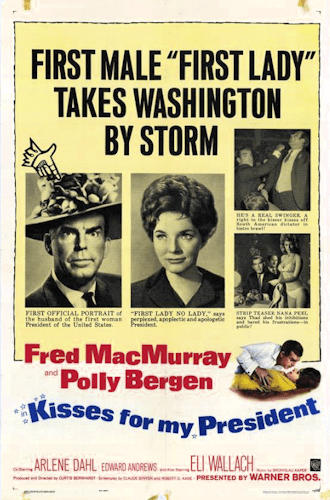
Shattered Politics #21: Kisses For My President (dir by Curtis Bernhardt)


Kisses_for_My_President_-_1964_-_Poster

If there’s anyone who deserves to be the subject of a big budget biopic, it’s Victoria C. Woodhull.  Back in the 19th century, at a time when women were not even allowed to vote, Victoria C. Woodhull was not only the first woman to ever work as a stockbroker but also the first to ever found her own newspaper.  A fierce advocate for women’s right and free love, Victoria Woodhull was also the first woman to ever run for President.  She was nominated in 1872 by the Equal Rights Party and, for the crime of trying to cast a vote for herself, she spent election day in jail.

Since that day, many more women have run for President but none have been elected.  Since 1984, two women have received major party nominations for vice president but neither came close to being elected.  Since 1964, Margaret Chase Smith, Shirley Chisholm, Patsy Mink, Ellen McCormack, Patricia Schroeder, Elizabeth Dole, Carol Mosely-Braun, Michele Bachman, and Hillary Rodham Clinton have all campaigned for the presidential nomination of one of the two major political parties but none of them have been nominated.

I do believe that a woman will be elected President within my lifetime.  In fact, it could even happen in 2016.  But until then, the only place where you can find a female President is on TV and in the movies.

Take, for instance, today’s final entry in Shattered Politics, the 1964 film Kisses For My President.  This may very well have been the very first movie to feature a woman as President.  Needless to say, in 1964, this idea was considered so outrageous that it had to be played for laughs.

Kisses For My President starts with an image of hundreds of women chanting “We want Leslie!”  We get a shot of Fred MacMurray looking out over the crowd.  The next scene, the new President is being sworn in.  We start with a close-up of the chief justice reciting the oath of office to “Leslie Harrison McCloud.”  The camera pans over to Fred MacMurray, listening intently.  However, just when 1964 audiences were expecting MacMurray to swear to uphold the constitution, the camera pans yet again, over to …. Polly Bergen!

“OH MY GOD!” audiences in 1964 gasped, “LESLIE McCLOUD IS A WOMAN!”

That’s right.  Polly Bergen is playing President Leslie McCloud and Fred MacMurray is playing her husband, Thad.  As the film makes apparent in its opening scenes, Thad is not quite sure what his role is supposed to be.  He has an office in the White House but it’s just so … feminine!  And it’s full of painting of previous first ladies who were all ladies!  And, at one point, Thad even imagines a picture of himself wearing a lady’s hat!

Oh my God!

Now, to be fair to the movie, Polly Bergen does get a few scenes where she shows herself to be a strong President.  There’s a great scene where she coolly dismisses a condescending senator (Edward Andrews) who suggests that, as a woman, Leslie might not be up to the task of standing up to America’s enemies.  It’s a brief scene but it’s a good one.

But, ultimately, it’s impossible to ignore the fact that Kisses For My President, a film about the first female President, is mostly interested in how Thad handles being “first gentleman.”  It’s a film that imagines a historic moment for women and then focuses on what it would mean for one man.

How 1964!

On the one hand, Kisses For My President is a dated comedy that runs way too long and tries to get too much mileage out of one joke (i.e., Fred MacMurray looking confused).  However, the film also features a great performance from Eli Wallach.  Playing a strutting dictator named Vasquez, Wallach is a lot of fun and the scenes where MacMurray shows him around Washington are the best in the film.  I also appreciated the fact that the President’s daughter reacts to the restrictions of living in the White House by dating a guy that she knows her parents will hate, largely because I would have done the same thing in her situation.

I’m a little bit torn on the ending of Kisses For My President.  (Should I spoil it?  No, I don’t think I will.)  On the one hand, it’s outrageously sexist and seems to suggests that Leslie — despite being a strong President during the few times we actually get to see her doing the job — should have been content to just be a wife and mother.  On the other hand, it’s one of those endings that would seem to perfectly capture the dominant culture of the time when the film was made.  So, it has some worth from a historical point of view.

When last I checked, Kisses For My President is currently available for free on YouTube. The film is interesting as a historical document if nothing else.


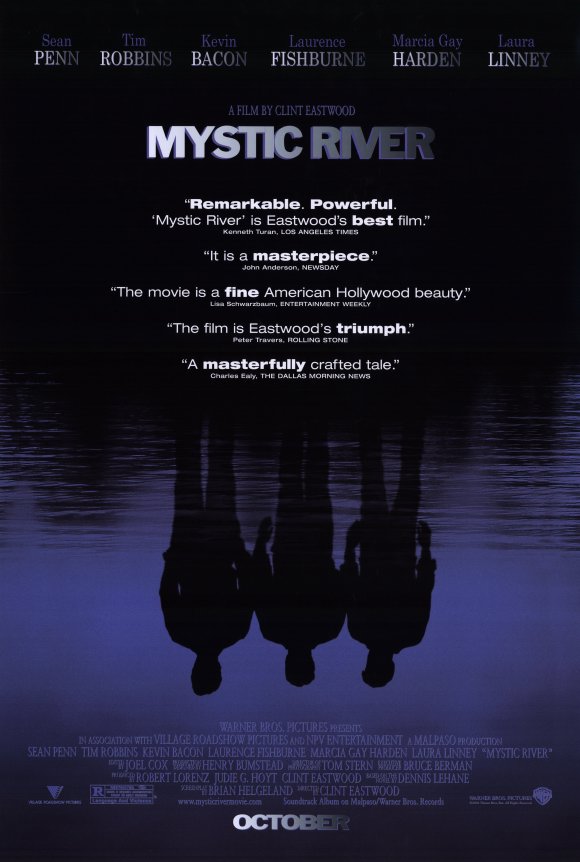
Embracing the Melodrama #51: Mystic River (dir by Clint Eastwood)


mystic-river

Much like In The Bedroom, 2003’s Mystic River is a film that deals with guilt, murder, and vengeance in New England.  Whereas In The Bedroom deals with the guilt of just four people, Mystic River deals with the guilt of an entire neighborhood.

Mystic River opens in Boston in 1975.  Three young boys are writing their names in wet cement when a car pulls up beside them.  An angry-looking man (played by the always intimidating John Doman) gets out of the car and announces that he’s a police officer and that the three boys are under arrest.  He orders them to get in the car.  Of the three boys, Jimmy and Sean refuse but meek Dave gets into the car, where he’s greeted by a leering old man.  Jimmy and Sean watch as the car drives away with their friend trapped in the back seat.  Dave is held prisoner and abused by the two men for four days until he finally manages to escape.

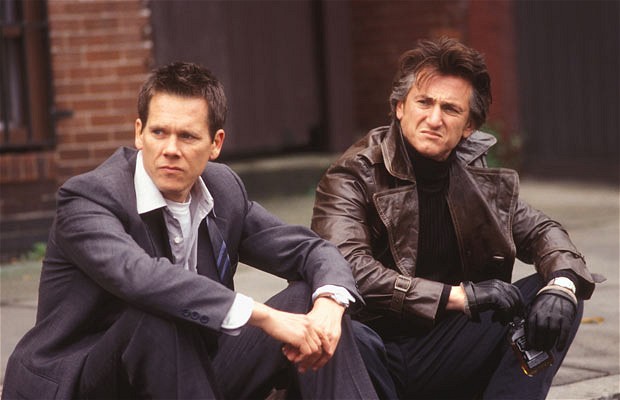
Twenty-five years later, the three boys have grown up but are still haunted by what happened.  Sean is now a detective with the Massachusetts State Police.  Jimmy is an ex-con who now owns a local store and who, despite being married to Annabeth (Laura Linney), the daughter of a local gangster, is trying to lead a law-abiding life.  As for Dave (Tim Robbins),  he is married to Celeste (Marcia Gay Harden) and manages to hold down a job but he’s also the neighborhood pariah.

Mystic River 1

When Jimmy’s daughter Katie (Emmy Rossum) is brutally murdered, Sean and his partner Whitey Powers (Laurence Fishburne) are assigned to the case.  The distraught Jimmy, however, starts to investigate the murder himself and, after talking to Celeste, he discovers that, on the night Katie died, Dave came home with blood on his clothes and claiming that he had a fight with a mugger.  That’s all the evidence that Jimmy and his friends need to believe that Dave is the murderer…

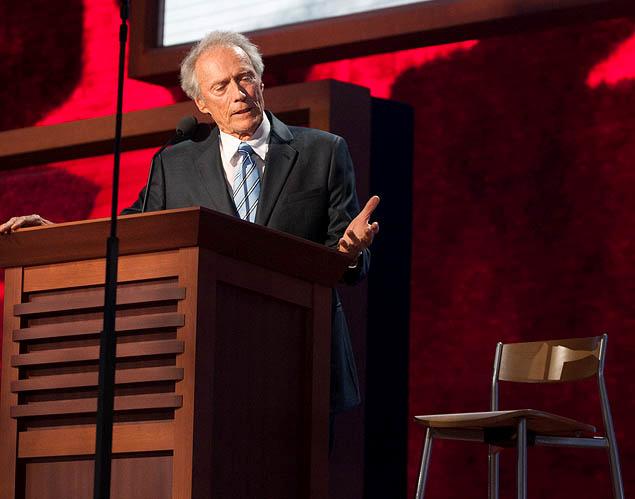
I have a lot of friends who will probably never forgive Clint Eastwood for not only endorsing Mitt Romney in 2012 but for also giving the “empty chair” speech at the Republican Convention.  From the way that a lot of them reacted, you would think that Eastwood had filmed himself drowning puppies as opposed to simply expressing his own cantankerous opinions about current events.  (Honestly, do you know any 82 year-olds who weren’t disgruntled in 2012?)  Myself, I thought the empty chair speech was an act of brilliant performance art, one that not only highlighted the fact that most politicians really are just empty chairs but also exposed just how humorless most political activists truly are.  (Admit it — if John Fugelsang had done that same routine at the 2004 Democratic convention and referred to the empty chair as being President Bush, most of the people who went on and on about how terrible it was that Eastwood was being disrespectful to the President would still be using it to create Facebook memes.)

Eastwood

Unfortunately, I sometimes find myself wondering why Clint Eastwood the director sometimes seem to struggle to be as interesting, innovative, and thought-provoking as the empty chair speech.  It sometimes seems that for every Eastwood film that works, there’s a handful films like Hereafter, Changeling, and Jersey Boys.  These aren’t bad films as much as they’re just uninspired films.  (Well, Hereafter is pretty bad…)  Ultimately, Eastwood is more of a storyteller than a Martin Scorsese-style innovator.  If Eastwood has a good story to tell, the film will work.  If he has a weak story — well, then the film will be weak.

Fortunately, with Mystic River, Eastwood has a good story and the end result is one of the best films of his uneven directorial career.  Eastwood uses a fairly standard murder mystery to explore themes of guilt, redemption, and paranoia.  Jimmy may be looking for revenge and Sean may be doing his job but ultimately, both of them are trying to absolve themselves from the consequences of their childhood decisions.  If Dave is guilty, then Jimmy will justified in having let him get in that car.  If Dave is innocent, Sean can finally step up and save him.

And complicating all of this is the Neighborhood, which is as much a character in this film as Jimmy, Dave, and Sean.  The Neighborhood will never allow anyone to forget or live down the past.  When, towards the end of the film, Jimmy is declared to be the “king of the neighborhood” by Annabeth, there’s little doubt that she’s right.  The question is whether Jimmy’s kingdom is one worth ruling.

Mystic River

Embracing the Melodrama #25: The People Next Door (dir by David Greene)


people_next_door

For the past week, I’ve been reviewing — in chronological order — fifty of the most, for reasons good and bad, memorable  film melodramas of all time.  I started with a film from 1916 called Where Are My Children? and now, as we reach the halfway mark, we also reach the 70s.  There were several reasons why I wanted to start the 70s with the 1970 drugs-in-the-suburbs melodrama, The People Next Door.  First off, not many people seem to have heard of it and I always enjoy discovering and sharing previously obscure films.  But, even more importantly, The People Next Door stars Eli Wallach, the great character actor who recently passed away at the age of 98.  Needless to say, Wallach is great in The People Next Door but then again, when wasn’t Wallach great?

At first glance, the Masons appears to be your typical suburban family.  Patriarch Arthur (Eli Wallach) may be a bit strict but he works hard to provide his family with a good life.  Wife Gerrie (Julie Harris) may seem to be a bit nervous at times but she still works hard to maintain a perfect home.  Son Artie (Stephen McHattie) may have long hippie hair and he does devote a lot of time to his band but otherwise, he seems to be a good kid.  And then there’s 16 year-old Maxie (Deborah Winters), who is blonde and pretty and overall the ideal American girl.  Even better the Masons live next door to the friendly Hoffmans, perfect David Hoffman (Hal Holbrook), his perfect wife Tina (Cloris Leachman), and their perfect teenage son, Sandy (Don Scardino).

But guess what?

Nobody’s perfect!

Arthur is actually a smug and overbearing bully whose constant bragging hides his own dissatisfaction with how his life has turned out.  He is jealous of his son’s future and his over protectiveness of his daughter takes on a distinctly disturbing tone as the film progresses.  Arthur is also having an affair with his secretary (Rue McClanahan).

Gerrie knows about Arthur’s affair but chooses to look the other way.  She goes through her day in a haze of smoke provided by the cigarettes that she is constantly smoking.  Like Arthur, she cannot understand her children.  Unlike Arthur, she does realize that she doesn’t have all the answers.

Artie may be a good kid but he feels totally and thoroughly alienated from the rest of the family and, because of his long hair, he is the constant subject of Arthur’s abuse.

And then there’s Maxie, who everyone believes to be perfect and wholesome until one night when she’s discovered tripping on LSD.  Arthur immediately assumes that Artie must have given his sister the drugs and kicks Artie out of the house.  However, what Arthur doesn’t realize, is that Maxie is actually getting the drugs from clean-cut Sandy.  Sandy doesn’t use himself but he has no problem with dealing.

To Arthur and Gerrie’s shock, Maxie tells them that she’s been using drugs for a while and she’s sexually active as well!  When Arthur subsequently discovers Maxie snorting cocaine and living with a naked biker, it’s naturally time for everyone to get into family therapy.  Unfortunately, the therapy doesn’t really help that much and soon, Maxie is again dropping acid and dancing naked on the front lawn…

As you can probably guess from the description above, The People Next Door is one of those families-in-crisis melodramas where everything that possibly can be wrong with a family is wrong with this family.  It’s always easy to dismiss well-intentioned films like this and The People Next Door has its share over-the-top moments.  But, at the same time, the film actually works better than most of the Suburban Hell melodramas of the early 70s.

That’s largely due to the performances, with Eli Wallach in particular giving an explosive performance as an all too plausible monster and Hal Holbrook and Cloris Leachman very believably bringing to life another family which turns out to be not quite as ideal as they first appear to be.  And then there’s Deborah Winters, who starts out as being so mannered that you think she’s going to give a bad performance but then, as the film progresses, you realize that Maxie is the one giving the performance because that’s the only way she can survive her “perfect” family.

I first came across The People Next Door on YouTube and, considering how much I love exposing people to obscure films, I was really looking forward to sharing it with you on this site.  But guess what?  In the three weeks between me watching this film and me staring this post, The People Next Door was taken down from the site.  I guess somebody is really dedicating to protecting the copyright on a film that hardly anybody in the world has actually heard of.

So, unfortunately, I can only share the trailer.

Watch it below!

Scenes That I Love: Eli Wallach Searches For The Gold In The Good, The Bad, and the Ugly


Eli Wallach

I just heard that, earlier today, the legendary character actor Eli Wallach passed away at the age of 98.  Wallach made his film debut in 1956’s Baby Doll and made his final film appearance 54 years later in Wall Street: Money Never Sleeps.  I have to admit that I don’t really remember much about Wall Street or Wallach’s performance in the film.  However, I do remember his wonderful cameo appearance in The Ghost Writer.

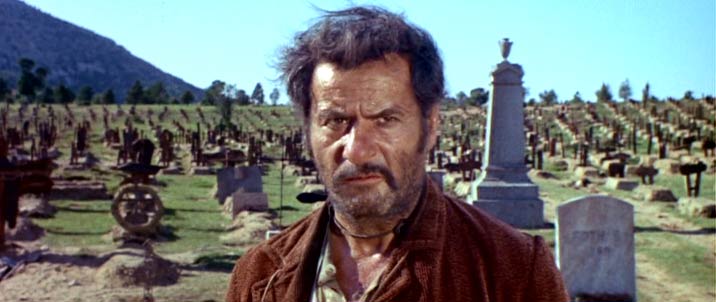
And, of course, everyone remembers Eli Wallach’s best role, that of Tuco in Sergio Leone’s classic spaghetti western The Good, The Bad, and the Ugly.  In the role of a comedic yet ruthless bandit, Wallach brought a lot of life to Leone’s epic portrait of greed in the west.  His unabashedly flamboyant performance provided a wonderful (and much-needed) contrast to the more stoic performances of Clint Eastwood and Lee Van Cleef.

For me, the best scene in The Good, The Bad, and the Ugly is one in which not a single bullet is fired nor a word uttered.  In this scene, Tuco has finally discovered the cemetery where a stolen shipment of gold has been buried.  All he has to do is find Arch Stanton’s grave and he’ll be a very rich man.  What Tuco did not take into consideration was just how many other graves there would be in the cemetery.

This is a rare moment in the film in which Tuco is not speaking but just watch Wallach’s performance here to see how much a great actor can do with just body language and facial expressions.  (Needless to say, Ennio Morricone’s classic score helps out as well.)

Eli Wallach, R.I.P.

44 Days of Paranoia #3: Winter Kills (dir by William Richert)


MPW-39279Yesterday, I took a look at Executive Action, a 1973 docudrama about the assassination of John F. Kennedy.  Today, I want to take a look at another film inspired by the Kennedys, the 1979 satire Winter Kills.

As the film opens, it’s been 16 years since a popular and dynamic President named Tim Kegan was assassinated in Philadelphia.  Despite constant rumors of conspiracy, the official story is that Kegan was killed by a lone gunman and that gunman was subsequently killed by another lone assassin.  The President’s half-brother, Nick (played by Jeff Bridges, who looks so impossibly young and handsome in this film), has disappointed his father (John Huston) by declining to follow his brother into politics.  Instead, he spends most of his time sailing on corporate oil tankers and dating fashion editor Yvette (Belinda Bauer).  This all changes when a dying man named Fletcher (and played, underneath a lot of bandages, by Joe Spinell) asks for a chance to speak to Nick.  Fletcher reveals that he was the 2nd gunman and that he was hired by to kill President Kegan.  Before dying, Fletcher tells Nick where he can find the rifle that was used to kill the President.

Following Fletcher’s directions, Nick finds both the rifle and proof that his brother’s death was the result of a conspiracy.  Determined to find out who was truly behind the conspiracy, Nick goes to see his father, the flamboyant tycoon Pa Kegan (John Huston) who, we discover, is only alive because he frequently gets blood transfusions from young women.  With Pa’s encouragement, Nick is sent on an increasingly bizarre odyssey into the darkest shadows of America, a world that is populated by militaristic businessmen, sinister gangsters, and an unemotional man named John Cerutti (Anthony Perkins) who very well may be the most powerful man in the world.

The martyred President might be named Tim Kegan, his accused assassin might be named Willie Abbott, and the man who shot Abbott might be named Joe Diamond (and might be played by Eli Wallach) but make no mistake about it — Winter Kills is a thinly disguised look at both the Kennedy assassination and the Kennedy family.  Based on a novel by Richard Condon (who also wrote the conspiracy classic, The Manchurian Candidate), Winter Kills takes all of the various Kennedy conspiracy theories and intentionally pushes them to their most ludicrous extremes.  The end result is a film that tries (and occasionally manages) to be both absurd and sincere, a portrait of a world where paranoia is the only logical reaction.

As I discovered from listening to director William Richert’s commentary on the Anchor Bay DVD, Winter Kills had a long and complicated production history.  The film was produced by two marijuana dealers, one of whom was murdered by the Mafia shortly after the film premiered while the other would later be sentenced to 40 years in prison on federal drug charges.  The production actually went bankrupt more than a few times, which led to Richert, Bridges, and Bauer making and releasing another film specifically so they could raise the money to finish Winter Kills.

When Winter Kills was finally released, it got a good deal of attention because of its spectacular cast.  Along with Bridges, Huston, Perkins, and Wallach, the film also features cameo appearances by Tomas Milian, Elizabeth Taylor, Ralph Meeker, Richard Boone, Sterling Hayden, Dorothy Malone, Toshiro Mifune, and a host of other actors who will be familiar to those of us who enjoy watching old movies on TCM.  And yet, according to Richert, the film itself was barely released in to theaters, the implication being that Winter Kills was a film about conspiracies that fell victim to a conspiracy itself.

Given the film’s history and the subject matter, I was really hoping that Winter Kills would turn out to be a great movie.  Unfortunately, it really doesn’t work.  The film struggles to maintain a balance between suspense and satire and, as a result, the suspense is never convincing and the satire is ultimately so obvious that it ends up being more annoying than thought-provoking.  The cast may be impressive but they’re used in such a way that film ultimately feels like it’s just a collection of showy celebrity cameos as opposed to being an actual story.

That said, Winter Kills remains an interesting misfire.  Jeff Bridges is a likable and compelling lead (and he gives the film much-needed focus) and, playing a role that has a lot in common with his better known work in Chinatown, John Huston is a always watchable if not necessaily likable.  Best of all is Anthony Perkins, who plays a role that, in light of what we now know about the NSA, seems oddly prophetic.

Finally, best of all, Winter Kills remains an interesting time capsule.  If nothing else, it reminds us that mistrust and paranoia are not unique to this century.

3260389_l1