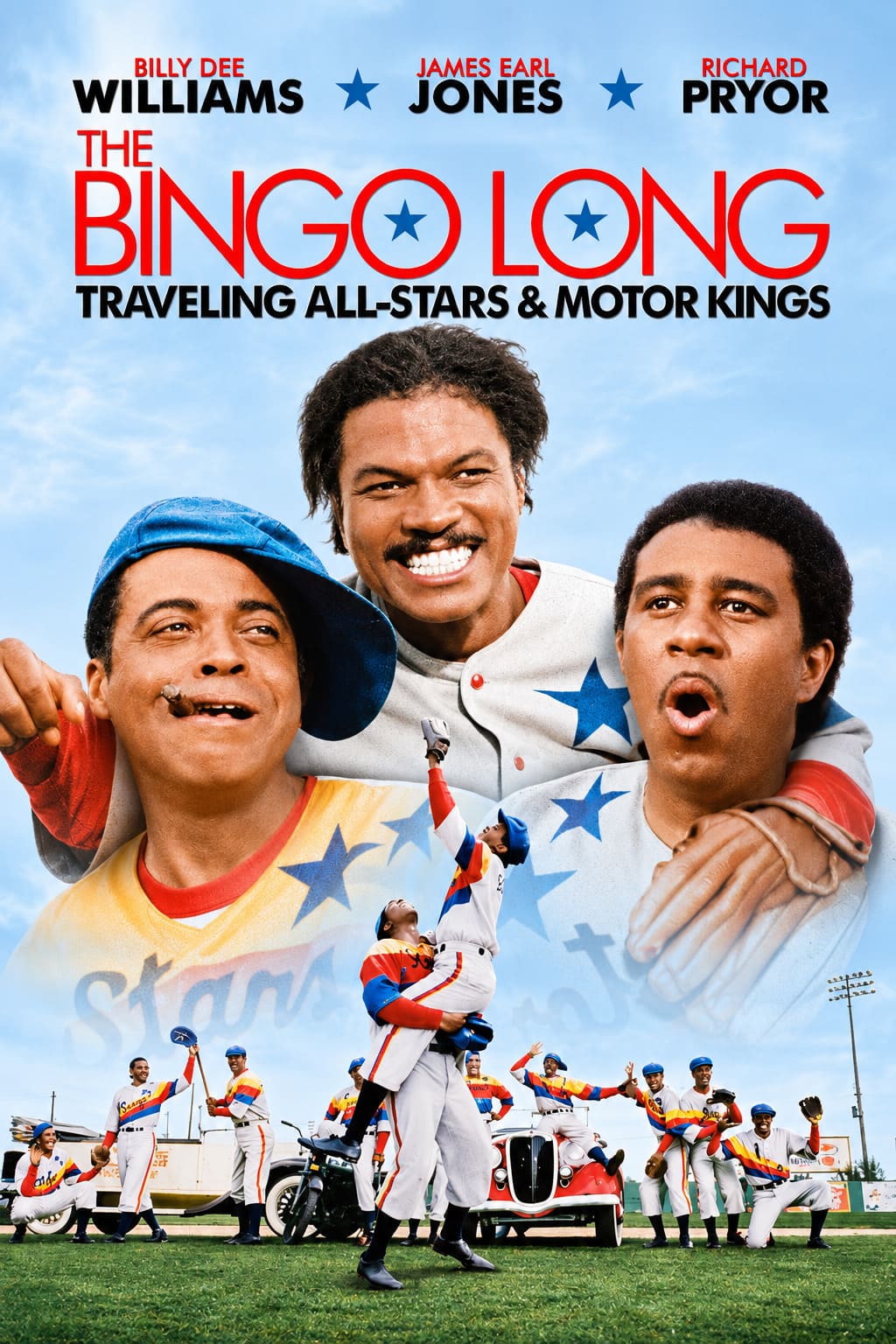
Film Review: The Bingo Long Traveling All-Stars & Motor Kings (dir. by John Badham)


“You put it in the plate, I put it on the fence.” — Leon Carter

The Bingo Long Traveling All-Stars & Motor Kings (1976), directed by John Badham, is a breezy baseball comedy with more on its mind than winning games. Set in the world of 1930s Negro League baseball, it follows star pitcher Bingo Long as he breaks away from an exploitative owner and builds a traveling club. Billy Dee Williams gives Bingo an easy confidence, James Earl Jones brings warmth to slugger Leon Carter, and Richard Pryor adds comic mischief as Charlie Snow. Together, they make this a lively underdog story about talented Black players trying to take control of their working lives.

The setup leaves room for the personalities to take over. Bingo is tired of making money for someone who treats him as replaceable, so he recruits other players to form an independent team. Their plan sounds appealing: travel, play ball, attract crowds, and split the proceeds. Making it work is another matter. Their former employers don’t want to lose their stars, and freedom comes with financial headaches. The story gives its familiar sports-movie premise a twist by making the players’ struggle about who benefits from their abilities, not simply who wins the next game.

The film’s look at the Negro Leagues is central to that struggle. This isn’t a comprehensive history, and its fictional team shouldn’t be mistaken for a documentary portrait. Instead, the movie presents a baseball world filled with skilled players, colorful personalities, demanding owners, and enthusiastic spectators. It treats Black baseball as a sporting culture with its own attractions and tensions, rather than merely a waiting room for acceptance into white professional baseball. That perspective gives the players’ work value on its own terms, even as segregation restricts their opportunities.

Just as importantly, the players aren’t reduced to noble victims. They’re ambitious, funny, proud, argumentative, and sometimes reckless. Their athletic ability is only one part of what makes them interesting. They also have to entertain crowds, negotiate bad arrangements, and figure out how to make a living in circumstances stacked against them. The movie’s affection for these men comes through in their banter and disagreements. It recognizes that surviving this baseball world requires more than a strong arm or a powerful swing; it also takes ingenuity, persistence, and people willing to stick together.

Williams makes Bingo a leader worth following without turning him into a flawless hero. His smile and swagger suggest a man who can sell an idea before he has settled every practical detail. That confidence gets the team moving, but it also creates problems when his instincts run ahead of everyone else’s concerns. He enjoys the spotlight, and Williams makes that vanity part of his appeal rather than an irritating distraction. Bingo’s desire for independence feels personal and believable, especially because he isn’t always certain what independence will require.

Jones provides an excellent counterweight as Leon. His steadier presence gives the film emotional weight without slowing its playful rhythm. Where Bingo gravitates toward spectacle and individual initiative, Leon is more concerned with the group and what the players owe one another. Their differences give the story something to explore beyond whether the team can beat its opponents. Both men want dignity and a fair return for their talent, but they don’t always agree about how to get there. The performances make those disagreements feel like conversations between teammates, not speeches inserted to explain a theme.

Pryor supplies a more mischievous energy as Charlie, whose attempts to maneuver around baseball’s racial barriers produce some of the broadest comedy. There’s a sting beneath the joke: being talented doesn’t mean he can simply present himself and expect a fair chance. Pryor keeps the material moving through his timing and restless confidence. The humor occasionally feels stretched, but Charlie’s schemes also underline how absurd the restrictions are. He’s another player forced to think beyond the game itself, looking for a way through doors that his ability should already have opened.

Badham makes the baseball entertaining without requiring viewers to know every rule. The team’s showmanship turns games into public performances, with crowd reactions and comic timing becoming almost as important as the score. This suits a story about players who must persuade people to pay attention wherever they stop. The on-field antics also let the movie celebrate their skill without becoming overly reverent. These men can be impressive athletes and shameless entertainers at the same time. The film is especially enjoyable when their confidence, coordination, and competitive instincts all come together.

The loose road-movie structure has drawbacks. Some stops are funnier than others, and the cheerful mood occasionally softens the economic exploitation and racial exclusion shaping the players’ lives. Anyone looking for a detailed examination of the Negro Leagues may find that the film raises more questions than it investigates. Still, its warmth is earned by the cast and its interest in the men beneath the uniforms. The Bingo Long Traveling All-Stars & Motor Kingssucceeds as an easygoing sports comedy whose real stakes extend beyond the scoreboard. Winning matters, but getting to decide how to live and work matters more.
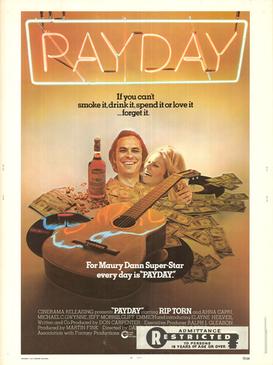
Film Review: Payday (dir by Daryl Duke)


First released way back in 1972, Payday tells the story of Maury Dann (played by the late, great Texas actor, Rip Torn).

Maury is a country singer.  He sings songs about wholesome values and good country girls.  His music isn’t exactly ground-breaking but his fans still love him and it’s easy to see why.  The movie opens with Maury performing in a small, country club and his charisma is undeniable.  He has a good singing voice and he easily dominates the stage.  Between songs, he flashes a friendly but slightly mischievous smile.  After his performance, he is perfectly charming when he meets his older fans.  And, when he meets a younger fan, he takes her outside and has sex with her in the backseat of his Cadillac.  He does this while her boyfriend is wandering around the parking lot looking for her.

Maury is a man who is in control when he’s on stage.  However, when he’s off-stage, the real Muary comes out.  When he’s not singing and basking in the applause of his fans, Maury is …. well, he’s a total mess.  Actually, mess doesn’t quite do justice to just how screwed up Maury Dann is.  He cheats on his girlfriend.  He pops pills constantly.  He treats the members of his band with a casual cruelty.  When Maury’s off-stage, that charming smile changes into a rather demented smirk.  Just when you think Maury’s done the worst possible thing that he could do, he does something even worse.

Payday follows Maury as he is driven through the South, singing songs and ruining lives.  Along the way, he gets into a fight with his mother and then a fight with his ex-wife and eventually, a fight with the boyfriend of that younger fan from the start of the movie.  We watch as Maury drinks, bribes DJs, and frames his employees for all sorts of crimes.  It’s an episodic film about a man who seems to understand that he’s destined to self-destruct no matter what he does.

Payday is very much a film of the early 70s.  Though the film may be about a self-destructive country star, it’s hard not to suspect that — as with most of the films from that era — Maury and his adventures were meant to be a metaphor for America itself.  Country Western is a uniquely American genre and by showcasing the damage that Maury does to everyone around him, the film seems to be suggesting that Maury’s sins are also America’s sins.  The people who idolize Maury and make him a star despite all of his flaws are the same people who reelected Richard Nixon and supported sending young men to die in Vietnam.

It’s all a bit much for one film to carry on its shoulders and spending two hours with Maury Dann is not exactly a pleasant experience but the film works because of the performance of Rip Torn.  When Torn died earlier this week, there was a lot of discussion about which performance was his best.  Quite a few people on twitter cited his roles in Defending Your Life and The Larry Sanders Show.  I personally mentioned The Man Who Fell To Earth and Maidstone.  But if you really want to see what made Rip Torn such a great actor, you simply must watch Payday.  Maury is a jerk with little in the way of redeeming qualities but Torn gives such a fearless and cheerfully demented performance that it’s impossible not to get caught up in his story.  As much as you want to look away, you can’t because Rip Torn keeps you so off-balance that you cannot stop watching.  Torn is smart enough to play Maury with just enough self-awareness that the character becomes fascinatingly corrupt as opposed to just being a self-centered jerk.

Finally, Payday simply feels authentic.  The film was made way before my time but I’m a Southern girl who has spent enough time in the country to know that the backroads of rural America haven’t changed that much over the past few decades.  At times, while watching Payday, I felt like I was back on my granduncle’s farm in Arkansas, walking through high grass and listening to the cicadas while watching the sun go down.

Payday is definitely a film that’s worth the trouble to track down.  Watch it and appreciate the fearless genius of the great Rip Torn.

Shattered Politics #21: Kisses For My President (dir by Curtis Bernhardt)


Kisses_for_My_President_-_1964_-_Poster

If there’s anyone who deserves to be the subject of a big budget biopic, it’s Victoria C. Woodhull.  Back in the 19th century, at a time when women were not even allowed to vote, Victoria C. Woodhull was not only the first woman to ever work as a stockbroker but also the first to ever found her own newspaper.  A fierce advocate for women’s right and free love, Victoria Woodhull was also the first woman to ever run for President.  She was nominated in 1872 by the Equal Rights Party and, for the crime of trying to cast a vote for herself, she spent election day in jail.

Since that day, many more women have run for President but none have been elected.  Since 1984, two women have received major party nominations for vice president but neither came close to being elected.  Since 1964, Margaret Chase Smith, Shirley Chisholm, Patsy Mink, Ellen McCormack, Patricia Schroeder, Elizabeth Dole, Carol Mosely-Braun, Michele Bachman, and Hillary Rodham Clinton have all campaigned for the presidential nomination of one of the two major political parties but none of them have been nominated.

I do believe that a woman will be elected President within my lifetime.  In fact, it could even happen in 2016.  But until then, the only place where you can find a female President is on TV and in the movies.

Take, for instance, today’s final entry in Shattered Politics, the 1964 film Kisses For My President.  This may very well have been the very first movie to feature a woman as President.  Needless to say, in 1964, this idea was considered so outrageous that it had to be played for laughs.

Kisses For My President starts with an image of hundreds of women chanting “We want Leslie!”  We get a shot of Fred MacMurray looking out over the crowd.  The next scene, the new President is being sworn in.  We start with a close-up of the chief justice reciting the oath of office to “Leslie Harrison McCloud.”  The camera pans over to Fred MacMurray, listening intently.  However, just when 1964 audiences were expecting MacMurray to swear to uphold the constitution, the camera pans yet again, over to …. Polly Bergen!

“OH MY GOD!” audiences in 1964 gasped, “LESLIE McCLOUD IS A WOMAN!”

That’s right.  Polly Bergen is playing President Leslie McCloud and Fred MacMurray is playing her husband, Thad.  As the film makes apparent in its opening scenes, Thad is not quite sure what his role is supposed to be.  He has an office in the White House but it’s just so … feminine!  And it’s full of painting of previous first ladies who were all ladies!  And, at one point, Thad even imagines a picture of himself wearing a lady’s hat!

Oh my God!

Now, to be fair to the movie, Polly Bergen does get a few scenes where she shows herself to be a strong President.  There’s a great scene where she coolly dismisses a condescending senator (Edward Andrews) who suggests that, as a woman, Leslie might not be up to the task of standing up to America’s enemies.  It’s a brief scene but it’s a good one.

But, ultimately, it’s impossible to ignore the fact that Kisses For My President, a film about the first female President, is mostly interested in how Thad handles being “first gentleman.”  It’s a film that imagines a historic moment for women and then focuses on what it would mean for one man.

How 1964!

On the one hand, Kisses For My President is a dated comedy that runs way too long and tries to get too much mileage out of one joke (i.e., Fred MacMurray looking confused).  However, the film also features a great performance from Eli Wallach.  Playing a strutting dictator named Vasquez, Wallach is a lot of fun and the scenes where MacMurray shows him around Washington are the best in the film.  I also appreciated the fact that the President’s daughter reacts to the restrictions of living in the White House by dating a guy that she knows her parents will hate, largely because I would have done the same thing in her situation.

I’m a little bit torn on the ending of Kisses For My President.  (Should I spoil it?  No, I don’t think I will.)  On the one hand, it’s outrageously sexist and seems to suggests that Leslie — despite being a strong President during the few times we actually get to see her doing the job — should have been content to just be a wife and mother.  On the other hand, it’s one of those endings that would seem to perfectly capture the dominant culture of the time when the film was made.  So, it has some worth from a historical point of view.

When last I checked, Kisses For My President is currently available for free on YouTube. The film is interesting as a historical document if nothing else.