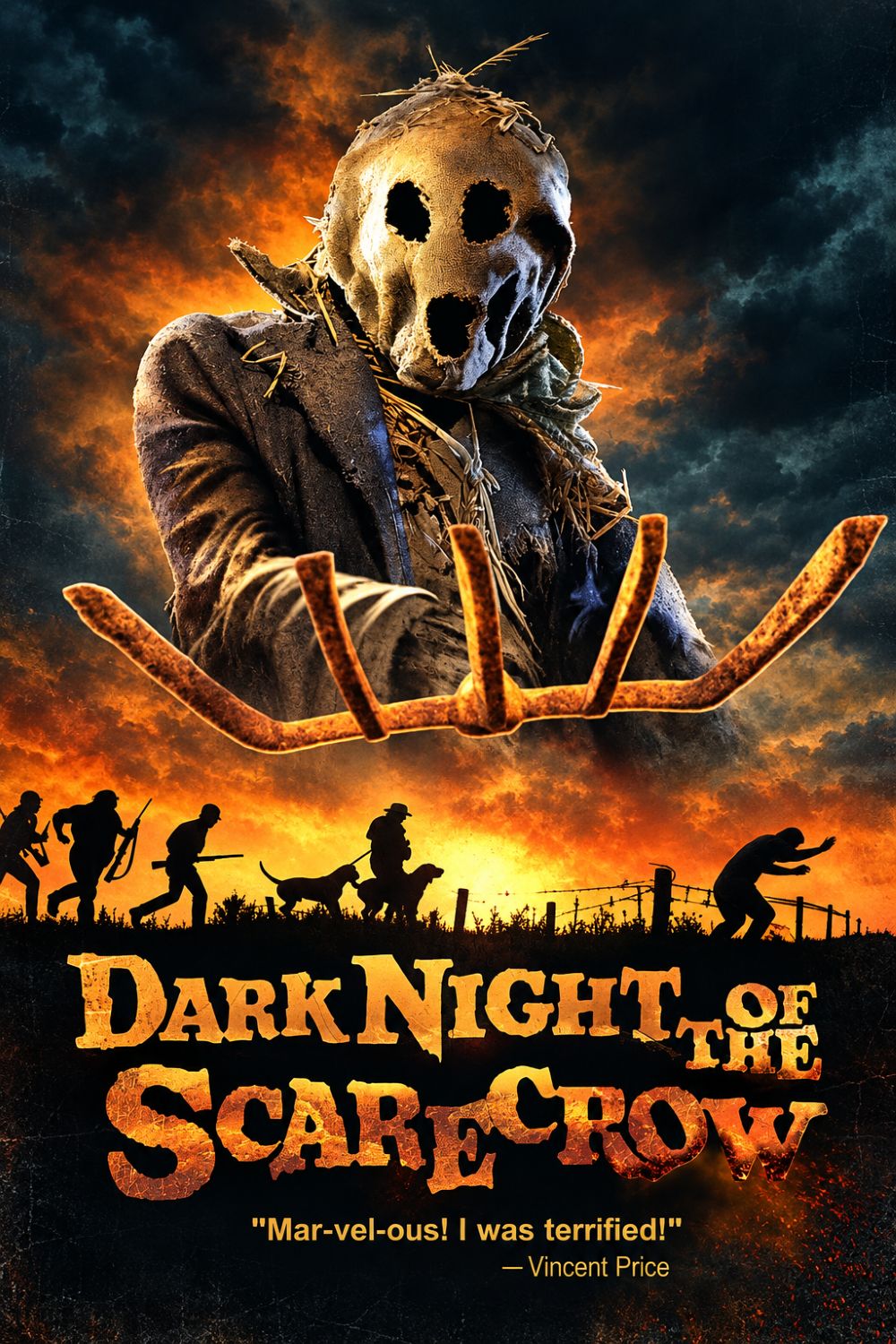
Horror Review: Dark Night of the Scarecrow (dir. by Frank De Felitta)


“You may think you’re getting off free, but there’s other justice in this world besides the law!” — Mrs. Ritter

Frank De Felitta’s Dark Night of the Scarecrow is one of those deceptively modest horror movies that earns its power through atmosphere, patience, and an unusually bitter sense of injustice. Originally made for television in 1981, it has none of the glossy excess or elaborate effects work associated with many theatrical horror releases of its era. What it does have is a sharply constructed premise, a remarkable villain performance from Charles Durning, and a quiet rural setting that becomes steadily more unnerving as the story moves from tragedy into supernatural revenge. It is the kind of film that understands a scarecrow is already an inherently creepy image; it does not need to overexplain or overuse that image to make it work.

The story takes place in a small Southern town where Bubba Ritter, played by Larry Drake, is a gentle, developmentally disabled man whose closest friend is a young girl named Marylee Williams. Their friendship is innocent and affectionate, but it is viewed with suspicion by Otis P. Hazelrigg, a cruel local mail carrier with a personal grudge against Bubba. When Marylee is attacked by a dog and briefly goes missing, Hazelrigg turns the situation into an accusation, convincing three other men that Bubba has harmed the girl. Before anyone bothers to learn the truth, the men hunt Bubba down, shoot him, and stage the scene to make it appear as though he was armed. It is a brutal opening act precisely because the movie refuses to treat its central tragedy as an excuse for cheap melodrama. Bubba is not a monster, and the men who kill him are not panicked heroes making an understandable mistake. They are cowardly, angry men who allow prejudice and resentment to become a death sentence.

That foundation is what separates Dark Night of the Scarecrow from a standard slasher or revenge movie. The supernatural material only becomes effective because the human evil comes first. Bubba’s death is not merely a plot device to unleash a vengeful ghost; it is the film’s moral wound. De Felitta, a veteran novelist as well as the director, approaches the story with an eye for the emotional damage left behind by that act. The film slows down after the killing, allowing the town to sit with the consequences while Hazelrigg becomes increasingly paranoid that Bubba has returned from the grave.

Charles Durning is the movie’s secret weapon. Hazelrigg is one of those villains who is frightening not because he is physically unstoppable, but because he is such a believable bully. Durning gives him a sweaty, blustering confidence that gradually rots into panic. He is the sort of man who believes his position in the community gives him the right to make judgments about everyone else, and he has no trouble manipulating weaker men into sharing responsibility for his own cruelty. Durning never plays Hazelrigg as a cartoonish sadist. Even when he is snarling threats or trying to cover up the murder, there is something painfully recognizable about him: a man who has built his identity around authority and cannot bear the possibility that he has been exposed as morally bankrupt.

Hazelrigg’s hatred of Bubba also has a nasty layer of projection to it. The movie never outright says he is a pedophile, but it heavily implies it through his creepy interest in Marylee, the way he watches her, and Mrs. Ritter’s pointed remarks. That makes his obsessive claim that Bubba is a threat even more grotesque: Hazelrigg seems to be accusing Bubba of the impulses he cannot admit in himself. The implication makes his hostility toward their friendship feel less like misplaced civic concern and more like jealousy, possessiveness, and a desperate effort to hide his own corruption behind moral outrage. It is one of the film’s darkest touches, especially because it remains mostly beneath the surface rather than being presented as a blunt plot revelation.

Larry Drake has a more difficult task because Bubba spends much of the movie absent, concealed, or transformed into a possible supernatural presence. Yet his early scenes are essential. Drake makes Bubba sweet and childlike without turning him into an object of pity or a collection of mannerisms. His relationship with Marylee, played warmly by Tonya Crowe, gives the film its emotional center. There is genuine tenderness in the way Bubba helps her, plays with her, and treats her with uncomplicated kindness. That sweetness makes the later violence feel all the more ugly. Marylee’s grief also carries real weight, because she is one of the only people who completely understands that Bubba was innocent.

The scarecrow itself is used with admirable restraint. There are no elaborate explanations about ancient curses, possession, or elaborate rules governing the entity. The film instead lets the audience wonder whether Bubba’s spirit has actually returned, whether the scarecrow is a physical vessel for vengeance, or whether Hazelrigg is simply losing his mind under the pressure of guilt. That ambiguity gives the movie much of its lasting chill. A scarecrow standing in a distant field, visible at the edge of a frame or appearing where it should not be, is often more frightening than a clearly defined monster charging at the camera. De Felitta recognizes that the image is powerful because it is still, silent, and vaguely human without actually being human.

The television origins are noticeable in some ways. The pacing is deliberate, the violence is largely implied rather than graphic, and the production is understandably small-scale. But those limitations wind up serving the movie. The lack of gore forces the film to emphasize suggestion, shadows, sound, and the ominous openness of its rural setting. Cornfields, dirt roads, farm equipment, abandoned buildings, and dark porches all become part of the film’s horror vocabulary. It feels less like a slick studio shocker and more like a regional ghost story someone might tell you after dark, the kind where the details are simple but the moral is savage.

De Felitta also has a good sense of escalation. The revenge scenes are not huge set pieces, but they are memorable because each one turns something ordinary into a source of menace. The scarecrow’s presence becomes a warning that the men involved in Bubba’s death cannot escape what they did. Instead of relying on body counts alone, the movie builds suspense around Hazelrigg’s growing desperation. Every time he sees the scarecrow—or thinks he sees it—his confidence cracks a little further. The real terror is not just that the dead may be coming for him. It is that there may be no way to outrun the truth.

The ending delivers the kind of grimly satisfying horror-movie justice that the story has earned. It is not triumphant in a cheerful sense, because nothing can undo the tragedy that put the plot in motion. Still, there is a bleak pleasure in watching Hazelrigg finally face the consequences of his actions. The film’s revenge is measured rather than sadistic, and that makes it more effective. It feels like a judgment rather than a spectacle.

Despite its TV roots, Dark Night of the Scarecrow has become a very underrated horror film, with many genre aficionados lauding it as one of the best horror films made, period. That reputation is understandable. It is not the loudest or bloodiest horror film of the early 1980s, and viewers expecting a fast-paced scarecrow slasher may initially be surprised by how much time it spends on character, grief, and small-town malice. But that is exactly why it endures. The film has a soul beneath its scares, and its simple supernatural premise gains force from the cruelty of the world around it.

Ultimately, Dark Night of the Scarecrow works because it never forgets that its monster is born from human wrongdoing. The scarecrow is frightening, but Hazelrigg and the mob that follows him are worse because they are entirely plausible. Frank De Felitta turns a compact television movie into a haunting morality tale about prejudice, guilt, repression, and the terrible cost of refusing to see another person’s humanity. Its effects may be modest, but its mood is potent, its villain is unforgettable, and its final image lingers like something standing motionless at the far end of a field.
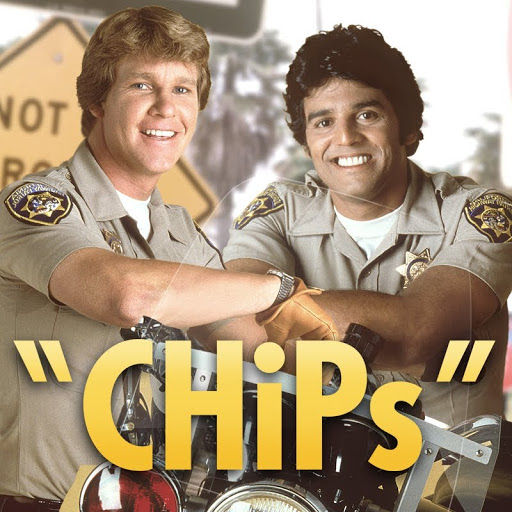
Late Night Retro Television Review: CHiPs 3.18 “Kidnap”


Welcome to Late Night Retro Television Reviews, a feature where we review some of our favorite and least favorite shows of the past!  On Mondays, I will be reviewing CHiPs, which ran on NBC from 1977 to 1983.  The entire show is currently streaming on Prime!

This week, two dumbs kids case a lot of trouble.

Episode 3.18 “Kidnap”

(Dir by Gordon Hessler, originally aired on January 26th, 1980)

Ponch and Baker have been assigned to escort to stupid kids — Pete (Brad Savage) and his weirdo friend Ray (Christopher Holloway) — to the country courthouse so that they can receive some sort of an award for an essay that they wrote about traffic safety.  I don’t know, it sound pretty dumb.  For some reason, local news reporter Pat Blake (Jayne Kennedy) is there to cover the story.  Ponch gets busy flirting with Pat and Baker’s busy hitting on Pete’s older sister (Judy Strangis) and nobody notices Pete and Ray getting into an unlocked limo and starting the engine.

Meanwhile, two crooks named Solkin (played by legendary character actor Timothy Carey) and Bickel (Warren Berlinger) escape from custody, run down to the parking garage, and hop in the limo.  Because those dumb kids turned on the engine, Solkin and Bickel steal the car with the two stupid kids in the backseat!

Even though this is entirely the fault of Pete and Ray, the entire Highway Patrol mobilizes to rescue them.  This episode is one long chase scene.  Solkin and Bickel want to drive up to Canada.  (Draft dodgers!)  Pete and Ray are trying to figure out a way to escape.  Ponch and Baker are trying to discreetly follow without letting the crooks know that they’ve been spotted.  Unfortunately, two stoners in a van try to help and almost give away the entire operation.

Of course, the kids are rescued and, of course, it’s all because of Ponch.  Ponch dresses like an auto mechanic and then borrows a banged-up Cadillac that has fuzzy pink seat covers.  Ponch follows the men and continually plays La Cucaracha by honking the car’s horn.  While Baker and the other members of the Highway Patrol struggle to keep track of the kidnappers and continually screw up, Ponch solves this case almost single-handedly!

Okay, that’s a little unfair on my part.  This is one of those episodes where the emphasis really is on team work.  Everyone — from Grossie to Getraer to Bear to Ponch and Jon — does their part to follow the limo and to come up with a plan to save the kids.  Still, it’s hard not to notice that, when it comes time to save the kids, it’s pretty much Ponch doing it on his own.  We’re closing in on the end of the third season and it’s pretty much undeniable that CHiPs has become The Ponch Show.

This episode was kind of annoying, despite the presence of the always entertaining Timothy Carey.  The main problem was that the two kids were jerks who had no one to blame but themselves for getting into that bad situation.  I hope they were grounded for the rest of their lives!

Late Night Retro Television Review: CHiPs 2.6 “Trick or Treat”


Welcome to Late Night Retro Television Reviews, a feature where we review some of our favorite and least favorite shows of the past!  On Mondays, I will be reviewing CHiPs, which ran on NBC from 1977 to 1983.  The entire show is currently streaming on Freevee!

It’s a Halloween episode!

Episode 2.6 “Trick or Treat”

(Dir by Phil Bondelli, originally aired on October 21st, 1978)

It’s Halloween in Los Angeles!  That means that people will be asking for treats and playing tricks and getting into all sorts of trouble.  But, for the California Highway Patrol, it’s just another day and night of trying to keep everyone safe.

Ponch’s day gets off to a bad start when he and Baker chase a van onto a movie lot.  The van’s driver, it turns out, was speeding because he was transporting thirteen black cats to a film set.  When Ponch and Baker finally pull over the van, the cats get loose and all 13 of them march past Ponch.  Later, at headquarters, Ponch is forced by a narrow hallway to walk under a ladder.  *GASP*  Ponch insists that he’s not superstitious but he also won’t stop talking about his encounter with the black cats.

Ponch is in for some bad luck and it shows up in the form of an 8 year-old named Tommy who squirts Ponch with perfume while Ponch is patrolling the neighborhood.  Ponch tells Tommy that playing tricks like that could lead to him getting arrested and hauled off to jail.  Tommy panics and runs away from home.  Guess who gets the blame for that?

That’s not all that’s going on this Halloween night.  (Since this episode aired in 1978, it’s also the night that He came home.)  Eddie (Bobby Van) and his girlfriend, Susan (Elaine Joyce), are holding up convenience stores.  (Susan distracts the cashiers by wearing a translucent ghost costume.)  An older woman (Fran Ryan) is stealing bags of candy from young trick-or-treaters.  Paula (Barbara Leigh) and Karen (Jenny Sherman) are stealing speed limit signs as part of a superfun scavenger hunt.  And Sgt. Getraer is determined to figure out the identity of the Hobgoblin, a member of the highway patrol who reads macabre poetry over the police radio throughout the night.

Fear not, though …. everything works out in the end.  Tommy is not only found hiding out in an abandoned house but Ponch is the one who finds and rescues him.  Eddie and Susan get chased and arrested after trying to pull one robbery too many.  (Their van crashes as a result of two teenagers throwing eggs on the windshield.  Some tricks are good, apparently.)  The old woman turns out to be a distraught suburbanite who lost her engagement ring and who thinks that she may have tossed it in some kid’s trick-or-treat bag.  (Fortunately, the ring is found in her candy bowl and no one presses charges.)  Paula and Karen lose the scavenger hunt but they win future dates with Ponch and Baker.  And Getraer figures out that Artie Grossman is the Hobgoblin.  In the end, everyone smiles and laugh and that’s the important thing.

For a Halloween episode, Trick or Treat was rather low-key but that’s okay.  I liked the day-in-the-life approach that the episode took and it was fun to see that even the members of the fearsome highway patrol were capable of enjoying the holiday.  We should have as good a Halloween as Ponch and Baker.

An Olympic Horror Film Review: Fatal Games (dir by Michael Elliot)


Like all good people, I am currently obsessed with the Winter Olympics!  As a result, over the past two weeks, I’ve been watching and reviewing a lot of Olympic-themed films.  Today, I watched the 1984 slasher film, Fatal Games!

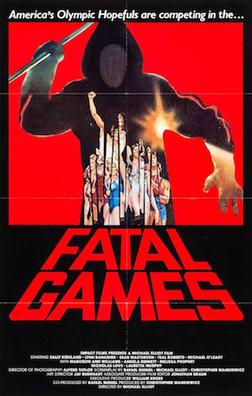
If you look at the poster above, you’ll see that Fatal Games was advertised as being a film about “America’s Olympic hopefuls … competing in the Fatal Games!”  That’s kind of true.  The Olympics are frequently mentioned throughout Fatal Games but technically, no one in the movie is actually a member of the Olympic team.  At least not yet.  Instead, they’re all students at a special athletic academy.  Apparently, it’s supposed to be a high school, though we don’t ever see anyone taking a math test or attending English class or anything like that.  Instead, it appears that everyone at the school spends all day practicing gymnastics, swimming, or running.  In fact, it appears that there’s only 20 students at the school and, at most, 5 members of the faculty.  Maybe it’s meant to be like that school that all of the clones attended in Never Let Me Go.  Either that or it’s just an indication that Fatal Games was an extremely low-budget film.

Anyway, seven of the students have just won some sort of regional competition and now they’re getting ready for nationals!  And, if they win at nationals, they’ll get to go to the Olympics.  However, they might not even make it to nationals.  Someone is stalking the blandly likable athletes and using a javelin to pick them off, one-by-one.

Interestingly, it takes people a while to notice that the number of potential Olympians is steadily dwindling.  Instead, people say stuff like, “Hey, have you seen Nancy?”  “Not for a few days.”  “Hey, have you seen Sue Ellen?”  “Didn’t she got to San Francisco to see her boyfriend?”

Well, I guess it’s understandable.  It’s not like anyone in the film is going to school to develop their critical thinking skills.  They’re athletes.  Who cares about all of the people mysteriously disappearing?  They have athletic stuff to worry about!

Fatal Games is pretty much a typical mid-80s slasher.  Interestingly enough, it’s structured like a giallo.  The murderer dresses in black and we get all of the required close-ups of the killer’s gloved hands.  The film introduces several potential suspects but doesn’t reveal the killer’s identity until the final ten minutes.

Is it the overly critical track coach?

Is it the creepy doctor?

Is it the nurse who is worried that the athletes are being injected with too many hormones?  (Obviously, she’s seen Goldengirl.)

Is it the swim coach?

Or is it her girlfriend, the swimmer who didn’t qualify for nationals?

Is it the gymnast whose grades are slipping?

Could it be the other gymnast who is always telling jokes?

Or the runner who has father issues?

Or is it Joe, the token weird guy?

They’re all given a scene or two to establish that they have a potential motive for wanting the seven aspiring Olympians dead.  When the killer and the killer’s motive is finally revealed, it’s so over-the-top and stupid that you can’t help but admire the film for actually going there.  The filmmakers obviously said, “Forget trying to make sense.  WE’RE GOING FOR IT!”

Anyway, the main problem with Fatal Games is that the murderer uses a javelin and, as a result, there’s a lot of scenes of the killer running through narrow school hallways, carrying this goofy-looking javelin.  Don’t get me wrong.  Javelins are sharp and scary and I wouldn’t want one thrown at me.  But still, when someone spends more than five minutes running down a narrow hallway while carrying a javelin, it just looks silly.  Let’s not even think about the logistics of using a javelin to kill someone in broad daylight without anyone else noticing.

That said, as silly and predictable as Fatal Games may have been, there were a few moments of inspired lunacy.  I already mentioned the ending, which is so over-the-top and silly that you can’t help but admire it.  But there’s also a few shots that are genuinely effective.  A scene where the killer suddenly appears in a doorway was handled well.  There’s also an oddly dream-like sequence in which a swimmer practices in the pool, little realizing that the killer is floating underneath her.  How did the killer get in the pool, with the javelin, without anyone noticing?  Who knows?  It’s still an effective scene.

Finally, I have to mention that Fatal Games opens with a song called “Take It All The Way,” which is so generically 80s that it’s oddly brilliant.  It’s almost as good as Graduation Day‘s “The Winner.”

Fatal Games is currently available for viewing on YouTube.