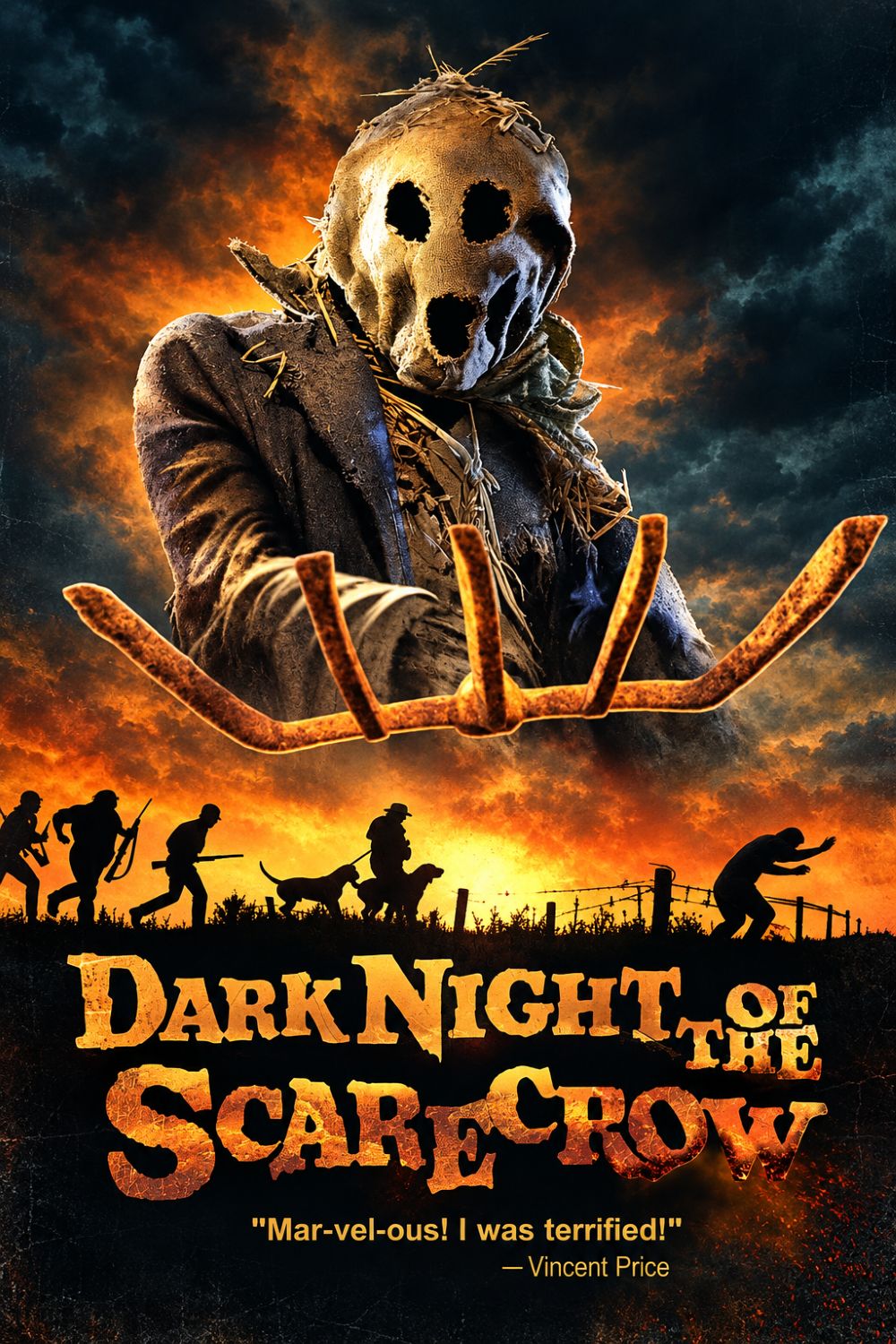
Horror Review: Dark Night of the Scarecrow (dir. by Frank De Felitta)


“You may think you’re getting off free, but there’s other justice in this world besides the law!” — Mrs. Ritter

Frank De Felitta’s Dark Night of the Scarecrow is one of those deceptively modest horror movies that earns its power through atmosphere, patience, and an unusually bitter sense of injustice. Originally made for television in 1981, it has none of the glossy excess or elaborate effects work associated with many theatrical horror releases of its era. What it does have is a sharply constructed premise, a remarkable villain performance from Charles Durning, and a quiet rural setting that becomes steadily more unnerving as the story moves from tragedy into supernatural revenge. It is the kind of film that understands a scarecrow is already an inherently creepy image; it does not need to overexplain or overuse that image to make it work.

The story takes place in a small Southern town where Bubba Ritter, played by Larry Drake, is a gentle, developmentally disabled man whose closest friend is a young girl named Marylee Williams. Their friendship is innocent and affectionate, but it is viewed with suspicion by Otis P. Hazelrigg, a cruel local mail carrier with a personal grudge against Bubba. When Marylee is attacked by a dog and briefly goes missing, Hazelrigg turns the situation into an accusation, convincing three other men that Bubba has harmed the girl. Before anyone bothers to learn the truth, the men hunt Bubba down, shoot him, and stage the scene to make it appear as though he was armed. It is a brutal opening act precisely because the movie refuses to treat its central tragedy as an excuse for cheap melodrama. Bubba is not a monster, and the men who kill him are not panicked heroes making an understandable mistake. They are cowardly, angry men who allow prejudice and resentment to become a death sentence.

That foundation is what separates Dark Night of the Scarecrow from a standard slasher or revenge movie. The supernatural material only becomes effective because the human evil comes first. Bubba’s death is not merely a plot device to unleash a vengeful ghost; it is the film’s moral wound. De Felitta, a veteran novelist as well as the director, approaches the story with an eye for the emotional damage left behind by that act. The film slows down after the killing, allowing the town to sit with the consequences while Hazelrigg becomes increasingly paranoid that Bubba has returned from the grave.

Charles Durning is the movie’s secret weapon. Hazelrigg is one of those villains who is frightening not because he is physically unstoppable, but because he is such a believable bully. Durning gives him a sweaty, blustering confidence that gradually rots into panic. He is the sort of man who believes his position in the community gives him the right to make judgments about everyone else, and he has no trouble manipulating weaker men into sharing responsibility for his own cruelty. Durning never plays Hazelrigg as a cartoonish sadist. Even when he is snarling threats or trying to cover up the murder, there is something painfully recognizable about him: a man who has built his identity around authority and cannot bear the possibility that he has been exposed as morally bankrupt.

Hazelrigg’s hatred of Bubba also has a nasty layer of projection to it. The movie never outright says he is a pedophile, but it heavily implies it through his creepy interest in Marylee, the way he watches her, and Mrs. Ritter’s pointed remarks. That makes his obsessive claim that Bubba is a threat even more grotesque: Hazelrigg seems to be accusing Bubba of the impulses he cannot admit in himself. The implication makes his hostility toward their friendship feel less like misplaced civic concern and more like jealousy, possessiveness, and a desperate effort to hide his own corruption behind moral outrage. It is one of the film’s darkest touches, especially because it remains mostly beneath the surface rather than being presented as a blunt plot revelation.

Larry Drake has a more difficult task because Bubba spends much of the movie absent, concealed, or transformed into a possible supernatural presence. Yet his early scenes are essential. Drake makes Bubba sweet and childlike without turning him into an object of pity or a collection of mannerisms. His relationship with Marylee, played warmly by Tonya Crowe, gives the film its emotional center. There is genuine tenderness in the way Bubba helps her, plays with her, and treats her with uncomplicated kindness. That sweetness makes the later violence feel all the more ugly. Marylee’s grief also carries real weight, because she is one of the only people who completely understands that Bubba was innocent.

The scarecrow itself is used with admirable restraint. There are no elaborate explanations about ancient curses, possession, or elaborate rules governing the entity. The film instead lets the audience wonder whether Bubba’s spirit has actually returned, whether the scarecrow is a physical vessel for vengeance, or whether Hazelrigg is simply losing his mind under the pressure of guilt. That ambiguity gives the movie much of its lasting chill. A scarecrow standing in a distant field, visible at the edge of a frame or appearing where it should not be, is often more frightening than a clearly defined monster charging at the camera. De Felitta recognizes that the image is powerful because it is still, silent, and vaguely human without actually being human.

The television origins are noticeable in some ways. The pacing is deliberate, the violence is largely implied rather than graphic, and the production is understandably small-scale. But those limitations wind up serving the movie. The lack of gore forces the film to emphasize suggestion, shadows, sound, and the ominous openness of its rural setting. Cornfields, dirt roads, farm equipment, abandoned buildings, and dark porches all become part of the film’s horror vocabulary. It feels less like a slick studio shocker and more like a regional ghost story someone might tell you after dark, the kind where the details are simple but the moral is savage.

De Felitta also has a good sense of escalation. The revenge scenes are not huge set pieces, but they are memorable because each one turns something ordinary into a source of menace. The scarecrow’s presence becomes a warning that the men involved in Bubba’s death cannot escape what they did. Instead of relying on body counts alone, the movie builds suspense around Hazelrigg’s growing desperation. Every time he sees the scarecrow—or thinks he sees it—his confidence cracks a little further. The real terror is not just that the dead may be coming for him. It is that there may be no way to outrun the truth.

The ending delivers the kind of grimly satisfying horror-movie justice that the story has earned. It is not triumphant in a cheerful sense, because nothing can undo the tragedy that put the plot in motion. Still, there is a bleak pleasure in watching Hazelrigg finally face the consequences of his actions. The film’s revenge is measured rather than sadistic, and that makes it more effective. It feels like a judgment rather than a spectacle.

Despite its TV roots, Dark Night of the Scarecrow has become a very underrated horror film, with many genre aficionados lauding it as one of the best horror films made, period. That reputation is understandable. It is not the loudest or bloodiest horror film of the early 1980s, and viewers expecting a fast-paced scarecrow slasher may initially be surprised by how much time it spends on character, grief, and small-town malice. But that is exactly why it endures. The film has a soul beneath its scares, and its simple supernatural premise gains force from the cruelty of the world around it.

Ultimately, Dark Night of the Scarecrow works because it never forgets that its monster is born from human wrongdoing. The scarecrow is frightening, but Hazelrigg and the mob that follows him are worse because they are entirely plausible. Frank De Felitta turns a compact television movie into a haunting morality tale about prejudice, guilt, repression, and the terrible cost of refusing to see another person’s humanity. Its effects may be modest, but its mood is potent, its villain is unforgettable, and its final image lingers like something standing motionless at the far end of a field.
What Lisa Marie Watched Last Night: Jersey Shore Shark Attack (dir. by John Shepphird)


On Friday night, I saw Moonrise Kingdom.  As our own Leon the Duke explained in his own review on this very site, Moonrise Kingdom is a thought-provoking, relentlessly quirky little film from Wes Anderson.  It’s a film that makes you think and, as a result, come Saturday, I was in the mood to watch something that required absolutely no thought at all.  Luckily, SyFy was willing to help me out by showing an original film called Jersey Shore Shark Attack.

Why Was I Watching It?

I’d been meaning to watch a SyFy film for a while, mostly because my friend Kelly Thul always provides the most interesting twitter commentary on them.  When I saw that something called Jersey Shore Shark Attack was apparently playing on the channel, there was no way I couldn’t watch it.  After all, my BFF Evelyn refers to me as L-Wowww.  I used to call her Evooki but, after seeing Jersey Shore Shark Attack, her new name is Nooki.

What’s It About?

It’s holiday weekend on the Jersey Shore.  Preppies are uncomfortably mingling with Guidos, Joey Fatone is scheduled to give a concert, and greedy mayor Paul Sorvino is greedily dreaming of the money that will be made.  The only thing could ruin the holiday fun would be if a bunch of sharks suddenly showed up and decided to attack the Jersey shore.

Which is exactly what happens.

Fortunately, when the greedy Mayor refuses to close down the beach, there are a few Guidos who are willing to do the right thing.  The Complication (Jeremy Luc) and his friends Paulie Balzac (Daniel Booko), Donnie (Joey Russo), J-Moni (Alex Mauriello), and BJ (Audi Resendiz) take it upon themselves to battle the sharks.  However, the Complication’s ex, Nooki (Melissa Molinaro), has defiantly gone sailing with a bunch of preppies and now finds herself stranded at sea, surrounded by circling sharks…

What Worked?

A lot of people are probably online right now talking about how “stupid” and how “bad” this movie was but you know what?  I loved it.  This movie was a lot of fun and, like the best film parodies, it was very smart about being stupid.  Let’s put it like this — if you’re criticizing this film for having silly dialogue, terrible special effects, and bad acting, you’re missing the point.

Add to that, the acting isn’t that bad.  The film’s stars do a good job at capturing the “personas” of their Jersey Shore counterparts and I would even go so far as to compare this movie to the classic South Park episode “It’s a Jersey Thing.”

Plus, Tony Sirico’s in it and he gets to go all Robert Shaw and deliver a half-crazed monologue about shark attacks.

Plus, there’s a reporter who says things like, “Stay away from the pier, yo!”

Plus, Joey Fatone’s in it!  And he gets eaten!

What’s not to love?

What Didn’t Work?

It all worked, dammit!

“Oh my God!  Just like me!” Moments

I’m Italian (well, a fourth-Italian) and I don’t swim either.   (Though I certainly don’t mind getting wet…)

Lessons Learned:

It’s a Jersey thing.

What Lisa Watched Last Night: Saved By The Bell: Wedding in Las Vegas (dir. by Jeff Melman)


Recently, I spent the night watching a bunch of commercials for Everest College that had been recorded onto my DVR.  Occasionally, the Everest commercials were interrupted by 1994’s made-for-tv movie Saved By The Bell: Wedding in Las Vegas.

Why Was I Watching It?

Back when I was like 10, I used to always watch Saved By The Bell: The New Class every Saturday morning.  Even at that age, I knew that show was kinda stupid and that Dustin Diamond’s Screech Powers was one of the most annoying television characters of all time.  But I still watched it and occasionally, I would catch a rerun of the Old Class as well.  (Quite honestly, up until a few years ago, there was never a time that reruns of Saved By The Bell weren’t being broadcast somewhere.)  By the time I was in high school, I appreciated Saved By The Bell as being almost a type of performance art.

As of late, it’s been difficult to find Saved By The Bell reruns on television and that made me a little bit sad because I felt like my childhood was disappearing and that I might be turning into an adult.  So, imagine how happy I was when I discovered that MTV2 now shows a two hour-block of Saved By The Bell every afternoon and, thanks to the wonderful thing that is the DVR, I can watch them without having to quit my job to do so.  Yay!

Two weeks ago, MTV2 showed the final Saved By The Bell movie, 1994’s Wedding in Las Vegas.  Though I knew, of course, that Zack (Mark-Paul Gosselaar) and Kelly (Tiffani Amber Thiessen) had gotten married at the end of the original series, I had never actually seen the wedding.  And I have to admit that I really didn’t have much desire to see the wedding until it suddenly showed up on my DVR…

What Was It About?

This is one of those rare cases where the film’s title truly tells you everything you need to know.  Zack and Kelly get married in Las Vegas while their friends Screech, Slater (Mario Lopez), and Lisa (Lark Voorhees) have wacky adventures of their own.  Zack has $1,200 dollars to try to put on his dream wedding but, as often happens in the world of Saved By The Bell, there are countless complications that are largely the result of Zack being a sociopathic pathological liar.  Zack loses all of his money but, instead of telling Kelly the truth, he attempts to win the money by becoming a male escort.  Meanwhile, Slater falls in love with a girl who is being pursued by the Mafia and Lisa (Hey, I just noticed that we have the same name!  Yay!) ends up flirting with a hot guy who has a pony tail and who, fortunately, happens to be as rich as everyone else that she went to high school with.

What Worked And What Did Not Work?

Normally, I separate this into two separate questions but that’s kind of pointless when you’re dealing with something like Saved By The Bell: Wedding Las Vegas.  The main thing that works about a show like Saved By The Bell is that absolutely nothing really works.  It’s all very silly, shallow, predictable, dated, occasionally cringe-worthy, and, in its way, very calming.  Despite the film’s many flaws, it’s difficult to really justify criticizing it too harshly because you know what you’re getting into when you decide to watch something called Saved By The Bell: Wedding In Las Vegas in the first place.

Almost everyone in the cast is really cute in a 90s kinda way and even the usually horrible Dustin Diamond (who I hated even when I was ten years old and watching him on the New Class) is tolerable in Las Vegas.  Though the film — much like the series — is focused on Mark-Paul Gosselaar as Zack, I’ve always felt that Zack was overrated.  Mario Lopez, with his confident smile and perfectly chiseled body, was (and still is) the hot one.   Whereas Zack always seemed to have an off-putting air of entitlement, Slater knew what he wanted and he took it.  That trend continues in Wedding In Las Vegas where Slater won’t even let the Mafia stand in the way of getting a date.

This film is technically a comedy though you don’t so much laugh with it as you laugh at it.  However, there was one moment that made me genuinely laugh out loud and that was the scene where “the gang” visits a 24-hour wedding chapel and director Jeff Melman gives us a quick tracking shot of the long line of couples waiting to get married.  Along with the expected Elvis impersonators, there’s also a very pregnant girl standing next to a scared-looking boy who has an old man pointing a shotgun at him.  That made me laugh.

This is yet another one of the shows where every single problem could have been avoided by the characters just not acting like idiots.  Seriously, I don’t know what’s worse — that Zack felt that it would be better to become a male escort as opposed to just telling Kelly the truth or that Kelly so quickly forgave him.  (Me, I would have been so mad at him but it doesn’t seem to bother Kelly that her future husband lied to her on the night before their wedding.)

As I stated before, there’s a lot that technically doesn’t work about Wedding in Las Vegas but it is Saved By The Bell, after all.

“Oh my God!  Just like me!” Moments

If ever get married in Las Vegas, I imagine it’ll be quite a bit like Saved By The Bell: Wedding in Las Vegas, in that I fully expect that 1) I’ll stay at a nice hotel, 2) I’ll get a mani/pedi with my best girlfriend, and 3) the Mafia will somehow be involved. 

That said, Dustin Diamond will not be invited to my wedding.

Lessons Learned

Nothing can stand in the way of true love.  Especially when you’re rich and white.

What Lisa Marie Watched Last Night: Betrayed at 17 (dir. by Doug Campbell)


It’s been too long since I did a What Lisa Marie Watched Last Night post so allow me to correct that by telling you about what I watched last night.  Last night, I turned on the Lifetime Movie Network and I watched a future classic — Doug Campbell’s Betrayed at 17.

Why was I watching It?

I was watching it for two reasons.  First off, I’m an unapologetic admirer of director Doug Campbell’s previous film, Accused at 17.  I’m hoping that Campbell will go the trilogy route and give us a Convicted at 17 at some point in the near future.  Secondly, this film was on the Lifetime Movie Network and I love LMN.

What Was It About?

Okay, there was a lot of plot to deal with here.  The film starts out with scummy high school football player Greg (Andy Fischer-Price) seducing insecure virgin Lexi (Amanda Bauer) and secret recording the encounter on his laptop because, apparently, that’s the type of terrible things that 17 year-old boys do.  Anyway, Greg’s got an ex-girlfriend named Carleigh (Katie Gill) and we know that Carleigh has some issues because she’s blonde, rich, drives a convertible, and says stuff to Lexi like: “I nearly ran your fat ass over.”  Well, Carleigh finds out about the sex tape and gets so upset that she uploads the video to YouTube and soon, the whole school is watching it and Lexi gets so upset that she runs out into the middle of the street and gets run over by a truck.

So far, we’ve got the makings of a typical anti-bullying polemic and the film seems to be going down that route as Lexi’s mom (Alexandra Paul) demands justice for her daughter.  However, then the film takes a sudden turn and just goes freaking crazy!  See, Greg is feeling guilty about his part in Lexi’s death so Carleigh shows up with a gun and kills him!  Then she steals Greg’s wallet and uses it to frame Lexi’s drug addict older brother (Shane Ross).  So, Lexi’s mom and Greg’s mom (Paula Trickey) team up to try to take Carleigh down.

By the way, did I mention that Carleigh’s Dad is apparently in the Mafia?  Well, I’m not sure if he actually is but he certainly acts like he is…

Seriously, this is a deceptively simple movie that’s really quite odd and compulsively watchable in the best Lifetime tradition.

What Worked?

In many ways, this film epitomized everything that I love about a good Lifetime film.  It took a serious issue (bullying, in this case) and then explored it in the most melodramatic, over-the-top, tawdry, and silly way possible. 

Just the title itself — Betrayed at 17 — is genius.  Seriously, when you’re 17, everything is such a drama!  Or at least it was for me.  And I can remember that everything — and I do mean everything — was framed through the lenses of nonstop, over-the-top melodrama.  Whether it was some other girl talking to “my man” or my best friend failing to answer her phone or any of the countless arguments that I had with my mom over things that seem so amazingly unimportant now, it was always all about being and feeling betrayed.

Finally, while this film is full of histrionic dialogue, there’s one scene that manages to perfectly capture the excruciating awkwardness of being in love when you’re in your teens.   Greg, while admiring Lexi’s legs, asks her about a scar.  “I cut myself shaving,” Lexi replies.  Now, believe it or not, I had almost the exact same conversation when I was 17 and this film got it right.

What Didn’t Work?

Well, originally this looked like it was going to be yet another mawkish, if well-intentioned anti-bullying polemic but once people started drawing guns on each other and desperately trying to take out security cameras, it all worked.  This was two hours of pure, silly Lifetime goodness.

“OMG!  Just like me!” Moment:

Oh my God, a few!  Listen, what 17 year-old girl didn’t get filmed having sex with a jock or accidentally end up shooting her ex-boyfriend?  Seriously, that’s just a part of growing up.

Lessons Learned:

1) Guns are dangerous.  So are videos of your ex having sex with some other girl.  Put them together and inevitably, someone’s going to end up dead.

2) Fortunately, it’s apparently very easy and simple to frame someone for murder.  So, if you haven’t done it yet, hurry up before things get complicated.

What Lisa Watched Last Night: Doing Time On Maple Drive (dir. by Ken Olin)


Early Friday morning, I found myself watching an old school made-for-TV movie, Doing Time On Maple Drive, on the Lifetime Movie Network.  If you’ve heard of this film, it’s probably because it features a kinda young Jim Carrey in a supporting role.

Why Was I Watching It?

Because when it’s 3 a.m. and you’re getting hit by the old insomnia curse, what’s a girl to do put turn on the TV and change the channel to the Lifetime Movie Network?

What’s It About?

The Carters appear to be the perfect American family.  They’ve got a beautiful house in the suburbs (on Maple Drive, no less), the children are all handsome and intelligent, the dad is a succesful businessman, the mom a perfect homemaker, and blah blah blah.  You know how this is going to turn out already, don’t you?  Dad is actually an overly competitive jerk, mom is in denial, the daughter is a neurotic mess, the youngest son is a closeted homosexual, and the oldest child is Jim Carrey.  He’s also an alcoholic and he claims that his name is actually Tim but that doesn’t change the fact that he’s still Jim Carrey.

What Worked?

Tolstoy once said that all happy families are the same but that each unhappy family is unique.  The family in this film is unique because — well, oh my God, how dysfunctional can you be?  Not only do you have the judgmental parents and the alcoholic son but you’ve got the frigid daughter and the self-loathing gay son.  Just using one of these stock characters would have made the film’s storyline seem familiar and predictable.  However, tossing all of them into the mix and you’ve got an old school camp classic, complete with dramatic monologues, scary silences, and all the rest.  Though this was originally made and shown by Fox, Doing Time On Maple Drive really does take the beloved Lifetime Family Drama formula to its most logical extreme.

The film is also pretty well-acted and features some familiar faces for those of us who love horror and exploitation films.  For instance, the gay son is played by William McNamara who, if you’re an Argento fan, you may remember his extremely graphic death scene in Opera.

Making the film even more odd, McNamara’s character is engaged to Alison, who is played by Lori Loughlin, the mom from 90210.  How often do you get to see a mix of Argento, 90210, and Jim Carrey on screen?

What Didn’t Work?

Jim Carrey!  Don’t get me wrong, Jim did a good enough job playing his role but the whole time you’re watching the film, you keep thinking “that’s not Tim the alcoholic, that’s Jim Carrey.”

What’s ironic about that, of course, is that Jim Carrey is probably the only reason why anyone ever chooses to watch Doing Time On Maple Drive.  Well, Jim Carrey and insomnia.

(As a sidenote, Jim Carrey had to deliver the line, “I’ve done my time on Maple Drive,” which, of course, meant I had to yell, “We have a title!”)

“Oh My God!  Just Like Me!” Moments

During one dramatic moment, Alison tells her boyfriend, “What’s funny is a part of me always suspected you might be gay…”  This line made me cringe just because I said the exact same thing to one of my ex-boyfriends once.  He started crying.  It was just kinda awkward.

Lessons Learned

If you ever meet the “perfect” family, run away.