That’s the plot of this 1957 film from director Bert I. Gordon. Chicago-haters will love this film, especially the scene where General Morris Ankrum announces that he has no choice but to nuke the entire city. If you don’t hate Chicago, you can still enjoy watching Peter Graves somehow retaining his dignity while dealing with the threat of giant locusts.
For the record, I’m enough of a country girl that I fully understand just destructive locusts can be. That said, when it comes to their appearance, they’re not the most intimidating creatures out there. The worst that can be said about them is that they look like really ugly grasshoppers. A giant grasshopper still looks like a giant grasshopper. And, needless to say, locusts do not attack humans.
(I’m also enough of a Southern girl that I can remember collecting the locust exo-skeletons that would always show up in the fall and winter.)
Here is the ludicrous and entertaining BeginningoftheEnd!
Welcome to Retro Television Reviews, a feature where we review some of our favorite and least favorite shows of the past! On Mondays, I will be reviewing Miami Vice, which ran on NBC from 1984 to 1989. The entire show can be purchased on Prime!
This week, Trudy is once again the main character. Fortunately, there’s no UFOs this time around.
Episode 4.17 “Hell Hath No Fury”
(Dir by Virgil W. Vogel, originally aired on March 11th, 1988)
Alan Beaks (Don Harvey), the scion of a prominent Florida family, has been released from prison after serving only a few years for raping a black school teacher named Ellen Mason (Carla Brothers). Beaks claims that he’s reformed and, at the start of the episode, he appears on a talk show where the audience agrees that Alan Beaks is the perfect example of someone who has straightened out his life.
“I wouldn’t want it to happen to me,” one woman in the audience says, “but if it did, I would hope he would be as charming as Alan Beaks.”
Beaks now wants to make a public apology to Ellen. However, she refuses to see him. When she starts to get threatening phone calls, both she and her best friend Trudy are convinced that Beaks is the one calling.
Castillo, however, doesn’t want Trudy to have anything to do with Ellen or Beaks. It’ll make the Vice Quad look bad, he says. (Since when has Castillo ever used that type of logic?) Still, when Ellen hires a hitman (John Finn) to kill Beaks, the Vice Squad finds itself involved. No one on the Squad has any sympathy for Beaks and they don’t make much of an effort to protect him. When a shootout leaves both Beaks and the hitman dead, Castillo tells the members of the Squad that they have failed and if they’re not going to full commit themselves to the job, they can transfer to another department. Meanwhile, even with Beaks dead, Ellen is still getting phone calls, implying the Beaks was actually not her stalker. The episode ends with a terrified Ellen listening as the caller threatens her….
Here’s my number one question about this episode: Why didn’t anyone trace the calls? Ellen, the victim in a high-profile rape case, is getting calls from someone threatening to harm her. That right there seems like the sort of thing that the police would normally investigate. Trudy is Ellen’s best friend. Trudy knows about the calls. Trudy is a cop. So, why didn’t the Vice Squad try to track down the caller? If they could have proven that Beaks was the caller, Beaks would have gone back to prison. If it turned out that someone else was the caller, that person would have gone to prison. Beaks would still be free but at least Ellen wouldn’t be getting threatened every ten minutes. In the past, that’s what would have happened on this show. For some reason, this episode features everyone forgetting how to act like a cop.
In the end, this episode tried to deal with a lot of issues — tabloid journalism, rehabilitation, vigilante justice, racism, classism — but it ultimately felt like fan faction that was written by someone who really didn’t know much about the show or the characters. (One would think that Gina, a rape survivor who gunned down her rapist during the first season, would have some thoughts on Ellen’s plan but instead, she spends the episode cheerfully exchanging one-liners with Switek.) This was another Season 4 disappointment.
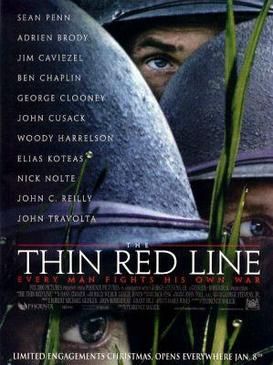
Based on a novel by James Jones (and technically, a sequel of sorts to From Here To Eternity), 1998’s The Thin Red Line is one of those Best Picture nominees that people seem to either love or hate.
Those who love it point out that the film is visually stunning and that director Terrence Malick takes a unique approach to portraying both the Battle of Guadalcanal and war in general. Whereas Steven Spielberg’s Saving Private Ryan told a rather traditional story about the tragedy of war (albeit with much more blood than previous World War II films), The Thin Red Line used the war as a way to consider the innocence of nature and the corrupting influence of mankind. “It’s all about property,” one shell-shocked soldier shouts in the middle of a battle and later, as soldiers die in the tall green grass of the film’s island setting, a baby bird hatches out of an egg. Malick’s film may have been an adaptation of James Jones’s novel but its concerns were all pure Malick, right down to the philosophical voice-overs that were heard throughout the film.
Those who dislike the film point out that it moves at a very deliberate pace and that we don’t really learn much about the characters that the film follows. In fact, with everyone wearing helmets and running through the overgrown grass, it’s often difficult to tell who is who. (One gets the feeling that deliberate on Malick’s point.) They complain that the story is difficult to follow. They point out that the parade of star cameos can be distracting. And they also complain that infantrymen who are constantly having to look out for enemy snipers would not necessarily be having an inner debate about the spirituality of nature.
I will agree that the cameos can be distracting. John Cusack, for example, pops up out of nowhere, plays a major role for a few minutes, and then vanishes from the film. The sight of John Travolta playing an admiral is also a bit distracting, if just because Travolta’s mustache makes him look a bit goofy. George Clooney appears towards the end of the film and delivers a somewhat patronizing lecture to the men under his command. Though his role was apparently meant to be much larger, Adrien Brody ends up two lines of dialogue and eleven minutes of screentime in the film’s final cut.
That said, The Thin Red Line works for me. The film is not meant to be a traditional war film and it’s not necessarily meant to be a realistic recreation of the Battle of Guadalcanal. Instead, it’s a film that plays out like a dream and, when viewed a dream, the philosophical voice overs and the scenes of eerie beauty all make sense. Like the majority of Malick’s films, The Thin Red Line is ultimately a visual poem. The plot is far less important than how the film is put together. It’s a film that immerses you in its world. Even the seeming randomness of the film’s battles and deaths fits together in a definite patten. It’s a Malick film. It’s not for everyone but those who are attuned to Malick’s wavelength will appreciate it even if they don’t understand it.
And while Malick does definitely put an emphasis on the visuals, he still gets some good performances out of his cast. Nick Nolte is chilling as the frustrated officer who has no hesitation about ordering his men to go on a suicide mission. Elias Koteas is genuinely moving as the captain whose military career is ultimately sabotaged by his kind nature. Sean Penn is surprisingly convincing as a cynical sergeant while Jim Caviezel (playing the closest thing the film has to a main character) gets a head start on humanizing messianic characters by playing the most philosophical of the soldiers. Ben Chaplin spends most of his time worrying about his wife back home and his fantasies give us a glimpse of what’s going on in America while its soldiers fight and die overseas.
The Thin Red Line was the first of Terrence Malick’s films to be nominated for Best Picture and it was one of three World War II films to be nominated that year. However, it lost to Shakespeare In Love.
The 1957 film, Beginning of the End, is perhaps the ultimate horror film for people who dislike Illinois.
Because it’s a Bert I. Gordon film and Gordon took his “Mr. Big” nickname seriously, it deals with giant monsters. In this case, the monsters are a bunch of locust who ate all of this radioactive grain that was being stored in a silo. The locusts grew to giant size and then they went on a rampage.
Fortunately, the rampage appears to be localized to Illinois. Apparently, the locusts have enough respect for state boundaries that they know better than to hop into Indiana, Missouri, or Wisconsin. Instead, the locusts take out the farming community of Ludlow and then start making their way to Chicago, perhaps hoping to battle the Chicago Outfit for control of the city’s politics. Do they seriously think Mayor Daley is just going to sit back while a bunch of locusts overrun his city?
The government wants to cover up the locust rampage because they don’t want to risk a mass panic in the 47 states that they actually care about. (This film came out before Alaska and Hawaii joined the Union.) However, when enterprising reporter Audrey Aimes (Peggie Castle) comes across the remains of Ludlow and discovers that the U.S. military has taken over the area, she is determined to discover what happened. She hooks up with Dr. Ed Wainwright (Peter Graves), whose work in making food bigger led to the giant locust attacks in the first place. In most movies, Ed would shoulder most of the blame for the locust attack but Beginning of the End seems to understand that these things happen when you’re dousing food with radiation and then keeping the food in a poorly secured silo.
Of course, the main reason why it’s not Ed’s fault is that Ed is played by Peter Graves and seriously, who could blame anything on Peter Graves? Graves was one of those actors who could deliver even the silliest of dialogue with a straight face and he certainly gets to do that in Beginning of the End. He seems to be taking the situation seriously, even if no one else is.
One reason why it is a little bit difficult to take the situation seriously is because it’s about giant locusts. Now, make no mistake about it. I’m enough a country girl that I know how destructive locusts can be. The problem is that locusts may be destructive but they don’t look all that menacing. Even giant locusts just look like really ugly grasshoppers. This film uses a lot of rear projection and still photography to create the idea of giant locusts crawling over buildings and threatening the soldiers who have been sent to fight them. As is so often the case with Bert I. Gordon’s film, there’s a definite charm to the cheap special effects. But still, locusts are locusts.
Chicago haters will love the scene where General Hanson (Morris Ankrum) announces that the locusts have only left him with one option, the drop an atomic bomb and wipe the city off the face of the Earth. Fortunately, Ed is there to suggest another solution. Good old Peter Graves. I don’t know what we would have done without him.
As a final note, I’ll just mention that the poster for this film is actually more exciting than the film itself:
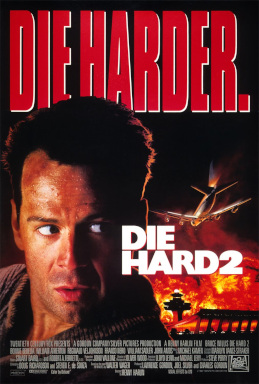
During 1990’s Die Hard 2, John McClane (Bruce Willis) asks himself, “How can the same shit happen to the same person twice?” and he does have a point.
I mean, consider the situation. In 1988, McClane spent his Christmas sneaking around a skyscraper and saving his wife from a group of sadistic mercenaries. Two years later, John McClane spends his Christmas sneaking around an airport and saving his wife from a group of sadistic mercenaries.
There are a few differences of course. In 1988, the mercenaries were only interested in stealing as much money as they could and each mercenary had his own properly ghoulish personality. In 1990, the mercenaries are really more of a cult, led by the fanatical Col. Stuart (William Sadler). And, along with trying to make some money, they are also trying to free General Ramon Esperanza (Franco Nero), a Central American drug lord and former CIA asset. Despite the fact that the mercenaries are played by familiar actors (like Robert Patrick, John Leguizamo, Tony Ganois, and Vondie Curtis-Hall), none of them are quite as memorable as the henchmen that Alan Rickman commanded in the first film. And while Sadler has charisma and makes a big impression during his first scene, his character is nowhere near as interesting or entertaining as Hans Gruber. Franco Nero, it must be said, is as dashing as ever. He really seems to be having fun in this movie.
A lot more people die in Die Hard 2 than died in the first Die Hard and the majority of them are innocent bystanders. This isn’t like the first film, where Harry Ellis died because his coke-addled mind led him to believe that he could outsmart Gruber. The victims in Die Hard 2 include a friendly church caretaker and over 200 passengers of an airplane that Stuart tricks into crashing on an airport runway. The scene where the plane crashes remains disturbing no matter how many times that you see it and it truly makes you hate Colonel Stuart. When the plane crashes, despite McClane’s futile efforts to warn the pilots, McClane sobs and it’s a powerful scene because it’s the first scene in which McClane has not had a quip or a one-liner ready to go. In this scene, McClane fails to save the day and, for a few minutes, he’s helpless. I usually end up crying with McClane. Today, those tears are also a reminder of what a good actor Bruce Willis truly could be whenever he let down his defenses and allowed himself to be vulnerable on screen.
Die Hard 2 is usually dismissed as not being as good as the first movie and …. well, that’s correct. It’s not as good but then again, few actions films are. There’s a reason why Die Hard continues to be held in such high regard. That said, Die Hard 2 is not bad. The stakes are a bit higher and the action scenes a bit more elaborate, as you would expect from a film directed by Renny Harlin. Bruce Willis plays McClane with the blue collar swagger that made his such an awesome hero in the first film. Bonnie Bedelia and William Atherton also return from the first film and Atherton once again gets his comeuppance in a crowd-pleasing moment. The cast is full of character actors, all of whom get a chance to make an impression. Dennis Franz is the profane head of security who eventually turns out to be not such a bad guy. John Amos is the major who eventually turns out to be not such a good guy. Colm Meaney has a few heart-breaking moments as the pilot of the doomed airplane. My favorite supporting performance is given by Fred Thompson, bringing his quiet authority to the role of tough but fair-minded Air Traffic Control director. Watching Die Hard 2, it does feel as if the viewer has been dropped in the middle of these people’s lives. Everyone seems real. No one seems like a mere plot device.
Is Die Hard a Christmas movie? You bet it is! But so is Die Hard 2 and it’s not a bad one.
That was my thought after I published my review of the first three episodes of Pam & Tommy. Don’t get me wrong. I stand by everything that I wrote in that review. The first three episodes were relatively well-made and they captured as specific point in time and Lily James was likably earnest as Pam.
Instead, my concern came from the fact that, by reviewing the first three episodes, I had now committed myself to watching and reviewing the entire series. And, the more I thought about it, the more I realized that there was no way that Pam & Tommy could remain interesting for a total of 8 hours, not unless the show abandoned its Ryan Murphy-lite approach and did something really unexpected with its recreation of the story. There’s just not enough there. This is a good 2-hour story but Pam & Tommy is an 8-epiosde miniseries. That’s 8-plus hours of Pam getting upset, Tommy acting like a dumbass, and Rand being every creepy guy who has ever approached you in a bar and started asking you about the book you’re reading. (It would, of course, never occur to him that the main reason you’re reading the book is to avoid talking to guys like him.)
Having now watched the fourth episode, it’s hard not to feel that I was very much correct in my concerns. Don’t get me wrong. The fourth episode had its moments. It featured an enjoyably intense performance from Don Harvey as the legendary Hollywood private investigator, Anthony Pellicano. Once Tommy finally discovers that his safe has been stolen and Pam reminds him about the videotape, Pellicano is the man who they approach to track down the perpetrator. This leads to a scene of Pellicano beating the crap out of Rand and it’s fun to watch. Some of that is because Don Harvey is a master of portraying urbane menace. But I have to admit that a lot of it is because Rand himself is such an annoying character. This episode opened with Seth Rogen, as Rand, wandering around a porn set and trying to reconnect with his estranged wife (Taylor Schilling), who significantly was just trying to read Anne Rice’s latest book when he approached her. Just the sight of Rand, with his mullet and his sad-sack facial expression, was so annoying that it was actually cathartic to see him get tossed around his apartment.
The problem is that the show wants us to feel some sympathy for Rand but there’s nothing sympathetic about him. He’s a loser and the fact that he still loves his wife and still wants to take care of her doesn’t make him any less of a loser. He’s a thief, a guy who accidentally stole a sex tape and then decided to put it online. The fact that he later feels guilty doesn’t change the fact that he did it. There’s as scene in the fourth episode where Rand is upset to see someone else selling bootleg copies of the tape. On the one hand, it’s not a bad scene. There’s an enjoyable irony to Rand discovering that someone has essentially stolen the tape from him after Rand went through so much trouble to steal the tape from Tommy. But the show doesn’t seem to be sure whether it wants us to laugh at Rand’s misfortune or to sympathize with him as he realizes that the consequences of his actions are out of his control. As a character, Rand is not compelling enough for both to be an option.
As for the title characters, both Sebastian Stan and Lily James do their best but I get the feeling that we’ve already learned all the we need to know about them. There was one good moment that examined Pam and Tommy’s different reactions to the release of the sex tape but otherwise, neither Tommy nor Pam are really that interesting as characters. I ended the fourth hour of Pam & Tommy very much aware that there were still four more hours to go. What else, I found myself wondering, could be left to be said?
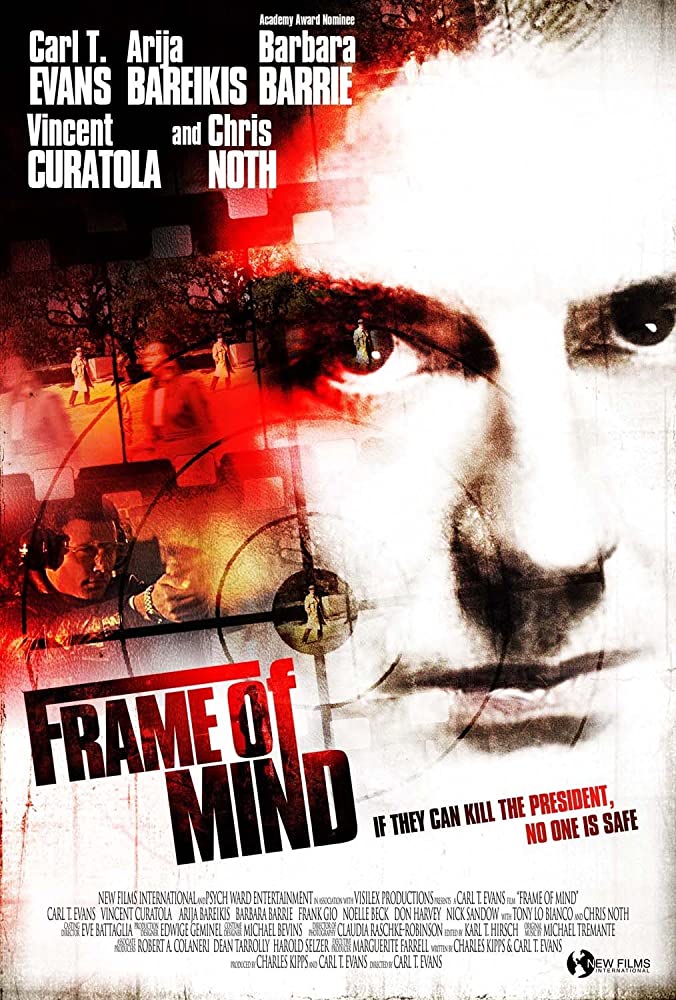
David Secca (Carl T. Evans, who also directed) is a New York cop who has just transferred to a town in New Jersey. His wife, Jennifer (Arija Bareikis) has a new job as a teacher. One day, while they’re out antiquing, they purchase a box that contains a roll of film. Looking at the film reveals pictures of a dangerous looking man who has a gun and who appears to be standing on the infamous grassy knoll in Dallas, Texas.
Convinced that he’s uncovered new evidence in the assassination of John F. Kennedy, Secca carries out his own investigation of the film. He tracks down the woman (Barbara Barrie) who actually shot the film and discovers that she is now 85 and confined to a nursing home. He talks to a skeptical conspiracy theorist (Chris Noth). As Secca investigates, his progress is monitored by people who, after all these years, still don’t want the truth about the Kennedy assassination to get out. As Secca discovers, these people are still willing to kill to protect the conspiracy.
Frame of Mind is an attempt to make a conspiracy thriller that, unfortunately, is done in by its own low budget. It’s difficult to make a conspiracy seem convincing when you don’t really have the money to hire more than a few extras. Probably the most interesting thing about the film is that, despite the low budget, there are a few established actors in the cast. Along with Barrie and Noth, Tony Lo Bianco, Don Harvey, Vincent Curatola, and even KISS’s Peter Criss all have small roles. The strangest cameo of all goes to former New York Mayor David Dinkins, who plays a senator. Being mayor of New York may be a dead end politically (just ask John Lindsay, Rudy Guiliani, Michael Bloomberg, and Bill De Blasio) but it can still serve as a launching pad for a career in the entertainment industry.
Frame of Mind might hold some interest for JFK assassination hobbyists, though it doesn’t really bring anything new to the able. It’s mostly interesting just to see who shows up in the cast.
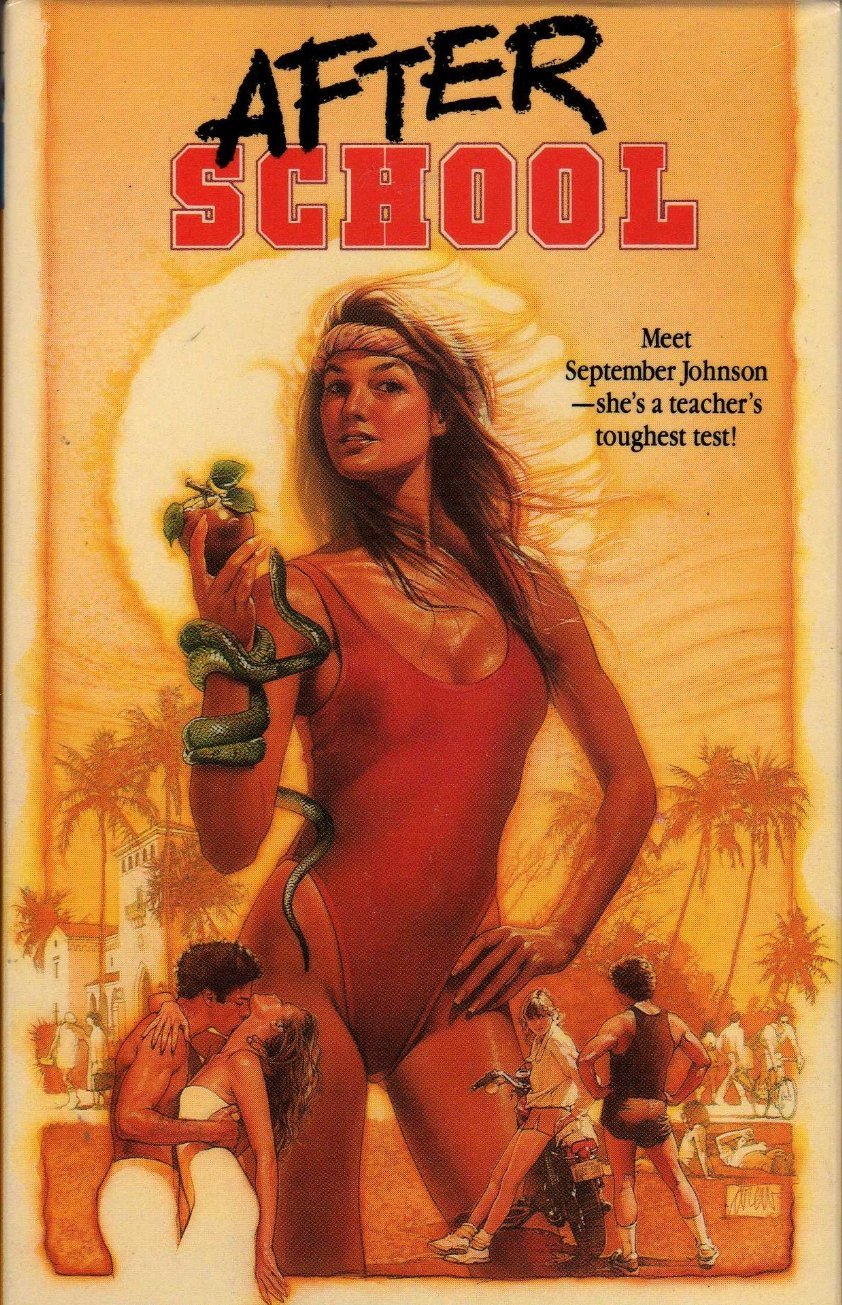
After School is a strange “what were they thinking?” type of movie. It’s also probably the only movie to end with a religious debate that’s moderated by Dick Cavett.
Cavett plays himself. In this film, he still has a talk show and one of his guests is going to be C.A. Thomas (Robert Lansing), a former priest who has written a novel claiming that man created God and not the the other way around. Cavett has reached out to the Catholic Church to ask them to send someone to represent their views on the show.
For reasons that are never clear, the Church selects Father Michael McClaren (Sam Bottoms), who teaches at a college in Florida. Father McClaren is youngish and he rides a motorcycle, which the monsignor thinks will appeal to younger viewers of Cavett’s show. (Did The Dick Cavett Show have younger viewers?) Because Dick Cavett is legendary for investigating the pasts of all of his guests (that’s what they say in the movie, anyway), another priest is sent down to Florida to make sure that Father McClaren does not have any skeletons in his closet.
At first, Father McClaren seems to be perfect but it turns out that he’s having a crisis of faith. It’s not just that the local bikers don’t have much respect for a priest, even when who does ride a bike. It’s also that he’s become attracted to one of his students, the improbably-named September Lane (Renee Coleman). It doesn’t take the movie long to settle into a familiar pattern of September coming on Father McClaren and then Father McClaren having to run off so that he can pray for strength.
So far After School might sound like a typical movie about a priest being tempted to break his vows. However, what sets After School apart from other films of its type is that there are frequent scenes featuring a group of cavemen living in prehistoric times. It’s never really made clear why the cavemen are in the film. The main caveman yells a lot and there’s a scene with a snake that suggests that he might live in the Garden of Eden. (The movie was originally released under the title Return to Eden.) There’s also several naked cavewomen who are in the film so that they can be ogled by the cavemen. Oddly, the cavepeople scenes are full of broad comedy while the rest of the movie takes itself fairly seriously.
Why are the caveman there and what does it have to do with Dick Cavett? Who knows? That’s one of the many unanswered questions to be found in After School. When C.A. Thomas and Father McClaren do finally meet on the Dick Cavett Show, they debate the origins of mankind. Neither one has nothing new to say on the subject. Even though everything that C.A. Thomas says sounds like New Age gobbledygook, Father McClaren proves himself to be incapable of countering him.
I don’t know what the point of After School was. There were so any scenes, like one in which Father McClaren attends an aerobics class, that didn’t seem to have any purpose. September’s lust for Father McClaren never makes any sense and his sudden declaration of love makes even less. Even if you can make sense of all that, there’s still the cavemen and Dick Cavett to deal with.
After School thinks that it is about something but who knows what?
Here are 6 more reviews of 6 other films that I watched this year. Why six? Because Lisa doesn’t do odd numbers, that’s why.
The Big Game (dir by Jalmari Helander)
In The Big Game, Samuel L. Jackson plays the President of the United States and you would think that fact alone would make this film an instant classic. Unfortunately, this film never really takes advantage of the inherent coolness of Samuel L. Jackson playing the leader of the free world. When Air Force One is sabotaged and crashes in the wilderness of Finland, President Jackson has to rely on a young hunter (Onni Tommila) from a group of CIA agents disguised as terrorists. Tommila does a pretty good job and the scenery looks great but at no point does Samuel L. Jackson says, “Check out this executive action, motherfucker,” and that’s a huge missed opportunity. As for the rest of the film, it takes itself a bit too seriously and if you can’t figure out the big twist from the minute the movie starts, you obviously haven’t seen enough movies.
The Connection (dir by Cedric Jiminez)
Taking place over the 1970s, the French crime thriller tells the largely true story of the efforts of a French judge (played by Jean Dujardin) to take down a ruthless gangster (Gilles Lellouche) who is the head of one of the biggest drug cartels in the world. The Connection run for a bit too long but, ultimately, it’s a stylish thriller that does a very good job of creating a world where literally no one can be trusted. Dujardin, best known here in the States for his Oscar-winning role in The Artist, does a great job playing an honest man who is nearly driven to the point of insanity by the corruption all around him.
Graduation Day (dir by Chris Stokes)
Hey, it’s another found footage horror film! Bleh! Now, I should admit that this horror film — which is NOT a remake of that classic 1980s slasher — does have a fairly clever twist towards the end, that goes a long way towards explaining a lot of the inconsistencies that, up until that point, had pretty much dominated the film. But, even with that in mind and admitting that Unfriended and Devil’s Due worked wonders with the concept, it’s still hard to feel any enthusiasm about yet another found footage horror film.
McFarland USA (dir by Niki Caro)
McFarland USA is an extremely predictable but likable movie. Kevin Costner plays a former football coach who, while teaching at a mostly Latino high school, organizes a cross country team that goes on to win the state championship. It’s based on a true story and, at the end of the film, all of the real people appear alongside the actors who played them. There’s nothing about this film that will surprise you but it’s still fairly well-done. Even Kevin Costner, who usually gets on my last nerve, gives a good performance.
Taken 3 (dir by Olivier Megaton)
Bryan Mills (Liam Neeson) is back and he’s killing even more people! Fortunately, they’re all bad people but you really do have to wonder what type of dreams Bryan has whenever he goes to sleep. In Taken 3, Bryan’s wife (Famke Janssen) has been murdered and Bryan has been framed. He has to solve the case and kill the bad guys while staying one step ahead of the police (represented by a bored-looking Forest Whitaker). Neeson does all of his usual Taken stuff — the intense phone conversation, the steely glare, and all the rest — but at this point, it has literally been parodied to death. If you’re into watching Liam Neeson kill ugly people, Taken 3 will provide you with adequate entertainment but, for the most part, it’s but a shadow of the first Taken.
War Room (dir by Alex Kendrick)
I saw the War Room in Oklahoma. It was being shown as part of a double feature with The Martian, of all things! Anyway, this film is about an upper middle class family that hits rock bottom but they’re saved by the power of prayer! Lots and lots of prayer! Seriously, this film almost qualifies as “prayer porn.” Anyway, the film was badly acted, badly written, incredibly heavy-handed, and ran on way too long but, on the plus side, it did eventually end.




 Through the Shattered Lens