Green Lantern Poster (WonderCon Exclusive)


DC Entertainment and Warner Brothers have been criticized these last few months for their handling of the ad/media blitz for their upcoming summer tentpole film: Green Lantern.

People have been quite underwhelmed with the teaser trailer shown a couple months ago then with releases of concept art for the film. It’s true that the character of Green Lantern is not as iconic as Batman or Superman, but who are outside of Spider-Man and the X-Men. Still it’s been quite perplexing how little hype Warner Brothers has been working on giving this film (starring Ryan Reynolds in the role of Hal Jordan as Green Lantern). One would think that both WB and DC Entertainment would make a massive push for this film not just to try and set it up as another DC film franchise the way Marvel has been creating their very own film universe with their properties.

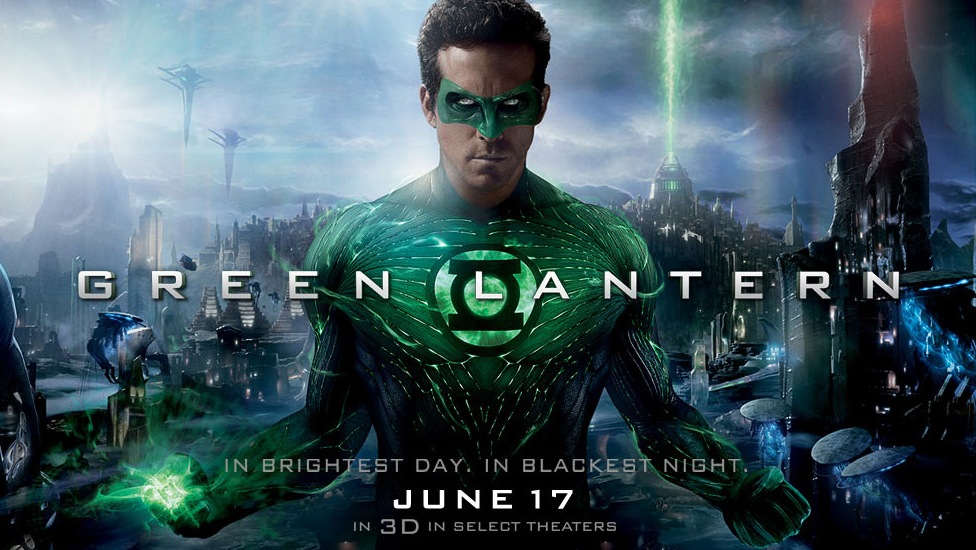
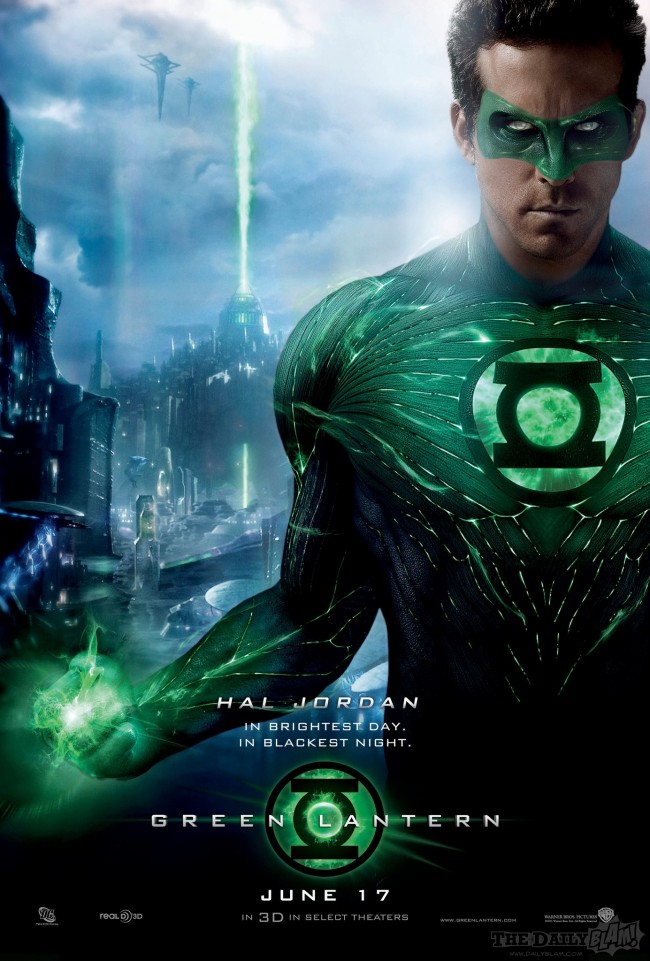
One thing that may be a sign that Warner Brothers and DC Entertainment are ready to unleash a major advert and media blitz for Green Lantern is the panel at this year’s WonderCon at San Francisco where the cast were available for roundtables and a con exclusive poster of the film was released. The poster will be one of the few things from WonderCon that non-attendees will be able to see and examine.

The poster goes a long way in helping dispel my feelings about this film. While I still haven’t fully bought into this project I do get a sense of the cosmic nature of this film which other superhero films of the past decade haven’t been able to convey. If WB and DC are able to build on the positives that this new poster is giving this film then maybe Green Lantern may just become a must-see for this summer.

Green Lantern is set for a July17, 2011 release date.

R.I.P. Dwayne McDuffie


February 22, 2011 marks a sad date for the comic book and animation world. One of it’s brightest and most forward thinking talents has passed away.

Dwayne McDuffie has become one of the giants in the comic book world. He began his career in comics in the late 80’s and early 90’s with Marvel Comics where he wrote for the titles, Damage Control and Deathlok. He would also do freelance work for DC up until 1993 when he finally decided to create his own comic book studio, Milestone Media, as his way to respond to how minority characters were being handled in the two main comic book houses.

With Milestone Media he was able to create a studio which  had multi-diversity character that had been lacking within the more traditional Marvel and DC Comics. Titles such as Icon and Static became fan favorites. Even though the studio he created finally shutdown in 1997 he was still able to parlay one of his Milestone titles into a WB cartoon series, Static Shock. He would find his true calling as writer and soon story editor in some of DC Animations best work. A majority of the stories for the animated series Justice League and Justice League Unlimited were either written or supervised by him. He would also be on hand to revamp Cartoon Network’s Ben 10 into Ben 10: Alien Force.

His return to comics in 20o6 would include stints as writer for Fantastic Four and Justice League of America. But his best work continued to be in the animation side as he writes two of the best received animation films from DC Animation with Justice League: Crisis on Two-Earths and, the recently released, All-Star Superman. The latter has already gained such a positive response from critics and fans alike that they’ve called it the best thing to be released by DC Animation.

So, it is with a sad heart that on the release date of his greatest work one Dwayne McDuffie passed away leaving behind legions of fans and contemporaries. There is no better tribute for this giant of the comic book world than one of the greatest episodes of Justice League.

The Dark Knight Rises Gets Selina Kyle and Bane


January 19, 2011 is the first day of the new year when the internet exploded with reactions concerning Warner Brothers’ announcement about two key characters in Christopher Nolan’s upcoming and final film in his Batman trilogy.

According to a Warner Brothers press release Anne Hathaway will take on the iconic role of Selina Kyle. For those who don’t recognize the name it’s the public face of the female foil for Batman. I’m talking about none other than Catwoman herself. While the press release doesn’t mention the name Catwoman anywhere it would be only logical that Hathaway as Selina Kyle will end up as Catwoman before the film ends.

The other character announcement was about who Tom Hardy was going to portray in the film. Speculation since Hardy was cast mostly had him taking on the role of the villain Hugo Strange, but in a curve out of left field it looks like Hardy will be playing villain Bane.

While reaction on Hathaway as Selina Kyle has mostly been positive the one concerning Hardy as Bane has been met with a combination of guarded optimism (much faith and trust has been earned by Nolan from fans) to outright fanboy rage. Both from film bloggers who should know better and just people who want to grab onto anything that they see as the downfall of the Nolan take on the Batman franchise.

Some still remember the catastrophic Bane from Schumacher’s deservedly-panned Batman & Robin thus think this Nolan take on Bane will be just the same. Others just never bought into the ‘roided-out criminal villain when he was first introduced in the “Knightfall” crossover during the 90’s. If Nolan hadn’t earned my trust as a film and comic book fan from his previous Batman films I would react the same way but I won’t.

While the comic book version of Bane did look like a muscle-bound luchador who used a super-soldier serum called “Venom” to roid-out people fail to remember that bane was very close to Batman’s equal when it came to the intellect department. This was the one villain who deduced Batman’s true identity and found a way to mentally and physically break the Bat down before finally breaking his back.

I believe that Nolan will probably dump the luchador mask and outfit and concentrate on Bane as a criminal kingpin who doesn’t just have the physicality to match Batman punch for punch but also the mental acuity equal to the task of breaking Batman. Does this mean that rumors of the character Hugo Strange has been nixed from the film?

I happen to think that either Hugo Strange will be merged with the character of Bane or may actually appear as the true mastermind who turns Bane loose on the Batman. Either way I’m quite interested in finding out how Christopher Nolan plans to adapt the Bane character to his realistic take on the Batman universe. I’d be very surprised if the wrestling mask and outfit remains. The venom injections could easily be adapted to become more believable and as Tom Hardy has shown in the film Bronson he can physically bulk up and look believable as a muscle-bound heavy.

Source: Slash Film

Review: 100 Bullets Vol. 1 – First Shot, Last Call


“I never told you to kill him. I just gave you the opportunity.” — Agent Graves

Brian Azzarello’s 100 Bullets stands as one of the strongest examples of mature storytelling to emerge from DC’s Vertigo imprint. From the outset, the series announces itself as something more than a standard crime comic. It is a hardboiled noir thriller, but one that pushes beyond mere style and atmosphere into the terrain of moral ambiguity, personal trauma, revenge, and consequence. In that sense, it recalls the classic detective and crime fiction of Dashiell Hammett, Mickey Spillane, and Raymond Chandler, while also feeling like a darker, more intricate evolution of the hyper-noir sensibilities Frank Miller explored in Sin City.

It would be easy to compare the two and simply declare one superior to the other, but the truth is more complicated than that. Sin City thrives on stark immediacy: its stories are blunt, violent, and stripped down to their most primal elements. 100 Bullets, by contrast, is more layered and methodical. Its stories take their time, constructing a web of motives, betrayals, and hidden histories that slowly reveal themselves. That extra complexity gives the series a different kind of power. Where Miller’s work depends on the force of simplicity, Azzarello and Risso create something that feels colder, more deliberate, and more psychologically unsettling.

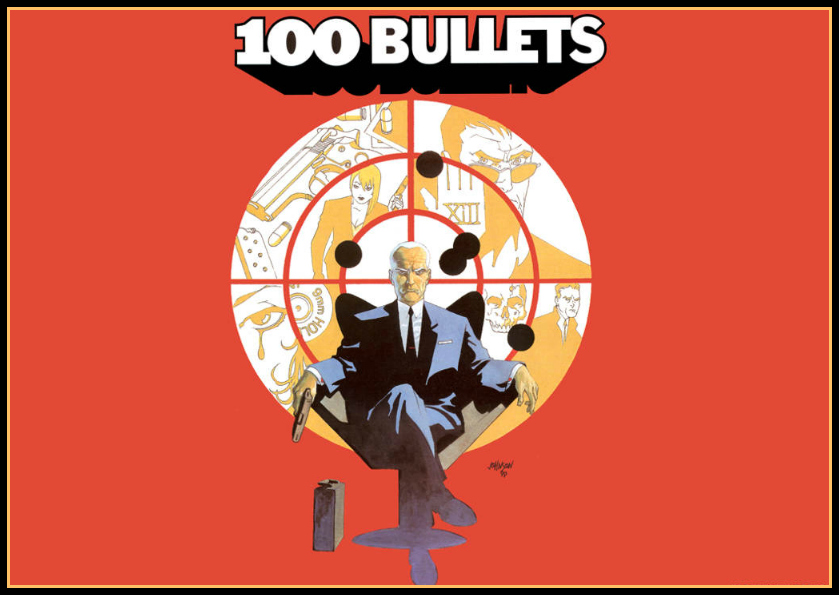
The first collected volume, First Shot, Last Call, serves as a perfect introduction to the series’ central premise and tone. It introduces Agent Graves, the enigmatic figure who functions as the series’ catalyst and perhaps its most important symbol. Graves looks like the kind of man who has walked out of a government conspiracy, a private war, or a decade-long nightmare and come out the other side untouched. He approaches recently paroled Dizzy Cordova with an offer that sounds impossible: an attaché case containing a gun, 100 untraceable bullets, and proof that the people responsible for destroying her life are known and reachable. The choice, however, is entirely hers. Graves does not force revenge; he simply places it within reach.

That premise is the genius of 100 Bullets. On the surface, it is a crime story built around assassination, hidden conspiracies, and the promise of vengeance. But underneath, it becomes a series about free will and the burden of choice. The question is never just whether a character will kill. It is whether revenge can ever truly heal the wounds that created the desire for it in the first place. Azzarello understands that vengeance is seductive precisely because it feels so simple. It offers closure where life has given none. Yet the series continually suggests that closure is an illusion, and that the acts people commit in the name of justice or revenge often become the first step toward deeper destruction.

Dizzy Cordova is a strong opening example of this theme. She is not written as a simplistic victim, nor as an idealized avenger. She is angry, wounded, and psychologically cornered, but she is also complicated and fully human. Her eventual decision feels earned because the story understands her pain rather than merely exploiting it. Azzarello writes her as someone whose past has stripped away the comfort of easy morality. The same can be said of Lee Dolan in the second major story arc. Dolan’s life has been shattered by an accusation that contaminated both his public identity and his personal relationships. He, too, is offered Graves’s case and the temptation of retaliation. But his response is different from Dizzy’s, and that difference matters. It shows how carefully Azzarello constructs his characters as individuals rather than as variations on a single revenge fantasy.

What makes these early stories especially effective is that each one feels self-contained while also contributing to a much larger design. Even in this first volume, Azzarello is laying the groundwork for a sprawling narrative that will eventually run exactly 100 issues. The structure gives the series an unusual density: every issue matters, every choice matters, and every seemingly isolated encounter feels like it may be part of a larger hidden architecture. That sense of design keeps the book from ever becoming repetitive. Instead, it feels like a slow-burning conspiracy thriller where the real mystery is not just who is manipulating whom, but why these people are vulnerable to manipulation in the first place.

Eduardo Risso’s artwork is the perfect visual counterpart to Azzarello’s writing. His style is often described in relation to other noir-influenced artists, but it would be inaccurate to call it merely minimalist. Risso’s pages have a cinematic rhythm that gives the book a visual identity all its own. His compositions are deceptively economical: characters are posed with dramatic clarity, shadows are used with purpose, and every panel seems designed to move the eye like a camera tracking through a scene. Even in moments where little physical action occurs, there is a sense of tension and motion in the framing.

Risso also has a strong eye for character design. His people are not rendered with perfect realism, nor are they reduced to exaggerated caricatures. Instead, they occupy a space that feels stylized but believable, which is ideal for a story like this. Their faces and bodies communicate attitude before they even speak. That matters in a noir story, where so much of the drama lies in what characters conceal as much as what they reveal. The women in particular are drawn with a confident sensuality that reflects the hard-edged world of the series without reducing them to empty decoration. Characters like Dizzy Cordova and Megan Dietrich feel distinct not just because of Azzarello’s writing, but because Risso gives them physical presence, posture, and visual identity that reinforce who they are.

What is especially impressive is that Risso’s art enhances the noir mood without becoming self-conscious about it. The book never feels like it is trying too hard to imitate classic crime fiction. Instead, the visuals and writing work together to create a world that is stylish, dangerous, and morally unstable. That balance is difficult to achieve, and 100 Bullets succeeds because both creators understand that atmosphere alone is not enough. The mood has to be supported by character, and the character has to be supported by consequences.

100 Bullets: First Shot, Last Call is therefore more than just a strong debut volume. It is a declaration of intent. Azzarello shows that he is willing to write adults as flawed, desperate, and self-deceiving people rather than as heroes or villains in any conventional sense. Risso, meanwhile, gives the story a visual voice that is sleek, uneasy, and unmistakably noir. Together, they create a comic that is intelligent, hard-hitting, and deeply memorable.

As an opening volume, it does exactly what it should: it hooks the reader, establishes the mythology, and makes clear that this is a story about choice, consequence, and the cost of acting on one’s darkest impulses. More importantly, it does so with confidence and style. 100 Bullets earned its reputation not because it imitates the best noir stories, but because it understands what makes noir endure: wounded people, dangerous opportunities, and the terrible freedom of deciding what to do next.