October True Crime: To Catch A Killer (dir by Eric Till)


Brian Dennehy was one of the great American character actors.

Rugged and exuding a sense of weariness, as if he were someone who had seen it all, Brian Dennehy cut a uniquely American figure. He was one of those actors who could play a New York fireman as easily as he could play a Tennessee farmer. He had those eyes that said, “Don’t mess with me,” but also the manner that made you feel everyone was welcome in his house as long as they didn’t think they were better than anyone else. He was one of those actors who could be both likable and intimidating. He was perfectly cast as Sheriff Teasle in First Blood because, even if he was a bit too hard on John Rambo when he first picked him up, it was still easy to see that Teasle didn’t mean to be a jerk. He was just doing his job. He thought he was keeping his town safe. Dennehy was just as credible playing a benevolent alien in Cocoon, a western outlaw in Silverado, or a burned-out cop in F/X. When Dennehy played a hero, you felt safe whenever he was onscreen. When he played a bad guy, he was absolutely terrifying.

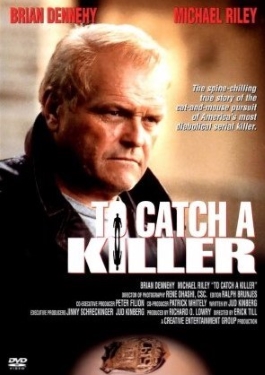
Dennehy played one of the worst of the real-life bad guys in the 1992 television film To Catch a Killer. He plays John Wayne Gacy, a contractor considered a pillar of his community in the suburbs of Chicago. He runs a successful business. He hires young men who really need the money. He has a big smile. He’s involved in local politics and even has a framed picture of himself with President Jimmy Carter’s wife. In his spare time, he dresses up like a clown and entertains the children at the local hospital. He uses the name Pogo and paints sharp points at the corners of his mouth, giving him a somewhat sinister appearance. Everyone seems to like him. Of course, most people don’t know that Gacy is an ex-con who did time for sexually assaulting a 15-year-old boy in Iowa. This film takes place in the late ’70s, before anyone could just hop online and look up public records.

To Catch a Killer follows Detective Joe Kozenczak (Michael Riley) as he investigates the disappearance of a young man last seen being offered a job by Gacy. Joe suspects Gacy from the start, but he’s continually told that Gacy is a pillar of the community. What makes this film so effective is that Brian Dennehy plays Gacy as someone so arrogant he barely bothers to hide his guilt, but also as someone with such a victim complex that he won’t stop whining about being suspected of doing something he definitely did. The scene where Gacy demonstrates a handcuff trick is frightening because Gacy seems so desperate for companionship, and so goofy, even while he’s preparing to murder someone. Personally, I prefer it when Dennehy is playing a good guy (or, at the very least, a misguided bad guy like in First Blood), but that doesn’t change the fact that he was frighteningly believable as John Wayne Gacy. Dennehy was Emmy-nominated for his performance here.

As for the real John Wayne Gacy, he killed at least 33 people before he was apprehended in 1978. (It’s thought that the actual number is much higher.) He was executed in 1994, two years after this film aired. Reportedly, his last words were, “Kiss my ass.”
Late Night Retro Television Review: Highway to Heaven 2.22 “Sail Away”


Welcome to Late Night Retro Television Reviews, a feature where we review some of our favorite and least favorite shows of the past!  On Thursdays, I will be reviewing Highway to Heaven, which aired on NBC from 1984 to 1989.  The entire show is currently streaming on Freevee and several other services!

This week, Jonathan helps a novelist get in touch with his long-passed muse.  He also helps him repair his relationship with his grandson before it’s time to move on.

Episode 2.22 “Sail Away”

(Dir by Michael Landon, originally aired on April 2nd, 1986)

Two novelists travel to a remote island.

Frank Worton (Lew Ayres) grew up on the island and was inspired to write a series of paperback romances based on his love for a girl named Jenna.  Sadly, Jenna died when Frank was a teenager and his books were his way of trying to get continue their relationship, if just in his imagination.

Todd Worton (David Einser) is Frank’s grandson.  Todd writes 3,000 words a day and is very strict about his routine.  He’s never written anything as successful as his grandfather’s pulpy romances and he feels that his grandfather has never respected his work.  What Todd doesn’t realize is that Frank feels the same way about him.

When they travel to the Island, Frank starts to act strangely.  He moves into the abandoned house where Jenna lived and claims that it still looks the same as it did when he was a young man.  At one point, he thinks that he sees Jenna walking along the beach.  Is he going senile or is he being haunted by a ghost?

Or is he being prepared for death?  Jonathan and Mark are running a ferry service, taking people to and from the Island.  (I can understand Jonathan knowing how to do all of this, as he’s an angel.  But how does Mark casually go from job to job?  That man’s resume must be a mess at this point.)  Just as he did with Eli Wallach a few episodes ago, Jonathan is preparing Frank to move on.  By the end of the episode, Frank is boarding a sailboat and heading off with his beloved Jenna.  But not before Todd reads the last novel that Frank wrote about Jenna and Frank reads the novel that Todd wrote about him.  The two finally make peace and Jonathan, in voice-over, tells us that both books became best sellers.

Awwww!  What a sweet episode.  This episode is largely a showcase for Lew Ayres and he definitely delivers, giving a heartfelt performance as a man haunted by his past.  If you don’t cry when he gets on that boat, you don’t have a heart and you might want to get that checked out.  You need a heart to live or so they tell me.

In the end, this is an episode that will make you want to sail away.  And while Highway to Heaven has never exactly been known as a subtle show (and I imagine that was by design), I am somewhat impressed at the restraint it must have taken to not include Styx’s Come Sail Away on the soundtrack.

Film Review: Left Behind: World At War (dir by Craig R. Baxley)


With the 2005 film, Left Behind: World At War, the Left Behind series enter special guest star territory.  Kirk Cameron and Brad Johnson, while still present in the film, were largely pushed to the background and Louis Gossett, Jr. and Charles Martin Smith popped up as Nicolae Carpathia’s two main adversaries.

Gossett plays President Gerald Fitzhugh.  Smith plays Vice President John Mallory.  (Speaking as someone of Irish descent, it fills me with pride to think that America will someday be led by the presidential ticket of Fitzhugh and Mallory.)  Despite the fact that Carpathia (again played by Gordon Currie) spent the previous film talking about how, under his leadership, there would be no more borders, it appears that there still are borders.  However, Carpathia has a plan to take care of that.  Mallory has discovered the plan but, right after he tells Fitzhugh about it, they’re attacked by Carpathia’s goons.  The presidential limo is blown up and with it, John Mallory.  (Poor Charles Martin Smith.)  Fitzhugh manages to escape, thanks to the help of the Tribulation Force.

It turns out that Carpathia’s latest scheme is to steal the few remaining bibles in the world, lace them with anthrax, and then distribute them back to the believers.  Gossett gets to go full action hero as he tries to stop Carpathia and good for him.  As for the other members of the Tribulation Force, Buck (Kirk Cameron) marries Chloe Steele (Janaya Stephens) and Chloe’s father, Rayford (Brad Johnson), meets his former lover, Hatti Dunham (Chelsea Noble).  Hattie is now Carpathia’s lover and is pregnant with his child.  Some members of the Tribulation Force die over the course of the film.  Buck has a moment of anger at God, which is the best scene in the film because it at least acknowledges that one can believe and still be angry.  The majority of the film, however, is Lou Gossett, Jr. wandering around with a “How did I go from winning an Oscar to appearing in this?” look on his face.

Anyway, credit where credit is due.  World at War is the most action-packed of the Left Behind films and, while it’s still definitely an evangelical film, it’s considerably less preachy than either the first Left Behind film or Tribulation Force.  World at War is pure melodrama, with a lot of plotting and evil cackling and overdone action scenes.  If you don’t want to listen to the dialogue, you can focus on just how small the film’s version of the Oval Office is.  That’s what happens when you try to a globe-spanning epic on a low budget.  Sometimes, you have to settle for a small replica of the Oval Office instead of trying for the real thing.

That’s not to say that World At War is a particularly good film.  Brad Johnson gets even less to do than in the second film and Kirk Cameron is still Kirk Cameron.  Since he lost his job at the end of Tribulation Force, we’re no longer asked to believe that Kirk Cameron’s playing a respected journalist.  Instead, Buck is now just a self-righteous evangelist and, for obvious reasons, it’s easy to believe Kirk Cameron in that role but Kirk Cameron is one of those actors who is far more likable when he’s miscast than when he’s playing himself.  Much as with Tribulation Force, World At War can’t seem to decide just how powerful Carpathia actually is.  He’s got supernatural powers and is apparently actually immortal and yet, he is often easily deceived by the simplest of ruses and is incapable of killing anyone until their usefulness to the film’s narrative has expired.

Louis Gossett, Jr. was smart enough to play a character who dies at the end of World At War, therefore freeing him from having to appear in any more Left Behind movies.  It turned out to be a moot point, however.  This was the last Left Behind film until the recent unsuccessful attempt to reboot the franchise with Nicolas Cage as Rayford Steele.

Horror Film Review: Happy Birthday To Me (dir by J. Lee Thompson)


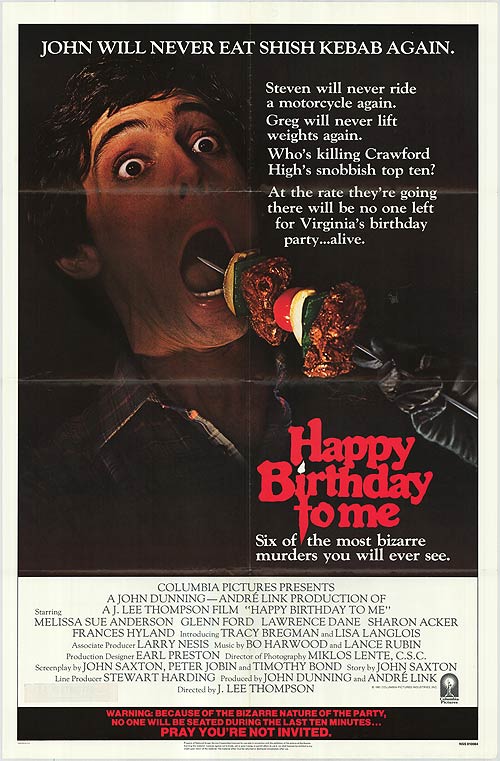
“John will never eat shish kebab again!” announces the poster for the 1981 Canadian slasher film, Happy Birthday To Me.  

Happy Birthday To Me is famous for three things.  One of those things is the poster above, which was apparently so controversial that it actually led to the film being banned in some countries.  That said, it’s a brilliant poster, one that probably belongs in the Film Poster Hall of Fame.  If I had been alive and old enough to sneak into the movies in 1981, that poster would have drawn me into the theater.

The other interesting thing about the poster is that no one in the movie is named John.  There is a shish kebab scene, of course.  But it happens to a guy named Steven, not to anyone named John.  Of course, the poster also says that Steven likes to ride a motorcycle but, in the movie, the motorcycle rider is a pervy French-Canadian named Etienne.  Maybe the film’s producers feared that American audiences would not be willing to watch a movie featuring a character named Etienne.  (They were probably right, by the way.  Happy Birthday To Me came out decades before Degrassi: The Next Generation taught America that it has nothing to fear from the Canadians.)

As for what else Happy Birthday To Me is famous for — well, first of all, there’s the actual shish kebab scene itself.  As cringe-inducing as it may appear to be on the poster, it’s even more disturbing in the actual film.  Interestingly enough, there’s not a lot of blood in the scene.  In fact, it’s one of the few scenes in Happy Birthday To Me to not be drenched in blood.  However, there is a lot of gagging and gurgling and the sounds are all the more disturbing because they’re taking place off-camera.  Making it even more unsettling is that Steven (played by Matt Craven, who has since become a distinguished character actor) is one of the few likable characters in the movie.  In a movie full of snobs, pervs, and weirdos, Steven is the guy who is always encouraging people to stop fighting, make love, and gamble.

Finally, Happy Birthday To Me is famous for not making a damn bit of sense.

Actually, to be fair, the movie does make sense up until the final ten minutes or so.  Up until that point, it’s simply been a well-made slasher film, albeit an above average example of the genre.  There’s a killer on the loose, killing students at Crawford Academy.  All of the victims are members of the Top Ten, an exclusive clique of rich and spoiled teens.  (Interestingly enough, not every member of the Top Ten is killed.  In fact, some of the people who you are sure are due to be killed somehow manage to survive.)  One member of the Top Ten, Ginny (Melissa Sue Anderson), should be excited about her upcoming birthday party but instead, she is haunted by flashbacks to a car accident and the brain surgery that she was forced to undergo afterward.  (Footage of actual brain surgery was used in the film.)  Her father (Lawrence Dane) is clueless.  Her therapist (Glenn Ford) insists that Ginny needs to move on with her life.  But Ginny can’t escape the feeling that something is not right, especially when all of her friends start to disappear.

As I said, it all makes sense up until the final ten minutes or so of the film.  That’s when the film produces a twist that is so out-of-nowhere and nonsensical that you cannot help but admire the film’s audacity.  I’m not going to spoil the twist, other than to say that it makes no sense and I absolutely loved it.  From what I’ve read, it appears that the twist ending was almost literally made up on the spot and it’s just so weird that it elevates the entire movie.

Of the many slasher films that came out in the early 1980s, Happy Birthday To Me is one of the best.  It’s a classic that need not ever be remade.  (I doubt any remake could match the audacity of the original’s finale.)  Nicely acted, intelligently directed, and batshit insane when it needed to be, Happy Birthday To Me is an October essential!