This October, I’m going to be doing something a little bit different with my contribution to 4 Shots From 4 Films. I’m going to be taking a little chronological tour of the history of horror cinema, moving from decade to decade.
We’ve reviewed a lot of science fiction and we’ve got a lot more left to go. (Keep an eye out for my reviews of Starcrash and The Humanoid over the upcoming few days.) However, from the beginning, this month has always been centered around Star Wars. You may have heard that there’s a little movie called Star Wars: The Force Awakens and it’s opening this week. Apparently, a few people are excited about it. Since we love reviewing little known art films here at the Shattered Lens, we decided why not review all of the previous Star Wars films during the week leading up to the release of The Force Awakens? Jeff (a.k.a. the blogger known asJedadiah Leland) started us off by reviewing The Phantom Menace.Then Alexandre Rothier took a look at Attack of the Clones, followed by Jeff’s look at Revenge of the Sith.Leonard Wilson was the next to step up to the plate, reviewing both A New Hope and The Empire Strike Back.
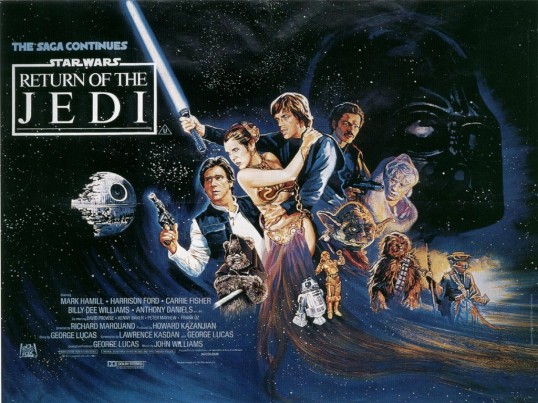
And now, it’s my turn to add my thoughts to this project. It’s time to review the 1983 film, Return of the Jedi. And I have to admit that, when I first thought about what I wanted to say in this review, I was totally intimidated. Unlike my fellow writers here at the Shattered Lens, I’m hardly an expert when it comes to Star Wars. Don’t get me wrong — I know the basics. I know that Darth Vader is Luke’s father. I know that Han Solo flies the Millennium Falcon and that Princess Leia is in love with him. I know there’s an evil Empire and I know that there are rebels. I’m not a virgin when it comes to Star Wars but, at the same time, I’m definitely not as experienced (with Star Wars) as most of my friends and fellow movie bloggers.
“Dang, Lisa, get over it!”
So, late this afternoon, when I sat down to watch Return of the Jedi, it was with more than a little trepidation. My obvious panic and welling tears convinced Jeff to watch the movie with me and I was happy for that. He loves Star Wars so I knew he could explain to me what was going on.
Finally, we watched Return of the Jedi and I discovered that I was panicking over nothing. Return of the Jedi may be the third part of trilogy and I may not be an expert on the films that came before it. But, even with all that in mind, Return of the Jedi is not a difficult film to figure out. As opposed to the finales of Harry Potter, The Hobbit, and The Hunger Games, Return of the Jedi keeps things simple. A good guy has been kidnapped by a bad guy. The other good guys come to the rescue and then go to another planet so that they can fight an even bigger bad guy. It’s not complicated.
As I watched Return of the Jedi and realized that I was having absolutely no problem following the film’s plot, I also realized that the Star Wars films are such a huge part of our culture that, regardless of how many of them we’ve actually sat through, everyone has absorbed them by osmosis. Bits and pieces of it are everywhere, showing up in everything from TV sitcoms to political commentary. (Remember how everyone used to compare Dick Cheney to Darth Vader?) The Star Wars franchise is almost biblical in that respect. At the same time, the fact that everyone knows about these movies makes them a little difficult to review. You don’t so much watch a Star Wars film as you join in a universal experience. As a reviewer, you definitely find yourself wondering what you can add to a conversation that everyone else has already had.
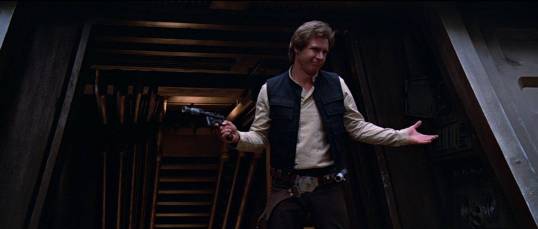
As a stand alone movie, Return of the Jedi is actually three separate films mixed together. The first film deals with Luke Skywalker (Mark Hamill) showing up at Jabba the Hutt’s palace and rescuing Han Solo (Harrison Ford), Princess Leia (Carrie Fisher), Chewbacca (Peter Mayhew), and two robots from being tossed into a creature called the Sarlacc, which is basically a giant vagina out in the middle of the desert. The second film deals with the rebels teaming up with a bunch of teddy bears and fighting the Empire on a jungle planet. And the third film features Luke and Darth Vader (body of David Prowse, voice of James Earl Jones, face of either Sebastian Shaw and Hayden Christensen, depending on which version of the film you’re watching) dealing with their family issues while the Emperor (Ian McDiarmid) cackles in the background. Some parts of the film work better than others. The end result is entertaining but definitely uneven.
Jedi‘s heart belongs to that third film, the one dealing with Luke and Darth Vader. I’ve read some pretty negative online comments about Mark Hamill’s performance in New Hope and Empire Strikes Back but, in Return of the Jedi, he brings an almost haunted intensity to the role of Luke. In theory, it’s easy to be snarky about all the talk about the “Dark Side of the Force,” but, when you look in Hamill’s eyes, you totally understand what everyone’s going on about. You see the fire and the anger but, even more importantly, you see the struggle between good and evil. There’s a very poignant sadness to the scenes where he and his father prepare to meet the Emperor.
And speaking of the Emperor, he is pure nightmare fuel! AGCK!
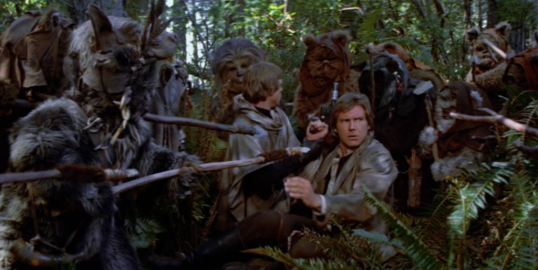
As for the other two films to found within Return of the Jedi, the jungles of Endor didn’t do much for me. Don’t get me wrong. I thought the action scenes were handled well and, unlike apparently everyone else in the world, I was not annoyed by the inclusion of the Ewoks, the killer teddy bears who helped to the Rebels to take down the Empire. I thought the Ewoks were cute and I actually got pretty upset when one of them was killed in battle. If I had been alive when Return of the Jedi had been released, I probably would have wanted a stuffed Ewok and, I imagine, that was the main reason they were included in the film. (I also imagine that’s the main reason why a lot of people can’t stand them.)
So, no, the Ewoks did not bother me. What did bother me was that under-construction Death Star floating out in the middle of space. It bothered me because I really couldn’t imagine any reason why — after the first Death Star was apparently such a colossal failure — the Empire would insist on trying to do the exact same thing all over again. This, along with the fact that they were rather easily defeated by a bunch of teddy bears, leads me to wonder whether the effectiveness of the Empire was just a little overrated. I mean, the Emperor was scary but otherwise, everyone involved with the Empire was pretty incompetent.
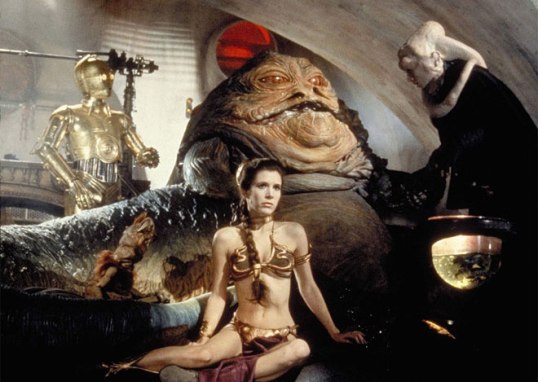
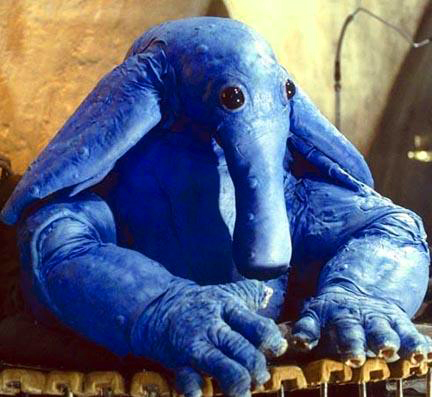
Far more impressive, as far as villains go, was Jabba the Hut. In fact, Jabba and his decadent entourage were so memorable and colorful and evil and icky that they pretty much overshadowed almost everything else in the film. I mean, Jabba even had a blue elephant playing music for him! And I know that I’m supposed to be critical of the film for putting Leia in that gold bikini but you know what? Leia may have been forced to wear a gold bikini but she never gave up her dignity or her defiance. And when it came time to take out Jabba, Leia used the tools of her oppression to do so, strangling him with his own chains. In that one scene, Leia proved herself to be a true rebel.
There’s a lot that’s good about Return of the Jedi but, as I said earlier, it’s definitely an uneven film. Richard Marquand’s direction is perhaps the epitome of workmanlike. It’s efficient and it’s dependable and there’s absolutely nothing surprising or particularly challenging about it.
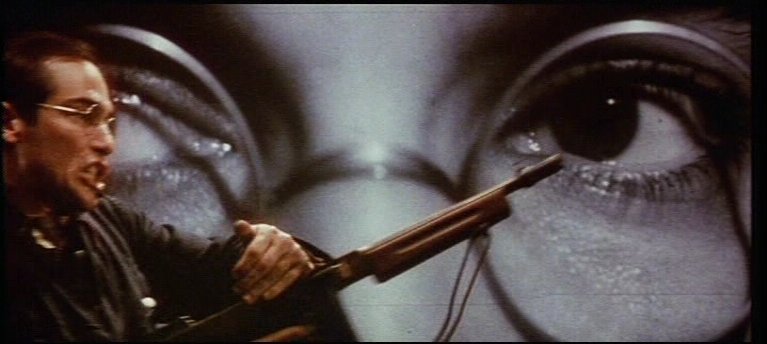
It’s interesting to note that, before Richard Marquand was selected as director, the job was offered to both David Lynch and David Cronenberg, two directors who are all about surprising and challenging the audience. What would David Lynch’s Return of the Jedi been like? Well, here’s one possibility:
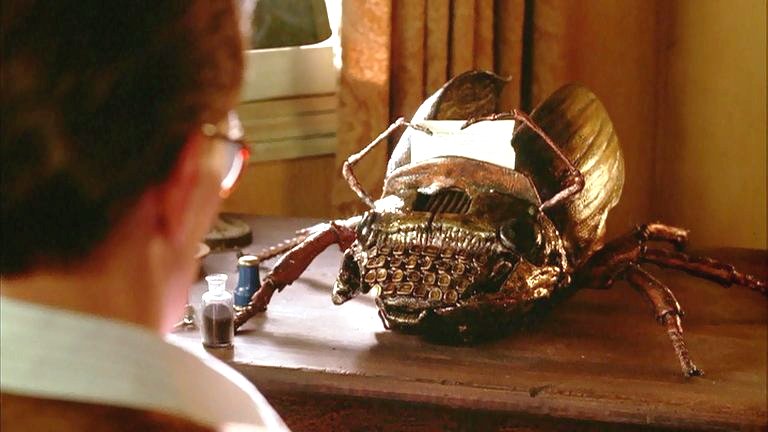
As for David Cronenberg’s Return of the Jedi, it might have looked something like this:
For better or worse, the world got Richard Marquand’s Return of the Jedi, which I imagine was pretty close to what George Lucas wanted the film to be.
As I sit here finishing up this review and wondering just why exactly I was so intimidated earlier (seriously, this turned out to be one the easiest reviews that I’ve ever written), I estimate that 75% of the people that I know are currently sitting in a theater and watching The Force Awakens. Keep an eye out for Arleigh’s review in the next few days!
And in closing, here’s that blue elephant that I mentioned earlier. Dance!
With just minutes left til the end of the day I thought it was time to wish one of my favorite a happy birthday.
I pretty much spent my junior high and high school years reading everything that Stephen King had written and published up to that point. The habit followed me after high school graduation and I’ve picked up on other authors since.
While Stephen King has slowed down some when it comes to the amount of novels he has released in the last decade or so, he is still one of the few authors whose books I will buy without even knowing what it’s about.
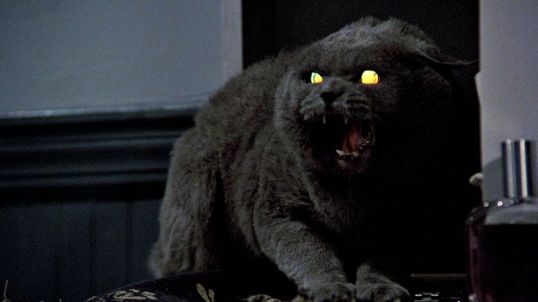
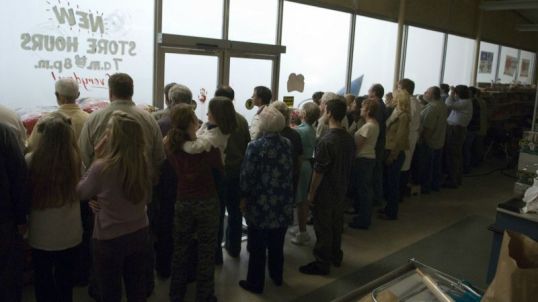
Here are just four films adapted from his stories that I consider favorites of mine. They’re just stories about a boy’s first car, a man waking up from a long sleep, a cat named Church and a grocery store full of people.
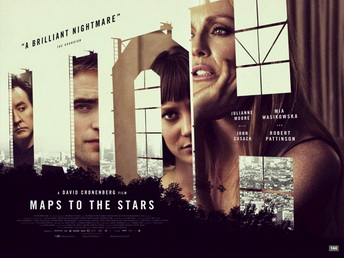
I have to admit that, for the most petty of reasons, I was dreading the 2014 release of David Cronenberg’s Maps to the Stars.
This was despite the fact that I happen to be a big fan of just about everyone in the cast and David Cronenberg as a director. (I still say that Cosmopolisis one of the best films of the decade and I don’t care who disagrees.)
My initial issue with Maps to the Stars — and again, I admit this is really petty — was that Sasha Stone, over the Awards Daily web site, was so damn fanatical about singing the film’s praises. I have a theory that Sasha tends to overpraise certain films specifically so she can have an excuse to get angry and go off on a rant when they don’t receive any Oscar nominations. Ever since Sasha went batshit crazy over The King’s Speech beating The Social Network, Awards Daily has pretty much gone from being a site about the Oscars to being a site about Sasha screaming in the wilderness like a biblical prophet (and not one of the interesting biblical prophets, like Elijah. We’re talking about Haggai here.) From what I had read about Maps To The Stars and judging from the response that it got at Cannes (where, despite mixed reviews, it did win an award when Julianne Moore was named best actress), this film seemed like the epitome of another deliberate lost cause.
Fortunately, the release date of Maps To The Stars was moved to 2015 and civilization was spared from having to deal with a thousand “If Cronenberg doesn’t get an Oscar, society is doomed!” rants. Instead, we had to deal with a thousand “If Hillary Swank doesn’t win for The Homesman, society is doomed!” rants.
“Okay,” you’re saying, “that’s great Lisa. Thank you for whatever all that was. But what about the movie itself!? Is it any good?”
Eh … I guess.
I mean, Maps to The Stars isn’t a bad movie. It’s not bad at all. It’s just maddeningly uneven.
One of my favorite up-and-coming stars, Mia Wasikowska, has a great role in it. She plays a schizophrenic, named Agatha, who comes to Hollywood. Agatha’s arms and the back of her neck are covered with burn scars and she is always taking pills. She is also obsessed with a vile teen star named Benjie Weiss (Evan Bird). There’s more to her obsession than you might originally think.
Benjie, meanwhile, has just gotten out of rehab and he is literally one of the worst characters ever. The film does try to build up some sympathy for him by revealing just how fucked up his home life is. His fragile mother (Olivia Williams) always seems to be on the verge of collapse. His father (John Cusack) is a glib and shallow psychologist. Benjie serves as a stand-in for every child star who has been destroyed by Hollywood. Unfortunately, the film devotes so much time to Benjie being a monster that it never really allows us to see why Benjie’s a star in the first place. Evan Bird gives such a boring, uninteresting, and flat performance that you never really buy the idea of Benjie could be a success. (Say what you will about Justin Bieber, he does at least have a cute smile. Evan Bird can’t even claim that.)
Agatha meets a lot of people in Hollywood, including a limo driver (Robert Pattinson) who is an aspiring screenwriter. She eventually gets a job working for actress Havana Segrand (Julianne Moore). Havana, herself the daughter of a legendary and self-destructive actress, is a monster but — unlike, Benjie — she’s a sympathetic monster. She’s a talented actress who grew up in Hollywood and now, because she’s no longer in her 20s, is being discarded by Hollywood. Havana is as much a victim as a victimizer.
Anyway, the film kinda wanders about. Along with all the other stuff going on, the characters are regularly visited by ghosts. Secrets are revealed. Hearts are broken. Lives are lost. And yes, relevant points about Hollywood are made but … well, so what? There’s nothing in Maps to the Stars that you couldn’t learn from rewatching Sunset Boulevardand Sunset Boulevard is a lot less pretentious. Plus, William Holden was a much better actor than Evan Bird.
As for Cronenberg’s direction — well, Maps to the Stars is definitely David Cronenberg on autopilot. It’s filled with identifiable Cronenberg touches. The emphasis placed on Agatha’s scars, for instance, is trademark Cronenberg. But still, Cronenberg’s direction often just seems to be going through the motions. Unlike his work in the far more interesting and challenging Cosmopolis (not to mention Eastern Promises), Cronenberg doesn’t really seem to care that much about the story that he’s telling.
Maps to the Stars is worth watching for the performances of Julianne Moore and Mia Wasikowska. Otherwise, it’s just another well-made but only occasionally interesting Hollywood melodrama.
So, it seems like every time that I write a review of any film based on a novel by Stephen King, I always have to start out by explaining that I think, while King’s success is undeniable, the fact that he’s overrated is also undeniable. It’s a comment that I always make and then I have to deal with people going, “But, Lisa, everyone loves Stephen King! He’s the most commercially successful author ever! He’s a modern-day Charles Dickens!”
Bleh.
Make no mistake, I think that Stephen King is a talented writer. However, I don’t think that he’s the greatest writer that has ever lived and that’s where I often come into conflict with King’s fans. (Stephen King fans tend to be like religious fanatics when it comes to defending their belief.) Having read both King’s earlier work and his more recent books, it’s hard for me not to feel that Stephen King has been growing steadily complacent. There’s a certain self-importance to his prose and his plotting that, for me, is the literary equivalent of nails on chalk board. If anyone is guilty of believing the most fawning praise of his biggest fans, it would appears to be Stephen King who, to judge from his twitter feed, appears to also believe that he’s our most important cultural critic as well.
(To be honest, I’d probably have more tolerance for King’s attempts at cultural and political criticism if he wasn’t so predictable about it all. Stephen King may write best sellers but that doesn’t mean he has anything interesting or unique to say about current events.)
Anyway, since I don’t feel like having to deal with all of that shit all over again, I’m not going to start this review by saying that I think Stephen King is overrated. In fact … whoops.
Okay, so much for that plan.
Even I have to admit that The Dead Zone is one of Stephen King’s better books. First off, it’s less than a 1,000 pages long. Secondly, the hero isn’t a writer who spends all of his time whining about the political preferences of his neighbors. Third, it deals with all of the “big” issues of faith, destiny, and morality but it does so in a far less heavy-handed manner than most of King’s books.
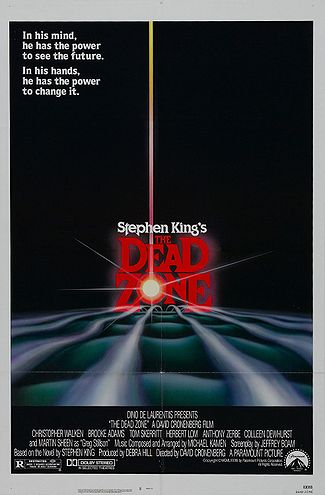
The Dead Zone is also the basis for one of the better films to be adapted from a Stephen King novel. Directed by David Cronenberg and starring Christopher Walken, the film’s plot closely follows the novel. Johnny Smith (Christopher Walken) is a high school teacher who, after a horrific car crash, spends five years in a coma. When he finally wakes up, he discovers that his girlfriend, Sarah (Brooke Adams), has married another man. His mother has become a religious fanatic. And, perhaps most importantly, whenever Johnny touches anyone, there’s a good chance that he’ll see either the person’s past or a possible future.
Needless to say, Johnny struggles with how to deal with his new powers. After he helps to catch a local serial killer, Johnny goes into seclusion. However, when he discovers that Sarah is now volunteering for ambitious politician Greg Stillson (Martin Sheen), Johnny goes to a Stillson rally, shakes the man’s hand, and has a vision. Johnny discovers that, if Stillson is elected to the senate, he’ll eventually become President and then he’ll destroy the world.
Much like The Shining, The Dead Zone benefits from being directed by a filmmaker who was both confident and strong enough to bring his own individual style to the material. (Usually, when a King adaptation fails, it’s because it followed the source material too closely, as if the film’s producers were scared of upsetting any of King’s constant readers.) Though the film’s plot may closely follow the novel, the movie itself is still definitely more of a product of David Cronenberg than Stephen King. Whereas King’s novel devoted a good deal of time to Johnny and Sarah’s relationship, it’s treated as almost an afterthought in Cronenberg’s film. Whereas King’s novel presented Johnny Smith as being an everyman sort of character, Cronenberg’s film gives us a Johnny who, from the start of the film, is a bit of an outsider even before he starts to see the future. Whereas King put the reader straight into Johnny’s head, Cronenberg approach is a bit more detached and clinical. Cronenberg’s Johnny is a bit more of an enigma than King’s version.
Fortunately, Cronenberg was fortunate enough to be able to cast Christopher Walken in the role of Johnny Smith. King’s preference for the role was Bill Murray. As odd as it may sound, you can actually imagine Bill Murray in the role when you read King’s book. But, for Cronenberg’s more detached vision, Walken was the perfect choice. People tend to spend so much time focusing on Christopher Walken’s quirky screen presence that there’s a tendency to forget that he’s actually a very talented actor as well. He’s very likable and sympathetic as Johnny and brings a humanity and a sense of humor to the role, which provides a good balance to Cronenberg’s sense of detachment.
The Dead Zone is a good book and it was later turned into an occasionally good (and, just as often, not-so-good) television series. However, the film is still the best.
I was one of the few people to appreciate David Cronenberg’s previous collaboration with Robert Pattinson, the criminally underrated Cosmopolis. Here’s the trailer to the second Cronenberg/Pattinson collaboration, Maps To The Stars.
As of this month, I have been reviewing films here at the Shattered Lens for 3 years. In honor of that anniversary, I thought I’d post my picks for the 50 best films that have been released in the U.S. since 2010.
Without further ado, here’s the list!
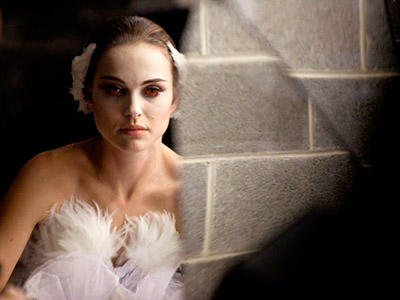
Black Swan (directed by Darren Aronofsky)
Exit Through The Gift Shop (directed by Banksy)
Hanna (directed by Joe Wright)
Fish Tank (directed by Andrea Arnold)
Higher Ground (directed by Vera Farmiga)
Shame (directed by Steve McQueen)
Anna Karenina (directed by Joe Wright)
The Cabin In The Woods (directed by Drew Goddard)
127 Hours (directed by Danny Boyle)
Somewhere (directed by Sofia Coppola)
Life of Pi (directed by Ang Lee)
Hugo (directed by Martin Scorsese)
Inception (directed by Christopher Nolan)
Animal Kingdom (directed by David Michod)
Winter’s Bone (directed by Debra Granik)
The Artist (directed by Michel Hazanavicius)
The Guard (directed by John Michael McDonagh)
Bernie (directed by Richard Linklater)
The King’s Speech (directed by Tom Hooper)
Bridesmaids (directed by Paul Feig)
Tinker, Tailor, Soldier, Spy (directed by Thomas Alfredson)
Django Unchained (directed by Quentin Tarantino)
Never Let Me Go (directed by Mark Romanek)
Toy Story 3 (directed by Lee Unkrich)
The Girl With the Dragon Tattoo (directed by Niels Arden Oplev)
Young Adult (directed by Jason Reitman)
Sucker Punch (directed by Zack Snyder)
The Master (directed by Paul Thomas Anderson)
Incendies (directed by Denis Villeneuve)
Melancholia (directed by Lars Von Trier)
Super (directed by James Gunn)
Silver Linings Playbook (directed by David O. Russell)
Scott Pilgrim Vs. The World (directed by Edgar Wright)
The Last Exorcism (directed by Daniel Stamm)
Skyfall (directed by Sam Mendes)
Easy A (directed by Will Gluck)
Harry Potter and the Deathly Hallows Parts 1 and 2 (directed by David Yates)
The Avengers (directed by Joss Whedon)
How To Train Your Dragon (directed by Chris Sanders and Dean DeBois)
Win Win (directed by Thomas McCarthy)
Les Miserables (directed by Tom Hooper)
Take This Waltz (directed by Sarah Polley)
Cave of Forgotten Dreams (directed by Werner Herzog)
Rust and Bone (directed by Jacques Audiard)
Cosmopolis (directed by David Cronenberg)
Ruby Sparks (directed by Jonathan Dayton and Valarie Faris)
Brave (directed by Mark Andrews and Brenda Chapman)
Martha Marcy May Marlene (directed by Sean Durkin)
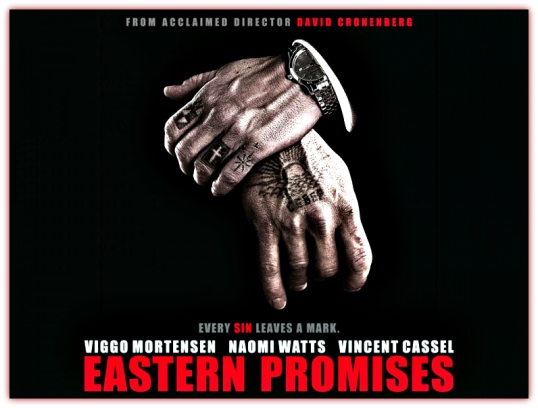
News that the sequel to Eastern Promises was one of the few pieces of news that really bummed me out when it made the rounds late 2012. The first film was one of my top ten for 2007 and consider it one of the better films about organized crime in the 21st century. A sequel to this film wasn’t needed, but most fans of the film wanted one just to see a furthering of the storyline between Viggo Mortensen’s character and that of Vincent Cassel’s character.
While the sequel may not be happening there’s still hope that it will get resuscitated in the future. Until that happens let’s take a look at what has to be one of the most realistic fight scenes on film. It’s the infamous (or famous depending on how you feel about the scene) Russian bath house scene near the end of the film. The scene sees Viggo Mortensen’s character of Nikolai Luzhin set upon by a couple of Chechen hitmen in the bath house where he proceeds to fight for his life in the most vulnerable fashion anyone can ever find themselves in.
Cronenberg has always been one of my favorite filmmakers and I continue to believe that his work body of work throughout his career puts him in the upper echelon, if not the elite level, of filmmakers living and working today. This fight scene has nothing glamorous about it. The cool factor that some attribute to the scene just emphasizes Cronenberg’s recent observation about the hypocrisy of those who denounce violence yet look at the violence he creates on film and call it art.
I consider this a scene I love just for the base simplicity of the scene itself. It’s primal and almost Darwinian in the lengths a person will go through to keep themselves alive for one second more. The scene also reminds me why Viggo Mortensen remains one of this era’s most underrated and greatest actors. Yes, it’s just a fight scene, but he gives so much into making it authentic that one could almost believe that his life was in danger and he did the fight for real (in fact Mortensen did injure himself so much during the several takes of the scene that his bruises afterwards became a problem for the make-up department who had to apply his vory v zakone tattoos every day).
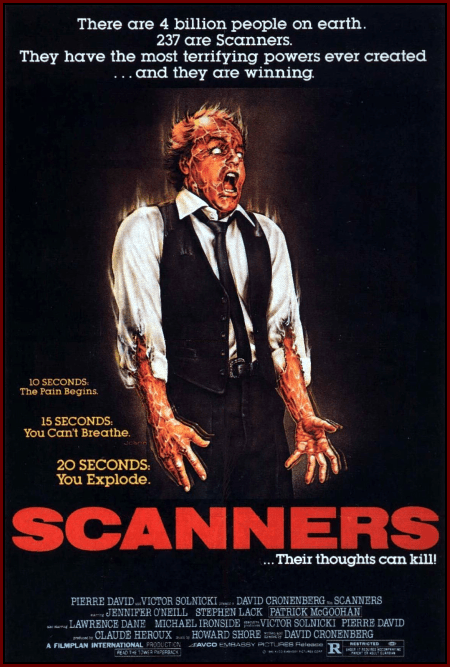
I’ve already shared a favorite scene from David Cronenberg’s landmark scifi/horror film Scanners over a year ago that saw a head explode. For October’s horror-themed month I picked another great scene from this film that always stuck with me long after I’ve finished watching the film each and every time.
The scene I’m talking about is the climactic showdown between Good Scanner Cameron and Evil Scanner Revok. This scene was filmed before the advent of CGI-effects and Cronenberg never had the sort of big-budgets to hire the top FX make-up artists to work on his films. Yet, Cronenberg ended up creating one of the best scenes ever put on film about two people fighting each other using their minds. We never see their mental abilities shooting off psychic blasts at each other but the performance by both Michael Ironside as Revok and Stephen Lack as Cameron was so believable that it made the scene work when it could’ve turned so cheesy and disastrous in the hands of a different filmmaker and other actors.
The battle ends but we’re left to believe the good guy lost and evil triumphs. This feeling pretty much plays out right up to the final scene before fade to black and even then we’re not sure if the final reveal is true or not. Either way there’s no better way to bookend the exploding head intro than with two psychic beings duking it out mentally with blood, spontaneous combustion and creepy white eyes added in for style.






 Through the Shattered Lens