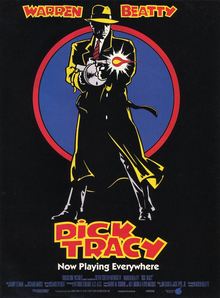
Dick Tracy (1990, directed by Warren Beatty)


The year is 1937 and “Big Boy” Caprice (Al Pacino) and his gang of flamboyant and often disfigured criminals are trying to take over the rackets.  Standing in their way is ace detective Dick Tracy (Warren Beatty), the yellow trench-wearing defender of the law.  Tracy is not only looking to take down Caprice but he and Tess Trueheart (Glenne Headly) are currently the guardians of The Kid (Charlie Korsmo), a young street kid who witnessed one of Caprice’s worst crimes.  Tracy’s investigation leads him through a rogue’s gallery of criminals and also involves Breathless Mahoney (Madonna), who has witnessed many of Caprice’s crimes but who also wants to steal Tracy’s heart from Tess.

Based on the long-running comic strip, Dick Tracy was a labor of love on the part of Warren Beatty.  Not only starring but also directing, Tracy made a film that stayed true to the look and the feel of the original comic strip (the film’s visual palette was limited to just seven colors) while also including an all-star cast the featured Madonna is an attempt to appeal to a younger audience who had probably never even heard of Dick Tracy.  When Dick Tracy was released, the majority of the publicity centered around Madonna’s participation in the film and the fact that she was dating Beatty at the time.  Madonna is actually probably the weakest element of the film.  More of a personality than an actress, Madonna is always Madonna no matter who she is playing and, in a film full of famous actors managing to be convincing as the members of Dick Tracy’s rogue gallery, Madonna feels out of place.  Michelle Pfeiffer would have been the ideal Breathless Mahoney.

It doesn’t matter, though, because the rest of the film is great.  It’s one of the few comic book films of the 90s to really hold up, mostly due to Beatty’s obvious enthusiasm for the material and the performances of everyone in the supporting cast who was not named Madonna.  Al Pacino received an Oscar nomination for playing Big Boy Caprice but equally good are Dustin Hoffman as Mumbles, William Forsythe as Flaptop, R.G. Armstong as Pruneface, and Henry Silva as Influence.  These actors all create memorable characters, even while acting under a ton of very convincing makeup.  I also liked Dick Van Dyke as the corrupt District Attorney.  Beatty knew audience would be shocked to see Van Dyke not playing a hero and both he and Van Dyke play it up for all its worth.  Beatty embraces the comic strip’s campiness while still remaining respectful to its style and the combination of Danny Elfman’s music and Stephen Sondheim’s songs provide just the right score for Dick Tracy’s adventures.  The film can be surprisingly violent at times but the same was often said about the Dick Tracy comic strip.  It wasn’t two-way wrist radios and trips to the Moon.  Dick Tracy also dealt with the most ruthless and bloodthirsty gangsters his city had to offer.

Dick Tracy was considered to be a box office disappointment when it was originally released.  (Again, you have to wonder if Beatty overestimated how many fans Dick Tracy had in 1990.)  But it holds up well and is still more entertaining than several of the more recent comic book movies that have been released.

The Eric Roberts Collection: Amazing Racer (dir by Frank E. Johnson)


2009’s Amazing Racer is the story of a teenage girl who meets her mother and learns how to ride a horse.

Shannon Greene (Julianne Michelle) is traumatized when her father dies and, having been told that her mother died giving birth to her, she now believes herself to be an orphan.  However, Dr. Rita Baker (Daryl Hannah) reveals that Shannon’s father was just a damn liar.  First, he told Shannon’s mother that her baby was stillborn.  Then, as Shannon was growing up, he told her that her mother was dead.  This is a lot to take in for both Shannon and the viewer.  Myself, I wondered not only how someone could do that but why they would do that.  Making the scene in which Shannon hears the truth even more surreal was the presence of Michael Madsen and Joanna Pacula, playing Shannon’s guardians.  Madsen played his good guy role in much the same way he played his bad guy in Reservoir Dogs.

Anyway, Shannon ends up living with her mother, Dr. Christine Pearson (Claire Forlani), and her mother’s boyfriend, Eric (Jason Gedrick).  Understandably, considering everything that she’s been through, Shannon is initially difficult and bratty but eventually, she comes to enjoy working on Eric’s horse ranch.  She even starts riding a horse and winning races!  This brings her to the attention of evil Mitchell Prescott (Eric Roberts), who wants her horse for himself and even has a spy working on the ranch….

There are a lot familiar faces in this movie.  Charles Durning makes his final film appearance as Floyd.  Steve Guttenberg has a bizarre cameo as a guy transporting a horse trailer.  Scott Eastwood and Kirsta Allen show up.  When it’s time for Shannon to finally start training for the big race, Lou Gossett Jr. pops up as the trainer.  The film itself a fairly predictable horse ranch movie and it’s enjoyable if you like that sort of thing.  (Myself, I like ranches and I like horses so I don’t mind movies like this.)  But really, most of the movie’s entertainment value comes from guessing who is going to show up next.  Some of the famous faces are bit distracting.  But sometimes, it really pays off.  I really wish Lou Gossett, Jr.’s role had been bigger because he does a great job with what little time he has.

As for Eric Roberts, he gets a bit more screentime than usual.  One gets the feeling that he may have actually spent more than two days shooting his scenes for this one.  Roberts is playing a villain here and he gives a enjoyably avuncular performance as the evil Mitchell.  Roberts has fun with the role and, as a result, he’s fun to watch in this movie.

I enjoyed Amazing Racer.  It had horses and it has Eric Roberts.  What more could you want?

Previous Eric Roberts Films That We Have Reviewed:

  1. Star 80 (1983)
  2. Blood Red (1989)
  3. The Ambulance (1990)
  4. The Lost Capone (1990)
  5. Love, Cheat, & Steal (1993)
  6. Voyage (1993)
  7. Love Is A Gun (1994)
  8. Sensation (1994)
  9. Dark Angel (1996)
  10. Doctor Who (1996)
  11. Most Wanted (1997)
  12. Mercy Streets (2000)
  13. Wolves of Wall Street (2002)
  14. Mr. Brightside (2004)
  15. Six: The Mark Unleased (2004)
  16. Hey You (2006)
  17. In The Blink of an Eye (2009)
  18. Enemies Among Us (2010)
  19. The Expendables (2010) 
  20. Sharktopus (2010)
  21. The Dead Want Women (2012)
  22. Deadline (2012)
  23. The Mark (2012)
  24. Miss Atomic Bomb (2012)
  25. Bonnie And Clyde: Justified (2013)
  26. Lovelace (2013)
  27. The Mark: Redemption (2013)
  28. Self-Storage (2013)
  29. This Is Our Time (2013)
  30. Inherent Vice (2014)
  31. Road to the Open (2014)
  32. Rumors of War (2014)
  33. Amityville Death House (2015)
  34. A Fatal Obsession (2015)
  35. Stalked By My Doctor (2015)
  36. Enemy Within (2016)
  37. Joker’s Poltergeist (2016)
  38. Prayer Never Fails (2016)
  39. Stalked By My Doctor: The Return (2016)
  40. The Wrong Roommate (2016)
  41. Dark Image (2017)
  42. Black Wake (2018)
  43. Frank and Ava (2018)
  44. Stalked By My Doctor: Patient’s Revenge (2018)
  45. Clinton Island (2019)
  46. Monster Island (2019)
  47. The Savant (2019)
  48. Seven Deadly Sins (2019)
  49. Stalked By My Doctor: A Sleepwalker’s Nightmare (2019)
  50. The Wrong Mommy (2019)
  51. Exodus of a Prodigal Son (2020)
  52. Free Lunch Express (2020)
  53. Her Deadly Groom (2020)
  54. Top Gunner (2020)
  55. Deadly Nightshade (2021)
  56. The Elevator (2021)
  57. Just What The Doctor Ordered (2021)
  58. Killer Advice (2021)
  59. The Poltergeist Diaries (2021)
  60. The Rebels of PT-218 (2021)
  61. A Town Called Parable (2021)
  62. Bleach (2022)
  63. My Dinner With Eric (2022)
  64. Aftermath (2024)
  65. The Wrong Life Coach (2024)

Film Review: Cop (dir by James B. Harris)


First released in 1988, Cop stars James Woods as Lloyd Hopkins, a homicide detective who does not …. wait for it …. GO BY THE BOOK!

Actually, has there ever been a movie about a homicide detective who always made sure to go by the book?  I’m sure there has been but I really can’t think of any off the top of my head.  Whenever a homicide detective shows up as the main character of a movie, you can be sure that he’s going to drink too much, carouse too much, and get yelled at by his superiors.  If the movie involves a serial killer, you can be sure that the detective and the killer are going to be mirror images of each other, two renegades who have found differing ways to work out their issues with the world.

As much as we talk about the cliché of the cop who does it his way, would we really want to see a movie about a cop who plays by the rules?  I mean, most people dread having to deal with cops.  It’s not just that cops usually bring bad news.  It’s also that dealing with a cop means having to spend a lot of time while they slowly and methodically go through all of their procedures.  There have been so many times that I’ve been pulled over speeding and I’ve just wanted to yell, “Just write the ticket!”  Most people agree that we need some sort of police force, regardless of what the Defund folks say.  But most people also hate following the rules, especially when those rules feel rather arbitrary.  That’s the appeal of the renegade cop.  The renegade cop fills a purpose in society but, at the same time, he dislikes dealing with all of the usual cop nonsense as much as the rest of us.

As for Lloyd Hopkins, he’s hyperactive, jittery, sleazy, and a terrible father and husband.  He cheats on his wife.  He tells his daughter all about the gory details of his job.  (His daughter, it should be noted, seems to enjoy hearing them.)  He obsesses on the crimes that he investigates and he pursues murderers with a fanaticism that suggests that Lloyd knows that he’s just one bad life choice away from becoming one of them himself.  (And, indeed, Lloyd kills quite a few people over the course of Cop, even allowing one person to get into another room and get a shotgun just so Lloyd will have an excuse to shoot him.)  Lloyd is someone who is dangerous to know but, at the same time, he’s also probably the only person who can stop the killer who is seemingly committing random murders in Los Angeles.

The plot is typical of films about obsessive detectives pursuing faceless killers but Cop stands out due to the director of James B. Harris and the lead performance of James Woods.  Harris creates an atmosphere of continual unease, one in which the viewers gets the feeling that anyone could become the killer’s next victim at any moment.  James Woods, meanwhile, plays Lloyd as being a live wire, someone who simply cannot stop thinking and talking because he knows that the minute he does, he’s going to have to take a serious look at the wreck of his life and his own less-than-stable behavior.  Lloyd may be a self-destructive bastard but he’s a compelling self-destructive bastard and, in this film’s version of Los Angeles, he’s about as close as one can get to avenging angel.  The film is full of good actors, like Charles Durning, Lesley Ann Warren, and Raymond J. Barry, but it is ultimately James Woods’s show.  Lloyd gets the film’s final line and it’s a killer but it works because, by the time he utters it, the viewer feels as if they have gotten to know Lloyd.

Cop is based on Blood on the Moon, a novel by James Ellroy.  I have not read that novel so I don’t know how closely Cop sticks to Ellroy’s original plot.  Nor do I know how James Ellroy felt about Cop, which was the first movie to be based on his work.  That said, Ellroy’s writing and Harris’s film share a dark vision of humanity and a subversive sense of humor.  Ellroy has often declared himself to be the world’s great crime novelist and, from what I’ve read of his work, I would tend to agree.  Cop is certainly not the greatest crime movie ever made (nor is it the best film to ever be adapted from Ellroy’s writing) but it’s still pretty damn good.

Horror Movie Review: When A Stranger Calls Back (dir by Fred Walton)


The 1993 film, When A Stranger Calls Back, opens with the recreation of an urban legend.

A teenager babysitter named Julia Jenz (Jill Schoelen) arrives at a big suburban house for a routine baby-sitting gig.  The two children are already asleep in bed.  All Julia has to do is sent in the living room and do her homework until the parents return from their party.  Julia settles in.  She gets one mysterious phone call but hangs up.

Then, someone knocks on the door.

The man on the other side of the door explains that his car has broken down and he asks if he can come inside to call his auto club.  (This is one of those films that could have only worked in the age of landline phones.)  Julia doesn’t want to let the man into the house but the man is insistent that he needs Julia’s help.  Finally, Julia says that she’ll call the auto club for him but, when she goes to the phone, she finds that the line is dead.  Rather than tell the man the truth, Julia lies to him and says that she called the auto club.  The man thanks Julia and says that he’s returning to his car.

(What is an auto club?)

Eventually, the man returns, knocking on the door and asking if Julia really called the auto club.  Julia continues to lie, even as the man becomes increasingly belligerent.  What Julia doesn’t know but soon discovers is that the man is not outside talking to her but he’s actually inside of the house.  And he’s abducted the children!

The opening scene, which of course harkens back to the original When A Stranger Calls, is a genuinely well-done and suspenseful sequence.  Again, much like as if with the first film, the opening of When A Stranger Calls Back is so strong that the rest of the film can’t really keep up.

When A Stranger Calls Back is indeed a sequel to When A Stranger Calls, which means that, after Julia’s terrifying night of babysitting, the film jumps forward five years.  The children are never found and the man who knocked on the door is never identified.  Julia is now a college student but she’s still traumatized by the night and has a difficult time trusting anyone.  When she starts to suspect that someone has been in her apartment, she turns to Jill Johnson (Carol Kane), who is a counselor at the college and also the protagonist from When A Stranger Calls.  Jill helps Julie out, teaching her how to shoot a gun and also calling in the man who killed her stalker, John Clifford (Charles Durning).  Clifford figures out that Julia’s stalker is probably a ventriloquist.  Personally, I think the film made a huge mistake by making the stalker a ventriloquist instead of the ventriloquist’s dummy.

Despite strong performances from Carol Kane, Charles Durning, and Jill Schoelen, When A Stranger Calls Back suffers from the same problem as When A Stranger Calls.  After a scary and effective opening sequence, the rest of the film just feels like a letdown.  The killer in When A Stranger Calls Back is not quite as wimpy as the phlegmatic British guy from the first When A Stranger Calls but still, how intimidated can you be by a ventriloquist?  An even bigger problem is that When A Stranger Calls Back cheats at the end, suddenly revealing that a character who we had every reason to believe to be dead is actually alive.  It feels a bit as cop out on the part of the film, an attempt to slap an improbable happy ending on a film that would otherwise be pretty dark.

These films make me happy that I was never responsible enough to be a babysitter.

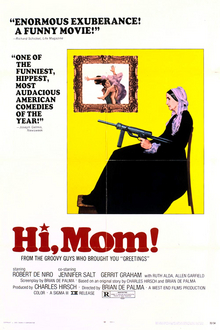
Film Review: Hi, Mom! (dir by Brian De Palma)


Released in 1970, Hi, Mom!, tells the story of Jon Rubin (played by a 26 year-old Robert De Niro).  The somewhat spacey and kind of creepy Jon has just returned to New York City from Vietnam.  After moving into a run-down apartment building and meeting the building’s superintendent (Charles Durning), Jon is hired to direct a pornographic film by producer Joe Banner (Allen Garfield).  Jon’s idea to simply point his camera at his building and to film his neighbors as they go about their day.  As quickly becomes apparent, Jon is mostly just looking for an excuse to watch and film Judy Bishop (Jennifer Salt).

Also living in the building is Gerrit Wood (Gerrit Graham), who is first seen triumphantly putting posters of Che Guevara and Malcolm X up in his apartment.  Gerrit is a freshly-minted political radical and the leader of a group of performance artists who put on a show called Be Black, Baby, in which the white audience members are forced to wear blackface and are then chased, attacked, and assaulted by black actors wearing whiteface.  (Gerrit himself is white.)  Jon is hired to play the police officer who beats and arrests the members of the audience at the end of the performance.  Of course, eventually, the real police show up….

An attempt at an episodic counter-culture comedy, Hi, Mom is definitely a product of the time in which it was made, both in its style and its thematic content.  Today, it’s best-known for being one of Brian De Palma’s early independent films and for featuring Robert De Niro in one of his first starring roles.  De Palma and De Niro aren’t exactly the first names that come to mind when one thinks about comedy and Hi, Mom shows that there’s a good reason for that.  As both a screenwriter who felt he had something important to say and a young director who was obviously eager to show off everything that he could do with a camera, Brian De Palma simply cannot get out of his own way.  Scenes are needlessly sped up.  Scenes are pointlessly slowed down.  The musical cues are obvious.  The dialogue is often so broad that it comes across as being cartoonish.  One gets the feeling that De Palma didn’t trust the audience to get the jokes so he went overboard to make sure everyone knew when to react.  All of the pointless camera trickery serves the same purpose that a laugh track would on an old sitcom.  Interestingly enough, the only sequence that really works as satire is the Be Black, Baby sequence and that’s because De Palma directs it in a semi-documentary fashion.  De Palma gets out of his own way and allow the sequence to develop a natural rhythm.  (Of course, seen today, the scene will bring to mind the upper class white liberals who pay money to have an activist lecture them about their privilege while having their friends over for dinner.)

As for Robert De Niro, he gives a typically nervy performance, one that feels like a dry run for his later work in Mean Streets, Taxi Driver, and King of Comedy.  Despite the reputation of those films, there are some genuinely funny moments to be found in all of them.  Most of them, like the classic Taxi Driver conversation between De Niro’s Travis and Peter Boyle’s Wizard, are funny because of how people react to De Niro’s obviously unhinged characters.  Both Taxi Driver and King of Comedy got mileage out of having normal people try to deal with De Niro’s unstable characters.  In Hi, Mom, everyone is equally wacky and, as such, De Niro doesn’t really have anyone to play off.  No one is really reacting to anything, De Niro-included.  (There is some spark to his scenes with Charles Durning and Allen Garfield but even those scenes seem to drag on forever.)

On the plus side, Hi, Mom! is was shot on the actual streets of New York City, guerilla-style.  (A “Re-Elect Mayor Lindsay” sign in the background confirms that the film was made on location in 1969.)  When De Palma isn’t getting in his own way with all of his fancy camera tricks, he manages to capture so memorably bleak images of New York City.  Hi, Mom! presents New York as being a dirty, crime-ridden, and menacing city but it also captures the odd grandeur of urban decay.  At its best, Hi, Mom! captures the love/hate relationship that many seem to have New York City.  The city feels both alive and dangerous at the same time.  Hi, Mom! is too uneven to work as a sustained satire but, as a documentary about New York at the end of the turbulent 60s, it’s worth watching.

I should mention that this was not the first time that De Palma and De Niro teamed up.  Indeed, De Niro was De Palma’s muse even before he met Martin Scorsese.  Hi, Mom! was a loose sequel to an earlier De Palma/De Niro film called Greetings.  (Like many of De Palma’s future films, both Greetings and Hi, Mom! were originally rated X but later re-rated R.)  De Palma and De Niro, of course, would both go onto have long Hollywood careers.  (They would later reunite for The Untouchables, a big-budget spectacle of a film that’s about as far from the grungy Hi, Mom! as one can get.)  De Palma’s career has had its ups and downs but, as of late, many of his films have been positively reevaluated.  As for De Niro, he can finally kind of play comedy.  That said, I’d rather watch Hi, Mom than Dirty Grandpa.

Guilty Pleasure No. 54: Solarbabies (dir by Alan Johnson)


Solarbabies is a film that has a reputation.  And it’s not a good one.

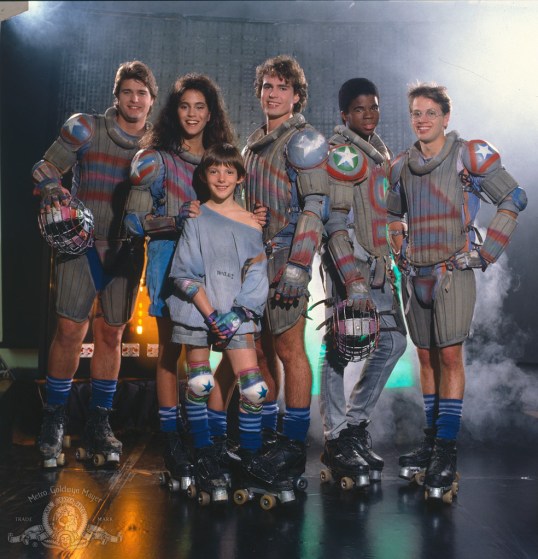
First released in 1986, Solarbabies is one of those post-Mad Max films that takes place in a post-apocalyptic desert society.  There are no more trees.  There is no more rain.  Order is kept by force.  The people are oppressed.  Outsiders live in desert towns that have names like “Tiretown.”  Children are forced to grow up in a combination of a prison and an orphanage.  The orphanage’s Warden (played by Charles Durning) mourns for the way the world used to be, before it became a sun-drenched nightmare without plants or water.  The fearsome Grock (Richard Jordan) makes sure that all of society’s rules are followed and the viewer knows he’s a bad guy because he wears a leather trench coat even when it’s over a 100 degrees outside.  (Grock never sweats.  If only the same could be said of the Warden.)  The evil Professor Shandray (Sarah Douglas) experiments on living subjects.  It’s a grim, grim world.

However, hope arrives in the form of a glowing orb!  A ten year-old deaf boy named Daniel (Lukas Haas) finds the orb and, after regaining his ability to hear, he names it Bodhi.  When Darstar (Adrian Pasdar) realizes that he can use Bodhi to protect the people of Tiretown, he steals the orb and runs off with it.  Determined to retrieve Bodhi, Daniel chases after him

How will Daniel survive in the desert?  Well, luckily, he’s not alone!  Daniel was a member of the orphanage’s roller hockey team, the Solarbabies.  Terra (Jami Gertz), Jason (Jason Patric), Metron (James LeGros), Rabbit (Claude Brooks), and Tug (Peter DeLuise) strap on their skates and roll out into the desert.  Pursuing them is Grock and his stormtroopers.

Meanwhile, somewhere in the desert, an old man named Greentree (Frank Converse) hopes to help the world recover.  Greentree looks like a thin version of Santa Claus and he hopes to bring rain and trees back to the Earth.  Yes, his name is Greentree.  There’s not really much room for subtlety in the world of Solarbabies.

Now, as I said at the beginning of this review, Solarbabies has a reputation.  Today, it’s probably best known for being the film that nearly bankrupted Mel Brooks.  Yes, that Mel Brooks.  When Brooks originally signed on to produce Solarbabies, it was envisioned as being a low-budget sci-fi film that would not have any spectacular special effects.  However, Brooks became convinced that Solarbabies had the potential to be a Star Wars-level hit so he increased the budget.  He also brought in Alan Johnson to direct the film, despite the fact that Johnson was a choreographer who had only directed one other film and had no experience with science fiction.  (Johnson’s previous film had been a remake of To Be Or Not To Be, which starred Brooks and featured Solarbabies’s Charles Durning in a supporting role).  At Brooks’s insistence, the film was shot in Spain to save money.  Unfortunately, no sooner had Johnson and the film’s cast arrived than Spain was hit by a series of unexpected storms that caused production to shut down.  Even when the rain stopped, disagreements between Johnson and the cast delayed the film even further.  The footage that was shot satisfied no one, leading to expensive reshoots.  In the end, Mel Brooks invested close to $20 million dollars in the film, even taking a second mortgage out on his house.  When the film was finally released, it was a critical and box office disaster, though Brooks later said that he did eventually break even after Solarbabies was released on DVD.

So, yes, Solarbabies has a bad reputation and it could be argued that it deserves it.  Tonally, the film’s a mess.  For a film that appears to have been made for a “family” audience, parts of the film are surprisingly violent  Scenes of the Solarbabies playing LaCrosse and cheerfully crossing the desert are mixed with some surprisingly graphic scenes of Grock and Shandray torturing prisoners.  Bodhi is a cute and glowing orb who gives Daniel back his hearing and then later brutally kills a lot of bad guys.  Jason Patric, Jami Gertz, and Charles Durning all seem to be trying to take the film seriously while Richard Jordan and Sarah Douglas give performances that feel more appropriate for a Hammer horror film.  Solarbabies is a bizarre mix of sincerity, sadism, and camp.  Nothing about it makes much sense.

And yet….

Listen, I can’t help it.  When I watched it last week, I enjoyed Solarbabies.  For all of its many and obvious flaws, it’s a hard film not to like.  It’s just so thoroughly ludicrous and messy that watching it becomes a rather fascinating viewing experience.  It’s hard not to, at the very least, be entertained by the sight of the cast roller skating through the desert.  A LaCrosse team battling futuristic Nazis for possession of a glowing orb that can cause rain to fall from a cloudless sky?  As far as I’m concerned, it’s impossible not to enjoy that on some level.

Of course, I seem to be in the minority as far as that’s concerned.  Alan Johnson never directed another movie after Solarbabies, though he did direct some of those really cool GAP commercials that aired in the early aughts.  You know the ones that featured people enthusiastically dancing in khakis?  That was him!  Those commercials are kind of a guilty pleasure themselves.  (Of course, because Mel Brooks nearly didn’t lose his house producing them, they’re not quite as infamous as Solarbabies.)  But still, Johnson stared his directorial career by directing Charles Durning to an Oscar nomination in To Be Or Not To Be and he ended it by directing Durning in a box office flop.  Well, no matter!  I enjoyed Solarbabies and I don’t care who knows it.

Previous Guilty Pleasures

  1. Half-Baked
  2. Save The Last Dance
  3. Every Rose Has Its Thorns
  4. The Jeremy Kyle Show
  5. Invasion USA
  6. The Golden Child
  7. Final Destination 2
  8. Paparazzi
  9. The Principal
  10. The Substitute
  11. Terror In The Family
  12. Pandorum
  13. Lambada
  14. Fear
  15. Cocktail
  16. Keep Off The Grass
  17. Girls, Girls, Girls
  18. Class
  19. Tart
  20. King Kong vs. Godzilla
  21. Hawk the Slayer
  22. Battle Beyond the Stars
  23. Meridian
  24. Walk of Shame
  25. From Justin To Kelly
  26. Project Greenlight
  27. Sex Decoy: Love Stings
  28. Swimfan
  29. On the Line
  30. Wolfen
  31. Hail Caesar!
  32. It’s So Cold In The D
  33. In the Mix
  34. Healed By Grace
  35. Valley of the Dolls
  36. The Legend of Billie Jean
  37. Death Wish
  38. Shipping Wars
  39. Ghost Whisperer
  40. Parking Wars
  41. The Dead Are After Me
  42. Harper’s Island
  43. The Resurrection of Gavin Stone
  44. Paranormal State
  45. Utopia
  46. Bar Rescue
  47. The Powers of Matthew Star
  48. Spiker
  49. Heavenly Bodies
  50. Maid in Manhattan
  51. Rage and Honor
  52. Saved By The Bell 3. 21 “No Hope With Dope”
  53. Happy Gilmore

Horror Film Review: When A Stranger Calls (dir by Fred Walton)


“Have you checked the children?” the stranger on the phone asks the terrified babysitter, who is unaware that the children are already dead and that the call is …. COMING FROM INSIDE THE HOUSE!

That’s the premise behind both an oft-repeated urban legend and the opening of the 1979 film, When A Stranger Calls.  I’ve often seen the original When A Stranger Calls described as being one of the scariest films ever made.  That’s not quite true, of course.  The first 20 minutes or so are effective.  The final scene has a few intense moments.  The majority of what lies in-between feels like filler, albeit well-acted filler.

When A Stranger Calls opens with Carol Kane as Jill, a teenage babysitter who is terrified one night by a caller who keeps asking her if she’s checked on the children.  This sequence — really, a mini-movie all of its own — is so well-executed and suspenseful that many people assume that the entire film is just Jill dealing with the mystery caller.  Actually, that’s just the first few minutes and, once the location of the killer has been revealed, Kane disappears from the film for an extended period.  That’s a shame since Kane’s empathetic performance is perhaps the best thing that When A Stranger Calls has going for it.  She’s so convincing as the emotionally shattered babysitter that it doesn’t matter that, at the start of the film, she’s obviously not a teenager.

Instead, the middle part of the film focuses on John Clifford (Charles Durning).  Clifford is a former policeman-turned-private investigator.  He is obsessed with Duncan (Tony Beckley), the man who called Jill at the start of the film.  Duncan has just escaped from a mental institution and Clifford has been hired to track him down.  Clifford is convinced that Duncan will try to find Jill.  Duncan, meanwhile, wanders through the sleaziest sections of downtown Los Angeles, briefly living with a pathetic alcoholic named Tracy (Colleen Dewhurst).  Clifford, of course, is right about Duncan wanting to find Jill.  And Clifford is so determined to kill Duncan that he might even be willing to use Jill as bait….

After the brilliantly horrific opening sequence, it’s impossible not to be disappointed with the drawn-out middle section of When A Stranger Calls.  Durning, Dewhurst, and especially Beckley all give good performances and downtown Los Angeles is so repellent that you’ll want to take a shower afterwards but, narratively, there’s really not much happening.  Clifford finds Duncan. Duncan runs away.  Duncan acts like a jerk and gets in a fight.  Tracy drinks.  The old school cop Clifford scowls at the sleaziness of the world while Duncan continues to lose what little sanity he has left.  Give the film some credit for not portraying Duncan as being some sort of charming, loquacious master criminal.  He’s a total loser, as all serial killers are despite the later popularity of fictional characters like Hannibal Lecter.  Duncan hates both himself and the world with equal fury.  But, that said, the narrative stalls during the middle part of the film.  There’s only so many time you can watch two men chase each other down a trash-strewn street before it gets dull.

Fortunately, Jill does eventually show up again and, after an hour of relentless sleaziness, you’re happy to see Carol Kane, again.  Jill is now married and has children of her own.  And soon, she’s again getting a phone call asking if she’s checked on the children….

And, again, the closing sequence is scary, even if it’s not quite as intense as the opening.  (The opening was scary because we didn’t know what the killer looked like.  By the time Duncan finds Jill a second time, we now know that Duncan is a sickly-looking alcoholic who can’t handle himself in a fair fight.)  The film does have one great jump scare left in its arsenal of tricks.  And yet, it’s impossible to watch When A Stranger Calls without wishing that the whole thing had just focused on Jill instead of getting sidetracked with Clifford searching Los Angeles.

When A Stranger Calls will always have a place in horror history.  “Have you checked the children?” will always produce chills.  It’s just unfortunate that the film spends a good deal of its running time ignoring what makes it scary in the first place.

Bubba’s Revenge: Dark Night of the Scarecrow (1981, directed by Frank De Felitta)


Dude, this movie.

Charles Durning plays Otis P. Hazelrigg, a postman in a small town who has an unhealthy interest in a ten year-old girl named Marylee (Tanya Crowe).  When Marylee is mauled and nearly killed by a dog, Otis decides that she was attacked by Bubba Ritter (Larry Drake), a mentally challenged man who has the mind of a child.  With Otis and his redneck friends looking to lynch him, Bubba’s mother disguises him as a scarecrow and tells him to stand out in a field and not move.  When Otis and his friends discover Bubba hiding, they all shoot him until he’s dead.  Otis puts a pitchfork in Bubba’s hands and tells the police that Bubba was attacking them and they didn’t have any choice but to shoot him.

Otis thinks that he’s gotten away with murder but he’s wrong.  After Marylee sings a song in the same field where Bubba was killed, Otis’s friends start dying.  One is suffocated in a grain silo.  Another falls into a thresher.  Before each one dies, they report seeing a scarecrow on their property.  Otis thinks that Bubba’s mother is behind the murders but what if Bubba has actually come back to life?

Dark Night of the Scarecrow will mess up your mind, give you bad dreams, and leave you with a lifelong phobia o scarecrows.  It’s that scary.  I remember that they used to frequently show this movie on TV when I was  growing up and even the commercials were scary.  (The part of the movie that always messed with me were the shots of Bubba’s frightened eyes darting around underneath the scarecrow mask.)  Scarecrows are naturally creepy and the movie’s atmosphere is unsettling but the most frightening thing about Dark Night of the Scarecrow is Otis and the redneck lynch mob that he puts together.  Otis is a thoroughly loathsome character and Charles Durning goes all out playing him.  Otis is a civil servant, which gives him some prestige in the town but he uses that prestige to bully Bubba and harass Marylee.  His concern with Marylee especially feels wrong and the movie does not shy away from the subtext of his interest.  The scarecrow might frighten you but you will absolutely loathe Otis and everyone who follows him.

Dark Night of the Scarecrow was made for television but it’s just as good as any theatrical release.   It is also might be the first movie to feature a killer scarecrow.  Several have been made in the years since but Dark Night of the Scarecrow was the first and it’s still the best.

A Scene That I Love: The Opening of Scarface


Produced by Martin Bregman, directed by Brian De Palma, written by Oliver Stone, and starring Al Pacino, the 1983 remake of Scarface is one of the best-known, most iconic gangster films ever made.  It opened to mixed reviews but it’s gone on to be recognized as a classic.  Everyone can quote the script:  “Say hello to my little friend!” “In this country, you gotta make the money first. Then when you get the money, you get the power. Then when you get the power, then you get the women.”  “Say goodnight to the bad guy!”

Scarface starts with one of my favorite opening scenes of all time.  Powered by Giorgio Moroder’s score, the opening credits of Scarface play out over footage of the real-life Mariel boatlift.  Combined with footage of Fidel Castro ranting that Cuba does not need the Marielitos, this opening gives real-world credibility to everything that follows.  We then segue from the actual boatlift to Al Pacino as Tony Montana, answering questions with that shit-eating grin on his face.

Listen to the interrogation scene carefully and you’ll hear both Charles Durning and Dennis Franz, dubbing the lines of the actors who played the immigration agents.

Embracing The Melodrama Part III #7: True Confessions (dir by Ulu Grosbard)


The 1981 film True Confessions tells many different stories.

It’s a story about Los Angeles.  It’s not necessarily a story about Los Angeles as it exists.  Instead, it’s a story about Los Angeles as we always imagine it.  It’s the late 40s and, having vanquished the Nazis in Europe, men are returning to California and looking for a new life.  Meanwhile, aspiring starlets from across the country flood into Hollywood, looking for stardom.  It’s a city where glitz and ruin exist right next to each other.  It’s the mean streets that were made famous by Raymond Chandler and, decades later, James Ellroy.

It’s a murder mystery, one that is based on one of the most notorious unsolved homicides of all time.  The bisected body of woman named Lois Fazenda has been found in a vacant lot.  When the newspapers discover that Lois was both a prostitute and a Catholic, she becomes known as “the Virgin Tramp.”  One need not have an encyclopedic knowledge of unsolved crimes to recognize that Lois Fazneda is meant to be a stand-in for Elizabeth Short, the tragic and infamous Black Dahlia.

It’s a story about corruption.  Crooked cops.  Rich perverts.  Greedy politicians.  Sinful clergy.  They’re all present and accounted for in True Confessions.  As quickly becomes apparent, Los Angeles is a city where you can do anything as long as you have the money to pay the right people off.

And finally, it’s a film about two brothers.  Tom and Des Spellacy grew up in a strong Irish Catholic family but, as they got older, their lives went in different directions.  Tom (Robert Duvall) became a detective, the type who is willing to cut corners but who, in the end, takes his job seriously.  Des (Robert De Niro) entered the priesthood and is now a monsignor in the Los Angeles diocese.  Des is ambitious and he has a powerful mentor, Cardinal Danaher (Cyril Cusack).

Though Tom and Des have gone their separate ways, they are still linked by Jack Amsterdam (Charles During).  To the public, Jack is a wealthy and respected businessman.  However, Tom and Des both know the truth.  When Tom first joined the department, he worked as a bagman for Jack and he knows that Jack made most of his money through a prostitution ring.  Des know that Jack donates to the Church as way to cover up his own corruption but Des looks the other way.  The Cardinal, after all, wants Jack’s money.

When Tom starts to investigate Lois’s death, it doesn’t take him long to figure out that Jack is probably the one responsible.  Meanwhile, Jack and his lawyer (Ed Flanders) start to pressure Des to convince his brother to let the case go.  Finding justice for Lois Fazneda could mean the end of both Tom and Des’s career.

Based on a novel by John Gregory Dunne, which was adapted into a screenplay by Dunne and Joan Didion, True Confessions is an imperfect but intriguing film.  This is one of Robert Duvall’s best performances and he brings a manic edge to the role that keeps the audience off-balance.  In the role of Jack Amsterdam, Charles Durning is the epitome of casual corruption and Burgess Meredith does a good job as an aging priest.  On the other hand, Robert De Niro seems strangely uncomfortable in the role of Des and you never quite believe that he and Duvall are actually brothers.  Director Ulu Grosbard does a good job of creating a proper noir atmosphere but, at the same time, he denies the audience the dramatic climax to which the film appears to be building up to.

That said, for whatever flaws True Confessions may have, it’s an always watchable and thought-provoking film.