In the 1960s, druken Pvt. Franklin Fairchild Bean (Charlie Sheen) punches an MP in West Germany. The rebellious Bean is hoping he’ll be discharged from the Army. Instead, he’s sent to the stockade for 90 days. The stockade is run by an alcoholic tyrant named Sgt. Otis McKinney (Martin Sheen) and, shortly after arrival, Bean discovers that he’s the only white prisoner. With McKinney determined to break him, Bean befriends his fellow prisoners, including Roosevelt Stokes (Laurence Fishburne), and the two white corporals (James Marshall and Ramon Estevez) who try to protect the prisoners from McKinney’s erratic behavior.
Cadence is the only film to have been directed by Martin Sheen. Considering that it co-stars two of his sons, it’s unfortunate that Cadence isn’t a better movie. Charlie Sheen gives a one-note performance as Franklin Bean but he still does better than his father, who is such a raging monster as Sgt. McKinney that it’s difficult to take him or the movie seriously. As a director, Martin Sheen always goes for the most ham-fisted shot and it’s hard to see what he’s really trying to say about the Army or Franklin Bean’s rebellion.
The supporting cast is better, especially James Marshall and Ramon Estevez. Laurence Fishburne brings his trademark gravitas to the role of Stokes. The other prisoners are played by Michael Beach, Blu Mankuma, John Toles-Bey, and Harry Stewart and they all make a good impression. Stewart plays the most saintly and innocent of the prisoners. Guess what happens to him.
Back in the day, this movie was an HBO mainstay. Somehow, I always seemed to catch the end of it but never the beginning.
1980’s The Final Countdown opens with a series of stunning overhead shots of Pearl Harbor. Warren Lasky (Martin Sheen), a systems analyst for Tideman Industries, is sent by his mysterious employer to observe operations on the USS Nimitz. Captain Yelland (Kirk Douglas), the commanding officer of the Nimitz, is polite to Lasky, even if he doesn’t quite understand why he’s been sent. For that matter, Lasky’s not sure what he’s supposed to do either. When the Nimitz is surrounded by a sudden storm and programs from 1941 start playing over the radio, Yelland suspects that it’s some sort of test and that Lasky has been sent to see how they react. However, when two Japanese airplanes are spotted overhead, it becomes clear that the Nimitz has somehow traveled through time. The date is December 6th, 1941 and, in just 24 hours, the Japanese are going to attack Pearl Harbor.
Commander Dick Owens (James Farentino) argues that it would be dangerous to try to change history by attacking the approaching Japanese fleet. However, it appears that the Nimitz has already changed history by saving the life of U.S. Senator Samuel Chapman (Charles Durning), who Owens believes would have been Roosevelt’s running mate in 1944 if he hadn’t been killed the day before Pearl Harbor. With Chapman demanding that Pearl Harbor be warned and Lasky arguing that the Nimitz should try to change history by preventing the attack, Captain Yelland has a decision to make.
The Final Countdown was made with the full support of the U.S. Navy. The production was allowed to film on the Nimitz and, outside of the main stars, the crew of the Nimitz played themselves. As a result, there’s a lot of awkward line deliveries amongst the minor characters but there’s also an authenticity to the film that elevates the story. Even when it becomes obvious that the Nimitz has traveled back to 1941, the crew handles things in a professional manner. One comes into the film expecting a good deal of panic and freaking out and instead, the movie offers up a ship of people who play it cool and who get the job done and it’s kind of nice to see. As for the professional actors, they all play their parts well enough. Charles Durning gets to bluster a bit as the senator and Katharine Ross (playing the senator’s secretary) looks like she’d rather be anywhere but on a aircraft carrier but Kirk Douglas, Martin Sheen, James Farentino, and Ron O’Neal all give solid, if not particularly memorable, performances.
The film asks an interesting question. Would you change history? For that matter, can history actually be changed? If the Nimitz prevented the attack on Pearl Harbor, would it have changed history for the better (as Lasky suggests) or would it have just kept America out of the war for a longer period of time? Would Japan have given up its plans to attack America or would its leaders have tried again? On a personal note, I’ve been to Pearl Harbor and it’s a moving experience. It’s hard not to look down at the remains of the USS Arizona and not feel something. I remember that, when I looked down at the Arizona, the first thing that I felt was anger that a ship that was sunk in an unprovoked attack also served as the tomb so many men who served their country. But then I felt a certain pride in the fact that, in the 1940s, America didn’t take that attack lying down. America didn’t make excuses or surrender. America stood for itself and kicked some ass and the world was and is better for it.
As for The Final Countdown, Don Taylor’s direction is fairly stolid (Taylor was no visual stylist) and there’s never really any explanation as to why the Nimitz went into the past in the first place. That said, I enjoyed the film. The premise is an intriguing one and the final twist works far better than one might expect. The Final Countdown is a good film that gets the job done.
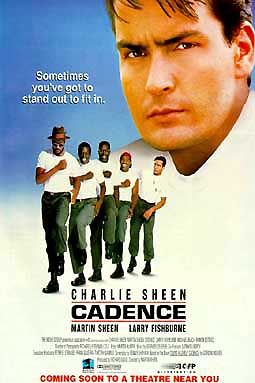 In the 1960s, druken Pvt. Franklin Fairchild Bean (Charlie Sheen) punches an MP in West Germany. The rebellious Bean is hoping he’ll be discharged from the Army. Instead, he’s sent to the stockade for 90 days. The stockade is run by an alcoholic tyrant named Sgt. Otis McKinney (Martin Sheen) and, shortly after arrival, Bean discovers that he’s the only white prisoner. With McKinney determined to break him, Bean befriends his fellow prisoners, including Roosevelt Stokes (Laurence Fishburne), and the two white corporals (James Marshall and Ramon Estevez) who try to protect the prisoners from McKinney’s erratic behavior.

