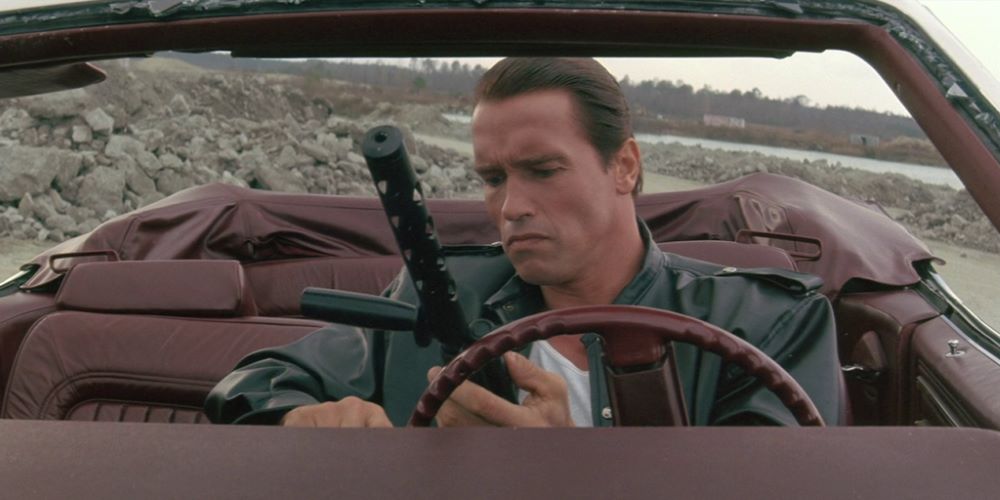
The gravel shootout in Raw Deal is pure, unfiltered 80s excess — the kind of scene that makes you grin even as you shake your head at the absurdity of it all. Arnold Schwarzenegger rolls up in a leather jacket over a white t-shirt, hair slicked back, with that dead-serious look that says he’s about to turn a quarry into a warzone. Then the Rolling Stones’ “(I Can’t Get No) Satisfaction” starts blaring — a choice so wildly on-the-nose that it wraps around to genius. Bullets fly, gravel explodes, and every bad guy who dares show his face gets launched off a cliff or riddled with rounds like it’s just another Tuesday.
It’s one of those moments where action filmmaking and rock-and-roll attitude collide in glorious overkill. Everything about it—the slow-motion carnage, the editing rhythm synced to Mick Jagger’s drawl, even the dust clouds swirling around Arnie—feels like a music video someone made after chugging pure testosterone. It’s ridiculous, it’s brilliant, and it’s exactly the sort of scene that makes Raw Deal such a lovable slice of 80s mayhem and why I just love this scene.
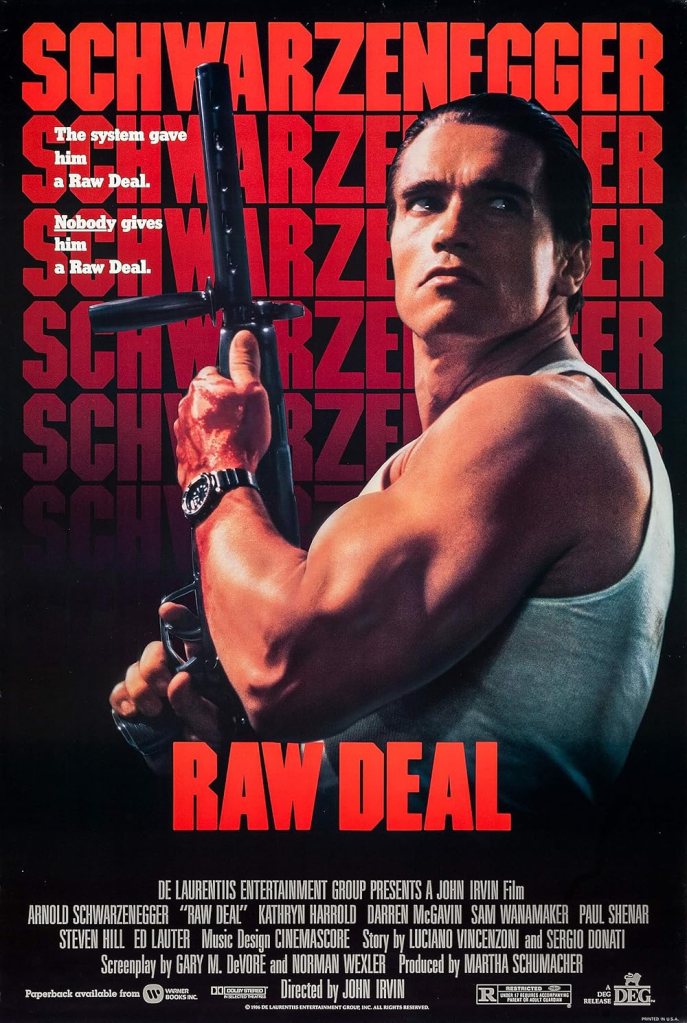
There is a point in every Arnold Schwarzenegger fan’s journey where they eventually circle back to Raw Deal and go, “Wait, how did this one slip through the cracks?” Set between Commando and Predator, this 1986 action vehicle often feels like the red-headed stepchild of Arnold’s golden era: a half-forgotten mob thriller dressed up as a one-man-army shoot-’em-up, with an undercover plot that keeps tripping over itself. Before Arnold was secret agent Harry Tasker in True Lies, he was already workshopping that whole undercover persona as former FBI man Mark Kaminski in Raw Deal. There is something strangely compelling about watching him play at being slick, whether he is posing as “Joseph Brenner” in mob circles or later reinventing himself as a suburban-family-man-turned-super-spy. Yet for all its clumsiness, tonal whiplash, and baffling choices, Raw Deal settles into that sweet, trashy groove where “this is bad” and “this is kind of awesome” blissfully merge. It is, in the purest sense, a guilty pleasure.
The setup is straightforward on paper. Arnold plays Mark Kaminski, a former FBI agent pushed out of the bureau for beating a suspect who assaulted and murdered a child, now stuck as a small-town sheriff in North Carolina with an unhappy, alcoholic wife and a life that feels like exile. His shot at redemption comes when his old FBI buddy Harry Shannon (Darren McGavin) recruits him for an off-the-books vendetta: infiltrate the Chicago mafia responsible for Shannon’s son’s death and tear them apart from the inside, in exchange for a possible path back into the bureau. Kaminski fakes his death, rebrands himself as “Joseph Brenner,” and sets out to worm his way into the organization run by boss Luigi Patrovita (Sam Wanamaker), while juggling mob politics, double-crosses, and a steady escalation of gunfire.
What makes the Kaminski era so weirdly fascinating is how hard the film leans on Arnold as a suave operator when his natural screen charisma is more brute-force than smooth-talking. In Raw Deal, he stalks through nightclubs and mob hangouts as an “undercover” tough guy, and you can almost see the movie trying to stretch him into a more traditional cool-gangster mode even as his sheer physicality keeps breaking the illusion. That tension carries right into True Lies, where the humor finally acknowledges how absurd it is to treat this gigantic Austrian bodybuilder as a low-key spy. The seeds of Harry Tasker’s double life are there in Kaminski: the awkward attempts at suave posturing, the undercover role-play, and the sense that the film is constantly asking the audience to accept him as something more than just the gun-toting tank he so effortlessly embodies. That tonal tug-of-war is kind of a mess, yet it’s also exactly why the movie is weirdly fun to revisit.
As an action piece, Raw Deal is very hit-or-miss, but when it hits, it goes all in on 80s excess. Director John Irvin stages a number of shootouts, but the standout sequence is the gravel pit massacre where Kaminski tears through mob soldiers with Mick Jagger’s “(I Can’t Get No) Satisfaction” blaring on the soundtrack, turning what should be a grim set piece into something closer to a music video about vengeance. The climactic assault on Patrovita’s casino base is another high point, with Kaminski stalking room to room, methodically mowing down henchmen in suits as the film abandons any pretense of undercover subtlety and embraces straight-up carnage. These moments are absurdly over the top, but they’re the reason the film lingers in the memory more than some “better” constructed movies from the same era.
The problem is that the film around those set pieces often feels oddly slack. For a movie with such a simple premise—ex-cop goes undercover in the mob—Raw Deal somehow manages to tangle itself in muddled plotting and underdeveloped subplots. Roger Ebert complained that the story is so basic it should be impossible to screw up, yet the movie still finds ways to make motivations cloudy and relationships confusing, especially when it comes to FBI leaks and why certain hits are happening. There are scenes, like the cemetery assassination setup, that should be loaded with emotional and narrative clarity but instead play as strangely opaque, leaving viewers wondering less “What will happen next?” and more “What exactly is going on?”
Despite the narrative wobbling, the cast gives the film more personality than it probably deserves. Schwarzenegger is still in that phase where his acting is limited but his screen presence is undeniable, and Raw Deal leans into that presence by letting him oscillate between stoic enforcer and deadpan comedian. He is not as effortlessly iconic here as he is in The Terminator or Predator, but he has a grounded gruffness in the early scenes as the weary small-town sheriff, and a playful swagger once he shifts into mob-infiltrator mode. The movie’s tonal confusion sometimes works in his favor: when he drops a ridiculous line in the middle of a supposedly serious undercover situation, it breaks the film’s self-seriousness in a way that oddly makes it more enjoyable.
On the supporting side, Darren McGavin brings a welcome dose of worn-out moral anguish as Harry Shannon, a man consumed by grief and desperate enough to go rogue, while Sam Wanamaker’s Patrovita and Paul Shenar’s lieutenant Max Keller give the mob side just enough theatrical menace to keep things lively. Kathryn Harrold’s Monique—Patrovita’s associate and Kaminski’s sort-of ally—is more underwritten than she should be, but she adds a smoky, world-weary charm to an otherwise thin role, bringing a touch of noir-vibe melancholy to a film that mostly cares about bullets. The dynamic between Kaminski and Monique hints at a more emotionally grounded movie lurking underneath, one that never fully arrives but peeks through in their quieter moments.
Visually and stylistically, Raw Deal fits comfortably into the mid-80s action aesthetic: slightly grimy urban backdrops, neon-lit nightclubs, smoky gambling dens, and anonymous industrial sites where bad guys go to die. John Irvin, better known for dramas and war films, occasionally tries to inject a more grounded tone, but the movie keeps undercutting that with comic-book logic and stylized violence, making it feel as if two different films are wrestling for control. On one level, that is a flaw; on another, that disjointed energy is part of what gives Raw Deal its “so off it becomes its own thing” quality, especially when watched now with decades of ironic distance.
Critically, the film was not well-loved on release, and its reputation has never really recovered in a mainstream sense. It holds a low Rotten Tomatoes score and only middling numbers on Metacritic, with reviewers at the time describing it as muddled, clichéd, and cheap compared to other action fare. Yet audience reactions have always skewed a bit warmer, with CinemaScore polling showing a respectable “B” grade and plenty of fans over the years framing it as an uneven but entertaining entry in Schwarzenegger’s catalog. The distance of time has turned Raw Deal into one of those movies where people admit its flaws freely but still find themselves rewatching it, chuckling at its corniness and vibing with its shootouts.
As a guilty pleasure, Raw Deal works because it is simultaneously too serious and not serious enough. It wants to be a gritty mob infiltration story but keeps indulging in gleefully excessive violence and dumb jokes; it dreams of being a tight cop thriller but never quite musters the narrative discipline. Yet that tension gives it a peculiar charm: it is a film that fails to be the sleek genre picture it might have been, but succeeds as a scrappy time capsule of 80s action sensibilities, carried by Arnold’s charisma and a few standout set pieces.
Viewed today, Raw Deal is hard to defend as “good” in any conventional sense, especially when measured against Commando’s pure cartoon energy or Predator’s lean genre perfection. But as a late-night watch, beer in hand, half-laughing at the dialogue while leaning forward during the gravel pit and casino shootouts, it absolutely delivers the specific pleasure it promises. The system may have given Mark Kaminski a raw deal, but for Arnold fans willing to embrace something messy, loud, and gloriously dated, this film still feels like a trashy little win
Whatever else one may want to say about it, 1996’s Jingle All The Way is a cute film.
It’s necessary to point that out because Jingle All The Way has a terrible reputation and, if we’re going to be honest, it deserves a lot of the criticism that it has gotten over the years. In many ways, it epitomizes the way a Hollywood studio can take an interesting idea and then produce a film that seems to have no understanding of what made that idea so interesting in the first place. Arnold Schwarzenegger plays Howard Langston, an overworked mattress store manager who waits until Christmas Eve to try to buy his son a Turbo Man action figure. (In the film, they call it a “doll,” which is one of the film’s false moments.) The only problem is that the Turbo Man action figure is the most popular gift of the year and everyone is looking for one. What starts out at as a satire of commercialism ultimately becomes a celebration of the same thing as Howard ends up dressed up as Turbo Man and taking part in his town’s Christmas parade. The film becomes a comedy without any sharp edges.
That said, it’s a cute film. It’s not cute enough to really be good but it is cute enough that it won’t leave you filled with rage. Arnold Schwarzenegger is in True Lies mode here, playing a seemingly boring and suburban guy who is secretly a badass. (In True Lies, Schwarzenegger was secretly a spy who had killed man people, though all of them were bad. In Jingle All The Way, he’s just a parent who has waited too long to go Christmas shopping.) Schwarzenegger’s main strength as an action star — even beyond his physique — was that he always seemed to have a genuine sense of humor and he’s the best thing about Jingle All The Way. This film finds him acting opposite actual comedic actors like Jim Belushi and Phil Hartman and holding his own. (The film also features Sinbad as another dad trying to get the Turbo Man action figure but Sinbad comes across as being more of a stand-up comedian doing bits from his routine than an actual character.) The film’s set pieces grow increasingly bizarre and surreal as Howard searches for his Turbo Man and the film actually becomes less effective the stranger that it gets. A scene of Howard fighting a crowd in a toy store works far better than a later scene where Howard battles a bunch of men dressed as Santa Claus and his elves. (It doesn’t help that, after an intelligent and well-edited opening thirty minutes, the film seems to lose all concept of comedic timing.) But there’s a sincerity to Schwarzenegger’s performance that keeps you watching.
Of course, today, Jingle All The Way feels like a relic from a different age. All the kids want a Turbo Man and you’re so busy at work that the stores are closed by the time you get home? Fine. Hop on Amazon at three in the morning and order one. Christmas shopping is a lot easier nowadays.
In this video, Arnold Schwarzenegger is sent to the past to eliminate Guns N’ Roses but ultimately decides that it would be a waste of ammo. Obviously, he knew that fulfilling his mission would change history and the world would never get to hear Chinese Democracy.
This song (and this video) were used to promote Terminator 2: Judgement Day.
After eight years of serving as Governor of California, Arnold Schwarzenegger made his big comeback as an action movie star in director Kim Jee-woon’s THE LAST STAND (2013). Sure, he put in a little work on the first two EXPENDABLES movies, but those were really just glorified cameos. Here, Arnold was front and center for the film’s 107 minute running time. This was an exciting time for me, because like most action movie fans, I loved him and had truly missed seeing him consistently kicking butt and taking names on the big screen. I gladly made my way to the movie theater in January of 2013 for a large tub of ‘corn, a big Mr. Pibb, and the true return of an action megastar!!
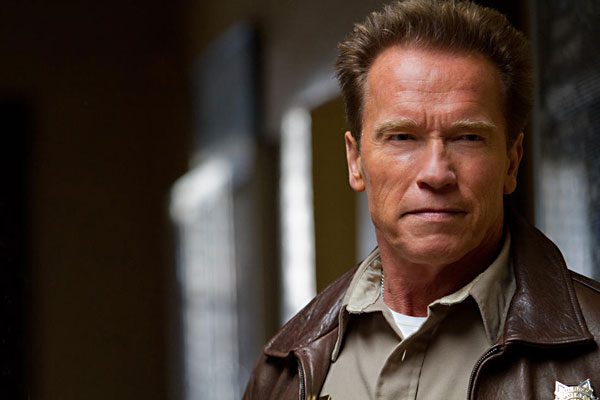
In THE LAST STAND, Schwarzenegger plays Ray Owens, a former LAPD narcotics officer who chose to leave the big city and take a job as the sheriff of the quiet, southern border town of Sommerton, Arizona. It won’t be quiet for long after notorious drug kingpin Gabriel Cortez (Eduardo Noriega) makes a daring escape from FBI custody. Cortez immediately heads towards the border in a souped up Corvette where an advanced group of highly trained gunmen, led by Burrell (Peter Stormare), are waiting to help him cross. Cortez and his small army of mercenaries appear to be on a collision course with Sheriff Owens and his ragtag group of deputies, including Mike (Luis Guzman), Jerry (Zach Gilford), and Sarah (Jaimie Alexander). Knowing they’re outgunned and outmanned, Sheriff Owens asks for additional help from ex-military man and current drunk Frank Martinez (Rodrigo Santoro), as well as the crazy local gun nut Lewis Dinkum (Johnny Knoxville). Add to this mixture, FBI agent John Bannister (Forest Whitaker) and his team’s attempts to try to stop Cortez before he gets to Sommerton, and the stage is set for lots of action!
I really liked THE LAST STAND when I saw it at the movie theater in 2013, and I really liked it again when I revisited the film this week. I made it a habit many years ago to not read reviews of a film before I go see it at the theater. I had found that reading potential negative comments could affect my viewing of a film, so I cut that out. As such, after totally enjoying myself with THE LAST STAND, I was surprised that the film wasn’t received very strongly by the audience or critical community, and I was even more surprised that it completely flopped at the box office, only bringing in a total of $12 million in the United States during its run. For me, the film delivered what I was looking for… Arnold Schwarzenegger kicking ass, spouting off some good one-liners, and outsmarting and outmuscling his much younger adversaries! No critic or keyboard warrior can take that away from me, as THE LAST STAND is an entertaining movie with a good cast. Heck, even the great Harry Dean Stanton pops in for a surprise cameo at the beginning of the action.
I also appreciate the fact that THE LAST STAND is the American directorial debut of the great South Korean director Kim Jee-woon, who has directed some of my favorite South Korean films, including A BITTERSWEET LIFE (2005) and I SAW THE DEVIL (2010). His direction brings some Asian flair that results in stronger, more graphic violence, as well a penchant for jarring changes in tone between humorous character interplay and sometimes violent tragedy. In a movie designed primarily as a piece of entertainment, I appreciate those more over-the-top touches that lift it above the norm.
Overall, I easily recommend THE LAST STAND to fans of Arnold Schwarzenegger and old-school action movies. It’s not a Schwarzenegger classic in the same way as movies like PREDATOR (1987), TERMINATOR 2 (1991), and TRUE LIES (1994), but it’s still a fun ride!
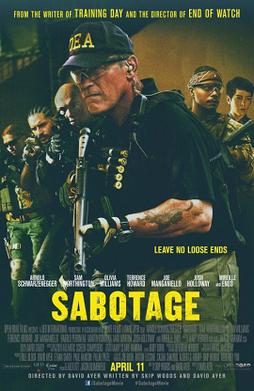
Atlanta Homicide detective Caroline Brentwood (Olivia Williams) and her partner, Darius Jackson (Harold Perrineau), are the primaries on the murder of a former DEA agent. Their investigation leads them to an elite special operations team led by “Breacher” Wharton (Arnold Schwarzenegger). Wharton and his crew were previously suspended for six months while the FBI investigates their last raid and why there was a $10 million dollar discrepancy between the amount of money the team reporter and the amount of money the FBI was expecting to be recovered. Someone is murdering the members of Breacher’s team one-by-one. Breacher and Brentwood investigate the murder and what happened to the money but they both discover that they can’t trust anyone.
Sabotage has got a cast that is full of talent and familiar faces, including Sam Worthington, Mireille Enos, Terrence Howard, Joe Manganiello, Martin Donavon, and Josh Holloway. It also has one truly great action scene, a violent chase down a busy Atlanta street that comes to sudden and very bloody conclusion. The film’s final scene takes Sabotage into western territory, with Schwarzenegger dominating the screen like a larger-than-life Sergio Leone hero. It’s just too bad that the rest of the movie isn’t as a good as its final shot or that one chase scene. Unfortunately, most of the film feels repetitive and half-baked, with way too much time being wasted on supporting characters who tend to blend together.
Arnold Schwarzenegger gives one of his better performances. When he made Sabotage, he was no longer a governor and he was also no longer an automatic box office draw and there’s a tired weariness to his performance. Unfortunately, the rest of the cast is either miscast (Olivia Williams) or stuck playing one-dimensional characters (everyone else). There’s enough good action sequences to keep Sabotage watchable and Schwarzenegger shows that he can actually be a very good actor but it’s also easy to see why this film didn’t reignite his his career.
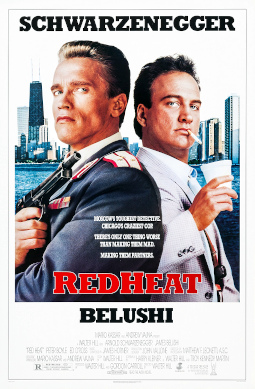
Ivan Danko (Arnold Schwarzenegger) is a Russian who lives in Moscow. Art Ridzik (James Belushi) is an American who lives in Chicago. They have two things in common. They’re both cops and they both recently lost their partners while pursuing Russian drug lord Viktor Rostavali (Ed O’Ross). When Danko comes to Chicago to bring the recently arrested Rostavali back to Moscow, Ridzik is assigned to be his handler. When Rostavali escapes from custody, Ridzik and Danko team up to take him down.
Directed by Walter Hill, RedHeat may not be as well-remembered as some of Arnold Schwarzenegger’s other action films from the 80s but it’s still a good example of Schwarzenegger doing what Schwarzenegger did best. Danko may not have been the quip machine that Schwarzenegger usually played but the movie gets a lot of comedic mileage out of his straight-to-the-point dialogue and the culture clash that Danko, a proud Soviet, experiences in Chicago. It’s also an exciting action film, featuring a classic bus chase that perfectly complements Schwarzenegger’s bigger-than-life persona.
It gets a lot of mileage from the comedic chemistry of Arnold Schwarzenegger and James Belushi. The always-talking Belushi provides a good comic foil to the steely Schwarzenegger. Made in the waning years of the Cold War, Red Heat featured Belushi learning that the Russian cops didn’t worry about Miranda warnings and Schwarzenegger learning about “decadent” capitalism. Belushi does a good job defending the honor of America. Schwarzenegger, an anti-communist in real life, does an equally good job defending the Soviet Union. Ultimately, they put aside their differences and show that even people on opposite sides can work together.
(We all know who won ultimately won the Cold War, though.)
Walter Hill specialized in buddy action movies. RedHeat isn’t up to the level of 48Hrs but it’s still an entertaining East-meets-West action film that packs a punch.
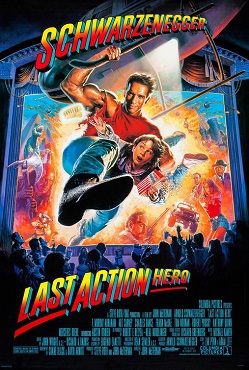
Ever since this film was first released in 1993, it’s usually held up as an example of a Hollywood fiasco. The script was originally written to be a modest satire of action films. The screenwriters wrote the character of Jack Slater, an movie action hero who comes into the real world, for Dolph Lundgren. Instead, the film became an Arnold Schwarzenegger extravaganza and the studio ended up tossing a ton of money at it. When the film was originally released, the reviews were mixed and the box office was considered to be disappointing. (That it went up against the first JurassicPark was definitely an underrated issue when it came to the box office.) Ever since then, The Last Action Hero has had a reputation for being a bad film.
Well, I don’t care. I like TheLastActionHero. Yes, it’s a bit overproduced for a comedy. (It breaks my own rule about how no comedy should run longer than two hours.) Yes, it gets a bit sentimental with ten year-old Danny Madigan (Austin O’Brien) using a magic, golden ticket to enter the film world of his hero, Jack Slater. If you want to argue that the film should have devoted more time to and gone a bit deeper into contrasting the film world with the real world, I won’t disagree with you. But I will also say that Sylvester Stallone starring as TheTerminator in Jack’s world was actually a pretty funny sight gag. Danny knowing better than to trust a character played by F. Murray Abraham made me laugh. Danny’s fantasy in which Arnold Schwarzenegger played Hamlet was made all the better by the fact that his teacher was played by Laurence Olivier’s wife, Joan Plowright. Danny DeVito as Whiskers the Cartoon Cat makes me laugh as well, even if it is perhaps a bit too bizarre of a joke for this particular film. (There’s nothing else about the Jack Slater films that would explain the presence of a cartoon cat.)
When you set aside the idea of the Last Action Hero being a symbol of Hollywood bloat and just watch it as a film, it emerges as an enjoyably goofy action movie, one that captures the joy of watching movies (because who hasn’t wanted to enter a movie’s world at some point in their life), and also one that features a rather charming performance from Arnold Schwarzenegger. (Schwarzenegger, I should add, plays both himself and Jack Slater. One of my favorite jokes is when the real Schwarzenegger is at a premiere and he mistakes the evil Ripper for Tom Noonan, the actor who played him in the previous Jack Slater film.) Yeah, the golden ticket is a little bit hokey but who cares? Underneath all of the special effects and action and money spent on star salaries, LastActionHero is an action movie and comedy with a heart. Danny meets his hero but also gets to become a hero himself. And Jack Slater turns out to be everything you would hope your movie hero would be. In the end, it’s obvious that a lot of the criticism of this film has more to do with the appeal of riding the bandwagon as opposed to what actually happens on screen.
LastActionHero is a movie that I’ll happily defend.
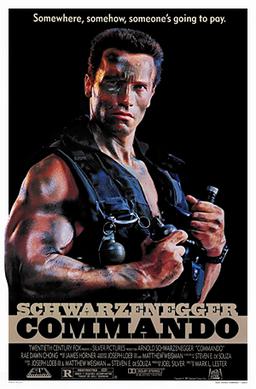
John Matrix (Arnold Schwarzenegger) is a former colonel in the U.S. Amy Special Forces. He was one of the best at what he did but he’s now retired from all that and lives in the mountains of California with his young daughter, Jenny (Alyssa Milano). When Capt Bennett (Vernon Wells), Martix’s former comrade-in-arms, kidnaps Jenny, Matrix is told that he has 11 hours to assassinate the leader of the country of Val Verde so that General Arius (Dan Hedaya) can launch a coup. Knowing that the bad guys are planning on killing both him and Jenny no matter what he does, Matrix instead takes out Arius’s men as he makes his way to where Jenny is being held captive.
Commando is one of my favorite Schwarzenegger films. It has some of the best one-liners (“I like you, Sully, I kill you last,”), some of the best character actors (Sully is played by David Patrick Kelly), and also one of Schwarzenegger’s best performances. In Commando, Schwarzenegger shows that he’s willing to poke fun at himself, which was something that set him apart from many of the action heroes of the 80s. (Stallone eventually learned how to poke fun at himself but it took a very long time.) At his California home, Matrix chops down and carries a tree without breaking a sweat. During a chase through a mall, Matrix easily lifts up a phone booth. Matrix may be trying to save the life of his daughter but he still takes the time to come up with one-liners and fall in love with flight attendant Cindy (Rae Dawn Chong). Commando is essentially just a big comic book brought to life and Schwarzenegger understands that and gives a very knowing, self-aware performance. Director Mark Lester wastes no time getting to the action and the result is one of the most entertaining action films of the 80s.
Believe it or not, Commando was originally envisioned as being a Gene Simmons picture. When the KISS frontman turned down the film, the script was rewritten for Arnold Schwarzenegger. Schwarzenegger made this film after TheTerminator and it was another box office success. As for Gene Simmons, he would have to wait for Runaway to make his action debut.
Though the Academy of Motion Picture Arts and Sciences claim that the Oscars honor the best of the year, we all know that there are always worthy films and performances that end up getting overlooked. Sometimes, it’s because the competition too fierce. Sometimes, it’s because the film itself was too controversial. Often, it’s just a case of a film’s quality not being fully recognized until years after its initial released. This series of reviews takes a look at the films and performances that should have been nominated but were, for whatever reason, overlooked. These are the Unnominated.
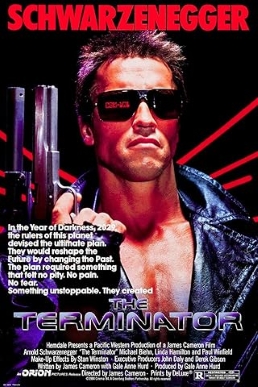
First released in 1984, TheTerminator was the one of the top box office hits of the year. It’s the film that established James Cameron as a filmmaker. It’s the film that made a bona-fide star out of Arnold Schwarzenegger. It’s a film that was imitated a thousand times before it even got its first official sequel. It’s a film that’s still celebrated today. 41 years later, people are still saying, “I’ll be back.” Would Arnold Schwarzenegger ever have become governor of California if he hadn’t first played a killing machine? There’s a reason why his political nickname was the Governator.
And yet, TheTerminator was not nominated for a single Oscar. For all of the explosions and the gunfire and the screaming, it wasn’t even nominated for Best Sound. Some of the special effects may now seem a bit hokey in this age of rampant CGI but it’s still a surprise that TheTerminator was not nominated for Best Visual Effects. The breath-taking action scenes did not result in a nomination for Best Editing. Linda Hamilton was not nominated for her fantastic performance as Sarah Connor, a young woman who finds herself being pursued by a killer cyborg from the future. Arnold Schwarzenegger was not nominated for playing one of the most memorable villains of the past 40 years. Those who claim that Schwarzenegger was just playing himself are being overly glib. Anyone could have said, “I’ll be back.” It took Schwarzenegger’s delivery to make it a great line.
The lack of nominations aren’t really not a surprise, of course. The Academy has only recently started to show an openness to nominating genre films for major awards and, even now, a genre film has to be considered a “cultural event” to even get a nomination. Black Panther, Get Out, and even Mad Max: Fury Road and Dune were all nominated because it was felt that they had transcended their genre origins. TheTerminator is a sci-fi action movie and it’s proud to be a sci-fi action movie. (Terminator 2: Judgment Day, it could be argued, transcended its genre origins but it was released in 1991 and Silence of the Lambs was destined to be the genre nominee that year.) It’s also so relentlessly paced and intelligently written and directed that it’s a film that, even after all these years, it can still leave you breathless. Nominated or not, The Terminator is a film that grabs your attention and holds it for a full 107 minutes. There’s not many films that can make that claim.
TheTerminator is a film that has held up surprisingly well. (It’s certainly held up better than some of its more recent sequels.) The performances of Linda Hamilton, Michael Biehn, and Arnold Schwarzenegger still work. It’s still terrifying to watch as The Terminator relentlessly kills everyone that he comes into contact with. (One thing that always gets me about the Terminator is that, even though he’s huge and superstrong and could probably physically rip anyone he wanted to apart, he still carries and uses a gun. This makes him seem like even more of a bully.) The Terminator is a machine and what makes him especially intimidating is that he doesn’t care if people see him coming or if they witness his crimes. He has one function and that’s all he worries about. When Michael Biehn first shows up, you can’t help but wonder why this guy, with his slight build and his somewhat nervous mannerisms, would be sent to try to stop the Terminator. Of course, by the end of the movie, you understand.
(And what an ending! The sight of those clouds, Linda Hamilton’s delivery of her final line, and the feeling that the future has already been determined, it all definitely makes an impression that has managed to survive every sequel after JudgmentDay. There’s a reason why Skynet — much like “I’ll be back” — has taken on a cultural life of its own.)
There were a lot of very good films that were nominated for Oscars in 1984. The Terminator, much like Once Upon A Time In America, was not one of them but it will still never be forgotten.
 Through the Shattered Lens