“Oh, this is awful in almost every conceivable way.” — Phil
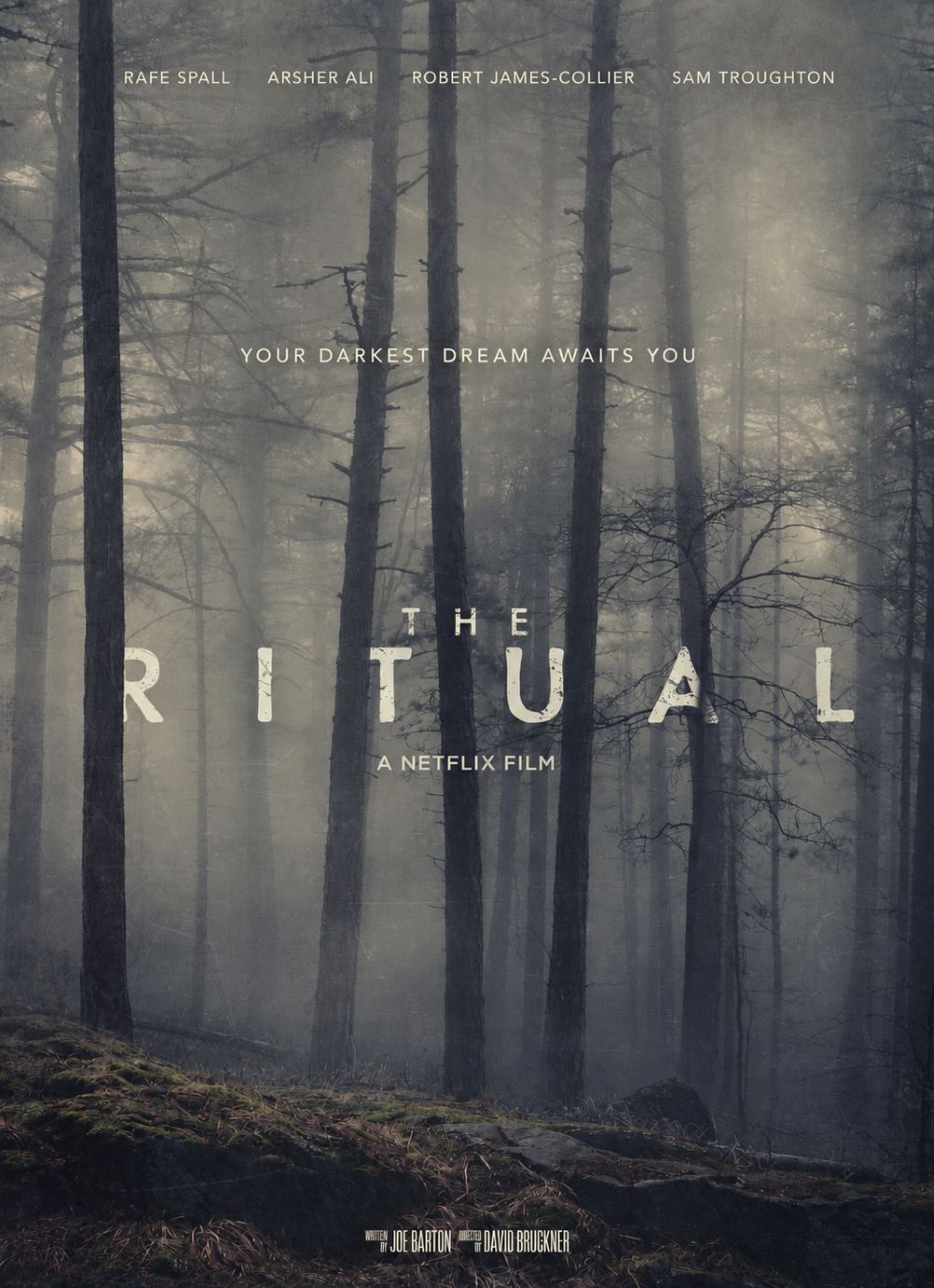
David Bruckner’s The Ritual turns a seemingly straightforward hiking-trip nightmare into a bleak, character-driven story about grief, guilt, and the fear of being judged by the worst thing you have ever done. Released in 2017, the film takes the familiar setup of friends becoming lost during a hiking trip and turns it into something far more tense, emotionally bruised, and unsettling. It is part of the wave of folk horror that began emerging in the late 2000s, with filmmakers returning to remote landscapes, old belief systems, pagan imagery, and the frightening idea that modern people are badly unprepared for places ruled by ancient customs. The Ritual contains the expected genre material—an ominous Scandinavian forest, strange symbols, a decaying cabin, and an isolated community—but its real strength is how tightly those elements connect to its characters’ unresolved guilt and resentment.
The film follows Luke, played by Rafe Spall, who is still deeply traumatized by the death of his friend Rob. In the opening sequence, Luke and Rob enter a liquor store after a night out and become caught in the middle of a robbery. Luke hides while Rob is killed trying to resist the attackers. It is an immediately harsh and effective opening because the film does not treat Luke’s inaction as something simple or easy to judge. He is terrified, frozen, and unable to process the situation. Even so, he cannot forgive himself for surviving. That moment becomes the defining wound of his life, and everything that happens afterward pushes him back toward it.
Luke eventually joins Phil, Dom, and Hutch on a hiking trip through Sweden that is meant to honor Rob’s memory. It becomes clear early on that the group’s friendship is not as solid as it once was. They know each other well enough to trade jokes and insults, but there is a lot of buried frustration underneath the banter. When Dom injures his knee, he argues that they should take a shortcut through the forest rather than continue along the longer established trail. The decision makes sense on a practical level, but it puts them in a setting where the normal rules of direction, distance, and safety quickly stop applying. The trip that is supposed to help them mourn Rob instead becomes a pressure cooker for every unresolved issue they have with one another.
That tension is what makes the first half of The Ritual more interesting than a routine “people get lost in the woods” movie. The men are not written as interchangeable victims waiting for the plot to remove them one by one. They have the worn-down chemistry of friends who have known one another for years but may have outgrown the version of themselves that first brought them together. Luke is defensive and emotionally closed off. Dom can be abrasive, especially when pain and fear make him more volatile. Phil is cynical and exhausted. Hutch is the closest thing the group has to a stabilizing influence, but even he cannot keep the old resentments from surfacing.
Bruckner gives their arguments a messy, lived-in quality. They do not stop to explain their entire friendship history for the audience; instead, the viewer picks up on it through accusations, half-finished insults, and the way everyone reacts when Rob’s death comes up. Luke’s guilt is the most obvious source of conflict, but the others are carrying their own anger toward him as well. They cannot openly say what they think without admitting that they may blame him for what happened. As the hike becomes more dangerous, that tension becomes harder to contain. The film understands that fear makes people meaner, more selfish, and more honest than they want to be.
The Swedish wilderness is easily one of the movie’s greatest assets. Bruckner and cinematographer Andrew Shulkind make the forest feel huge and claustrophobic at the same time. The woods are not shot like a scenic tourist destination. They are wet, dark, muddy, and disorienting, filled with thin trees that block the characters’ view and make every direction seem identical. The lack of clear landmarks matters because it slowly strips the group of confidence. At first, they are annoyed hikers trying to save time. Before long, they are struggling to tell where they have been, where they are going, or whether the forest is allowing them to leave at all.
The film excels at building dread through details rather than relying on constant jolts. The friends discover unnerving signs scattered through the woods: an animal carcass hanging impossibly high in the trees, crude figures made from sticks, unfamiliar markings, and evidence that somebody—or something—has been watching them. One of the most memorable sequences takes place in an abandoned cabin that the group uses for shelter. Inside, they find a grotesque shrine and signs of an old ritualistic practice that seem completely out of place in the modern world. The scene is disturbing because of how wrong it feels. These men have not just stumbled into an empty house; they have crossed into a space defined by beliefs they do not understand.
That atmosphere is where The Ritual most clearly earns its place in modern folk horror. The movie is not simply interested in isolated woods as a convenient backdrop for scares. It treats the forest as a place with a history and a set of rules that exist independently of the characters. Luke, Dom, Phil, and Hutch arrive with backpacks, maps, phones, and ordinary personal problems, but those things become almost useless once the landscape begins to feel hostile. Their modern routines and assumptions do not protect them. The horror comes partly from the idea that they are outsiders who have entered a world where their explanations mean nothing.
The later sections introduce an isolated group whose beliefs are rooted in an older, more ritualized worldview. This element can feel more direct than the earlier ambiguity, but it still fits the movie’s larger themes. The people Luke encounters represent a twisted alternative to the kind of shame and grief that have been consuming him. Their world offers a warped version of survival: submit to fear, accept the rules, and give up the parts of yourself that make resistance possible. It is an ugly kind of community, one that turns spiritual tradition into coercion and treats personal suffering as something to be exploited.
Rafe Spall is the key to why the film works as more than an exercise in atmosphere. Luke is not an idealized horror protagonist. He is stubborn, defensive, and sometimes hard to like, particularly when he tries to avoid talking about Rob. But Spall makes his guilt feel immediate and human. Luke is not haunted just because he saw someone die; he is haunted because he believes that his failure in that moment reveals who he really is. The forest repeatedly forces him to confront that belief through hallucinatory transitions that blur the wilderness with the liquor-store robbery. Doors in the forest become entrances to the shop. The wooded darkness gives way to fluorescent aisles. Luke seems to be reliving the same failure from different angles, unable to escape the moment he most wishes he could change.
Those surreal flashbacks are some of Bruckner’s best directing choices. They are visually simple but highly effective, placing Luke’s internal guilt directly into the physical environment around him. The movie never turns into a vague psychological-horror story that dismisses everything as a dream, but it uses Luke’s trauma to make the supernatural setting feel more personal. The threat in the woods is frightening because it seems to recognize his weakness. It does not just want to harm him; it wants him to surrender to the version of himself that he already hates.
If The Ritual has a flaw, it is that the final act loses a little of the earlier section’s mystery once the film begins explaining more about what is happening in the forest. The strongest passages are often the quietest ones: the men arguing while lost, the unsettling evidence in the trees, the cabin sequence, and the growing suspicion that they are being pushed in a direction they cannot understand. Still, the conclusion works because it brings the movie back to Luke’s personal struggle. His escape is not simply about reaching safety. It is about refusing to let guilt define his identity forever.
By the end, The Ritual delivers a satisfying sense of catharsis without pretending that Luke has been completely healed. He survives an experience that forces him to face the fear he has been carrying since Rob’s death, but that does not erase the loss or make him a different person overnight. What changes is his willingness to stop living as though one terrible moment has permanently decided who he is. That emotional resolution gives the film more weight than many survival-horror stories.
Overall, The Ritual is a smart, atmospheric, and surprisingly character-driven horror film. Its strongest qualities are its oppressive forest setting, its believable group dynamics, its gradual escalation, and Rafe Spall’s deeply uncomfortable performance. Most importantly, it recognizes that folk horror becomes powerful when the ancient and supernatural elements expose something painfully human. Bruckner turns a memorial hike into a nightmare about guilt, masculinity, friendship, and the terror of being unable to outrun your own past.