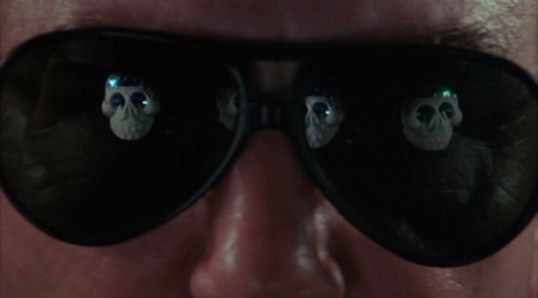
4 Or More Shots From 4 Or More Films is just what it says it is, 4 shots from 4 of our favorite films. As opposed to the reviews and recaps that we usually post, 4 Shots From 4 Films lets the visuals do the talking!
Director and screenwriter Nicholas Ray was born 115 years ago today, in Galesville, Wisconsin. He would go on to become one of the most influential American directors of all time, making independently-minded films that celebrated rebels and iconoclasts. The directors of the French New Wave loved him and for good reason.
Today, we celebrate the life and legacy of Nicholas Ray with….
4 Shots From 4 Nicholas Ray Films
In A Lonely Place (1950, dir by Nicholas Ray, DP: Burnett Guffey)
Rebel Without A Cause (1955, dir by Nicholas Ray, DP: Ernest Haller)
Bigger Than Life (1956, dir by Nicholas Ray, DP: Joseph MacDonald)
Party Girl (1958, dir by Nicholas Ray, DP: Robert J. Bronner)
“All I have in this world is my balls and my word.” — Tony Montana
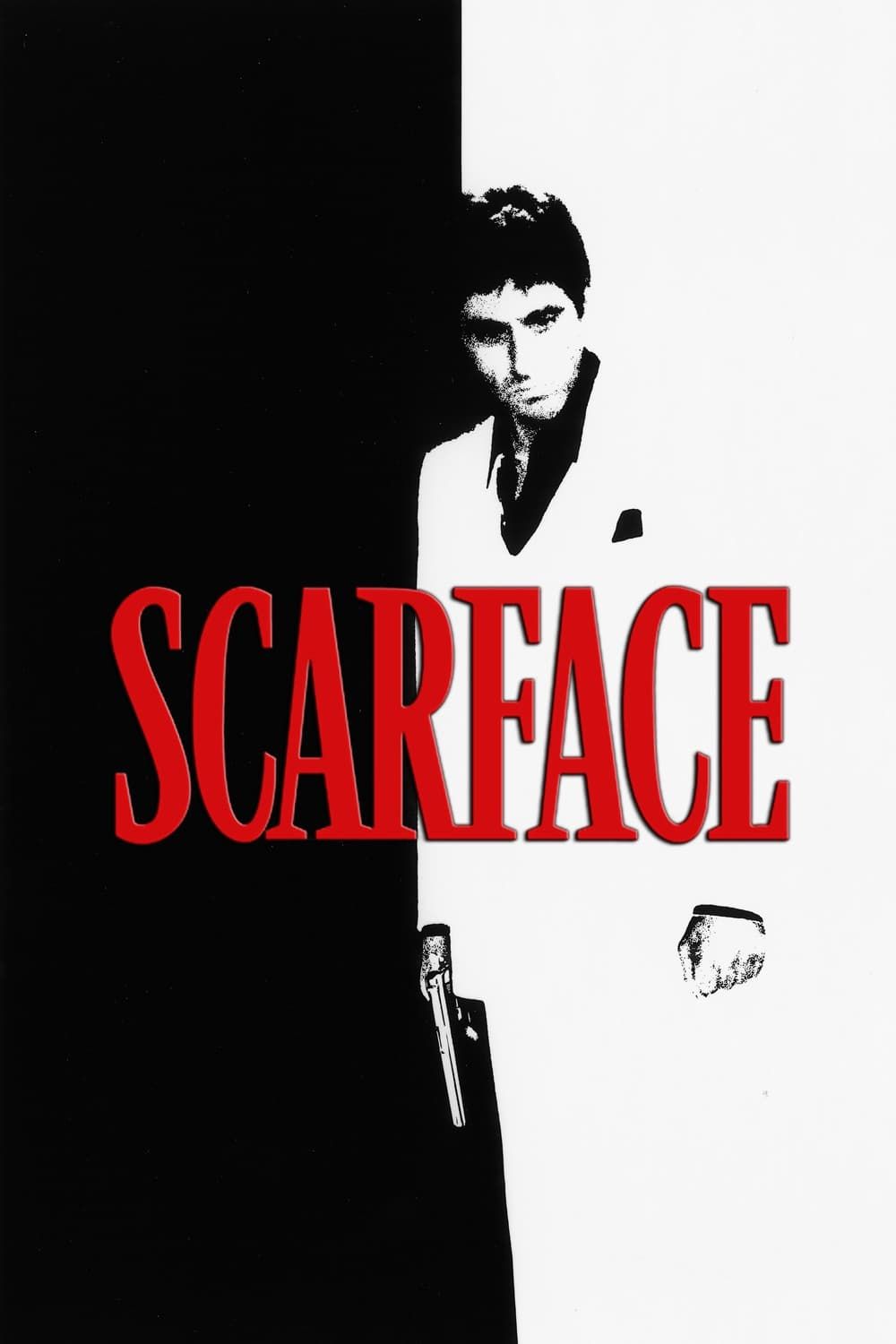
Brian De Palma’s Scarface is one of those movies that seems almost impossible to discuss at a normal volume. Everything about it is loud, excessive, sweaty, violent, vulgar, and deliberately too much. The movie does not simply tell the story of Tony Montana, a Cuban immigrant who rises through Miami’s cocaine trade before destroying himself. It turns that rise and fall into a neon-lit, operatic explosion of greed, paranoia, sex, money, and violence. At first, Scarface can feel like an overlong, incredibly entertaining gangster fantasy. But underneath all the cocaine mountains and machine guns, it is also a deeply cynical story about the American dream and what happens when ambition is allowed to become a substitute for an actual soul.
Tony arrives in Miami during the Mariel boatlift, immediately presenting himself as someone who refuses to be intimidated. He is not interested in being grateful, polite, or patient. Tony wants power, and he wants it quickly. That impatience is both his greatest strength and the obvious source of his downfall. He is willing to do things that other people are too afraid to do, which helps him climb the criminal ladder. At the same time, he cannot understand the idea of limits. Every success only makes him want something bigger: more money, more cocaine, more influence, a bigger house, a more beautiful wife, and absolute control over everyone around him.
The screenplay by Oliver Stone gives Tony a kind of blunt, almost cartoonishly direct philosophy. He believes that the world belongs to people who take it. In Tony’s mind, morality is mostly an excuse invented by people who lack the courage to seize what they want. That attitude makes him magnetic, but the film never truly presents his worldview as admirable. Tony may have the confidence of a king, but he behaves more like a man who is constantly terrified that someone will discover he is not really in control. His bravado is a shield against humiliation, poverty, and powerlessness. The more successful he becomes, the more obvious it is that he is still fighting the same emotional battle he was fighting when he first arrived.
Al Pacino’s performance is the central reason Scarface remains so watchable. He plays Tony as a human grenade, a character who seems to be vibrating with anger even when he is sitting still. The accent, the posture, the rapid shifts in mood, and the exaggerated physical gestures could easily have turned Tony into a parody. In fact, there are moments when Pacino absolutely does push the character into parody. Yet that is also part of the performance’s strange power. Tony is a man who has constructed himself as a larger-than-life personality, so Pacino makes him seem like someone performing Tony Montana even while he is alone.
Pacino understands that Tony’s violence is not simply about cruelty. It is about insecurity, pride, and the panic of losing status. Tony cannot tolerate being laughed at, challenged, ignored, or treated as inferior. A casual insult can become a life-or-death confrontation because he experiences disrespect as an existential threat. Pacino makes those reactions frightening, but he also gives them a pathetic quality. Tony is powerful enough to terrify an entire room, yet emotionally he often behaves like a wounded child demanding recognition.
That contradiction is what keeps the performance from becoming empty scenery chewing. Tony is ridiculous, but he is also tragic. He is disgusting, but he has flashes of genuine feeling, especially in his relationship with his sister Gina. Unfortunately, even his love for her becomes possessive and destructive. Tony wants to protect Gina, but he also wants to own her choices, her sexuality, and her future. He cannot separate love from control. The same problem affects his relationship with Elvira, played by Michelle Pfeiffer, and eventually his entire empire. Tony does not know how to care for people without turning them into extensions of himself.
De Palma’s direction matches Tony’s personality. The film is staged like a gangster epic filtered through a fever dream. Miami becomes a place of bright colors, glass surfaces, giant mansions, tropical heat, and constant artificial light. The city feels less like a real environment than a hallucination of wealth. Tony’s home is especially important because it looks like a monument to success but gradually becomes a prison. The famous final shootout transforms that mansion into a battlefield, with Tony defending his kingdom even after it has already collapsed around him.
The violence in Scarface is often shocking, but it is also theatrical. De Palma uses suspense, wide compositions, sudden bursts of brutality, and moments of grotesque visual humor to make the violence feel both horrifying and unreal. The movie’s excess can be exhausting, particularly in the middle section, where Tony’s rise begins to blur into an endless parade of deals, parties, arguments, and drug use. The length is part of the point: we are meant to feel Tony’s world becoming bloated and unstable. Still, some of the film’s scenes repeat ideas that it has already established. Tony is ambitious, Tony is paranoid, Tony is violent, and eventually Tony is high. The movie sometimes keeps shouting after the audience has already heard it.
That criticism matters because Scarface is not a flawless film. Its dialogue can be clumsy, its supporting characters are sometimes more functional than fully developed, and its treatment of women is frequently limited by Tony’s perspective. The film wants to condemn male domination and criminal capitalism, but it is also fascinated by the same things it condemns. It shows us the luxury, the clothes, the cars, the glamorous parties, and the apparent freedom of Tony’s lifestyle. Even while warning that this life ends in misery, it makes the fantasy visually seductive.
That tension helps explain the movie’s complicated legacy. When Scarface was first released in 1983, many critics found it excessive, ugly, and morally confused. Over time, however, its reach expanded dramatically through home video and popular culture. The movie became especially important to hip-hop, where artists recognized Tony’s language of survival, hustle, ambition, and self-invention. Al Pacino has credited hip-hop with helping the film find its audience, saying that rappers understood and embraced it. That relationship became one of the most important parts of Scarface’s afterlife.
Hip-hop did not simply treat Tony as a cool gangster. It also turned him into a symbol. The character could represent ruthless ambition, immigrant struggle, street credibility, material success, or the danger of becoming trapped by one’s own myth. Lines from the movie entered rap lyrics, album skits, music videos, and stage names. The film’s imagery became a shorthand for a certain kind of rise-from-nothing fantasy, even when the original movie was trying to show how poisonous that fantasy could be. In this sense, Scarface became bigger than its initial critical reputation. It stopped being only a crime film and became a cultural text that people could quote, remix, parody, and reinterpret.
Its influence on video games is just as obvious, especially in Grand Theft Auto: Vice City. That game’s 1980s Miami setting, neon colors, criminal empire structure, radio culture, and flamboyant protagonist clearly operate in the same general territory as Scarface. The film has also been connected directly to other games, including Scarface: The World Is Yours, which imagines an alternate continuation after the movie’s ending. The game allows players to rebuild Tony’s empire, purchase businesses, intimidate rivals, and expand across Miami. It turns the movie’s rise-and-fall structure into an interactive fantasy in which the player gets to ignore the ending and keep climbing.
That difference between film and game is revealing. Scarface ultimately insists that Tony’s dream cannot survive because Tony himself is incapable of moderation, trust, or self-knowledge. Video games can take the same world and make the player feel rewarded for doing exactly what Tony does: acquiring territory, collecting money, buying weapons, and becoming more powerful. In that format, the critique of excess can easily become a celebration of excess. Yet that is also why the film remains so influential to games. It provides an instantly understandable fantasy of criminal ascent, complete with a distinctive visual style and a protagonist whose personality is impossible to ignore.
In the end, Scarface is both a warning and a temptation. It tells us that Tony Montana is doomed, but it makes his climb so entertaining that we understand why generations of viewers, rappers, and game designers kept returning to him. Al Pacino’s performance is the movie’s beating heart: outrageous, funny, frightening, and occasionally heartbreaking. De Palma’s film may be messy and overstuffed, but its messiness is part of its identity. Scarface does not want to be tasteful or balanced. It wants to overwhelm you, seduce you, and then leave you staring at the wreckage of a man who mistook having everything for being somebody.
Hi, everyone! Tonight, on Mastodon, I will be hosting the #TubiThursday watch party! Join us for a true classic, Dirty Dancing!
You can find the movie on Tubi and you can join us on Mastodon at 9 pm central time! (That’s 10 pm for you folks on the East Coast.) We will be using #TubiThursday hashtag! See you then!
The great Robert Mitchum was born, on this date, 108 years ago. Today’s scene that I love comes from one of my favorite Mitchum films, the classic 1947 noir Out of the Past.
In this scene, we are reminded that no one was cooler than Robert Mitchum. And no one threw a better punch.
4 Or More Shots From 4 Or More Films is just what it says it is, 4 shots from 4 of our favorite films. As opposed to the reviews and recaps that we usually post, 4 Shots From 4 Films lets the visuals do the talking!
On this date, 98 years ago, Andy Warhol was born. Today, we mark this occasion with….
4 Shots From 4 Andy Warhol Films
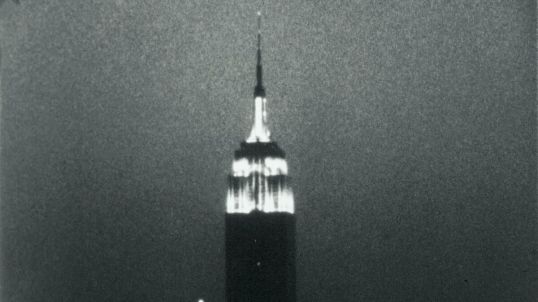
Empire (1965, dir by Andy Warhol)
Vinyl (1965, dir by Andy Warhol)
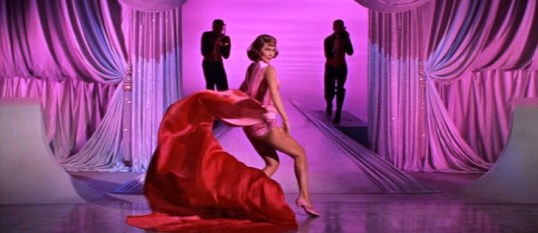
Poor Little Rich Girl (1965, dir by Andy Warhol)
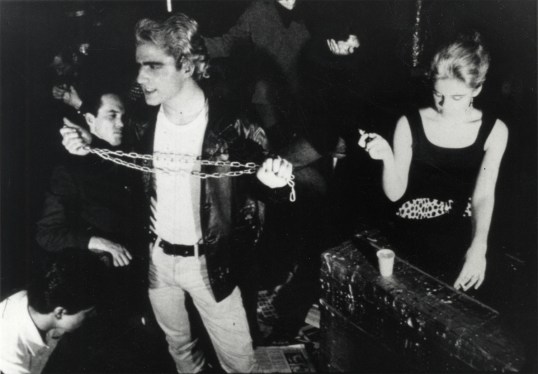
Chelsea Girls (1966, dir by Andy Warhol and Paul Morrissey)
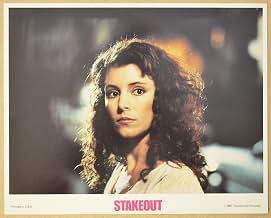
I loved STAKEOUT when I was a teenager. Richard Dreyfuss and Emilio Estevez are hilarious and Aidan Quinn is suitably nasty as the bad guy, but I have to admit that the main reason I love the movie is because it’s the first time I remember seeing Madeleine Stowe. I was 14 years old when our family rented it for the very first time, and I’ve been in love with her ever since.
STAKEOUT was released on August 5, 1987. In celebration of its 39th anniversary, I present this scene that was burned into my memory a long time ago.
(Parental Discretion is advised, as the Rhythm is probably gonna get you!)
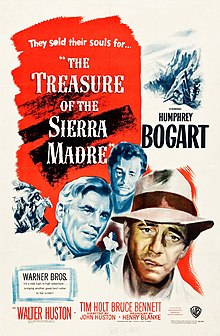
In this scene, we meet Fred C. Dobbs (played by Humphrey Bogart) and we watch as he begs and scrounges for money. The man in the white suit is played by John Huston himself. This was Huston’s first acting role. He would go on to be nominated for best supporting actor for his role in The Cardinal. He would also give unforgettable performances in films like The Other Side of the Wind, The Visitor, and Chinatown.
4 Or More Shots From 4 Or More Films is just what it says it is, 4 shots from 4 of our favorite films. As opposed to the reviews and recaps that we usually post, 4 Shots From 4 Films lets the visuals do the talking!
120 years ago today, the writer/director/actor John Huston was born in Nevada, Missouri. Today, we honor his life and films with….
4 Shots from 4 John Huston Films
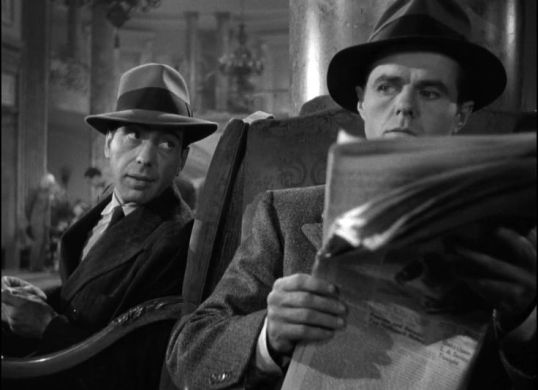
The Maltese Falcon (1941, dir by John Huston, DP: Arthur Edeson)
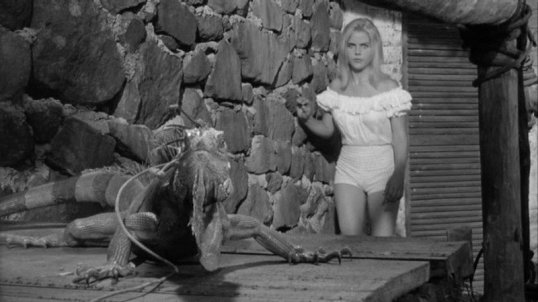
The Night of the Iguana (1964, dir by John Huston, DP: Gabriel Figueroa)
The Bible (1966, dir by John Huston, DP: Giuseppe Rotunno)
Under the Volcano (1984, dir by John Huston, DP: Gabriel Figueroa)
“Men sometimes have strange motives for the things they do.” — Matthew Hopkins
In the pantheon of folk horror, few antagonists are as unsettling as Matthew Hopkins, brought to life with chilling restraint by Vincent Price in Michael Reeves’s 1968 masterpiece, Witchfinder General. While Hopkins was a very real historical figure who terrorized 17th-century England, Price’s portrayal reimagines him not as a raving religious zealot, but as a shockingly mundane monster. He navigates the war-torn countryside with a terrifying blend of sleaze and sophistication. It is precisely this departure from the supernatural madman archetype—replacing it with a grounded, opportunistic con artist—that makes Price’s Hopkins such a uniquely repellent figure. He is a villain who doesn’t haunt your dreams with dark magic, but rather with the cold, calculated reality of systemic corruption.
The “urbane” quality of Price’s Hopkins is his most disarming weapon. Dressed immaculately and speaking with a measured, aristocratic cadence, he brings a veneer of courtly civility to the muddy, blood-soaked villages he targets. He does not shout or rave about the devil; instead, he politely asks for lodging, drinks wine, and discusses his gruesome work with the detached professionalism of a bureaucrat. This refinement creates a jarring cognitive dissonance for the audience. Hopkins isn’t some wild-eyed backwoods fanatic; he is an educated, well-groomed gentleman, which makes his descent into barbarism feel all the more invasive. His urbane nature acts as a mask, legitimizing his presence in the homes of both the gentry and the peasantry, allowing him to get close to his victims before the trap springs shut.
Yet, beneath this polished exterior lies a profound and inescapable sleaziness. Price imbues Hopkins with a predatory, voyeuristic gaze that transforms his legal authority into a tool for personal gratification. This is most evident in his interactions with Sara Lowes, where his polite requests quickly curdle into thinly veiled threats of sexual coercion. He uses his position to isolate vulnerable women, leveraging their fear of torture and death to extract sexual favors under the guise of “interrogation.” Furthermore, his method of operation—finding a woman accused of witchcraft, accepting bribes from her terrified relatives to spare her, and then executing her anyway to collect the standard fee from the local magistrate—is the epitome of sleazy grifting. He is a lecher and an extortionist hiding behind the cloak of the law.
What truly cements Hopkins’ status as a villain, however, is his complete lack of genuine belief in the very witchcraft he prosecutes. Unlike so many cinematic inquisitors driven mad by religious fervor or a sincere desire to purge evil, Hopkins is a pure opportunist. He views the mass hysteria of the era merely as an untapped market. Witchfinding is not a holy crusade for him; it is a lucrative business model. He carries a manual that dictates exactly how much he can charge per town, treating human life as a commodity to be tallied in a ledger. By stripping away any ideological justification for his actions, Reeves and Price reveal a far more terrifying truth: the greatest evils are often committed not by true believers, but by cynical men who exploit the beliefs of others for power and profit.
In a profoundly unsettling way, Hopkins’ brand of opportunistic parasitism has not been consigned to the history books; if anything, characters exactly like him are even more prevalent in today’s society. We are surrounded by modern-day “witchfinders”—sleazy yet urbane grifters, pundits, and political operatives who latch onto powerful men and disruptive ideologies like parasites. They feed on societal fears, anxieties, and moral panics, weaponizing the culture wars not because they genuinely care about the causes they champion, but to further their own agendas, sell books, and secure lucrative media contracts. Just as Hopkins peddled false accusations of Satanism to line his pockets amid the chaos of the English Civil War, today’s opportunists monetize outrage and exploit divisions for clout and capital. Vincent Price’s brilliant, restrained performance endures because it holds up a dark, timeless mirror to human nature, reminding us that the most dangerous monsters are rarely the true believers, but rather the charming, well-dressed opportunists profiting off the fears of everyone else.