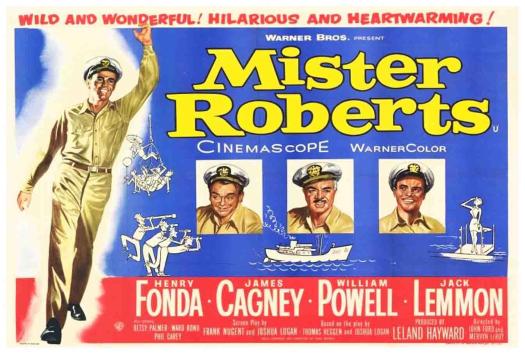
I grew up a “Navy brat”, often accompanying my dad to bases in Newport, RI. and Bethesda, MD. I’d hang out at the Enlisted Men’s Club he ran, watching Bugs Bunny and Road Runner cartoons with the sailors while dad did the books. I remember going aboard ship plenty of times, and saw one of my first movies with the crew on Family Night (the Cary Grant/Doris Day flick THAT TOUCH OF MINK). So naturally, I have a soft spot for nautical tales, and one of my favorites has always been MISTER ROBERTS.
The film marked Henry Fonda’s return to the screen after an eight year absence. Fonda had starred in the original Broadway production to great acclaim, and his performance is imbued with his own experiences during WWII. Douglas Roberts is a lieutenant (j.g.) assigned to the cargo ship Reluctant in the South Pacific, run by the vain…
To quote The Main With No Name, “When a man’s got money in his pocket, he begins to appreciate peace.”
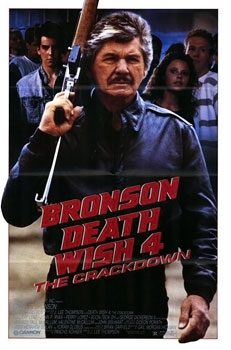
Two years have passed since Paul Kersey (Charles Bronson) last visited and cleaned up New York. He is back in Los Angeles, the president of his own successful architectural firm. Now a rich man, he has retired from killing criminals, though he still has dreams where he shoots muggers in parking garages. Paul has a new girlfriend, journalist Karen Sheldon (Kay Lenz). When Karen’s teenage daughter, Erica (Dana Barron), dies of a cocaine overdose, it’s time for Paul to get his gun out of storage and blow away a drug dealer.
Shortly after shooting that drug dealer, Paul finds a note on his front porch. “I know who you are,” it reads. Paul then gets a call from a mysterious man (John P. Ryan) who identifies himself as being a reclusive millionaire named Nathan White. Nathan explains that his daughter also died of a cocaine overdose. He wants to hire Paul to take out not just the drug dealers but also the men behind the dealers, the bosses. Using his vast resources, Nathan has prepared a file on every major drug operation in Los Angeles. He offers to share the information with Paul.
“I’ll need a few days to think about it,” Paul says but we all know he’s going to accept Nathan’s offer just as surely as we know that Nathan White has an ulterior motive that won’t be revealed until the movie’s final twenty minutes.
For the first time, Paul is no longer just targeting muggers and other street criminals. This time, Paul is going after the guys in charge and trying to bring an end to drug trade once and for all. (The idea that the best way to win the war on drugs was just to kill anyone involved in the drug trade was a very popular one in the late 80s.) L.A.’s two major drug cartels are led by Ed Zacharias (Perry Lopez) and the Romero Brothers (Mike Moroff and Dan Ferro). Along with their own activities, Paul and Young work the turn the two cartels against each other.
It’s not just the criminals that have changed in Death Wish 4. Paul has changed, too. Paul used to just shoot criminals and run away. In Death Wish 4, he gets more creative. He sneaks into Zacharias’s mansion and bugs the phone so that he can keep track of what’s going down. When it comes time to kill a table full of drug dealers (one of whom is played by Danny Trejo), Paul doesn’t shoot them up. Instead, he sends them a bottle of champagne that explodes when they open it. By the end of the movie, Paul is blowing away the bad guys with a grenade launcher! How many former conscientious objectors can brag about that?
The biggest difference between Death Wish 4 and the films that came before it is the absence of director Michael Winner. Winner and Bronson had a falling out following Death Wish 3 and, as a result, Winner had little interest in returning to the franchise. Instead, Winner was replaced by J. Lee Thompson, who had already directed Bronson in several other Cannon films. As a result, Death Wish 4 is less “heavy” than the previous Death Wish films. Whereas Winner’s direction often felt mean-spirited and exploitive, Thompson plays up the film’s sense of airy adventure.
Though it barely made a profit at the box office and has been dismissed by critics, Death Wish 4 is an enjoyable chapter in Paul’s story. If you’re looking for mindless 80s mayhem, Death Wish 4 gets the job done with admirable efficiency. It would have made a great ending for the franchise but Bronson would return to the role one last time.
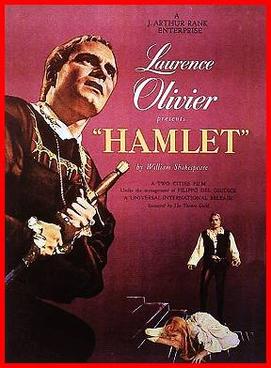
(With the Oscars scheduled to be awarded on March 4th, I have decided to review at least one Oscar-nominated film a day. These films could be nominees or they could be winners. They could be from this year’s Oscars or they could be a previous year’s nominee! We’ll see how things play out. Today, I take a look at the 1948 best picture winner, Hamlet!)
Hamlet is a film of firsts.
It was the first British production to win the Oscar for Best Picture. In winning, it beat out three American films (Johnny Belinda, The Snake Pit, and The Treasure of the Sierra Madre) and one other British film (The Red Shoes).
It was also the first adaptation of Shakespeare to win Best Picture. Of course, it wasn’t the first Shakespeare adaptation to be nominated. That honor would go to 1935’s A Midsummer Night’s Dream. Adaptations of Romeo and Juliet would be nominated in 1936, 1961, and 1968. Henry V (which, like Hamlet, was directed by and starred Laurence Olivier) was a 1946 nominee. Then there was 1953’s Julius Caesar.The Dresser featured scenes from Shakespeare. Shakespeare in Love imagined the circumstances behind the writing of Romeo and Juliet. However, Hamlet was the first to win.
It also remains the only traditional Shakespearean adaptation to win. West Side Story updated Romeo and Juliet while Shakespeare in Love … well, let’s just not get into it.
It was the first Best Picture winner to be directed by the man starring in the movie. Laurence Olivier was nominated for both Best Director and Best Actor. He lost the directing Oscar to John Huston but he won for his performance as Hamlet. In winning, he became the first actor to direct himself to an Oscar.
Finally, Hamlet was the first of 24 films to feature both Peter Cushing and Christopher Lee! In fact, this was Lee’s film debut. Now, before anyone gets too excited, I should point out that Cushing and Lee don’t actually interact. In fact, Lee doesn’t even speak in the film. He appears in the background as a Spear Carrier and it’s pretty much impossible to spot him. He has no dialogue and wasn’t even listed in the final credits. From what I’ve read, I don’t think Lee and Cushing even knew each other at the time and, when they later met, they were surprised to learn that they had both appeared in the film. For his part, Cushing plays Osiric, the courtier who everyone remembers because he had such a cool name.
It’s always fun to play “what if.” Rosencrantz and Guildenstern do not appear in Olivier’s adaptation of the play. To modern audiences, that might seem strange but, really, that’s just because we’re all familiar with the two characters from Tom Stoppard’s Rosencrantz and Guildenstern Are Dead. When Olivier filmed Hamlet, he excised portions of the play in the interest of time. (Hamlet uncut runs over four hours. Olivier’s version clocks in at nearly three.) Rosencrantz, Guildenstern, Fortinbras, and the second gravedigger are all dropped from Olivier’s version and, to be honest, none of them are particularly missed.
And yet … as I watched Hamlet, I found myself wondering what would have happened if Olivier had kept Rosencrantz and Guildenstern around and had cast Cushing and Lee in those roles. It probably wouldn’t have happened, of course. Cushing maybe but Lee was a total unknown at the time. Still, how amazing would that have been?
As for the actual film, Olivier’s Hamlet turned out to be far more cinematic than I was anticipating. Olivier’s camera snakes through the darkened hallways of Elsinore Castle while Olivier’s Hamlet veers between self-righteous fury and apparent madness as he seeks revenge on his Uncle Claudius (Basil Sydney). As Hamlet grows more obsessed with death and vengeance, the castle seems to grow darker and the hallways even more maze-like, as if the castle’s changing shape to conform with the turmoil in Hamlet’s mind. Among the cast, Jean Simmons is poignantly fragile as Ophelia while Eileen Herlie is the perfect Gertrude, despite being 12 years younger than the actor playing her son. Olivier gives a wonderfully physical performance as Hamlet, killing Polonious with a demented gleam in his eye and literally leaping towards his uncle at the end of the film.
If you’re one of those people who thinks that Shakespeare is boring … well, Olivier’s Hamlet probably won’t change your mind. One thing I’ve noticed about the “Shakespeare is boring” crowd is that nothing can change their minds. But, for the rest of us, Olivier’s Hamlet is an exciting adaptation of Shakespeare’s more difficult play.
You won’t miss Rosencrantz and Guildenstern at all. And seriously, Fortinbras who?
Could Black Panther be the first comic book movie to receive an Oscar nomination?
Last year, around this time, we were asking the exact same question about Logan. Logan didn’t pick up a Best Picture nomination but it was nominated for Best Adapted Screenplay, which would seem to suggest that the Academy is slowly coming around to accepting that so-called “Super Hero Films” can also be legitimate Oscar contenders.
As for Black Panther, it is currently the most critically acclaimed and financially successful film of 2018. For those who say that there’s no way the Academy will ever nominate a comic book film for best picture, it should be remembered that there was a time when people said that Academy would never nominate a horror comedy for Best Picture. Much like Get Out, Black Panther could prove the naysayers wrong.
Anyway, here are my Oscar predictions for February. As always, it ‘s really way too early to be making these predictions. Usually, Sundance provides at least a little bit of a guide but this year, Sundance was pretty low-key. The most obvious Sundance Oscar contender — Burden — doesn’t even have a release date yet.
Also, the uncertain status of The Weinstein Company has thrown a lot of films into limbo. Some of the unreleased TWC films might find homes with other studios. Others will probably be left in limbo. Then again, even if those films do get a release, I doubt the Academy is going to nominate any films stained with the noxious fingerprints of the Weinsteins.
Even more than usual, the guesses below are random. At this time next year, we’ll probably look at this list and laugh. Some of you might laugh today.
(With the Oscars scheduled to be awarded on March 4th, I have decided to review at least one Oscar-nominated film a day. These films could be nominees or they could be winners. They could be from this year’s Oscars or they could be a previous year’s nominee! We’ll see how things play out. Today, I take a look at the 1994 best picture nominee, Four Weddings and a Funeral!)
(SPOILERS)
Four Weddings and a Funeral is truly an oddity. It’s a romantic comedy that works wonderfully well, despite the fact that there’s next to no chemistry between the two leads.
Hugh Grant plays Charles, a neurotic bachelor who lives in London and who, despite having been in several relationships, has yet to marry. As he’s explains it, he’s spent his life expecting love to hit him like a thunderbolt and it hasn’t happened yet. Andie MacDowell plays Carrie, an American who has one of those vaguely defined magazine jobs that are so popular in romantic comedies. Carrie and Charles meet over the course of … well, four weddings and a funeral. From the minute they first meet, they are attracted to one another but the path of true love is never an easy one. After spending the night with him, Carrie leaves for America. When Charles meet her for a second time, she’s now engaged to Sir Hamish Banks (Corin Redgrave), a rather boring politician.
Hugh Grant is perfectly cast as Charles. It can be easy to make fun of an actor like Grant, what with all the stammering and the carefully calculated charm. But it works perfectly in Four Weddings and a Funeral, in which Grant manages to believable as both a hopeless romantic and a committed cynic. Within moments of his first scene (in which Charles wakes up and realizes he’s late for a friend’s wedding), you forget that you’re watching Hugh Grant. He is Charles.
On the other hand, Andie MacDowell never convinces us that she’s Carrie. That’s not totally MacDowell’s fault, of course. Carrie is an underwritten character, one who serves more as a plot device than anything else. We’re never quite sure how she feels about Charles. For that matter, we never understand why she’s marrying Hamish. When she shows up at the film’s funeral, we’re left wondering if she’s really mourning or if she’s just showing up to be polite. Carrie never comes to life and MacDowell never feels comfortable in the role. When she gives a warmly received speech at her own wedding reception, the scene feels false because you never feel as if the words are coming from Carrie.
The film ends with Charles and Carrie finally getting together. Charles both swears his love for her and asks if she’ll agree to never marry him. We later see them in a snapshot, with a child. But, despite all of that, you never believe that Charles and Carrie are going to stay together. There’s just not enough chemistry between Grant and MacDowell to convince you that Carrie isn’t going to get bored and run off with whoever it is she meets at the next wedding she attends.
So, why does this film work so well? It works because it’s a love story. However, it’s not about the love between Charles and Carrie. Not really. Instead, it’s about the love between Charles and his friends. Because of the way the film is structured, we only get to see how these people behave at weddings and a funeral. We never really get to see what these people do for a living or what they’re like during the week. In fact, we don’t even find out how they all became friends in the first place.
But it doesn’t matter. The friendships feels real. The friendships feels authentic. You might not know how they all became friends but that doesn’t matter. By the end of the movie, you feel as if you could go to London and possibly run into any of these people going about their daily lives. They become real in a way that Carrie never does.
There’s Scarlett (Charlotte Coleman), who is Charles’s roommate and who gets flirty when she has too much to drink.
And then there’s David (David Bower), who is Charles’s younger brother. Both the actor and the character are deaf. One of the sweetest scenes in the film is when a woman who has been crushing on David attempts to show off her sign language skills. Everything she signs is wrong but David’s sweet smile tells us all we need to know about how he feels towards her.
Fiona (Kristin Scott Thomas) and Tom (James Fleet) are siblings. Fiona, who dresses in black, presents a hard exterior but, in one of the film’s more poignant scenes, she admits that the reason she’s never gotten married is because she’s been in love with Charles for ten years. Tom is a goofy optimist, the type who never doubts that he’s going to find happiness no matter what.
Gareth (Simon Callow) and Matthew (John Hannah) are as close to being married as anyone within Charles’s clique of friends. (Four Weddings and a Funeral was released twenty years before the legalization of same-sex marriage in the UK. If someone views the film 50 years from now, they’ll probably wonder why, exactly, Matthew is always described, by those outside of his central group of friends, as merely being a “close friend” of Garth’s.) Sadly, the funeral of the title is for the fun-loving Gareth.
It’s during the funeral, when Matthew reads a poem from Auden, that it becomes apparent that the heart of this film belongs not to Charles and Carrie but to their friends. Ultimately, Four Weddings and a Funeral is a celebration of the bonds of friendship. At the end of the movie, you’re happy, not because Charles and Carrie are finally together but because this unique and wonderful group of friends have all found each other. Everyone should be so lucky.
Four Weddings and a Funeral was nominated for best picture but lost to Forrest Gump.
To quote Roger Murtaugh, “I’m too old for this shit.”
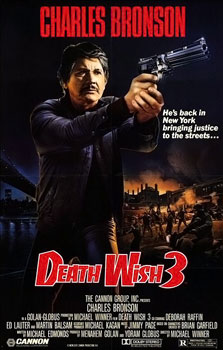
It has been ten years since Paul Kersey (Charles Bronson) left New York City and the place has gone to Hell. It’s no longer just muggers that you have look out for. Now, there are roving street gangs of directionless teenagers, terrorizing the elderly and forcing them to live like prisoners in their own apartment building.
One street corner now looks like a war zone, controlled by spiky-haired, face-painting punks who look like something from a Mad Max movie. Manny Fraker (Gavan O’Herlihy) rules this street corner, supported by a gang that worships him as if he was some sort of god. Manny thinks that he is immortal but he’s just targeted the wrong person. The gang may think that Charley (Francis Drake) is just a defenseless old man but what they don’t know is that, when Charley served in Korea, his best friend was Paul Kersey.
The past few years have been busy for Paul. He’s killed muggers and rapists in Los Angeles, Chicago, and Kansas City and now he’s returned to New York City, to visit his old friend Charley. Paul arrives at Charley’s apartment just in time to witness Fraker’s gang murdering him. The gang flees and when the police arrive, they take Paul into custody.
While public defender Kathryn Davis (Deborah Raffin) tries to figure out why Paul is being held in jail, Paul has a conversation with Lt. Shriker (Ed Lauter). Shriker remembers Paul as being the New York vigilante and he has a proposition for him. Paul can kill as many members of Fraker’s gang as he wants, as long as he allows the police to take the credit and reports everything that he discovers to Shriker. Paul agrees.
In the neighborhood, Paul starts to put Fraker and his gang (one of whom is played by pre-Bill and Ted Alex Winter) in their place. In a scene borrowed from Brian Garfield’s original Death Wish novel, he uses a used car as bait to gun down two aspiring car thieves. When Paul gets a new gun, he tests it out on a depraved mugger known as the Giggler. Though some might call him a serial killer, Paul is soon a hero to the entire neighborhood. Though Charley may be gone, Paul befriends the other residents of the apartment. He shows the elderly Kaprovs how to catch anyone trying to climb through their window. He protects Maria Rodriguez (Marina Sirtis) from the gang. Best of all, he befriend Bennett Miller (Martin Balsam), a World War II vet who still remembers how to load a machine gun.
(Balsam and Bronson previously co-starred in The Stone Killer, though in that one Bronson was a cop and Balsam was on the other side of the law.)
He also finds time to pursue a relationship with Kathryn Davis. This is one recurring element in the Death Wish franchise that has never made sense to me. Paul always has a new girlfriend, despite the fact that almost every woman that he ever gets involved with ends up getting killed. Paul also only seems to go out with women who would be upset to discover that they were dating a notorious vigilante. In Death Wish II, he went out with a crusading journalist who was against the death penalty. In Death Wish 3, he falls for a public defender whose job is to provide legal counsel to the very people that Paul is trying to kill. After Death Wish 3, Paul would date yet another crusading journalist and, finally, the ex-wife of a notorious mobster. Maybe Paul should just give up and concentrate on mourning his wife.
Michael Winner returned to direct Death Wish 3 and, this time around, he imagines New York City as being a post-apocalyptic wasteland, full of abandoned buildings and murderous scavengers. Imagine A Clockwork Orange if Charles Bronson suddenly showed up to shoot Alex and the Droogs. As played by Gavan O’Herlihy, Manny Fraker is the type of seemingly indestructible bad guy who can actually give Paul Kersey a challenge, something that was missing from the previous films.
The other thing that distinguishes Death Wish 3 is that it was one the only film in the franchise to directly confront an obvious truth. Charles Bronson was 53 when the first Death Wish was released. By the time he made Death Wish 3, he was 64 and decades older than the typical action star. (As way of comparison, Clint Eastwood was 55 when Death Wish 3 was released and was already experimenting with less action-orientated roles.) By partnering him with Martin Balsam and the other elderly residents of the neighborhood, Death Wish 3 not only acknowledged Bronson’s advanced age but also took advantage of it. Death Wish 3 is a film where the old folks finally get to teach the young punks a thing or two. If the other Death Wish films were about one man fighting a lonely war, Death Wish 3 is about a community refusing to be silenced. The chance to put those kids in their place even seems to perk up Charles Bronson, who gives one of his best performances in Death Wish 3.
Death Wish 3 may have been roundly despised by the critics but it’s the best of the Death Wish sequels. It made a fortune at the box office so naturally, another sequel would follow.
The world of 1950’s live TV gets the comic treatment in Richard Benjamin’s MY FAVORITE YEAR, a hilarious homage to those golden days of yore. Executive producer Mel Brooks had first-hand knowledge of the era, and much of the hysterical Norman Steinberg/Dennis Palumbo screenplay is based on his experiences, though completely exaggerated and laugh-out-loud funny. The film earned star Peter O’Toole an Oscar nomination for his role as Alan Swann, a dissipated movie star based on swashbuckling Errol Flynn .
Swann arrives at NBC’s 30 Rock, scheduled to be the week’s special guest on “Comedy Calvacade”, totally smashed, much to the displeasure of gruff show host Stan ‘King’ Kaiser (Joseph Bologna in a brilliant Sid Caesar parody), who immediately wants to fire him. But young comedy writer Benjy Stone (Mark Linn-Baker, later of TV’s PERFECT STRANGERS), who idolizes the movie great, pleads with Kaiser to give Swann another chance. He…
According to my sister, who does a pretty good of keeping track of these things, today is International Polar Bear Day!
So, I figured that I would honor the polar bears by sharing one of my favorite scenes from Santa Claus Conquers The Martians! Even better, this video comes with a bonus scene, involving a robot named Tor.
(With the Oscars scheduled to be awarded on March 4th, I have decided to review at least one Oscar-nominated film a day. These films could be nominees or they could be winners. They could be from this year’s Oscars or they could be a previous year’s nominee! We’ll see how things play out. Today, I take a look at the 1949 best picture nominee, The Heiress!)
“I have been taught by the masters.”
— Catherine Sloper (Olivia De Havilland) in The Heiress (1949)
I’m not going to spoil too much of the ending of The Heiress, beyond saying that those are the words with which Catherine ends the film. Taken out of context, they may not seem like much. However, after you’ve spent two hours with Catherine, her father, and the man who claims that he’s in love with her, these are perhaps seven of the most chilling words ever uttered. When you hear them, you don’t know if you should cheer or be very, very afraid. Myself, I had both reactions but, then again, I often do.
The Heiress, which is based on a play that’s based on a novel by Henry James, takes place in 19th century New York City. Austin Sloper (Sir Ralph Richardson) is a widely admired and very successful physician. He’s also a very cold man, one who has never recovered from the death of his wife. He lives with his daughter, Catherine (Olivia de Havilland). Catherine is shy and is continually told that she’s plain and boring. She’s devoted to her father, though Austin is cruelly manipulative of her. Catherine, who has never been in a relationship, has pretty much accepted that she’s destined to be alone.
Or, at least, she has until she meets Morris Townsend (Montgomery Clift).
From the first minute that Catherine meets him, Morris seems to be perfect. He’s handsome. He’s intelligent. He’s witty. He’s charming. He’s Montgomery Clift, for God’s sake! For Catherine, it’s love at first sight and Morris says that it’s the same for him. Suddenly, Catherine’s life no longer revolves around her father. Now, she dreams of marrying Morris.
Austin isn’t happy about this. Despite showing his daughter nothing but disdain for most of her life, Austin suddenly become protective of her. He says that Morris only wants to marry her because she stands to come into a great deal of money. To prove his point, he announces that, if Catherine and Morris get married, he will disinherit Catherine and neither she nor her husband will ever get their hands on his money.
How will Morris respond to Austin’s threat? Well, you’ll have to watch the movie to find out and you really should! The Heiress is a great movie, featuring noirish direction from William Wyler and brilliant performances from by de Havilland, Richardson, and Clift. Dr. Sloper may be a monster but Richardson plays him with so much authority that it’s hard to dismiss his worries about Morris, no matter how much you may want to. Montgomery Clift, meanwhile, keeps you guessing about Morris’s intentions. And, finally, the great Olivia de Havilland deservedly won an Oscar for her performance as Catherine Sloper. Over the course of the film, Catherine goes from being a withdrawn wallflower to being a … well, I can’t tell you anymore. I don’t want to spoil the film any more than I already have. The ending will leave you shaken in the best possible way.
The Heiress was nominated for best picture but lost to All The King’s Men.


 To quote The Main With No Name, “When a man’s got money in his pocket, he begins to appreciate peace.”



 To quote Roger Murtaugh, “I’m too old for this shit.”