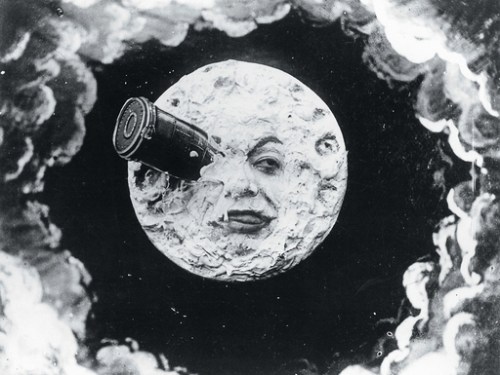
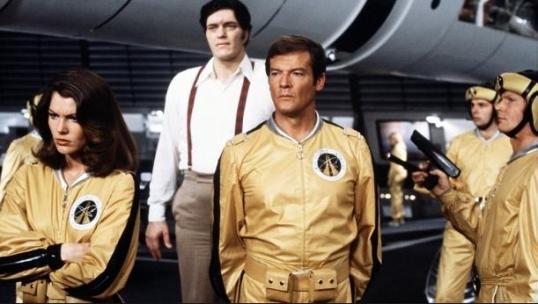
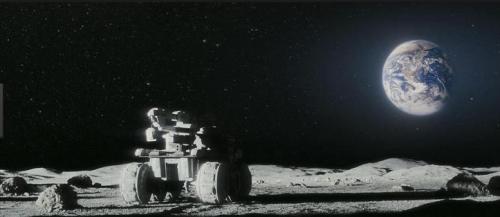
4 Shots From 4 Films is just what it says it is, 4 shots from 4 of our favorite films. As opposed to the reviews and recaps that we usually post, 4 Shots From 4 Films lets the visuals do the talking.
Today, we pay tribute to the moon! It’s time for….
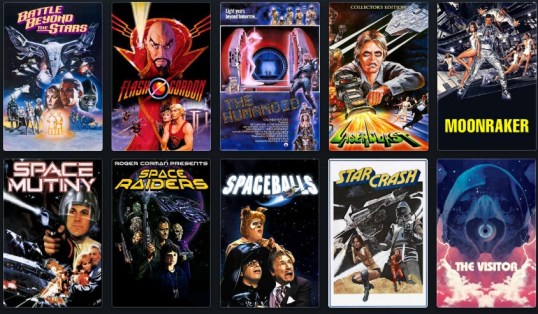
If you want to celebrate the 4th of May but you really don’t feel like sitting through any of the Star Wars films (especially now that you know that Leia, Luke, and Han’s struggle was pretty much for naught), here are ten other sci-films that will keep you entertained without ruinng your childhood memories!
Starcrash (1978, dir by Luigi Cozzi)is not only the best of the so-called Star Wars rip-offs, it’s also one of the best space adventures ever made. In fact, I would argue that Cozzi’s film is actually more entertaining than Star Wars, just because of Cozzi’s unabashed love of the genre and the fact that Starcrash had a bit more deliberate wit than George Lucas’s film. Starcrash also had a once-in-a-lifetime cast of Caroline Munro, Marjoe Gortner, Joe Spinell, Christopher Plummer, and David Hasselhoff. Starcrash is a true pop art masterpiece.
Laserblast (1978, dir by Charles Band) — Fresh from menacing Mark Hamill in Corvette Summer, Kim Milford plays a totally 70s dude who finds a discarded alien weapon and turns into a green monster. At one point, Milford blows up a StarWars billboard. Roddy McDowall is a small-town doctor. Eddie Deezen and Dennis Burkley are bullies. The Claymation aliens are adorable, especially when they start arguing with each other.
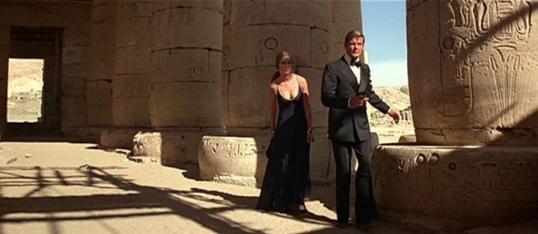
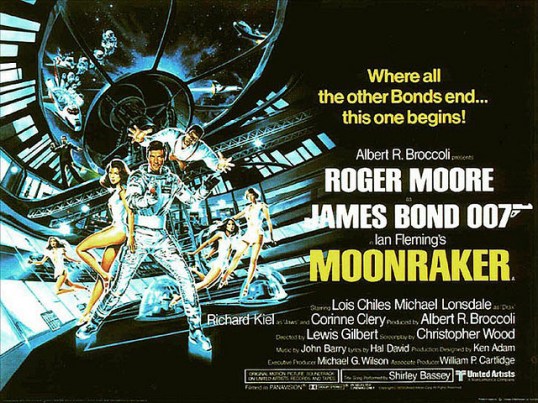
Moonraker (1979, dir by Lewis Gilbert) –– James Bond in space! I’m well aware that Moonraker does not have a great reputation as far as Bond films are concerned but actually, it’s one of Roger Moore’s most enjoyably ludicrous outings. Daniel Craig’s Bond could never go into space but Roger Moore could. That’s why Moore will always be the superior Bond.
The Humanoid (1979, dir by Aldo Lado) — After playing Jaws in both The Spy Who Loved Me and Moonraker, Richard Kiel got to play a leading role. “I believe that jacket belongs to Mr. Gilmore….” No, this was before Happy Gilmore! In The Humanoid, Kiel plays the kindly Golob who is transformed into a hulking, evil warrior. Good Golob has a beard. Evil Golob doesn’t. This movie is a bit long but Kiel is always a delight to watch and it also features a cute dog robot. Barbara Bach is the evil Lady Agatha, who is kept young by space virgin blood. Ivan Rassimov, owner of the best hair in Italian exploitation, is Lord Graal.
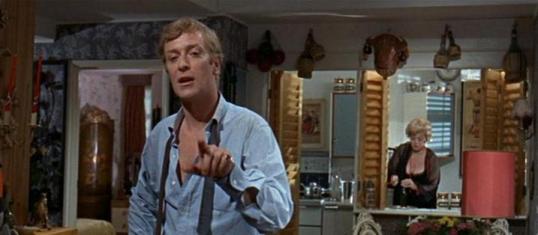
The Visitor (1979, dir by Giulio Paradisi) — What happens when you mix The Omen, The Exorcist, and Star Wars with a bunch of basketball stock footage? You end up with one of the greatest Italian films ever! John Huston is the alien/angel! Lance Henriksen is the devil worshipper who owns a basketball team! Franco Nero is Jesus, who lives on the Moon with a bunch of bald children! Shelley Winters is Shelley Winters! The Visitor is a film that simply has to be seen.
Battle Beyond The Stars (1980, dir by Jimmy T. Murakami) — This Roger Corman-produced film never would have been made if not for the success of Star Wars. That said, it’s actually a science fiction version of The Magnificent Seven, featuring the type of cast that only Corman could put together. Richard Thomas, Robert Vaughn, George Peppard, Darlanne Fluegel, John Saxon, and Sybil Danning, they’re all in this terrifically entertaining space opera.
Flash Gordon (1980, dir by Mike Hodges) — How many people have been driven mad after getting the theme song stuck in their head? At every watch party that I host, Flash Gordon is always at the top of the list of films that people want me to select. (Unfortunately, it’s not streaming anywhere for free right now.) Like Starcrash and The Visitor, it’s a pop art masterpiece. All together now: “Godon’s alive!”
Space Raiders (1983, dir by Howard Cohen) — Roger Corman produced this film about a dumbass kid (David Mendenhall, who also played Stallone’s son in Over The Top) who stows away with a bunch of lovable space pirates and basically gets everyone killed. This is worth seeing for Thom Christopher as Flightplan. This film also features a scene where the kid tries to shout across space. “HAWK!”
Spaceballs (1987, dir by Mel Brooks) — Mel Brooks sends up the Star Wars saga as only he can. It’s not totally successful but there are plenty of funny lines and Rick Moranis and John Candy are a delight. Bill Pullman wisely plays his role straight and allows the supporting crew to get most of the laughs.
Space Mutiny (1988, dir by Neal Sundstrom and David Winters) — “GO! GO! GO!” Reb Brown yells as Dave Ryder, the new head of security for Cameron Mitchell’s space fleet. And Brown has a lot to yell about because John Phillip Law is leading a mutiny in plain sight. Space Mutiny has a reputation for being one of the worst films ever made. It may be. But I still enjoy it. Every space ship needs a disco.
4 Shots From 4 Films is just what it says it is, 4 shots from 4 of our favorite films. As opposed to the reviews and recaps that we usually post, 4 Shots From 4 Films lets the visuals do the talking.
Today, we pay tribute to the moon! It’s time for….
In honor of National Science Fiction Day, today’s song of the day comes from the film that sent James Bond into space!
Released in 1979, Moonrakermay not get as much respect as some of the Bond films but I’ve always liked it. The theme song was the third and final Bond song to be performed by Shirley Bassey. The song was originally written for Frank Sinatra but he turned it down. Johnny Mathis then agreed to perform the song but he backed out at the last minute. Shirley Bassey came in to record the song just weeks before the film was due to premiere.
Because this is a 70s film, there were two versions of this song, the original and the disco. Because I’m the one writing this post, we’re going with the disco version.
Where are you, why do you hide Where is that moonlight trail that leads to your side? Just like the moonraker goes in search of his dream of gold I search for love, for someone to have and hold
I’ve seen your smile in a thousand dreams Felt your touch, and it always seems You love me, you love me
Where are you, when will we meet? Take my unfinished life and make it complete Just like the moonraker knows His dream will come true someday I know that you are only a kiss away
I’ve seen your smile in a thousand dreams Felt your touch, and it always seems You love me, you love me
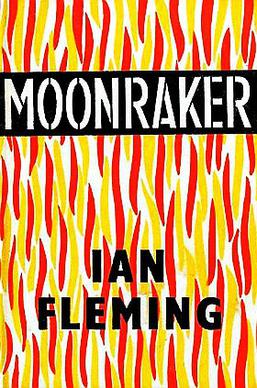
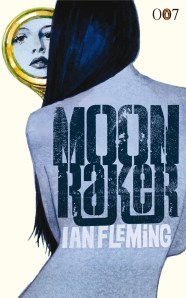
First published in 1955, Moonraker was the third of the original James Bond novels and it was also the first of the series to be totally set in Great Britain. At no point does Bond leave his home country. In fact, he spends a great deal of the book in his office. (If you’ve ever wondered what Bond’s job entails when he’s not on a mission, this is the book to check.) That said, it’s appropriate that Moonraker remains in Bond’s home country because it starts with a very British problem.
Hugo Drax is the most popular man in Britain. Drax was horribly disfigured during the Second World War but, despite all of the scars and a somewhat boorish manner, he has managed to make himself into one of the most important industrialists in the world. Drax is building an immensely powerful nuclear missile, the Moonraker. His missile will keep Britain safe from both the USSR and the USA. At the start of the novel, even Bond admires Drax. Except…
…DRAX CHEATS AT CARDS!
It turns out that M and Drax both play cards at the same club and M is sure that Drax must be cheating. Why would such a powerful man feel the need to cheat? Even more importantly, how can a man be trusted with Britain’s security when he can’t even be trusted to play bridge? Both to prevent a public scandal and to make sure that Drax really can be trusted, M bring Bond to the club so that Bond can beat Drax at his own game.
One bridge game later and suddenly, Bond has been assigned to work at Drax’s laboratory. Already on the case and working as Drax’s secretary is Special Branch officer Gala Brand. Bond being Bond, he discovers that Drax is at the head of a nefarious scheme. He also tries to figure out why Gala Brand is apparently the only woman in the world who is not won over by his manly charm…
Moonraker is one of my favorite Bond novels. Drax is an interesting villain and Fleming makes a good decision by having Bond initially admire the man. Fleming takes a lot of joy in describing both Drax’s bad manners and grotesque appearance. Drax started a tradition of Bond having to face physically unappealing bad guys. After playing a minor role in the first two books, M takes a more central role in Moonraker and we also get a chance to explore his paternal but strict relationship with 007. Gala is one of the few of the so-called Bond girls to be portrayed as being an equal to Bond and the book’s final scene between her and Bond is considerably more poignant than it has any right to be. Finally, Fleming’s love of Britain is evident on every page. If Fleming spent Casino Royale and Live and Let Die being snarky about the places that Bond visited, Moonraker finds both the author and his most famous creation in a surprisingly sentimental mood.
Moonraker came close to being the first James Bond novel to make it to the big screen. In 1955, American actor John Payne pursued the rights to the book, hoping to star as Bond in the film version. However, it would be another 24 years before Moonraker was adapted to film. Other than featuring Drax as a villain, the film version would have little do with the original novel.
For the past two weeks, here at the Shattered Lens, we’ve been reviewing the James Bond film franchise. We’ve reviewed the good, the bad, and the ugly of James Bond and today, we’re going to take a look at James Bond at his silliest. Today, we’re going to review the 11th official James Bond film, 1979’s Moonraker.
Moonraker starts out with a genuinely exciting pre-credits sequence. James Bond (Roger Moore) is on an airplane when he’s suddenly attacked by the stewardess, the co-pilot, and Jaws (Richard Kiel), the henchman with the steel teeth. All four of them end up falling out of the plane. In mid-air, Bond wrestles the pilot’s parachute away from him and uses it to safely land on the ground. The pilot and the stewardess presumably plunge to a very grisly death. Jaws, meanwhile, crashes into a circus tent and walks away without a scratch. This scene pretty much establishes the tone of Moonraker — increasingly implausible action sequences that usually end with some sort of crowd-pleasing joke. In short, Moonraker is Bond as pure spectacle. Those looking for another From Russia With Love should look elsewhere.
As for the rest of the film, someone’s stolen a space shuttle and James Bond and CIA agent Holly Goodhead (Lois Chiles) team up to find it. It turns out that the shuttle was stolen by Hugo Drax (Michael Lonsdale), who plans to wipe out life on the Earth and start a new society in space.
That’s right, in space!
Moonraker was made in 1979, at the height of the cinematic science fiction boom. In the late 70s, everyone was going into space and James Bond wasn’t going to get left behind. Not surprisingly, it turns out that Drax has a secret HQ in a space station that’s orbiting the Earth and Bond is not only the world’s greatest secret agent but the universe’s as well!
It also turns out that Jaws is now working for Drax and his girlfriend Dolly (Blanche Ravelec) works in the space station. I know that a lot of Bond fans hate Moonraker because of this very subplot but seriously, just take a look at the happy couple! They’re so cute together!
I have to admit that I have mixed feelings on Moonraker. On the one hand, it’s the most over-the-top of Roger Moore’s Bond films and it’s certainly the silliest. Your reaction to it will depend on just how seriously you take or want to take your Bond films. Myself, I appreciate Moonraker as a celebration of excess but, at the same time, I can also understand why so many fans of the Bond franchise consider Moonraker to be a low point for the series.
At its weakest, Moonraker feels almost like a generic Bond rip-off as opposed to an official Bond film. It’s obvious that most of the preproduction attention was devoted to the film’s special effects. The rest of the film feels almost like an afterthought and several of the sequences feel as if they’ve been lifted from other Bond films. Bond’s initial meeting with Hugo Drax is reminiscent of the golf game in Goldfinger and both Drax’s evil scheme and motivation appear to have been borrowed from The Spy Who Loved Me‘s Karl Stromberg.
Especially when compared to his witty performance in The Spy Who Loved Me, Roger Moore appears to be simply going through the motions here and he has next to no chemistry with Lois Chiles. One gets the feeling that Bond is merely with her so that he can brag to his mates back in London that he actually hooked up with someone named Holly Goodhead. If her name was Holly Smith, he wouldn’t have any interest in her.
On the plus side, Michael Lonsdale makes for a good villain, the film’s special effects still look good over 30 years later, and I like the way that Jaws’ storyline is resolved. I know that a lot of people hate the fact that Jaws softens up by the end of this film but I wouldn’t have it any other way. Richard Kiel and Blanche Ravalec are so cute together that you simply can’t help but smile at their unlikely romance.
Finally, how can you not enjoy the curiosity value of having James Bond in space? I’m not a huge sci-fi fan. Whenever I hear people mention Dr. Who, Star Wars, or Star Trek, my eyes roll up into the back of my head and I end up zoning out for a few hours. But there’s just something so odd and vaguely inappropriate about the idea of James Bond floating around in a space station with a laser gun. If nothing else, Moonraker serves as a time capsule of the late 70s, a time when even James Bond could turn up in outer space.
Much like The Spy Who Loved Me, Moonraker has little in common with the book that inspired it. The literary Moonraker featured a villain named Hugo Drax but the Moonraker of the title was a nuclear missile. Nobody went into outer space and there was certainly no one named Holly Goodhead. Instead, Bond worked (and fell for) a fellow agent named Gala Brand. It’s a shame that no one has ever filmed a faithful adaptation of Moonraker because it’s actually one of the best of the Bond novels. Bond and Gala have a genuinely interesting relationship and the book has a melancholy, rather introspective feel to it. Surprisingly, the end of the book deals with why none of Bond’s relationships last that long and makes an attempt to deal realistically with the psychological consequences of being the world’s greatest secret agent.
Surprisingly enough, the spectacular, effects-heavy Moonraker would be followed by the much more realistic and low-key For Your Eyes Only. We’ll take a look at that film tomorrow.